
Reading view

There are new articles available, click to refresh the page.

DOJ Targets Crypto Fraud in ‘America First’ Blitz as AI Scams Spike 450%

The U.S. Department of Justice is intensifying its efforts on crypto-related fraud as it escalates to execute what the authorities refer to as an “America First” enforcement agenda in response to a surge of digital asset-related frauds driven more by artificial intelligence.

The shift was outlined in the DOJ Criminal Division Fraud Section 2025 Year in Review, published on Thursday, indicating prosecutors accused 265 defendants with a cumulative alleged loss on fraud cases of over $16 billion, nearly twice the amount reported the previous year.
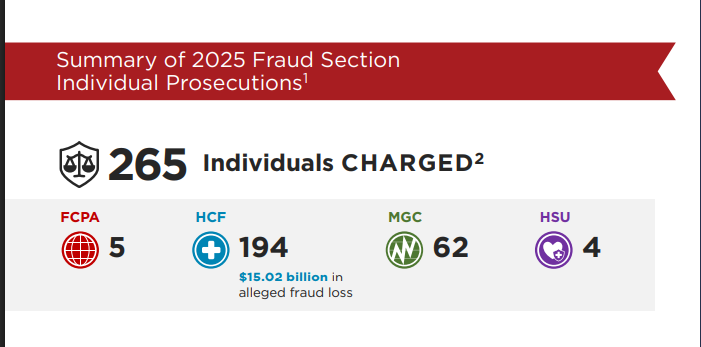
Source: DOJ Criminal Division Fraud Section

Although the cases were in medical care, consumer protection, corporate fraud, and market manipulation, the DOJ said that cryptocurrency was increasingly becoming a type of payment rail, laundering, or asset category due to illicit funds.

In some significant cases, authorities seized crypto alongside cash, real estate, and luxury goods, showing the strong integration of digital assets into conventional fraudulent actions.

DOJ Health Care Fraud Crackdowns Lead to Major Crypto Seizures

One of the most prominent cases cited involved a $1 billion amniotic wound allograft fraud scheme that allegedly generated more than $600 million in improper Medicare payments.

Prosecutors charged Tyler Kontos, Joel Kupetz, and Jorge Kinds with targeting elderly and terminally ill patients for medically unnecessary procedures.

As part of the investigation, law enforcement seized more than $7.2 million in assets, including bank accounts and cryptocurrency.

The DOJ also highlighted the National Health Care Fraud Takedown carried out last year, the largest in the department’s history.

That operation charged 324 individuals across 50 federal districts for schemes involving more than $14.6 billion in intended losses.

Authorities confiscated more than $245 million in assets in the sweep, including significant amounts of cryptocurrency.

Simultaneously, the regulators prevented over $4 billion of fraudulent Medicare payments prior to their disbursement, indicating a more active, data-driven enforcement strategy.

Behind these cases is the DOJ Fraud Section, which operates through four specialized units that increasingly intersect with crypto-related crime.

Its units include foreign bribery, market and consumer fraud, healthcare fraud, and health and safety crimes, areas where digital assets and blockchain-based laundering are now frequently involved.
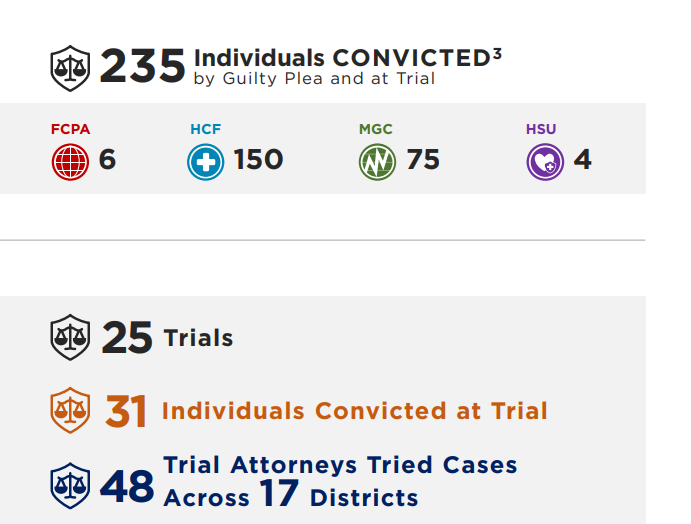
Source: DOJ Criminal Division Fraud Section

Prosecutors reported securing 235 convictions in 2025, including 25 trials across 17 federal districts.

AI-Assisted Scams Drive Sharp Rise in Crypto Fraud Losses

This enforcement surge comes as reported crypto fraud losses continue to climb. The FBI’s Internet Crime Complaint Center recorded more than 41,500 crypto investment scam complaints in 2024, with reported losses exceeding $5.8 billion.

Federal data shows total crypto scam losses reached roughly $9.3 billion last year, with older Americans disproportionately affected.

👾 The FBI recorded $9.3 billion losses spread across various crypto-related investment scams, extortion, ATM and kiosks, among others, in 2024.#FBI #CryptoFraud #CryptoScamhttps://t.co/1Eb8KStAHk

— Cryptonews.com (@cryptonews) April 24, 2025

In 2025, blockchain analytics firms reported that average scam payments rose more than 250%, while AI-assisted scams have surged by more than 450%, as criminals deployed deepfake audio, synthetic identities, and automated phishing at scale.
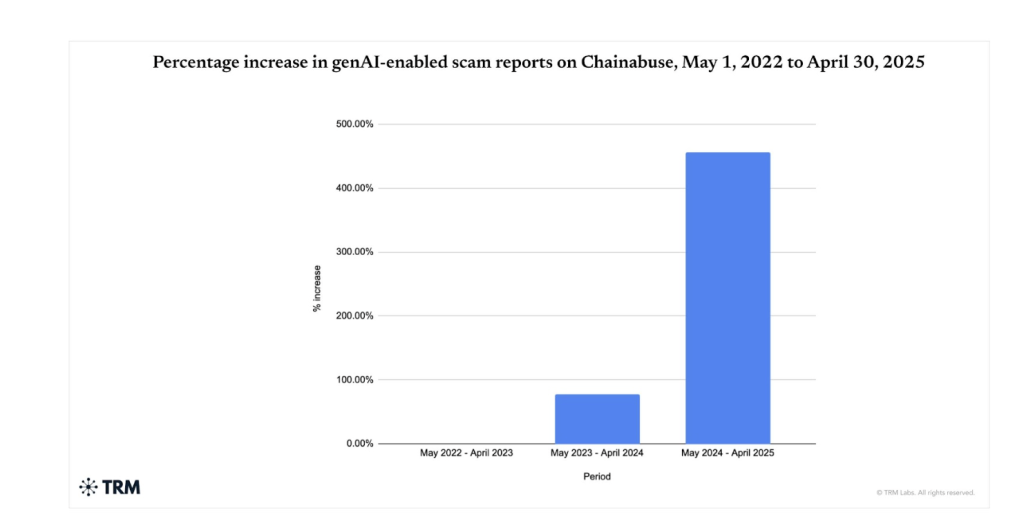
Source: TRM Labs

In response, the DOJ and other agencies have launched coordinated initiatives aimed at transnational fraud networks, particularly so-called “pig butchering” scams linked to criminal groups operating in Southeast Asia.

A multi-agency strike force announced late last year has already seized and forfeited more than $401 million in cryptocurrency, including the largest bitcoin seizure in U.S. history.

Separately, the FBI’s Operation Level Up has notified thousands of potential victims and helped prevent hundreds of millions of dollars in additional losses.

Lawmakers have also moved to tighten the legal framework, as bipartisan bills introduced in Congress seek harsher penalties for AI-assisted fraud and stronger coordination across federal agencies to combat crypto-related scams.

In addition, two U.S. senators introduced the SAFE Crypto Act aimed at tightening the government’s response to cryptocurrency-related fraud.

The post DOJ Targets Crypto Fraud in ‘America First’ Blitz as AI Scams Spike 450% appeared first on Cryptonews.
South Korea Probes Theft of Seized Bitcoin Worth $48M in Suspected Phishing Heist

South Korean prosecutors are investigating the disappearance of a significant amount of Bitcoin that had been confiscated as criminal proceeds, after an internal audit suggested the assets may have vanished while under state custody.

The Gwangju District Prosecutors’ Office believes the loss likely occurred during the management period last year and is treating the incident as a suspected phishing attack, raising fresh concerns over how seized digital assets are stored and safeguarded.

According to a senior prosecution source cited by local media, preliminary internal assessments suggest the missing Bitcoin was worth roughly 70 billion won, or about $48 million, at the time of the loss.

Seized Bitcoin Lost After Wallet Password Exposure, Officials Say

An official at the prosecutor’s office stated that the investigators are striving to establish the locations of the seized properties, but they could not verify any additional information at the moment.

Local news states that the bitcoin was linked to an illegal gambling situation and that it was being seized as an illegal piece of property when it was lost.

The estimates reported in the domestic media indicate that the value might be in tens of billions of won, which would translate to several million dollars, but those numbers have not been verified by prosecutors.

The early evidence indicates that the bitcoin was stored in a portable USB, as opposed to a more durable custody system.

The wallet password was also reported to have been revealed to a third party during a regular examination of confiscated items, which provided an opportunity to illegally access it and transfer money.

🚨 @KoinlyOfficial warns a third-party breach may have exposed user emails but stresses that no wallet, transaction, tax, or portfolio data was shared with Mixpanel.#CryptoSecurity #CryptoTax #Koinlyhttps://t.co/ASDxMchfyg

— Cryptonews.com (@cryptonews) December 23, 2025

The case is one of the most recent high-profile cases of stolen cryptocurrency being re-stolen by law enforcement via social engineering instead of technical merits.

Phishing attacks are deceptive, not technical, as they take advantage of a trusting party. In a more institutionalized environment, they usually prosper through human error and poor internal controls as opposed to blockchain weaknesses.

South Korea’s Expanding Authority Over Seized Digital Assets

The Gwangju District Prosecutors’ Office is no stranger to large crypto seizure cases. In March 2024, it pursued the recovery of roughly 170 billion won, or about $127 million at the time, in Bitcoin linked to another illegal gambling operation.

The seizure of digital assets has been gradually institutionalized in South Korea in recent years after several landmark Supreme Court decisions made it clear that cryptocurrencies can be regulated as property under the Criminal Procedure Act.

🇰🇷 South Korea's Supreme Court rules Bitcoin on exchanges can be legally seized under Criminal Procedure Act, establishing precedent as regulators expand asset freeze powers and AML enforcement.#SouthKorea #Bitcoinhttps://t.co/3fa5PxHMMG
— Cryptonews.com (@cryptonews) January 9, 2026

Such a legal basis was initially established in 2018, when the Supreme Court decided that cryptocurrencies are intangible assets and have economic value and thus can be seized in case they are linked to a crime.

Later judicial decisions have further broadened the power of the seizure, and a December case verified that the bitcoin kept on domestic exchanges like Upbit and Bithumb may also be confiscated.

The recent case arrived on the day when the South Korean regulators are busy increasing control over the crypto industry.

In January, financial regulators announced an intention to test a payment freeze system whereby investigators can temporarily freeze crypto-related accounts before the suspected illicit funds are taken off or deposited in an offshore account.

The post South Korea Probes Theft of Seized Bitcoin Worth $48M in Suspected Phishing Heist appeared first on Cryptonews.

Guernsey Seizes $11.4M in OneCoin Fraud as Cryptoqueen’s Empire Crumbles

Guernsey has recovered over £8.5 million, or about $11.4 million, of money associated with the OneCoin fraud, which is one of the most tangible financial recoveries to date connected with the case of fugitive founder Ruja Ignatova, also known as the “Cryptoqueen.”

The ruling adds fresh weight to international efforts to dismantle what remains of OneCoin’s financial footprint, even as its mastermind has been missing for more than eight years.

According to the report issued by the Guernsey Press, the Royal Court of Guernsey agreed to an overseas forfeiture order sought by German prosecutors in the city of Bielefeld.

The decision of the court was that the money in the name of Aquitaine Group Limited held in Guernsey in the account of RBS International, which amounted to £8.59 million plus accumulated interest, was under the control of Ignatova and that it should be seized.

The money is now in the Seized Asset Fund of Guernsey, where it is to be utilized mainly to recompense victims and aid law enforcement.

How OneCoin’s Fake Crypto Trail Led to £8.8M in Seized Assets

Ignatova was a Bulgarian-born German citizen who established OneCoin in 2014 and marketed it to the world as a disruptive cryptocurrency and a killer of Bitcoin.

In practice, prosecutors subsequently confirmed that OneCoin did not even have an operating blockchain or working mining procedure but was a multi-level marketing business where returns were subsidized by additional deposits of new investors.

💰 OneCoin’s legal chief pleaded guilty to money laundering and wire fraud charges, according to a statement released today from the U.S. Attorney’s Office for the Southern District of New York.#CryptoNewshttps://t.co/zKdVwzCWse

— Cryptonews.com (@cryptonews) November 9, 2023

The FBI estimates that investors worldwide lost more than $4 billion, though some assessments place total losses higher.

The Royal Court noted that Ignatova was given 28 days in November to object to the confiscation application.

There was no answer since Ignatova had not appeared in public since October 2017, when she vanished days after a sealed arrest warrant was issued in the United States.

She was subsequently the only female ever to be listed on the FBI’s Ten Most Wanted Fugitives list, and authorities in the United States were willing to pay a reward of up to $5 million for information leading to her arrest.

The US Department of State announced a new incentive, a $5 million reward, for information leading to OneCoin founder Ruja Ignatova's arrest.#onecoin #reward #ignatovahttps://t.co/XWdRn6yYhs

— Cryptonews.com (@cryptonews) June 26, 2024

German prosecutors, working with Guernsey authorities, have been seeking to recover proceeds from the sale of two London apartments previously owned by Ignatova through Guernsey-registered companies.

The properties, a penthouse and a smaller apartment, were placed under a Royal Court restraint order in November 2021 and later sold for more than £11 million.

After fees and taxes, about £8.8 million remained as of May 2024, forming the bulk of the confiscated sum.

OneCoin’s Inner Circle Faces Justice as Ignatova Mystery Drags On

This latest action fits into a broader pattern of asset recovery and legal fallout that has continued years after OneCoin’s collapse.

Several of Ignatova’s close associates have been convicted and sentenced.

In 2023, co-founder Sebastian Greenwood was sentenced to 20 years in prison.

⚖ OneCoin Crypto Scam: German Court Sentences Fraudsters to Jail


Founders of the infamous OneCoin cryptocurrency scam have been sentenced to several years in jail by a German court.#CryptoNews #newshttps://t.co/JZj5HWattJ

— Cryptonews.com (@cryptonews) January 10, 2024

Other figures, including senior legal and financial facilitators, have also been jailed.

At the same time, questions about Ignatova’s fate remain unresolved.

Investigative reporting, including a 2023 and 2024 BBC investigation, has pointed to alleged links between Ignatova and Bulgarian organized crime figures.

This figure includes Hristoforos Nikos Amanatidis, known as “Taki,” who reportedly provided security during her escape.

There have been some indications that she was possibly murdered in 2018, perhaps on a yacht in the Ionian Sea, but law enforcement has emphasized that no concrete evidence has been presented.

This has made international agencies still treat her as a fugitive who may still be alive.

The post Guernsey Seizes $11.4M in OneCoin Fraud as Cryptoqueen’s Empire Crumbles appeared first on Cryptonews.

Nigerian SEC Partners With Police To Tackle Crypto Ponzi Schemes – Details

The Nigerian Securities and Exchange Commission (SEC) is maintaining an intense focus on the local cryptocurrency industry, as indicated by recent developments. While introducing minimum capital requirements for previously unregulated virtual asset service providers (VASPs), the securities regulator has also formed an alliance with the Nigeria Police Force (NPF) against cryptocurrency fraud, among other illegal operations.

Nigerian SEC Looks To Improve Crypto Investors’ Protection

According to local media Voice of Nigeria, the SEC is ramping up efforts aimed at investor protection and transparent market operations in the crypto ecosystem. In a recent meeting with the NPF, the Commission’s Director-General (DG), Dr. Emomotimi Agama, communicated to the Inspector General of Police (IGP), Kayode Egbetokun, concerns over malicious actors in the financial markets who exploit investors’ trust for personal gains. 

Dr. Agama said:

They cloak their deceit in the glamorous but misunderstood language of cryptocurrency and forex trading. They target the vulnerable, the optimistic, and the simply unsuspecting, leaving behind a trail of shattered lives, depleted pensions, and broken trust. This is not just a financial crime; it is a social menace that erodes public confidence in our entire financial system.

Currently, there is a gap, a seam between identification and enforcement that these scammers exploit. Today, we aim to close that gap permanently.

In particular, the SEC DG is proposing the formation of a specialized SEC-NPF team with members who bring understanding of the financial principles and operations and the tactical intelligence to curb these investment frauds and protect the Nigerian cyberspace. The IGP approved the collaboration request while also stating a strong commitment to help the SEC achieve its aims.

Crypto Fraud In Nigeria

Notably, Nigerians have been victims of several cryptocurrency investment scams in the past few years. The most prominent of these is the Crypto Bridge Exchange (CBEX) platform, which crashed in April 2025, losing over N1.3 trillion ($916 million) in user funds. 

The Nigerian SEC is strongly committed to reducing such menace as shown by the recent collaboration with the NPF alongside other measures such as a revised minimum capital requirements for VASPs and a published list of all identified fraudulent crypto and financial investment businesses. 

Notably, Nigeria remains one of the fastest-growing crypto hubs globally. According to data from TripleA, approximately 10.34% of Nigeria’s population, i.e., 22 million people, hold one digital asset or the other, therefore indicating the need for an effective regulatory oversight and protection system. 

Nigeria

❌