❌

Reading view

There are new articles available, click to refresh the page.

Crypto Developers Could Get Long-Term Shield Under New Senate Bill

US Senators Cynthia Lummis and Ron Wyden introduced a standalone measure that would protect blockchain developers and other non-custodial infrastructure providers from being treated as money transmitters solely for writing code or maintaining networks. The bill is being filed as the Blockchain Regulatory Certainty Act, a name that also appears in earlier House paperwork filed last year.

Crypto: Bill Aims To Protect Non-Custodial Developers

The draft would create a safe harbor for developers who do not control user funds, making liability turn on actual custody or control of assets rather than on the act of creating software. That change would mean node operators, protocol maintainers, and many open-source coders could avoid money-transmitter rules so long as they do not hold or direct users’ tokens.

Writing code is not the same as controlling money and developers who build blockchain infrastructure without touching user funds shouldn’t be treated like banks. @RonWyden and I are ensuring that won’t happen. pic.twitter.com/9zIgh07e0b

β€” Senator Cynthia Lummis (@SenLummis) January 12, 2026

Industry Pressure And A History Of Concern

Reports have disclosed months of lobbying from exchanges, developer groups, and advocacy coalitions that urged lawmakers to clarify this point. Those groups warned that without clear language, developers could face licensing and enforcement risks that would chill US-based development. The House version of the measure first appeared in May last year and set out similar safe-harbor text.

Senate Markup Delayed As Negotiations Continue

Lawmakers have paused a larger Senate market-structure push while they work through a range of open issues, including stablecoin policy and yield rules. With that broader package pushed later into the month, sponsors moved the developer protections into a standalone bill to give that issue its own spotlight. Reports suggests the pause means Congress may act on the developer language sooner than the full market bill.
What Developers And Advocates Are Saying

Some protocol teams and industry lawyers welcomed the step as a much-needed clarification, saying it would reduce legal uncertainty for projects that do not custody funds.

Others urged care, noting that clear definitions will be crucial to prevent loopholes and to make sure bad actors cannot hide behind the safe harbor. Coverage indicates sponsors emphasized the bill’s goal is narrow: protect those who build and maintain, not those who handle other people’s assets.

The proposal for a separate law is being introduced while there are still many uncertainties surrounding how cryptocurrencies will be regulated in the US. In the latter part of 2025 and into 2026, the crypto sector has demonstrated that it has a great deal of clout within political circles in Washington D.C.

There has been a significant increase in lobbying by large crypto-related businesses as legislators review various options for regulating this industry. Several reports have linked the current political environment to the legislative actions taken to regulate crypto in Congress, as well as how interest in legislative action has increased due to Trump’s administration.

Featured image from Unsplash, chart from TradingView

New Hope For Crypto: Senators Introduce Blockchain Regulatory Certainty Act

In a major new development for the crypto industry, Senators Ron Wyden and Cynthia Lummis announced on Monday evening the introduction of a bipartisan, standalone version of the Blockchain Regulatory Certainty Act (BRCA).Β 

This legislation aims to provide much-needed clarity for software developers and infrastructure providers in the blockchain space, particularly concerning their classification under federal law.

New Crypto Bill To Protect Blockchain DevelopersΒ 

According to the detailed press release regarding the matter, the BRCA specifies that developers and providers who do not have control over user funds will not be classified as money transmitters. Senator Lummis highlighted the ongoing challenges faced by blockchain developers, stating:Β 

Blockchain developers who have simply written code and maintain open-source infrastructure have lived under threat of being classified as money transmitters for far too long. This designation makes no sense when they never touch, control, or have access to user funds, and unnecessarily limits innovation.Β 

Lummis emphasized that the bill provides developers with the clarity needed to advance digital finance without the fear of legal repercussions for activities that do not pose a money laundering risk. Lummis added, β€œIt’s time to stop treating software developers like banks simply because they write code.”

Senator Wyden echoed these concerns, arguing that imposing the same regulatory requirements on developers as those applied to exchanges or brokers is fundamentally flawed.Β 

Main Highlights Of The BRCA

The Blockchain Regulatory Certainty Act aims to set clear federal standards defining when blockchain developers and service providers can be exempt from money transmitter regulations.Β 

Under current legislation toward crypto, the Senators assert blockchain developers face regulatory ambiguities that have not only stifled innovation but also driven many projects offshore, as they navigate conflicting regulations across different states.

The bill specifically establishes that a β€œnon-controlling developer or provider” refers to any entity that develops or maintains distributed ledger technology but does not possess the unilateral authority to initiate or execute transactions involving users’ digital assets without third-party consent.

In addition, the crypto bill clarifies protected activities, including the development or publication of software for distributed ledgers, maintenance services for blockchain networks, offering customer self-custody solutions, and providing necessary infrastructure to support distributed ledger services.Β 

Importantly, while the bill allows states to enforce their laws consistent with federal regulations, it also prevents them from imposing money transmitter requirements on developers engaged solely in the specified protected activities.

Crypto

Featured image from DALL-E, chart from TradingView.comΒ 

Arizona Introduces Bill To Exempt Bitcoin and Crypto From Property TaxesΒ 

Bitcoin Magazine

Arizona Introduces Bill To Exempt Bitcoin and Crypto From Property TaxesΒ 

Arizona state Sen. Wendy Rogers has introduced a package of legislation aimed at reshaping how digital assets are treated under state and local tax law, renewing a broader push by some lawmakers to position Arizona as a jurisdiction with clearer and more favorable rules for cryptocurrencies and blockchain infrastructure.

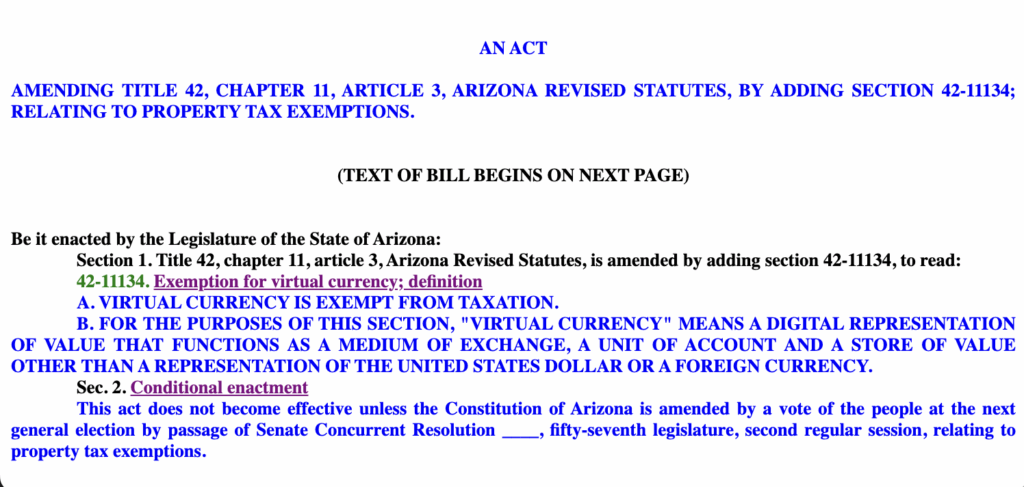
In bills prefiled with the Arizona Senate, Rogers proposed amending state statutes to exempt virtual currency from taxation (SB 1044), prohibiting counties, cities and towns from taxing or fining entities that operate blockchain nodes (SB 1045), and advancing a constitutional amendment to clarify how digital assets fit into Arizona’s property tax framework (SCR 1003).

The measures take different procedural paths. SB 1045, which focuses on protections for blockchain node operators, could move through the legislature and become law if approved by lawmakers and signed by the governor.Β 

By contrast, SB 1044 and SCR 1003 are tied together and would ultimately require voter approval during the next general election in November 2026.

SCR 1003 proposes amending Arizona’s constitution to explicitly exclude virtual currency from property taxation. SB 1044 would mirror that change in state statutes, adding language that clarifies digital assets are not subject to property tax. Under Arizona law, changes to constitutional tax definitions must be approved by voters, making the ballot measure a central hurdle for the broader tax exemption effort.

SB 1045 addresses a narrower, but increasingly debated issue: the treatment of blockchain nodes at the local level. The bill would bar cities, towns and counties from imposing β€œa tax or fee on a person that runs a node on blockchain technology,” effectively preventing local governments from singling out node operators through taxes or penalties.Β 

Arizona is one of many states embracing bitcoin and crypto

Arizona’s legislative activity around digital assets builds on earlier efforts that have already placed the state among a small group with crypto-specific laws on the books. Arizona is one of the few U.S. states that allows the government to take custody of digital assets deemed abandoned after three years.Β 

That framework emerged from past attempts by crypto advocates to establish a state-level digital asset reserve and has since become part of a wider debate over how much authority states should have to hold or invest in cryptocurrencies such as bitcoin.

Rogers was previously a co-sponsor of a bitcoin reserve bill that was vetoed by Arizona Governor Katie Hobbs in May. Following the veto, Rogers criticized the decision and said she planned to refile similar legislation in a future session.

Arizona’s proposals arrive as states across the country experiment with different approaches to digital asset policy. New Hampshire and Texas have also enacted laws related to digital asset reserves, while other states have focused on narrower tax questions.Β 

Ohio lawmakers advanced a bill that would exempt cryptocurrency transactions under $200 from capital gains taxes, though it has stalled since June.

Β In New York, a proposal to impose a 0.2% excise tax on digital asset transactions was referred to committee earlier this year and has not moved forward.

At the federal level, Sen. Cynthia Lummis of Wyoming introduced draft legislation proposing a de minimis exemption for digital asset transactions and capital gains of $300 or less.Β 

Lummis announced on Friday that she plans to retire from the U.S. Senate in January 2027.

arizona

Bitcoin is trading at $87,341, down 3% over the past 24 hours. Its 24-hour trading volume is $46β€―B. The price is 3% below its 7-day high of $90,031 and 1% above its 7-day low of $86,806.

With a circulating supply of 19,966,021 BTC (out of a maximum 21 million), Bitcoin’s market cap stands at approximately $1.74β€―T, reflecting a 3% drop in the last 24 hours.


This post Arizona Introduces Bill To Exempt Bitcoin and Crypto From Property TaxesΒ  first appeared on Bitcoin Magazine and is written by Micah Zimmerman.

❌