❌

Reading view

There are new articles available, click to refresh the page.

Washington State May Mandate 'Firearm Blueprint Detection Algorithms' For 3D Printers

Adafruit managing director Phillip Torrone (also long-time Slashdot reader ptorrone ) writes: Washington State lawmakers are proposing bills (HB 2320 and HB 2321) that would require 3D printers and CNC machines to block certain designs using software-based "firearms blueprint detection algorithms." In practice, this means scanning every print file, comparing it against a government-maintained database, and preventing "skilled users" from bypassing the system. Supporters frame this as a response to untraceable "ghost guns," but even federal prosecutors admit the tools involved are ordinary manufacturing equipment. Critics warn the language is overbroad, technically unworkable, hostile to open source, and likely to push printing toward cloud-locked, subscription-based systemsβ€”while doing little to stop criminals.

Read more of this story at Slashdot.

FBI's Washington Post Investigation Shows How Your Printer Can Snitch On You

By: BeauHD
alternative_right quotes a report from The Intercept: Federal prosecutors on January 9 charged Aurelio Luis Perez-Lugones, an IT specialist for an unnamed government contractor, with "the offense of unlawful retention of national defense information," according to an FBI affidavit (PDF). The case attracted national attention after federal agents investigating Perez-Lugones searched the home of a Washington Post reporter. But overlooked so far in the media coverage is the fact that a surprising surveillance tool pointed investigators toward Perez-Lugones: an office printer with a photographic memory. News of the investigation broke when the Washington Post reported that investigators seized the work laptop, personal laptop, phone, and smartwatch of journalist Hannah Natanson, who has covered the Trump administration's impact on the federal government and recently wrote about developing more than 1,000 government sources. A Justice Department official told the Post that Perez-Lugones had been messaging Natanson to discuss classified information. The affidavit does not allege that Perez-Lugones disseminated national defense information, only that he unlawfully retained it. The affidavit provides insight into how Perez-Lugones allegedly attempted to exfiltrate information from a Secure Compartmented Information Facility, or SCIF, and the unexpected way his employer took notice. According to the FBI, Perez-Lugones printed a classified intelligence report, albeit in a roundabout fashion. It's standard for workplace printers to log certain information, such as the names of files they print and the users who printed them. In an apparent attempt to avoid detection, Perez-Lugones, according to the affidavit, took screenshots of classified materials, cropped the screenshots, and pasted them into a Microsoft Word document. By using screenshots instead of text, there would be no record of a classified report printed from the specific workstation. (Depending on the employer's chosen data loss prevention monitoring software, access logs might show a specific user had opened the file and perhaps even tracked whether they took screenshots). Perez-Lugones allegedly gave the file an innocuous name, "Microsoft Word - Document1," that might not stand out if printer logs were later audited. In this case, however, the affidavit reveals that Perez-Lugones's employer could see not only the typical metadata stored by printers, such as file names, file sizes, and time of printing, but it could also view the actual contents of the printed materials -- in this case, prosecutors say, the screenshots themselves. As the affidavit points out, "Perez-Lugones' employer can retrieve records of print activity on classified systems, including copies of printed documents." [...] Aside from attempting to surreptitiously print a document, Perez-Lugones, investigators say, was also seen allegedly opening a classified document and taking notes, looking "back and forth between the screen corresponding the classified system and the notepad, all the while writing on the notepad." The affidavit doesn't state how this observation was made, but it strongly suggests a video surveillance system was also in play.

Read more of this story at Slashdot.

New York Introduces Legislation To Crack Down On 3D Printers That Make Ghost Guns

By: BeauHD
New York Governor Kathy Hochul is proposing first-of-its-kind legislation that would require 3D printers sold in the state to include built-in software designed to block the printing of gun parts used to make "ghost guns." The plan would also add criminal penalties for making 3D-printed firearms and hold printer owners or manufacturers liable if safety controls aren't in place. 3D Printing Industry reports: "From the iron pipeline to the plastic pipeline, these proposals will keep illegal ghost guns off of New York streets, and enhance measures to track and block the production of dangerous and illegal firearms in our state," Hochul said. In addition to mandating printer-level safeguards and restricting access to CAD files, the proposed legislation would require law enforcement agencies to report any recovered 3D printed firearms to a statewide database. The measure also includes a provision requiring commercial gun manufacturers to redesign pistols so they cannot be easily converted for automatic fire. "These illegal firearms are being manufactured in homes and used in crimes right now, which is why I have been working with my colleagues in Albany and the private sector over the past several years to stop their proliferation. Passing these measures will reduce crime and strengthen public safety for all New Yorkers," said Manhattan District Attorney Alvin Bragg.

Read more of this story at Slashdot.

Build a 2K Resolution MSLA 3D Resin Printer for Cheap

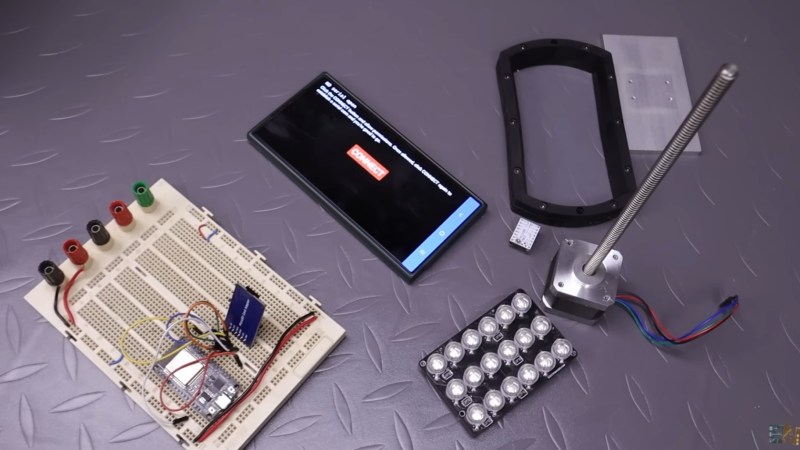
A photo of the various parts for this MSLA 3D printer

Have an old Android device collecting dust somewhere that you’d like to put to better use? [Electronoobs] shows us how to make a Masked Stereolithography Apparatus (MSLA) printer for cheap using screens salvaged from old Android phones or tablets.

[Electronoobs] wanted to revisit his earlier printer with all the benefits of hindsight, and this is the result. The tricky bit, which is covered in depth in the video below the break, is slicing up the model into graphics for each layer, so that these layers can be rendered by the LCD for each layer during the print.

The next tricky bit, once your layer graphics are in hand, is getting them to the device. This build does that by installing a custom Android app which connects to a web app hosted on the ESP32 microcontroller controlling the print, and the app has a backchannel via a USB OTG adapter installed in the device. [Electronoobs] notes that there are different and potentially better ways by which this full-duplex communication can be achieved, but he is happy to have something that works.

If you’re interested in resin printer tech, be sure to check out Continuous Printing On LCD Resin Printer: No More Wasted Time On Peeling? Is It Possible? and Resin Printer Temperature Mods And Continuous IPA Filtration.

❌