Reading view

There are new articles available, click to refresh the page.

Readiness gaps may leave communities vulnerable when the next disaster strikes

Interview transcript:

Terry Gerton A couple of months ago, we covered your first report in this disaster assistance high-risk series where you looked at the federal response workforce. You’re back with report number two, looking at state and local response capabilities. Talk to us about the headlines.

Chris Currie The headline for this report is that the capabilities of state and local governments across the country vary drastically for a disaster or other type of event. You know, what we did is we actually look at data that the states prepare and provide to FEMA as part of their justification for federal preparedness grants. It’s meant to be a very, very honest self-assessment of capabilities. And for that reason, we actually don’t provide states individually, we sort of roll it up and wrap it up anonymously because some of that information, as you imagine, could be sensitive. We looked at states that have been involved in major disasters over the last two to three years, and some of these states are very experienced, large states, and even they vary in terms of their capabilities. There’s actually 32 capabilities that FEMA sets in the National Preparedness System that you want to achieve to be prepared to respond for a disaster or a large event. And states vary. Some of the areas, they were less than 10% prepared — met less than 10% of those capabilities — and others, they were much more. So the reason that’s important right now is to understand that if you were to change the support that FEMA and the federal government provide to states quickly, then they’re going to have capability gaps that are going to have to get filled.

Terry Gerton Let’s talk about some of the support that FEMA does provide. One of the ways that they support the states is through preparedness grants, and those help build local capacity. What did you find as you dug into the preparedness grants?

Chris Currie Those preparedness grants started after 9/11, and since 9/11, there’s been over $60 billion provided to states. It’s the main way that the federal government transfers funds to state and local governments to get them ready to handle something bad that could happen, not just a natural disaster, but it could be a terrorist attack. And those grants have built capabilities tremendously over the years. But those capabilities change over time, and we identify through real-world events and exercises the gaps that still need to be addressed. So I’ll give you a great example. After Hurricane Helene and after other disasters, housing for disaster survivors is always a perennial challenge. Housing is a capability area that is assessed and we want to build up through these preparedness grants. It’s an area that states, even very experienced disaster states, still fall short of in terms of their capabilities. And the federal government kind of comes in after a disaster and provides a lot of that support because states don’t. So if the federal governments not going to provide it, then someone else is going to have to provide it. And that’s going to be someone at the state or local level.

Terry Gerton Talk to me about the flexibility and the allocation framework for these grants. Is it meeting requirements? Does it seem to be focused on the places that have the greatest need?

Chris Currie There’s a couple different ways they’re given out. There’s a portion of the grants that are supposed to go towards certain national priorities, and FEMA sets those targets. So think about things like election security or other national priorities. But then a large part of the grant, they’re discretionary, and the states can use them and they’re supposed to use them in the areas where they assess they have gaps. And that’s the data I was talking about earlier that we provided. For example, certain states may have gaps in their ability to handle a mass casualty situation or may struggle to house disaster survivors because they don’t have a lot of housing stock or rental. So those are things they’re supposed to identify and then target those grants towards those specific areas, which makes sense. You want to close your gaps so you’re ready to go when something happens.

Terry Gerton FEMA also provides a great deal of training and technical assistance. How effective has that been in helping states be ready?

Chris Currie This is, I think, one of the biggest success stories since Hurricane Katrina. If you remember Hurricane Katrina, the issue was the role of various levels of government was not clear, and thus, nobody stepped up and was proactive in responding to that event. And people lost their lives. Since that time, the National Preparedness System and FEMA leading that has been extremely effective through exercises, through training, through just regional relationships in taking care of a lot of those problems. So today we are way more proactive and responsive to disasters than we were 20 years ago in Hurricane Katrina. So that’s a huge success story. Having said that, a disaster is a disaster. There’s always going to be things that happen that you don’t expect. And there’s areas where states still have major gaps and require resources and people to address those. And the federal government comes in fills a lot of those gaps. Here’s a great example. Hurricane Helene happened and devastated a very remote part of our country in places like rural Tennessee and North Carolina and Virginia. States and localities don’t have the search and rescue assets for such a large swath of that kind of terrain. Federal government provided a lot of that. They provided a lot of the air support, the land support, the temporary bridges — Army Corps of Engineers. You know, the federal government really kicks in when something’s too big for a state or locality to handle.

Terry Gerton I’m speaking with Chris Currie. He’s director, Homeland Security and Justice at GAO. So Chris, all of this begs the question. This administration has been very clear that it wants states and localities to pick up more of the disaster response mission and that it wants a much smaller FEMA. Given what you found in your first study about the federal response workforce and the impacts of downsizing there, and now the variability in state and local readiness, what are the implications for national disaster response?

Chris Currie I want to make one thing really clear, because all I know is what we know now and the data that we’ve looked at. And I want it to be clear that nothing has changed in terms of FEMA’s responsibilities today. There’s been a lot of talk about it. There’s the president’s council that studied it. But there has been no change so far. So FEMA is still responsible for what it was responsible for two years ago. They have lost some staff. We looked at that in our first report, as you mentioned. They have lost about 1,000 staff, and maybe a little bit more than that, at this point, but they haven’t been cut drastically or cut in half as has been discussed. So they still have the same responsibilities and they’re still performing the same functions on disasters throughout the country, even though last year we didn’t have a huge land-falling hurricane. So what’s important about that is that everybody’s waiting to hear what the next steps are going to be and what’s going to happen to FEMA. One of the things we wanted to do in this report is we wanted to provide a comprehensive picture of preparedness to show what’s going to be necessary if that FEMA support is pulled back or FEMA is made smaller. And the bottom line is that states and localities are going to have to do more. However, it’s going to be critical that they have the time to prepare for that. For example, a lot of the assistance that’s provided to individual survivors, like cash payments and housing, that comes from the federal government. It does not come from the state or local government. So if FEMA is not going to be providing that, the state of the locality is going to have to fill that need. And that requires a lot of money and a lot preparation and planning that you can’t just turn on in a heartbeat. You don’t want to start figuring out programs to help people after a disaster happens.

Terry Gerton You bring up a good point on that time to prepare. As you did the survey, you talked to lots of state and local response officials. What did they tell you, beyond time to prepare, that they were going to need to be effective?

Chris Currie Very simple: Just tell us what we need to do. Tell us what were going to expect from you, the federal government. Nobody knows right now. The FEMA Council has not finished its work. There has been reform legislation introduced in the House and in the Senate, but nothing has passed yet. So the key message is, tell us what the roles and responsibilities are going to be so we know what to prepare for, so we don’t get caught flat-footed in the case of something really bad happening. One of my fears is that last year, like I said, we didn’t have a large land-falling hurricane. It was the first year in a long time we did not. We did not have a catastrophic disaster, other than Los Angeles fires early in the year. So my fear is that folks are going to look at last year and say, hey, things have gone pretty well. We don’t need to be thinking about it. And that is an absolute mistake. Because we’ve seen in years like 2017, 2018, 2024 — my fear is we’re going to have another situation this year or next with multiple concurrent disasters, and we’re just not going to the resources to deal with them.

Terry Gerton So what will you be watching for in the next few months to see if Congress and the federal government and the states have taken your recommendations on board?

Chris Currie Well, when the FEMA Council report comes out, I would like to see, in whatever the execution is for FEMA reform or the changes in how the system works now, an understanding of how this needs to be rolled out so states and localities can prepare and have as clear roles and responsibilities as possible. We’d also like to see them address many of the problems that we’ve pointed out. And to be clear, we’ve pointed out a number of issues with FEMA, particularly in the frustrating recovery phase. I want to see that they’re making sure that we don’t break what’s not broken and we fix the issues that are broken. And there are a number those things.

The post Readiness gaps may leave communities vulnerable when the next disaster strikes first appeared on Federal News Network.
© Federal News Network
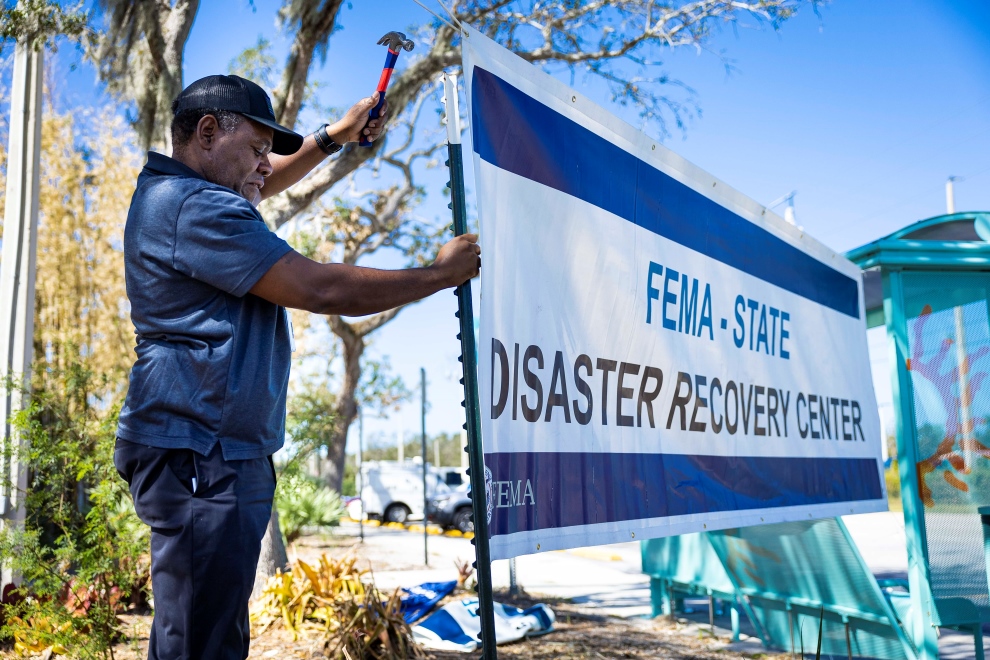
FEMA workers set up a new disaster recovery center in Manatee County, Florida, following Hurricane Milton. Survivors can meet with FEMA staff at centers to discuss their applications and available federal resources. (Photo credit: FEMA)

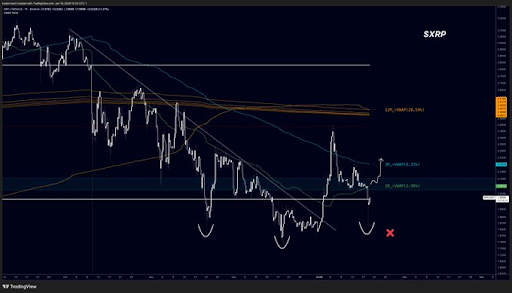
What the Triple-Tap At $1.80 Means For The XRP Price

Crypto analyst Dom has commented on the current XRP price action, revealing what the triple tap at $1.80 means for the altcoin. This comes as XRP sheds most of its gains from the start of the year amid the recent crypto market crash

XRP Price Reaches Major Support With Triple Tap At $1.80

In an X post, Dom stated that there is a triple tap in the $1.80 zone, which is the last possible expression of a bottoming structure for the XRP price. The analyst warned that any further moves to the downside are likely to trigger a breakdown for the altcoin. He added that regaining $2.05 is the goal for bulls to put the chart back in a “safe zone.”

This analyst comes amid the XRP price crash below the psychological $2 level. The altcoin has crashed alongside the broader crypto market, losing most of its yearly gains in the process. This comes on the back of the latest Trump tariffs on eight European nations, which have sparked bearish sentiment in the market. 

XRP

Commenting on the 30% rally for the XRP price earlier in the month, Dom reiterated that it was a weak move. He noted that the order flow analysis showed no strong buyer support and that the push was possible due to low liquidity. On-chain analytics platform Glassnode also recently commented on the current price action, noting that the current market structure for XRP closely resembles that of February 2022. 

Glassnode stated that investors active over the 1-week to 1-month window are now accumulating below the cost basis of the 6-month to 12-month cohort. They added that as this structure persists, psychological pressure on top buyers continues to build over time. 

XRP’s Structure Still Intact 

In an X post, crypto analyst Egrag Crypto stated that the XRP price structure remains intact, with the upper resistance at between $3.40 and $3.60. Meanwhile, the lower support is between $1.85 and $1.95, and the price is currently near the range lows. The analyst also noted that the 21 EMA is sloping down and acting as resistance, with the price still below it, suggesting weak short-term momentum. 

As for what could happen next, Egrag Crypto predicted a liquidity sweep rather than a confirmed breakdown in the XRP price. He explained that a wick below $1.85 is a normal liquidity behavior within a range. However, a weekly close below this level could signal structural failure and increase cycle risk. 

Until that happens, Egrag Crypto noted that the XRP price is still ranging, holding structure, not broken, and not in macro failure. He added that his stance remains unchanged as he is still bullish and holding as long as the structure remains valid. 

At the time of writing, the XRP price is trading at around $1.90, down over 3% in the last 24 hours, according to data from CoinMarketCap.

XRP

Trump lauds ‘tremendous’ federal workforce cuts. Good government group calls them ‘disturbing.’

As he marked one year since being sworn into office, President Donald Trump on Tuesday touted the actions of his administration — including praising the major reductions to the federal workforce throughout 2025.

“I don’t want to cut people, but when you cut them and they go out and get a better job, I like to cut them,” Trump said during a nearly two-hour press briefing, while also stating his administration “slashed tremendous numbers of people off the federal payroll.”

The White House on Tuesday also released a list of “365 wins” over the last year, commending the administration’s efforts to ensure a “merit-based” federal workforce. The list includes federal workforce actions overhauling the probationary period; eliminating diversity, equity and inclusion across government; requiring employees to work on-site full-time; slashing federal jobs; and limiting agencies to one new hire for every four employees who exit the civil service.

“I say, get rid of everybody that’s unnecessary, because that’s the way you make America great again,” Trump said. “When you have all these jobs where people are sitting around doing nothing and they get a lot of money from the government, it’s no good.”

But good government groups such as the Partnership for Public Service tell a much different story of the administration’s impact on the federal workforce. Max Stier, the Partnership’s president and CEO, described 2025 as “the most significant reduction in federal government capacity that we’ve ever experienced in our history.”

“And that reduction in capacity is best represented in our most important asset: our federal workforce,” Stier told reporters on a press call last week.

Governmentwide, federal workforce data shows that about 320,000 federal employees left government during 2025, while just tens of thousands joined the civil service. The Office of Personnel Management reported a net loss of about 220,000 federal employees over the course of the year.

“It tells a disturbing story about who we’ve lost in our government and what is actually happening to the workforce,” Stier said. “But it doesn’t tell you anything about what is truly most fundamental — their morale and what they think about what’s happening right now.”

The Partnership, a non-profit organization that advocates for non-partisan, “good government” reforms, released a report on Tuesday, noting that the Trump administration’s actions over the last year created “confusion, distrust and stress within the federal workforce.”

“There were large-scale layoffs of employees, cuts to government programs and the ending of many grants, altering how the government does — or does not — serve the public and the outcomes it can achieve,” the report states. “Not only did the government lose invaluable expertise, it became less responsive to public needs and less prepared to keep Americans safe.”

“It is impossible to gain a full picture of the layoffs and their impact,” the Partnership added. “The administration has provided few specifics about what positions have been eliminated and which personnel have been laid off or incentivized to resign.”

The Partnership’s report also detailed the specific impacts of federal workforce losses over the last year, including effects at agencies like the IRS, Social Security Administration, Department of Health and Human Services, FEMA and many others.

As a result of the governmentwide staffing cuts, the Partnership argued, agencies are less prepared to deliver disaster assistance during emergencies, and less efficient in administering crucial government programs, leading to delays in basic services and increased wait times.

By contrast, OPM Director Scott Kupor has argued that the Trump administration’s federal workforce overhauls will lead to better employee accountability, merit and performance across government. Kupor also touted the loss of one-third of OPM’s internal workforce during 2025, while saying the agency’s service delivery improved.

“President Trump was clear from day one: The federal workforce must be accountable, performance-driven and focused on serving the American people,” Kupor said in a Dec. 31 press release. “This year, OPM delivered on that vision — modernizing government operations, rewarding excellence and putting taxpayers first.”

But Rob Shriver, director of the Civil Service Strong program at Democracy Forward, questioned the Trump administration’s workforce reductions, saying there are no forward-looking plans for continuing to effectively deliver services after the cuts.

“The singular focus on headcount reduction as a blunt instrument reveals that DOGE was never about efficiency,” Shriver, a former acting director of OPM during the Biden administration, said in commentary on Tuesday. “It was about retribution and stifling dissent by intimidating federal workers into leaving their jobs or, if they decided to stay, intimidating them into not questioning their political leaders.”

At the same time, information on the federal workforce’s perspective over the course of 2025 will likely be limited. After months of postponing, OPM last year opted to cancel the 2025 Federal Employee Viewpoint Survey. In an attempt to fill the data gap, the Partnership conducted its own federal workforce survey.

The results of the Partnership’s survey are expected to be released in March. But Partnership officials have said it will still be difficult as an external organization to replicate the depth of data OPM can attain through FEVS.

Going forward, the Trump administration is looking to make further changes for the federal workforce, including overhauls to the probationary period and federal hiring processes, as well as performance management and senior executive development.

OPM’s Kupor said the upcoming changes will make government “leaner,” while making federal employees more results-oriented, accountable and efficient.

But some painted a darker picture for federal employees throughout 2026.

“The harms caused by these cuts have already begun to play out, and we’ll see more and more of that in 2026, when the impacts of the thoughtless workforce cuts are felt more deeply around the country,” Shriver said.

The Trump administration is also expected to soon issue a final rule to implement “Schedule Policy/Career.” The forthcoming regulations will let agencies reclassify career federal employees in “policy-influencing” positions, in effect removing their civil service protections and making them easier to fire at-will.

“The change of our federal government into one that is a loyalist workforce, as opposed to a professional one, is a process that we anticipate moving forward in 2026,” Stier said. “As challenging as 2025 was, I think we can expect even harder days ahead in 2026.”

The post Trump lauds ‘tremendous’ federal workforce cuts. Good government group calls them ‘disturbing.’ first appeared on Federal News Network.

© AP

A muddy American flag rests in a window of a home damaged by floodwaters Wednesday, Oct. 7, 2015 in Columbia, S.C. (AP Photo/John Bazemore)

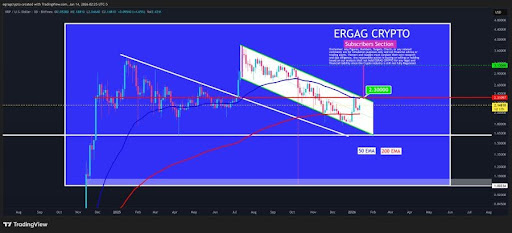
XRP Compresses At A Breakout Line — Structure Says Expansion Is Brewing

XRP is tightening up at a critical breakout level, with price action suggesting the market is coiling for its next decisive move. While short-term volatility has cooled, the broader structure remains constructive, pointing to a potential expansion phase as compression builds near key resistance.

XRP Compresses Into A Critical $2.30–$2.40 Decision Zone

According to a latest update from Egrag Crypto, the XRP 3-day chart continues to flash strong bullish signals despite recent consolidation. Price action remains constructive, with XRP compressing inside a descending channel as it approaches a crucial decision zone between $2.30 and $2.40.

From a structural standpoint, several technical elements point to underlying strength. The 50-period EMA has begun to flatten, suggesting that selling pressure is gradually easing. At the same time, the 200-period EMA continues to trend higher, reinforcing the idea that the broader, macro trend remains bullish.

Furthermore, XRP is holding above the EMA cluster, indicating that the market structure has not yet broken down. Notably, the upper boundary of the descending channel aligns closely with the former $2.30 breakout level, adding technical significance to this zone.

XRP

From here, the implications are clear. A clean and decisive 3-day close above $2.40 would likely confirm a breakout from compression, opening the door for continuation toward the $2.70 region, with $3.13 emerging as a higher upside objective.

On the other hand, rejection at resistance would likely keep XRP trading in a range. However, as long as the price remains above the $2.00 area, the overall bullish structure stays intact. This is not a breakdown scenario; rather, it reflects tightening price action that often precedes a strong expansion.

Triple Tap Hits Range Highs, Reaching A Key Inflection Point

In a recent market update, CrediBULL Crypto noted that XRP has now completed its triple-tap move, successfully reaching the upper boundary of its range. With liquidity at the range highs already taken, the market now stands at a clear crossroads, presenting two distinct paths for price action going forward.

The first scenario frames the recent move as nothing more than a relief bounce, sweeping liquidity at the highs before resuming its local downtrend, within the higher-timeframe uptrend. If this plays out, price could move lower again, potentially dropping below the $1.77 level.

In the alternative scenario, the triple-tap pattern is interpreted as the formation of a solid base of structural demand. Under this view, pullbacks are likely to be met with buying interest, with the $1.77 lows acting as a support zone rather than a level to be broken.

Weighing the broader context, particularly Bitcoin’s position and overall market conditions, CrediBULL leans toward the second outcome. That bias favors looking for long opportunities, with the expectation that XRP will continue to expand higher and eventually target untapped levels above the current range.

XRP

Bitcoin Nears ‘Historic’ Technical Test As Price Eyes $93,500 Barrier – What’s Next?

As Bitcoin (BTC) breaks out of key resistance levels, an analyst suggests that the cryptocurrency is positioning itself for a move to higher levels and a retest of a crucial technical area in the coming weeks.

Bitcoin Approaching Make-Or-Break Test

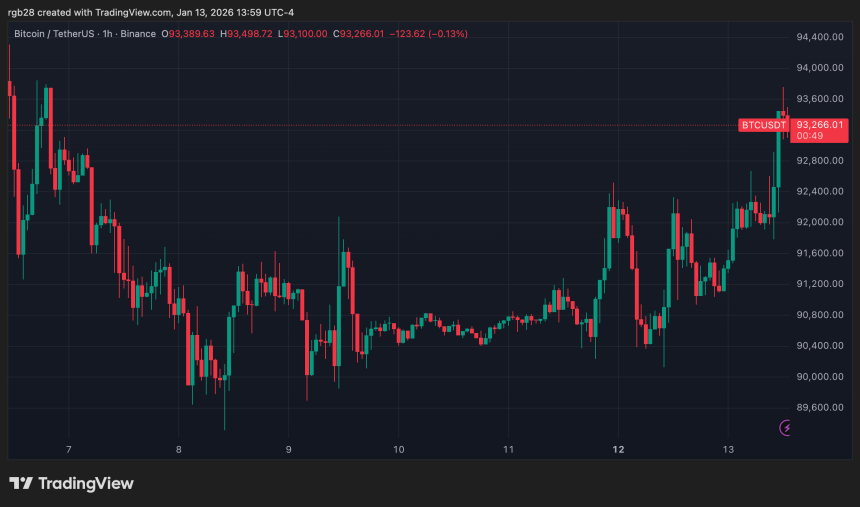
On Tuesday, Bitcoin surged 2.5% to retest the $93,500 resistance level for the first time in a week. The cryptocurrency has been hovering between the $84,000 to $93,500 price range for three months and has failed to turn this level into support multiple times.

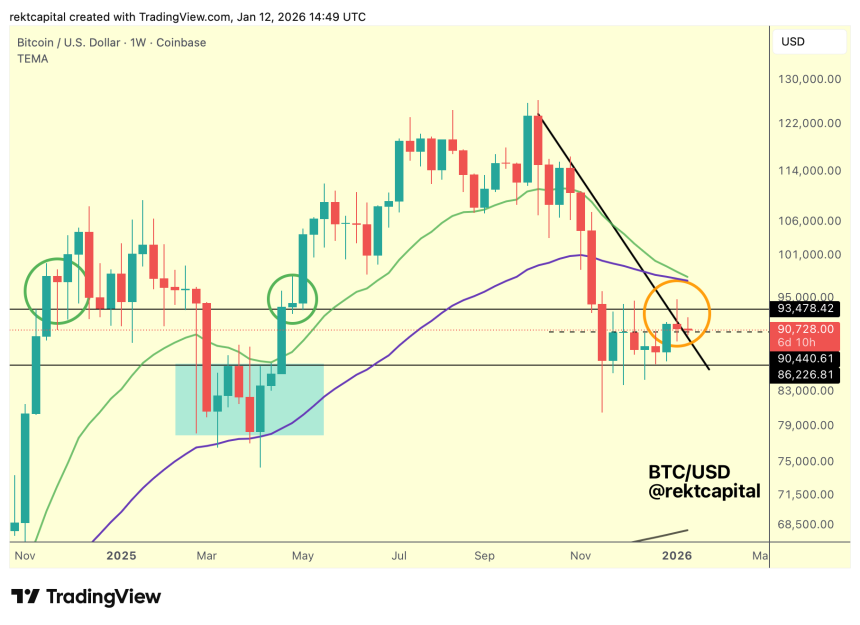
Analyst Rekt Capital recently noted that the flagship crypto is near a “historic” test as it has begun to form “another technically decisive region” just above current price levels.

The market watcher explained that BTC is approaching its dynamic Bull Market Exponential Moving Average (EMA) cluster, where the 50-week EMA and 21-week EMA are getting closer.

Bitcoin

This key cluster, currently located between the $96,000 and $97,500 levels, has historically been tested before a “meaningful crossover,” with the Bitcoin price overextending beyond the cluster.

However, this has usually been followed by an unsuccessful confirmation of this region as support. “When that happens, the crossover itself often follows the bearish price event, rather than causing it, with the EMA cluster flipping into resistance from the underside and leading to downside continuation,” the analyst detailed.

Notably, past cycles reveal that the 50-week and 21-week EMAs can move very close together, Rekt Capital wrote, emphasizing that they can even overlap for prolonged periods before a decisive crossover.

Currently, Bitcoin has yet to retest and overextend beyond the two EMAs, but its historical performance suggests that it will likely occur. Moreover, BTC’s price is “positioning itself in a way that could allow for a springboard higher, potentially enabling a test of this cluster in the weeks ahead. The key question is timing.”

BTC Price Breaks Out Of Key Resistances

In his analysis, the market observer discussed BTC’s recent performance, which has seen a structural change despite the sideways price action. Last week, the cryptocurrency’s price closed above its multi-week downtrend, which has been serving as a major resistance point since late November.

This marks “a small but notable technical milestone” as Bitcoin now holds above the November and December highs in the weekly timeframe, treating the previous resistance as support.

In addition, the mid-zone of its local range, around the $90,500 level, is now “almost perfectly confluent with the former Downtrend, meaning the Downtrend that last week rejected price is beginning to act as layered support instead.”

Therefore, if Bitcoin continues to hold the mid-range region, the price should be able to challenge higher levels and find a path toward $100,000. Rekt Capital added that, unlike previous retests, the most recent rejection from the crucial $93,500 resistance was significantly shallower and shorter, suggesting that it was getting weaker.

Now, the flagship crypto has successfully retested the downtrend breakout area as support and momentarily reclaimed the $93,500 resistance, surging above the $94,000 area once again.

Ultimately, BTC will need to hold this area and close the week above $93,500 to “kickstart a breakout from the Weekly Range as per previous green circles,” the analyst concluded.

As of this writing, BTC trades at $94,334, a 2.6% increase in the weekly timeframe.

bitcoin, btc, btcusdt

Meatballs for lunch

What’s on the Plate: 1. Lamb & Turkey Meatballs (3 medium) 2. Quinoa (~3/4 cup cooked) 3. Veggie Stir-fry (carrots, broccoli, green beans, zucchini – ~1 cup) 4. Sliced Cucumbers (~1/2 cup) 5. Homemade Yogurt (~1/4 cup) Estimated Nutrition (Per Plate) Nutrient Amount Calories ~490–540 kcal Protein ~33–38 g Carbohydrates ~35–40 g Fiber ~6–8 g Fat ~22–26 g

Chicken Keema Kebabs in Air Fryer | High Protein Air Fryer Chicken Kebab Recipe

By: Priyanka

If you think chicken breast can only give you dry and boring chicken kebabs, then here I am to prove you utterly wrong with these chicken keema kebabs of mine which are made in an air fryer with minimal oil and turn out super juicy & tender!

Air fryer has become my right hand which is handling most of my healthy cooking these days! If you own an air fryer but haven't yet checked my air fryer recipe collection, you are definitely missing out a lot!

I can assure you that you will get absolutely workable air fryer recipes there which you can make even on a hectic workday!

So predictably enough, I am back with another air fryer recipe for all of you who are looking for high protein yet low calorie tasty dishes that you can enjoy without messing up your healthy eating plans!

Hence air fryer chicken keema kebabs came into existence when I was trying to make something realistically quick & easy for my own lunch or dinner.

What are chicken keema kebabs?

Chicken keema kebabs are the Indian version of chicken patty or chicken cakes which are essentially of flat round shape.

I call them chicken keema kebabs as they are grilled in an air fryer and not deep or shallow fried in oil. These are also called chicken tikkis sometimes as they resemble the popular aloo (i.e. potato) tikkis.

The post Chicken Keema Kebabs in Air Fryer | High Protein Air Fryer Chicken Kebab Recipe first appeared on Flavor Quotient.

Chicken-Keema-Kebab-FQ-3-2

Video recipe: Lamb Meatballs in Red Curry

Here is a curry you can make in under 30 minutes! Lamb is literally what we make most Sundays. This time H bought home ground lamb. It got me thinking, how can I make this extra delicious? I tried something new, and it tasted great. Give it a try. I combined ground lamb with homemade bread crumbs, eggs, fresh coriander, pepper, onions, ginger garlic and green chilies, made meatballs, shallow

Chicken Pakora

By: KaviRuchi

Pakoras are an all-time favorite snack across India. It is basically a crisp fried appetizer prepared with onion, besan, rice flour along with some spices. Which evening would not be delightful with a cup of masala chai and pakoras! 

How about pakoras with chicken? Yes! Pakoras with chicken taste absolutely delicious and can be an amazing evening chicken snack for kids or when guests are home or for parties

chicken pakora | kaviruchi.com

Chicken in minced form is usually called kheema which is nothing but ground meat. Use minced chicken in kebab recipes. A kind of Indian meatball is made by blending minced chicken with breadcrumbs, an egg and spices then placed on skewers, and baked. Minced chicken can also be stir-fried rapidly with vegetables, mushrooms, Chinese spices, and Chinese sauces, then stuffed into lettuce or cabbage leaves. Apart from making the very famous Indian chicken kheema recipe, here is a quick appetizer with ground chicken.

Ground Chicken may be easily available in the supermarket, however, you would be happy to know how easy it can be made at home without a meat-grinder. And without worrying of chicken becoming a paste. Here is the process to easily make ground chicken at home


HOW TO MAKE GROUND CHICKEN AT HOME?

What you need:

  • A Food Processor or a Blender.
  • Skinless and boneless Chicken breasts or thighs.

Directions:

  1. Rinse chicken in cold water and pat dry thoroughly.
  2. Cut the chicken into 1-inch chunks.
  3. Lay the chicken chunks in a single layer on a foil-lined baking sheet.
  4. Place the baking sheet in the freezer for about 20-25 mins, the chicken should get firm but not frozen though.
  5. Put the chunks into a food processor or blender, in batches of about 10 at a time and pulse them until it resembles ground chicken.
  6. Use the ground chicken immediately or freeze until ready to use.

So, now you know how easily ground chicken can be made at home, so let’s get on to an easy appetizer preparation using this ground chicken.

It is very similar to our traditional onion pakoras but with additions of few spices to enhance the taste of ground chicken and prepared very similar to any other pakoras. Serve hot with a dash of chat masala on top along with tomato ketchup and green chutney. 

Chicken Pakora can be an easy and quick appetizer for your weekend meal.

chicken pakora | kaviruchi.com
“Weekend meal with chicken pakora as appetizer”

Do give a try.  Pakoras with chicken are yummier than ever! Kids would love to munch on these chicken snack for evening.

chicken pakora | kaviruchi.com
“Evening Snack for kids”


Recipe Card for Chicken Pakora:

chicken pakora | kaviruchi.com
Print

Crispy Chicken Pakora | ಚಿಕನ್ ಪಕೋಡ | Chicken Pakoda recipe | Easy Chicken Snack for kids | Chicken-Onion Bajji

Crispy Chicken Pakora is a quick Indian appetizer made with ground chicken, onions, gram flour, and spices. Great for parties or an evening chicken snack for kids.
Course Appetizer, Snack
Cuisine Indian
Keyword chicken, pakora
Prep Time 10 minutes
Cook Time 15 minutes
Total Time 25 minutes
Servings 4
Author KaviRuchi

Ingredients

  • 1 cup Ground/Minced Chicken kheema
  • 1 Onion thinly sliced
  • 4 Green Chili finely chopped
  • ¼ cup Rice Flour
  • ½ cup Besan/Gram Flour
  • ½ tsp Ginger-Garlic Paste
  • ½ tsp Fennel Seeds
  • 1 tsp Chili Powder
  • 1 tsp Garam Masala
  • 2 spring Curry Leaves finely chopped
  • Salt as per taste
  • Oil to deep fry

Instructions

PREPARATION:

  • Thinly Slice 1 large Onion.
    chicken pakora | kaviruchi.com
  • Finely chop 4 Green Chili and 2 springs of Curry leaves.
    chicken pakora | kaviruchi.com

METHOD:

  • In a large mixing bowl, add thinly sliced onion and crumble to separate onion slices.
    chicken pakora | kaviruchi.com
  • Next, add in finely chopped green chili and curry leaves.
    chicken pakora | kaviruchi.com
  • Additionally add fennel seeds, chili powder, garam masala and ginger-garlic paste.
    chicken pakora | kaviruchi.com
  • Add in the ground chicken and mix well.
    chicken pakora | kaviruchi.com
  • Next, add besan(gram flour), rice flour and salt. Mix until everything is well combined to form a thick dough. The moisture from onions and chicken is enough to form a dough. Sprinkle little water only if required.
    chicken pakora | kaviruchi.com
  • On high flame, heat oil a pan/kadai for deep frying.
  • Once the oil is hot, reduce the flame to medium and drop in small-ball sized dough mixtures into the hot oil one after other.
    chicken pakora | kaviruchi.com
  • Do not overcrowd oil, as the chicken pakoras need enough space to cook and turn crispy.
    chicken pakora | kaviruchi.com
  • Fry pakoras until they turn crispy and golden brown on medium flame, stir occasionally.
    chicken pakora | kaviruchi.com
  • Finally, remove to a colander lined with a paper towel.
    chicken pakora | kaviruchi.com
  • Follow the same procedure to fry the rest of the pakoras.
  • Serve hot with a cup of chai. Sprinkle some chat masala on top before serving.
  • Also, serve with tomato ketchup and green chutney for Kids evening snack.
    chicken pakora | kaviruchi.com
  • Munch the crunchy chicken pakodas!!
    chicken pakora | kaviruchi.com

Video

Notes

  • Add more or less of the green chilis mentioned in the recipe, according to spice level required(or skip if making for kids).
  • You could also add mint and coriander leaves to make more flavor full chicken pakodas.
  • Use could also use Corn flour in place of rice flour for crispy pakodas. 
  • Do not add water, the moisture from onion and chicken is sufficient enough to form a dough. If needed sprinkle a very little amount of water.
  • Deep fry and use the dough mixture immediately for crispy pakodas, oozes water if stored for a long time.
  • Make sure to fry pakodas on medium flame, cooking on high flame might brown pakoras quickly but uncook chicken inside, also cooking on low flame makes chicken pakodas hard and chewy.


Enhance the flavor of your dishes with this homemade ginger garlic paste, as homemade is always best & healthy choice!!


Check out other chicken recipes…


Tried this Recipe?

♥ I’d love to hear from you! Please share your food photo with hashtag #kaviruchi on Facebook or Instagram so I can see it and others can enjoy it too!

For more Quick & Tasty Recipes…

♥Follow me on FACEBOOKINSTAGRAM, PINTEREST and Subscribe to my YOUTUBE Channel.

♥Stay in touch! Feel free to drop me an EMAIL and share your feedback. I will always respond.

Thank you and Happy Cooking!

The post Chicken Pakora appeared first on KaviRuchi.

Is Telegram messenger secure?

There are numerous free messaging apps around, but one of the most popular is Telegram. Telegram earned that reputation mainly because of two features: group chat facilities and security.  Its huge possibilities for groups and channels are unchallenged, but concerning security, there are some issues we have to explore.

Telegram is an open source app created by two Russian brothers, Nikolai and Pavel Durov. The app was banned from Russia, however, and the company now has offices in the United Kingdom, Germany, and Dubai. Concerning data storage, Telegram has a hybrid system where you can decide whether to store the data on your phone or one of the several servers worldwide. The first point of concern: Telegram has not subjected its app to an independent and experienced auditor. For that reason, it is wise to be suspicious.

You need a mobile phone number to register and use Telegram. Apart from that, the phone is not a necessary tool because Telegram also has desktop apps for Windows, Mac, and Linux. However, essential features like secret chats are not available on the desktop version. That can be confusing because you are not necessarily aware of some contacts not having read your secret chats because they do not use a mobile device.

How safe are these normal, secret chats? To start with normal chats, they are not encrypted at all. Even WhatsApp is safer in this regard. Sending normal messages in Telegram, therefore, is an absolute no-go. It is kind of confusing and problematic that encryption is not applied by default. Other secure messaging services – such as Signal – apply end-to-end (E2E) encryption on all communications (normal chats, group chats, and voicecalls) by default.

The group chat possibilities on Telegram are huge, with support for up to 200.000 members per group. These chats (cloud chats) are securely encrypted only in transit between devices. But the group chats are not safe. Telegram can read chat data since it handles the encryption and decryption of messages at the servers.

If you use the secret chat option, all messages are end-to-end encrypted using MTProto. Secret chats are not stored on the Telegram servers and can only be accessed through the sending and receiving devices. Secret chats also have auto self-destruct options and informs about the other end taking a screenshot, further increasing the security. Finally, voicecalls are automatically E2E encrypted and are considered to be secure.

If we take a closer look at the privacy policy and the encryption method – MTProto security – things start to get worse. The protocol has been criticized by several cryptography experts. Concerning Telegram’s privacy policy, Telegram can collect lots of personal information like IP address, devices, and history of usernames and keep it for up to twelve months. They will probably also use this to utilize aggregated metadata. Finally, the information in the cloud chats is not safe either, can be shared with linked companies, and could be provided to law enforcement institutions.

Sophos post exploring Signal’s new PIN Secure Value Recovery system to help you maintain your @signalapp account even if you lose or change phones. I learned they’re using @Intel SGX. https://t.co/oFwBE6qJgf #IAmIntel #security #privacy #messaging

— Jim St. Leger (@JimStLeger) May 22, 2020

To be on the safe side, go for a more secure alternative like Signal. If you wish to continue using Telegram, be aware that your IP address will be saved. Therefore, install a VPN when making an account and to use the app. Furthermore, do not use your own phone number when creating an account, but use a paid or free SMS service (disposable SMS). Finally, only use secret chats and voicecalls. Keep these precautions in mind, and some Telegram features can be safe.

For individuals or groups who place high importance on privacy and security, there are far better alternatives, free or paid. Some examples are Signal, Threema, and Wire.

The post Is Telegram messenger secure? appeared first on Rana News.

❌