❌

Reading view

There are new articles available, click to refresh the page.

Bitcoin Hashrate Continues To Fall, Now Lowest Since September

On-chain data shows the Bitcoin Hashrate has continued to decline, with its 7-day average value hitting lows not seen since early September.

Bitcoin Hashrate Has Been Sliding Down

The Bitcoin β€œHashrate” refers to a measure of the total amount of computing power that the miners as a whole have connected to the network. It’s denoted in units of hashes per second (H/s) or, more practically, in exahashes per second (EH/s). This indicator can be useful for gauging the sentiment shared by the miners. Growth in the network Hashrate can signal that this cohort is either responding to a period of profitability or expanding in anticipation of future price action. On the other hand, a decline can signal a weakening of sentiment.

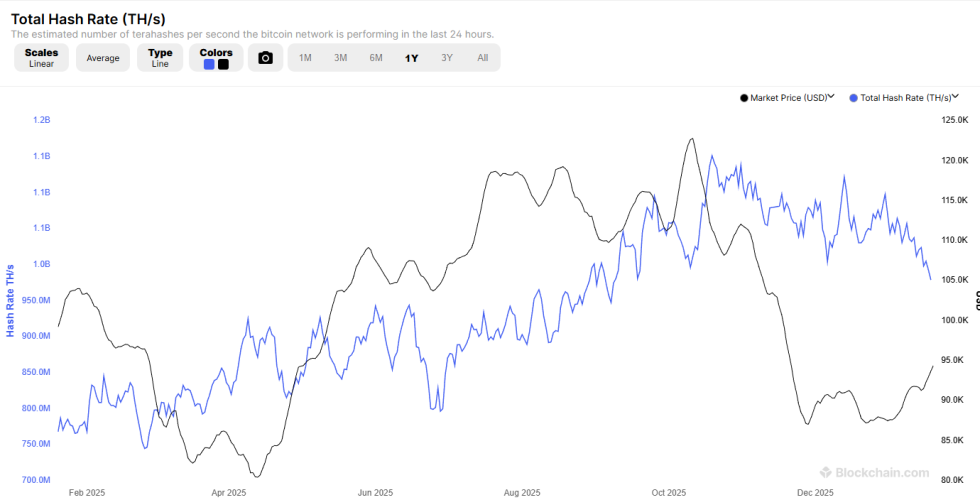
As the chart below fromΒ Blockchain.com shows, the 7-day average value of the Bitcoin Hashrate has been following the latter kind of trajectory in recent months.
Bitcoin Hashrate

The Hashrate set a new all-time high (ATH) in mid-October, but miners moved to decommissioning power as the cryptocurrency’s price went through its bearish shift in that month. Recently, BTC has shown some recovery, but that doesn’t appear to have changed opinion among the miners, as the metric’s value has only continued to go down.

Currently, the 7-day average Bitcoin Hashrate is sitting at 978.8 EH/s, which is the lowest level since the first half of September. The recent low levels are on a path to affect another BTC-network-related metric: the Difficulty. The Difficulty is a feature built into the blockchain that controls how hard it is for miners to mine blocks.Β This metric automatically changes its value about every two weeks based on how fast miners have been performing their duty since the last adjustment.

Satoshi coded in a simple rule for the network to follow: block time should converge to 10 minutes. If miners take an average time faster than this to find a block, the chain raises its Difficulty in the next adjustment. Similarly, a decrease instead happens if the validators are slower at their job.

As miners have reduced their computing power over the last few months, their pace has been going down, and the network has been adjusting the Difficulty lower.

With the Hashrate decline only continuing recently, the network is once again moving toward another relaxation in Difficulty, as data from CoinWarz suggests.
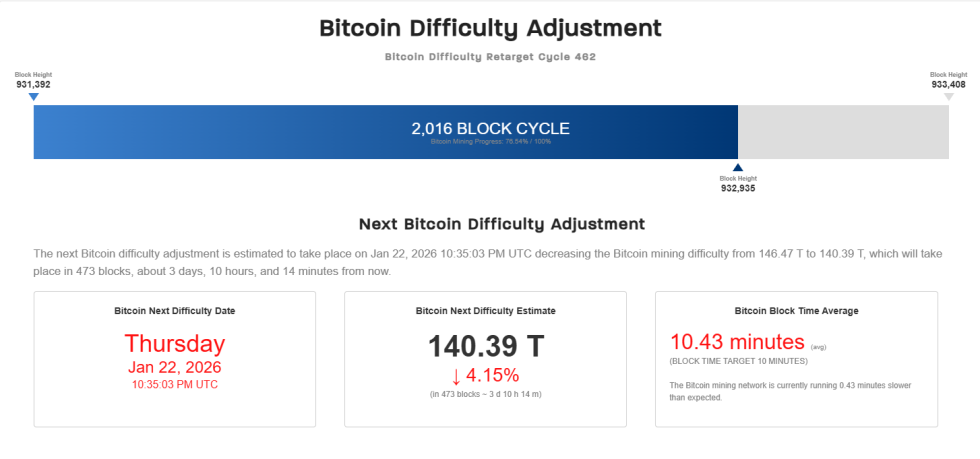
Bitcoin Difficulty

The average Bitcoin block time has stood at 10.43 minutes since the last adjustment, which is notably slower than the standard rate. As a result, the network is estimated to reduce the Difficulty by 4.15%.

With the adjustment still being a few days away, however, this figure could change depending on whether miners expand or decommission in the coming days.

BTC Price

At the time of writing, Bitcoin is floating around $93,000, up 2.5% in the last seven days.

Bitcoin Price Chart

Turkmenistan Legalizes Crypto Mining and Exchanges Under Tight State Control

Bitcoin Magazine

Turkmenistan Legalizes Crypto Mining and Exchanges Under Tight State Control

Turkmenistan just legalized crypto mining and exchanges this year, marking a sharp policy shift for one of the world’s most closed economies and fulfilling legislation that was accepted in November, 2025.Β 

President Serdar Berdimuhamedov signed the Law on Virtual Assets, bringing digital assets under civil law for the first time. The legislation creates a licensing regime for miners, exchanges, and custodial services overseen by the Central Bank of Turkmenistan.

Cryptocurrencies will not yet be recognized as legal tender, currency, or securities. They cannot be used to pay for goods or services. The law defines virtual assets strictly as β€œproperty or investment instruments.”

The move stands out in a country known for tight state control. Turkmenistan maintains strict internet censorship and limited access to foreign platforms. Entry rules for foreigners have long been among the world’s toughest.

The government says the law is meant to support economic development and attract foreign capital. Turkmenistan’s economy depends heavily on natural gas exports. China is its main buyer.

Authorities are also advancing a pipeline project linking Turkmenistan to Afghanistan, Pakistan, and India.

Turkmenistan’s new crypto rules

Under the new framework, both individuals and companies may mine cryptocurrencies. All miners must register with the central bank and meet technical standards. Covert mining practices, including cryptojacking, are banned.

Crypto exchanges and custodians are also permitted to operate with a license. Domestic and foreign entities may own these services, except firms linked to offshore jurisdictions.Β 

Exchanges must enforce know-your-customer and anti–money laundering rules. Anonymous wallets and transactions are prohibited.

The law divides virtual assets into secured and unsecured categories. Secured assets are backed by underlying property. Unsecured assets include bitcoin and similar tokens. None carry payment status under Turkmen law.

Supervision will extend beyond the central bank. The Cabinet of Ministers and the Ministry of Finance and Economy will monitor compliance. Regulators retain the power to suspend or revoke licenses for violations.

The legislation passed parliament in November and came into force on January 1, 2026. It follows earlier steps toward limited digital opening. Turkmenistan introduced an electronic visa system last year to ease entry for foreigners.

Central Asia has emerged as a testing ground for crypto policy. Kazakhstan became a major bitcoin mining hub after China’s 2021 crackdown. Kazakhstan said they are preparing to establish a national cryptocurrency reserve fund worth between $500 million and $1 billion

Pakistan launched a national virtual assets authority in 2025.

Turkmenistan remains one of the least visited countries in the world. Its media environment is tightly managed. Internet access is limited.

This post Turkmenistan Legalizes Crypto Mining and Exchanges Under Tight State Control first appeared on Bitcoin Magazine and is written by Micah Zimmerman.

Riot Platforms Opens $500M Stock Offering as Bitcoin Production Falls

Bitcoin Magazine

Riot Platforms Opens $500M Stock Offering as Bitcoin Production Falls

Riot Platforms opened a new $500 million at-the-market equity offering this week as the bitcoin miner reported lower November production and continued to sell a large portion of its monthly output to fund operations and expansion.

In a filing with the U.S. Securities and Exchange Commission yesterday, Riot said it entered into a definitive sales agreement allowing it to issue and sell up to $500 million of common stock at prevailing market prices through the Nasdaq Capital Market.Β 

The facility replaces a prior at-the-market program established in August 2024, which Riot terminated effective Tuesday.

Under the new agreement, Riot retains discretion over the timing and volume of any share sales. The company said proceeds will be used to fund capital expenditures, potential strategic acquisitions, investments in existing and future data centers and bitcoin mining projects, as well as general corporate purposes.Β 

The company also noted that stock buybacks could be funded with the proceeds, alongside working capital needs.

Riot’s bitcoin production

Riot sold roughly $600.5 million worth of stock under the 2024 agreement before terminating it, leaving about $149.5 million of unused capacity. The new program resets the company’s fundraising flexibility as it continues to scale infrastructure in Texas. Shares were down nearly 1% in trading Wednesday.Β 

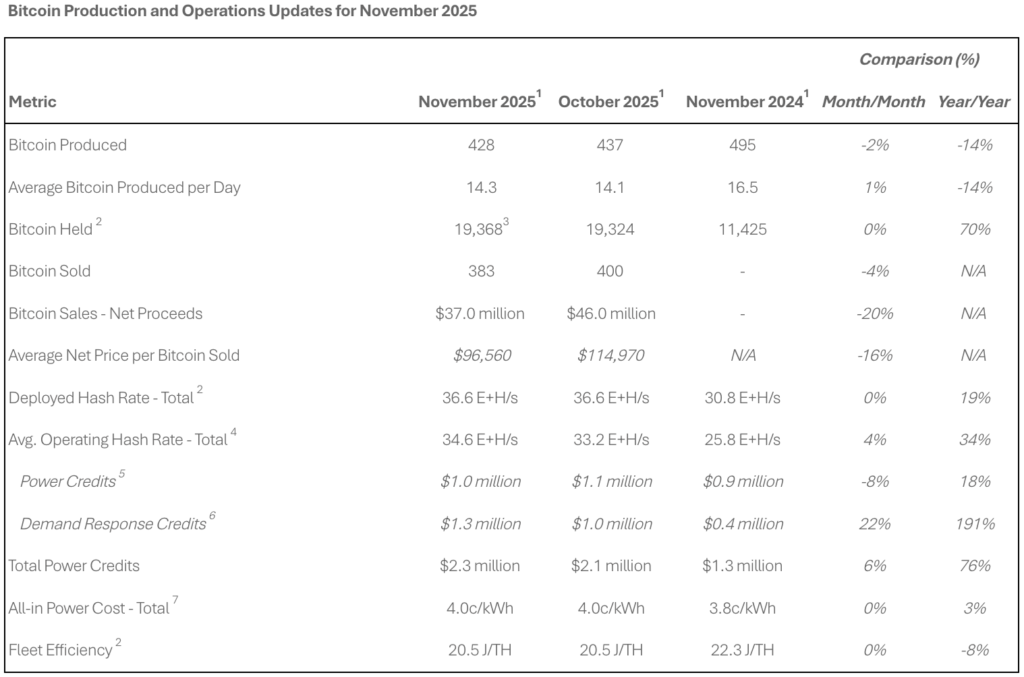
The capital raise comes alongside a mixed monthly operating update. The company said it produced 428 bitcoins in November, a 14% decline from the same month a year earlier.Β 

The company attributed the year-on-year drop to higher network difficulty and planned curtailments tied to power strategy. Total bitcoin holdings stood at 19,368 at the end of November, up 70% from a year earlier, but only four bitcoins higher than in October.

Riot sold 383 bitcoins during the month, generating $37 million in net proceeds. That compares with October, when the company sold 400 bitcoins for $46 million. The average realized sale price fell sharply to $96,560 in November from $114,970 a month earlier, reflecting the pullback in bitcoin prices during late autumn trading.

At the time of writing, bitcoin was trading around $88,000, up just over 1% on the day, with retail sentiment also leaning bearish.Β 

Riot stock remains up 24% year-to-date and 21% over the past 12 months, despite recent volatility.

Institutional analysts continue to see longer-term upside tied to Riot’s infrastructure footprint. J.P. Morgan recently forecast 45% upside for the shares through 2026, citing expectations that the company could secure a 600-megawatt colocation deal at its Corsicana site by the end of next year.Β 

The company currently owns roughly 1.7 gigawatts of power capacity across two large-scale Texas facilities, which analysts describe as rare tier-one assets in the bitcoin mining sector.

Riot

This post Riot Platforms Opens $500M Stock Offering as Bitcoin Production Falls first appeared on Bitcoin Magazine and is written by Micah Zimmerman.

MicroBT Launches WhatsMiner M70 in Abu Dhabi, Pushing for Sustainable Bitcoin MiningΒ 

Bitcoin Magazine

MicroBT Launches WhatsMiner M70 in Abu Dhabi, Pushing for Sustainable Bitcoin MiningΒ 

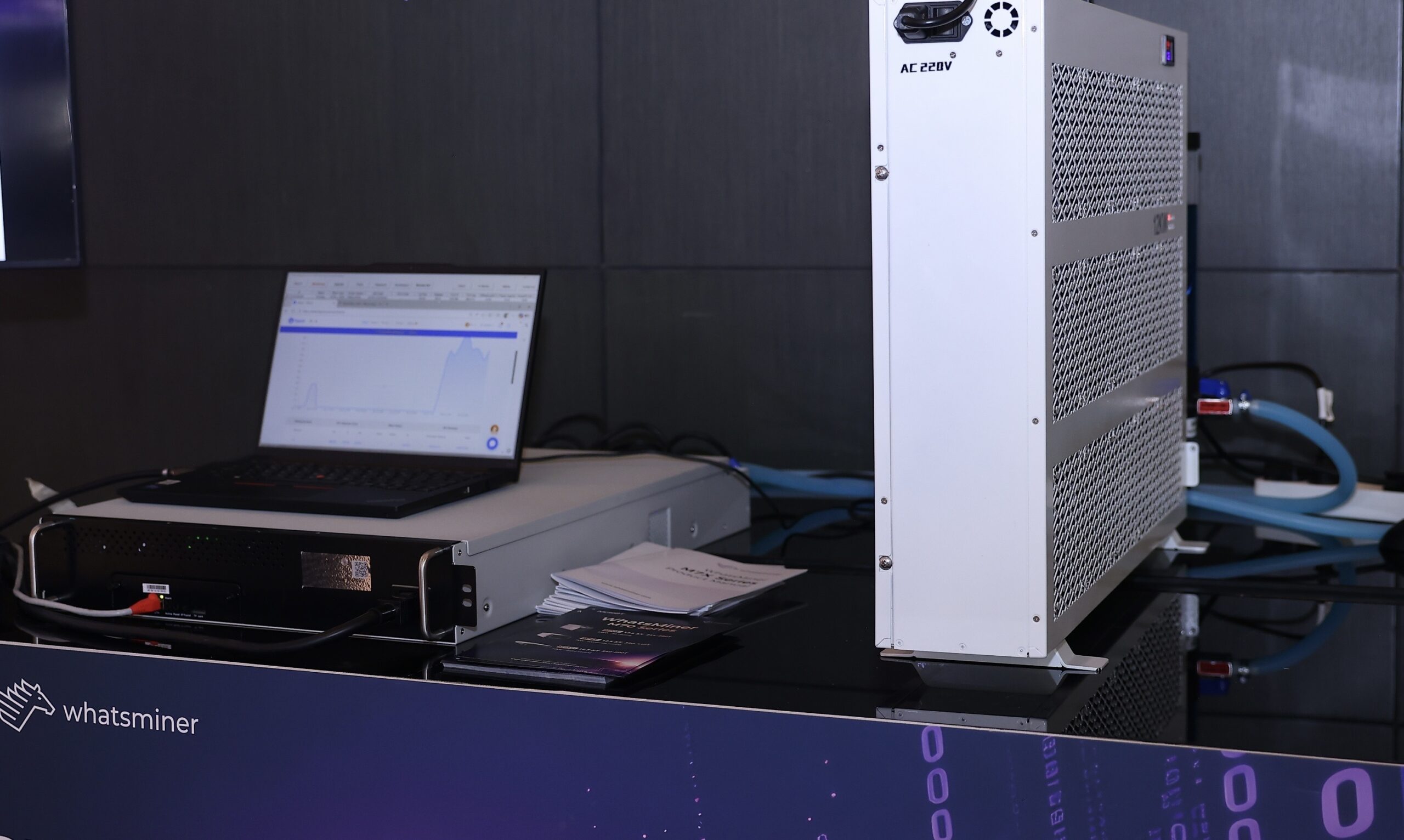
MicroBT, a leading developer of Bitcoin mining hardware, launched its latest WhatsMiner M70 series in at Bitcoin MENA in Abu Dhabi on Monday, according to a note shared with Bitcoin Magazine.Β 

The event, themed β€œGreen-Driven, Ecosystem Redefined,” brought together mining executives, strategic partners, and key clients, marking a significant step in the company’s efforts to shape a more sustainable mining industry.

Dr. Yang Zuoxing, Founder and CEO of MicroBT, opened the event with a keynote that highlighted the connection between technological leadership and long-term industry growth.

He framed the conversation around energy innovation, presenting strategies that aim to integrate renewable sources into mining operations.Β 

Central to his remarks was an off-grid solar solution capable of 200kW output. This system, using an 800V DC supply and a β€œload-following-source” design, improves efficiency compared to traditional AC setups and enables uninterrupted operation.Β 

Dr. Yang also noted the potential of hybrid energy approaches, combining gas-powered generation with careful miner selection to extend hardware lifespan and operational reliability.

Bitcoin mining efficiency

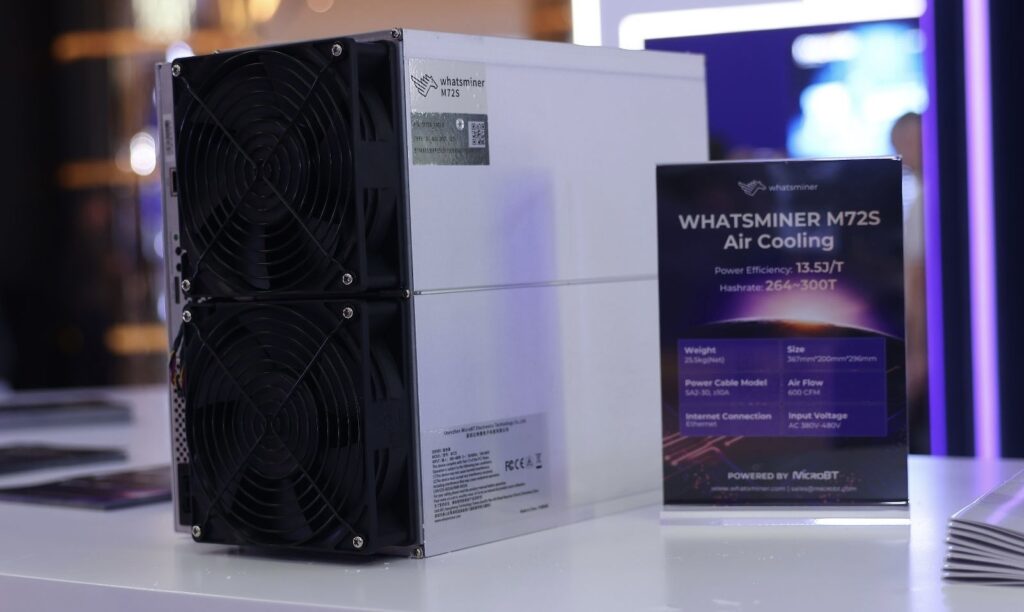
The unveiling of the WhatsMiner M70 series drew the most attention. The new line features models with power efficiencies of 14.5J/T, 13.5J/T, and 12.5J/T. These figures reflect a push to balance performance with energy use.

Following the technical presentation, MicroBT’s Sales and Marketing Director, Wright Wang, addressed the company’s ecosystem strategy. He outlined a vision that extends beyond hardware, focusing on shared-value partnerships and joint mining.Β 

Wang highlighted the network of certified solution partners who provide expertise in cooling, energy management, and operations.Β 

By linking these partners to clients, MicroBT positions itself not just as a supplier but as a facilitator of a connected, collaborative mining ecosystem.

The launch included presentations from a range of partners, including HeatCore, HashHouse, FogHashing, Giga, HashSmith, Pauway Energy, Lumen Capital, BitMars, and Luxor.Β 

bitcoin
Images from Bitcoin MENA

Their contributions spanned topics from advanced cooling techniques to financial models for hashrate management. The breadth of participation underscored the interdependence of the modern mining industry and highlighted the role of collaboration in driving innovation.

Tether’s VP of Energy and Mining, Giv Zanganeh, also addressed the audience on the topic of redefining the Bitcoin mining ecosystem. His presence reflected growing confidence in MicroBT’s approach and signaled an emerging alignment between hardware innovation, energy management, and financial infrastructure.

MicroBT’s WhatsMiner M70 launch illustrates a shift in the industry. As miners face increasing pressure to manage energy use and operational risks, the company is betting on a model that combines technical innovation with strategic partnerships.Β 

The launch in Abu Dhabi positions MicroBT as a company seeking to influence both the technology and the practices of Bitcoin mining, framing sustainability and ecosystem growth as inseparable goals.

This post MicroBT Launches WhatsMiner M70 in Abu Dhabi, Pushing for Sustainable Bitcoin MiningΒ  first appeared on Bitcoin Magazine and is written by Micah Zimmerman.

❌