 Login
LoginXRP Secures Top-Tier Allocation in Cathie Wood’s ARK Invest New ETF Filing
Cathie Wood’s Ark Invest has filed an S-1 application with the U.S. SEC for the ARK CoinDesk 20 Crypto ETF, highlighting XRP among the fund’s most significant holdings.

Cathie Wood’s Ark Invest has filed an S-1 application with the U.S. SEC for the ARK CoinDesk 20 Crypto ETF, highlighting XRP among the fund’s most significant holdings.
Accreditation: Training Certificate for 1 CPE*
AI tools promise faster threat detection, reduced analyst workload and greater resilience, but government agencies often lack clear frameworks for setting objectives or assessing impact.
In this webinar, government and industry experts explore how federal organizations can establish mission-aligned goals for AI systems, measure REAL cybersecurity outcomes and track effectiveness over time.
Complimentary Registration
Please register using the form on this page. Participants can earn 1 CPE credit in Information Technology. To receive CPE credit you must arrive on time and participate in the attendance surveys throughout the webinar. In accordance with the standards of the National Registry of CPE Sponsors, 50 minutes equals 1 CPE. For more information regarding complaint and program cancellation policies, please contact FederalNewsNetwork.com at (202) 895-5023. Due to this program being offered free of charge, there will be no refunds issued.
Additional Information
Prerequisites and Advance Preparation: Basic experience in federal IT recommended, but not required.
Program Level: Beginner
Delivery Method: Group Internet-Based Training
By providing your contact information to us, you agree: (i) to receive promotional and/or news alerts via email from Federal News Network and our third party partners, (ii) that we may share your information with our third party partners who provide products and services that may be of interest to you and (iii) that you are not located within the European Economic Area.
Federal News Radio, part of the Federal News Network, is registered with the National Association of State Boards of Accountancy (NASBA) as a sponsor of continuing professional education on the National Registry of CPE Sponsors. State boards of accountancy have final authority on the acceptance of individual courses for CPE credit. Complaints regarding registered sponsors may be submitted to the National Registry of CPE Sponsors through its website: www.nasbaregistry.org.
The post Billington CyberSecurity Cyber and AI Outlook Series Episode 5: ROI for AI: Setting Goals and Tracking Outcomes first appeared on Federal News Network.

© Getty Images/KanawatTH
How are high impact service providers driving digital excellence across government?
Federal agencies designated as HISPs are leading the charge to deliver seamless, secure and human-centered services. Our new Federal News Network Expert Edition brings together insights from leaders who are shaping the future of customer experience in government.
Get tips and insights from:
Explore how these leaders are leveraging AI, data and design thinking to simplify service delivery, scale personalization and build trust with the public.
Read the full e-book now!
The post Expert Edition: Reimagining service: How HISPs lead the digital charge sponsored by Carahsoft first appeared on Federal News Network.

© Federal News Network

Ripple CEO Brad Garlinghouse subtly references XRP in reaction to Binance’s official listing of the company’s stablecoin RLUSD. Garlinghouse’s remarks follow reports that RLUSD will commence trading on Binance on January 22, 2025.

A look at why ETH is disappearing and the Fed’s new “Wait and See” game.
The Cybersecurity Vault — episode 52, with guest Wil Klusovsky.
Wil discusses the essential questions that CEOs should be asking their CISOs. He explores the importance of effective communication between technical and business perspectives, the need for investment in cybersecurity with clear ROI, and the significance of understanding risks and setting priorities.
The conversation also delves into the importance of business resilience, managing third-party risks, and preparing for future threats in the ever-evolving cybersecurity landscape. The episode emphasizes the need for CISOs to articulate their strategies in business terms to align with corporate goals and secure necessary resources.
Subscribe for more episodes of Cybersecurity Vault!
00:00 Introduction to Cybersecurity Questions
02:06 Importance of CEO-CISO Communication
05:03 Investment and ROI in Cybersecurity
08:17 Establishing Cybersecurity Priorities
11:12 Identifying the Biggest Risks
14:24 Understanding the Risk Register
15:41 Crafting a Compelling Risk Narrative
18:21 Blind Spots in Cybersecurity Awareness
21:27 Understanding Accepted vs. Unknown Risks
24:29 The Importance of Documentation in Risk Management
25:22 Business Resilience and Recovery Planning
27:52 Engaging Third-Party Vendors in Cybersecurity
31:09 Cybersecurity as a Business Advantage
34:44 Future Threats and Technological Advancements
38:42 Translating Cybersecurity into Business Language
40:51 The Impact of CISO Responses on Business Outcomes
Wil’s LinkedIn Profile: https://www.linkedin.com/in/wilklu/
9 CISO Questions LinkedIn Post: https://www.linkedin.com/feed/update/urn:li:activity:7394720767416107008
Keyboard Samurai Podcast: https://www.youtube.com/@KeybdSamurai
Website: https://www.wilklu.me/podcast
Follow Matthew on
· LinkedIn: https://www.linkedin.com/in/matthewrosenquist/
· SubStack: https://substack.com/@matthewrosenquist
Visit Cybersecurity Insights at https://www.cybersecurityinsights.us
Subscribe to the Cybersecurity Insights channel: https://www.youtube.com/CybersecurityInsights
The post 9 Cybersecurity Questions that Define a CISO appeared first on Security Boulevard.
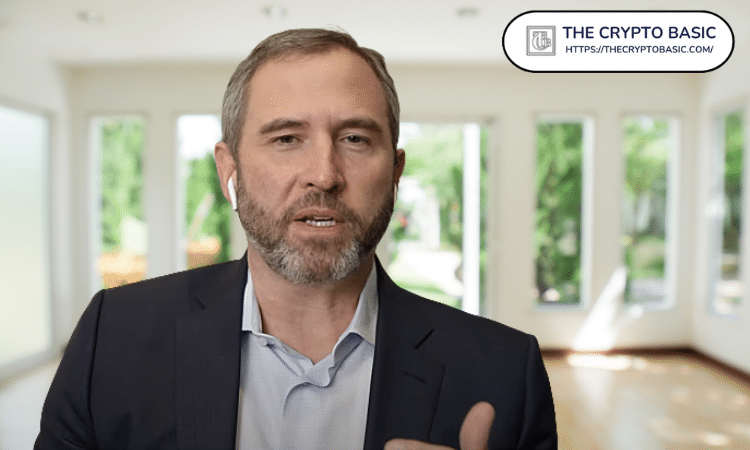
Ripple CEO Brad Garlinghouse has reaffirmed his support for the Clarity Act, urging lawmakers and the crypto industry to keep pushing the bill forward. Garlinghouse's recent comments came on the back of a surprise delay, which halted the progress of the bill in the Senate following Coinbase CEO Brian Armstrong's decision to withdraw support.
The XRP ETFs recently recorded the largest daily capital inflow for any crypto ETF, beating Bitcoin, Ethereum, and Solana. According to data from market resource Sosovalue, XRP ETFs witnessed a little above $17 million worth of capital inflows on Jan.
XRP ETFs extend the current inflow streak with $10.63 million in daily net flow, as their total traded value reaches a five-day high. Specifically, data from SosoValue shows that the five US XRP spot ETFs recorded a daily trading volume of $44.11 million on January 14.
While OPM processes a record 140,000 retirement applications in 2025, more than any year in at least two decades, federal employees face mounting concerns about market volatility and inflation protection.
According to a 2024 survey by the National Active and Retired Federal Employees Association (NARFE), 68% of FERS employees cite these as top retirement planning concerns.
The good news is a lesser-known provision of the TSP Modernization Act has quietly opened a door most federal employees don’t realize exists, and it helps protect against these concerns.
For FERS employees over 59½ and federal retirees, that door leads to a powerful diversification strategy: diversifying your TSP with physical gold backed by the U.S. Mint.
Before 2019, the TSP operated under what retirement advisors called the “one-and-done” rule. If you were over 59½ and still working, you could take only one age-based in-service withdrawal. Use it once, even for an emergency, and you’d forfeit future access to your own money until retirement.
But Public Law 115-84, aka the “TSP Modernization Act”, eliminated that restriction entirely.
Now, FERS employees over 59½ can execute unlimited partial withdrawals. You can move money out as often as every 30 days. No penalties. No mandatory distributions.
For federal retirees, the change is equally significant. You’re no longer forced to make a single, all-or-nothing withdrawal election. You can take partial withdrawals every 30 days, giving you complete control over your retirement assets.
The government designed this flexibility so people could access their savings. But there’s another use: strategic asset reallocation.
The TSP Modernization Act allows you to move a portion of your TSP into a Gold IRA and own physical gold that protects against inflation while keeping all your tax advantages.
Most federal employees and retirees don’t know this option exists. The TSP doesn’t advertise it. Your HR office probably hasn’t mentioned it. But it’s there, written into federal law.
Let’s talk about the G-Fund. It’s the most popular TSP fund for a reason. It guarantees you won’t lose principal. For risk-averse federal employees, that’s comforting.
But that guarantee comes with a hidden cost.
The G-Fund’s yield is calculated using the weighted average of Treasury securities with four or more years to maturity. When inflation runs hot, the G-Fund historically delivers negative real returns. Your balance grows on paper, but your purchasing power shrinks.
Here’s what that looks like in practice. Between 2021 and 2023, inflation averaged 3.9% annually. The G-Fund yielded an average of 3.1%. That’s almost a 1% loss on the value of your savings every year.
Compound that over a decade, and you’re looking at roughly 10% erosion of buying power.
The G-Fund isn’t a savings account. It’s a slow leak. It’s mathematically designed to underperform inflation during what economists call “super-cycles.”
With rising national debt, expanded money supply, and persistent inflation concerns, this erosion matters more than ever. For federal employees approaching retirement and retirees already drawing from their accounts, protecting purchasing power isn’t optional. It’s essential.
The TSP is an excellent accumulation vehicle. Low fees. Simple structure. Automatic payroll deductions. But it also has limitations most people don’t discover until they need flexibility.
Here’s one most federal employees don’t know about: when you take a withdrawal from the TSP, you can’t choose which fund to sell.
Let’s say your portfolio is 60% C-Fund (stocks) and 40% G-Fund (bonds). You need $20,000. You’d probably want to sell from the G-Fund and protect your stock position, right?
The TSP won’t let you. It forces a pro-rata distribution. You have to sell 60% from the C-Fund and 40% from the G-Fund.
In a down market, this means you’re forced to liquidate equities at a loss just to access cash. You have zero surgical control.
A Gold IRA works differently. You decide exactly what you want to sell and when.
In 2022, the TSP introduced a mutual fund window to allow more diversification. It sounded promising. In practice, high fees and restrictions have made it a disappointment.
For starters, there’s a $55 annual fee, plus a $95 maintenance fee. Then the big one: a fee of $28.75 per trade.
You can only invest 25% of your total balance. And you still can’t buy physical precious metals. You’re limited to paper assets like ETFs, which hold the same risks as the G-Fund.
The mutual fund window proves the TSP knows people want outside options. But because of those fees and restrictions, it’s impractical for most people.
A Gold IRA solves this. You get direct ownership of physical gold with no TSP middleman and no extra fees.
For FERS employees over 59½ and federal retirees, the TSP Modernization Act created a unique opportunity that didn’t exist before.
You can use an age-based in-service withdrawal (or a standard rollover if you’re retired) to move a portion of your TSP balance into a self-directed IRA that holds IRS-approved gold.
It’s known as a Gold IRA.
That means you can own American Gold Eagles (and American Silver Eagles) in your retirement account. These are coins minted and guaranteed for weight and purity by the U.S. Mint.
You’re not abandoning the safety of government-backed systems. You’re simply shifting from government paper (Treasury securities in the G-Fund) to government metal (American Eagles issued by the U.S. Mint).
Both are backed by the full faith and credit of the United States. The difference? One is designed to preserve purchasing power during inflationary cycles. The other isn’t.
If you’re working and between ages 59½ and 65, or if you’re already retired, then this is for you. It’s a unique opportunity that very few people know about.
You’ve spent decades building your TSP balance. But the reality is because it’s based on the markets, a single market correction or another inflation spike could wipe out years of progress in months.
The TSP Modernization Act lets you move a portion of your TSP into a Gold IRA, so you can own physical gold that protects against inflation and market crashes, and keep all your tax advantages. No penalties. No taxes due at transfer.
You don’t have to move everything. Most advisors recommend keeping 60-70% in traditional TSP funds and moving 10-30% into gold for protection and diversification.
The strategy is simple: use a portion of your TSP to diversify into an asset the government mints, the central banks hoard, and that has protected wealth for thousands of years.
The TSP is a good plan. Low fees. Simple structure. Solid way to build a retirement portfolio.
But it’s not a complete plan. It lacks a preservation vehicle. You’re 100% exposed to the dollar and the stock market, with clear signs of economic volatility ahead.
For federal employees who’ve spent decades in public service, the question isn’t whether the system will work.
The question is whether you’ve positioned your money to withstand the things the system can’t control: inflation, market corrections, currency devaluation.
That’s why the TSP Modernization Act was created.
Most federal employees have no idea this option exists. TSP doesn’t advertise it. Your HR office probably doesn’t mention it. And financial advisors who only manage TSP funds have no incentive to bring it up (gold doesn’t pay fees).
That’s why National Gold Group created a free guide written specifically for federal employees and retirees, called “The TSP Gold Guide.”
Inside this free guide, you’ll discover:
You’ve earned your retirement. This guide shows you how to protect it.
Download your free copy here.
The post The TSP Modernization Act’s hidden provision: What federal employees need to know about portfolio diversification first appeared on Federal News Network.

© Getty Images/Richard Stephen
Detectify vs Acunetix is a common comparison for AppSec teams evaluating Dynamic Application Security Testing (DAST) tools.
This article provides a direct comparison between Detectify and Acunetix, focusing on key challenges such as attack surface visibility, vulnerability assessment methodology, and time to value. It is intended for security teams evaluating DAST solutions or researching an Acunetix alternative.
Acunetix (part of the Invicti family since 2017) has been part of the DAST world for 20 years, known for its deep code-level internal scanning capabilities. Detectify, on the other hand, is built on a more forward-looking approach. It combines its proprietary, payload-based scanning engine and a multi-source intelligence model, powered by a private community of elite ethical hackers (Detectify Crowdsource), an AI researcher, and an internal team, enabling it to also find the novel, non-CVE vulnerabilities that are often missed by other tools.
This comparison is based on feedback from prospective customers, evaluations by teams previously using Acunetix, and publicly available documentation and demos from Acunetix:
The post Product comparison: Detectify vs. Acunetix appeared first on Blog Detectify.
Artificial intelligence is no longer a future promise for federal agencies — it is delivering measurable results today. From improving decision-making to increasing efficiency and preventing waste, fraud and abuse, agencies are moving beyond pilot projects to real-world impact.
At the Defense Department, AI is reshaping logistics and supporting faster, better-informed decisions. Across civilian agencies, AI is boosting employee productivity, modernizing customer experience and helping leaders tackle long-standing operational challenges.
During two afternoons, Federal News Network’s AI & Data Exchange will examine how agencies are applying the latest AI tools — including generative and agentic AI — to reduce administrative burdens, accelerate data analysis and drive mission outcomes.
Through in-depth conversations with Federal News Network journalists, government and industry leaders will share practical insights on how agencies can:
Join us to explore how federal leaders are turning AI and data into real impact — and what it takes to move from experimentation to enterprise-wide results.
Register today for a front-row virtual seat!
The post Federal News Network’s AI & Data Exchange 2026 first appeared on Federal News Network.

© Getty Images/Shinsei Motions
The XRP ETFs have now officially recovered the $40 million worth of capital outflow they recorded earlier this year. This comes on the back of the latest inflow data, as the products attracted $12.98 million worth of capital influx on Jan.

Crypto markets just flipped the mood switch. Bitcoin ‘s CPI-fueled breakout above $92,500 sent optimism rippling across altcoins, pushing sentiment out of fear and back into neutral. With macro pressure easing, on-chain metrics holding strong, and traders re-entering risk mode, the market may be quietly setting the stage for its next explosive move.
Total crypto market cap rose slightly as Bitcoin led gains post-U.S. CPI data matching forecasts at 2.7% YoY, easing Fed rate hike fears. Political tensions around Fed Chair Powell boosted risk assets, with BTC jumping above $92,500 briefly. Altcoins like DOGE and SOL followed with 2%+ moves amid rising volumes.
Whoa — Crypto Fear & Greed Index just surged to 52, breaking out of fear into Neutral territory. This shift reflects rising optimism from Bitcoin’s rally and favorable macro cues, yet staying shy of full greed signals investor caution amid volatility.

Bitcoin traded $90K-$96K, closing near $94,670 after +4% intraday spike from CPI alignment and Fed independence headlines. Ethereum fluctuated $3,087-$3,375, ending at $3,321 with +7.5% gain driven by Bitmine’s $4B staking and Tom Lee’s bullish call ending ‘mini crypto winter’.Perplexity Finance+3
Key metrics show steady network health despite volatility.
VWAP, support $90K, resistance $96.0–96.5K.
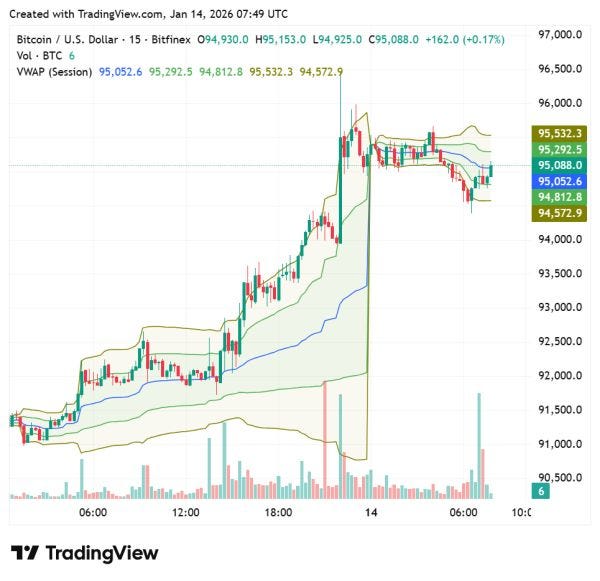
BTCUSD buy order just executed successfully, capitalizing on the breakout momentum. Take-profit order strategically placed at $93,934 to lock in gains amid rising bullish signals and VWAP support.
Ethereum network shows staking surge and low fees.
ETHUSD position activated a buy order as price broke upward, entering consolidation mode post-breakout. Take Profit order now set tightly near current market levels at $3,311.20 — smart risk management amid hovering resistance around $3,340.
DXY at 104.65, down 0.64% in 24H amid strong US CPI but Fed policy concerns. Weaker dollar supports crypto as inverse correlation holds; global sentiment favors risk-on with US rate cut hopes.
BTC eyes $100K short-term on momentum, with $92K support; analysts see $110K by Q1 end. ETH targets $3,500-$3,800 this month per forecasts, fueled by staking and upgrades.
Crypto has officially stopped hiding under the bed. Fear has loosened its grip, Bitcoin is flexing above key levels, and Ethereum is enjoying its staking glow-up. Bulls aren’t partying yet-but they’re definitely warming up the speakers.
Source: Coincentral.com, Tradingview.com, Coinranking.com, Coingecko.com, Coinmarketcap.com
Originally published at https://aipt.lt on January 14, 2026.
Bitcoin Breaks Fear Zone — Is the $100K Run Starting? was originally published in Coinmonks on Medium, where people are continuing the conversation by highlighting and responding to this story.

Bitcoin refused to blink near $91,000, even as ETF money quietly slipped out the back door from crypto. Meanwhile, altcoins like ID, GMT and POL decided they’d had enough of waiting and exploded higher. When money rotates this fast, something big is usually brewing.
Crypto markets showed mixed signals over the past 24 hours, with total market cap at around $3.03 trillion and 24-hour volume at $83.6 billion, amid neutral funding rates and selective altcoin surges. Bitcoin held near $91,000 despite pressures, while outperformers like ID, GMT, and POL jumped 26%, 23%, and 19%.
Major cryptos traded mixed, with BTC up slightly at 0.31% to $90,683 early, but later data shows c onsolidation around $91,151 down 3% from peaks. ETF outflows hit $1.1B in recent days, contrasting price resilience above $91,500, signaling structural skepticism yet bullish defenses at key levels. Ethereum on-chain activity remains hot into 2026, with record daily transactions near 2.2 million recently.
The Crypto Fear and Greed Index remained unchanged over the past 24 hours.
Bitcoin fluctuated between $89,850-$92,083, closing near $91,151, pressured by ETF outflows and overhead supply but defended at VWAP around $92,800. Ethereum traded at $3,091 down 0.23%, bouncing in a fragile head-and-shoulders but supported by MFI bullish divergence and dip buying from longer-term holders. Reasons include neutral BTC/ETH sentiment, Fed inflation comments aligning with easing, and rotation to alts.
Key Bitcoin metrics reflect steady network health despite price wobbles.
The 24-hour BTC chart with VWAP, support at $89,600 (Value Area High), and resistance at $92,000 (overhead/200-day EMA).

A powerful Buying signal has formed on the BTCUSD chart precisely at $92,494, signaling potential bullish momentum for savvy investors. This key level aligns with recent highs around $92,170 and current price action near $92,164 (up 1.07% today), where breakout potential could target resistance near the 200-day EMA.
Ethereum’s network hit historic engagement peaks.
In the ETHUSD position, the Buy long signal is at $3,170.20.
US Dollar Index (DXY) traded at 104.65, with daily range 104–104.65, down amid 5-day +0.64% but monthly -2.54%. A weaker DXY boosts crypto as risk assets like BTC/ETH gain appeal versus strengthening USD; recent Fed official notes on inflation aligning by April eased USD pressure. This inverse correlation drove BTC defense and alt rotations.
Current market eyes BTC stabilizing above $91K for upside to $103K (200-day EMA), with bulls back if $88K POC holds. E thereum forecasts January avg $3,403 (up to $3,720, +26.7% ROI), breaking symmetrical triangle to $4,100 (+30%). Overall, DXY weakness and on-chain strength signal cautious rally into late January.
For explosive potential: Layer Brett ($LBRETT) — L2 memecoin with 792% APY, low fees, 25–50x by 2026 via scalability. Rexas Finance ($RXS) — RWA tokenization leader, 567% recent gain, 7,500% projected post-launch with AI yields. Pendle ($PENDLE) — Yield trading innovator, 7,500% forecast amid DeFi 2.0.
Crypto is doing what it does best — confusing bears, teasing bulls, and keeping traders glued to their screens. Bitcoin is holding the fort, Ethereum’s network is on fire, and altcoins are throwing a party. Whether this turns into a full-blown rally or just another fake-out, one thing is certain: boredom is officially cancelled.
Source: Coincentral.com, Tradingview.com, Coinranking.com, Coingecko.com, Coinmarketcap.com
Originally published at https://aipt.lt on January 13, 2026.
Is This the Next Big Crypto Breakout? — Investment make Easy was originally published in Coinmonks on Medium, where people are continuing the conversation by highlighting and responding to this story.
The Defense Department has made maintaining its competitive edge in an increasingly software-defined battlespace a central focus of its most recent transformation efforts. A major theme of this wide-ranging effort is to transform how it delivers software by modernizing its processes, empowering teams and fostering innovation throughout the lifecycle.
Federal News Network will devote March 24 and 25 to exploring the programs currently underway to achieve these transformation initiatives.
Our journalists will talk to DoD and industry leaders about how the department intends to:
Register today for a front-row virtual seat!
The post Federal News Network’s DoD Modernization Exchange 2026 first appeared on Federal News Network.

© Getty Images/Slim3D
Artificial intelligence continues to accelerate — expanding both its capabilities and its use across government. How are federal agencies applying AI to advance mission outcomes, manage risk and prepare for what’s next?
During this webinar, you’ll hear directly from senior government technology leaders on the strategies shaping AI adoption today:
Panelists also will share lessons learned, challenges and solutions, and a vision for the future.
The post Federal Executive Forum: Artificial Intelligence Strategies in Government Progress and Best Practices 2026 first appeared on Federal News Network.

© Getty Images

Crypto markets just blinked green again. Bitcoin climbed back above $92,000, and suddenly the fear started to fade. Meanwhile, Ethereum’s network is busier than ever, even though prices are still catching their breath. In other words, the market is whispering: something is building.
Crypto markets stabilized with a mild rebound, total cap at $3.10T up 0.35% in the last 24 hours amid Bitcoin recovery. Network activity, especially on Ethereum, hit highs despite mixed price action.
Bitcoin climbed 1.47% to $92,112, holding above key support as dominance rose to 59.34%. Ethereum gained modestly around 1.90% near $3,036 equivalent, with altcoins like SOL and DOGE following suit. Trading volume steady at $177B signals cautious optimism pre-U.S. inflation data.
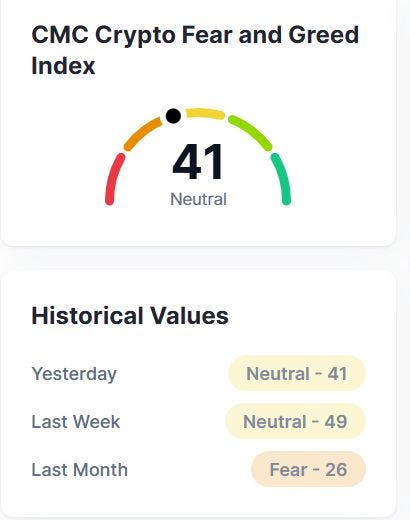
The Crypto Fear and Greed Index has risen to 41, signaling a shift from fear toward a more neutral market sentiment.

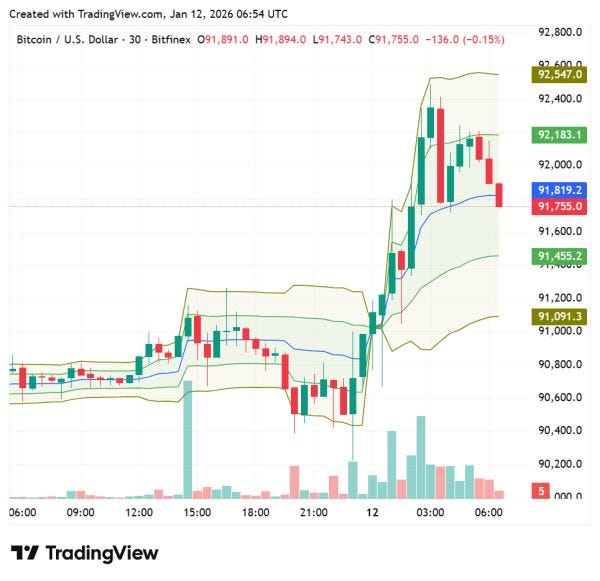
BTC rebounded from $90,404 lows toward $92,000 on reduced selling pressure and accumulation. VWAP hovers near $91,500, with support firm at $90K and resistance at $92,500.
ETH edged up 1.90% amid record network activity and stablecoin growth, though price lags. Busy chain with low fees boosts DeFi usage.
Bitcoin metrics reflect steady health: fees and TVL stable, incentives active.
BTCUSD price chart is forming a support zone. For now, we will keep the long buy order at the same level as before.
Ethereum transactions dipped slightly to ~10.3M weekly but daily highs persist; supply velocity slows.
ETHUSD pozicija užsidarė su 3% nuostoliais. Bet teisingai manėme, kad šioje vietoje formuojasi palaikymas. Palaukiam kol jis sustiprės.
The Dollar Index steady at 104.65, up ~0.64% on 5-day basis from U.S. econ strength and Fed outlook. Mild dollar firmness caps crypto upside.
Bears hit 69% of coins, but these stars shone with huge volume: Story leads explosive rally.
BTC targets $95K short-term on support hold, accumulate zone per charts. ETH poised for $3,200+ by mid-Jan on network strength.
Crypto today feels like a gym in January — it may not look impressive yet, but everyone is already sweating. Bitcoin is holding above support, Ethereum’s network is buzzing, and altcoins are starting to stretch their legs. If the dollar loosens its grip, bulls might finally get room to run. For now, it’s not euphoria — but it’s definitely not panic either. And in crypto, that already counts as a small victory
Source: Coincentral.com, Tradingview.com, Coinranking.com, Coingecko.com, Coinmarketcap.com
Originally published at https://aipt.lt on January 12, 2026.
Crypto Turns Green Again: Is This the Big Rebound? was originally published in Coinmonks on Medium, where people are continuing the conversation by highlighting and responding to this story.

Ripple CEO Brad Garlinghouse expresses optimism as the company heads into 2026, emphasizing long-term value creation for XRP and RLUSD over short-term market cycles in the crypto industry. The company's CEO made this known in his 2026 New Year commentary to members of the crypto community, particularly XRP.
Ready for the next wave of secure, AI-driven development?
Our latest e-book, Future-ready development: Secure, smart, AI-driven, brings together insights from leading voices shaping technology and cybersecurity.
Inside, you’ll find expert perspectives:
The conversations in our Federal News Network Expert Edition explore the common thread across these stories: Speed without security is a false economy. Learn how agencies can harness automation, AI and modern frameworks without inheriting risks.
Download the new e-book now!
The post Expert Edition: Future-ready development: Secure, smart, AI-driven first appeared on Federal News Network.

© Federal News Network
