Reading view

There are new articles available, click to refresh the page.

Portugal Bans Polymarket Over €4M Insider Trading Scandal

Portugal’s gaming regulator has banned crypto prediction platform Polymarket following suspicious trading patterns during the country’s presidential election that saw over €4 million wagered in just two hours before results emerged.

The Portuguese Gaming Regulation and Inspection Service (SRIJ) ordered the platform to cease operations and face blocking after determining its activities violate national laws prohibiting political betting.

The controversy centers on suspicious shifts in betting odds that occurred precisely when exit polls began circulating privately, raising serious questions about information leakage and insider trading on prediction markets.

🚨Portugal Takes Action Against @Polymarket: A Wake-Up Call for Crypto Prediction Markets?🇵🇹

According to Rádio Renascença, Portugal's gambling regulator SRIJ has ordered the blockchain-based prediction platform Polymarket to immediately cease operations in the country and… https://t.co/4dVlcPNCiG

— Tax guy 🇵🇹 (@cryptaxpt) January 20, 2026

Suspicious Betting Patterns Trigger Investigation

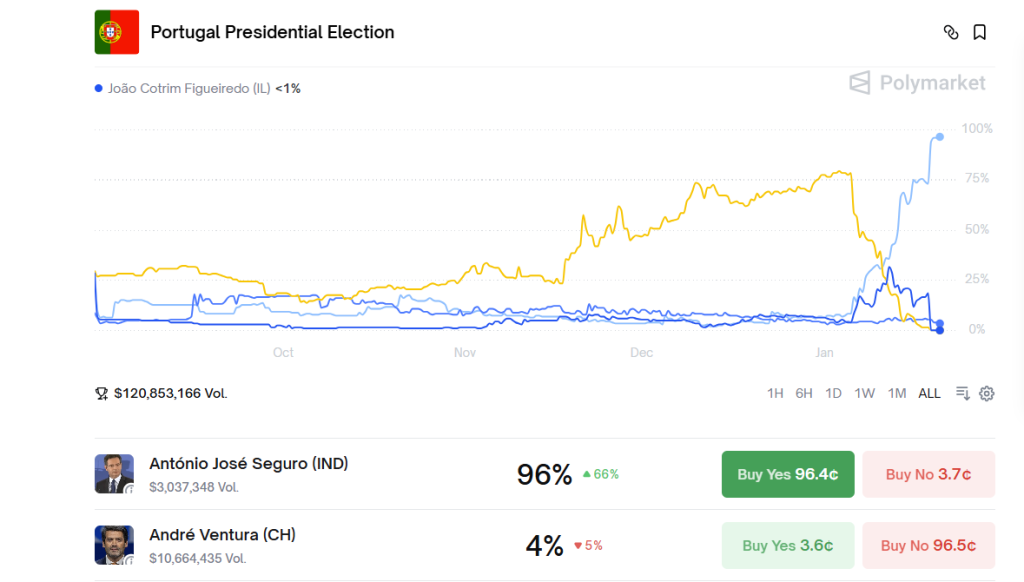
According to reports from Portuguese outlet Renascença, António José Seguro entered Sunday’s presidential election with 60% odds on Polymarket while challenger André Ventura held just 30%.

By 6 PM, one full hour before polls closed, Seguro’s probability had surged to 96%, reaching 100% when official projections confirmed his victory.
Portugal Bans Polymarket - Polymarket Prediction Image
Source: Polymarket

The timing proved even more suspicious in markets predicting the next President of the Republic.

At 6:30 PM, Seguro’s chances of reaching Belém Palace rocketed from 68.6% to 93.2% within a single hour.

During that same period, Cotrim de Figueiredo’s odds collapsed from 22% to merely 2.5%, settling at 95% for Seguro by 8 PM when Portuguese voters first learned the results.

Between 6 PM and 8 PM, the critical window between Seguro’s odds surge and public result announcements, over €5 million traded across various markets.

Trader who knew more than the rest turned $576 into $2,300 in 1 hour on Polymarket

On the market "João Cotrim de Figueiredo vote share in Portuguese presidential first round?" there was extreme volatility

The "16%-18%" range was at 97%, then collapsed to 15%, and an hour later… pic.twitter.com/4FfmHntGHw

— Logics (@immortalhowwl) January 19, 2026

Total volume in the main presidential market exceeded $120 million (approximately €103 million), while alternative markets accumulated nearly $10 million (approximately €8.1 million).

The apparent mystery of how bettors correctly identified the winner two hours before official announcements dissolves upon closer examination.

Around 6 PM, preliminary exit poll projections began circulating privately, all confirming a comfortable Seguro victory with over 30% of the vote.

The two candidates will face off in a runoff ballot on February 8, though Polymarket won’t be available for Portuguese bettors this time.

Portugal Regulatory Crackdown and Compliance Measures

The SRIJ confirmed it became aware of Polymarket “very recently” and considers the company’s activity “illegal.”

According to Renascença, the regulator stated that “the website is not authorized to offer betting in Portugal, and under national law, betting on political events or happenings, whether national or international, is not permitted.”

Polymarket received notification on Friday to cease Portuguese operations within 48 hours.

As of Monday, the site remained active, prompting SRIJ to notify network services for platform blocking.

Portugal joins a growing list of countries restricting the platform.

Polymarket has been banned in Ukraine, Singapore, and France, while facing blocks in Australia, Belgium, Germany, the UK, Iran, and North Korea, amongst others.

🚨 Ukraine blocks @Polymarket over unlicensed gambling and “war bets.”#Polymarket #Ukrainehttps://t.co/GkEnLZVayy

— Cryptonews.com (@cryptonews) January 13, 2026

Notably, concerns over insider trading on prediction markets have intensified following high-profile bets on geopolitical events, particularly after Polymarket nearly perfectly predicted President Trump’s 2024 victory.

Austin Weiler, a researcher at blockchain intelligence firm Messari, argued that preventing insider trading is “realistically possible only on prediction markets applying Know Your Customer (KYC) measures.”

“For KYC’d platforms, the most effective mechanism is to restrict access upfront for users to specific markets,” Weiler explained, adding that state actors could be barred from political or geopolitical markets.

Kalshi Challenges Polymarket Dominance In Prediction Market

KYC requirements vary widely across established prediction platforms.

Kalshi enforces identity verification as part of its regulated model under the US Commodity Futures Trading Commission (CFTC) authority, leading regulated exchanges like Coinbase to develop prediction market websites operating through Kalshi’s federally approved framework.

While Polymarket is also legally recognized by the CFTC, access and permitted markets differ significantly, with ongoing legal questions about whether the platform features contract trading or gambling under another name.

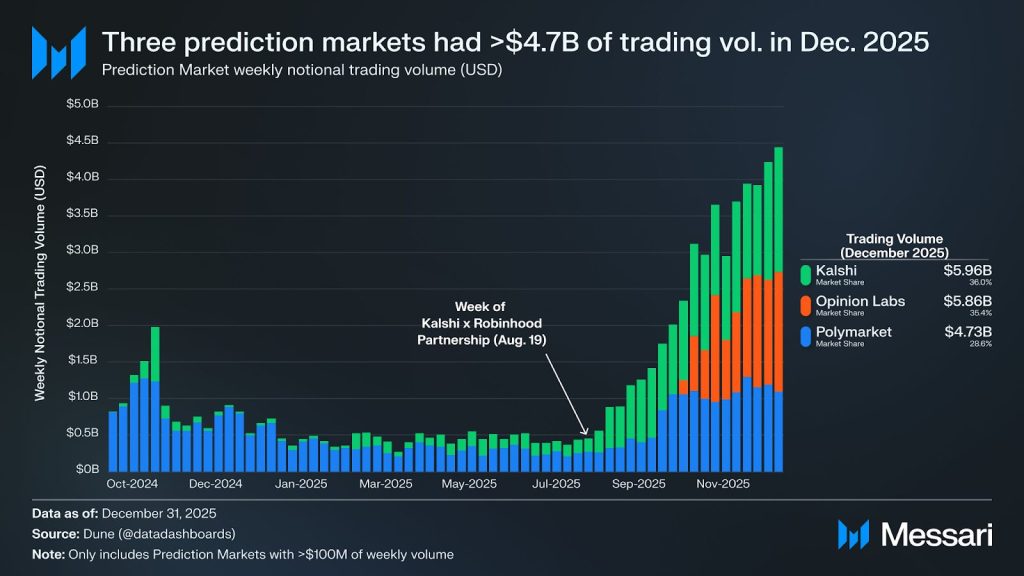
Amid regulatory hurdles and Kalshi lawsuits, Polymarket’s December 2025 volume breakdown showed a 28% increase in politics betting, with over $4.3 billion wagered compared to Kalshi’s $5.96 billion in the same period.
Portugal Bans Polymarket - Messari Volume Chart
Source: Messari

The post Portugal Bans Polymarket Over €4M Insider Trading Scandal appeared first on Cryptonews.

Stablecoins, Base and ‘everything exchange’: a look inside Coinbase’s strategy to expand in 2026

  • Stablecoins and the Base network sit at the core of its plans through 2026.
  • The strategy places Coinbase closer to retail brokerages and derivatives platforms.
  • Security and support concerns remain a constraint as the platform broadens.

Coinbase is entering 2026 with a platform that looks increasingly different from a traditional crypto exchange.

The company is placing greater emphasis on stablecoins, its Ethereum layer-2 network Base, and a wider range of trading products that stretch well beyond digital tokens.

The shift reflects how crypto platforms are adapting as growth in spot trading cools and competition intensifies.

Rather than positioning itself only as a gateway to cryptocurrencies, Coinbase is aligning its business around broader financial access, with trading, payments, and onchain activity increasingly converging inside a single ecosystem.

Platform strategy shift

In a New Year’s post, Brian Armstrong reiterated Coinbase’s ambition to build what it calls an “everything exchange.”

The strategy focuses on expanding product lines so users can trade and interact with multiple asset classes from one interface.

That direction was formalised at the company’s year-end conference in December, where Coinbase rolled out stock trading and prediction markets.

These launches marked a clear move beyond cryptocurrencies and into areas traditionally dominated by retail brokerages and derivatives platforms.

Coinbase executives have framed the rollout of stock trading on the main app as a key step toward enabling round-the-clock access to markets, with crypto, equities, and exchange-traded funds sitting side by side.

Expansion beyond crypto

Coinbase’s product push is not limited to its exchange. The company has rebranded its wallet as an “everything app,” adding social networking features and deeper onchain functionality.

The aim is to keep users active across more use cases, rather than relying solely on trading volumes.

The company has also launched onchain prediction markets in partnership with Kalshi, allowing users to participate in markets tied to real-world events.

Alongside this, Coinbase has flagged plans for perpetual futures that would cover both crypto assets and stocks.

These additions move the platform further into direct competition with firms that operate across equities, derivatives, and commodities, rather than only crypto-native rivals.

Stablecoins and Base

Stablecoins form a central part of Coinbase’s longer-term roadmap.

The company has described them as essential financial infrastructure, particularly for cross-border payments, payroll, and settlement.

Armstrong has said banks are likely to seek interest-bearing stablecoin products over time, underlining Coinbase’s view that stablecoins will play a growing role in mainstream finance.

Base, Coinbase’s Ethereum layer-2 network, is positioned as another pillar of this strategy.

The network is designed to support consumer applications, creators, and onchain services that can scale beyond Ethereum’s main chain.

However, Base’s handling of creator coins has attracted criticism from some developers, who argue the approach risks prioritising viral growth while the company promotes creators as a key onboarding channel.

The post Stablecoins, Base and ‘everything exchange’: a look inside Coinbase’s strategy to expand in 2026 appeared first on CoinJournal.

Coinbase is About to Launch Prediction Markets and Tokenized Stocks: Report

Bitcoin Magazine

Coinbase is About to Launch Prediction Markets and Tokenized Stocks: Report

Coinbase is reportedly preparing to launch its own prediction markets, powered by U.S.-based operator Kalshi, in a move that could expand the types of assets available on the exchange amid cooling investor interest in cryptocurrencies, according to reporting from Bloomberg and CNBC.

The announcement is expected to come next week, coinciding with Coinbase’s “Coinbase System Update” showcase on Dec. 17. While the exchange declined to confirm specifics, it encouraged users to tune into the livestream for updates.

Rumors of the new prediction markets have been circulating for nearly a month. In mid-November, tech researcher Jane Manchun Wong shared a screenshot of what appeared to be Coinbase’s prediction markets dashboard. 

The Information first reported the planned launch on Nov. 19, and Bloomberg later cited a source saying the event would also feature the rollout of tokenized stocks.

Coinbase as an ‘everything’ exchange

Coinbase’s moves align with CEO Brian Armstrong’s long-stated vision of building an “everything exchange” — a single platform offering access to crypto tokens, tokenized equities, and event-based contracts. 

Armstrong told investors in May that Coinbase aims to become a leading financial services app within the next decade.

The exchange is accelerating these initiatives amid rising competition from firms such as Robinhood, Gemini, and Kraken

Over the past year, these platforms have expanded tokenized stock offerings outside the U.S. and explored prediction markets, reflecting growing demand for alternative trading instruments.

The timing also comes as investor sentiment toward digital assets has cooled. A wave of liquidations in highly leveraged positions in mid-October triggered a crypto market pullback, prompting some investors to shift capital into safer assets. 

For Kalshi, the partnership marks another step in its strategy to integrate event contracts into mainstream trading platforms. 

Earlier this year, the company embedded its prediction markets into Robinhood, and it is reportedly in discussions with other brokers, including those in crypto, to expand its reach.

Prediction markets let users speculate on outcomes ranging from elections to sports games, and they have grown increasingly popular over the past year. Traditional exchanges and crypto platforms alike are now exploring them as a new way to engage traders. 

Gemini recently received approval to roll out its own prediction markets, while Crypto.com has partnered with the Trump Media & Technology Group on similar initiatives.

Coinbase’s planned in-house tokenized stock offerings would put it on par with competitors like Robinhood and Kraken, which currently offer similar products outside the U.S.

This post Coinbase is About to Launch Prediction Markets and Tokenized Stocks: Report first appeared on Bitcoin Magazine and is written by Micah Zimmerman.

❌