Reading view

There are new articles available, click to refresh the page.

Another Dogecoin ETF Has Gone Live For Trading, How Did It Perform?

The US crypto market has welcomed a new entrant as 21Shares rolls out its Spot Dogecoin ETF, giving investors another avenue to engage with the infamous dog-themed meme coin. Trading kicked off amid a mix of curiosity and caution, with on-chain data already showing how much the DOGE ETF has performed so far. 

21Shares Launches Dogecoin ETF

In a press release on Thursday, January 22, 21Shares announced the official launch of its Spot Dogecoin ETF, TDOG, which began trading on NASDAQ the same day. The new ETF provides investors with direct exposure to Dogecoin through a fully backed, regulated, and transparent vehicle. Each ETF share is also backed 1:1 by DOGE held in institutional-grade custody. 

Notably, the launch of the new TDOG ETF brings the total number of US Dogecoin ETFs to three, joining Grayscale’s GDOG and Bitwise’s BWOW. 21Shares is also the only ETF provider endorsed by House of Doge, the official corporate arm of the Dogecoin foundation, highlighting the global asset manager’s close ties to the meme coin. 

As one of the largest crypto ETF issuers, 21Shares continues to expand its crypto product lineup with the introduction of TDOG. This follows the investment company’s previous ETF offerings, including TSOL, a Solana ETF released in November 2025; ARKB, a Spot Bitcoin ETF launched in January 2024; and TETH, an Ethereum ETF introduced in July of the same year. Together, these products demonstrate 21Shares’ commitment to providing institutional-grade access to high-demand digital assets. 

Federick Brokate, Global Head of Business Development at 21Shares, highlighted DOGE’s large and active global community, calling it a unique digital asset with constantly growing use cases. He added that the new TDOG ETF will give investors regulated, physically backed exposure through a familiar ETF structure they know and trust. 

Marco Margiotta, the CEO of House of Doge, also shared comments on the recently launched 21Shares ETF. He said that TDOG is a step toward making Dogecoin easier to access through traditional financial systems. He also disclosed that House of Doge’s partnership with 21Shares will help more people get involved as the Dogecoin ecosystem grows. 

How 21Shares Dogecoin ETF Has Performed So Far

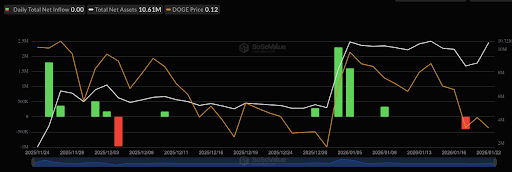
Contrary to expectations, 21Shares’ recently launched Dogecoin ETF saw weak performance on the first day of trading, signaling investors’ lack of interest in the investment product. Data from SoSoValue shows that TDOG experienced no inflows on January 22 and instead declined by about 0.07%. Despite it being the second day of trading, the DOGE ETF has still not registered any flows. 
Dogecoin

This lackluster performance has been observed across all Dogecoin ETFs this week. Grayscales’ GDOG and Bitwise BWOW have reported zero inflows over the last week. The last time GDOG saw positive activity was on January 8, when it received around $333,083 in investments. Before that, the ETF recorded its highest inflows on January 2, totaling roughly $2.3 million. Since its launch in November 2025, GDOG ETF inflows have been unstable, with more days of inactivity than significant investment. 

Dogecoin

Crypto’s Q4 Weakness Mirrors Pre-Rebound 2023: Analysts

Bitwise’s take on the final months of 2025 reads like a careful, hopeful note rather than a loud market call. Momentum on the chains rose even as prices stalled, and that gap is exactly what has traders talking. Some think it marks a bottom. Others say it’s too soon to be sure.

Crypto: On-Chain Activity Surges

According to Bitwise, Ethereum activity and layer-two transactions climbed to new highs, and decentralized trading grew markedly. Stablecoin supplies also swelled, with the total market cap passing the $300 billion mark in Q4.

Reports note that decentralized exchange volumes at times matched or exceeded those of major centralized venues. These are hard numbers. They are signs that real use and liquidity are expanding under the surface.

The latest Bitwise Crypto Market Review just dropped—and it’s the most important one we’ve ever published.

Why? Because it shows a tension in crypto markets that has historically signaled a bear-market bottom (see Q1 2023).

Receipts: During Q4 2025…

– ETH’s price fell 29% ……

— Bitwise (@BitwiseInvest) January 21, 2026

Why Prices Have Lagged

Bitwise’s chief investment officer, Matt Hougan, compared this setup to early 2023 when prices trailed rising fundamentals before a significant rebound took hold over the following two years.

The comparison makes sense on paper. Price can be stubborn. Market psychology often lags behind on-chain realities, and traders sometimes wait for a clearer macro story before committing capital.

Fundstrat’s Tom Lee offers a counterpoint, saying the year could be bumpy until late, with tariffs and political tensions weighing on risk appetite. That view keeps many investors cautious.

Crypto, Stablecoins And DeFi At The Center

According to market data, flows into stablecoins accelerated, and fund inflows to crypto firms outpaced several other sectors in the stock market. DeFi use was no longer a niche metric; it was central to the Q4 narrative.

“That’s the type of divergence you get at the bottom of bear markets, when sentiment is down but fundamentals are up,” Hougan said.

Some infrastructure firms reported rising revenues. At the same time, trading volumes remained muted compared with the peaks seen earlier, which helps explain the mismatch between on-chain strength and sideways price action.

Why This Might Matter For 2026

Bitwise highlighted 10 broad indicators it sees as health signs for the market, ranging from transaction counts to custody and fee trends. Progress on regulatory clarity was also flagged.

Reports say the Clarity Act could change how stablecoins are treated in the US, and a new US Federal Reserve chair could shift policy in ways that matter for risk assets.

Bitwise sees Q4 as a quiet period where things were improving behind the scenes, even if prices didn’t show it. The firm says this kind of gap between price and activity has happened before big rebounds. It doesn’t mean a rally will happen right away, but the market could be setting itself up for a stronger year ahead.

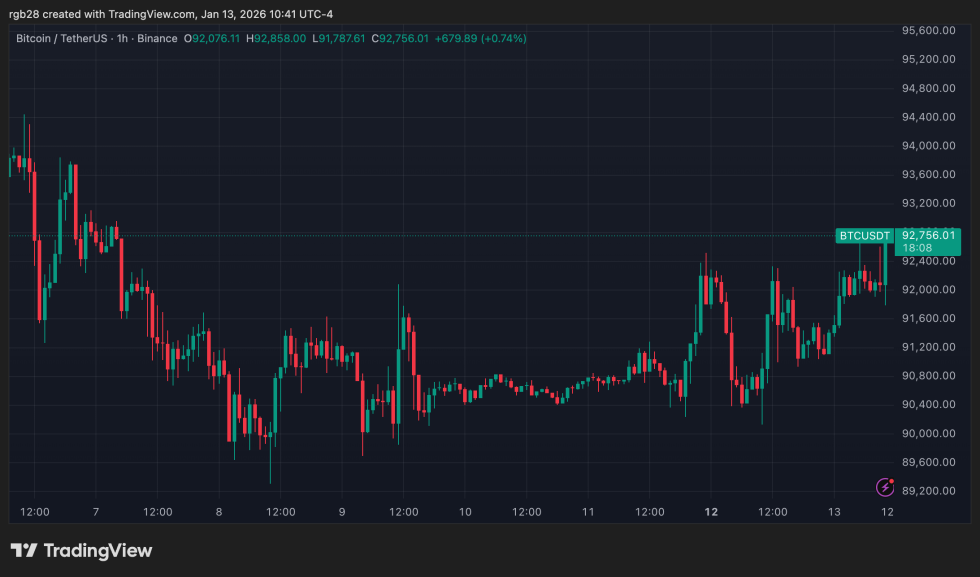
Featured image from Unsplash, chart from TradingView

Q4 2025 May Have Marked the End of Crypto Bear Market: Bitwise

By: Amin Ayan

The fourth quarter of 2025 may have quietly signaled the end of the crypto bear market, according to a new report from digital asset manager Bitwise, even as prices struggled to reflect improving fundamentals.

Key Takeaways:

  • Bitwise says Q4 2025 showed strengthening crypto fundamentals despite continued price weakness.
  • Hougan sees parallels with early 2023, when muted prices preceded a major market rally.
  • Analysts remain split on 2026, even as on-chain activity and crypto revenues hit new highs.

In a report shared Wednesday, Bitwise chief investment officer Matt Hougan said Q4 presented a confusing picture for investors.

Crypto prices weakened through much of the quarter, yet on-chain data, user activity, and revenue metrics across the sector continued to strengthen.

Bitwise’s Hougan Draws Parallels Between Today’s Market and Post-FTX 2023

Hougan compared the current setup to early 2023, when markets were still reeling from the collapse of FTX.

At the time, crypto prices appeared directionless despite signs of recovery under the surface. Bitcoin rebounded from lows near $16,000 and ultimately surged to around $98,000 by the start of 2025.

“At the time, we were starting to rebound post-FTX, and the data was topsy-turvy; some up, some down, some sideways,” Hougan said. “In the two years that followed, crypto prices soared.”

According to Hougan, the same divergence between sentiment and fundamentals emerged again in late 2025. While asset prices pulled back, key indicators across the crypto economy moved sharply higher.

The latest Bitwise Crypto Market Review just dropped—and it’s the most important one we’ve ever published.

Why? Because it shows a tension in crypto markets that has historically signaled a bear-market bottom (see Q1 2023).

Receipts: During Q4 2025…

– ETH’s price fell 29% ……

— Bitwise (@BitwiseInvest) January 21, 2026

The outlook for 2026, however, remains a point of debate among analysts.

Fundstrat head of research Tom Lee has warned that macro headwinds, including trade tariffs and political uncertainty, could weigh on markets for much of the year before a late rebound.

By contrast, VanEck expects the first quarter of 2026 to favor “risk-on” assets such as crypto, citing greater fiscal clarity and signs of stabilization in the U.S. economy.

Hougan highlighted four trends from Q4 that he believes strengthen the case for a market bottom.

Ethereum and layer-2 networks saw transaction volumes climb to record levels, suggesting growing real-world usage.

At the same time, revenues among crypto-focused companies outpaced many traditional sectors in the stock market.

Stablecoin Market Hits Record $300B as Transaction Volumes Surge

Stablecoins also played a central role. Transaction volumes and assets under management surged throughout 2025, with total stablecoin market capitalization surpassing $300 billion in Q4, marking a new all-time high.

Decentralized finance adoption rounded out the list. Hougan pointed to Uniswap, noting that the decentralized exchange now consistently processes more transaction volume than Coinbase.

“That’s the kind of divergence you get at the bottom of bear markets, when sentiment is down but fundamentals are up,” he said.

Bitwise added that several potential catalysts could push crypto markets higher in 2026, including progress on the CLARITY Act, continued growth in stablecoins, a new Federal Reserve chair appointment, and major wirehouses opening client access to crypto exchange-traded funds.

The post Q4 2025 May Have Marked the End of Crypto Bear Market: Bitwise appeared first on Cryptonews.

Bitwise CIO Defends Bitcoin In 401(k)s Amid Sen. Warren’s New Warning

While a senator presses the Securities and Exchange Commission (SEC) against Bitcoin (BTC) and other cryptocurrencies in 401(k) plans, Bitwise’s CEO has defended the Trump administration’s push to allow digital assets’ inclusion in retirement funds.

Hougan Slams Bitcoin Restrictions In 401(k)s

On Monday, Bitwise CIO Matt Hougan discussed whether 2026 will be the year investors can own Bitcoin and other cryptocurrencies in 401(k) plans, as the inclusion of digital assets is becoming more common in individual retirement accounts (IRAs).

In an interview, the executive argued that providers are “slow to move,” but noted that the Trump administration’s pro-crypto shift, which removed “what was effectively a ban on Bitcoin from 401(k)s,” has opened the doors.

Hougan pointed out that large firms like Vanguard had strong restrictions but have recently relaxed their stance on Bitcoin investments. He argued that these bans are “ridiculous,” calling BTC “just another asset” that is no more volatile than stocks, such as those of Nvidia.

Does it go up and down? Absolutely. Is there risk in it? Absolutely. But it’s actually less volatile over the last year than Nvidia stock. And you don’t see any rules about banning 401k providers from offering Nvidia stock. That’s not that would seem ridiculous.

Recent K33 Research data showed that Bitcoin recorded the least volatile year in the asset’s history in 2025. Notably, BTC registered its lowest volatility level last year, with just 2.24%.

“So, I don’t know if the 401(k) providers will get all the way to the point of actually putting it in this year. These are very slow moving institutions, but we’re moving in that direction and eventually it’ll be normalized like other assets, which is how it should be treated,” he concluded.

Senator Warren Issues New Warning

Bitwise CEO’s remarks came as Democratic Senator Elizabeth Warren reached out directly to SEC chairman Paul Atkins to question how the Commission intends to protect investors from potential financial risks now that crypto investments are allowed in retirement plans.

As reported by Bitcoinist, the Department of Labor (DOL) rescinded in May a 2022 guidance that discouraged fiduciaries from including cryptocurrency investments in 401(k) retirement plans.

Months later, US President Donald Trump signed an Executive Order (EO) that aimed to allow more private equity, real estate, cryptocurrency, and other alternative assets in 401(k) retirement accounts.

The EO, signed on August 7, 2025, directed the DOL and the SEC to reduce regulatory barriers that prohibited investments in alternative assets in their defined contribution retirement plans.

In a new letter, the anti-crypto senator shared her concerns, cautioning that allowing Bitcoin and other crypto assets into these accounts could enable significant risks. She listed the “volatility associated with cryptocurrencies, the lack of market transparency, and potential conflicts of interest” as reasons to be cautious about introducing these assets into retirement plans.

She also emphasized that 401(k) plans are a vital source of retirement security for most Americans. Therefore, they should not be treated as a “playground for financial risk” that could put investors in vulnerable positions.

Despite Warren’s warnings, multiple US lawmakers have supported the Trump Administration’s efforts. In September, nine House members asked Atkins to provide “swift assistance” in implementing the president’s executive order and work with the DOL to protect workers.

Later, House of Representatives member Troy Downing proposed a bill to codify Trump’s directive, giving “the force and effect of law” and making it easier for investors to access Bitcoin and other alternative assets in their 401(k) retirement plans.

bitcoin, btc, btcusdt

Another Dogecoin ETF Just Dropped: When Will It Begin Trading?

21Shares is set to launch its Dogecoin ETF after gaining approval from the U.S. Securities and Exchange Commission (SEC) and Nasdaq. This is expected to provide some bullish momentum for the meme coin even as DOGE funds see muted interest from institutional investors. 

21Shares To Launch Dogecoin ETF After Filing Final Prospectus

Crypto ETF issuer 21Shares has filed the prospectus for its Dogecoin ETF, signaling plans to launch this fund this week. However, the asset manager has yet to announce a specific launch date. This will be the third spot DOGE fund to launch after Grayscale and Bitwise’s DOGE ETF, which launched last year. 

21Shares Dogecoin ETF will launch on the Nasdaq under the ticker ‘TDOG.’ Crypto exchange Coinbase is listed among the Trust’s custodians alongside BitGo and Anchorage. Meanwhile, the fund will offer in-kind creations and redemptions, similar to other existing spot crypto ETFs. 21shares will charge a 0.50% management fee for the fund. 

The Dogecoin ETF will be 21Shares’ fifth spot U.S. crypto ETF, as the asset manager already offers Bitcoin, Ethereum, Solana, and XRP ETFs. The DOGE fund’s launch is bullish for the foremost meme coin as it could attract more institutional flows into its ecosystem. However, it is worth noting that the other existing spot U.S. DOGE funds have only seen moderate demand so far. 

SoSoValue data shows that the inflows into these Dogecoin ETFs have been minimal, with these funds currently boasting net assets of just under $10 million, which is less than 1% of the meme coin’s market cap. They have also mostly recorded zero-flow days since launching, with most inflow days below $1 million. However, it is worth noting that these funds saw greater demand at the start of the year, when DOGE rose to around $0.15. As such, they could attract more inflows as the market recovers. 

A Generational Buying Opportunity

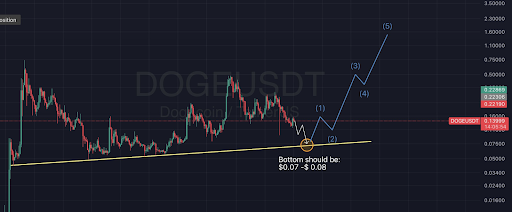
Crypto analyst Hokage described the current DOGE price level as a generational buying opportunity amid the imminent launch of the Dogecoin ETF. This came as the analyst remarked that while the short-term is extremely hard to figure out, the long-term support will eventually get hit. His accompanying chart showed that the leading meme coin could rally to as high as $1.6 in the long term. 

Dogecoin

The crypto analyst highlighted the potential integration of Dogecoin into Elon Musk’s X as one catalyst that could spark this run. He opined that the meme coin will eventually get integrated into X as a payment and tips feature. Hokage added that it is just a matter of time and not if. 

Related Reading: Dogecoin Is Breakout Ready: Analyst Shows Major Target For The Meme Coin King

At the time of writing, the Dogecoin price is trading at around $0.137, down over 2% in the last 24 hours, according to data from CoinMarketCap.

Dogecoin

Bitwise files for spot SUI ETF as competition intensifies in crypto fund market

  • The proposed ETF would use Coinbase Custody and include staking and in-kind transactions.
  • Several asset managers are now competing to bring SUI-based ETFs to the US market.
  • Regulatory changes under the current SEC leadership are accelerating altcoin ETF activity.

Crypto asset manager Bitwise has formally filed a Form S-1 with the US Securities and Exchange Commission, seeking approval to launch a spot exchange-traded fund linked to SUI.

The proposal adds fresh momentum to the fast-expanding crypto ETF landscape, where issuers are increasingly targeting altcoins beyond Bitcoin and Ethereum.

Rather than focusing on short-term market moves, the filing highlights how fund structures, custody choices, and regulatory positioning are evolving as competition intensifies.

With multiple firms now pursuing similar products, SUI is quickly becoming a key test case for the next phase of crypto ETFs in the US.

The proposed product, named the Bitwise SUI ETF, is designed to track the spot price of SUI, the native token of the Sui Network.

If approved, it would give investors direct exposure to SUI without requiring them to hold the asset themselves, reflecting growing institutional interest in simplified crypto access.

How Bitwise is structuring the ETF

The filing shows that Coinbase Custody has been selected as the custodian for the fund, underlining a continued reliance on established US-based crypto infrastructure.

Bitwise has not yet revealed the ETF’s ticker symbol or intended listing exchange, but the structure clearly focuses on holding spot SUI rather than futures or other derivatives.

One notable element of the proposal is the inclusion of staking. The ETF would be able to stake its SUI holdings, allowing it to earn additional tokens over time.

This approach could potentially enhance returns compared with products that only hold assets passively, although it also introduces additional operational considerations.

The filing also details in-kind creations and redemptions.

This means authorised participants would be able to exchange SUI tokens directly for ETF shares and vice versa, instead of using cash.

This structure is increasingly favoured by issuers as it can improve efficiency and reduce tracking error.

Rising competition around SUI products

Bitwise is not alone in targeting SUI.

Grayscale, 21Shares, and Canary Capital have already submitted filings for similar spot SUI ETFs, signalling a crowded field forming around the asset.

The growing interest follows recent regulatory developments, including the SEC’s approval of a 2x leveraged SUI ETF from 21Shares.

Although no spot SUI ETF has yet launched in the US, these filings suggest that issuers see a clearer regulatory path emerging.

SUI itself launched in 2023 and has climbed into the top tier of digital assets by market capitalisation, currently ranked 31st with a value of about $5 billion.

Bitwise has also integrated SUI into its 10 Crypto Index ETF, reinforcing the firm’s broader commitment to the network.

Market response and regulatory context

SUI’s market price showed little immediate reaction to the filing, trading near $1.40 and remaining more than 12% lower over the past week.

Market participants generally view ETF filings as longer-term signals rather than short-term price drivers.

The timing of the application is significant. Under SEC Chair Paul Atkins, the regulator has moved toward clearer and more standardised ETF listing frameworks.

This shift has already helped products linked to assets such as XRP, DOGE, and SOL advance through the approval process.

As more issuers push forward with altcoin ETFs, SUI’s progress may offer early insight into how far and how fast the US crypto ETF market can broaden.

The post Bitwise files for spot SUI ETF as competition intensifies in crypto fund market appeared first on CoinJournal.

Bitwise Says Bitcoin’s Four-Year Cycle Is Dead, Predicts Bitcoin New Highs in 2026

Bitcoin Magazine

Bitwise Says Bitcoin’s Four-Year Cycle Is Dead, Predicts Bitcoin New Highs in 2026

Asset manager Bitwise released a new report that argues that bitcoin is poised to break from its historical four-year market cycle, setting new all-time highs in 2026 while becoming less volatile and less correlated with equities.

Bitwise’s Chief Investment Officer Matt Hougen outlined three forecasts he says matter most for crypto investors: the end of the four-year cycle, continued volatility compression, and declining correlation between BTC and traditional stock markets.

The four-year cycle is ‘significantly weaker’

Bitcoin has historically followed a four-year pattern tied to the halving cycle, typically marked by three years of gains followed by a sharp pullback. Under that framework, 2026 would be expected to be a down year.

Bitwise disagrees.

“The forces that previously drove four-year cycles — the BTC halving, interest rate cycles, and crypto’s leverage-fueled booms and busts — are significantly weaker than they’ve been in past cycles,” Hougan wrote.

He pointed to the diminishing impact of successive halvings, expectations for falling interest rates in 2026, and reduced systemic leverage following record liquidations in October 2025. Improving regulatory clarity is also expected to lower the risk of major market blow-ups.

More importantly, Bitwise expects institutional capital flows to accelerate. With spot bitcoin ETFs approved in 2024, the firm anticipates broader participation from major wealth platforms such as Morgan Stanley, Wells Fargo, and Merrill Lynch, alongside increased adoption from Wall Street and fintech firms amid a more favorable regulatory environment following the 2024 U.S. election.

Bitwise believes these factors could push bitcoin to fresh all-time highs, effectively ending the relevance of the four-year cycle.

NEW: $15 billion asset manager Bitwise predicts #Bitcoin will break the 4 year cycle and set a new all time high in 2026 🐂 pic.twitter.com/5UkwidKKkf

— Bitcoin Magazine (@BitcoinMagazine) December 16, 2025

Bitcoin volatility continues to decline

The firm also challenged the long-standing criticism that BTC is too volatile for mainstream investors.

According to Bitwise, BTC was less volatile than Nvidia stock throughout 2025, a comparison Hougan says underscores the asset’s ongoing maturation. Data cited in the report shows bitcoin’s volatility has steadily declined over the past decade as its investor base has diversified and traditional investment vehicles like ETFs have expanded access.

Bitwise expects that trend to continue into 2026, likening bitcoin’s evolution to gold’s transition following the launch of gold ETFs in the early 2000s.

Lower correlation with equities

Finally, Bitwise predicts BTC’s correlation with stocks will fall further in 2026. While critics often claim bitcoin trades in lockstep with equities, Hougan noted that rolling 90-day correlations with the S&P 500 have rarely exceeded 0.50.

Looking ahead, Bitwise expects crypto-specific catalysts—such as regulatory progress and institutional adoption—to drive bitcoin independently, even as equity markets grapple with valuation concerns and slowing economic growth.

Taken together, the firm sees 2026 shaping up as a favorable year for bitcoin investors, characterized by strong returns, lower volatility, and reduced correlation with traditional assets.

“That’s the trifecta for investors,” Hougan wrote, adding that these dynamics could drive tens of billions of dollars in new institutional inflows.

This post Bitwise Says Bitcoin’s Four-Year Cycle Is Dead, Predicts Bitcoin New Highs in 2026 first appeared on Bitcoin Magazine and is written by Micah Zimmerman.

❌