❌

Reading view

There are new articles available, click to refresh the page.

NASA topples towers used to test Saturn rockets, space shuttle

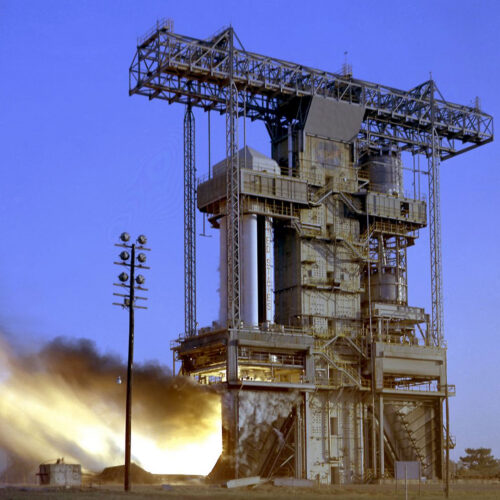
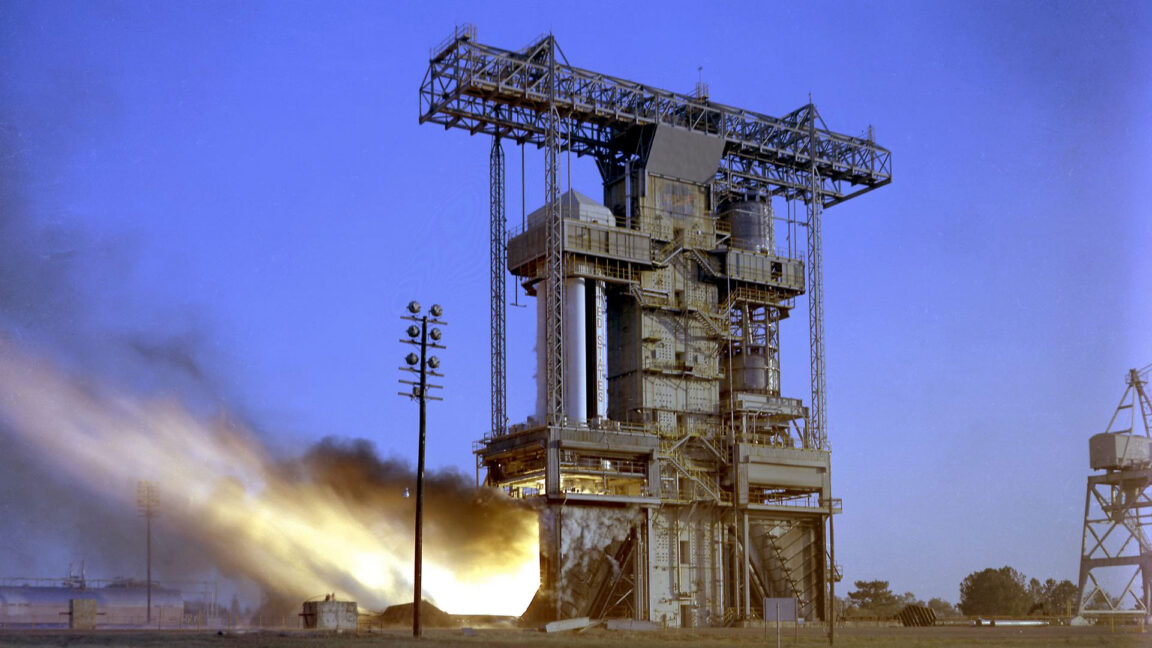
Two historic NASA test facilities used in the development of the Saturn V and space shuttle launch vehicles have been demolished after towering over the Marshall Space Flight Center in Alabama since the start of the Space Age.

The Propulsion and Structural Test Facility, which was erected in 1957β€”the same year the first artificial satellite entered Earth orbitβ€”and the Dynamic Test Facility, which has stood since 1964, were brought down by a coordinated series of implosions on Saturday, January 10. Located in Marshall's East Test Area on the US Army's Redstone Arsenal in Huntsville, the two structures were no longer in use and, according to NASA, had a backlog of $25 million in needed repairs.

"This work reflects smart stewardship of taxpayer resources," Jared Isaacman, NASA administrator, said in a statement. "Clearing outdated infrastructure allows NASA to safely modernize, streamline operations and fully leverage the infrastructure investments signed into law by President Trump to keep Marshall positioned at the forefront of aerospace innovation."

Read full article

Comments

Β© NASA

NASA Awards Launch Range Contract for Wallops Flight Facility

The letters NASA on a blue circle with red and white detail, all surrounded by a black background
Credit: NASA

NASA has selected ARES Technical Services Corporation of McLean, Virginia, to provide launch range operations support at the agency’s Wallops Flight Facility in Virginia.

The Wallops Range Contract has a total potential value of $339.8 million with a one-year base period expected to begin Tuesday, Feb. 10, and four one-year option periods that if exercised would extend it to 2031. The contract includes a cost-plus-fixed-fee core with an indefinite-delivery/indefinite-quantity component and the ability to issue cost-plus-fixed-fee or firm-fixed-price task orders.

The scope of the work includes launch range operations support such as radar, telemetry, logistics, tracking, and communications services for flight vehicles including orbital and suborbital rockets, aircraft, satellites, balloons, and unmanned aerial systems. Additional responsibilities include information and computer systems services; testing, modifying, and installing communications and electronic systems at launch facilities, launch control centers, and test facilities; and range technology sustainment engineering services.

Work will primarily occur at NASA Wallops with additional support at sites such as the agency’s Bermuda Tracking Station, Poker Flat Research Range in Alaska, and other temporary duty locations.

For information about NASA and agency programs, visit:

https://www.nasa.gov/

-end-

Tiernan Doyle
Headquarters, Washington
202-358-1600
tiernan.doyle@nasa.gov

Robert Garner
Goddard Space Flight Center, Greenbelt, Md.
301-286-5687
rob.garner@nasa.gov

NASA’s DiskSat Technology Demo Launches to Low Earth Orbit

Seven people wearing blue lab coats stand near a lab table that supports two disk-shaped spacecraft
A team of engineers at The Aerospace Corporation’s facility in El Segundo, California, gather around two completed DiskSats as they conduct final checks before shipment. From left: Albert Lin, DiskSat system engineer, Elijah Balcita, intern, Darren Rowen, DiskSat chief engineer, Catherine Venturini, DiskSat principal investigator, and Eric Breckheimer, NASA program office program manager at The Aerospace Corporation; Roger Hunter, Small Spacecraft & Distributed Systems program manager at NASA; and Ziba Shahriary, DiskSat program manager at The Aerospace Corporation.
The Aerospace Corporation

NASA’s DiskSat technology demonstration mission will test the performance of a new small spacecraft platform designed to expand the capabilities of current small spacecraft. By demonstrating the advantages of a flat, disk-shaped architecture over the conventional CubeSat design, DiskSat aims to enable lower-cost space missions, broaden scientific opportunities, and increase overall access to space.

At 12:03 a.m. EST on Thursday, Dec. 18, DiskSat launched aboard a Rocket Lab Electron rocket from the company’s Launch Complex 2 on Wallops Island, Virginia.

The demonstration will evaluate the performance of the DiskSat spacecraft themselves and a specialized dispenser mechanism. The dispenser is engineered to securely contain four DiskSat spacecraft during launch, then sequentially deploy them into low Earth orbit where they will perform maneuvers. Each DiskSat is a circular, flat spacecraft 40 inches (one meter) in diameter and one inch (two-and-a-half centimeters) thick – similar to a small coffee table. Each has an electric propulsion system to allow for orbit changes and maintenance. The DiskSat design is also conducive to operations in very low Earth orbit, which can offer sharper Earth imaging and sensing capabilities as well as lower latency communications solutions.

DiskSat boosts U.S. innovation and commercial space opportunities while providing mission designers new flexibility, enabling them to pursue and achieve NASA’s goalsΒ fasterΒ andΒ more affordably. DiskSats offer an alternative platform that could significantly expand the scope of future small spacecraft missions for NASA, the commercial space industry, other government agencies, and academia. The DiskSat demonstration also supports NASA’s long-term plans for sustained exploration at the Moon and Mars as well as advancing our ability to study and better understand our home planet.

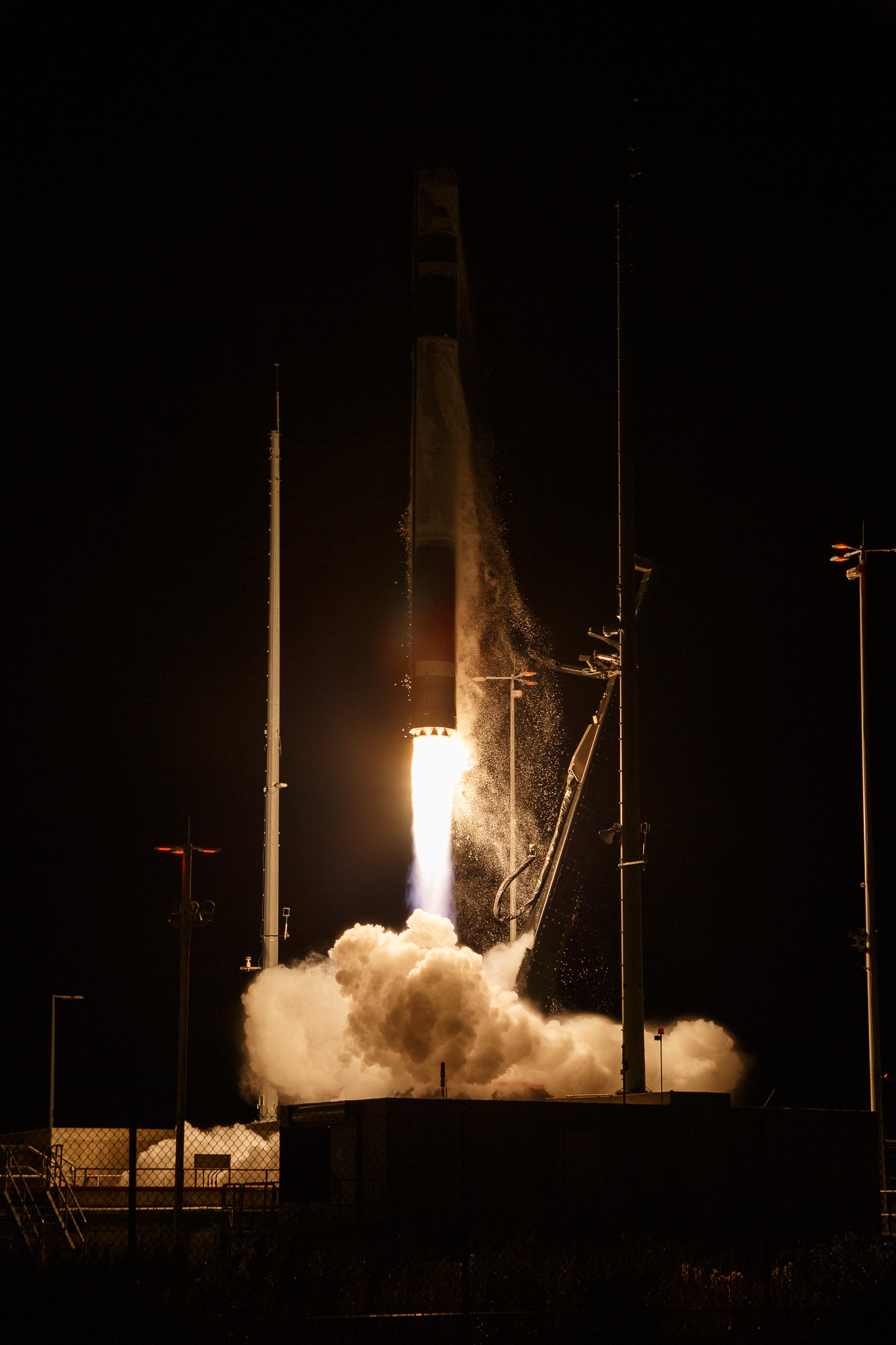
An Electron rocket lifting off from the pad at night time. A bright white fire leave the bottom with smoke spreading out around the pad.
An Electron Rocket launches from Wallops Island, Virginia, Dec. 18; 2025, at 12:03 a.m. EST from Rocket Lab’s Launch Complex 2. The rocket carried NASA’s DiskSat technology demonstration mission, which will test the performance of a new small spacecraft platform designed to expand the capabilities of current small spacecraft.
NASA/Garon Clark

The Aerospace Corporation, headquartered in Chantilly, Virginia, is leading the design and development of the DiskSat concept as well as the DiskSat spacecraft. NASA’s Small Spacecraft & Distributed Systems program within the agency’s Space Technology Mission Directorate funded the development of the DiskSat technology and demonstration mission. The program is based at NASA’s Ames Research Center in California’s Silicon Valley. The DiskSat launch and in-orbit operations are funded by the U.S. Space Force’s Rocket Systems Launch Program (RSLP) and Department of War Space Test Program (STP), respectively. Rocket Lab USA, Inc., of Long Beach, California is providing launch services. NASA’s Wallops Flight Facility, the agency’s only owned and operated launch range, enabled the mission providing services such as tracking, telemetry, and range safety to ensure a safe and successful mission.

Members of the news media interested in covering this topic should reach out to theΒ NASA Ames newsroom.Β 

Weed-Funded Rec Center Opens in Aurora, Colorado

The city of Aurora, Colorado hosted a grand opening on Tuesday for its brand new 77,000-square foot, nearly $42 million recreational facility that was funded entirely by tax revenue generated from legal marijuana sales.Β 

Known as the β€œSoutheast Recreation Center and Fieldhouse,” the facility boasts a slew of amenities, according to local news station KDVR: β€œA 23,000-square-foot fieldhouse with temperature controlled indoor environment; A full-sized field with professional-grade turf; An 8,000-square-foot multiuse gymnasium [that] will be able to accommodate one main basketball court, two cross basketball courts, two volleyball courts or three pickleball courts; A 1/9-mile long track elevated above the fitness area and gymnasium; A 7,600-square-foot fitness area with state-of-the-art equipment, including: A functional fitness area; An outdoor fitness space; A fitness studio; A large community room; [and a] natatorium, which in turn is comprised of: A 125,000-gallon swimming pool with a maximum depth of seven feet; A spa pool with water jets; A leisure pool that includes a 25-yard, four-lane lap pool, a lazy river, and a 20-foot-tall waterslide.” 

The city broke ground on the facility in early 2021, and it is the second new recreational facility to open in Aurora in the last four years.

The other rec center, which opened in 2019, was also funded by taxes from marijuana sales, according to KDVR. The news outlet Westworld reported that the Aurora City Council in 2020 β€œapproved increasing the city’s sales tax on recreational marijuana from 7.75 percent to 8.75 percent, with the additional revenues going to fund youth violence prevention projects.” 

β€œWe are excited to open our newest recreation center and fieldhouse,” Brooke Bell, the director of the Aurora Parks, Recreation and Open Space, said in a press release from the city earlier this month. β€œAfter an extensive community engagement process, the feedback received guided the creation of this exceptional facility; we look forward to the community enjoying the space they helped envision for years to come.”

In the press release, the city said that the Southeast Recreation Center is located β€œnear several neighborhoods and the Aurora Reservoir,” and that β€œthe center is a regional destination boasting the first indoor fieldhouse within the city in addition to a variety of other amenities and breathtaking views of the Colorado mountains.”

The construction of the two recreational facilities in Aurora serve as β€œproof of concept” for advocates who helped Colorado become one of the first two states to legalize recreational cannabis a little more than a decade ago when voters there approved Amendment 64.Β 

Supporters of marijuana legalization have long contended that a regulated cannabis retail market could be an economic boon for state and local governments.Β 

β€œColorado did what no one had done before,” Colorado Gov. Jared Polis said at an event in October commemorating the 10th anniversary of the state’s legalization measure, as quoted by the Denver Gazette. β€œWith voter [approval] of Amendment 64, we made history and therefore it is fitting that we are celebrating today 10 years here at History Colorado.”

Polis, a Democrat, has worked to strengthen the marijuana law. Last summer, he signed an executive order β€œto ensure that no Coloradan is subject to penalization for the possession, cultivation, or use of marijuana as this substance is legal in Colorado as a result of Amendment 64,” his office announced at the time.

β€œThe exclusion of people from the workforce because of marijuana-related activities that are lawful in Colorado, but still criminally penalized in other states, hinders our residents, economy and our State. No one who lawfully consumes, possesses, cultivates or processes marijuana pursuant to Colorado law should be subject to professional sanctions or denied a professional license in Colorado. This includes individuals who consume, possess, cultivate or process marijuana in another state in a manner that would be legal under Colorado law,” Polis said in a statement.

The post Weed-Funded Rec Center Opens in Aurora, Colorado appeared first on High Times.

❌