Reading view

There are new articles available, click to refresh the page.

Coast Guard, Sovereignty, and Homeland Defense

OPINION — U.S. defense planning rests on the assumption that wars are fought abroad, by expeditionary forces, against defined adversaries. For decades, those assumptions held. But today, many of the most consequential security challenges facing the United States violate all three. They occur closer to home, below the threshold of armed conflict, and in domains where sovereignty is enforced incrementally.

The shift has exposed a chronic mismatch between how the United States defines its defense priorities and how it allocates resources and respect. While defense discourse continues to stubbornly emphasize power projection and high-end conflict, many of today’s challenges revolve around the more modest and rote enforcement of U.S. territorial integrity and national sovereignty—functions that are vital to U.S. strategic objectives yet lack the optical prestige of winning wars abroad.

Sitting at the center of this gap between prestige and need is the U.S. Coast Guard, whose mission profile aligns directly with America’s most important strategic objectives—the enforcement of sovereignty and homeland defense—yet remains strategically undervalued because its work rarely resembles the celebrated and well-funded styles of conventional warfighting. In an era of increased gray-zone competition and persistent coercion, the failure to properly appreciate the Coast Guard threatens real strategic fallout.

In the third decade of the 21st century, U.S. defense planning remains heavily oriented toward expeditionary warfighting and high-end kinetic conflict. Budget conversations still revolve around Ford-class supercarriers, F-35 fighters, and A2/AD penetration. This orientation shapes not only force design and budget allocations, but also institutional prestige and political capital. The services associated with visible combat power, with the Ford-class and the F-35, continue to dominate strategic discourse—even as many of the most persistent security challenges confronting the United States unfold close to home, in the gray-zone, without the need for fifth-generation air power or heavy armor.

The Cipher Brief brings expert-level context to national and global security stories. It’s never been more important to understand what’s happening in the world. Upgrade your access to exclusive content by becoming a subscriber.

At the most basic level, any nation’s military exists primarily to defend territorial integrity, enforce sovereignty, and protect the homeland. Power projection, forward presence, and deterrence abroad are important—but they are secondary functions derived from the primary purpose of homeland defense. Yet U.S. defense discourse often treats homeland defense as a background condition when it should be revered as the first priority. The result is a blind spot in how security resources are evaluated and allocated.

The Coast Guard operates at a unique point where law enforcement, military authority, and sovereign enforcement all converge. On any given day, the Coast Guard may board foreign-flagged vessels suspected of sanctions violations, police maritime borders against illicit trafficking, secure ports that underpin global supply chains, and maintain a persistent presence in contested spaces, like the Arctic, without inviting escalation. The Coast Guard is equipped to intercept illegal fishing fleets, escort commercial shipping through sensitive waterways, and assert jurisdiction in legally ambiguous areas. These activities rarely resemble traditional warfighting, they rarely result in a Hollywood blockbuster, and they can be accomplished without nuclear-powered submarines or intercontinental ballistic missiles. But these are not peripheral activities—they are arguably amongst the most important daily functions the U.S. military undertakes.

Distinct among the military branches, the Coast Guard operates under a legal framework that is uniquely suited to today’s security environment. Under Title 14 status, the Coast Guard falls within the Department of Homeland Security, conducting law enforcement and regulatory missions on a daily basis. Yet, when needed, the service can transition to Title 10 status, under the Department of Defense, and operate as an armed service when required. This agility allows the Coast Guard to remain continuously engaged across the spectrum of competition, whether enforcing U.S. law in peacetime, managing escalation in gray-zone encounters, or integrating seamlessly into military operations. Few other elements of U.S. power can move so fluidly between legal regimes.

Still, despite such strategic relevance, the Coast Guard suffers from a persistent optical problem. U.S. defense culture has long privileged services and missions associated with visible, kinetic combat—those that lend themselves to clear narratives of victory, sacrifice, and heroism. The Coast Guard’s work rarely fits that cinematic mold. Its success is measured not in territory seized or targets destroyed, but in disruptions prevented, borders enforced, and crises that never materialize. Inherently quiet work with outcomes that reflect a force operating exactly as designed, although without generating institutional prestige or political support. In a system that rewards the loudest and the brightest, the Coast Guard’s quiet enforcement of sovereignty is easy to overlook.

Need a daily dose of reality on national and global security issues? Subscriber to The Cipher Brief’s Nightcap newsletter, delivering expert insights on today’s events – right to your inbox. Sign up for free today.

Continuing to overlook the value of the Coast Guard carries strategic consequences. Specifically, persistent underinvestment in the Coast Guard weakens maritime domain awareness, reduces sustained presence in key waterways, and narrows the set of tools available to manage gray-zone competition. As adversaries increasingly rely on legal ambiguity, deniable actors, and incremental pressure to test U.S. resolve, gaps in enforcement become opportunities. In this environment, the absence of credible, continuous sovereignty enforcement invites probing behavior that becomes harder to deter over time.

Advocacy for the Coast Guard does not require reassigning prestige, or elevating one service at the expense of others. It is merely an argument for strategic alignment. If territorial integrity, sovereignty enforcement, and homeland defense are truly core national-security priorities, then the institutions most directly responsible for those missions should be treated accordingly. As competition increasingly unfolds in the gray-zone between peace and war, the United States will need forces designed not only to win conflicts—but to prevent them from starting in the first place.

The Cipher Brief is committed to publishing a range of perspectives on national security issues submitted by deeply experienced national security professionals. Opinions expressed are those of the author and do not represent the views or opinions of The Cipher Brief.

Have a perspective to share based on your experience in the national security field? Send it to Editor@thecipherbrief.com for publication consideration.

Read more expert-driven national security insights, perspective and analysis in The Cipher Brief, because national security is everyone’s business.

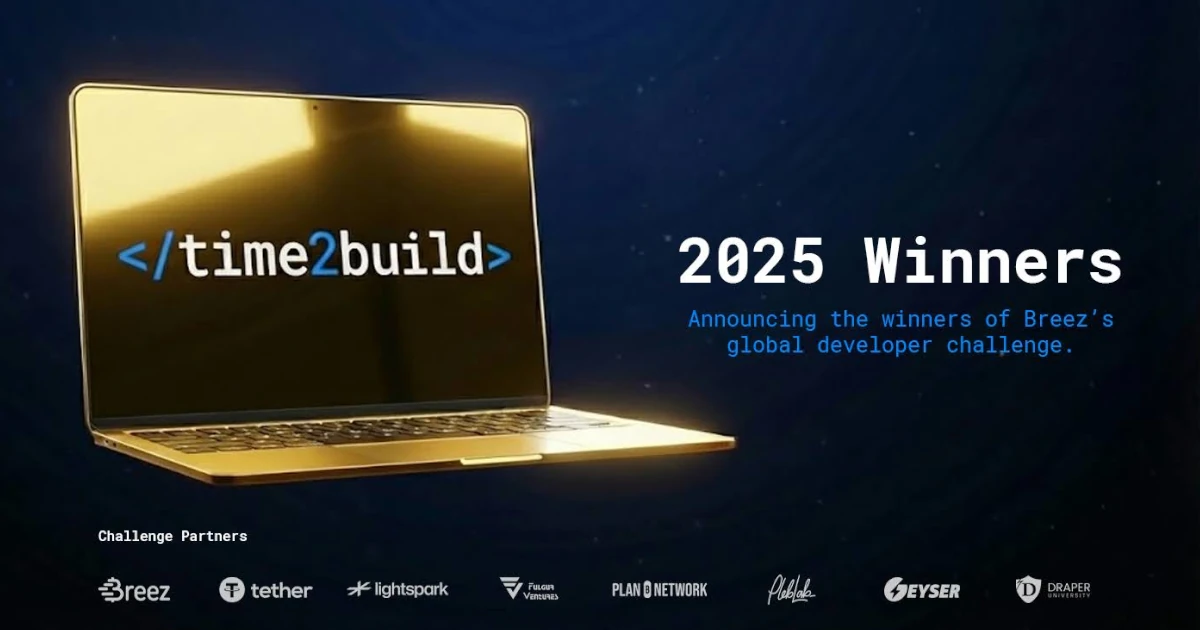
Time2Build 2025 Winners: Breez Awards Bitcoin Prizes for Lightning Integrations in BTCPay Server, Primal, and More

By: Juan Galt

Bitcoin Magazine

Time2Build 2025 Winners: Breez Awards Bitcoin Prizes for Lightning Integrations in BTCPay Server, Primal, and More

The Time2Build developer challenge just announced its 2025 winners. It was organized by Breez in collaboration with partners including TetherLightsparkFulgur VenturesPlan ₿ NetworkPlebLabGeyser, and Draper University. The initiative, which ran from October 7 to November 15, 2025 (with a merge period through December 16), focused on integrating self-custodial Lightning Network payments into existing open-source applications using the Breez SDK.

More than 50 developer communities worldwide participated, resulting in a range of plugins, tools, and integrations designed for long-term use rather than one-off demonstrations. The challenge emphasized practical Bitcoin functionality in areas such as merchant payments, social platforms, identity protocols, and Nostr-based applications.

Key trends observed across submissions included:

  • Lightning as an interoperability layer — Developers frequently paired Lightning with protocols like Nostr and Cashu to enable value transfer between systems without altering native designs.
  • Preference for plugins over deep integrations — Participants favored lightweight plugins for content management systems, forums, game engines, and creator tools. This approach allowed faster deployment, independent iteration, and reduced dependence on upstream maintainer approval.

The winners selected by a panel of judges, including Abubakar, Giacomo, Jeff, Kevin, Keyan, Lisa, Roy, and Subash. Prizes were paid in Bitcoin.

$3,500 Prize Winners

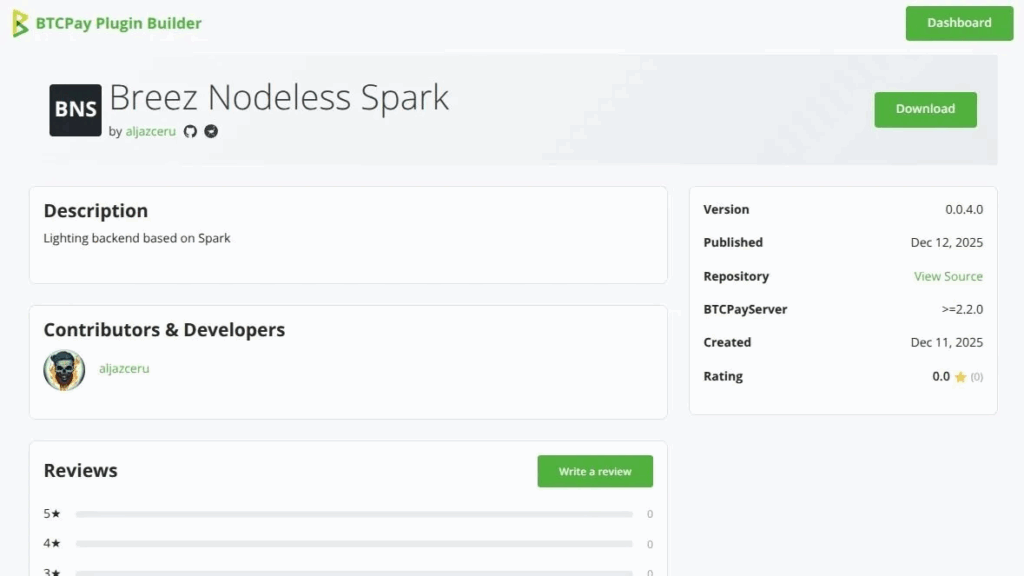
BTCPay Server plugin (Team: Aljaz) — The plugin enables Lightning payments on BTCPay Server, the open-source payment processor used by merchants globally, by leveraging the Breez SDK. It eliminates the need for operators to manage a full Lightning node, including channel liquidity, while maintaining self-custodial Bitcoin functionality.

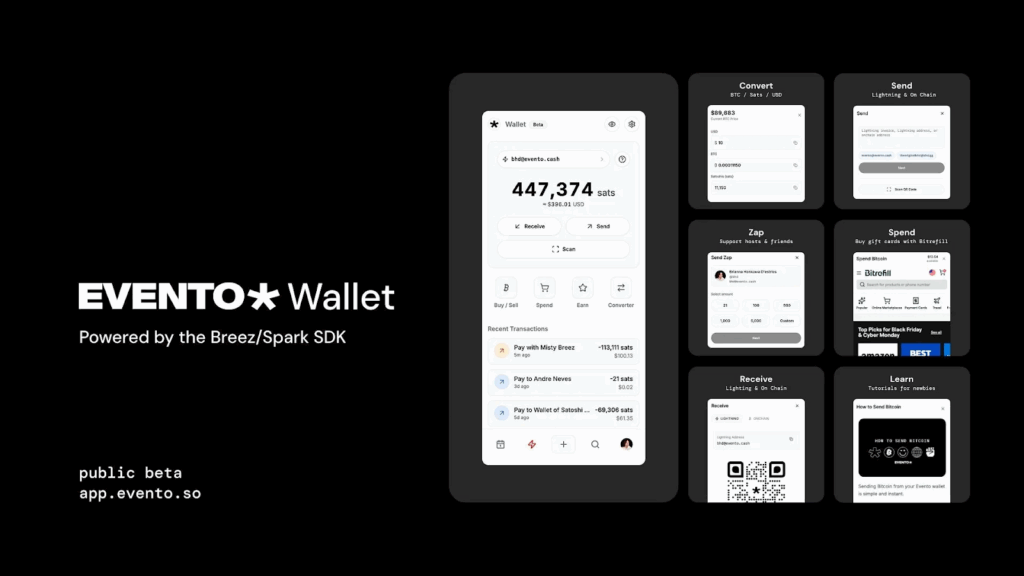
Evento (Team: Brianna, Andre, and Aaliyah) — Lightning was added to Evento, a social events platform for community building. Users can tip participants, support hosts, send/receive sats, and interact with services like Bitrefill purchases directly in the app, enabling peer-to-peer value flow within events.

Portal (Team: Alessandro, Gianluca, Gabriele, and John) — The team integrated the Breez SDK into Portal, a protocol and mobile app for identity and payments. Lightning becomes a native protocol feature, allowing any application built on Portal to inherit send/receive Bitcoin capabilities.

Primal (Team: Daniel) — Lightning was incorporated into the Primal web client, a widely used Nostr application. The Breez SDK provides a self-custodial wallet experience, replacing a previous custodial onboarding process that required KYC and could fail due to location or email restrictions. Onboarding now requires no personal information and completes in approximately one minute.

$1,000 Prize Winners and Special Mentions

Additional $1,000 awards went to projects including:

Special prizes from Draper University and PlebLab recognized additional contributions in education gamification and Nostr-focused wallets. Winners of these special prices were:

  • Lib de Satoshi & B4OS — A community platform that integrated Lightning to gamify education. Rewarded by DraperU.
  • Sparkihonne — A Nostr-focused wallet experience blending identity, messaging, and payments. Rewarded by PlebLab.

Other notable non-winning submissions included Sabi Wallet, Backend for CDK mints, Jumble, Breez MCP Server – Docker Catalog, CoFi Lab, OpNode, and BitNGN.

The challenge demonstrated growing developer interest in embedding Bitcoin payments where users already engage, particularly through plugins and Lightning as a bridging layer. Organizers stated that future development will depend on continued builder participation in areas such as messaging apps, wallets, and new applications.

The Breez team shared their enthusiasm in a press release with Bitcoin Magazine, saying; “For us, the next steps are clear. The era of building has begun. Whether that means adding Bitcoin to messaging apps like Signal, integrating it into leading crypto wallets, or bringing Lightning into entirely new apps with use cases we’ve yet to dream up, we can’t wait to see what you do next. It’s time to build.” 

This post Time2Build 2025 Winners: Breez Awards Bitcoin Prizes for Lightning Integrations in BTCPay Server, Primal, and More first appeared on Bitcoin Magazine and is written by Juan Galt.

The War You Can’t See: Gray Zone Operations Are Reshaping Global Security


EXPERT PERSPECTIVE -- In the middle of the night, with no witnesses, a single ship flagged out of Hong Kong drags its anchor across the Baltic Sea. In silence, it severs a vital gas pipeline and the digital cables that link northern capitals. By morning, millions lose connectivity, financial transactions stall, and energy grids flicker on the edge.

The culprit vanishes behind flags of convenience, leaving blame circulating in diplomatic circles while Moscow and others look on, exploiting maritime ambiguity and the vulnerabilities of Europe's lifelines.

Meanwhile, in Warsaw and Vilnius, shoppers flee as flames engulf two of the largest city malls. Investigators soon discover the arsonists are teenagers recruited online, guided by encrypted messages, and paid by actors connected to hostile state agencies. The chaos sows fear, erodes social trust, and sends shockwaves through European communities—proxy sabotage that destabilizes societies while providing plausible deniability to those orchestrating the acts.

Thousands of kilometers away, Chinese dredgers and coast guard vessels silently transform disputed reefs into fortified islands in the South China Sea. With no declaration of war and no pitched battles, new airstrips and bases appear, steadily shifting maritime boundaries and economic interests. Each construction project redraws the strategic realities of an entire region, forcing neighbors and distant powers alike to reckon with incremental, shadowy coercion and efforts to change the status quo.

In early 2024, Chinese state-sponsored hackers, known as "Volt Typhoon," penetrated U.S data repositories and embedded themselves deep within the control systems of U.S. critical infrastructure, including communication networks, energy grids, and water treatment facilities.

Then-FBI Director Christopher Wray described it as a pre-positioning of capabilities by China that can be turned on whenever Beijing wanted - wreaking havoc and causing real-world harm to American citizens and communities. China has denied any connection to these attacks on U.S. sovereignty.

And just weeks ago, around 20 Russian drones violated Poland’s airspace. Russia’s denials were predictable and since then, Russian drones and jets have violated airspace in Romania, Estonia, and over the Baltic Sea.

Were these threats, tests of capability and resolve, provocations, or demonstrations—or maybe all of the above? Just as NATO will develop a set of lessons-learned for future incursions, it’s also likely that Russia learned from these episodes and will recalibrate future incursions.

Threaded almost invisibly through all of these gray zone activities, and countless others like them, is cognitive warfare—a persistent tool of our adversaries. It is an assault on cognition. The information and decision spaces are flooded with weaponized narratives, AI-powered disinformation, synthetic realities, and the coercive use of redlines and intimidation.

The goal is clear—deceive, change how we see the world, fracture societies, destroy faith in institutions and partnerships, erode trust, challenge and replace knowledge and belief, coerce and intimidate; and perhaps most importantly; undermine decision autonomy. It is here, in the crowded intersection of AI; cyber; traditional tools such as narratives and storytelling; and cognition; that today’s most urgent battles are fought.

These are all operations in the gray zone. We all use somewhat different terms for this, but let me share the definition of the gray zone that I think works well.

The gray zone is the geopolitical space between peace and war where adversaries work to advance their own national interests while attacking and undermining the interests of their adversaries and setting the conditions for a future war without triggering a military response.

We might refer to attacks in the gray zone as gray warfare. It is the domain of ambiguity, deniability, and incremental aggression calculated to limit deterrence and discourage persuasive response.

The 2026 Cipher Brief HONORS Awards are open for nominations. Find out more at www.cipherbriefhonors.com

Today, it is the space where global competition, particularly great power competition, is playing out.

Why are we seeing more gray zone activity today?

First, great power competition is intensifying. This includes great powers, middle powers, and impacts almost every other nation. Almost every nation has a role to play, even if involuntary: competitor, ally and supporter, enabler, spoiler, surrogate, or innocent bystander and victim. Like the African proverb says, “When elephants fight, it is the grass that suffers.”

But great powers will go to great lengths to avoid 21st Century superpower conflict, primarily because of the fear of unintended losses and damage to national power that could take decades to recover. The catastrophic damage to nations and militaries from WWII are distant—but still vivid—reminders of the impact of a war of great powers.

Today, just look at the unprecedented loss of national power by Russia in indirect superpower conflict. Superpower conflict has consequences. Given these strategic considerations, the gray zone and gray warfare provide an effective strategic alternative to conventional war. Our adversaries have calculated that there are more gains than risks in the gray zone, and that any risks they do face are acceptable.

Second, technology levels the playing field, creating new opportunities for gray zone attacks. Cyberattacks, even those that are disrupted, lead to more effective cyber capabilities by our adversaries. AI-driven cognitive warfare now delivers persuasive content with unprecedented global access and immediacy. Small kinetic drones can be wielded by state and non-state actors to pose both kinetic and cognitive threats. Technology also enables adversaries to conceal their operations and increase non-attribution. Even simple technologies have the potential to generate strategic effects in the gray zone.

Third, surrogates and proxies offer expanded reach, ambiguity, and impact

Little Green Men, hired criminals, ghost ships, unknown assassins and saboteurs, and shadowy companies that help evade sanctions blur attribution, providing bad actors with a veneer of deniability while increasing their reach, impact, and lethality. On a broader scale, Houthi attacks on global shipping and North Korean soldiers fighting Ukraine elevate the effects of this ambiguous warfare to a higher level. This trend is likely to intensify in the future.

Fourth, it is important to address the direct impacts of Russia’s war on Ukraine on an increase in gray zone attacks. Russia’s significant loss of national power and limited battlefield gains have created pressure on the Kremlin to reassert relevance, project power, and potentially punish antagonists. This dynamic almost certainly means a continued escalation of gray zone activities targeting Europe and aimed at destabilizing the continent. Many experts believe the Baltics and the Balkans may be particularly vulnerable.

That Russian gray bullseye is crowded—the U.S. is also a traditional target, and more Russia activity to undermine and weaken the U.S. is coming, despite Putin’s offers of renewed diplomatic and economic cooperation.

Finally, there are more gray zone attacks because real deterrence and persuasive responses to gray attacks are challenging, and our adversaries know it. In other words, gray zone attacks in most cases are relatively low cost, often effective, provide a level of deniability, and frustrate efforts at deterrence and response.

Our adversaries have calculated that they can hide behind ambiguity and deniability to violate sovereignty, ignore national laws and international norms, and engage in activities such as political coercion, sabotage, and even assassinations without triggering an armed response.

This “no limits” approach exploits the openness, legal norms, and ethical standards of democratic societies, making coordinated, timely, and effective response more difficult.

So, what can we do?

The most important outcome of our actions is to change the risk calculation of our adversaries. Gray zone attacks that go unanswered reward our adversaries and reinforce the idea that there are more gains than risk in the gray zone and encourage more attacks. Further, our adversaries calculate, often accurately, that our reasonable concerns for avoiding escalation will lead to indecision, weak responses, or the acceptance of false choices.

We need improved and shared gray zone intelligence to see through the fog of disinformation, synthetic realities, false risks and threats, and an overload of information by our adversaries to understand what is taking place in the gray zone. This not only strengthens our operations to counter gray zone attacks but it helps our citizens, communities, and countries to understand, recognize, reject, and remain resilient in the face of gray zone attacks.

We have to employ “strategic daylighting” to expose and put into context the gray zone activity by our adversaries—stripping away deniability and laying bare nefarious and illegal actions—knowing that our adversaries will go to great lengths to conceal, defend, and attack our efforts to expose their activities.

We have to speak frankly and convincingly to our adversaries and of course, we have to back up our words with persuasive action. Empty warnings and rhetoric will fall short. Changing the risk calculation of our adversaries means real consequences across a broad spectrum—public, diplomatic, economic, legal, informational, or even kinetic. It means a strategy on how to respond - not just a series of hasty responses. Real deterrence will result from planning and strategy; not decisions in the moment based on immediate circumstances.

Finally, we need to think of deterrence and response as a team sport - an “Article 5 mindset.” Our adversaries will seek to divide and isolate. Collective, unified action and resolve can form a powerful deterrent.

Of course, none of this is new. All of us need a solid understanding of the problems and the likely best solutions and implementation remains the greatest challenge.

We can go a long way with a good strategy, good partners, and resolve which seems like a reasonable place to start.

This Cipher Brief expert perspective by Dave Pitts is adapted from a speech he recently delivered in Sarajevo. Comments have been lightly edited for clarity. All statements of fact, opinion, or analysis expressed are my own and do not reflect the official positions or views of the US Government. Nothing in my remarks should be construed as asserting or implying US Government authentication of information or endorsement.

The Cipher Brief is committed to publishing a range of perspectives on national security issues submitted by deeply experienced national security professionals.

Opinions expressed are those of the author and do not represent the views or opinions of The Cipher Brief.

Have a perspective to share based on your experience in the national security field? Send it to Editor@thecipherbrief.com for publication consideration.

Read more expert-driven national security insights, perspective and analysis in The Cipher Brief

Seizing a 21st Century Cognitive Advantage

EXPERT PERSPECTIVE — In 1943, a body washed up on a beach in Huelva, Spain. It was the body of a Royal Marine officer, Major William Martin. Martin was carrying papers, cuffed to his wrist in a briefcase, suggesting that the Allies would invade Greece and Sardinia, not Sicily. Spain was officially neutral, but a few Spanish officials sympathetic to the Nazis allowed German agents to discreetly photograph the documents before Spain quietly passed the documents to the British. Those British officials appeared to be in a state of panic over the lost briefcase.

Would this opportunistic espionage expose a critical Allied operation? In reality, Major William Martin never existed. The body was that of Glyndwr (“Glendure”) Michael, a Welsh drifter who died from consuming rat poison. You probably recognize this as Operation Mincemeat. British intelligence developed this incredible ruse, with American approval, and painstakingly developed a plan for the body to wash up near Huelva Spain and provided background and a personal story for Michael that allowed the body to pass convincingly as a Royal Martine officer who perished at sea while delivering sensitive documents.

The Germans took the bait. Convinced by this fabricated narrative, Hitler diverted significant forces away from Sicily. When the Allies landed in Sicily, they encountered far less resistance than expected, saving countless lives and accelerating the collapse of Axis defenses in southern Europe.

Beyond innovation and sheer audacity, this was a master class in story-telling, in knowing the pressures facing the target audience (Hitler), in creating a believable altered reality, in understanding how information moved through Nazi circles and among those who enabled them and, most importantly, in persuading our adversaries to make consequential decisions that advanced our interests over theirs. It was cognitive warfare on the offense, it represented a cognitive advantage during a perilous period, and it remains a reminder of the timeless power of cognitive persuasion.

History has many other examples of where commanders and leaders have stepped beyond traditional thinking and conventional operations into the information and cognitive space to confuse our adversaries, to win the day, and, at times, to change history.

Is this important today? Let us put cognitive warfare in strategic perspective.

First, great power competition is intensifying and the stakes are high.

The U.S is now facing the most significant global challenges than at any time in our history. We face more capable peer adversaries, more aspiring regional nations, and more proxy threats than ever before. The global environment is more uncertain than ever, and our place in it is not guaranteed. If we are to remain the global leader, we’ll have to be ready for today’s and tomorrow’s rapidly evolving competition and warfare. We must look to prioritize and commonly orient our Nation’s capabilities toward actively maneuvering and gaining advantage across the cognitive landscape to help ensure our security interests, and to actively deny any adversary their own advantage.

Second, great powers will go to great lengths to avoid direct military engagement that could have catastrophic consequences. Russia has lost the equivalent of what would be one of the world’s largest militaries and it has experienced a massive reduction in national power in the war with Ukraine. We also know the examples from WWII when nations and great militaries were defeated and even decimated as a result of great power conflict.

China has advocated winning without fighting for decades, and it still does. Khrushchev famously said “We will take American without firing a shot. We do not have to invade the U.S. We will destroy you from within.” Putin is a believer and practitioner in that approach.

Their approaches are not a mystery. Our adversaries have telegraphed how they plan to attack us, and to defeat us, without direct military engagement.

Third, given those considerations, our adversaries are increasingly relying on operations in the gray zone, or gray warfare, to advance their national interests and to take steps to undermine and weaken the United States, without risking a superpower conflict. They have prioritized their resources, decisions, and actions toward this end.

China and Russia, and even Iran and North Korea, believe there are more gains than risks in the gray zone, and any risks they do face are manageable, so we should expect them to expand their activities. If we solely maintain an unblinking stare at the conventional military capabilities of our adversaries, we might miss the real war already well underway in the gray zone.

Finallycognitive warfare stands as the most prevalent and consequential activity our adversaries conduct in the gray zone.

This is not your grandfather’s Cold War disinformation. This is an assault on cognition, powered by advanced technology and enabled by an information environment that provides camouflage, infrastructure, and operational resources for our adversaries. Ultimately, cognitive warfare is a contest for truth and knowledge—a struggle to shape perception, control understanding, and influence both the decision-making process and its outcomes.

The Cipher Brief brings expert-level context to national and global security stories. It’s never been more important to understand what’s happening in the world. Upgrade your access to exclusive content by becoming a subscriber.

Never before in history have individuals, organizations, societies, and nations faced such a sustained assault on our ability to make our own decisions—our autonomy to think, decide, and act in our own best interests. From our adversaries’ perspective, controlling perceptions, manufacturing realities, steering decision-making, intimidation as persuasion, decision fatigue, and manufactured false choices make for persuasive and effective strategy.

In this global information landscape, where technology levels the playing field, any individual or group, and state or non-state actors can reach global audiences almost immediately. Thousands of internet sites, fake users, fabricated organizations, bots, and willing surrogates, managed by Russia, China, Iran, and North Korea, wage cognitive warfare against the U.S., our allies, and our partners at unprecedented scale and velocity. Artificial intelligence now serves as a force multiplier—amplifying reach, supercharging deception, automating the manipulation of public opinion, and constricting time in the information maneuver space.

As individuals and groups within America, this is everything from how we see the world, how we vote, how we invest, whom and what we trust, which policies we support or oppose, and who we believe are our friends and partners—locally, regionally, and globally.

For national security leaders, policymakers, and corporate and military decision-makers, our adversaries seek to influence consequential decisions on issues like Ukraine, Taiwan, trade, military posture, supply chains, alliances, participation in international organizations, technology development, and a host of other issues that could tip the balance in our adversaries’ favor.

For China, Russia, Iran, and North Korea, this is integrated national strategy where the instruments of national power—government, private sector, and surrogates—are combined to achieve strategic impact. Further, the willingness of our adversaries to defy international law; challenge economic interests, and violate the sovereignty and laws of every country including the U.S.; engage in bribery, political coercion, sabotage, and assassinations—essentially a “no limits” approach” to cognitive warfare—gives them considerable leverage—made more effective by our lack of focused emphasis on recognizing, prioritizing and taking action to mass and commonly orient our great national strengths.

If we are to make consequential decisions with confidence, we must have high certainty in the information we receive, value, and share. In the cognitive domain, truth is a strategic asset—precious, powerful, and fragile. To endure, it must be shielded from the relentless assault of manipulation, coercion, and altered realities initiated by our adversaries to shape the strategic landscape and create influence attack vectors intended to undermine and disable our ability to do the same.

Churchill recognized both the strategic value and fragile nature of truth in a time of conflict. He famously said, “In wartime, the truth [is] so precious that it should always be attended by a bodyguard of lies.” The lesson is clear. Today, just as in 1943, we must seize and defend the cognitive advantage if we are to navigate these equally perilous times.

What do we need to do to achieve a cognitive advantage?

- First, we need to reassert a strong U.S. national narrative.

In the cognitive domain, our national narrative is both sword and shield. It projects power, influence, and advances our interests. It tells the story of our values, our history, our aspirations, our view of the world, and our resolve and is reinforced by actions and deeds. Our military and economic strength and our global leaderships are strong parts of this narrative. It supports confidence in our actions, our institutions, and our commitments. It also counters adversary narratives and actions that seek to undermine America within our own borders and across the world. We all know today that our national narrative is being questioned by some at home and abroad. Regardless of how we see the political environment, we must articulate and advance a strong seamless U.S. national narrative as foundational to a cognitive advantage. We must take this on.

- Second, we need to empower our master storytellers.

Our master storytellers are not just communicators; they are architects of persuasion. We all know this; we read, we watch movies, and we listen. Facts are fleeting, but stories remain with us—they shape how we feel which in turn drives how we behave. In the cognitive domain, well-crafted stories—including those tailored to navigate today’s hyper-technical environment and chaotic information environment—shape threat perceptions, influence our perception of reality, sustain resolve, and can tip the balance in competition or conflict.

Adversaries recognize the power of narrative and weaponize it; even the truth is more persuasive when it is delivered as part of a compelling story. History proves the advantage: in cognitive warfare, facts alone rarely shift outcomes—compelling narratives and persuasive storytelling do. As in 1943, our edge will be defined by those who can craft and deliver the stories that influence minds and shape events. Yes, we need our master storytellers as much today as we did in 1943.

- Third, we need to see and understand our adversaries’ capabilities and intentions in the cognitive domain—where perception, knowledge, and decision-making are contested. Our adversaries, of course, go to great lengths to mask and conceal their activities. It is time for cognitive intelligence—intelligence in and about the cognitive domain and our ability to reliably understand how, where, and why adversaries seek to shape our thinking and decisions—to emerge as a priority.

- Fourth, we need a sustain a technological edge in AI, Cognitive Science, Cyber, and other technologies that force our adversaries to go on the defensive. China in particular is working to take that advantage from us by its own means but also by stealing U.S. data, technologies, and intellectual property to use against us. We must safeguard the extraordinary capabilities of U.S. technologies—including those small, bold startups—that not only provide a critical national security advantage but are also relentlessly targeted by our adversaries.

- Fifth—and critically important—we need to plan, organize and drive designed strategies and actions across our governmental institutions, international partners, and private sector at the intersections of shared security interests to defend against adversary tactics that target our economic, military, infrastructure, informational and Cyber pillars of security each fueled by human perception, reasoning, and effective decision-making. If you remember anything from this article, please remember this. As a priority, we need a strategy and a commitment to play offense in a quiet but relentless manner that confuses our adversaries, shatters their confidence, and forces them—not us—to deal with the uncertainties of cognitive warfare.

- Finally, if all of this is to work, we need to harness the incredible intellectual power, critical thinking, and collaboration among government, private sector, academia, and in many cases, our allies. We need to work at the nexus of shared interests. In this collaboration; we need leaders; not to overly prescribe or to build bureaucracy, but to inspire, convene, add clarity of purpose, and to enable the incredible capability this community offers. We must use the power to convene to commonly inform and set conditions for mutually beneficial action and outcomes, and to help close the relationship seams used by our adversaries as attack vectors.

Need a daily dose of reality on national and global security issues? Subscriber to The Cipher Brief’s Nightcap newsletter, delivering expert insights on today’s events – right to your inbox. Sign up for free today.

For our leaders, a reminder that when relegated to small tasks and small thinking, influence operations in the cognitive domain will achieve small results. This is a time for vision, for big thoughts, innovation, and audacity. With those attributes, and thinking back to the remarkable achievements of 1943, today’s operations in the cognitive domain can and will do remarkable things.

Those elements, we believe, are the foundation of a cognitive advantage. If we are successful, it means we have a sustained ability to protect our decision-making autonomy at all levels; we preserve domestic and allied social cohesion; we retain global influence, credibility and narrative power; we expose and undermine adversary efforts at cognitive warfare; and we achieve U.S. objectives without resulting in direct conflict. Challenging?—Yes. Attainable?—Certainly.

A final word. Last June, Dave Pitts visited Normandy for the 80th Anniversary of D-Day—which was our last conventional war of great powers. It was a war that resulted in a devastating loss of human life and unprecedented destruction. Omaha Beach, the Drop Zones around St. Mere Eglise, and the American Cemetery were vivid reminders. That war established the U.S as a global superpower and established a world order that has lasted 80 years. It also enshrined in history the “Greatest Generation.”

Today, authoritarian rule is on the rise, national sovereignty around the world is being undermined, and the global order as we know it is under attack. Once again, our preeminence, leadership, and resolve are being challenged. Let’s be clear, the next war—a quieter war, a gray war—is already underway. The outcome of that war will be as consequential as conventional war.

Cognitive warfare may very well be the defining contest of this era—a generational challenge—given the threats it poses to U.S. national security, our place and influence in the world, and our commitment to our own self-determination. If you are a professional in this space—government, private sector, academia, and ally—this is clearly your time.

Today, we are surrounded by threats, but we are also surrounded by opportunities, by extraordinary expertise, and by willing partners. The challenges ahead are formidable, but so are our experiences and capabilities as a nation. The incredible resolve, sacrifice, and refusal to fail—hallmarks of the Greatest Generation—are woven into the fabric of America and will continue to serve us well. Securing our future now demands leadership, collaboration, a bias for action, and adaptability—the hallmarks of this generation. We have what it takes.

Yes, confidence is clearly justified—but we must just as clearly match that confidence with decisive action. Time is not on our side as others have already decided to prioritize cognitive related strategies. It is time to take a bold step forward in the cognitive domain and to seize the cognitive advantage.

All statements of fact, opinion, or analysis expressed are those of the author and do not reflect the official positions or views of the U.S. Government. Nothing in the contents should be construed as asserting or implying U.S. Government authentication of information or endorsement of the author's views.

The Cipher Brief is committed to publishing a range of perspectives on national security issues submitted by deeply experienced national security professionals.

Opinions expressed are those of the author and do not represent the views or opinions of The Cipher Brief.

Have a perspective to share based on your experience in the national security field? Send it to Editor@thecipherbrief.com for publication consideration.

Read more expert-driven national security insights, perspective and analysis in The Cipher Brief

❌