In a small clinical trial, customized mRNA vaccines against high-risk skin cancers appeared to reduce the risk of cancer recurrence and death by nearly 50 percent over five years when compared with standard treatment alone. That's according to Moderna and Merck, the two pharmaceutical companies that have collaborated on the experimental cancer vaccine, called intismeran autogene (mRNA-4157 or V940).
So far, the companies have only reported the top-line results in a press release this week. However, the results align closely with previous, more detailed analyses from the trial, which examined rates of recurrence and death at earlier time points, specifically at two years and three years after the treatment. More data from the trial—a Phase 2 trial—will soon be presented at a medical conference, the companies said. A Phase 3 trial is also underway, with enrollment complete.
The ongoing Phase 2 trial included 157 patients who were diagnosed with stage 3 or stage 4 melanoma and were at high risk of having it recur after surgical removal. A standard treatment to prevent recurrence after such surgery is immunotherapy, including Merck's Keytruda (pembrolizumab). This drug essentially enables immune cells, specifically T cells, to attack and kill cancer cells—something they normally do. But, in many types of cancers, including melanoma, cancer cells have the ability to bind to receptors on T cells (called PD-1 receptors), which basically shuts the T cells down. Keytruda works by physically blocking the PD-1 receptors, preventing cancer cells from binding and keeping the T cells activated so they can kill the cancer.
Imaging of a rat heart created using Alpenglow Biosciences technology. (Photo courtesy of Azalia M. Martinez Jaimes and Karen M. Gonzalez of the Red Horse Lab at Stanford University)
Seattle-based Alpenglow Biosciences today announced a partnership with PathNet, a leading U.S. pathology laboratory, to help commercialize use of the startup’s 3D microscope technology in clinical settings. The effort aims to modernize critical diagnostic tests for prostate and bladder cancers.
The company also confirmed $250,000 in new funding from Mike Rice, former CEO of BioLife Solutions and an Alpenglow advisory board member.
Alpenglow, which spun out of the University of Washington in 2018, has developed tools for quickly creating multi-dimensional images from biological tissue samples and accurately analyzing the results.
The technology is already in use in academic research labs and pharmaceutical companies. The move into clinical applications serving patients requires additional rigor.
“People’s lives are depending on it,” CEO and co-founder Dr. Nick Reder said in an interview. “So there’s a lot more regulatory compliance and validation that needs to be done.”
Alpenglow has been collaborating with the international optics pioneer Zeiss to engineer the unique microscope hardware and analytics software needed for clinical use. PathNet will take the technology from that partnership and use it at its Little Rock, Ark., lab to develop and validate tools for cancer diagnoses.
Jason Camilletti, CEO of PathNet, praised Alpenglow’s “revolutionary 3D platform.” The new partnership, he added in a statement, can “modernize genitourinary cancer diagnostics for clinicians and patients across the country.”
Nick Reder, co-founder and CEO of Alpenglow Biosciences. (LinkedIn Photo)
Reder launched the company to solve problems he experienced as a medical resident in pathology at the University of Washington.
“I wasted hundreds, no thousand of hours of my time, sifting through the images and trying to make sense of them,” Reder said.
Alpenglow’s AI-trained algorithms, he said, can analyze biological samples “and then predict ‘this is your risk for metastasis,’ or ‘this is the likelihood that you’ll respond to a drug.’ And so it really adds a lot of value to the diagnostic workflow.”
The startup has 22 employees and raised approximately $10 million from investors. It has also received roughly $10 million in grant support.
Last year the company was awarded $2 million in federal funding to create a prostate cancer diagnostic tool alongside CorePlus, a pathology software company. Alpenglow is also part of a multi-institution, five-year project worth up to $21 million that launched as part of the Biden administration’s Cancer Moonshot. The effort is developing technology for identifying tumor margins during cancer surgeries.
Alpenglow has customers including GSK (formerly GlaxoSmithKline), InSight Biopharmaceuticals, dermatology companies and others.
The other co-founders are Jonathan Liu, an affiliate professor in the UW’s Department of Mechanical Engineering; Adam Glaser, now a senior scientist at the Allen Institute; and the UW’s Lawrence True.
Reder is pleased to reach this point of development with the company after so many years of work.
“Actually getting into the clinic this year and then hopefully regulatory approval next year and all these big landmarks, it’s really exciting,” he said. “That was always the goal.”
As areas of uncontrolled cell growth, cancerous growth form a major problem for a multi-celled organism like us humans. Thus before they can begin to affect our long-term prospects of a continued existence, eradicating these cells-gone-wrong is essential. Unfortunately, doing so without affecting healthy cells significantly is tough. Treatments such as chemotherapy are correspondingly rough on the body, while radiation therapy is a lot more directed. Perhaps one of the more fascinating treatments involves ultrasound, with the IEEE Spectrum magazine recently covering one company providing histotripsy equipment.
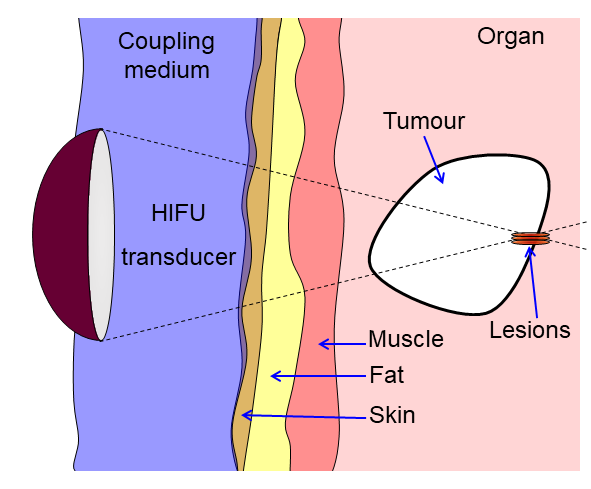
Diagram showing how HIFU can be used to destroy tissue in the body. An acoustic lens is used to focus sound to a small point in the body. (Credit: James Ross McLaughlan, Wikimedia)
Ultrasound has found many applications in the medical field far beyond imaging, with therapeutic ultrasound by itself covering a variety of methods to perform actions within the body without breaking the skin. By using high-energy ultrasound, everything from kidney stones to fat cells and cancerous cells can be accurately targeted and destroyed. For liver tumors the application of so-called histotropsy has become quite common, allowing certain types of tumors to be ablated non-invasively after which the body can handle the clean-up.
Histotropsy is a form of high-intensify focused ultrasound (HIFU) that uses either continuous or pulsed waves to achieve the desired effect, with the HIFU transducer equipped with an acoustic lens to establish a focal point. In the case of histotripsy cavitation is induced at this focal point that ends up destroying the local tissue. Beyond liver tumors the expectation is that other tumors will soon be treated in a similar manner, which could be good news for especially solid tumors.
Along with new approaches like CAR T cell immunotherapy, the prospects for cancer becoming a very treatable set of diseases would seem to be brighter than ever.
Mark Litton, president and CEO of Athira Pharma. (Athira Photo)
In a remarkable pivot, Athira Pharma is shifting its primary focus from Alzheimer’s to oncology following a multi-year period marked by clinical failures and leadership turnover.
The Bothell, Wash.-based company announced today that it has licensed a Phase 3 breast cancer drug from Sermonix Pharmaceuticals, supported by $90 million in funding from a group of healthcare investment firms. It could land an additional $146 million if the research yields promising results.
Athira will simultaneously continue researching ATH-1105, its own drug candidate for treating ALS.
Athira President and CEO Mark Litton called the development “exciting and transformative news.”
“By securing rights to this late-stage program — while also advancing pATH-1105 for ALS — we are building a pipeline that we believe has the potential to change lives and create enduring value,” Litton said on LinkedIn. “We are honored to have the backing of some of the most respected biotechnology funds in the industry.”
Following the deal announcement, the company’s stock rose 70% to $7 per share.
Athira has been through a tumultuous few years:
Its Alzheimer’s disease drug candidate, called fosgonimeton, stumbled and then failed a Phase 2/3 trial last year.
That sank Athira’s stock price and triggered a layoff of 49 employees, or about 70% of its workforce in September 2024.
In 2021, Athira CEO and President Leen Kawas resigned after it was confirmed she had altered images in scientific papers from her graduate studies that helped form the company’s foundation.
Details on the deal
Under today’s deal, Athira secures an exclusive license to develop and commercialize the breast cancer therapeutic for nations outside of Asia and select Middle Eastern countries. The drug, called lasofoxifene, is currently in a clinical trial that has enrolled over half of its target patient population, with initial results expected in mid-2027.
The agreement provides Sermonix with 5.5 million shares of Athira’s stock. The Seattle company has also committed to paying Sermonix up to $100 million plus limited royalties if certain commercial targets are reached.
Three lead investors are backing the research: New York’s Commodore Capital, biotech hedge fund Perceptive Advisors, and California-based TCGX. Additional participants are ADAR1, Blackstone Multi-Asset Investing, Kalehua Capital, Ligand Pharmaceuticals, New Enterprise Associates (NEA), Spruce Street Capital and 9vc.
Athira raised $90 million by selling stock and warrants to investors, extending its cash runway into 2028. If investors choose to exercise those warrants in the future, the company could receive up to an additional $146 million to fund its clinical programs.
“We’re proud to support this evolution and excited by the opportunity to deliver meaningful impact for patients and shareholders alike,” said Joseph Edelman, founder and CEO of Perceptive Advisors, in a statement.
Regarding its own ALS drug candidate, Athira this year successfully completed Phase 1 safety trials, and plans to start Phase 2 trials early next year.
A schematic illustration of how GigTIME can take a hematoxylin and eosin (H&E) pathology slide and use AI to virtually identify a suite of proteins that would otherwise require multiplex immunofluorescence (mIF). (Microsoft, Providence and UW Illustration)
Pacific Northwest tech and cancer researchers are publicly releasing an AI tool that can perform sophisticated tumor analysis in a fraction of the time and cost of existing methods, potentially making cutting-edge cancer insights available to far more patients.
The GigaTIME model uses artificial intelligence to virtually generate detailed immune system data from standard pathology slides — analysis that would normally require days of lab work and thousands of dollars per sample.
The breakthrough could accelerate the shift toward precision medicine, where treatments are tailored to each patient’s specific cancer biology, said Hoifung Poon, general manager of Microsoft Research’s Real-World Evidence program.
Traditional pathology slides show tumor and immune cells but offer limited insights into whether a patient’s immune system is actively fighting cancer. A more sophisticated technique called multiplex immunofluorescence (mIF) analysis peers closely into the tumor’s microenvironment, adding information about whether immune cells are working based on which proteins are present.
Hoifung Poon, general manager of Microsoft Research’s Real-World Evidence program. (LinkedIn Photo)
But mIF analysis “just for one sample, could easily take days and cost thousands of dollars,” Poon said, severely limiting its use in routine care.
GigaTIME bypasses that bottleneck by generating the information virtually by simply analyzing standard pathology slides.
“GigaTIME is about unlocking insights that were previously out of reach,” said Dr. Carlo Bifulco, chief medical officer of Providence Genomics and a medical director at the Providence Cancer Institute.
The project brings together researchers from Microsoft; Providence facilities in Renton, Wash., and Portland; and the University of Washington’s Paul G. Allen School of Computer Science and Engineering. They’re publishing a peer-reviewed study today in the journal Celland releasing the tool online for free on Hugging Face, GitHub and Microsoft Foundry.
Last year the three institutions released GigaPath, a model for diagnosing cancer.
The initiatives are part of the Seattle-area’s growing efforts to integrate complex health datasets using AI to facilitate advances in medicine. The Allen Institute last month released the Brain Knowledge Platform for neuroscience research, while biotech startup Synthesize Bio has built tools for designing experiments and predicting their outcomes using publicly available data. And the Fred Hutch Cancer Center helped produce a privacy-protecting, data-sharing model through the Cancer AI Alliance.
The scale of the GigaTIME project is giant:
Researchers trained the model on a Providence dataset of 40 million cells, pairing pathology slides with mIF data examining 21 different proteins.
They applied GigaTIME to samples from 14,256 cancer patients across 51 hospitals and more than 1,000 clinics in the Providence system.
The work produced a virtual population of approximately 300,000 mIF images that cover 24 cancer types and 306 cancer subtypes.
Poon has even bigger ambitions that include blending together data gleaned from cell and biopsy samples plus CT radiology reports, MRIs and other diagnostics to create a more holistic picture of a patient. These advanced models could potentially offer predictions about how a disease might progress or respond to treatment.
The new tools could one day help curb the massive costs and time associated with clinical trials by providing better insights for selecting drug candidates and designing studies.
The goal is making advanced cancer care both more effective and more widely accessible.
“I’m personally biased, but I think there can’t be a more exciting time than right now,” Poon said, pointing to the convergence of AI capabilities and digital medical records as “two really powerful forces.”
Authors of the paper “Multimodal AI generates virtual population for tumor microenvironment modeling” are Jeya Maria Jose Valanarasu, Hanwen Xu, Naoto Usuyama, Chanwoo Kim, Cliff Wong, Peniel Argaw, Racheli Ben Shimol, Angela Crabtree, Kevin Matlock, Alexandra Q. Bartlett, Jaspreet Bagga, Yu Gu, Sheng Zhang, Tristan Naumann, Bernard A. Fox, Bill Wright, Ari Robicsek, Brian Piening, Carlo Bifulco, Sheng Wang and Hoifung Poon.
For the Heffernan family, 2017 was a tumultuous year. Bob Heffernan, the patriarch and pitmaster of their barbecue trailer, Heffernan Bar-B-Que, learned he had lung cancer in the spring. His oncologist estimated he had seven months to live. Bob’s wife, Jeannie, helped run the business, but Bob was the one who made the barbecue. The couple’s older son, Cole, had already graduated college and was starting his career. If the torch were to be carried, it would fall to their younger son, Evan, to do it. “I knew if I said no, it would be gone forever,” Evan said. He felt a responsibility to sustain what his father had started, so he dropped out of college and tied on an apron.“I had really no aspirations…
When it comes to treating cancer, groups of synergistic drugs are often more effective than standalone drugs. But coordinating the delivery of multiple drugs is easier said than done. Drugs’ molecular properties tend to differ, making it difficult to ensure that pharmaceuticals make it to their destinations without losing effectiveness along the way. An all-new multidrug nanoparticle might be the solution. A team of researchers at MIT has created a “molecular bottlebrush” capable of delivering any number of drugs at the same time.
Drug-loaded nanoparticles—or ultrafine particles ranging from one to 100 nanometers in diameter—prevent treatments from being released prematurely, which ensures that the drug reaches its destination before beginning to do its job. This means nanoparticles carrying cancer treatments can collect at the tumor site, facilitating the most effective treatment possible. There is, of course, one caveat: Only a few cancer-treating nanoparticles have been approved by the FDA, and only one of those is capable of carrying more than one drug.
MIT’s molecular bottlebrush, detailed Thursday in the journal Nature Nanotechnology, challenges that. Chemists start by inactivating drug molecules by binding and mixing them with polymers. The result is a central “backbone” with several spokes. All it takes to activate the inactivated drugs sitting along the backbone is a break in one of those spokes. This unique design is what enables the new nanoparticle to carry (and thus deliver) multiple drugs at a time.
(Image: Detappe et al/Nature Nanotechnology/MIT)
The team tested the molecular bottlebrush in mice with multiple myeloma, a type of cancer that targets the body’s plasma cells. They loaded the nanoparticle with just one drug: bortezomib. On its own, bortezomib usually gets stuck in the body’s red blood cells; by hitching a ride on the bottlebrush, however, bortezomib accumulated in the targeted plasma cells.
The researchers then experimented with multidrug combinations. They tested three-drug bottlebrush arrangements on two mouse models of multiple myeloma and found that the combinations slowed or stopped tumor growth far more effectively than the same drugs delivered sans bottlebrush. The team even found that solo bortezomib, which is currently approved only for blood cancers and not solid tumors, was highly effective at inhibiting tumor growth in high doses.
Through their startup Window Therapeutics, the researchers hope to develop their nanoparticle to the point that it can be tested through clinical trials.

 Login
Login





 For the Heffernan family, 2017 was a tumultuous year. Bob Heffernan, the patriarch and pitmaster of their barbecue trailer, Heffernan Bar-B-Que, learned he had lung cancer in the spring. His oncologist estimated he had seven months to live. Bob’s wife, Jeannie, helped run the business, but Bob was the one who made the barbecue. The couple’s older son, Cole, had already graduated college and was starting his career. If the torch were to be carried, it would fall to their younger son, Evan, to do it. “I knew if I said no, it would be gone forever,” Evan said. He felt a responsibility to sustain what his father had started, so he dropped out of college and tied on an apron.“I had really no aspirations…

