Gobi Manchurian is a popular Indian-Chinese appetizer made with batter-coated, crispy fried cauliflower tossed in a spicy, slightly sweet, umami sauce. The sauce is prepared with spring onions, capsicum, green chillies, ginger, garlic, soy sauce, and tomato ketchup. The dry version is most commonly served in Chinese restaurants as a starter or snack. While it...
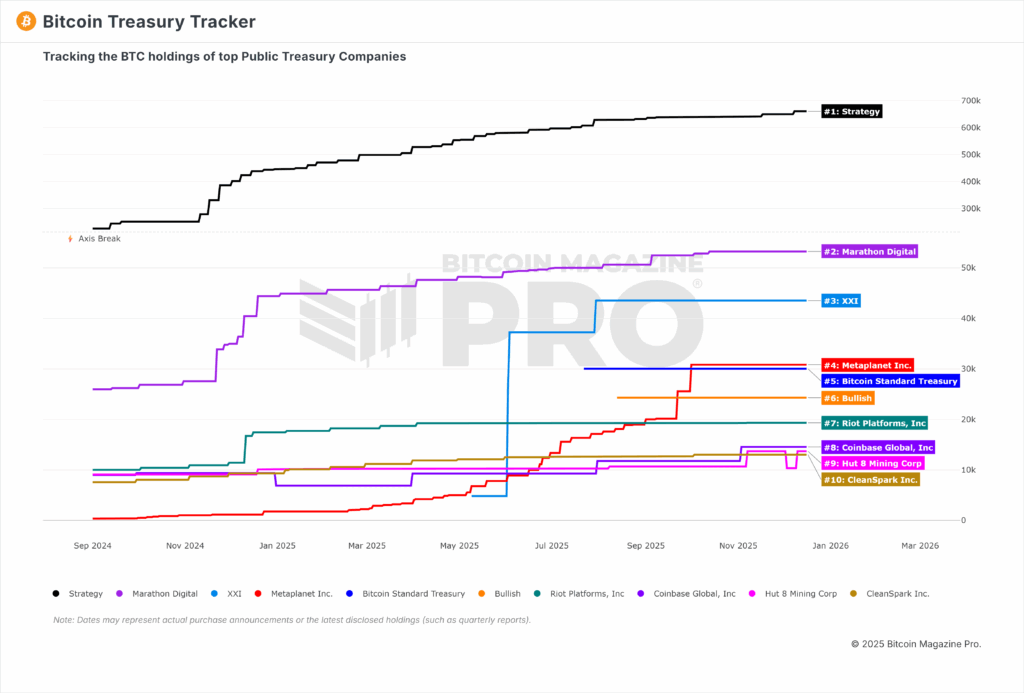
Bitcoin treasury companies have been hit hard by Bitcoin’s disappointing price action throughout 2025. Publicly traded firms holding significant BTC reserves are suffering the most, with leaders like (Micro)Strategy pushing aggressive accumulation amid headwinds—yet most now trade below net asset value, creating a rare opportunity for risk-tolerant strategic investors.
Figure 1: Tracking BTC holdings of the top public Bitcoin Treasury Companies. View live chart.
The Bitcoin Treasury Companies Landscape
Not all Bitcoin treasury companies are created equally. Strategy stands apart as the industry standard-bearer, the “Bitcoin among treasury companies,” as it were. The company has maintained its accumulation discipline even as its stock has suffered, recently announcing a $1.44 billion USD reserve specifically designed to pay dividends and debt obligations without forcing Bitcoin sales.
This capital buffer theoretically eliminates the need for excessive dilutive share issuance or forced BTC liquidation, a critical distinction from weaker competitors. Many will likely face shareholder pressure and potential forced selling as their stock prices decline, creating a cascade of supply pressure that could paradoxically benefit the strongest players like MSTR.
Valuation Dynamics of Bitcoin Treasury Companies
The most compelling aspect of current treasury company valuations is that they now trade below net asset value on a per-share basis. In practical terms, you can currently purchase one dollar’s worth of Bitcoin for less than one dollar through treasury company stock. This represents an arbitrage opportunity for investors, though one accompanied by elevated volatility and company-specific risks.
Figure 2: Bitcoin Magazine Pro’s top 20 public Bitcoin Treasury Company HODLboard. View live table.
Strategy currently sits at a net asset value premium of less than 1, meaning the company’s market capitalization is below the value of its Bitcoin holdings alone. The upside scenario is striking. If Bitcoin reclaims its previous all-time high around $126,000, Strategy continues accumulating toward 700,000 BTC, and the market assigns even a modest 1.5x to 1.75x net asset value premium, Strategy could approach the $500 region per share.
From Weak to Strong: The Future of Bitcoin Treasury Companies
Examining Strategy’s performance during the previous Bitcoin bear market and overlaying it onto the current cycle reveals eerie alignment. The bar patterns suggest current price levels represent reasonable support, with only a catastrophic final flush justified by Bitcoin weakness providing reason to expect substantially lower levels.
As weaker treasury companies face forced selling, a consolidation thesis emerges, that Strategy and similar strong-positioned players will potentially accumulate cheap Bitcoin from distressed sellers, further concentrating holdings in the most disciplined accumulators. This dynamic mirrors Bitcoin’s own consolidation process, weaker hands sell, stronger hands accumulate, and the asset becomes more concentrated among conviction holders.
Conclusion: Opportunity in Bitcoin Treasury Companies
Bitcoin treasury companies have for the most part delivered disappointing returns in 2025, but this performance has created a window of exceptional opportunity for disciplined investors. At current valuations, Strategy is essentially selling one dollar of Bitcoin for approximately 90 cents, a discount that becomes even more attractive if Bitcoin experiences one final capitulation flush. The probability of this scenario combined with Strategy’s positioned upside creates asymmetric risk-reward worthy of small, carefully-sized positions within aggressive portfolios.
Disclaimer: This article is for informational purposes only and should not be considered financial advice. Always do your own research before making any investment decisions.
The Bitcoin Magazine Pro Price Forecast Tools chart provides a comprehensive framework for identifying potential price floors during bear cycles and forecasting upside targets based on on-chain fundamentals and network-derived data points. By aggregating multiple metrics, this methodology has historically called Bitcoin market cycle peaks and bottoms with remarkable accuracy. Can these tools continue to provide a basis for reliable BTC price forecasting over the next 12 months and beyond?
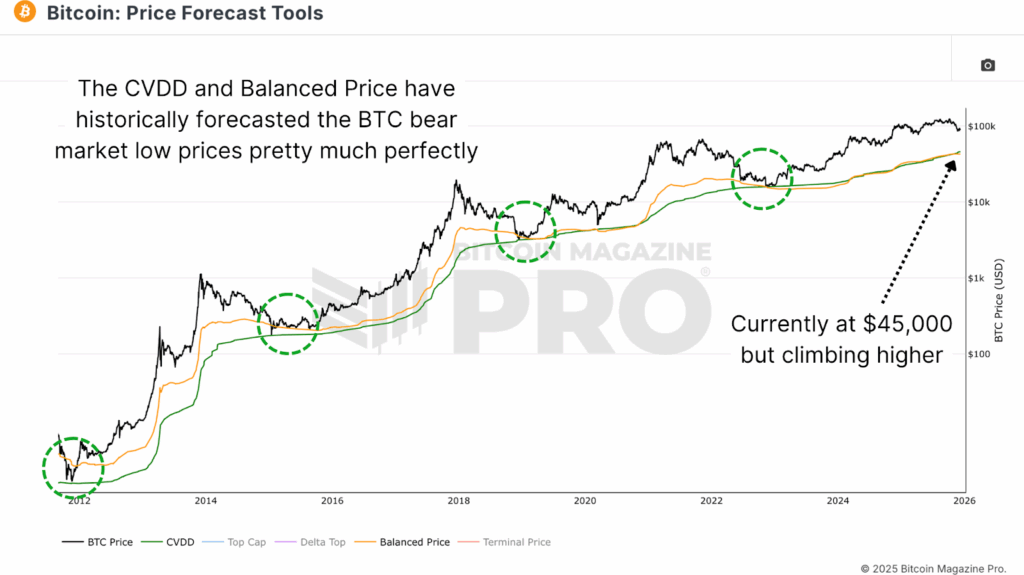
The Cumulative Value Days Destroyed (CVDD) metric has historically called Bitcoin price cycle lows almost to perfection across every cycle since Bitcoin’s inception. This metric begins with Coin Days Destroyed, a measure that weights Bitcoin transfers by the duration they were held before movement. For example, holding 1 Bitcoin for 100 days produces 100 coin days destroyed when transferred, while holding 0.1 Bitcoin for the same result requires 1,000 days of holding. Large spikes indicate that the network’s most experienced long-term holders are transferring significant amounts of Bitcoin.
Figure 1: The convergence of the CVDD and Balanced Price with BTC price has historically aligned with bear market lows.View Live Chart
The CVDD takes this one step further by measuring the USD valuation at the time of transfer rather than just the coin days destroyed quantity alone. This value is then multiplied by 6 million to produce the final metric. When examined across Bitcoin’s entire history, the CVDD has indicated bear market lows with accuracy extending across every cycle. Currently, the CVDD sits at approximately $45,000, though this level trends upward over time as the metric naturally evolves with new transfers and Bitcoin’s price appreciation.
The Balanced Price metric complements this downside projection by subtracting the Transferred Price (its calculation methodology is explained later) from the Realized Price, the cost basis or average accumulation price for all bitcoin holders, providing another historically accurate bear cycle low signal.
The Top Cap metric begins with the all-time average cap, the cumulative sum of Bitcoin’s market capitalisation divided by the number of days Bitcoin has existed. This all-time weighted moving average is then multiplied by 35 to produce the Top Cap. Historically, this metric has been remarkably accurate for calling bull market peaks, though in recent cycles it has exceeded actual price action, currently projecting to a seemingly unattainable ~$620,000.
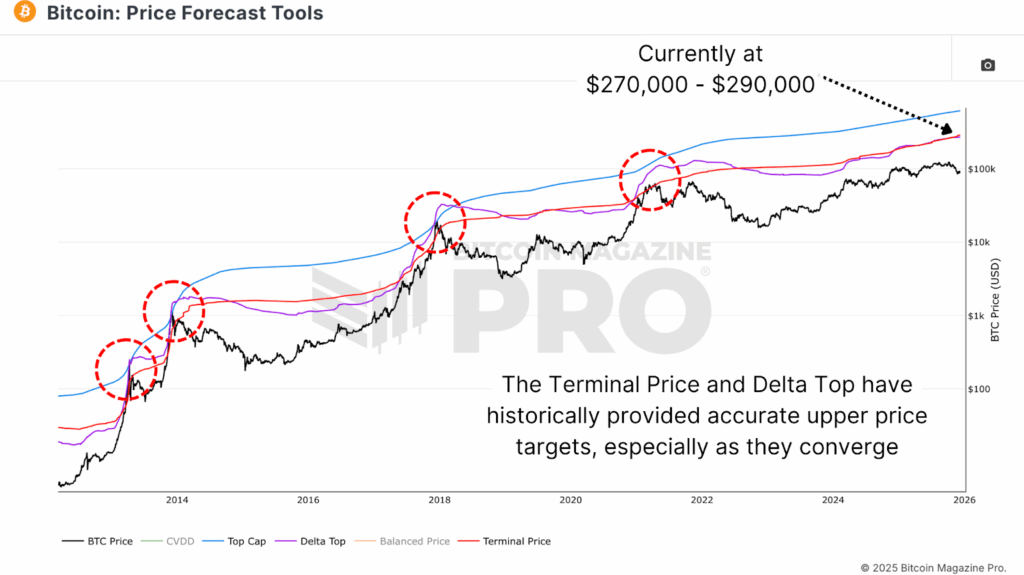
The Delta Top refines this approach by using the realized cap. The realized cap currently stands at approximately $1.1 trillion. Delta Top is calculated by subtracting the average cap from the realized cap and multiplying by 7. This metric has been accurate historically, though it was slightly off during the 2021 cycle, and it is looking more likely that it will not be reached in the current cycle, currently sitting at approximately $270,000.
Figure 2: Delta Top and Terminal Price metrics have frequently aligned with market tops.View Live Chart
The Terminal Price metric provides another layer of sophistication. It calculates the Transferred Price, the sum of Coin Days Destroyed divided by the Circulating Bitcoin Supply, and multiplies this by 21 (the maximum Bitcoin supply). This produces a price level based on the fundamental assumption of total network value distributed across all 21 million Bitcoins. Historically, the Terminal Price has been one of the most accurate top-calling tools, marking previous cycle peaks nearly to perfection. This metric currently sits at approximately $290,000, not too far above Delta Top’s current value.
Bitcoin Cycle Master: Aggregated Bitcoin Price Fair Value Framework
Integrating all these individual metrics into a unified framework produces the Bitcoin Cycle Master chart, which combines these on-chain forecast tools for confluence. This has helped to identify where Bitcoin may be in a cycle, either close to bull or bear market highs, or oscillating around its ‘Fair Market Value’.
Figure 3: The Bitcoin Cycle Master currently indicates a Fair Market Value of approximately $106,000.View Live Chart
Examining the past two cycles demonstrates the utility of this framework. When Bitcoin trades above the Fair Market Value band, bull markets have historically entered exponential growth phases. When beneath this band, Bitcoin typically signals bear market conditions where defensive positioning and aggressive accumulation become appropriate strategies.
By extracting raw data from the price forecast tools and projecting the slope of both the CVDD and Terminal Price forward to the end of 2026, two scenarios emerge. The CVDD, which has moved at a predictable rate of change over the past 90 days, projects to approximately $80,000 by December 31, 2026. This level could represent a potential bear cycle floor, though Bitcoin has already traded beneath this level during recent downward moves, suggesting current prices may already offer compelling value.
Figure 4: Extrapolating the CVDD and Terminal Price metrics across 2026 provides a considerable range for potential BTC price action.
The Terminal Price, extrapolating its current upward trend, could reach over $500,000 by the end of 2026, though this projection could only be a realistic outcome with a bullish macro environment with significant liquidity injections and broad realization of Bitcoin’s fundamental value proposition.
Conclusion: What Bitcoin Price Forecast Tools Are Signaling for 2025–2026
These Bitcoin price forecast tools, formulated using on-chain fundamental and network-derived data points rather than psychological levels or traditional technical analysis applicable to equities and commodities, have historically provided exceptional accuracy in calling market cycle peaks and bottoms. Forecasting based on their current values suggests a potential bear cycle floor in the $80,000 range by the end of 2026, with upside targets potentially reaching over $500,000, depending on macro conditions and capital flows.
While these projections represent extrapolations of current trends rather than certainties, the historical accuracy and on-chain foundation of these metrics warrant serious consideration. Investors and traders should continue monitoring both the raw price forecast tools and the aggregated Bitcoin Cycle Master framework to identify fair valuation levels, extreme overvaluation warnings, and attractive accumulation zones within the current cycle. However, all projections change daily as new data emerges, making reactive analysis superior to long-term prediction.
Disclaimer: This article is for informational purposes only and should not be considered financial advice. Always do your own research before making any investment decisions.
Bitcoin miner hash rate has experienced a significant decline since mid-October, falling sharply despite years of near-uninterrupted growth. This pullback reflects genuine bitcoin miner capitulation driven by deteriorating profitability in the face of Bitcoin’s recent price weakness. However, could this bitcoin miner shift actually provide a golden opportunity?
Bitcoin Miner Profitability
The Bitcoin network’s total computational hash rate has entered a notable downtrend since October 18th, reversing what has otherwise been a consistent multi-year climb. The hash ribbons indicator, which compares the 30-day moving average of hash rate against the 60-day moving average, has turned red, indicating miner capitulation. When the longer-term moving average crosses above the shorter-term one, it signals that miners are withdrawing computational power from the network, typically because profit margins have become too thin to justify continued operations at previous levels.
The Puell Multiple, which measures daily USD earnings for miners relative to their 365 day moving average, recently collapsed to approximately 0.67. This means miners are earning only two-thirds of their yearly average revenue. The metric reveals a concerning trend, as Bitcoin has matured and the network has grown, mining economics have become increasingly compressed.
Bitcoin Miner Revenue Under Pressure
A deeper issue lies in the composition of miner revenue. Bitcoin miners derive income from two sources: block subsidies and transaction fees. The current block subsidy stands at 3.125 BTC per block, representing the lion’s share of miner revenue. However, transaction fees, which could theoretically offset declining subsidies over time, have entered a long-term downtrend throughout this cycle. When measured in USD terms, miner fee revenue is now practically negligible compared to the block subsidy.
This creates an uncomfortable math problem. The block subsidy decreases by 50% every four years at the halving. For miner revenue to remain constant, Bitcoin’s price must reliably double every four years. This requirement becomes increasingly unrealistic as Bitcoin matures and approaches tens or hundreds of trillions in market capitalization. Within 20-30 years, the halvings would require Bitcoin prices of tens of millions of dollars per unit merely to maintain current revenue levels for miners.
Structural Hurdles for Bitcoin Miners
When block subsidies eventually decline toward zero over the coming decades, transaction fees must theoretically fill that gap. Yet the current cycle demonstrates that fee revenue is moving in the opposite direction and declining as users migrate to more efficient layer-two solutions like the Lightning Network and as on-chain transaction volume stagnates.
Layer-two scaling solutions are good for Bitcoin’s utility and lower users’ costs. Similarly, fewer on-chain transactions reducing congestion and fees is positive for accessibility. But these developments and improvements that make Bitcoin more practical as a payments layer simultaneously reduce the revenue available to secure the base layer long-term.
Conclusion: Bitcoin Miner Capitulation as Opportunity
Bitcoin miners are undoubtedly capitulating, driven by declining price action and deteriorating profit margins. For tactical traders and accumulation-minded investors, this represents a favorable window to scale into positions, particularly once the hash ribbons reversal signal emerges. History suggests such periods rarely persist without eventually producing sharp Bitcoin rallies.
Disclaimer: This article is for informational purposes only and should not be considered financial advice. Always do your own research before making any investment decisions.
Bitcoin has struggled to maintain a sustained correlation with Gold, recently only moving in unison during market downturns. However, examining Bitcoin’s price action through the lens of Gold rather than USD reveals a more complete picture of the current market cycle. By measuring Bitcoin’s true purchasing power against comparable assets, we can identify potential support levels and gauge where the bear market cycle may be approaching its conclusion.
Bitcoin Bear Market Officially Begins Below Key Support
Breaking beneath the 350-day moving average at about $100,000 and the significant psychological 6-figure barrier marked the functional entry into bear market territory, with Bitcoin declining approximately 20% immediately thereafter. From a technical perspective, trading beneath The Golden Ratio Multiplier moving average has historically indicated Bitcoin entering a bear cycle, though the narrative becomes more interesting when measured against Gold rather than USD.
Figure 1: BTC breaking beneath the 350DMA has historically coincided with the start of bear markets.View Live Chart
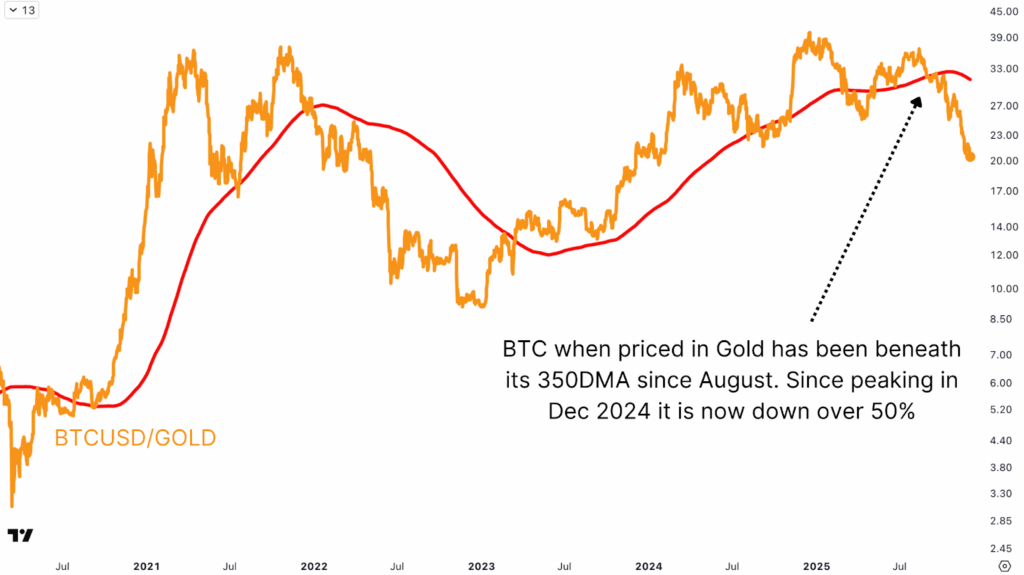
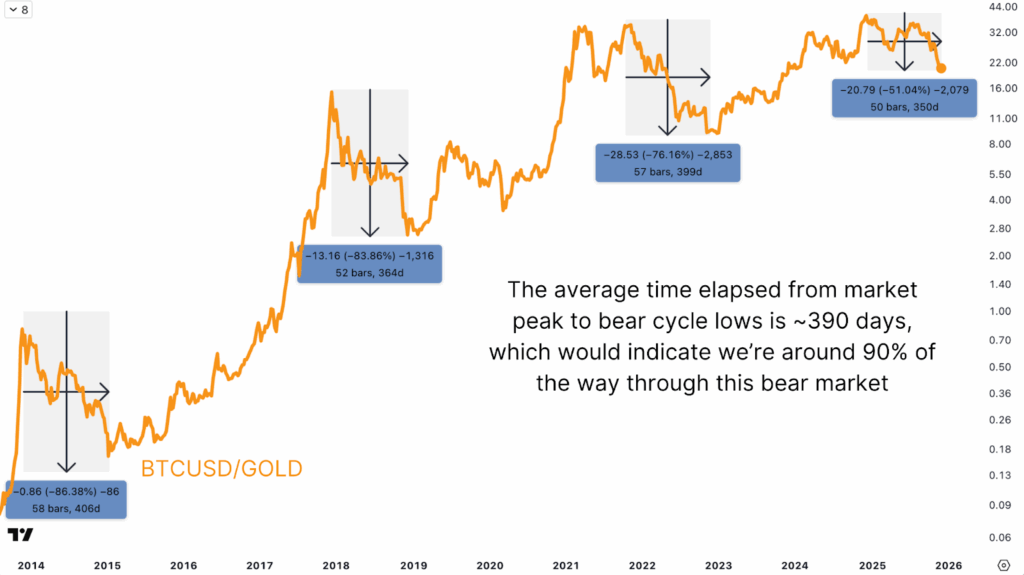
The Bitcoin versus Gold chart tells a notably different story than the USD chart. Bitcoin topped out in December 2024 and has since declined over 50% from that level, whereas the USD valuation peaked in October 2025, significantly beneath the highs set the prior year. This divergence suggests that Bitcoin may have been in a bear market for considerably longer than most observers realize. Looking at historical Bitcoin bear cycles when measured in Gold, we can see patterns that suggest the current pullback may already be approaching critical support zones.
Figure 2: When priced in Gold, BTC dropped beneath its 350DMA back in August.
The 2015 bear cycle bottomed at an 86% retracement lasting 406 days. The 2017 cycle saw 364 days and an 84% decline. The previous bear cycle produced a 76% drawdown over 399 days. Currently, at the time of this analysis, Bitcoin is down 51% in 350 days when measured against Gold. While percentage drawdowns have been diminishing as Bitcoin’s market cap grows and more capital flows into the market, this trend reflects the rising tide of institutional adoption and lost Bitcoin supply rather than a fundamental change in cycle dynamics.
Figure 3: Plotting BTC’s value in Gold reveals a cycle pattern that suggests we could already be 90% of the way through this bear market.
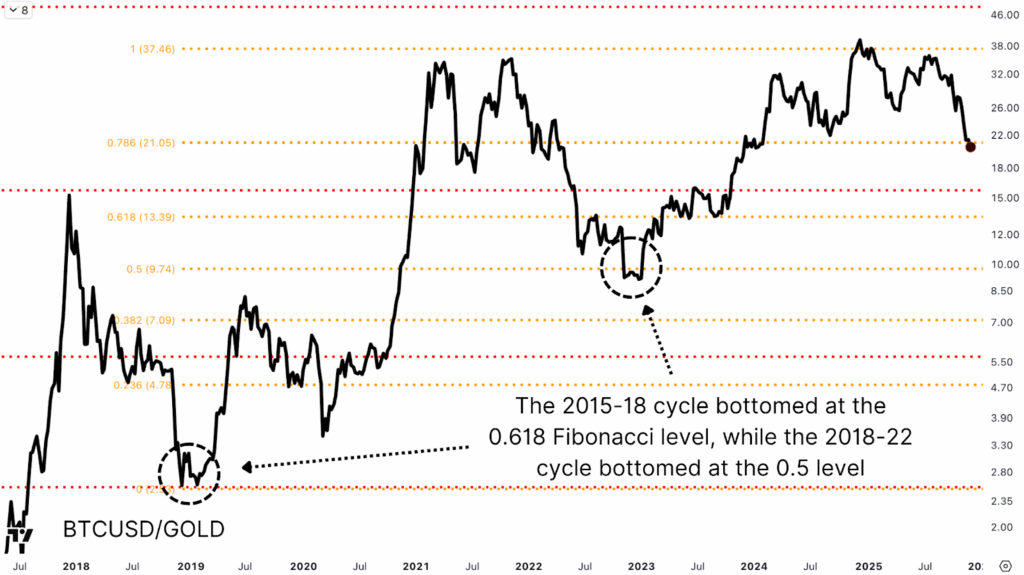
Rather than relying solely on percentage drawdowns and time elapsed, Fibonacci retracement levels mapped across multiple cycles provide greater precision. Using a Fibonacci retracement tool from bottom to top across historical cycles reveals striking levels of confluence.
Figure 4: In previous cycles, bear market bottoms have aligned with key Fibonacci retracement levels.
In the 2015-2018 cycle, the bear market bottom occurred at the 0.618 Fibonacci level, which corresponded to approximately 2.56 ounces of Gold per Bitcoin. The resulting price action marked the bottom with remarkable clarity, far cleaner than the equivalent USD chart. Moving forward to the 2018-2022 cycle, the bear market bottom aligned almost perfectly with the 0.5 level at approximately 9.74 ounces of Gold per Bitcoin. This level later acted as meaningful resistance-turned-support once Bitcoin reclaimed it during the subsequent bull market.
Translating Bitcoin Bear Market Gold Ratios Back to USD Price Targets
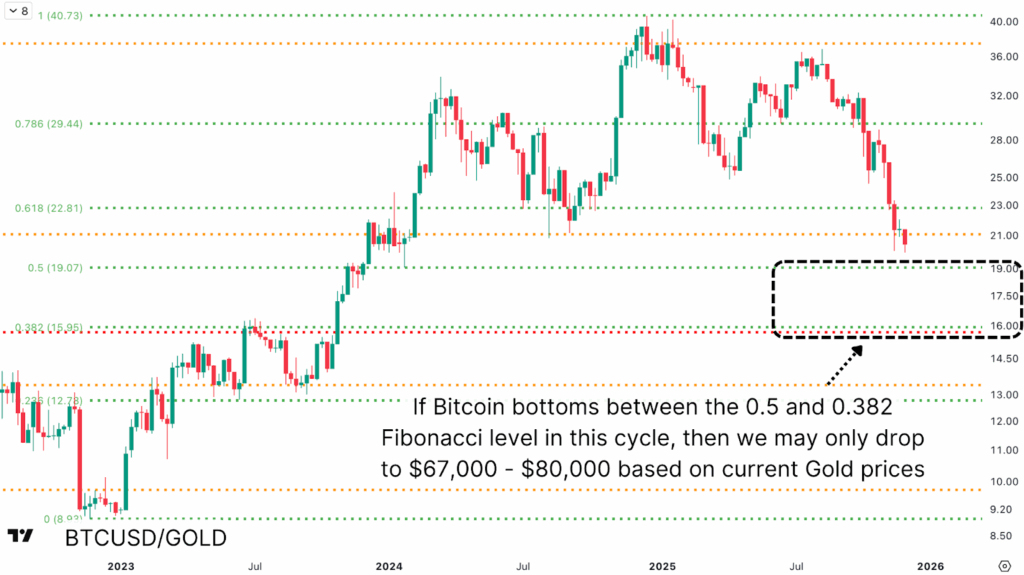
From the previous bear market low through the current bull cycle high, the 0.618 Fibonacci level sits at approximately 22.81 ounces of Gold per Bitcoin, while the 0.5 level rests at 19.07 ounces. Current price action is trading near the midpoint of these two levels, presenting what may be an attractive accumulation zone from a purchasing power perspective.
Figure 5: Applying Fibonacci levels to predict market lows for BTC versus Gold and subsequently pricing these back into USD, illustrates where Bitcoin’s price may bottom.
Multiple Fibonacci levels from different cycles create additional confluence. The 0.786 level from the current cycle translates to approximately 21.05 ounces of Gold, corresponding to a Bitcoin price around $89,160. The 0.618 level from the previous cycle aligns near $80,000 again. These convergence zones suggest that if Bitcoin were to decline further, the next meaningful technical target would be around $67,000, derived from the 0.382 Fibonacci retracement level at approximately 15.95 ounces of Gold per Bitcoin.
Conclusion: The Bitcoin Bear Market May Be 90% Complete Already
Bitcoin has likely been in a bear market for substantially longer than USD-only analysis suggests, with purchasing power already declining significantly since December 2024, when measured against Gold and other comparable assets. Historical Fibonacci retracement levels, when properly calibrated across multiple cycles and converted back into USD terms, point toward potential support confluence in the $67,000 to $80,000 range. While this analysis is inherently theoretical and unlikely to play out with perfect precision, the convergence of multiple data points across time horizons and valuation frameworks suggests the bear market may be approaching its conclusion sooner than many anticipate.
Disclaimer: This article is for informational purposes only and should not be considered financial advice. Always do your own research before making any investment decisions.
Sabudana Vada, one of our favorite fasting snacks is a crispy, soft, savory and mildly sweet patty featuring softened tapioca pearls (sago), mashed potatoes, crunchy peanuts, fragrant spices and fresh herbs. It is naturally gluten-free and vegan. This foolproof Maharashtrian style Sabudana Vada recipe gives you a super delicious, crispy vada with a soft and...
Poha is a light and popular Maharashtrian breakfast made with flattened rice, onions, herbs, spices, and sometimes peanuts or potatoes. It has many regional versions like Kanda Poha, Dadpe Pohe, and Indori Poha. This Kanda Poha recipe is made with onions, potatoes, peanuts, and basic spices. It is easy to cook, filling, and naturally vegan...
Paneer Butter Masala is one of the most loved paneer curries, both in restaurants and Indian homes. I’ve been making this recipe for years, refining it until it became a family favorite. This restaurant-style curry is creamy, lightly spiced, and always a hit. With my step-by-step photos and video, you’ll see how easy it is...
Schezwan Fried Rice is a vibrant Indo-Chinese dish made by stir-frying cooked rice with a spicy, tangy Schezwan sauce, mixed vegetables and mushrooms, garlic, spring onions, celery, vinegar, salt and pepper, creating a flavorful, zesty rice dish that’s perfect as a main or side, often served with manchurian or other Chinese-inspired dishes. Schezwan Fried Rice...
Besan Ladoo (also referred to as Besan ke Laddu) is a traditional as well as a popular North Indian sweet made by slow-roasting gram flour (besan) in ghee until golden and aromatic, then mixing it with powdered sugar, cardamom, and chopped nuts before shaping it into round, melt-in-the-mouth balls. Rich, nutty and fragrant, these laddus...
Ahh, today is that glorious day when I realize that my plan to write one or even two articles a month on my wonderful blog is failing. And then I remind myself that my worth checking series is not only there to share knowledge and interesting material but also to save my ass in just such situations. To
I hope you haven’t forgotten about the Worth Checking series. Here you can check out the latest one. I thought I’d post monthly in this format, but it would turn out that I’d have more entries like this than my own :) If there were maybe 10 articles a month, it would make as much sense as possible.
Tomato Rice, also known as Thakkali Sadam, is a flavorful South Indian rice dish made with rice sautéed in a spiced tomato masala, tempered with mustard seeds, curry leaves, herbs and aromatic spices. Tangy, mildly spicy and comforting, this one-pot meal is a popular choice for lunchboxes and quick meals, best enjoyed with raita or...
Ghee is a type of clarified butter that is traditional in Indian cuisine. This nutty flavored and high smoke point fat has been used for thousands of years, with deep roots in Ayurvedic practices. Making desi ghee at home is simple, easy and cost effective and will render much better flavor than commercially available varieties....
Soft fluffy & creamy swiss rolls with fruity strawberry filling… Swiss Jelly Roll, also known as Swiss Roll, is a type of cake that is made with a light sponge cake rolled around a filling, usually jelly or cream. The cake is typically baked in a jelly roll pan and then rolled up while still […]
The Weekly Stash is a recap of the week’s top business headlines in the cannabis industry for the week ending February 10, 2023.
Canopy Growth Corp. (TSX: WEED) (Nasdaq: CGC) reported slumping revenues on Thursday and signaled a new cost-savings era that includes cutbacks on cultivation and 800 layoffs. Revenue fell by 28% to $101 million in the quarter. Canopy ‘s historical cash burn has swelled its net losses 131% over the year to $266.7 million. Cash and short-term investments fell by a whopping $583 million to $789 million at the end of December from $1,372 million at the end of March 2022.
The acquisition of New York medical cannabis operator Etain by Riv Capital is entering another messy chapter. Scotts Miracle-Gro (NYSE: SMG), owner of the hydroponic company Hawthorne, has filed a lawsuit against Jason Wild and TerrAscend (OTC: TRSSF) claiming they ruined its $175 million investment. Hawthorne is complaining that Wild fought Riv Capital’s plans to buy Etain asking the board to call off the deal and threatening to attain a hemp license in the state in a move to kill the deal. Wild’s position is that Riv Capital overpaid for the property.
SNDL Inc. (Nasdaq: SNDL) finalized its purchase of Canadian dispensary chain Superette out of bankruptcy, with plans to support the brand and its stores.SNDL will license some of Superette’s IP to Spirit Leaf Ontario for their retail locations, the company said.
In state news,
Over the first three-day weekend of legal recreational marijuana sales in Missouri, medical and adult-use retail sales combined to hit $12.6 million in sales, the state announced. Many shops reported long lines this past Friday. According to the Missouri Department of Health & Senior Services’ Cannabis Division Regulation, the industry sold $8.5 million in recreational cannabis and another $4.1 million in medical marijuana for Feb.3-5, for a grand total of $12,689,965.
In a break from a national trend, a federal judge in Washington state upheld the state’s residency requirement for cannabis business ownership and ruled that the U.S. Constitution’s dormant commerce clause doesn’t apply because marijuana is still federally illegal. U.S. District Judge Benjamin Settle sided with the Washington Liquor and Cannabis Board and tossed a lawsuit filed in 2020 by marijuana investor Todd Brinkmeyer, who had asked the court to rule that Washington’s residency requirement is unconstitutional.
The start date for Maryland’s upcoming adult-use cannabis market could be as soon as July 1, under the terms of a new legislative bill introduced this week by state lawmakers.
New York has said it will begin cracking down on illegal operators while the state’s Office of Cannabis Management recommended that medical licenses be expanded. The OCM also suggested that medical patients no longer have to register.
If you haven’t already signed up for the Morning Rise newsletter. It’s free and hits your inbox at 7 am with fresh content – not just a collection of headlines from other outlets. Wake and partake of the GMR Rise.
Chicken thighs grilled and charred over charcoal grill. Then sliced and used for a quick and easy Pellet Grill BBQ-style Chicken Pizza using White BBQ Sauce, Jalapeños and lots of cheese! This recipe is a perfect Football Food!
WHAT MALCOM USED IN THIS RECIPE:
Grilled chicken thighs used to make a simple – quick and easy – BBQ Chicken Pizza… using White BBQ Sauce, Jalapeños and lots of cheese! This recipe is a perfect Football Food!
Prepare a charcoal grill for 2 zone grilling. Hot coals on one side and a cool zone on the other.
Season boneless, skinless chicken thighs with Killer Hogs Hot Rub.
Place the chicken thighs on direct side of the grill. Flip sides for even cooking every 3-5 minutes. Continue cooking chicken thighs until internal temp hits 165 minimum. You can always move chicken to cool side to allow to finish cooking if needed.
Rest the chicken thighs for 5 minutes and slice into thin strips.
Preheat pellet grill – or any other grill – set up for indirect cooking at 425 degrees F. You can also cook pizza in the oven.
Open pizza crust and spread it on a greased baking sheet.
Spread Killer Hogs White Sauce over crust. Sprinkle half the mozzarella over sauce.
Top with grilled chicken thigh strips. Add sliced jalapeños and diced onion followed by triple blend cheddar and remaining mozzarella.
Place pizza on grill and cook until cheese has melted and edges are golden brown – about 25-30 minutes but keep an eye on it.
Remove pizza from grill and drizzle too with Killer Hogs The BBQ Sauce before cutting to serve.
Curaleaf Holdings, Inc. (CSE: CURA) (OTCQX: CURLF) is finally exiting a trio of legacy western states in search for better profits. The exodus will begin this month with the “proactive closure of the majority of its operations” including its production and cultivation facilities in California, Colorado, and Oregon. The company cited the lack of enforcement over the illicit market and price compression as to why it was tapping out of the west coast. The company is also laying off 10% of its workforce. The company said it expects to save $60 million through the moves.
New York-based Ascend Wellness Holdings (CSE: AAWH.U) (OTCQX: AAWH) announced its expansion into Maryland with its $19 million purchase of Devi Holdings, which runs four operational medical marijuana dispensaries. The move marks the seventh state in which Ascend Wellness has a footprint, according to a press release. The company already has cannabis shops in Illinois, Massachusetts, Michigan, New Jersey, Ohio, and Pennsylvania, according to its website.
Long-awaited federal guidance on cannabis clinical drug trials for humans has finally arrived. The guidance document from the U.S. Food and Drug Administration follows the 2018 federal farm bill, which removed cannabis with less than 0.3% THC by dry weight from the list of controlled substances. The move could dramatically accelerate the value of the CBD industry, which has been waiting on the guidance, and it could also help the industry back up some of the health claims various companies have made, which got them warning letters from the agency.
In state news…
Mississippi began its medical cannabis sales this week. The state legalized medical marijuana just a year ago.
New York opened its first social equity applicant dispensary and the state approved 30 more retail licenses.
In legal news this week, Nike is suing a Texas cannabis company for using the slogan “Just Hemp it”. A Michigan developer filed a $60 million lawsuit claiming delays led to a loss of funding and tenants for its project and Helping Hands Wellness Center Inc. in Nevada had its licenses suspended after inspectors “discovered Helping Hands’ employees were diverting product to the illicit market.
As a reminder, you can now submit applications to the 2023 GMR Women’s Leadership Awards, just head over to the website and there’s a link in our Summits tab.
Next week we expect earnings from High Tide, Scotts Miracle-Gro, and MedMen.

 Login
Login