Reading view

There are new articles available, click to refresh the page.

Monero, Zcash, And Dash Prohibited In India Amid Money-Laundering Crackdown

India’s Financial Intelligence Unit (FIU‑IND) has launched a fresh anti‑money‑laundering crackdown aimed at privacy‑focused cryptocurrencies. The move targets Monero (XMR), Zcash (ZEC), and Dash (DASH), which together represent the largest and most widely used privacy coins globally.

India Tightens Crypto Oversight

Details of the action were shared on Friday by market analyst MartyParty on social media platform X (previously Twitter), who notes that FIU‑IND has issued a directive to crypto exchanges registered in India, instructing them to immediately suspend deposits, withdrawals, and trading activity for Monero, Zcash, and Dash. 

At the heart of the regulator’s concerns is the technology underpinning these assets. Privacy coins rely on advanced cryptographic techniques designed to obscure transaction details, wallet balances, and user identities. 

Monero uses ring signatures to hide the sender and receiver, Zcash allows shielded transactions that conceal transaction data, and Dash offers optional privacy features. 

While these tools are valued by users seeking confidentiality, regulators argue they make it difficult for exchanges to meet know‑your‑customer (KYC) and transaction‑monitoring obligations. The regulator views these features as posing elevated risks related to money laundering, terrorist financing, and sanctions evasion. 

The latest directive applies to all cryptocurrency exchanges registed in the country, which currently includes crypto platforms operating in compliance with Indian regulations. They have been instructed to stop supporting the assets, including delisting, blocking all deposits and withdrawals, and disabling any associated trading pairs.

Monero, Zcash, And Dash Show Mixed Market Reaction

The latest action builds on a broader regulatory push by Indian authorities. In October 2025, FIU‑IND ordered internet service providers to block access to 25 offshore crypto exchanges that failed to register. 

By contrast, only a handful of exchanges currently remain fully registered and compliant in the country. Binance, Mudrex, Coinbase, CoinSwitch (CoinSwitch Kuber), and ZebPay continue to operate legally in India.

Despite the regulatory pressure, market prices for the targeted privacy coins showed short‑term resilience. Over the past 24 hours, all three assets posted gains after recovering from sharp losses earlier in the week. 

Monero was trading at $524 at the time of writing, up 3.5% on the day. Zcash also rebounded modestly, rising 2.2% to trade at $372. Dash recorded the strongest daily performance, jumping 11.6% during the same period.

However, the broader trend remains negative. According to CoinGecko data, Monero, Zcash, and Dash are still down sharply on a weekly basis, with losses of approximately 21%, 8%, and 20% respectively over the past seven days. 

Monero

Featured image from DALL-E, chart from TradingView.com

Monero Triggers Retail Alert That Preceded ZEC And DASH Drops As Privacy Coin Hype Returns

Monero (XMR), one of crypto’s most established privacy-focused assets, has exploded higher to start 2026, delivering one of the strongest moves in the market over the past few days. Monero is built around private, censorship-resistant transactions, using cryptography to obscure wallet balances and transfer details on-chain. That privacy-first design has kept XMR in its own category for years, often moving independently from large-cap altcoins when narrative-driven momentum returns.

Since the beginning of the year, XMR has surged from roughly $410 to nearly $799, a near-vertical move that reflects both aggressive demand and a rapid shift in trader attention toward the privacy coin sector. The breakout comes after similar sharp rallies in names like Zcash (ZEC) and Dash (DASH), which also experienced explosive upside followed by fast pullbacks.

Zcash climbed to around $750 before reversing toward the $400 zone, while Dash ran to roughly $120 and later dropped to near $35. Those moves set the tone for a volatile privacy coin rotation, where price action tends to accelerate quickly once momentum enters the sector.

Now, with Monero leading the pack, the market is watching whether this rally can establish higher support levels, or if it becomes another short-lived spike driven by crowded positioning and thin liquidity.

Retail Hype Signal Flashes As Monero Extends Its Breakout

Monero’s surge is now starting to show the same “retail frenzy” footprint that appeared earlier in other privacy coins, raising questions about how sustainable this move really is. A trading frequency signal—often associated with crowded participation and late-stage chasing—previously lit up in Zcash and Dash near their local tops, before both coins reversed sharply.

Monero Futures Retail Activity Through Trading Frequency Surge | Source: CryptoQuant

In Zcash, the retail-heavy activity spike aligned with a push to roughly $698, and the price has since slid back to around $442, a drawdown of about 37%. Dash followed a similar pattern. The trigger appeared near $120, before the market cooled off aggressively and dragged the price down to the $57 zone. A decline of roughly 52%.

Now, the same signal is flashing for Monero. The retail-frequency threshold appeared around $714 as XMR traded deep into its parabolic advance. That matters because these setups often reflect emotional participation, where buyers enter late, liquidity thins, and volatility increases sharply.

This doesn’t guarantee an immediate top, but history suggests a clear risk: once retail demand becomes dominant, the rally can become fragile. The bigger question is whether Monero can absorb profit-taking without breaking structure—or if it repeats the same post-spike unwind seen in ZEC and DASH.

XMR Surges Into Parabolic Territory

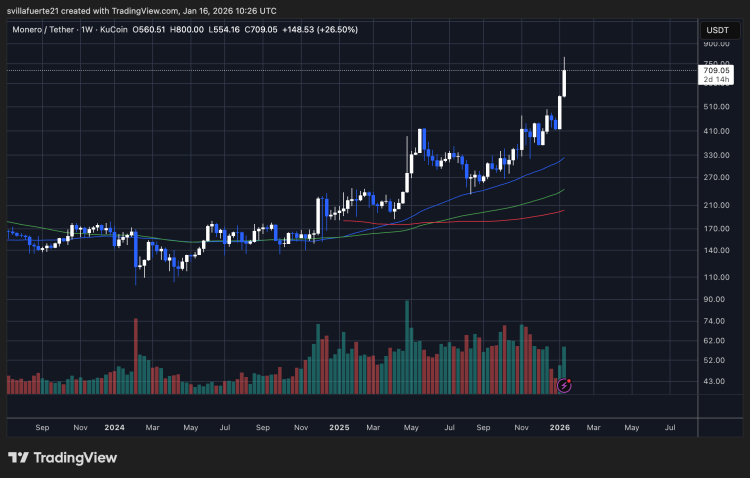
Monero is showing one of the strongest price trends in the market. The weekly chart is now moving into a clear parabolic expansion phase. After spending much of 2024 in a slow accumulation range, XMR gradually built a base and repeatedly defended higher lows. This has set the stage for the subsequent breakout.

Once Monero reclaimed the $200 area, momentum accelerated sharply, and buyers began to absorb sell pressure without allowing deep pullbacks. The chart shows a clear bullish structure. With price holding above rising moving averages and using them as dynamic support during each consolidation phase. This type of price behavior usually reflects sustained demand rather than a single short-lived spike.

However, the most notable development is the latest impulse candle. We saw the price surge into the $700 zone with almost no overhead resistance. These kinds of vertical advances often signal aggressive market participation and can lead to a volatility expansion event. Price either continues trending higher or enters a sharp correction after exhaustion.

From a market structure perspective, the key is whether Monero can hold above previous breakout zones near $500–$600. If buyers defend those areas, the uptrend remains intact. If not, a deeper retracement could unfold quickly.

Featured image from ChatGPT, chart from TradingView.com 

Monero price prediction: XMR hits an all-time high of $716

Key takeaways

  • XMR has hit an all-time high price of $716 after adding 4% to its value in the last 24 hours.
  • The rally comes as privacy tokens have been recording gains since the start of the year.

XMR continues its rally, hits an ATH of $716

Monero (XMR) continued its excellent start to the year after hitting a new all-time high. The coin has added more than 4% to its value in the last 24 hours to hit an all-time high of $716 a few hours ago.

At press time, XMR has slightly retraced to now trade at $708 per coin. The rally means that XMR has added more than 50% to its value in the last seven days, outperforming other cryptocurrencies in the top 20.

Thanks to the ongoing rally, Monero is now the 12th-largest cryptocurrency, with a market cap close to $13 billion.  

However, crypto analytics platform Santiment has warned investors that the rising FOMO surrounding Monero could be risky. According to Santiment, XMR’s social dominance peaked on Sunday, while development activity has declined.

“If you are looking for an entry point, consider doing so after social hype and FOMO wears off slightly,” Santiment added. 

The coin is currently facing a retracement after hitting the all-time high price. 

XMR could rally higher amid growing FOMO

The XMR/USD 4-hour chart is bullish and efficient thanks to Monero adding 50% to its value in the last seven days. The coin is trading at $708 per coin and could rally higher in the near term. 

The momentum indicators are in the overbought region, which could result in Monero undergoing a correction. 

The Relative Strength Index (RSI) of 84 shows that XMR is overbought, signaling heightened bullish momentum. Overbought conditions in the RSI often lead to a short-term correction, as evidenced by XMR’s recent moves.

XMR/USD 4H Chart

The MACD lines are also in the bullish zone, adding more confluence to the market conditions. 

If the rally continues, XMR could hit an all-time high of $750 or more in the near term. However, if the market undergoes a correction, the leading privacy coin could retrace towards the support level at $601.

The post Monero price prediction: XMR hits an all-time high of $716 appeared first on CoinJournal.

UK drops mandatory digital ID for workers after backlash and liberty concerns

  • Almost three million people signed a parliamentary petition opposing mandatory digital ID cards.
  • Digital right-to-work checks will remain mandatory under the updated policy approach.
  • The UK digital ID scheme, expected around 2029, will be offered as optional alongside electronic alternatives.

The UK government, led by Prime Minister Keir Starmer, has dropped plans to make a centralised digital ID mandatory for workers, stepping back from a proposal that would have changed how employees prove their right to work.

Under the original plan, workers would have been required to use a government-issued digital credential, rather than relying on traditional documents such as passports.

The reversal follows months of criticism from politicians and civil liberties campaigners, as well as a large-scale public response that questioned whether employment access should depend on one centralised system.

Critics warn of surveillance and data security risks

The mandatory digital ID proposal drew backlash from opponents across the political spectrum, including UK Member of Parliament Rupert Lowe and Reform UK leader Nigel Farage.

Civil liberties groups and campaigners also raised concerns about how a centralised identifier could be used over time.

Opponents warned it could lead to an “Orwellian nightmare” by giving the state a stronger ability to monitor citizens.

Another major fear was that centralising sensitive personal data could create a single “honeypot” vulnerable to hacking and misuse.

Critics also pointed to the risk of mission creep, where a scheme launched for employment checks could gradually expand into other areas, including housing, banking, and voting.

Petition pressure forces a policy climbdown

Public resistance to mandatory digital ID became visible through formal political channels.

Almost three million people signed a parliamentary petition opposing digital ID cards, making the issue difficult for ministers to ignore.

Lowe celebrated the policy shift in a video posted on X, saying he was off for “a very large drink to celebrate the demise of mandatory Digital ID”.

Farage also backed the rollback, calling it “a victory for individual liberty against a ghastly, authoritarian government”.

Digital right-to-work checks stay mandatory from government

Despite dropping plans for a mandatory digital ID credential, officials say digital right-to-work checks will remain mandatory.

That means the government is still committed to keeping employment verification in a digital process, even if it is no longer built around a single government ID system.

When the UK’s digital ID scheme launches around 2029, it is now expected to be optional rather than compulsory.

Instead of becoming the only approved route for proving work eligibility, it will be offered alongside alternative electronic documentation.

Digital euro, EU identity, and crypto privacy debates return

The UK’s partial rollback is also feeding into wider debates about digital control systems, including central bank digital currencies and the European Central Bank’s digital euro project.

In those discussions, civil society groups and some lawmakers have argued for strict privacy guarantees rather than systems that could allow broad traceability.

At the same time, the European Union is moving ahead with its own digital identity framework and digital euro work, while exploring privacy-preserving designs.

One approach includes using zero-knowledge proofs, allowing citizens to prove attributes such as age or residency without revealing their full personal information.

These designs connect to decentralised identity tools and privacy-preserving blockchain technologies, including zero-knowledge credential systems and privacy-enhancing smart contract structures.

The aim is to support compliance while minimising how much personal data is exposed or stored in one place.

Privacy-focused crypto tools have also remained in focus, including privacy coins such as Zcash (ZEC) and Monero (XMR), alongside decentralised identity protocols.

Interest in these tools has continued as regulators step up scrutiny of DeFi and explore identity checks for self-hosted wallets.

The US Treasury’s proposed DeFi ID framework, alongside renewed attention on privacy tokens, shows how policymakers are testing stronger Anti-Money Laundering and Know Your Customer controls on-chain, even as builders push alternative designs.

The post UK drops mandatory digital ID for workers after backlash and liberty concerns appeared first on CoinJournal.

Monero price forecast: Is XMR heading towards $700?

Key takeaways

  • Monero has hit a new all-time high of $596 after outperforming the other major cryptocurrencies.
  • XMR is currently the 12th-largest cryptocurrency by market cap.

XMR hits a new all-time high of $596

XMR, the native coin of the Monero blockchain, is the best performer among the top 20 cryptocurrencies by market cap. It is up 15% in the last 24 hours and is currently trading at $573 per coin.

The privacy coin hit an all-time high of $596 during the early hours of Monday, but has slightly retraced due to the poor performance by Bitcoin and other leading cryptocurrencies. 

XMR is up by nearly 35% since the start of the month as the Zcash developers’ crisis boosts capital rotation to Monero. If the coin crosses the $600 mark, it could rally towards a new all-time high of $640 in the near term.

The rally comes as privacy coins record excellent gains thanks to growing retail demand.  Zcash and other privacy-related assets, such as Canton, also advanced, extending gains that began in late December.

XMR could rally towards $700

The XMR/USD 4-hour chart is bullish but inefficient thanks to Monero’s violent upward movement since the start of the year. The technical indicators suggest that the coin could rally higher in the near term. 

XMR/USD 4H Chart

The Relative Strength Index (RSI) is at 80, signaling intense overbought conditions with an underlying risk of unsustainable buying pressure. 

Furthermore, the Moving Average Convergence Divergence (MACD) extends the upward trend, suggesting heightened trend momentum.

If the rally continues, XMR could surge towards a new all-time high of $640, with the $700 psychological mark also a possibility in the near term.

However, if the bears regain control of the market, XMR could retest the $569 support level over the next few hours. An extended bearish performance could see XMR gain efficiency on the 4-hour timeframe at $489.

The post Monero price forecast: Is XMR heading towards $700? appeared first on CoinJournal.

❌