NASA Selects Participants to Track Artemis II Mission
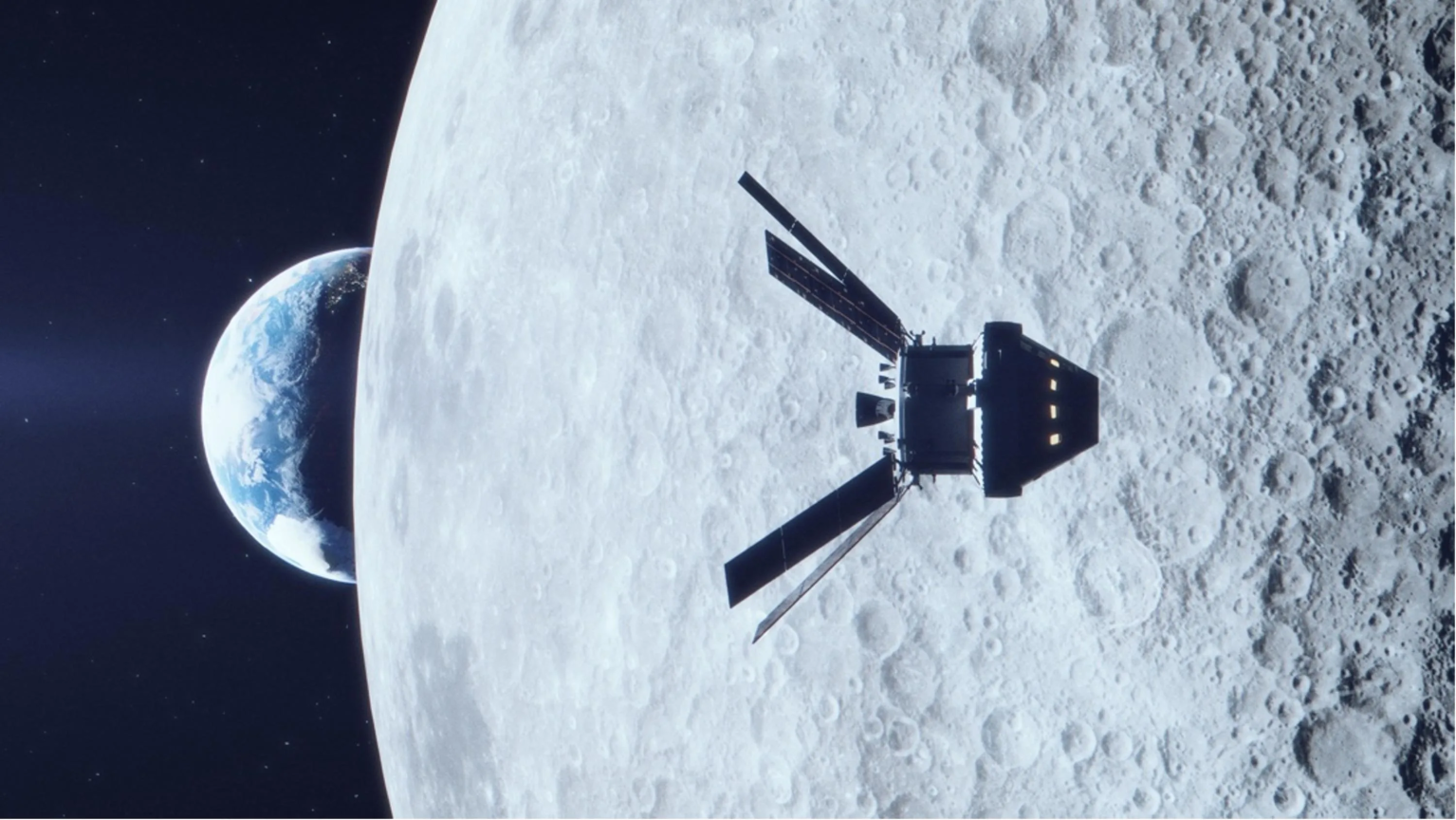
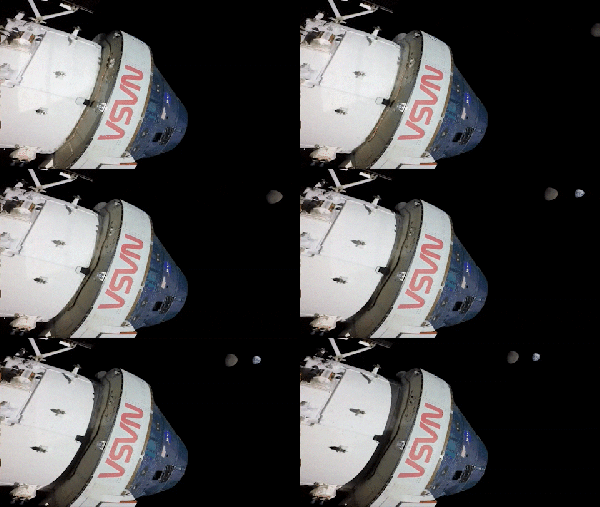
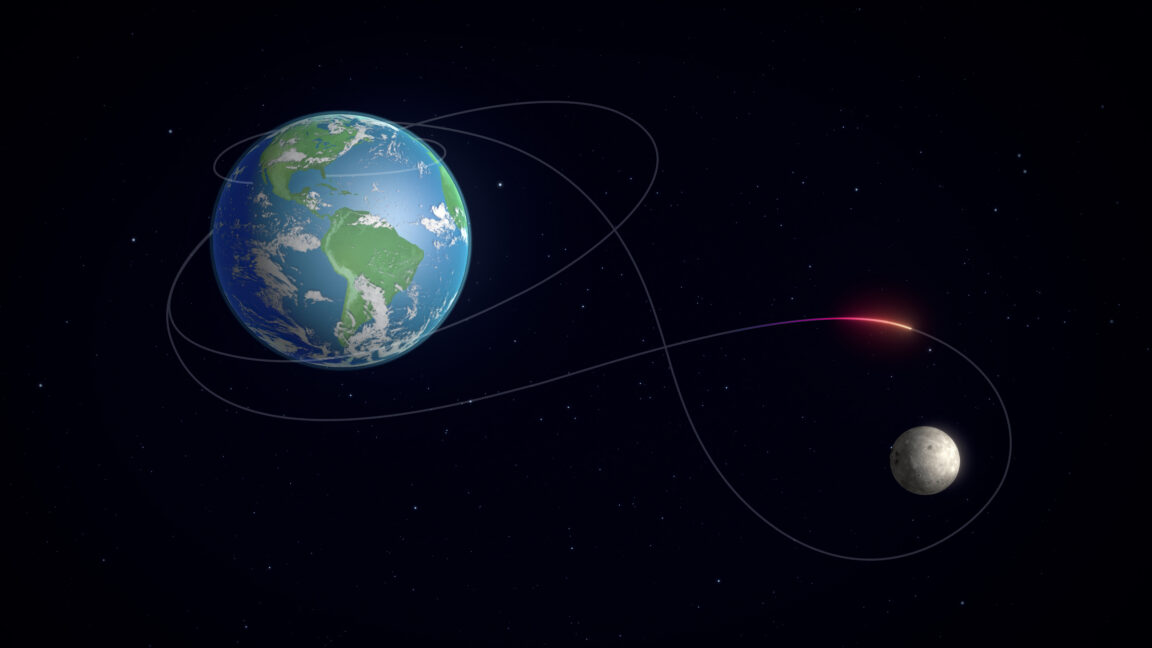
A visual representation of NASA’s Artemis I mission.
Credits: NASA
NASA has selected 34 global volunteers to track the Orion spacecraft during the crewed Artemis II mission’s journey around the Moon.
The Artemis II test flight will launch NASA’s Space Launch System (SLS) rocket, carrying the Orion spacecraft and a crew of four astronauts, on a mission into deep space. The agency’s second mission in the Artemis campaign is a key step in NASA’s path toward establishing a long-term presence at the Moon and confirming the systems needed to support future lunar surface exploration and paving the way for the first crewed mission to Mars.
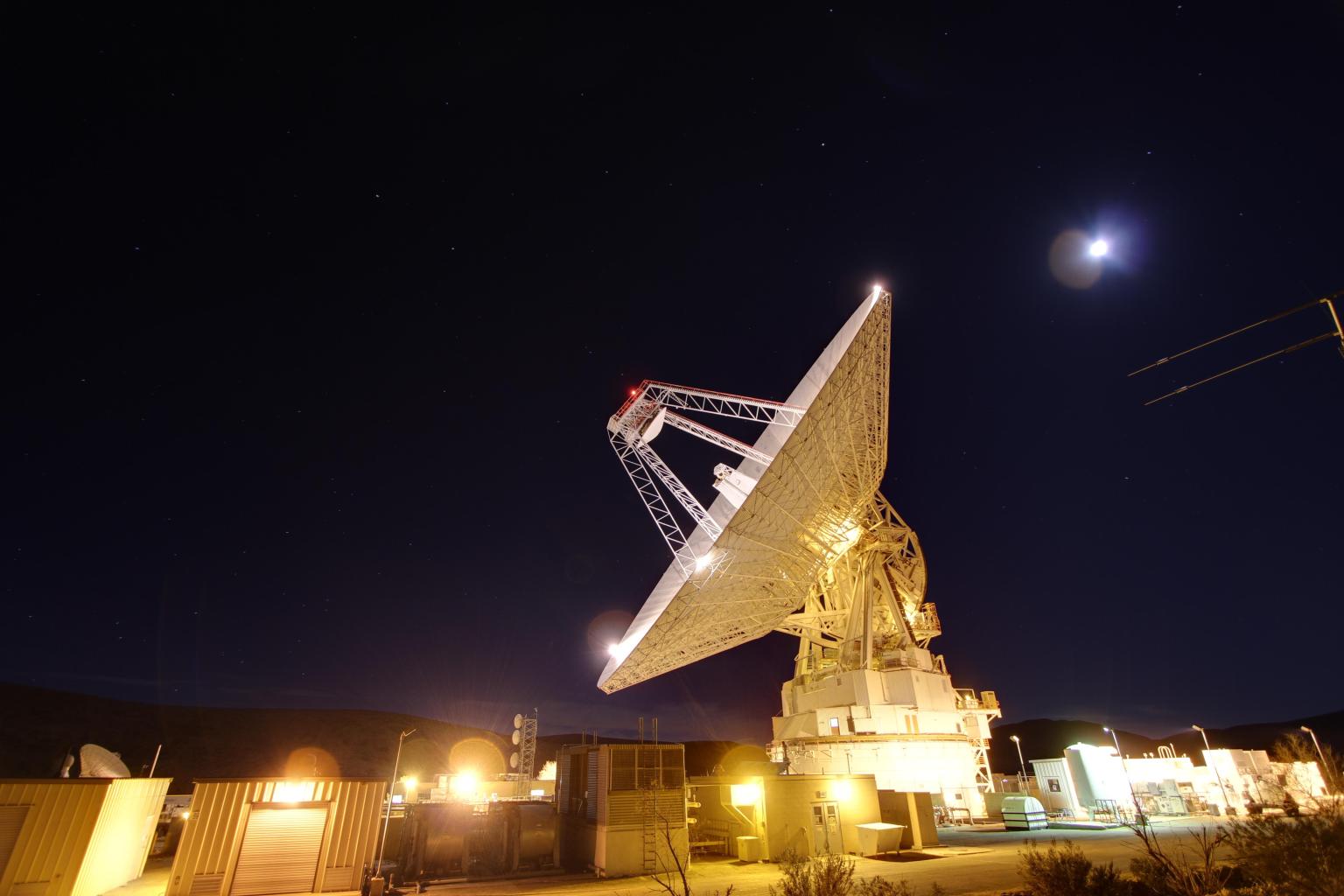
While NASA’s Near Space Network and Deep Space Network, coordinated by the agency’s SCaN (Space Communication and Navigation) program , will provide primary communications and tracking services to support Orion’s launch, journey around the Moon, and return to Earth, participants selected from a request for proposals published in August 2025, comprised of established commercial service providers, members of academia, and individual amateur radio enthusiasts will use their respective equipment to passively track radio waves transmitted by Orion during its approximately 10-day journey.
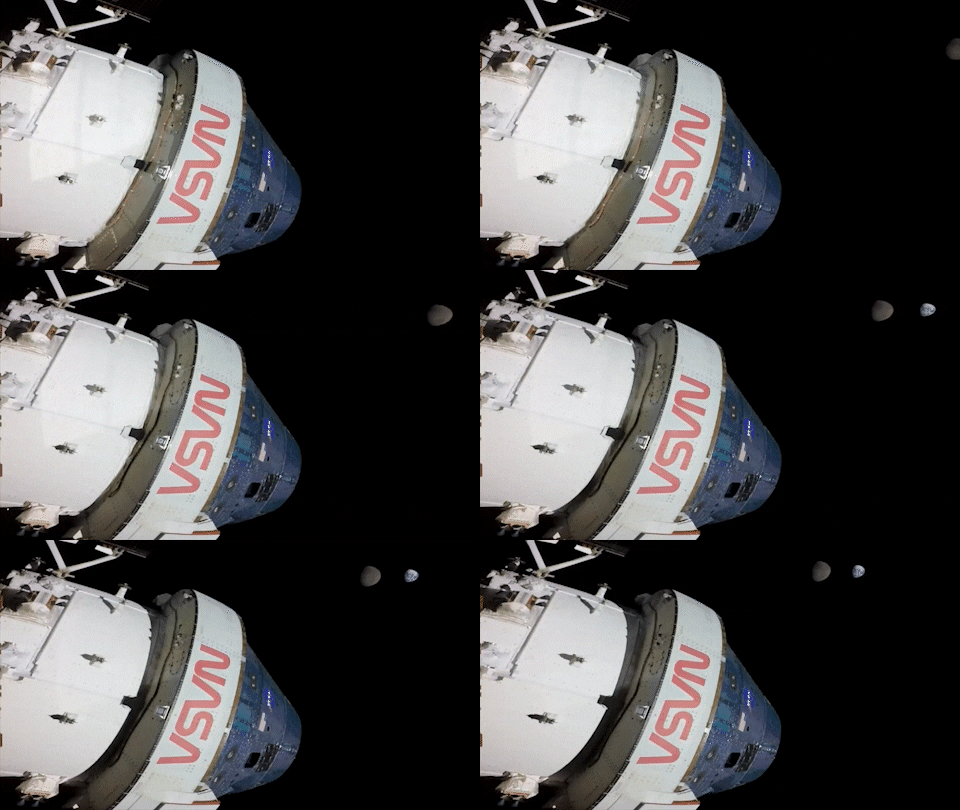
The Orion capsule viewing the Moon during Artemis I.
NASA
“The Artemis II tracking opportunity is a real step toward SCaN’s commercial-first vision. By inviting external organizations to demonstrate their capabilities during a human spaceflight mission, we’re strengthening the marketplace we’ll rely on as we explore farther into the solar system,” said Kevin Coggins, deputy associate administrator for SCaN at NASA Headquarters in Washington. “This isn’t about tracking one mission, but about building a resilient, public-private ecosystem that will support the Golden Age of innovation and exploration.”
This isn’t about tracking one mission, but about building a resilient, public-private ecosystem that will support the Golden Age of innovation and exploration.”
KEvin Coggins
NASA Deputy Associate Administrator for SCaN
These volunteers will submit their data to NASA for analysis, helping the agency better assess the broader aerospace community’s tracking capabilities and identify ways to augment future Moon and Mars mission support. There are no funds exchanged as a part of this collaborative effort.
This initiative builds on a previous effort in which 10 volunteers successfully tracked the Orion spacecraft during Artemis I in 2022. That campaign produced valuable data and lessons learned, including implementation, formatting, and data quality variations for Consultative Committee for Space Data Systems, which develops communications and data standards for spaceflight. To address these findings, SCaN now requires that all tracking data submitted for Artemis II comply with its data system standards.
Compared to the previous opportunity, public interest in tracking the Artemis II mission has increased. About 47 ground assets spanning 14 different countries will be used for to track the spacecraft during its journey around the Moon.
Participants List:
Government:
Canadian Space Agency (CSA), Canada
The German Aerospace Center (DLR), Germany
Commercial:
Goonhilly Earth Station Ltd, United Kingdom
GovSmart, Charlottesville, Virginia
Integrasys + University of Seville, Spain
Intuitive Machines, Houston
Kongsberg Satellite Services, Norway
Raven Defense Corporation, Albuquerque, New Mexico
Reca Space Agency + University of Douala, Cameroon
Rincon Research Corporation & the University of Arizona, Tucson
Sky Perfect JSAT, Japan
Space Operations New Zealand Limited, New Zealand
Telespazio, Italy
ViaSat, Carlsbad, California
Von Storch Engineering, Netherlands
Individual:
Chris Swier, South Dakota
Dan Slater, California
Loretta A Smalls, California
Scott Tilley, Canada
Academia:
American University, Washington
Awara Space Center + Fukui University of Technology, Japan
Morehead State University, Morehead, Kentucky
Pisgah Astronomical Research Institute, Rosman, North Carolina
University of California Berkeley, Space Sciences Laboratory, California
University of New Brunswick, ECE, Canada
University of Pittsburgh, ECE, Pittsburgh
University of Zurich – Physics Department, Switzerland
Non-Profit & Amateur Radio Organizations:
AMSAT Argentina, Argentina
AMSAT Deutschland, Germany
Amateur Radio Exploration Ground Station Consortium, Springfield, Illinois
CAMRAS, Netherlands
Deep Space Exploration Society, Kiowa County, Colorado
Neu Golm Ground Station, Germany
Observation Radio Pleumur-bodou, France
Artemis II will fly around the Moon to test the systems which will carry astronauts to the lunar surface for economic benefits and scientific discovery in the Golden Age of exploration and innovation.
The networks supporting Artemis receive programmatic oversight from NASA’s SCaN Program office. In addition to providing communications services to missions, SCaN develops the technologies and capabilities that will help propel NASA to the Moon, Mars, and beyond. The Deep Space Network is managed by NASA’s Jet Propulsion Laboratory in Southern California, and the Near Space Network is managed by NASA’s Goddard Space Flight Center in Greenbelt, Maryland.
Katrina Lee is a writer for the Space Communications and Navigation (SCaN) Program office and covers emerging technologies, commercialization efforts, exploration activities, and more.
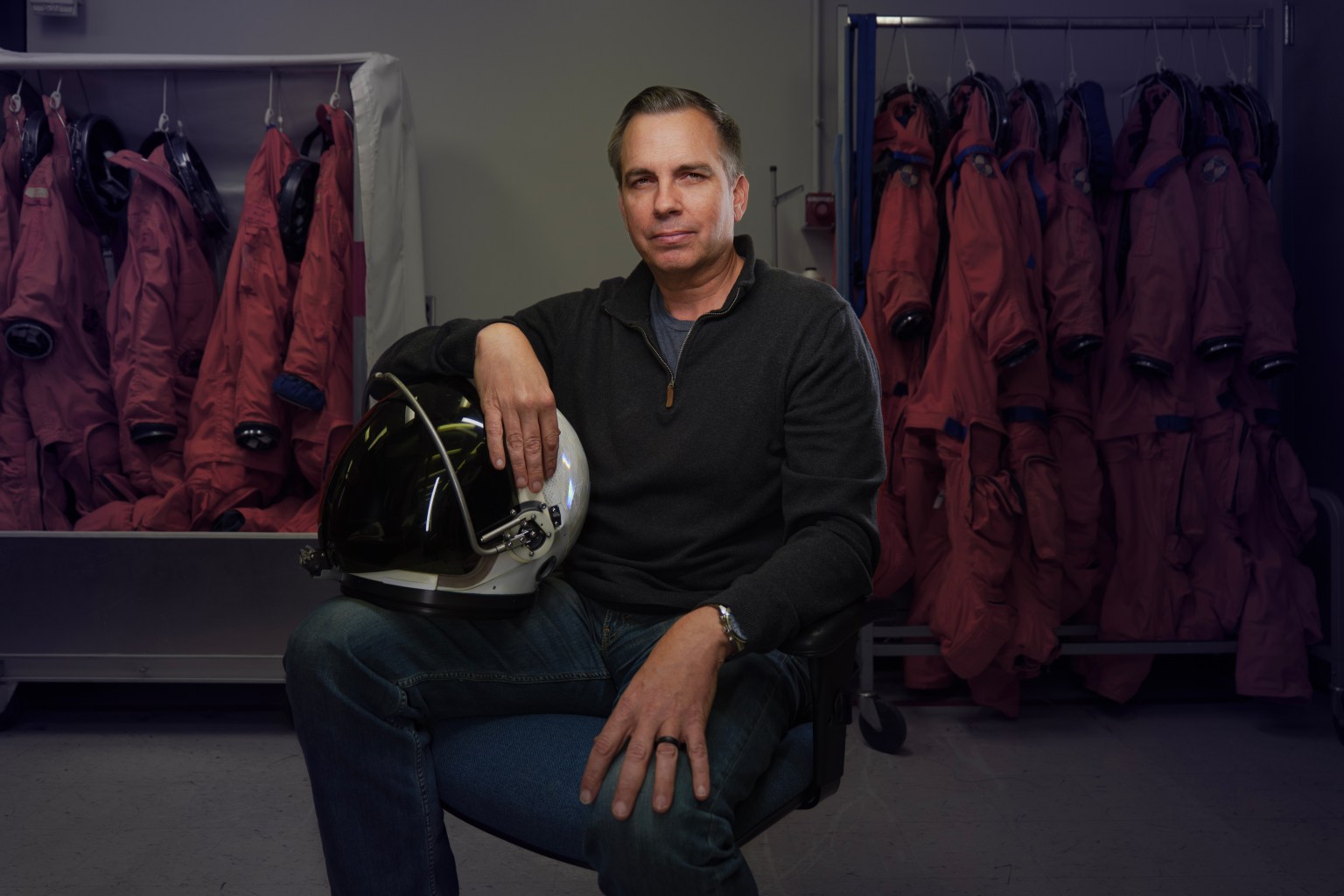
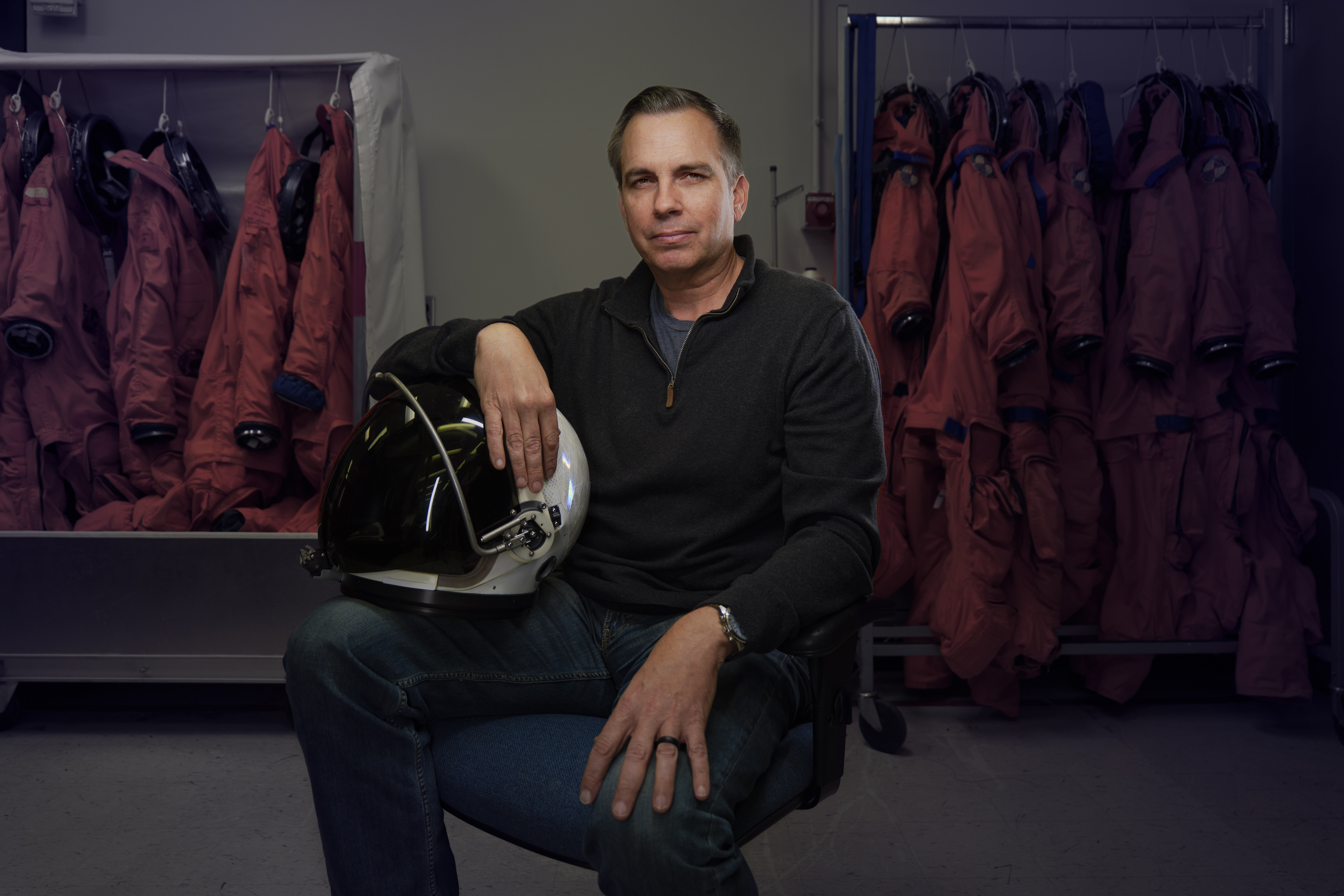
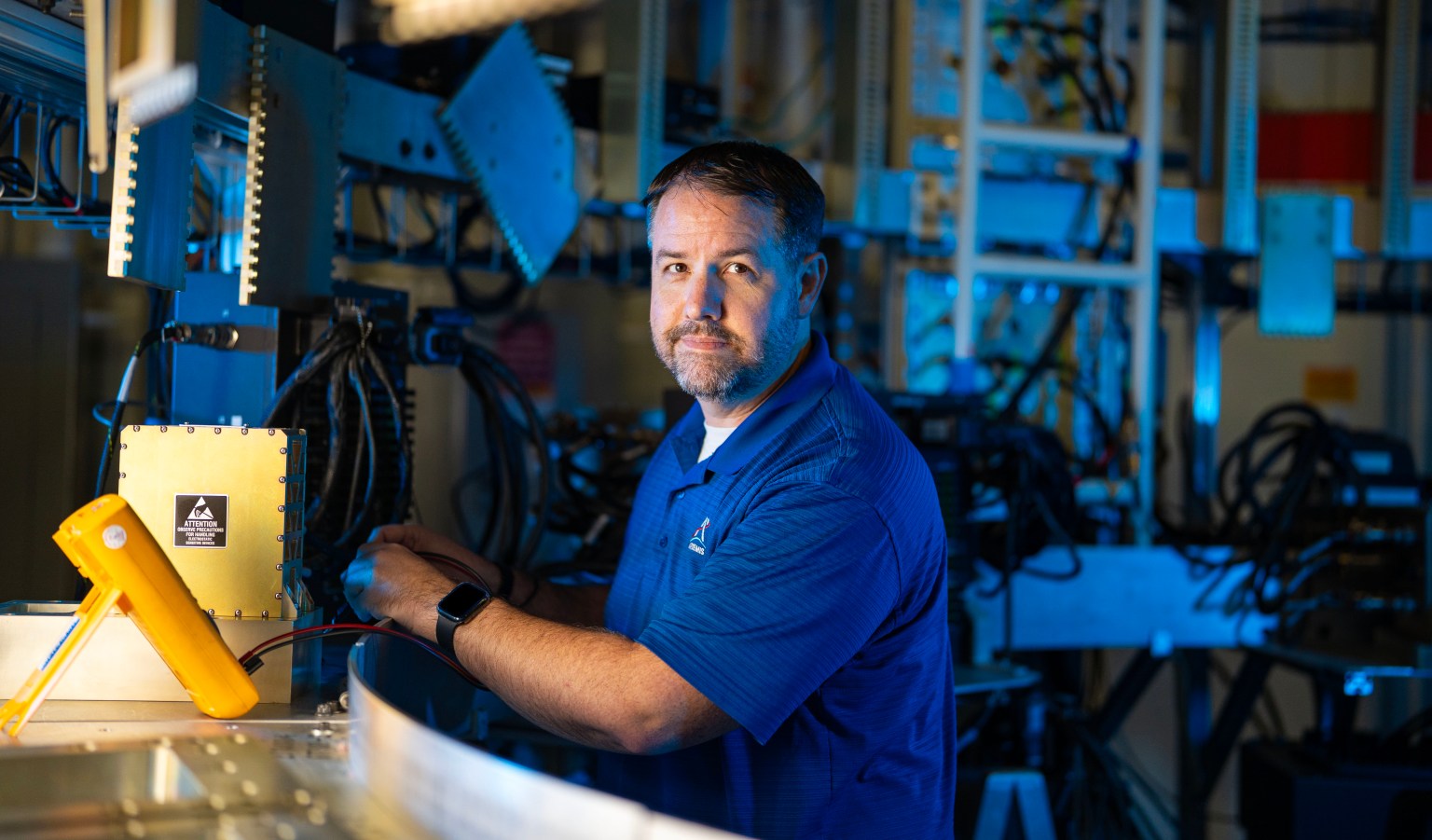
Dustin Gohmert, Orion Crew Survival System (OCSS) manager, sits in the OCSS Lab at NASA’s Johnson Space Center in Houston.
Credits: NASA/Rad Sinyak
Listen to this audio excerpt from Dustin Gohmert, Orion Crew Survival System (OCSS) manager:
0:00 / 0:00
During NASA’s Artemis II mission around the Moon, the astronauts inside the Orion spacecraft will be wearing specialized pressure suits designed to protect them throughout their journey. At NASA’s Johnson Space Center in Houston, Dustin Gohmert leads the team responsible for these suits, known as the Orion Crew Survival System (OCSS).
“We work with the crew to say, ‘Here’s this design concept we have. How does this really work in the spaceflight environment?’” Gohmert said. “As we evolve the design, we take the crew’s input and we adapt the suit over time to take into account not only the desire we have for safety, but the real-world impacts that it has.”
The suits will protect astronauts on launch day, throughout high-risk parts of missions near the Moon, during the high-speed return to Earth, and in emergency situations if such events arise. The OCSS suits are engineered to sustain life for up to six days in the event of an emergency, and can provide the astronauts oxygen, hydration, food, and waste management needed on their way back to Earth.
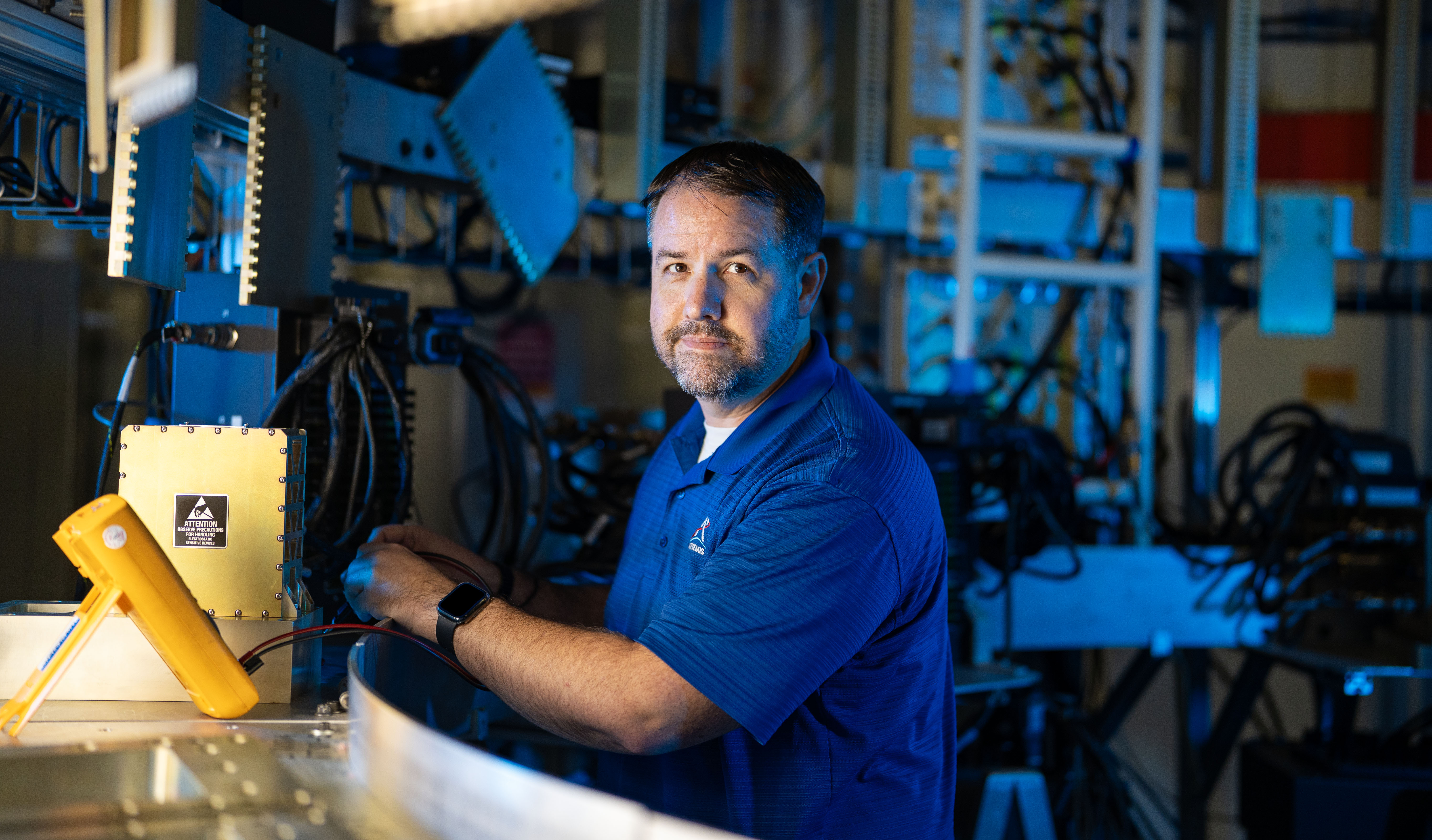
Dustin Gohmert, Orion Crew Survival System (OCSS) manager, sits in the OCSS Lab at NASA’s Johnson Space Center in Houston.
Credits: NASA/Rad Sinyak
“In an emergency, you’re essentially living in a personal spacecraft that’s only an inch bigger than your body,” Gohmert said. “That’s the reality of survival in space.”
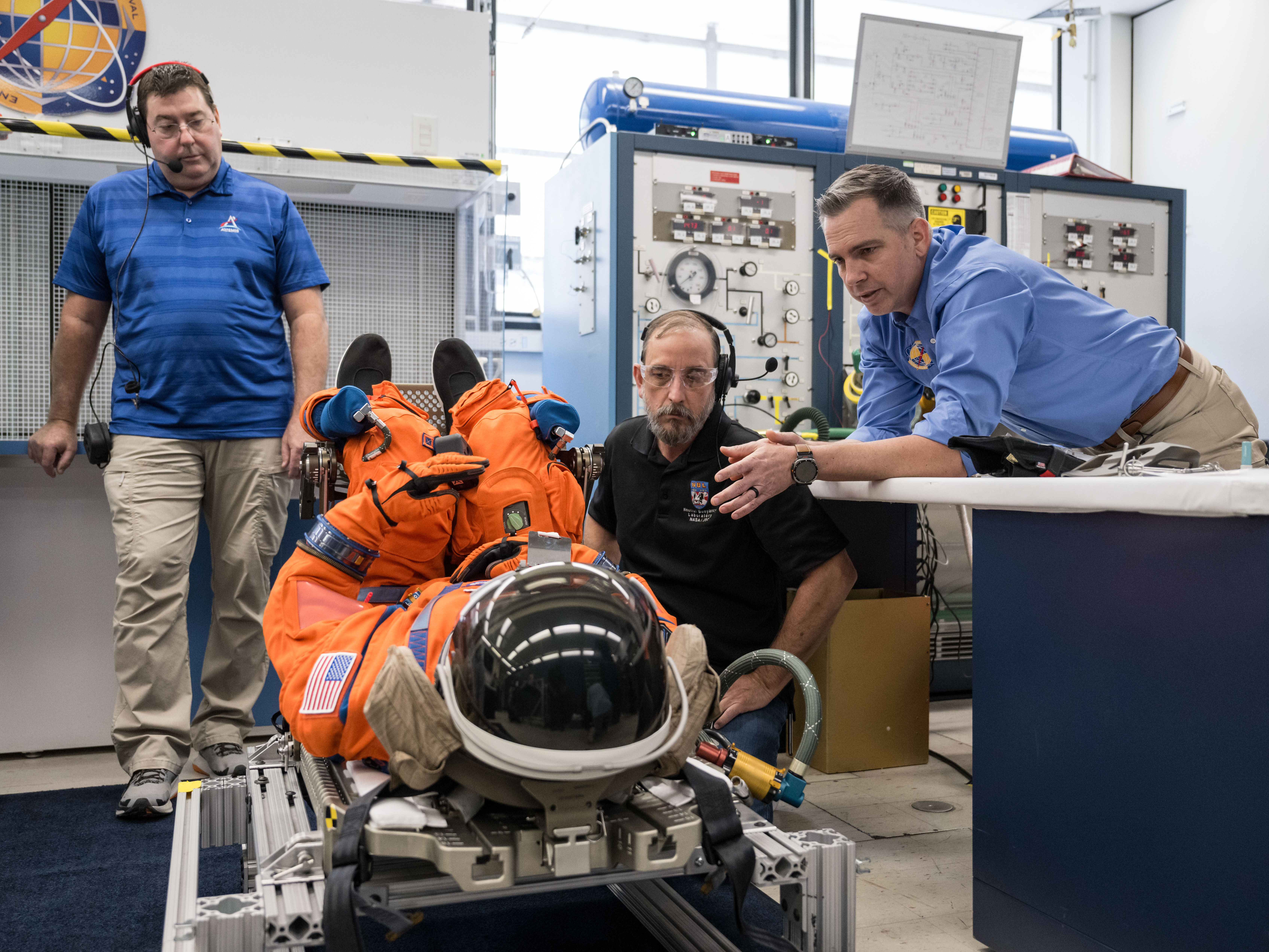
Gohmert’s team in the Orion Crew Survival Systems Lab manages every phase of the suits, including processing, designing, qualifying, and testing them for the mission, as well as integrating them with the Orion spacecraft. Their work addresses engineering challenges, such as how much internal pressure the suit can safely maintain and for how long.
The team custom-builds each suit to fit the anatomy of the astronauts. Crew members undergo detailed sizing and multiple fit checks to ensure precision, and their feedback is a key part of the design evolution and refinement of the suit.
Orion Crew Survival System (OCSS) Manager Dustin Gohmert and his team perform a flight suit long duration fit check with Artemis II crew member Christina Koch in the OCSS Lab at NASA’s Johnson Space Center in Houston.
Credit: NASA/Josh Valcarcel
After earning his bachelor’s in mechanical engineering from the University of Texas at San Antonio and his master’s in engineering from the University of Texas at Austin, Gohmert joined United Space Alliance before becoming a NASA civil servant. He worked through the end of the Space Shuttle Program and later transitioned to Orion. Working on the suit throughout his career has been both technically challenging and a deeply personal responsibility.
The weight of it is incredible; knowing the ultimate responsibility you and the team share in the safety of the crew and the mission. Every thought we have, every piece of paper we write — crew is the number one priority.
dustin Gohmert
Orion Crew Survival Systems (OCSS) Manager
As NASA prepares to explore deep space with Artemis II, Gohmert’s role will play a part in safely sending crew members around the Moon and returning them home.
“I was born after the last Moon landing,” he said. “To actually be a part of the next round is kind of overwhelming. It’s awe-inspiring in every possible way.”
NASA announced Tuesday the selection of three new science investigations that will strengthen humanity’s understanding and exploration of the Moon. As part of the agency’s CLPS (Commercial Lunar Payload Services) initiative and Artemis campaign, American companies will deliver these research payloads to the lunar surface no earlier than 2028.
“With CLPS, NASA has been taking a new approach to lunar science, relying on U.S. industry innovation to travel to the surface of the Moon and enable scientific discovery,” said Joel Kearns, deputy associate administrator for exploration, Science Mission Directorate, NASA Headquarters in Washington. “These selections continue this pipeline of lunar exploration, through research that will not only expand our knowledge about the Moon’s history and environment, but also inform future human safety and navigation on the Moon and beyond.”
The selected scientific payloads are:
Emission Imager for Lunar Infrared Analysis in 3D (EMILIA-3D). The EMILIA-3D payload will create three-dimensional thermal models of the lunar terrain, using a thermal imager to measure the temperature of the landscape coupled with a stereo pair of visible-light cameras. These models will help the U.S. better image and navigate the Moon’s surface through improved understanding of the properties of the dusty lunar soil, called regolith, and what temperature measurements convey about the lunar surface. The principal investigator is Andrew Ryan at the University of Arizona.
Lunar Instrumentation for Subsurface Thermal Exploration with Rapidity (LISTER). The LISTER instrument will measure the heat flow of the Moon’s interior by drilling beneath the lunar surface, pausing at intervals to measure temperature changes and the ability of the subsurface material to conduct heat. A previous version of LISTER flew on the Blue Ghost Mission 1 CLPS delivery to the Moon’s near side, where it took eight temperature and thermal conductivity measurements and drilled down to about three feet beneath the lunar surface. This new LISTER investigation will study the heat flow generated by the Moon itself, giving us a better understanding of its thermal history. The principal investigator is Seiichi Nagihara at Texas Tech University.
Site-agnostic Energetic Lunar Ion and Neutron Environment (SELINE). The SELINE payload will provide new insight into the Moon’s radiation environment by studying, for the first time at the lunar surface, the radiation from both primary galactic cosmic rays and their secondary particles and how this radiation interacts with the lunar regolith. Data from SELINE will improve our understanding of the planetary processes at work on the Moon, as well as inform space weather preparation and safety for long-term human exploration of the lunar surface. The principal investigator is Drew Turner at Johns Hopkins University.
These science experiments, selected through NASA’s Payloads and Research Investigations on the Surface of the Moon call for proposals, do not require a specific landing site on the lunar surface to gather their data, and NASA will assign them to specific CLPS delivery task orders at a later time.
NASA uses CLPS to send scientific instruments and technology demonstrations to advance capabilities for science, exploration, or commercial development of the Moon and beyond. By supporting a steady cadence of lunar deliveries, the agency will continue to enable a growing lunar economy while leveraging the entrepreneurial innovation of the commercial space industry.
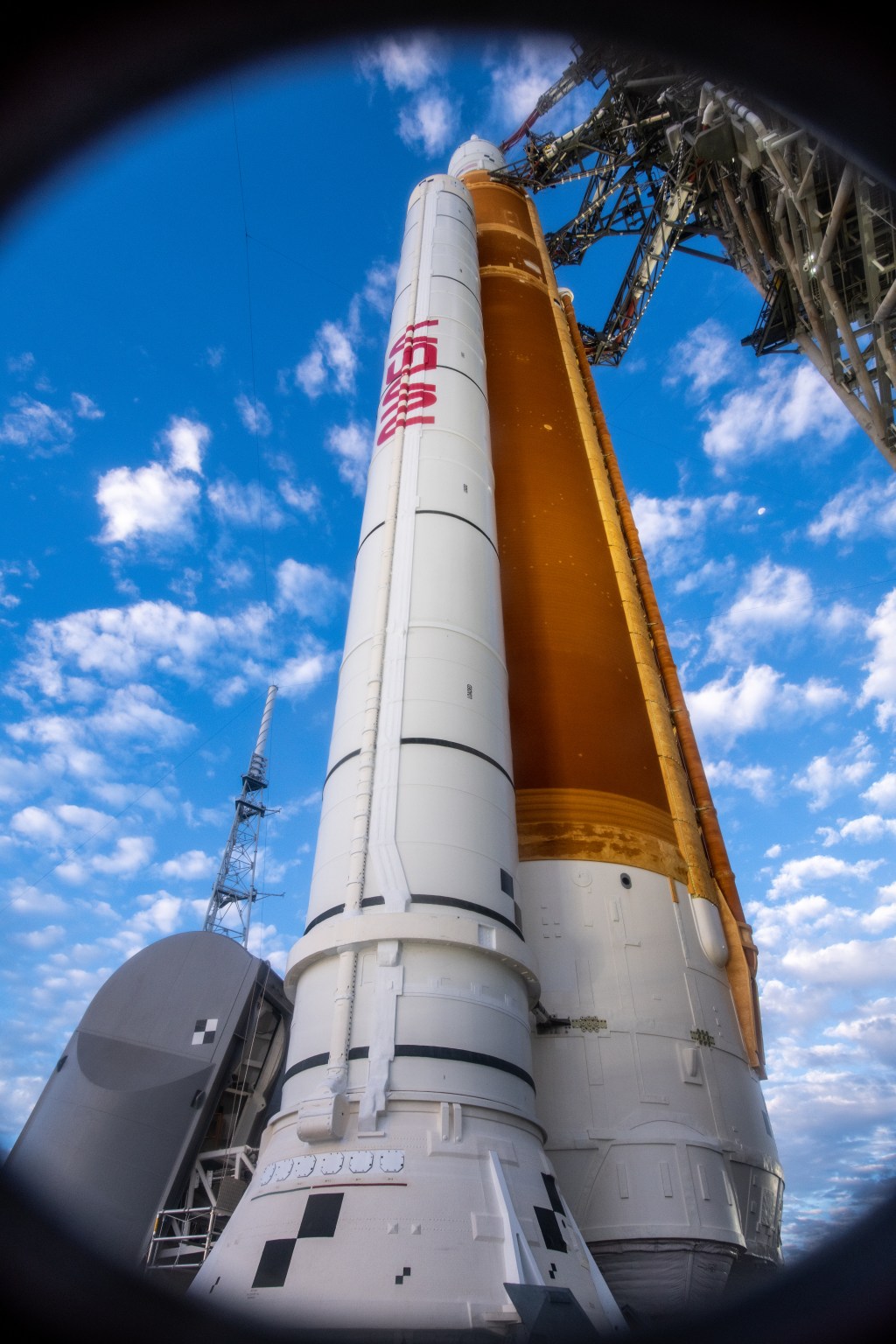
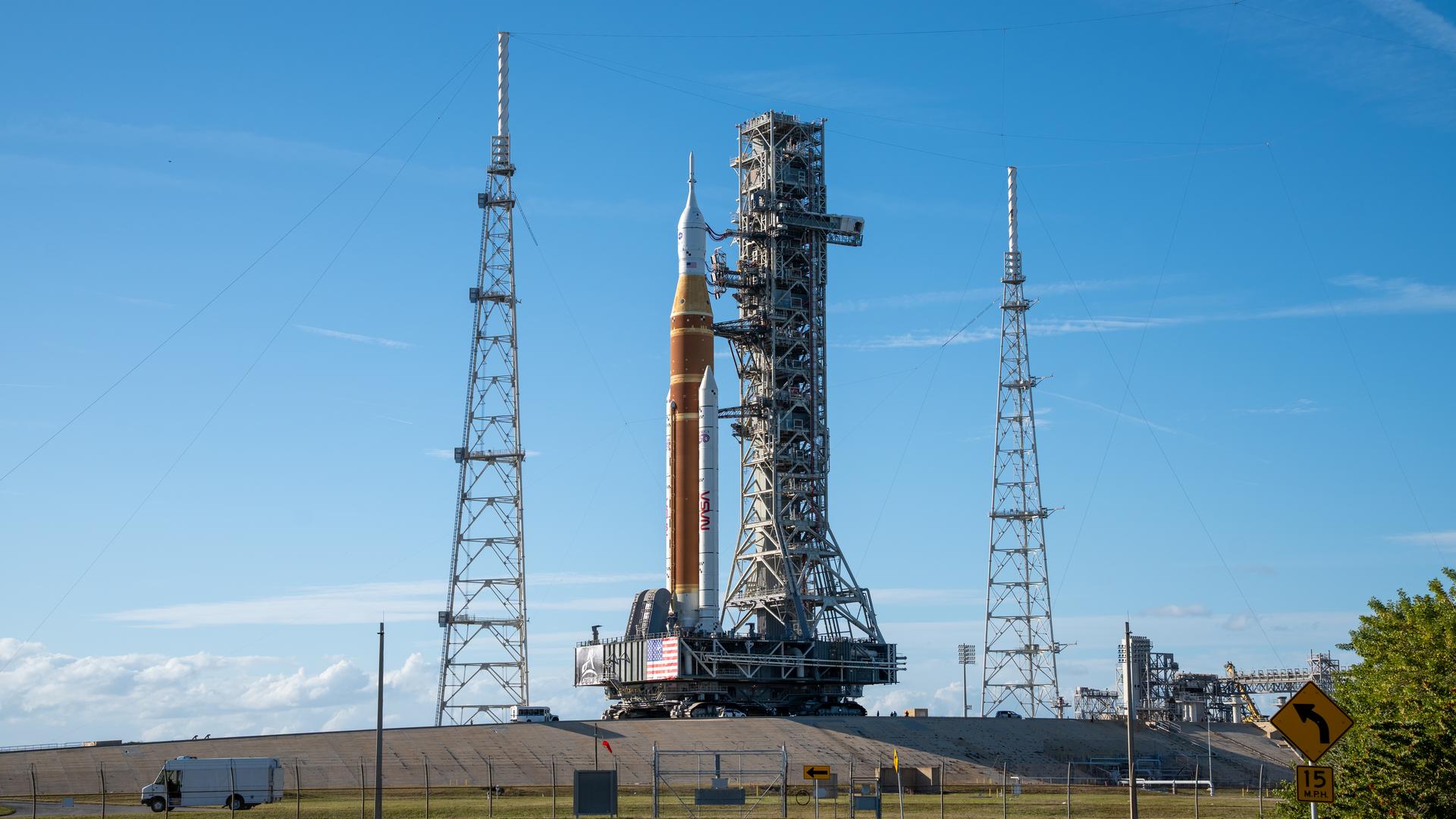
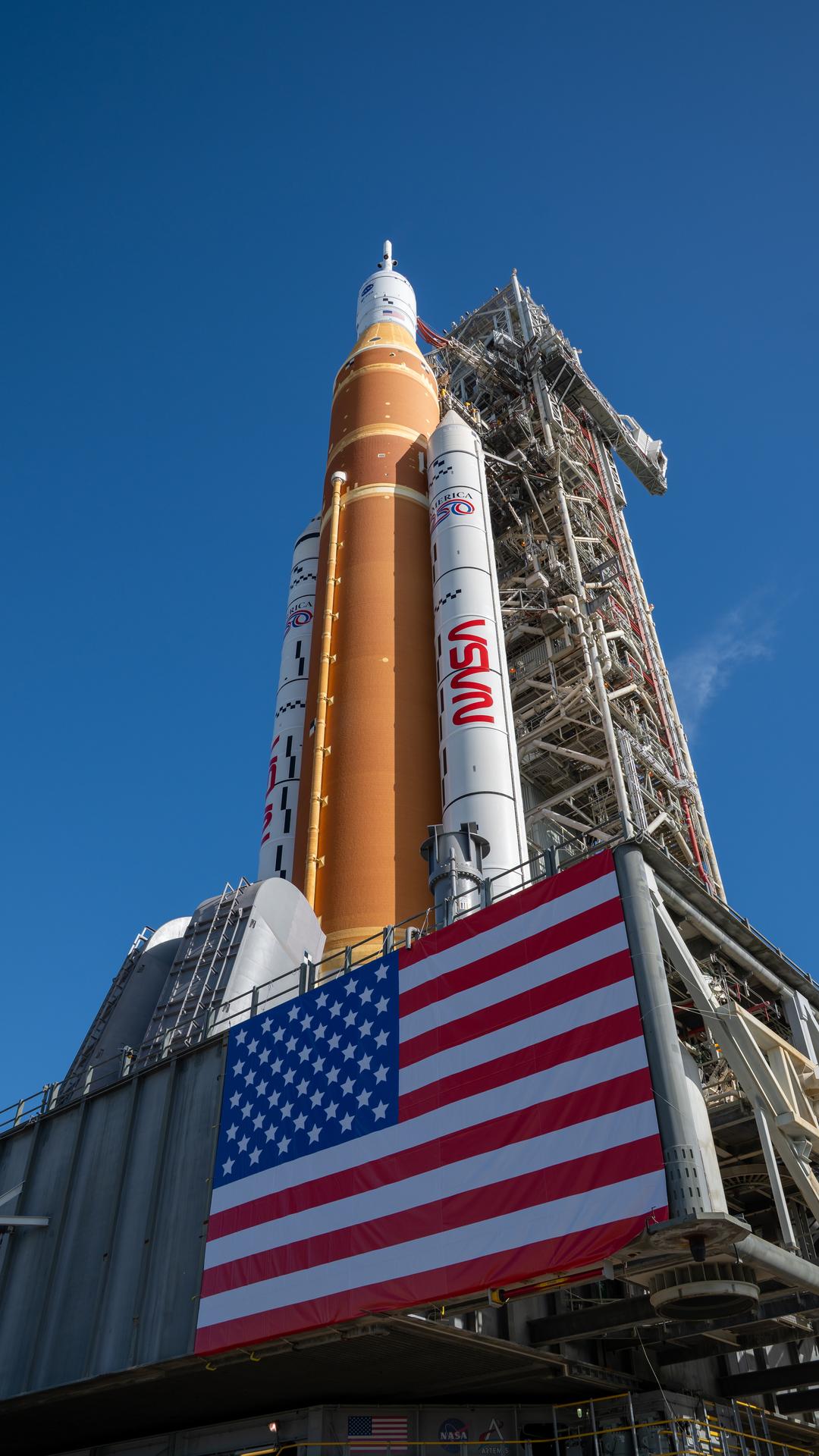
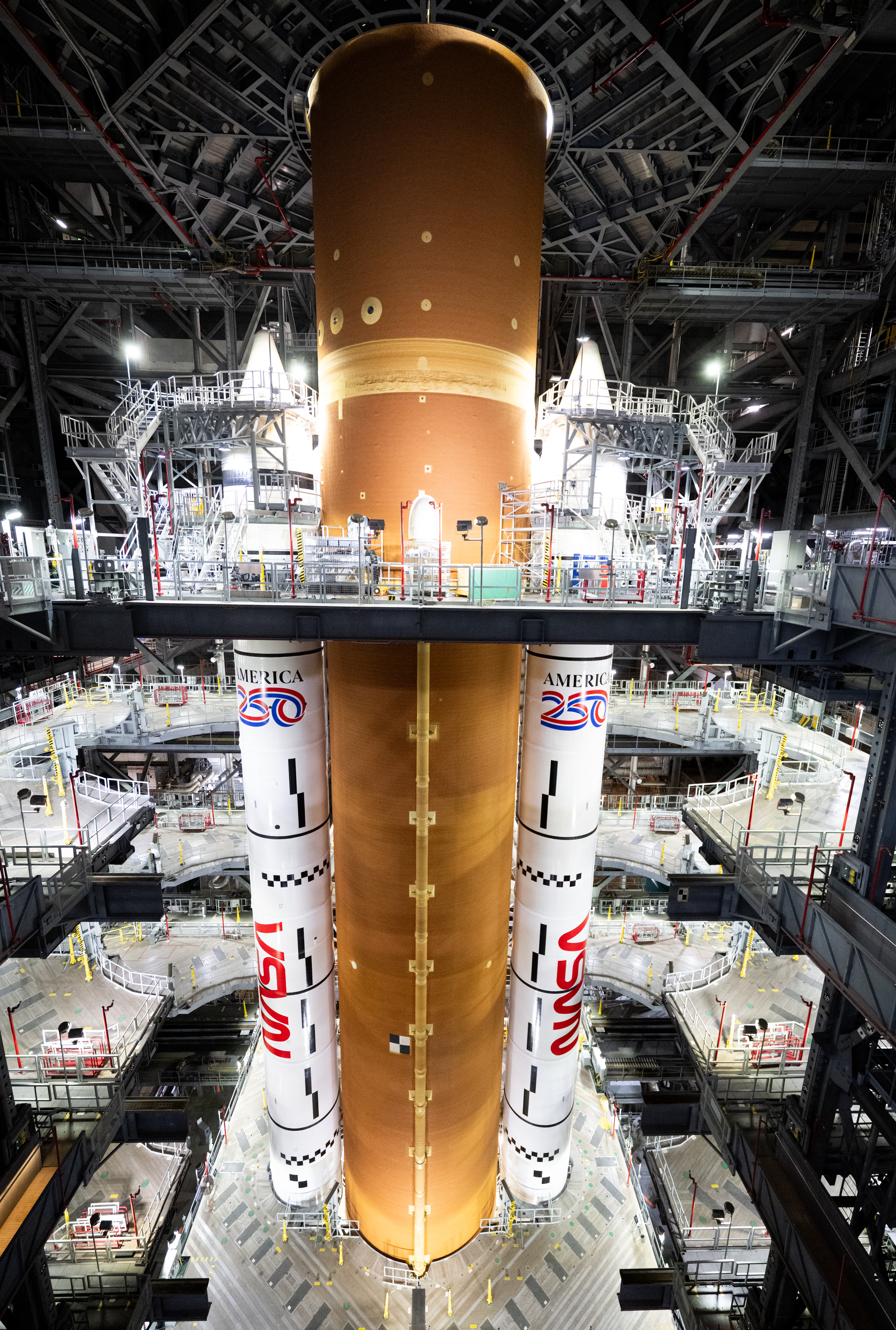

NASA’s SLS (Space Launch System) and Orion spacecraft rolled out of the Vehicle Assembly Building at the agency’s Kennedy Space Center in Florida on Saturday, Jan. 17, 2026 in preparation for the Artemis II mission.
Credit: NASA/Brandon Hancock
One year into President Donald J. Trump’s second term, NASA is delivering measurable progress across human spaceflight, science, aeronautics, and cutting-edge technology. These advances mark the beginning of a new Golden Age of American space leadership driven by clear national direction and historic investment through the Working Families Tax Cut Act.
Since his inauguration as the 47th President of the United States, NASA has sharpened its mission rooted in President Trump’s national space policy, reinforcing American superiority in space and accelerating progress across exploration, discovery, and innovation. With a renewed focus on human spaceflight, scientific excellence, and national capability, the agency is moving with clarity and momentum.
President Trump’s enduring commitment to space exploration has shaped every aspect of this progress. During his first term, the United States stood up the U.S. Space Force, commenced the Artemis campaign, established the Artemis Accords, which now have 60 signatories and are still growing, and returned American astronauts to human spaceflight from U.S. soil following the space shuttle era.
Now, with a clear National Space Policy and Working Family Tax Cut Act, NASA has the direction, resources, and authority to advance a bold vision for the future.
In the first year of the President’s second term, NASA has flown two human spaceflight missions, launched 15 science missions, and successfully test-flown a new X-plane, while accelerating work across lunar exploration, Earth science, planetary defense, next-generation aeronautics, and technologies to prepare for future missions to Mars.
Soon, NASA will launch the Artemis II mission, sending humans around the Moon for the first time in over 50 years, and setting the stage for America’s return to the lunar surface, but this time, to stay. These milestones reflect a workforce empowered to move faster, think bigger, and deliver results for the American people.
“In the first year of this administration, NASA has moved with clarity, purpose, and momentum, advancing President Trump’s bold vision for American leadership in space,” said NASA Administrator Jared Isaacman. “From strengthening our focus on human spaceflight and preparing for the first deep space exploration by NASA astronauts in more than half a century, to accelerating innovation across science, technology, and national capability, the President has provided the clearest executive direction for NASA since the Kennedy era. President Trump’s National Space Policy sharpened our mission, aligned our priorities, and empowered our workforce to move faster and think bigger. Because of that leadership, NASA is confidently delivering on a future of American space superiority for generations to come.”
NASA is positioned to build on this momentum. Under President Trump’s leadership, American astronauts will return to the surface of the Moon by 2028 and establish a sustained human presence with a lunar base. The agency will continue launching missions of science and discovery, including bringing the Nancy Grace Roman Space Telescope into operation before the end of the year. In line with the President’s vision, NASA is advancing nuclear power and propulsion technologies to enable deep space missions and transform what is possible for exploration.
With a focused mission, empowered workforce, and strong partnership with industry and international allies, NASA is entering the second year of President Trump’s second term positioned to change the world, extending American leadership in space and unlocking discoveries that will benefit humanity for decades to come.
For more information about NASA’s missions and programs, visit:
KENNEDY SPACE CENTER, Florida—Preparations for the first human spaceflight to the Moon in more than 50 years took a big step forward this weekend with the rollout of the Artemis II rocket to its launch pad.
The rocket reached a top speed of just 1 mph on the four-mile, 12-hour journey from the Vehicle Assembly Building to Launch Complex 39B at NASA's Kennedy Space Center in Florida. At the end of its nearly 10-day tour through cislunar space, the Orion capsule on top of the rocket will exceed 25,000 mph as it plunges into the atmosphere to bring its four-person crew back to Earth.
"This is the start of a very long journey," said NASA Administrator Jared Isaacman. "We ended our last human exploration of the moon on Apollo 17."
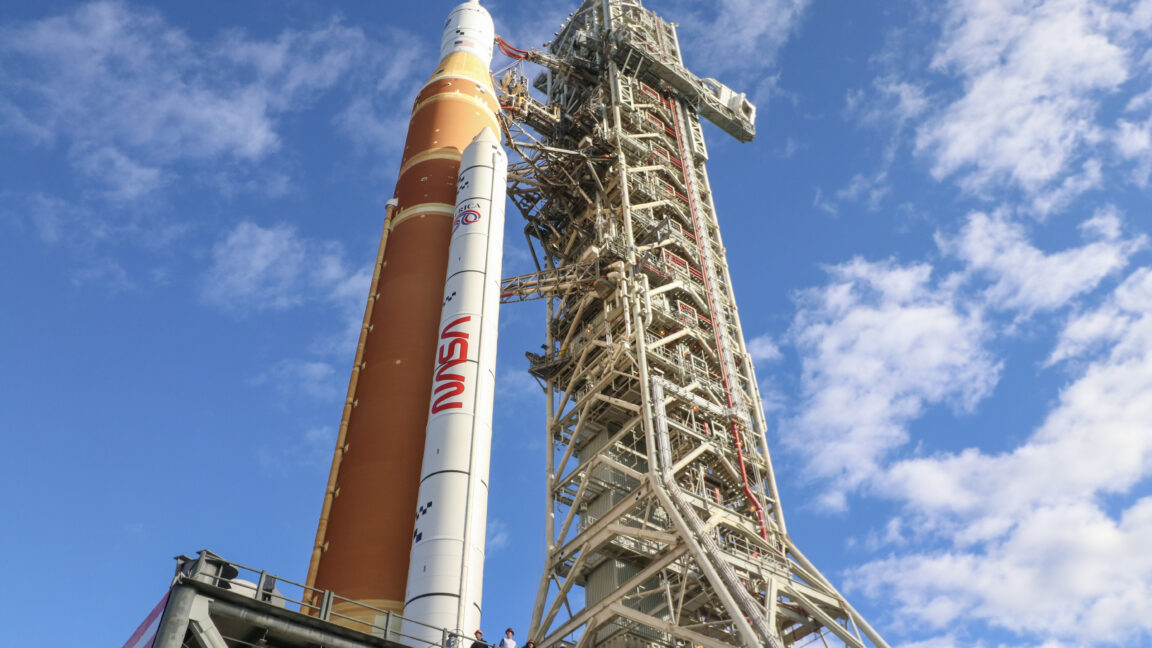
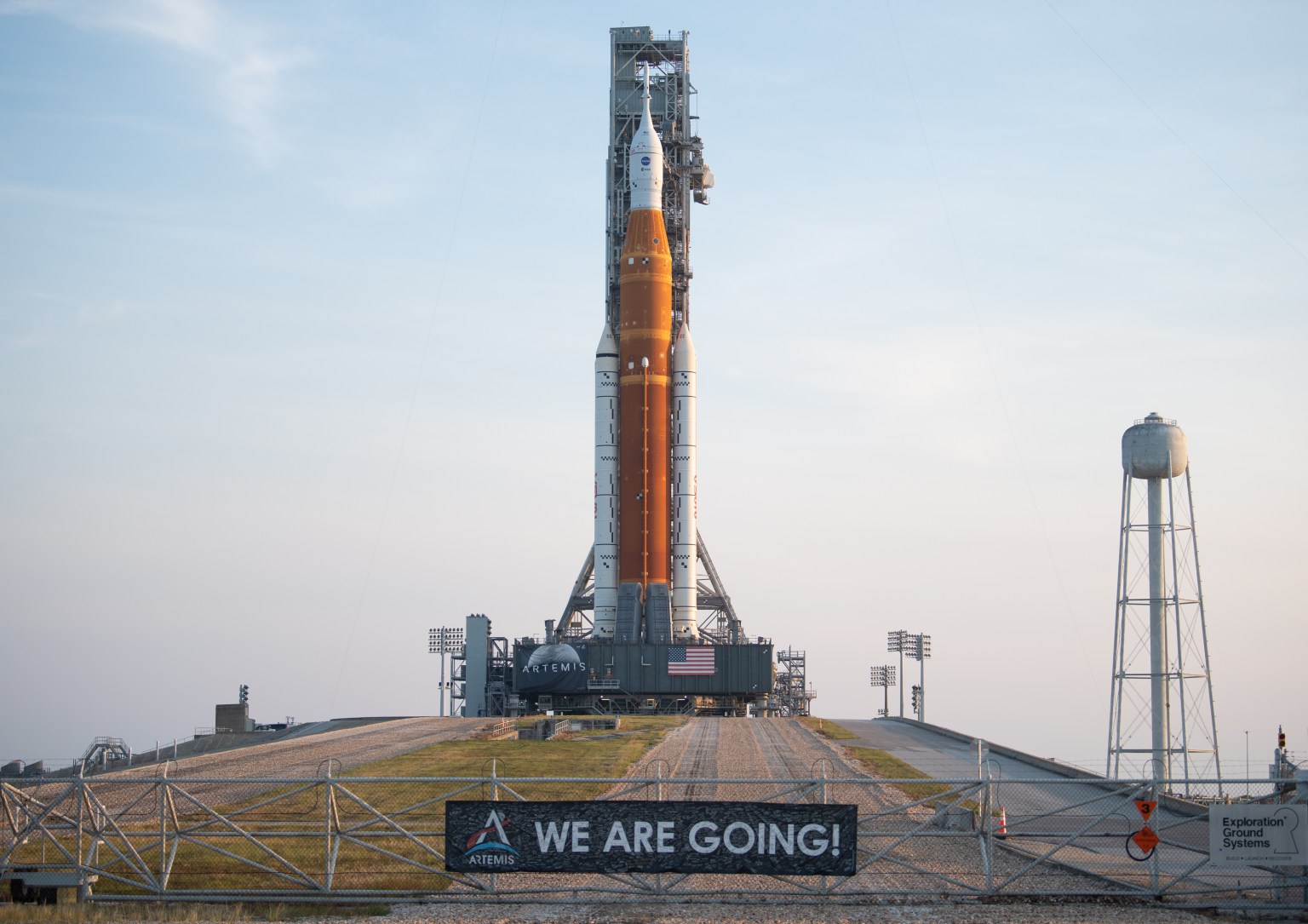
NASA’s Space Launch System (SLS) rocket and Orion spacecraft reached the Launch Pad 39B at the Kennedy Space Center in Florida on Saturday following a 4-mile, 12-hour crawl from the Vehicle Assembly Building. The rocket is being prepped for the Artemis II mission, which will carry three Americans and one Canadian on a voyage around […]
Looking for a unique vacation spot? Have at least $10 million USD burning a hole in your pocket? If so, then you’re just the sort of customer the rather suspiciously named “GRU Space” is looking for. They’re currently taking non-refundable $1,000 deposits from individuals looking to stay at their currently non-existent hotel on the lunar surface. They don’t expect you’ll be able to check in until at least the early 2030s, and the $1K doesn’t actually guarantee you’ll be selected as one of the guests who will be required to cough up the final eight-figure ticket price before liftoff, but at least admission into the history books is free with your stay.
This never happened.
The whole idea reminds us of Mars One, which promised to send the first group of colonists to the Red Planet by 2024. They went bankrupt in 2019 after collecting ~$100 deposits from more than 4,000 applicants, and we probably don’t have to tell you that they never actually shot anyone into space. Admittedly, the Moon is a far more attainable goal, and the commercial space industry has made enormous strides in the decade since Mars One started taking applications. But we’re still not holding our breath that GRU Space will be leaving any mints on pillows at one-sixth gravity.
Speaking of something which actually does have a chance of reaching the Moon on time — on Saturday, NASA rolled out the massive Space Launch System (SLS) rocket that will carry a crew of four towards our nearest celestial neighbor during the Artemis II mission. There’s still plenty of prep work to do, including a dress rehearsal that’s set to take place in the next couple of weeks, but we’re getting very close. Artemis II won’t actually land on the Moon, instead performing a lunar flyby, but it will still be the first time we’ve sent humans beyond Low Earth Orbit (LEO) since Apollo 17 in 1972. We can’t wait for some 4K Earthrise video.
In more terrestrial matters, Verizon users are likely still seething from the widespread outages that hit them mid-week. Users from all over the US reported losing cellular service for several hours, though outage maps at the time showed the Northeast was hit particularly hard. At one point, the situation got so bad that Verizon’s own system status page crashed. In a particularly embarrassing turn of events, some of the other cellular carriers actually reached out to their customers to explain it wasn’t their fault if they couldn’t reach friends and family on Verizon’s network. Oof.
Speaking of phones, security researchers recently unveiled WhisperPair, an attack targeting Bluetooth devices that utilize Google’s Fast Pair protocol. When the feature is implemented correctly, a Bluetooth accessory should ignore pairing requests unless it’s actually in pairing mode, but the researchers found that many popular models (including Google’s own Pixel Buds Pro 2) can be tricked into accepting an unsolicited pairing request. While an attacker hijacking your Bluetooth headset might not seem like a huge deal at first, consider that it could allow them to record your conversations and track your location via Google’s Find Hub network.
Incidentally, something like WhisperPair is the kind of thing we’d traditionally leave for Jonathan Bennett to cover in his This Week in Security column, but as regular readers may know, he had to hang up his balaclava back in December. We know many of you have been missing your weekly infosec dump, but we also know it’s not the kind of thing that just anyone can take over. We generally operate under a “Write What You Know” rule around here, and that means whoever takes over the reins needs to know the field well enough to talk authoritatively about it. Luckily, we think we’ve found just the hacker for the job, so hopefully we’ll be able to start it back up in the near future.
Finally, we don’t generally promote crowdfunding campaigns due to their uncertain nature, but we’ll make an exception for the GameTank. We’ve covered the open hardware 6502 homebrew game console here in the past, and even saw it in the desert of the real (Philadelphia) at JawnCon 0x2 in October. The project really embraces the retro feel of using a console from the 1980s, even requiring you to physically swap cartridges to play different games. It’s a totally unreasonable design choice from a technical perspective, given that an SD card could hold thousands of games at once, but of course, that’s not the point. There’s a certain joy in plugging in a nice chunky cartridge that you just can’t beat.
See something interesting that you think would be a good fit for our weekly Links column? Drop us a line, we’ve love to hear about it.
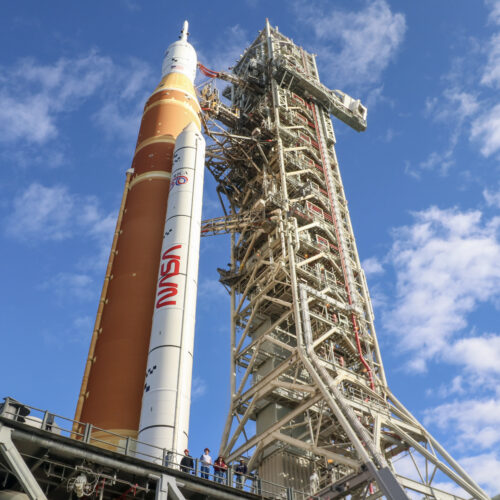
NASA’s Space Launch System rocket and its mobile launcher head for the launch pad. (NASA Photo / Keegan Barber)
NASA’s massive Space Launch System rocket crept to its Florida launch pad today at a top speed of about 1 mph, marking the first step in a journey that will eventually send astronauts around the moon for the first time in more than 50 years.
The 4-mile trek to Launch Complex 39B at NASA’s Kennedy Space Center began at 7 a.m. ET (4 a.m. PT) and lasted nearly 12 hours. Because the rocket with its mobile launcher stands more than 300 feet tall and weighs millions of pounds, the trip required the use of a crawler-transporter — the same vehicle used for the Apollo and space shuttle programs, now upgraded for NASA’s Artemis moon program.
Liftoff for the Artemis 2 mission could come as early as Feb. 6, but there’s lots to be done in the weeks ahead. After today’s rollout, the mission team will conduct a thorough checkout of the Space Launch System and its Orion crew spacecraft. Then there’ll be a “wet dress rehearsal,” during which the launch team will fuel the rocket and count down to T-minus 29 seconds.
“We have, I think, zero intention of communicating an actual launch date until we get through wet dress,” NASA Administrator Jared Isaacman told reporters.
Artemis 2 is slated to send three NASA astronauts and one Canadian astronaut on a 10-day journey tracing a figure-8 route around the moon. The trip will take them as far as 4,800 miles beyond the lunar far side — farther out than any human has gone before.
One of the crew members, Christina Koch, recalled an exchange she had with Apollo 13’s Fred Haise at a commemorative event. “Before I even said, ‘Hello, sir, great to see you,’ he goes, ‘I heard you’re going to break our record,'” she said.
Mission commander Reid Wiseman said he’s already seeing the moon in a different light.
“One of the most magical things for me in this experience is, when I looked out a few mornings ago, there was a beautiful crescent in the morning sunrise, and I truly just see the far side,” he said. “You just think about all the landmarks we’ve been studying on that far side, and how amazing that will look. And seeing Earthrise, just flipping the moon over and seeing it from the other perspective, is what I think when I look out right now.”
Although Artemis 2 will be historic in its own right, the mission’s main purpose is to prepare the way for Artemis 3, which will put humans on the lunar surface for the first time since Apollo 17 in 1972. That mission is officially set for no earlier than mid-2027, but industry experts expect the schedule to slip.
During today’s news briefing, Isaacman took an even longer view. “This is the start of a very long journey,” he said. “I hope someday my kids are going to be watching, maybe decades into the future, the Artemis 100 mission.”
Isaacman, who served as the billionaire CEO of the Shift4 payment processing company before becoming NASA’s chief last month, said that America’s space effort is sending humans back to the moon “to figure out the orbital and lunar economy, for all of the science and discovery possibilities that are out there, to inspire my kids, your kids, kids all around the world, to want to grow up and contribute to this unbelievable endeavor that we’re on right now.”
Blue Origin’s New Glenn rocket is expected to send an uncrewed cargo version of the Blue Moon lander to the moon sometime in the next few months. Isaacman hinted that Blue Origin could be in for a bigger role in the lunar economy as the Artemis program hits its stride.
“I will say I did meet with both Blue Origin and SpaceX on their acceleration plans. These are both very good plans,” he said. “If we are on track, we should be watching an awful lot of New Glenns and Starships launch in the years ahead.”
KENNEDY SPACE CENTER, Florida—The rocket NASA is preparing for sending four astronauts on a trip around the Moon will emerge from its assembly building on Florida's Space Coast early Saturday for a slow crawl to its seaside launch pad.
Riding atop one of NASA's diesel-powered crawler transporters, the Space Launch System rocket and its mobile launch platform will exit the Vehicle Assembly Building at Kennedy Space Center around 7:00 am EST (11:00 UTC). The massive tracked transporter, certified by Guinness as the world's heaviest self-propelled vehicle, is expected to cover the four miles between the assembly building and Launch Complex 39B in about eight to 10 hours.
The rollout marks a major step for NASA's Artemis II mission, the first human voyage to the vicinity of the Moon since the last Apollo lunar landing in December 1972. Artemis II will not land. Instead, a crew of four astronauts will travel around the far side of the Moon at a distance of several thousand miles, setting the record for the farthest humans have ever ventured from Earth.
NASA is weeks away from sending astronauts farther than any crew has traveled before, with the agency’s second mission in its Artemis campaign. The Artemis II Press Kit now is available with information on the mission, astronauts, and other resources for media.
“Artemis II will be a momentous step forward for human spaceflight. This historic mission will send humans farther from Earth than ever before and deliver the insights needed for us to return to the Moon — all with America at the helm,” said NASA Administrator Jared Isaacman. “Artemis II represents progress toward establishing a lasting lunar presence and sending Americans to Mars. I could not be more impressed by our NASA team and the Artemis II crew, and wish them well. Boldly forward.”
Under the Artemis campaign, NASA is returning humans to the Moon for economic benefits, scientific discovery, and to prepare for crewed missions to Mars.
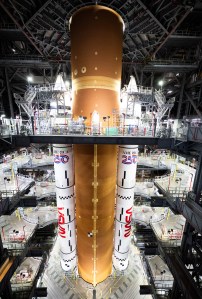
NASA’s SLS (Space Launch System) rocket is seen inside High Bay 3 of the Vehicle Assembly Building as teams await the arrival of Artemis II crewmembers to board their Orion spacecraft on top of the rocket as part of the Artemis II countdown demonstration test, Saturday, Dec. 20, 2025, at NASA’s Kennedy Space Center in Florida.
Credit: NASA/Joel Kowsky
NASA’s integrated SLS (Space Launch System) rocket and Orion spacecraft for the Artemis II mission is inching closer to launch – literally.
The agency is targeting no earlier than 7 a.m. EST, Saturday, Jan. 17, to begin the multi-hour trek from the Vehicle Assembly Building to Launch Pad 39B at NASA’s Kennedy Space Center in Florida.
A pre rollout mission news conference, live feed of rollout, and a media gaggle will stream on NASA’s YouTube channel. Individual streams for each of these events will be available from that page. Learn how to stream NASA content through a variety of online platforms, including social media.
The time of rollout is subject to change if additional time is needed for technical preparations or weather.
All times are Eastern. Events are as follows:
Friday, Jan. 16:
12 p.m.: Artemis II Rollout, Mission Overview News Conference
John Honeycutt, Artemis II mission management team chair
Charlie Blackwell-Thompson, Artemis launch director, Exploration Ground Systems
Jeff Radigan, Artemis II lead flight director, Flight Operations Directorate
Lili Villarreal, landing and recovery director, Exploration Ground Systems
Jacob Bleacher, chief exploration scientist, Exploration Systems Development Mission Directorate
Saturday, Jan. 17:
7 a.m.: Rollout, Artemis II Live Views from Kennedy Space Center feed begins
9 a.m.: Artemis II Crew Rollout Media Event
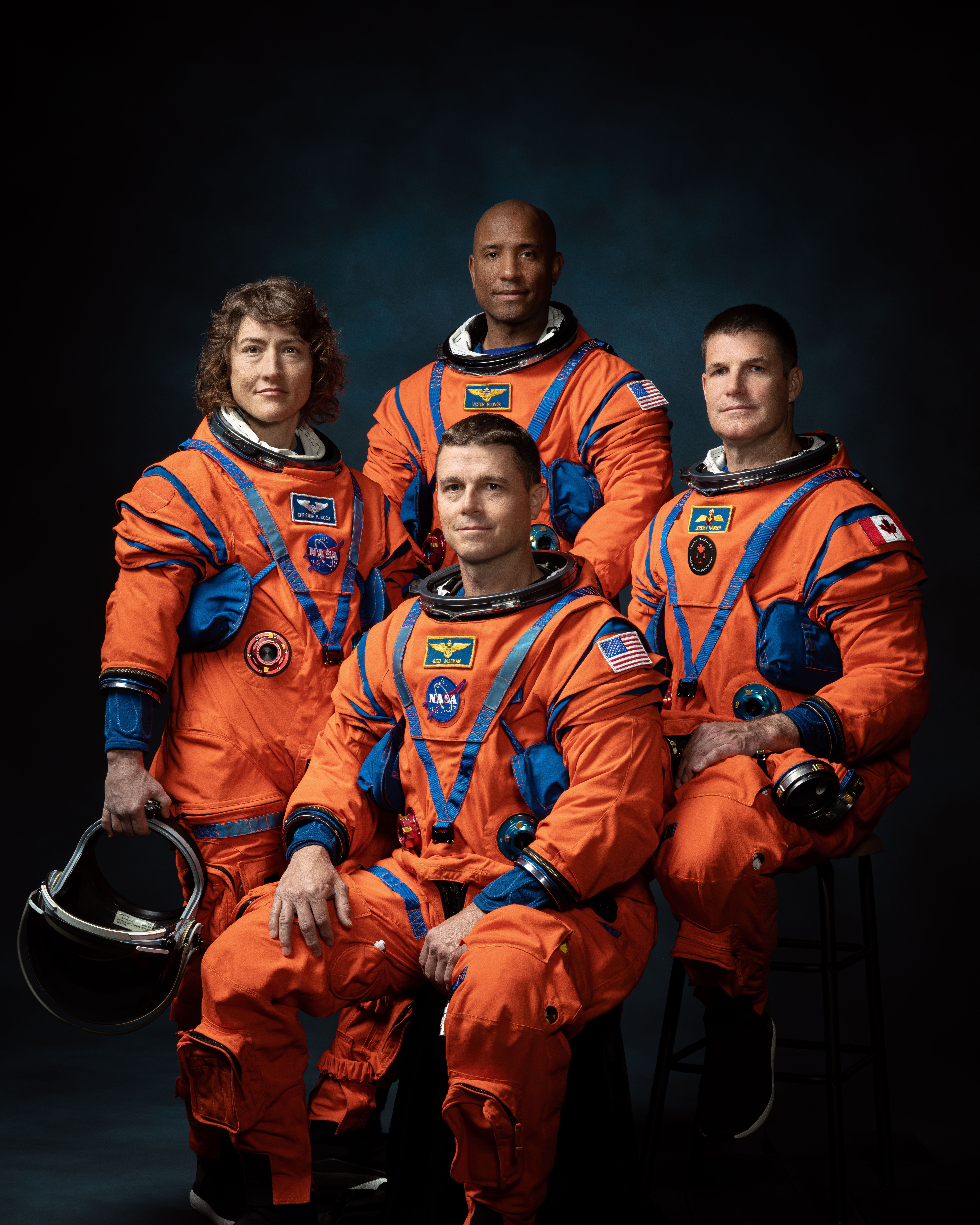
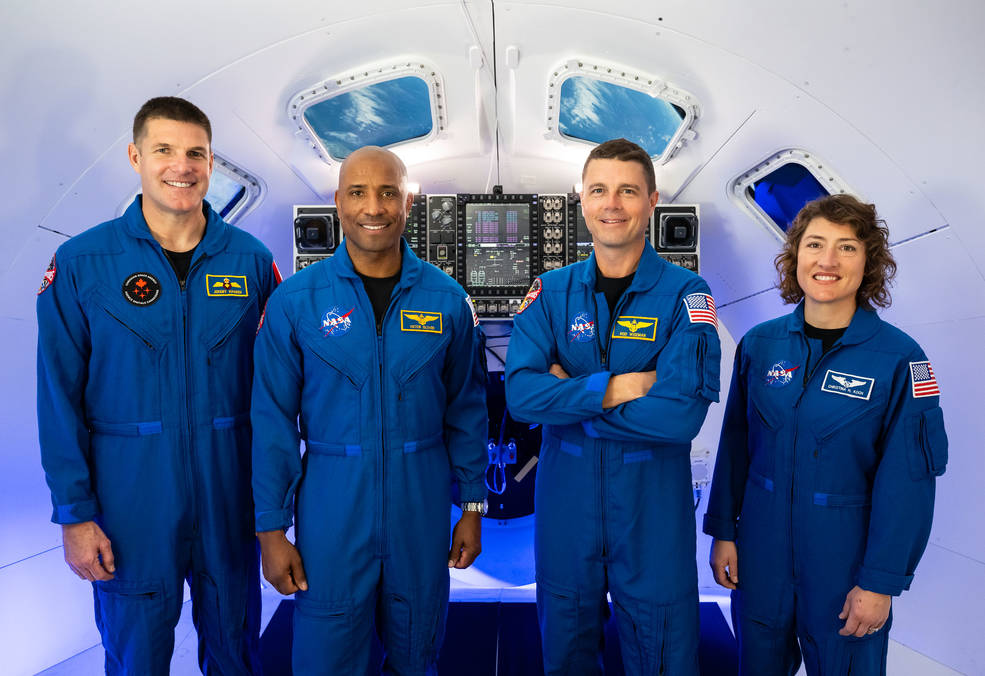
NASA Administrator Jared Isaacman and the Artemis II crew, including NASA astronauts Reid Wiseman, Victor Glover, and Christina Koch, and CSA (Canadian Space Agency) astronaut Jeremy Hansen, will answer questions about their preparations and the mission for media in-person at the countdown clock.
NASA’s crawler-transporter 2 will carry the 11-million-pound stack at about one mile per hour along the four-mile route from the Vehicle Assembly Building to Launch Pad 39B, on a journey that will take up to 12 hours.
To participate in the news conference by telephone, media must RSVP no later than two hours before the start to: ksc-newsroom@mail.nasa.gov.
These events will be open in-person only to media previously credentialed for launch. The deadline has passed for in-person accreditation for Artemis II events at Kennedy.
Rollout to the pad marks another milestone leading up to the Artemis II mission. In the coming weeks, NASA will complete final preparations of the rocket and, if needed, rollback SLS and Orion to the Vehicle Assembly Building for additional work. While the Artemis II launch window opens as early as Friday, Feb. 6, the mission management team will assess flight readiness after the wet dress rehearsal across the spacecraft, launch infrastructure, and the crew and operations teams before selecting a launch date.
Through Artemis, NASA will send astronauts to explore the Moon for scientific discovery, economic benefits, and to build the foundation for the first crewed missions to Mars.
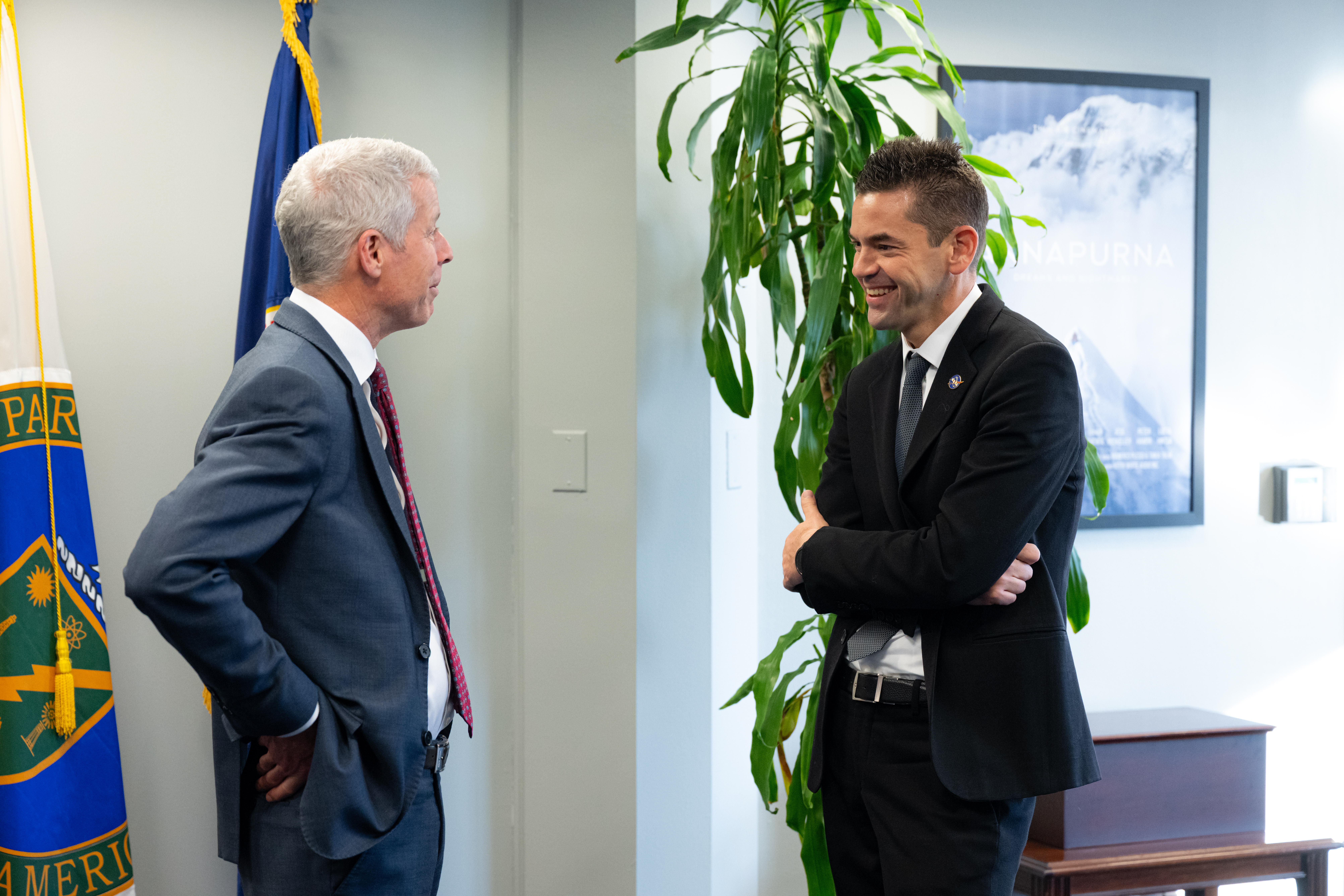
U.S. Secretary of Energy Chris Wright (left) and NASA Administrator Jared Isaacman (right) meet at the Department of Energy headquarters in Washington on Jan. 8, 2026.
Credit: NASA/John Kraus
NASA, along with the U.S. Department of Energy (DOE), announced Tuesday a renewed commitment to their longstanding partnership to support the research and development of a fission surface power system for use on the Moon under the Artemis campaign and future NASA missions to Mars.
A recently signed memorandum of understanding between the agencies solidifies this collaboration and advances President Trump’s vision of American space superiority by deploying nuclear reactors on the Moon and in orbit, including the development of a lunar surface reactor by 2030. This effort ensures the United States leads the world in space exploration and commerce.
“Under President Trump’s national space policy, America is committed to returning to the Moon, building the infrastructure to stay, and making the investments required for the next giant leap to Mars and beyond,” said NASA Administrator Jared Isaacman. “Achieving this future requires harnessing nuclear power. This agreement enables closer collaboration between NASA and the Department of Energy to deliver the capabilities necessary to usher in the Golden Age of space exploration and discovery.”
NASA and DOE anticipate deploying a fission surface power system capable of producing safe, efficient, and plentiful electrical power that will be able to operate for years without the need to refuel. The deployment of a lunar surface reactor will enable future sustained lunar missions by providing continuous and abundant power, regardless of sunlight or temperature.
“History shows that when American science and innovation come together, from the Manhattan Project to the Apollo Mission, our nation leads the world to reach new frontiers once thought impossible,” said U.S. Secretary of Energy Chris Wright. “This agreement continues that legacy. Thanks to President Trump’s leadership and his America First Space Policy, the department is proud to work with NASA and the commercial space industry on what will be one of the greatest technical achievements in the history of nuclear energy and space exploration.”
The agencies’ joint effort to develop, fuel, authorize, and ready a lunar surface reactor for launch builds upon more than 50 years of successful collaboration in support of space exploration, technology development, and the strengthening of our national security.
For more about NASA’s Moon to Mars exploration plans, visit:
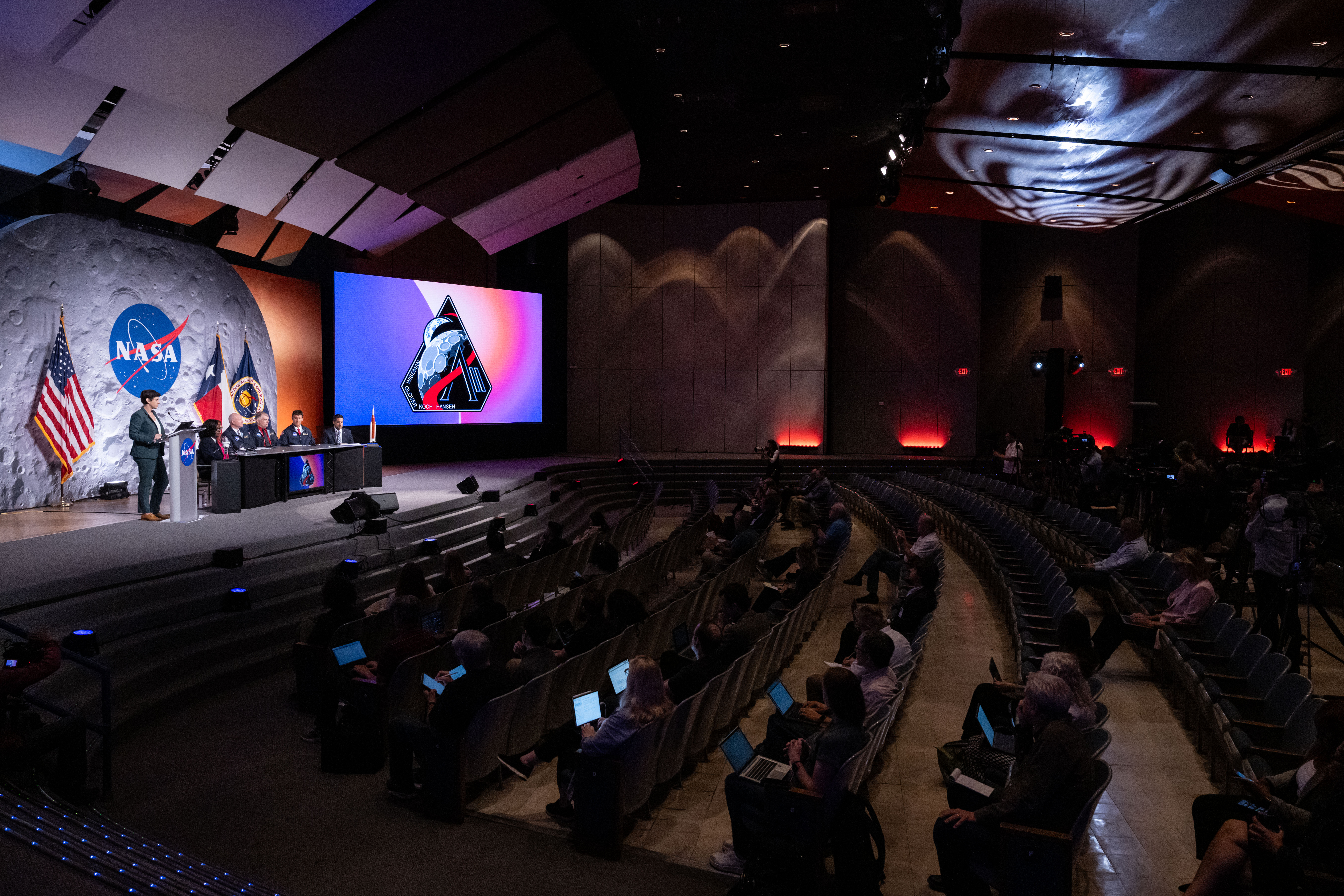
NASA hosted the Artemis II Mission Overview briefing in the Teague Auditorium at NASA’s Johnson Space Center in Houston, Sept. 23, 2025.
NASA/James Blair
Media accreditation is open to attend Artemis II mission activities at NASA’s Johnson Space Center in Houston. Johnson is where flight controllers in mission control will manage the test flight after liftoff of the first crewed Moon mission under the agency’s Artemis campaign.
Targeted to launch no earlier Friday, Feb. 6, the Artemis II mission will send NASA astronauts Reid Wiseman, Victor Glover, Christina Koch, and CSA (Canadian Space Agency) astronaut Jeremy Hansen on an approximately 10-day journey around the Moon and back to test the systems and hardware, which will return humanity to the lunar surface.
After launch day, NASA will host daily briefings at Johnson throughout the mission with agency managers and mission experts. The briefings will be streamed on NASA’s YouTube channel.
International media without U.S. citizenship must apply to cover the mission in person at Johnson by 5 p.m. CST Friday, Jan. 16. U.S. media must apply by Friday, Jan. 30. Media representatives must apply by contacting the NASA Johnson newsroom at jsccommu@mail.nasa.gov. NASA’s media accreditation policy is available online.
Due to high interest, in-person space is limited. Credentialed media will receive a confirmation email if approved. Those who are accredited to attend the Artemis II launch at NASA’s Kennedy Space Center in Florida are not automatically accredited to attend events at Johnson and must receive a separate confirmation for activities in-person at NASA Johnson.
As part of a Golden Age of innovation and exploration, Artemis will pave the way for new U.S.-crewed missions on the lunar surface in preparation to send the first astronauts to Mars.
To learn more about the Artemis II mission, visit:
Hugo Costa, executive director for the Portuguese Space Agency, and U.S. Ambassador to Portugal John J. Arrigo pose for a photo on Jan. 12 during a ceremony in Lisbon, Portugal, to mark the country’s signing of the Artemis Accords.
Credit: U.S. State Department
Portugal is the latest nation to sign the Artemis Accords alongside 59 other countries in a commitment to advancing principles for the responsible exploration of the Moon, Mars, and beyond with NASA.
“Portugal joins a cadre of nations building the framework for safe, transparent, and prosperous activity in space,” said NASA Administrator Jared Isaacman in recorded remarks. “This is our generation’s Golden Age of Exploration. Together, we are advancing innovation, driving international collaboration, and discovering the secrets of the universe.”
Portugal’s Secretary of State for Science and Innovation Helena Canhão signed the Artemis Accords on behalf of the country on Jan. 11.
“2026 is the year in which humans will return to the Moon. It will mark the beginning of a new era of space exploration, reminiscent of the Portuguese explorers of the past, such as Magellan and his circumnavigation of our planet,” said Hugo Costa, executive director of the recently established Portuguese Space Agency, about the signing. “As a nation that approaches space sustainability with great care and responsibility, Portugal and the Portuguese Space Agency are proud to join the Artemis Accords and contribute to the sustainable, beneficial, and peaceful use of space for all humankind.”
A ceremony to recognize the signing was held on Monday in the capital city Lisbon, during a semi-annual meeting between the United States and Portugal to discuss cooperation between the two governments.
“This is a meaningful step forward for responsible space exploration,” said U.S. Ambassador to Portugal John J. Arrigo, who participated in the event. “Shared principles like those in the Artemis Accords are essential to ensuring that space remains a domain of stability, safety, and opportunity for all nations.”
In 2020, during the first Trump Administration, the United States, led by NASA and the U.S. Department of State, joined with seven other founding nations to establish the Artemis Accords, responding to the growing interest in lunar activities by both governments and private companies.
The accords introduced the first set of practical principles aimed at enhancing the safety, transparency, and coordination of civil space exploration on the Moon, Mars, and beyond.
Signing the Artemis Accords means to explore peaceably and transparently, to render aid to those in need, to ensure unrestricted access to scientific data that all of humanity can learn from, to ensure activities do not interfere with those of others, to preserve historically significant sites and artifacts, and to develop best practices for how to conduct space exploration activities for the benefit of all.
More countries are expected to sign the Artemis Accords in the months and years ahead.
El cohete Sistema de Lanzamiento Espacial (SLS, por sus siglas en inglés) de la NASA, visto en la nave High Bay 3 del Edificio de Ensamblaje de Vehículos mientras los equipos t esperan la llegada de los tripulantes de Artemis II para abordar su nave espacial Orion en la parte superior del cohete como parte de la prueba de demostración de la cuenta atrás de Artemis II, el sábado 20 de diciembre de 2025, en el Centro Espacial Kennedy de la NASA en Florida.
Conforme la NASA se acerca al lanzamiento del vuelo de prueba Artemis II, la agencia pronto llevará por primera vez su cohete Sistema de Lanzamiento Espacial (SLS, por sus siglas en inglés) y la nave espacial Orion a la plataforma de lanzamiento en el Centro Espacial Kennedy de la agencia en Florida para comenzar la integración final, las pruebas y los ensayos para el lanzamiento.
La NASA tiene como objetivo comenzar desde el sábado 17 de enero su traslado desde el Edificio de Ensamblaje de Vehículos hasta la Plataforma de Lanzamientos 39B, lo que tardará varias horas. El viaje de casi 6,5 kilómetros (cuatro millas) en el vehículo transportador oruga 2 podría durar hasta 12 horas. Los equipos técnicos están trabajando día y noche para dar por terminadas todas las tareas antes del transporte del cohete. Sin embargo, esta fecha objetivo está sujeta a cambios si fuera necesario tiempo adicional para los preparativos técnicos o debido a las condiciones meteorológicas.
“Nos estamos acercando a la misión Artemis II, y tenemos su lanzamiento a la vuelta de la esquina”, dijo Lori Glaze, administradora asociada interina para la Dirección de Misiones de Desarrollo de Sistemas de Exploración de la NASA. “Nos quedan pasos importantes en nuestro camino hacia el lanzamiento, y la seguridad de la tripulación seguirá siendo nuestra principal prioridad en todo momento, a medida que nos acercamos al regreso de la humanidad a la Luna”.
Al igual que con todos los nuevos desarrollos de sistemas complejos, los ingenieros han estado solucionando varios problemas en los últimos días y semanas. Durante las comprobaciones finales antes del traslado, los técnicos detectaron que un cable relacionado con el sistema de terminación de vuelo estaba doblado en contra de las especificaciones. El personal técnico lo está reemplazando y hará pruebas con el nuevo cable durante el fin de semana. Además, una válvula relacionada con la presurización de la escotilla de Orion presentó problemas que hicieron necesario llevar a cabo pruebas de demostración de la cuenta regresiva el 20 de diciembre pasado. El 5 de enero, el equipo reemplazó la válvula e hizo pruebas de su funcionamiento que resultaron exitosas. Los ingenieros también trabajaron para resolver fugas en el hardware de soporte en tierra que es necesario para cargar oxígeno gaseoso en Orion a fin de proporcionar aire respirable.
Traslado
Una vez que el cohete y la nave espacial integrados lleguen a la plataforma de lanzamiento, la NASA comenzará inmediatamente una larga lista de verificación para los preparativos en la plataforma de lanzamiento, incluyendo la conexión de equipos mecánicos de apoyo en tierra, como líneas eléctricas, conductos del sistema de control ambiental de combustible y tomas de surtido de combustible criogénico. Los equipos de personal técnico encenderán todos los sistemas integrados en la plataforma por primera vez para garantizar que los componentes del hardware de vuelo funcionen correctamente entre sí, con el lanzador móvil y con los sistemas de infraestructura terrestre.
Una vez que esté todo completado, los astronautas de Artemis II, Reid Wiseman, Victor Glover y Christina Koch de la NASA, y el astronauta de la CSA (Agencia Espacial Canadiense) Jeremy Hansen, llevarán a cabo una caminata final en la plataforma.
Ensayo general con circulación de combustible y llenado de tanques
A finales de enero, la NASA llevará a cabo un ensayo general con circulación de combustible, el cual es una prueba previa al lanzamiento para llenar los tanques de combustible en el cohete. Durante este ensayo general, el personal técnico hace una demostración de la capacidad de cargar más de 700.000 galones de combustible criogénico en el cohete, lleva a cabo una cuenta regresiva para el lanzamiento y practica la extracción segura del combustible del cohete sin tripulación presente en el sitio.
Durante el lanzamiento, el equipo de cierre, o de tareas finales, será responsable de asegurar a los astronautas en Orion y cerrar sus escotillas. El personal de cierre también utilizará este ensayo para practicar sus procedimientos de forma segura sin tener tripulación a bordo de la nave espacial.
El ensayo general con circulación de combustible incluirá varios “encendidos”, o pruebas de funcionamiento, para demostrar la capacidad del equipo de lanzamiento para detener, reanudar y reiniciar operaciones en varios momentos diferentes de los últimos 10 minutos de la cuenta regresiva, conocida como conteo terminal.
La ejecución del primer encendido comenzará aproximadamente en las 49 horas antes del lanzamiento, cuando los equipos encargados de lanzamiento son llamados a sus estaciones, hasta 1 minuto y 30 segundos antes del lanzamiento, seguido de una pausa planificada de tres minutos y luego la reanudación de la cuenta regresiva hasta 33 segundos antes del lanzamiento, el punto en el que el secuenciador de lanzamiento automático del cohete controlará los últimos segundos de la cuenta regresiva. Luego, los equipos técnicos volverán a reiniciar a T-10 minutos y detendrán el conteo, y luego reanudarán los procedimientos hasta 30 segundos antes del lanzamiento como parte de una segunda ejecución.
Si bien la NASA ha integrado las lecciones aprendidas con Artemis I en los procedimientos de la cuenta regresiva para el lanzamiento, la agencia hará una pausa para abordar cualquier problema durante la prueba o en cualquier otro momento si surgen retos técnicos. Los ingenieros vigilarán de cerca la carga de combustible de hidrógeno líquido y oxígeno líquido en el cohete, después de los desafíos que se encontraron con la carga de hidrógeno líquido durante los ensayos generales con circulación de combustible de Artemis I. Los equipos técnicos también prestarán mucha atención a la efectividad de los procedimientos recientemente actualizados para limitar la cantidad de nitrógeno gaseoso que se acumula en el espacio que está entre el módulo de tripulación de Orion y las escotillas del sistema de cancelación de lanzamiento, lo que podría representar un problema para el personal de cierre.
Es posible que se requieran ensayos generales con circulación de combustible adicionales para garantizar que el vehículo esté completamente revisado y apto para el vuelo.
De ser necesario, la NASA podría trasladar al cohete SLS y la nave Orion de vuelta al Edificio de Ensamblaje de Vehículos para realizar trabajos adicionales antes del lanzamiento después del ensayo general con circulación de combustible.
Próximos pasos para el lanzamiento
Después de un exitoso ensayo general con circulación de combustible, la NASA convocará una revisión de aptitud para el vuelo en la cual el equipo de gestión de la misión evaluará la aptitud de todos los sistemas, incluyendo el hardware de vuelo, la infraestructura y el personal de lanzamiento, vuelo y recuperación antes de comprometerse con una fecha de lanzamiento.
Aunque la ventana para el lanzamiento de Artemis II se podría iniciar tan pronto como el viernes 6 de febrero, el equipo de gestión de la misión evaluará la aptitud para el vuelo después del ensayo general con toda la nave espacial, la infraestructura de lanzamiento, y la tripulación y el personal de operaciones antes de seleccionar una fecha para el lanzamiento.
A fin de determinar las posibles fechas de lanzamiento, los ingenieros identificaron las restricciones clave necesarias para cumplir la misión y mantener a salvo a la tripulación dentro de Orion. Los períodos de lanzamiento resultantes son los días o las semanas en los que la nave espacial y el cohete pueden cumplir los objetivos de la misión. Estos períodos de lanzamiento explican la compleja mecánica orbital relacionada con el lanzamiento en una trayectoria precisa hacia la Luna mientras la Tierra rota sobre su eje y la Luna orbita la Tierra cada mes en su ciclo lunar. Esto da como resultado un patrón de alrededor de una semana de oportunidades de lanzamiento, seguido de tres semanas sin oportunidades de lanzamiento.
Existen varios parámetros principales que establecen la disponibilidad del lanzamiento dentro de estos períodos. Debido a su trayectoria única en relación con las misiones de alunizaje posteriores, estas limitaciones clave son exclusivas del vuelo de prueba de la misión Artemis II.
El día y la hora de lanzamiento deben permitir que SLS pueda llevar a Orion a una órbita terrestre alta, donde la tripulación y los equipos técnicos en tierra evaluarán los sistemas de soporte vital de la nave espacial antes de que la tripulación emprenda su viaje con rumbo a la Luna.
Orion también debe estar en la alineación adecuada con la Tierra y la Luna en el momento del encendido de motores con inyección translunar. El encendido de motores con inyección translunar de Artemis II pone a Orion en rumbo de sobrevolar la Luna, y también lo pone en una trayectoria de retorno libre, en la cual la nave espacial utiliza la gravedad de la Luna para enviar la nave espacial de regreso a la Tierra sin maniobras adicionales importantes de propulsión.
La trayectoria para un día determinado debe garantizar que Orion no esté en la oscuridad durante más de 90 minutos a la vez para que las alas de los paneles solares puedan recibir y convertir la luz solar en electricidad, y la nave espacial pueda mantener un rango de temperatura óptimo. Los planificadores de la misión eliminan las posibles fechas de lanzamiento que llevarían a Orion a eclipses prolongados durante el vuelo.
La fecha de lanzamiento debe sustentar una trayectoria que permita el perfil de entrada adecuado planificado durante el regreso de Orion a la Tierra.
Los períodos a continuación muestran la disponibilidad de llevar a cabo el lanzamiento hasta abril de 2026. Los planificadores de la misión mejoran estos períodos en función de un análisis actualizado más o menos dos meses antes de que estos comiencen, y ellos están sujetos a cambios.
Período de lanzamiento del 31 de enero al 14 de febrero
Oportunidades de lanzamiento los días 6, 7, 8, 10 y 11 de febrero
Período de lanzamiento del 28 de febrero al 13 de marzo
Oportunidades de lanzamiento los días 6, 7, 8, 9, 11 de marzo
Período de lanzamiento del 27 de marzo al 10 de abril
Oportunidades de lanzamiento los días 1, 3, 4, 5, 6 de abril
Además de las oportunidades de lanzamiento basadas en la mecánica orbital y los requisitos de desempeño, también existen restricciones sobre qué días dentro de un período de lanzamiento pueden ser viables en función de la reposición de productos básicos, las condiciones meteorológicas y las operaciones de otros usuarios en el cronograma del Área Este. Como regla general, se pueden hacer hasta cuatro intentos de lanzamiento dentro de la semana aproximada de oportunidades que existen dentro de un período de lanzamiento.
Mientras la agencia se prepara para su primera misión tripulada más allá de la órbita terrestre en más de 50 años, la NASA espera aprender durante los procesos, tanto en tierra como en vuelo, y dejará que la aptitud y el desempeño de sus sistemas indiquen el momento en que la agencia está lista para el lanzamiento.
Como parte de una edad de oro de innovación y exploración, el vuelo de prueba de Artemis II, el cual tendrá una duración aproximada de 10 días, es el primer vuelo tripulado para la campaña Artemis de la NASA. Este es otro paso hacia nuevas misiones tripuladas de Estados Unidos en la superficie de la Luna, lo que llevará a una presencia sostenida en la Luna que ayudará a la agencia a prepararse para enviar a los primeros astronautas estadounidenses a Marte.
Encuentra más información sobre la campaña Artemis de la NASA en el siguiente sitio web (en inglés):
NASA’s SLS (Space Launch System) rocket is seen inside High Bay 3 of the Vehicle Assembly Building as teams await the arrival of Artemis II crewmembers to board their Orion spacecraft on top of the rocket as part of the Artemis II countdown demonstration test, Saturday, Dec. 20, 2025, at NASA’s Kennedy Space Center in Florida.
As NASA moves closer to launch of the Artemis II test flight, the agency soon will roll its SLS (Space Launch System) rocket and Orion spacecraft to the launch pad for the first time at the agency’s Kennedy Space Center in Florida to begin final integration, testing, and launch rehearsals.
NASA is targeting no earlier than Saturday, Jan. 17, to begin the multi-hour trek from the Vehicle Assembly Building to Launch Pad 39B. The four-mile journey on the crawler-transporter-2 will take up to 12 hours. Teams are working around the clock to close out all tasks ahead of rollout. However, this target date is subject to change if additional time is needed for technical preparations or weather.
“We are moving closer to Artemis II, with rollout just around the corner,” said Lori Glaze, acting associate administrator for NASA’s Exploration Systems Development Mission Directorate. “We have important steps remaining on our path to launch and crew safety will remain our top priority at every turn, as we near humanity’s return to the Moon.”
As with all new developments of complex systems, engineers have been troubleshooting several items in recent days and weeks. During final checkouts before rollout, technicians found a cable involved in the flight termination system was bent out of specifications. Teams are replacing it and will test the new cable over the weekend. Additionally, a valve associated with Orion’s hatch pressurization exhibited issues leading up to a Dec. 20 countdown demonstration test. On Jan. 5, the team successfully replaced and tested it. Engineers also worked to resolve leaky ground support hardware required to load gaseous oxygen into Orion for breathing air.
Rollout
Once the integrated rocket and spacecraft reach the launch pad, NASA will immediately begin a long checklist of launch pad preparations, including connecting ground support equipment such as electrical lines, fuel environmental control system ducts, and cryogenic propellant feeds. Teams will power up all integrated systems at the pad for the first time to ensure flight hardware components are functioning properly with each other, the mobile launcher, and ground infrastructure systems.
Once complete, the Artemis II astronauts, NASA’s Reid Wiseman, Victor Glover, and Christina Koch, and CSA (Canadian Space Agency) astronaut Jeremy Hansen, will conduct a final walkdown at the pad.
Wet dress rehearsal, tanking
At the end of January, NASA will conduct a wet dress rehearsal, which is a prelaunch test to fuel the rocket. During wet dress, teams demonstrate the ability to load more than 700,000 gallons of cryogenic propellants into the rocket, conduct a launch countdown, and practice safely removing propellant from the rocket without astronauts onsite.
During launch, a closeout crew will be responsible for securing astronauts in Orion and closing its hatches. The closeout crew also will use this rehearsal to practice their procedures safely without astronauts aboard the spacecraft.
The wet dress rehearsal will include several “runs” to demonstrate the launch team’s ability to hold, resume, and recycle to several different times in the final 10 minutes of the countdown, known as terminal count.
The first run will begin approximately 49 hours before launch when launch teams are called to their stations, to 1 minute 30 seconds before launch, followed by a planned three-minute hold and then countdown resumption to 33 seconds before launch – the point at which the rocket’s automatic launch sequencer will control the final seconds of the countdown. Teams then will recycle back to T-10 minutes and hold, then resume down to 30 seconds before launch as part of a second run.
While NASA has integrated lessons learned from Artemis I into the launch countdown procedures, the agency will pause to address any issues during the test or at any other point should technical challenges arise. Engineers will have a close eye on propellant loading of liquid hydrogen and liquid oxygen into the rocket, after challenges encountered with liquid hydrogen loading duringArtemis I wet dress rehearsals. Teams also will pay close attention to the effectiveness of recently updated procedures to limit how much gaseous nitrogen accumulates in the space between Orion’s crew module and launch abort system hatches, which could pose an issue for the closeout crew.
Additional wet dress rehearsals may be required to ensure the vehicle is completely checked out and ready for flight.
If needed, NASA may rollback SLS and Orion to the Vehicle Assembly Building for additional work ahead of launch after the wet dress rehearsal.
Next steps toward launch
Following a successful wet dress rehearsal, NASA will convene a flight readiness review where the mission management team will assess the readiness of all systems, including flight hardware, infrastructure, and launch, flight, and recovery teams before committing to a launch date.
While the Artemis II launch window opens as early as Friday, Feb. 6, the mission management team will assess flight readiness after the wet dress rehearsal across the spacecraft, launch infrastructure, and the crew and operations teams before selecting a launch date.
To determine potential launch dates, engineers identified key constraints required to accomplish the mission and keep the crew inside Orion safe. The resulting launch periods are the days or weeks where the spacecraft and rocket can meet mission objectives. These launch periods account for the complex orbital mechanics involved in launching on a precise trajectory toward the Moon while the Earth is rotating on its axis and the Moon is orbiting Earth each month in its lunar cycle. This results in a pattern of approximately one week of launch opportunities, followed by three weeks without launch opportunities.
There are several primary parameters that dictate launch availability within these periods. Because of its unique trajectory relative to subsequent lunar landing missions, these key constraints are unique to the Artemis II test flight.
The launch day and time must allow SLS to be able to deliver Orion into a high Earth orbit where the crew and ground teams will evaluate the spacecraft’s life support systems before the crew ventures to the Moon.
Orion also must be in the proper alignment with the Earth and Moon at the time of the trans-lunar injection burn. The Artemis II trans-lunar injection burn places Orion on course to flyby the Moon, and also sets it on a free return trajectory, in which the spacecraft uses the Moon’s gravity to send the spacecraft back to Earth without additional major propulsive maneuvers.
The trajectory for a given day must ensure Orion is not in darkness for more than 90 minutes at a time so that the solar array wings can receive and convert sunlight to electricity, and the spacecraft can maintain an optimal temperature range. Mission planners eliminate potential launch dates that would send Orion into extended eclipses during the flight.
The launch date must support a trajectory that allows for the proper entry profile planned during Orion’s return to Earth.
The periods below show launch availability through April 2026. Mission planners refine the periods based on updated analysis approximately two months before they begin and are subject to change.
Launch Period Jan. 31 – Feb. 14
Launch opportunities February 6, 7, 8, 10, and 11
Launch Period Feb. 28 – March 13
Launch opportunities March 6, 7, 8, 9, 11
Launch Period March 27 – April 10
Launch opportunities April 1, 3, 4, 5, 6
In addition to the launch opportunities based on orbital mechanics and performance requirements, there are also limitations on which days within a launch period can be viable based on commodity replenishment, weather, and other users on the Eastern Range schedule. As a general rule, up to four launch attempts may be attempted within the approximate week of opportunities that exist within a launch period.
As the agency prepares for its first crewed mission beyond Earth orbit in more than 50 years, NASA expects to learn along the way, both on the ground and in flight, and will let the readiness and performance of its systems dictate when the agency is ready to launch.
As part of a Golden Age of innovation and exploration, the approximately 10-day Artemis II test flight is the first crewed flight under NASA’s Artemis campaign. It is another step toward new U.S.-crewed missions to the Moon’s surface, leading to a sustained presence on the Moon that will help the agency prepare to send the first astronauts – Americans – to Mars.
Dave Reynolds, the booster manager for SLS (Space Launch System), works inside the Next Generation Booster Avionics Mockup at NASA’s Marshall Space Flight Center in Huntsville, Alabama. Reynolds is responsible for the design, development, and flight of the boosters for the rocket that carry NASA’s Orion spacecraft and astronauts to the Moon as part of the Artemis II mission.
Credits: NASA
As booster manager for NASA’s SLS (Space Launch System), Dave Reynolds’ path to NASA is embodied by his childhood poster of the space shuttle’s Return to Flight initiative, which hangs in his office, serving as a constant reminder that his journey to the agency began decades ago.
Growing up in Roy, Utah, Reynolds remembers standing outside to watch the billowing smoke rise from booster tests at Northrop Grumman’s Promontory facility. Rockets were the backdrop of his childhood, and growing up during the shuttle missions sparked his fascination for space exploration.
As the booster manager for the SLS, Dave is responsible for the design, development, and flight of the boosters—work that echoes the sense of significance that inspired him as a child to study spaceflight.
“I couldn’t quite verbalize what I felt then, but as I’ve matured over time, I now realize I want to be a part of the team sending astronauts to the Moon, and I have a personal desire to ensure the safety of those individuals,” Reynolds said.
Dave Reynolds, the booster manager for SLS (Space Launch System), works inside the Next Generation Booster Avionics Mockup at NASA’s Marshall Space Flight Center in Huntsville, Alabama. Reynolds is responsible for the design, development, and flight of the boosters for the rocket that carry NASA’s Orion spacecraft and astronauts to the Moon as part of the Artemis II mission.
NASA
Early in his career at NASA’s Marshall Space Flight Center in Huntsville, Alabama, Reynolds worked on the J-2X — a liquid-cryogenic engine that was once slated as a candidate to power the SLS upper stage. In 2012, he made a jump to solid rocket motors when he became the subsystem manager for the SLS boosters office. Reynolds spent his days managing and testing motor cases, seals, igniters, and separation motors.
He was promoted to deputy manager for the SLS office where he helped oversee development of the solid rocket boosters. He also was given the task of developing and managing the evolved composite boosters that would be used for future Artemis missions.
With the launch of Artemis II on the horizon, Reynolds is thrilled to be part of the team preparing to send a crew of four astronauts around the Moon.
Deep down, I’m really excited about Artemis II. The eight-year-old me is still in there, eager to watch the smoke rising from those booster tests at a distance. He wouldn’t believe the things I’ve seen and what I’m about to see.
Dave Reynolds
Booster Manager for Space Launch System
“Deep down, I’m really excited about Artemis II. The eight-year-old me is still in there, eager to watch the smoke rising from those booster tests at a distance. He wouldn’t believe the things I’ve seen and what I’m about to see,” Reynolds said.
Reynolds witnessed moments that would have stunned his eight-year-old self. In 2022, he watched as the SLS illuminated the morning sky during the launch of Artemis I. More recently, the evolved booster he helped develop performed its first full-scale test. Reynolds watched as the booster roared to life – just miles from his hometown in Utah.
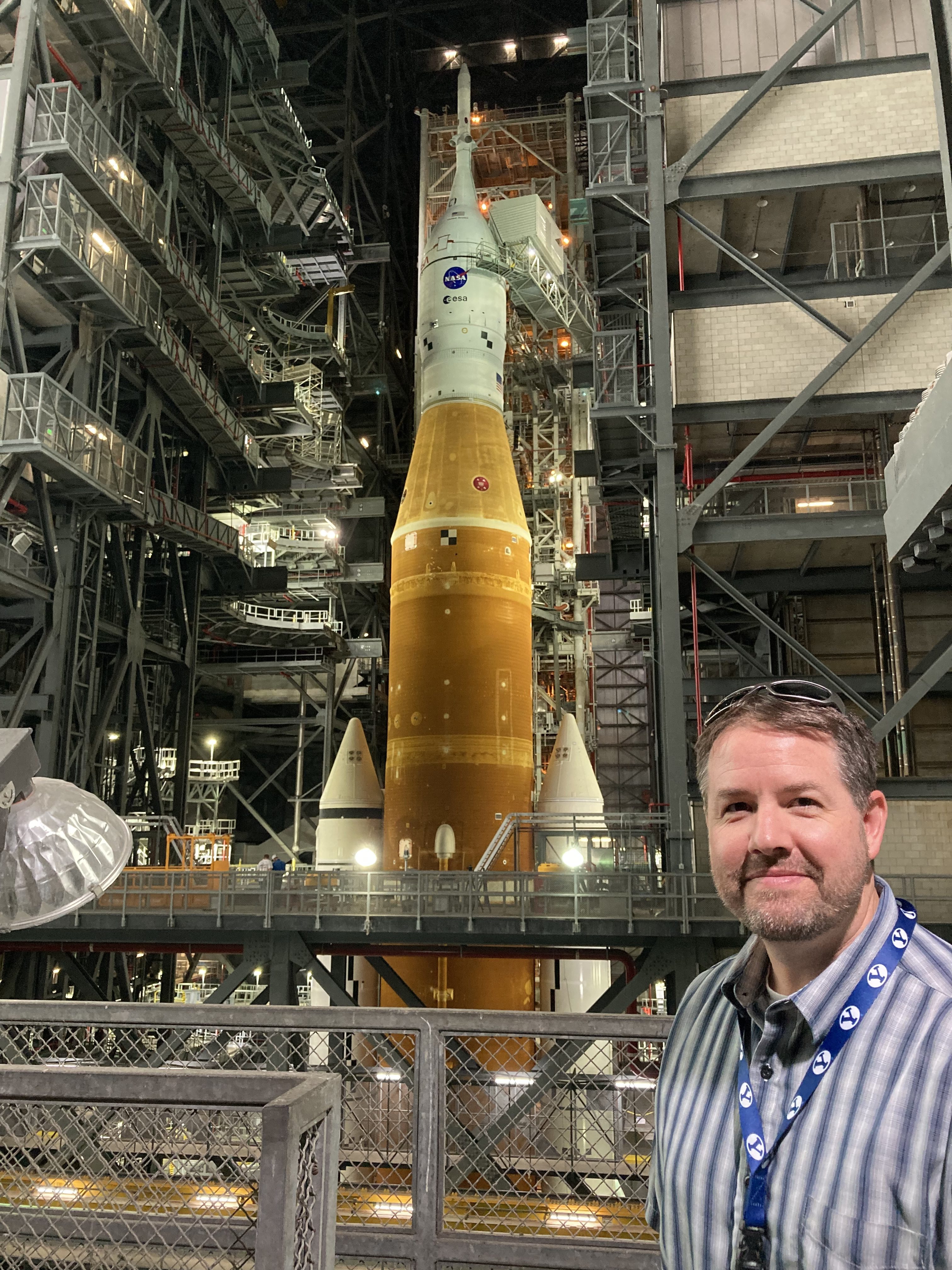
Reynolds, at NASA’s Kennedy Space Center’s Vehicle Assembly Building in front of the SLS rocket that powered the Artemis I mission. Through Artemis, NASA will send astronauts to explore the Moon for scientific discovery, economic benefits, and build the foundation for the first crewed missions to Mars.
NASA
From his driveway to the test site, Reynolds’ curiosity grew into a career shaped by purpose, responsibility, and respect for the work ahead. The poster hanging on Reynolds’ wall isn’t just a souvenir from the past – it’s a reminder of where his interest took root and how far that curiosity has carried him.
As the team moves closer to the launch of Artemis II which will take astronauts around the Moon, Reynolds feels a familiar sense of exhilaration. The questions that once drew him toward space are still guiding him today, except this time he is one of the individuals helping to shape the answers.
Preparations for Next Moonwalk Simulations Underway (and Underwater)
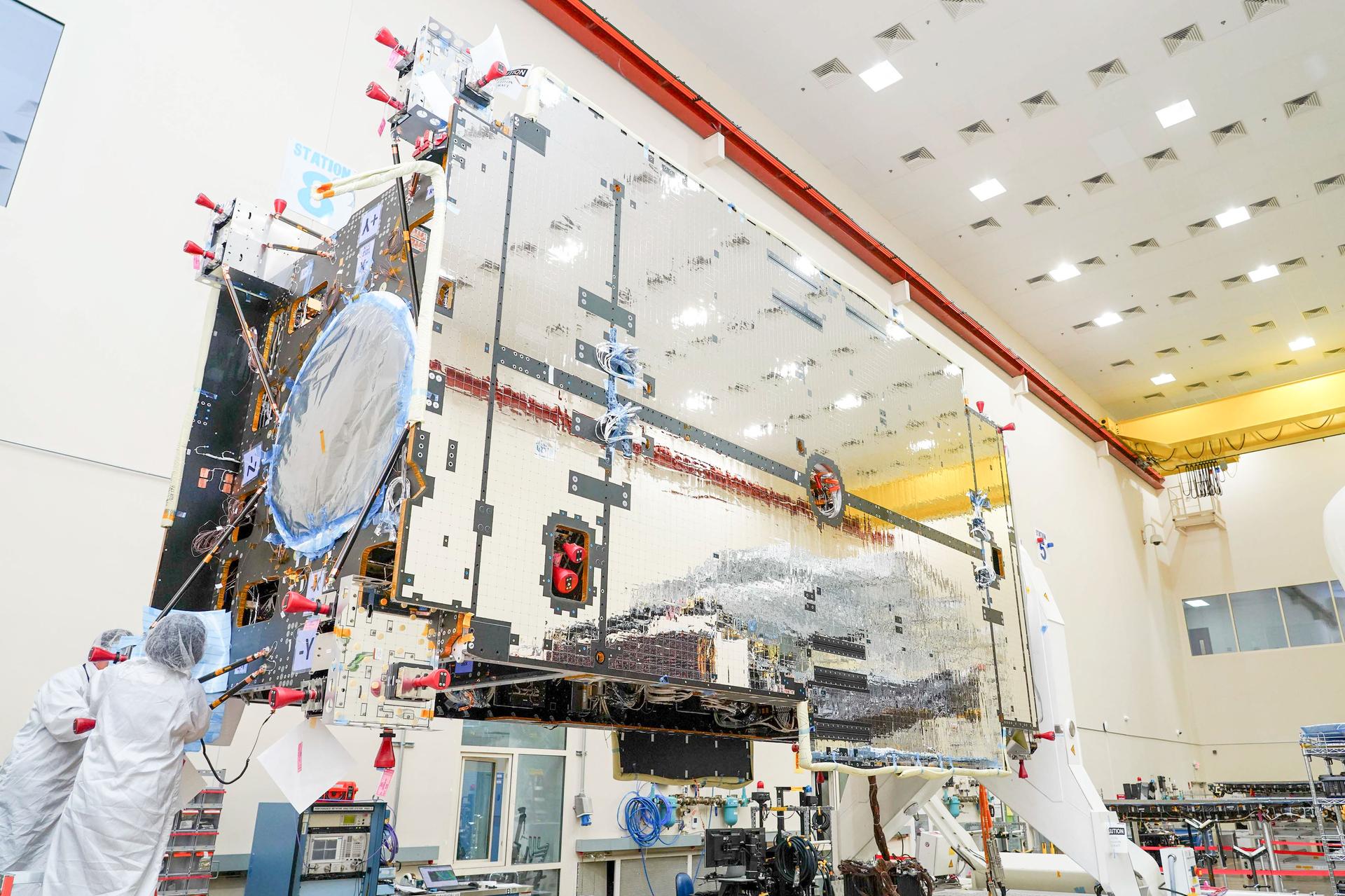
The primary structure of Gateway’s Power and Propulsion Element (PPE) undergoing assembly, integration, and testing at Lanteris Space Systems in Palo Alto, California, on September 29, 2025.
Lanteris Space Systems
Development continues on NASA’s Power and Propulsion Element, a solar electric propulsion spacecraft designed to provide power for Gateway in lunar orbit.
Able to generate 60 kilowatts of power, the element was successfully powered on earlier last year. The milestone demonstrates the element can provide the spacecraft with power, high-rate communications, attitude control, as well as the ability to maintain and maneuver between orbits.
The Power and Propulsion Element is managed by NASA’s Glenn Research Center in Cleveland and built by industry partner Lanteris Space Systems in Palo Alto, California, where teams have secured the element’s main electrical system inside protective exterior panels. On deck for installation at Lanteris Space Systems are three 12-kilowatt advanced electric propulsion system thrusters, manufactured by L3Harris, and four 6-kilowatt Busek-built BHT-6000 thrusters. The roll-out solar arrays for Gateway are complete and moving through testing at Redwire’s facility in Goleta, California.
For more information about NASA’s lunar exploration missions, visit:
Last year delivered doses of drama and excitement in the space business, with a record number of launches, breathtaking vistas of other worlds, and a multitude of breakthroughs and setbacks. 2026 is shaping up to be another thrilling year in the cosmos.
For the first time in more than 54 years, astronauts are training to travel to the vicinity of the Moon, perhaps within the next couple of months. NASA, SpaceX, Blue Origin, and other companies are poised to take major steps toward actually landing humans on the Moon, perhaps within a few years.
New rockets are slated to debut in 2026, and scientists hope to open new windows on the Universe. Here, we list the most anticipated space missions scheduled for this year, ranked according to our own anticipation for them. We also assess the chances of these missions actually happening in the next 12 months. Unless specified, we don't assess the chances of a successful outcome.
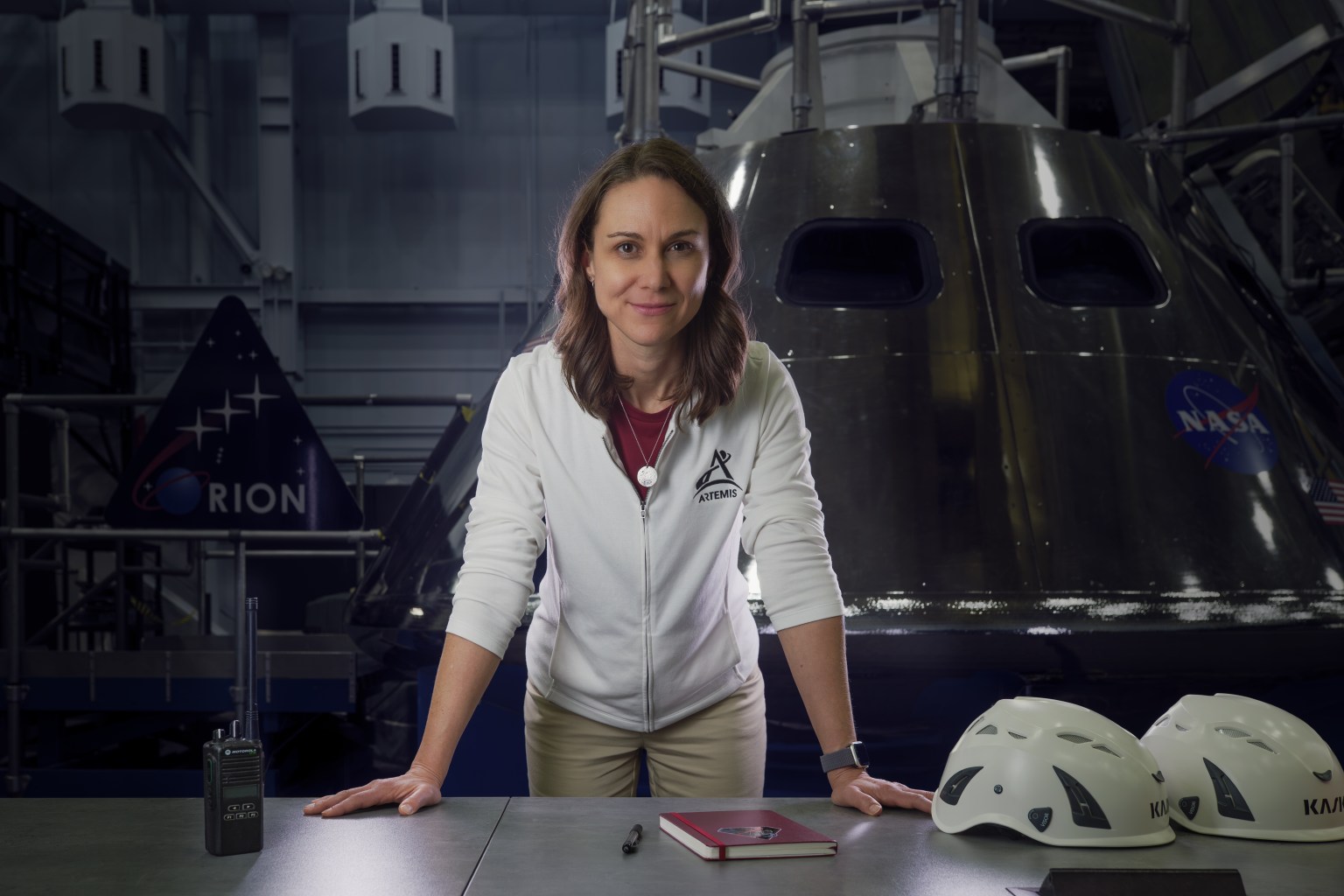
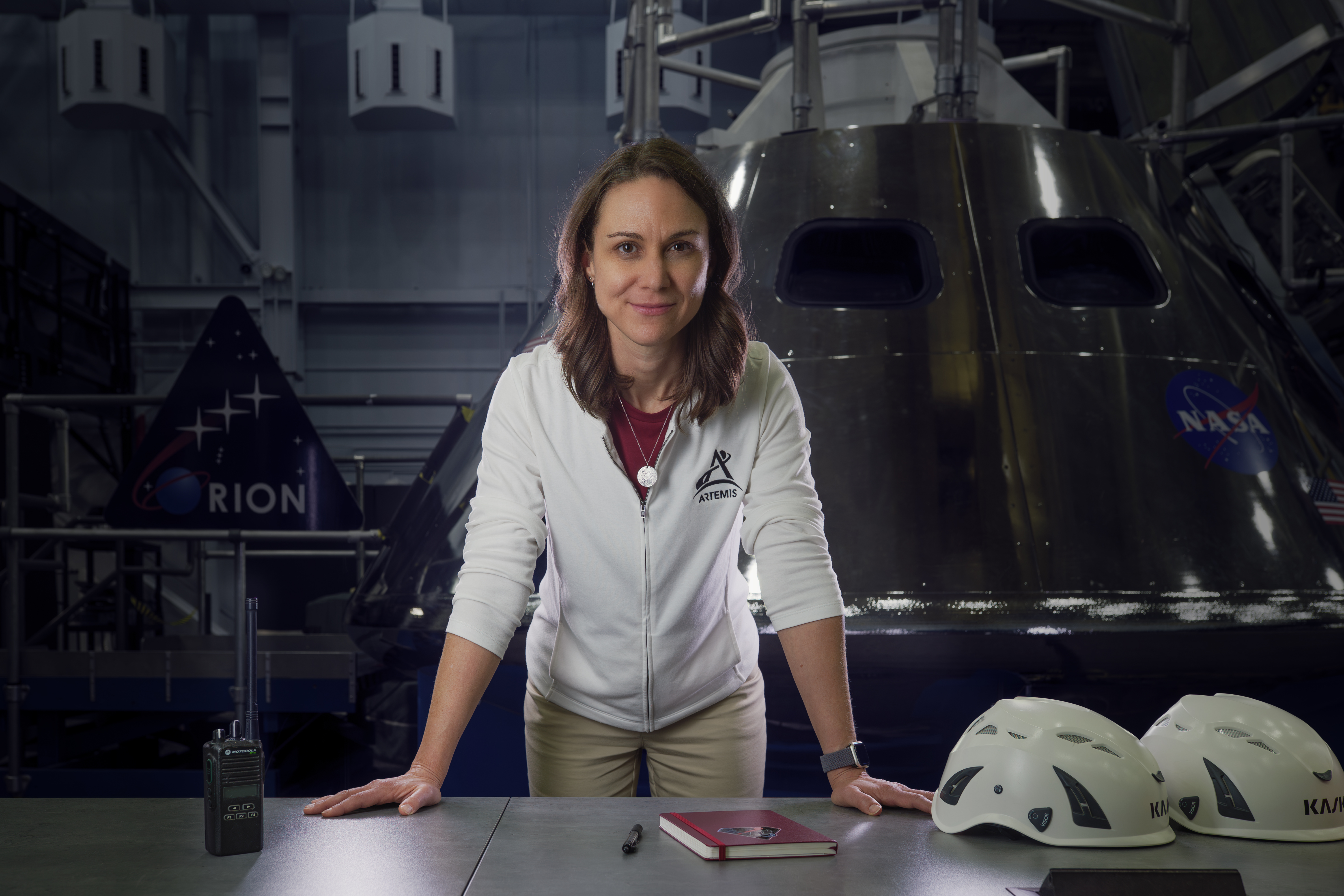
Jacki Mahaffey, Artemis II chief training officer at NASA’s Johnson Space Center in Houston, stands in front of the Orion mockup in Johnson's Space Vehicle Mockup Center.
Credits: NASA/Rad Sinyak
Listen to this audio excerpt from Jacki Mahaffey, Artemis II chief training officer:
0:00 / 0:00
When the Artemis II crew travels around the Moon aboard the Orion spacecraft, they will have spent countless hours training for their lunar mission, and Jacki Mahaffey will have played a role in preparing them for their journey.
As the Artemis II chief training officer at NASA’s Johnson Space Center in Houston, Mahaffey manages the planning, development, and implementation of the astronauts’ training and integrated simulations. Her job is to ensure that when the Artemis II crew travels around the Moon inside Orion, the astronauts and flight controllers are ready for every moment — expected and unexpected.
Training is all risk mitigation for the mission. By preparing the astronauts and flight controllers for what they might encounter, we enable mission success.
Jacki Mahaffey
Artemis II Chief Training Officer
The Artemis II crew began their rigorous training in 2023, but the work of Mahaffey and her team started long before that. Years before the training began, her team gathered the experts on how to operate the different aspects of Orion, and what the crew will need to know to execute their mission.
“One of my favorite moments from that process was when we all got together in one room, and everyone brought a piece of paper for every single lesson or training event that they expected to do with the crew,” Mahaffey said. “And we laid the entire thing out to figure out what’s the most logical order to put all of this training in, to help build that big picture for the crew.”
Training for Artemis II began shortly after the crew was announced, with Mahaffey and her team introducing the astronauts to Orion’s systems and operational basics. Once the necessary simulators and mockups were ready, the crew transitioned into hands-on training to build familiarity with their spacecraft.
At Johnson, Mahaffey’s team utilizes a range of specialized facilities, including the Space Vehicle Mockup Facility, where astronauts rehearse living and working inside the Orion mockup; the Orion Mission Simulator, which replicates flight software and displays; and the Neutral Buoyancy Laboratory, where the crew practices water survival techniques for post-splashdown scenarios.
Jacki Mahaffey, Artemis II Chief Training Officer at NASA’s Johnson Space Center in Houston, stands in front of the Orion mockup in Johnson’s Space Vehicle Mockup Facility.
NASA/Rad Sinyak
“We try to simulate as much as we can here on Earth,” said Mahaffey. “But we still have gravity, so we rely on the crew’s experience to imagine how they’ll use the space in microgravity”
Three of the four Artemis II astronauts have flown in space before, and Mahaffey sees their experience as a powerful asset. They bring insights that shape procedures and training plans, and they learn from each other’s unique problem-solving styles.
“They are teaching us back about how to have that crew perspective of working in space and the things that are going to matter most,” she said.
Mahaffey’s journey began with a love for engineering and a role as a flight controller in Johnson’s Mission Control Center. She found joy in training others and eventually transitioned into a full-time training role. Now, she leads a team of about 100 contributors, all working to prepare the crew for their historic mission.
“I didn’t start out wanting to be a trainer — I studied engineering because I loved physics and math,” she said. “But as the job shifted toward applying that engineering knowledge, communicating, and planning how to operate a spacecraft, the natural next step was teaching others.”
In our organization, once you’ve learned to fish, you teach someone else to fish.
Jacki Mahaffey
Artemis II Chief Training Officer
For Mahaffey, Artemis is a bridge connecting her family’s legacy with the future of space exploration. Her grandfather worked on control systems for Apollo, and she sees her work as a continuation of that story, now with more advanced technology and new frontiers.
“We’re doing some of the same things Apollo did, but expanding on them,” she said. “We’re learning more about the Moon, our Earth’s history, and how we’ll get to Mars.”
Her role during Artemis II also includes serving as an Artemis capcom, short for capsule communicator, the position in mission control that directly communicates with the crew members. Mahaffey plans to work the entry shift for Artemis II — helping to guide the crew to splashdown and ensuring their safe recovery. The moment will be a culmination of her entire team’s hard work.
“I’ll feel good when the recovery forces report that the hatch is open,” Mahaffey said. “That moment will be incredible.”
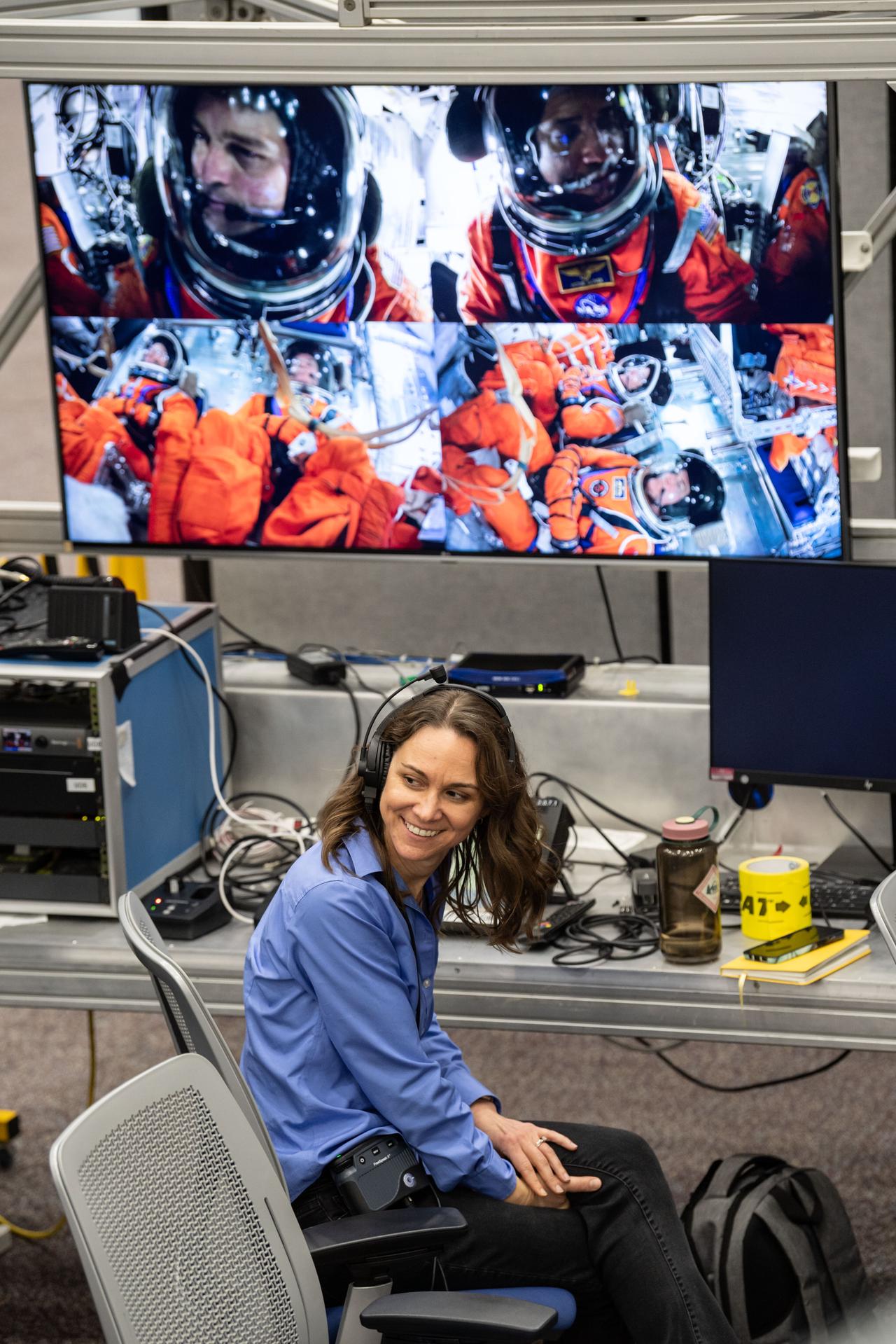
The Artemis II crew’s Chief Training Officer Jacki Mahaffey smiles during post insertion and deorbit preparation training at Johnson’s Space Vehicle Mockup Facility in Houston, Texas. The crew practiced getting the Orion spacecraft configured once in orbit, how to make it habitable, and suited up in their entry pressure suits to prepare for their return from the Moon.

 Login
Login