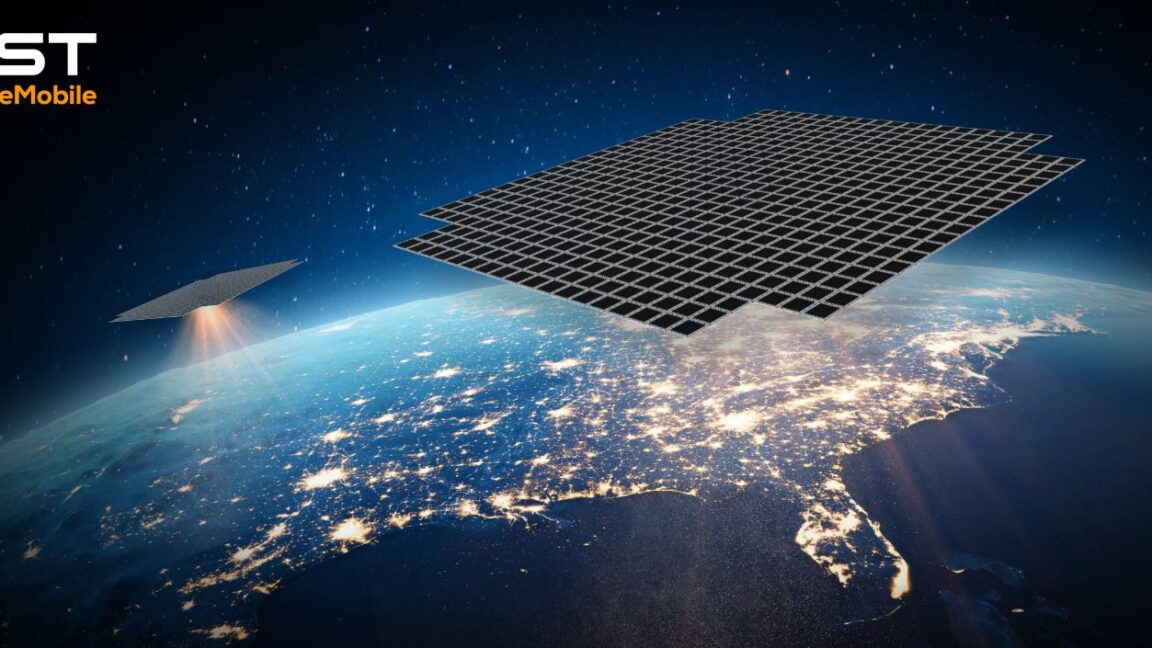
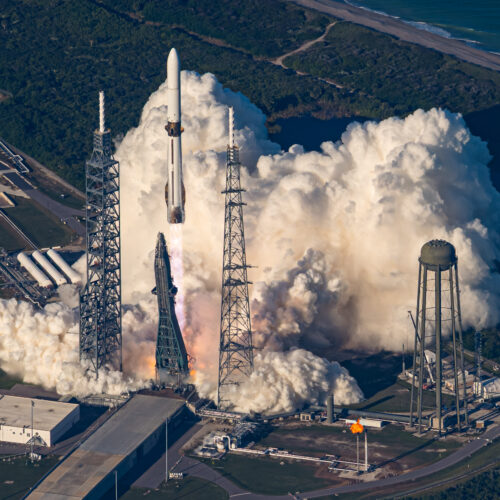
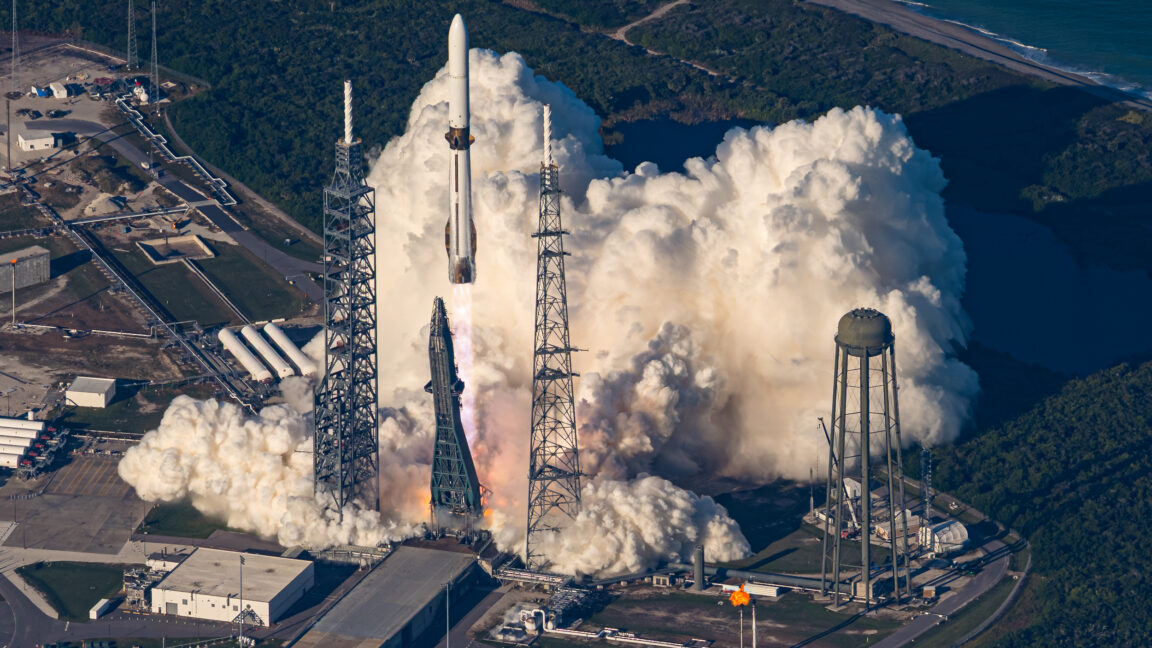
Blue Origin confirmed Thursday that the next launch of its New Glenn rocket will carry a large communications satellite into low-Earth orbit for AST SpaceMobile.
The rocket will launch the next-generation Block 2 BlueBird satellite "no earlier than late February" from Launch Complex 36 at Cape Canaveral Space Force Station.
However, the update from Blue Origin appears to have buried the real news toward the end: "The mission follows the successful NG-2 mission, which included the landing of the 'Never Tell Me The Odds' booster. The same booster is being refurbished to power NG-3," the company said.
Jeff Bezos' Blue Origin had previously suggested that the third launch of the mega-rocket would take the space company's robotic lunar lander to the moon.
Blue Origin has lifted the curtain on its plan for an ultra-high-speed satellite data network called TeraWave. (Credit: Blue Origin)
Jeff Bezos’ Blue Origin space venture says it’ll be ramping up an ultra-high-speed satellite data network called TeraWave, which will compete with SpaceX’s Starlink network for business from data centers, large-scale enterprises and government customers.
The service appears to dovetail with Amazon Leo, the satellite-based broadband internet service that was Bezos’ brainchild while he served as Amazon’s CEO. Amazon Leo — previously known as Project Kuiper — promises downlink speeds of up to 1 gigabit per second (Gbps). In contrast, TeraWave is targeting higher-end data applications with symmetrical data speeds of up to 6 terabits per second (Tbps), a rate that’s 6,000 times faster.
In today’s announcement, Blue Origin said TeraWave’s constellation would consist of 5,408 laser-linked satellites in low Earth orbit (LEO) and medium Earth orbit (MEO). It plans to start deploying the satellites in late 2027, presumably using the company’s New Glenn rockets.
Blue Origin’s plans are discussed in an application and technical annex filed today with the Federal Communications Commission. In its application, the company is seeking waivers from several regulatory requirements in order to get TeraWave off the ground quickly.
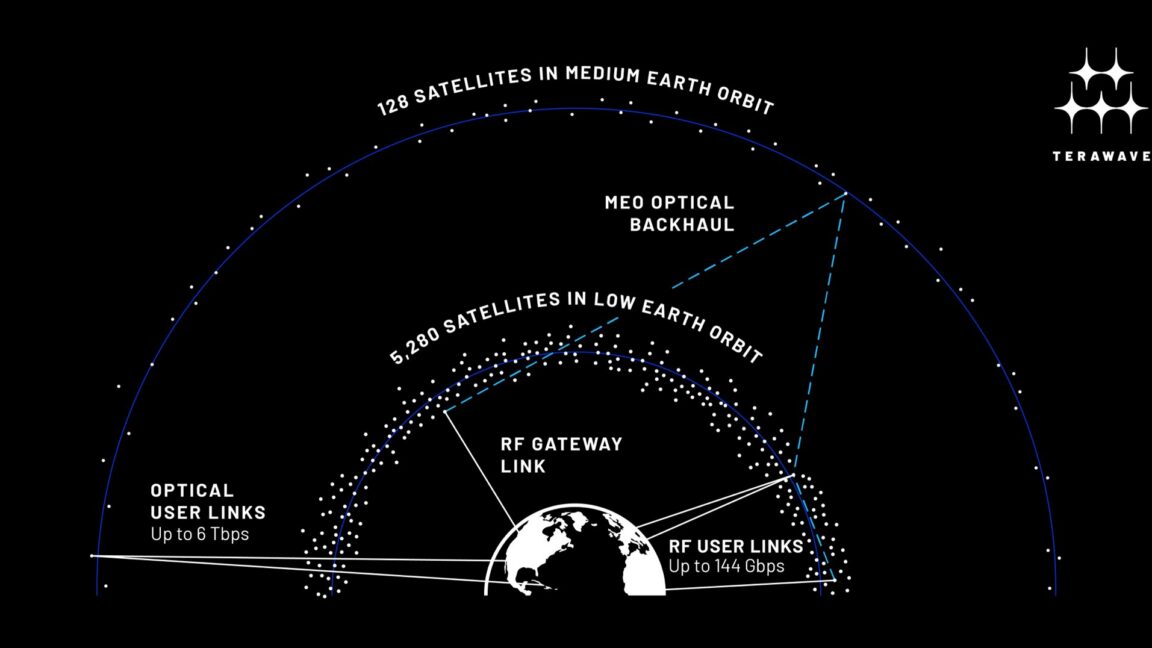
“TeraWave addresses the unmet needs of customers who are seeking higher throughput, symmetrical upload/download speeds, more redundancy and rapid scalability,” Blue Origin said. An array of 5,280 satellites in LEO would provide access speeds of up to 144 Gbps, while another 128 satellites in MEO would offer terabit-level speeds.
Blue Origin said the multi-orbit network design would facilitate ultra-high-throughput links between global hubs and distributed gigabit-scale user connections, particularly in parts of the world that are not well-served by optical fiber connections.
This chart shows how the satellites in the TeraWave constellation would be connected using optical and radio links. Click on the chart for a larger version. (Blue Origin Infographic)
But what about Amazon, which is in the process of putting more than 3,200 satellites into low Earth orbit for Amazon Leo? Tech consultant Tim Farrar, the founder of TMF Associates, said the emergence of TeraWave raises questions about the relationship between the two best-known companies founded by Bezos.
“This is a very different design from Amazon Leo/Kuiper, but there is certainly overlap with Amazon’s target customers in the government and enterprise sectors,” Farrar told GeekWire in an email. “Is this all part of an ongoing negotiation with Amazon? … Or an alternative source of launch demand [for Blue Origin] in case Amazon decides to scale back their near-term space investments while they try to prove the case for Amazon Leo Gen1, before spending more money to launch a Gen2 system?”
Farrar speculated that the TeraWave initiative might represent an effort by Bezos to pressure Amazon’s current leadership to keep investing in space, or to spin off the Leo system to Blue Origin. He also said Blue Origin (Bezos’ private space venture) may be in a better position than Amazon (the publicly traded retail giant) to build out a next-generation satellite network.
“One takeaway is that everyone recognizes the value of vertical integration, where rocket makers create their own launch demand by building a constellation, as SpaceX has done,” Farrar said. “Amazon doesn’t have that right now, and it is a problem when you want to develop a mass-market satellite system with good enough economics to meet consumer price points, because you end up paying the full retail price for your launches.”
The announcement came out of the blue, from Blue, on Wednesday.
The space company founded by Jeff Bezos, Blue Origin, said it was developing a new megaconstellation named TeraWave to deliver data speeds of up to 6Tbps anywhere on Earth. The constellation will consist of 5,408 optically interconnected satellites, with a majority in low-Earth orbit and the remainder in medium-Earth orbit.
The satellites in low-Earth orbit will provide up to 144Gbps through radio spectrum, whereas those in medium-Earth orbit will provide higher data rates through optical links.
Which US rocket companies achieved the most during 2025?
Once again, Ars Technica is here to provide some answers in the form of our annual power ranking of US launch companies. We began doing this in 2022 and have since put out a top-10 list every year (see 2023 and 2024). Our intent, as always, is to spark debate, discussion, and appreciation for the challenge of operating a successful rocket company. It's a demanding business, both technically and financially. We respect the grit and hustle because we know just how hard this stuff is.
Please also note that this is a subjective list, although hard metrics such as total launches, tonnage to orbit, success rate, and more were all important factors in the decision. And finally, our focus remains on what each company accomplished in 2025, not on what they might do in the future.
An artist’s conception shows the Orion spacecraft’s main engine firing during a lunar flyby, surrounded by eight auxiliary engines built by L3Harris’ Aerojet Redmond facility. (NASA Illustration)
Lunar missions once felt like the domain of history books rather than current events, but an upcoming trip around the moon is poised to generate headlines at a level not seen since the Apollo era.
NASA’s Artemis 2 mission, which is due to launch four astronauts on a round-the-moon journey as a warmup for a future lunar landing, is shaping up as the spaceflight highlight of 2026. NASA Administrator Jared Isaacman, who took the agency’s helm this month after a tumultuous year, says it’s the top item on his must-see list.
“What’s not to be excited about?” he said last week on CNBC. “We’re sending American astronauts around the moon. It’s the first time we’ve done that in a half-century. … We’re weeks away, potentially a month or two away at most from sending American astronauts around the moon again.”
The Pacific Northwest plays a significant role in the back-to-moon campaign. For example, L3Harris Technologies’ team in Redmond, Wash., built thrusters for Artemis 2’s Orion crew vehicle. And Artemis 2 isn’t the only upcoming moon mission with Seattle-area connections: Jeff Bezos’ Blue Origin space venture, headquartered in Kent, plans to send an uncrewed Blue Moon Mark 1 lander to the lunar surface in 2026 to help NASA get set for future moon trips.
“We are taking our first steps to help open up the lunar frontier for all of humanity,” Paul Brower, Blue Origin’s director of lunar operations, said in a recent LinkedIn post.
2026 could also be the year when Seattle-based Interlune sends its first prospecting instrument to the lunar surface to hunt for signs of helium-3, a rare material the company aims to bring back to Earth for use in fusion reactors or quantum computers.
As we close out 2025, here’s a look back at five of the past year’s space milestones and five trends to watch in the year to come.
Looking back at 2025
Blue Origin goes orbital: After a decade of development, Blue Origin launched its orbital-class New Glenn rocket for the first time in January, on a mission that lofted test equipment for its Blue Ring space mobility platform into orbit. A second launch in November sent NASA’s Escapade probes toward Mars and marked the first successful at-sea recovery of a New Glenn booster. On the suborbital side, Blue Origin’s New Shepard program provided rides to space for seven crews. Notable passengers included Lauren Sanchez, who became Bezos’ wife two months after her flight; Justin Sun, the crypto entrepreneur who paid $28 million for his space ticket; and Michaela Benthaus, the first wheelchair user to fly to space.
Rubin Observatory delivers first images: A decade and a half ago, Microsoft’s Bill Gates and Charles Simonyi donated $30 million to support the creation of a giant sky-survey telescope in Chile. in June, the Rubin Observatory finally made its star-studded debut, with Simonyi in attendance. Researchers at the University of Washington played key roles in shepherding the $800 million project to completion.
SpaceX’s Starship goes through ups and downs: Many of SpaceX’s ambitions, ranging from orbital data centers to moon landings to Mars migrations, depend on the successful development of its Starship super-rocket. Starship also plays a crucial role in the business models for lots of space startups, including Starcloud and a Seattle-based space travel venture called Orbite. Three Starship test flights ended badly in the first half of 2025, but SpaceX bounced back with two successful test flights in the second half of the year. Now SpaceX is working on an upgraded version of Starship — and dealing with the aftermath of a booster anomaly that occurred during a pressurization test in November.
Looking ahead to 2026
Artemis 2 to send humans around the moon: For the first time since Apollo 17 in 1972, humans will leave Earth orbit. The current plan calls for the Artemis 2 mission to take place in the February-to-April time frame. A crew of four — three Americans and one Canadian astronaut — will climb into the Orion spacecraft and be sent into space atop NASA’s Space Launch System rocket. The round-the-moon route will be similar to the trajectory used for NASA’s uncrewed Artemis 1 flight in 2022. If Artemis 2 goes well, that could set the stage for an Artemis 3 crewed lunar landing as early as 2027 (but more likely later).
Jeff Bezos and Blue Origin employees pose for a picture in front of the Blue Moon Mark 1 lunar lander. (Blue Origin Photo)
Blue Moon’s lunar delivery: Blue Origin’s uncrewed lander is tasked with delivering a NASA experiment called SCALPSS to the moon’s south polar region. Stereo cameras will document how the landing burn interacts with the dusty lunar surface — and the results will be factored into plans for future landings. This Blue Moon Mark 1 mission will blaze a trail for Blue Origin’s Mark 2 lander, which is due to start taking astronauts to the lunar surface in 2030. Other robotic spacecraft scheduled for moon landings in 2026 include China’s Chang’e 7 rover, Firefly’s Blue Ghost 2 lander, Intuitive Machines’ IM-3 lander and Astrobotic’s Griffin lander (which will be carrying twomini-rovers and Interlune’s helium-hunting camera).
Golden Dome takes shape: A proposed $175 billion missile defense system known as the Golden Dome is already attracting interest from space ventures — particularly ventures that are focusing on in-space mobility (such as Portal Space and Starfish Space) or in-space data processing (such as Starcloud and Seattle-based Sophia Space). Marysville, Wash.-based Gravitics is building an orbital carrier that would serve as a “pre-positioned launch pad in space” for the U.S. Space Force, under the terms of a deal that could be worth as much as $60 million. Other big-ticket military projects are likely to come to light in 2026.
Whither NASA? Or will NASA wither? Isaacman is taking over at NASA following a year of layoffs and science program cuts. He has pledged to land astronauts on the moon during the current presidential term, but funding remains a hurdle. “I almost guarantee you he’s going to be walking up the street to the White House, saying ‘I really need more money,’” NASAWatch’s Keith Cowing said on Israel’s i24 TV.
Bonus: Coming to a sky (or a screen) near you: Keep an eye out for a total lunar eclipse on March 3 that will be visible over the U.S., weather permitting. There’s also a solar eclipse on Aug. 12 that will bring totality to narrow stretches of Greenland, Iceland and Spain. Although this eclipse can’t be seen in Seattle’s skies, you should be able to catch the highlights online.
United Launch Alliance CEO Tory Bruno, shown here at the Space Symposium in 2016, is joining Blue Origin. (GeekWire Photo / Alan Boyle)
Eleven years after United Launch Alliance CEO Tory Bruno partnered with Blue Origin to create a new rocket engine, he’s joining Jeff Bezos’ space venture as the president of Blue Origin’s newly created National Security Group.
The move could signal a major shift in the commercial space race as Kent, Wash.-based Blue Origin revs up its competition with SpaceX. Bezos welcomed Bruno to his company on social media, and Bruno told Bezos that “we are going to do important work together.”
In Friday’s announcement of the change, Blue Origin said Bruno would report to CEO Dave Limp. “We share a deep belief in supporting our nation with the best technology we can build,” Limp said in a post on X. “Tory brings unmatched experience, and I’m confident he’ll accelerate our ability to deliver on that mission.”
Bruno, 64, led ULA for 11 years following a 30-year career at Lockheed Martin. Not long after taking the reins at ULA in 2014, Bruno sat beside Bezos to announce a close collaboration on the development of Blue Origin’s BE-4 engine, which is used on ULA’s Vulcan rocket as well as Blue Origin’s orbital-class New Glenn rocket.
United Launch Alliance is a joint venture between Boeing and Lockheed Martin. Last year, there were rumors that ULA was the subject of acquisition talks, perhaps involving Blue Origin or Sierra Space, but so far those rumors haven’t panned out.
Brinc’s Responder drone launches from its charging station. The Seattle company stands to benefit as new FCC restrictions limit Chinese drone makers. (Brinc Photo)
New federal restrictions on foreign-made drones, announced this week, promise to boost Washington state as a hub for domestic drone manufacturing — adding thousands or even tens of thousands of jobs in the process.
That’s the prediction from Blake Resnick, CEO of Seattle-based Brinc Drones, who says the region’s concentration of aerospace talent makes it uniquely positioned to benefit from the shift. He cites the presence of companies including Boeing, Blue Origin, Amazon (with its Prime Air unit) and SpaceX, along with an existing base of aerospace suppliers and technicians.
“I don’t even think you have to look outside of Washington to find all the talent that’s needed to build an incredible, globally competitive drone company,” Resnick said in an interview.
The FCC this week added foreign-made drones to its list of equipment deemed national security threats. That blocks new foreign-made drone models from obtaining FCC equipment authorization — effectively preventing the import, marketing, and sale of new models.
The move primarily impacts Chinese giant DJI, which controls roughly 70% of the global drone market.
It has drawn sharp criticism from drone hobbyists, who worry it will drive up prices and limit access to affordable, high-quality options. The Academy of Model Aeronautics warned that the move will “have huge implications for both the hobbyist and commercial airspace industries moving forward.”
There is a carve-out: existing models that have received prior FCC approval can still be sold, which means that the impact will unfold over an extended period of time. But as current inventory depletes and DJI’s product line ages, U.S. manufacturers will need to scale up.
Resnick said he foresees a need for hundreds of thousands and potentially even millions of square feet of new manufacturing space across the U.S. drone industry.
Washington’s aerospace industry employs more than 77,000 workers directly and generates more than $71 billion in total economic activity, according to a July 2024 analysis by the Seattle Metropolitan Chamber of Commerce. That gives the region a major edge in drone production.
Resnick knows this first-hand. He relocated Brinc from Las Vegas to Seattle in 2021, drawn by the region’s engineering talent pool. The company, which employs about 140 people, develops drones and related technology for police, fire, and emergency response agencies. It closed a $75 million funding round and announced a strategic alliance with Motorola Solutions earlier this year.
Brinc CEO Blake Resnick at the company’s headquarters in 2024. (GeekWire Photo / Todd Bishop)
Brinc has spent $660,000 on lobbying over the past three years, including advocacy for controls on Chinese-made drones, Forbes reported in a story on Resnick earlier this month. The company’s prominence in the trade war has made it a target: In 2024, China formally sanctioned Brinc and Resnick, freezing any assets in the country and barring Resnick from entry.
Speaking with GeekWire this week, Resnick said DJI’s dominance stems from billions in Chinese government subsidies, making fair competition nearly impossible.
“Frankly, I think this just evens the playing field,” he said.
Brinc, which has manufacturing operations at its Seattle headquarters, has already shifted to a non-Chinese supply chain, sourcing components from Taiwan, Germany, the U.K., and Japan. Resnick said the new restrictions will require a further shift toward domestic suppliers: “Moving forward, we are going to have to do a lot more business with American companies.”
Resnick said this shift ensures the U.S. industrial base remains resilient even if international partners face constraints during a conflict. While the transition presents a hurdle, Resnick described it as an “organizational cost that we’re very happy to pay” in exchange for a market free of state-sponsored Chinese competition.
He acknowledged that there could be a price premium in the drone market overall as American suppliers scale up, a process he estimates will take two to three years.
When asked if he sees these events as an opening for Brinc to expand into other sectors, beyond public safety, Resnick didn’t entirely rule out the possibility. “The free world,” he said, “needs more drone manufacturing capacity in a whole bunch of different verticals.”
German engineer Michaela Benthaus celebrates after her suborbital space trip. (Blue Origin via YouTube)
Jeff Bezos’ Blue Origin space venture added a page to the space history books today by sending the first wheelchair user into space.
“It was the coolest experience,” said Michaela “Michi” Benthaus, a German-born aerospace and mechatronics engineer at the European Space Agency who sustained a spinal cord injury in a mountain biking accident in 2018.
Blue Origin’s suborbital New Shepard rocket ship lifted off from the company’s Launch Site One in West Texas at 8:15 a.m. CT (6:15 a.m. PT).
An initial launch attempt had been called off on Thursday because the flight team “observed an issue with our built-in checks prior to flight,” Blue Origin said. It didn’t provide further details about the issue, but today’s countdown went off without a hitch.
This was the 37th New Shepard mission, and the 16th to carry humans on a brief ride above the 100-kilometer (62-mile) altitude level that marks the internationally accepted boundary of space. Eighty-six people, including Bezos himself, have now flown on New Shepard. Six have gone multiple times.
When Benthaus lost the use of her legs, she initially thought her flight into space “was never going to happen.” But in 2022, her hopes got a big boost when she experienced a zero-G flight arranged through AstroAccess, a project that’s dedicated to paving the way for spacefliers with disabilities. Last year, she was the commander of an analog space mission conducted at the Lunares Research Station in Poland.
Now the 33-year-old has blazed a new trail for space access. “You should never give up on your dreams,” she said after today’s flight.
Blue Origin CEO Dave Limp said in a post to the X social-media platform that the mission marked “another step toward making spaceflight accessible for everyone.” Phil Joyce, Blue Origin’s senior vice president for the New Shepard program, said in a mission recap that “Michi’s flight is particularly meaningful, demonstrating that space is for everyone, and we are proud to help her achieve this dream.”
Kent, Wash.-based Blue Origin has been working for several years to improve accessibility at its launch facility in Texas — for example, by adding an elevator to the seven-story launch tower. A business resource group named New Hawking, in honor of the late wheelchair-using physicist Stephen Hawking, helped lead the way. Blue Origin says it has previously flown people who are hard of hearing, have limited mobility or limb differences, have low vision or are legally blind.
Blue Origin didn’t need to make significant modifications in the New Shepard crew capsule for today’s flight. But launch commentator Joel Eby said the mission team made “a few ground system improvements,” such as providing a bench that Benthaus could use to get into and out of the capsule with assistance from others.
During their 10-minute flight, Benthaus and the rest of the crew rose to an altitude of 106 kilometers (65.7 miles). They experienced a few minutes of zero-gravity and views of a curving Earth against the blackness of space. At the end of the mission, the booster made an autonomous landing not far from the launch pad, while the crew capsule descended to a parachute-assisted touchdown in the West Texas desert.
Afterward, Benthaus said she enjoyed the ride. “I tried to turn upside-down,” she said.
The crew for Blue Origin’s NS-37 suborbital space flight includes, from left, Neal Milch, Michi Benthaus, Hans Koenigsmann, Adonis Pouroulis, Jason Stansell and Joey Hyde. (Blue Origin Photo)
Benthaus’ crewmates included:
Joey Hyde, a physicist and quantitative investor who recently retired from his career at Citadel, a leading hedge fund. He lives in Florida with his wife and five children.
Hans Koenigsmann, a German-American aerospace engineer whose career has been dedicated to advancing reusable spacecraft and launch vehicles, most notably as an early team member at SpaceX. Koenigsmann played a supporting role in arranging Benthaus’ flight and occasionally helped her get around. After landing, Koenigsmann said the spaceflight was “actually more intense than I thought.”
Neal Milch, a business executive and entrepreneur who launched his career through Laundrylux, a family-owned business. He now serves as the chair of the Board of Trustees at the Jackson Laboratory, a nonprofit biomedical research institute.
Adonis Pouroulis, an entrepreneur, investor and mining engineer with more than 30 years of experience in the natural resources and energy sector. He is the founder and chairman of Pella Resources, co-founder of Energy Revolution Ventures, chairman of Rainbow Rare Earths, and the CEO of Chariot Limited.
Jason Stansell, a computer scientist and a self-proclaimed space nerd rooted in West Texas. He’s been watching from a front-row seat as the space industry has expanded to offer opportunities for commercial spaceflight.
Blue Origin typically doesn’t reveal how much people pay to take trips on New Shepard. In some cases, crew members have flown as invited guests. On the other end of the spectrum, crypto entrepreneur Justin Sun paid $28 million for a ticket in a widely publicized auction.
Update for 8:40 a.m. PT: NASA’s new administrator, Jared Isaacman, congratulated Blue Origin and the NS-37 crew, with special shout-outs for Koenigsmann and Benthaus:
Congrats to the Blue Origin team and the NS-37 crew–including @HansKoenigsmann one of the great engineers of this new era. His work enabled so many to reach space–I am glad he finally made the journey himself. pic.twitter.com/hgtKRSZpPq
Until now, the aerospace outfit Blue Origin was little more than a plaything for Amazon billionaire Jeff Bezos. The company’s New Shepard rocket has launched a few space tourists, but its upcoming New Glenn vehicle will have a shot at something more important. NASA has awarded Blue Origin a contract to launch a Mars mission next year, marking the firm’s first interplanetary launch.
NASA has chosen Blue Origin to handle launch services for the Escape and Plasma Acceleration and Dynamics Explorers (ESCAPADE) mission, which is part of the agency’s Venture-Class Acquisition of Dedicated and Rideshare (VADR) program. Blue Origin is one of 13 companies to get contracts under the program, designed to tolerate higher risk to allow for more innovation and lower overall costs.
Blue Origin has been developing New Glenn since 2012, announcing the vehicle in 2016, but it has yet to fly. When complete, New Glenn will be 322 feet (92 meters) tall with a diameter of 23 feet (9 meters). That’s larger in both dimensions than the Falcon 9 (70 x 3.7 meters). Like New Shepard, this rocket is designed to have a reusable first stage to reduce launch costs. It’s powered by seven BE-4 engines, a more powerful version of the oxygen and methane-fueled BE-3 used on New Shepard.
A render of what New Glenn may look like when finished.
The timeline is going to be tight — Blue Origin initially expected the first New Glenn launch to happen in 2020, but it has pushed it back several times. Currently, the rocket is slated to fly no earlier than Q4 of this year. NASA plans to launch the ESCAPADE about a year later, at the end of 2024. It’ll be up to Blue Origin to make sure its rocket is ready to go — projects in the VADR program call for less NASA oversight in order to save money.
Assuming Blue Origin comes through on its first interplanetary NASA contract, the ESCAPADE spacecraft will separate from the launch vehicle and spend 11 months coasting toward the red planet. Once there, the spacecraft will split into two identical orbiters, working together to analyze the planet’s magnetosphere. The mission will improve our understanding of how the solar wind interacts with Mars’ weak magnetic field. That’s important information to have if we ever intend to send humans to Mars, for either a quick jaunt or long-term colonization. Although, either one is probably a long way off.

 Login
Login