The Trump administration is directing employees at the U.S. Department of Agriculture to investigate foreign scientists who collaborate with the agency on research papers for evidence of “subversive or criminal activity.”
The Prince of Persia Sands of Time Remake canceled news is now official. Ubisoft has confirmed it has discontinued the long-delayed remake, closing the door on a modern take of the 2003 classic after years of setbacks. The cancellation lands inside a broader shake-up at Ubisoft, one that’s meant to tighten greenlights and concentrate spending. […]
Launching a crypto exchange is no longer just an idea for large tech companies. Many startups, fintech firms, and entrepreneurs now explore crypto exchange businesses as part of their growth plans. One option that often comes up is white label cryptocurrency exchange software. It promises faster launch times and lower technical effort, but it may not suit every business equally. Before choosing this path, it is important to understand what white label crypto exchange software offers, what it limits, and how it aligns with different business models. This article breaks down those aspects in a clear and practical way.
Understanding What White Label Crypto Exchange Software Really Is
White label cryptocurrency exchange software is a ready-made trading platform that can be rebranded and customized to some extent. Instead of building an exchange from scratch, businesses adopt an existing framework and launch under their own name. The core trading engine, wallet system, admin panel, and security setup are already developed. Businesses mainly focus on configuration, branding, and compliance setup. This approach significantly reduces development time and technical complexity. However, using white label software also means accepting certain predefined structures. Understanding this trade-off is key when evaluating whether it fits your business goals.
white label crypto exchange software
Business Models That Benefit the Most From White Label Exchanges
White label crypto exchange software works best for businesses that prioritize speed and market entry. If the goal is to launch quickly, test a market, or expand an existing financial service offering, this model can be practical. Startups with limited technical teams often benefit because they avoid long development cycles. Financial service providers entering crypto for the first time can use white label solutions to reduce risk while learning market behavior. Educational platforms, regional exchanges, and niche trading communities also find value in white label exchanges, especially when customization needs are moderate rather than complex.
Cost, Time, and Resource Considerations
One of the biggest reasons businesses choose white label cryptocurrency exchange software is cost efficiency. Building a custom exchange requires significant investment in development, testing, security audits, and long-term maintenance. White label solutions reduce upfront costs and shorten launch timelines. Instead of months or years, businesses can go live in weeks. This allows faster revenue generation and earlier market feedback. However, long-term costs should also be considered. Licensing fees, customization limits, and scaling expenses can affect profitability over time. A lower initial cost does not always mean lower total cost.
Customization Limits and Brand Differentiation
While white label platforms allow branding changes such as logos, colors, and basic feature settings, deep customization can be limited. The underlying architecture remains the same for all users of the software. For businesses that rely heavily on unique trading features or innovative user experiences, this can be a challenge. Differentiating the platform beyond surface-level branding may require additional development layers or integrations. If your business model depends on standing out through advanced trading tools or novel workflows, it is important to assess whether white label software can support that vision.
Security, Compliance, and Operational Control
Security is a major concern for any crypto exchange. White label cryptocurrency exchange software usually comes with built-in security features such as encryption, wallet protection, and access controls. This can be beneficial for teams without deep security expertise. However, operational control may be shared or limited depending on the setup. Businesses must understand who manages updates, security patches, and infrastructure stability. Compliance flexibility also matters. Regulatory requirements vary by region, and not all white label platforms are equally adaptable. A business must ensure the software can support necessary identity checks, transaction monitoring, and reporting standards.
Scalability and Long-Term Growth Planning
White label exchanges are often designed to handle moderate growth efficiently. They can support increasing user numbers and trading volume up to a certain point. For businesses planning aggressive expansion or global operations, scalability becomes a critical question. Some white label platforms may struggle under high load or require costly upgrades to scale further. Long-term growth planning should include evaluating whether the software can evolve with market changes, new asset types, and increasing regulatory demands.
When White Label Software May Not Be the Right Choice
White label cryptocurrency exchange software may not be ideal for every business. Companies with strong technical teams and long-term innovation goals may prefer building a custom platform. If control, flexibility, and unique architecture are central to your business strategy, white label solutions may feel restrictive. Similarly, businesses targeting institutional traders or complex financial products may need deeper customization than white label platforms can offer. Choosing white label software without aligning it to the business model can lead to limitations that slow growth later.
Final Thoughts
White label cryptocurrency exchange software can be the right fit for many businesses, but only when used with clear expectations. It offers speed, cost efficiency, and reduced technical complexity, making it attractive for startups and market entrants. At the same time, it comes with limits around customization, control, and long-term scalability. The decision should be based on your business goals, technical capacity, and growth plans rather than convenience alone. Understanding where white label exchanges perform best and where they fall short helps businesses make informed choices and build sustainable crypto trading platforms.
Meme coins have evolved far beyond internet jokes and speculative hype. What began as playful experiments inspired by online culture has matured into a serious niche within blockchain development. Today, meme coin development when executed with discipline and technical clarity represents the transformation of digital culture into functional financial code. Stripped of noise and short-term speculation, this process blends community psychology, token engineering, and decentralized infrastructure into a credible blockchain asset.
From Internet Humor to Programmable Value
Internet culture thrives on relatability, speed, and shared identity. Memes spread because they compress complex emotions or ideas into instantly recognizable symbols. Meme coins leverage this same mechanism, but instead of stopping at humor, they encode it into programmable assets. The meme becomes the entry point, while the blockchain gives it permanence, transparency, and utility.
In practical terms, meme coin development starts with a cultural narrative that resonates with a specific online community. This narrative is then translated into smart contract logic that defines how the token is minted, distributed, transferred, and governed. The success of a meme coin depends not on the joke itself, but on how effectively that cultural energy is transformed into a secure, scalable, and trustable digital asset.
Tokenomics as Cultural Architecture
One of the most overlooked aspects of meme coin development is tokenomics. While many projects rely on exaggerated supply numbers or aggressive burn mechanisms to attract attention, sustainable meme coins use tokenomics as a form of cultural architecture. Every economic decision reflects how the community interacts with the token.
For example, fair launch models reinforce decentralization and inclusivity, values often celebrated in internet-native communities. Liquidity locks and transparent vesting schedules help counter skepticism fueled by past rug pulls. Even transaction taxes, when used carefully, can fund community initiatives, marketing, or long-term development without exploiting holders.
By designing tokenomics that align with community behavior rather than speculative manipulation, developers turn cultural participation into measurable economic activity.
Smart Contracts: Where Culture Meets Code
At the core of every meme coin lies its smart contract. This is where internet culture stops being abstract and becomes enforceable logic. Smart contracts define rules that cannot be altered on a whim, making trust a technical feature rather than a marketing promise.
Modern meme coin development emphasizes contract audits, gas optimization, and modular design. Features such as automated liquidity provisioning, governance hooks, and cross-chain compatibility allow meme coins to exist beyond a single viral moment. When the contract is well-structured, the meme coin can integrate with decentralized exchanges, NFT platforms, and Web3 applications, extending its relevance.
This disciplined approach ensures that humor does not compromise security and that creativity coexists with engineering rigor.
Community Is the Real Infrastructure
Unlike traditional financial assets, meme coins derive much of their value from social consensus. Community engagement is not an accessory, it is the infrastructure. Development teams that understand this focus on tools that empower participation, such as DAO-based voting, transparent treasury management, and open communication channels.
However, sustainable growth requires filtering noise from meaningful engagement. Instead of chasing fleeting trends, successful meme coin projects nurture long-term contributors: developers, designers, content creators, and moderators. These participants help the project evolve organically, keeping the cultural narrative alive while reinforcing technical credibility.
When community governance is backed by on-chain mechanisms, internet culture gains a formal structure without losing its spontaneity.
Utility Beyond the Meme
The next phase of meme coin development centers on utility. While cultural appeal attracts attention, functional use cases sustain relevance. Integration with gaming ecosystems, NFT marketplaces, tipping systems, or creator economies allows meme coins to circulate naturally rather than relying solely on trading volume.
Some projects use meme coins as access tokens, rewarding participation or unlocking exclusive experiences. Others embed them into decentralized applications where cultural identity and financial interaction intersect. In these cases, the meme becomes a brand layer on top of real economic activity.
This shift from novelty to function marks the transition from speculative tokens to digital assets with purpose.
Cutting Through the Hype
Developing meme coins without noise requires restraint. Clear documentation, transparent roadmaps, and realistic expectations replace exaggerated promises. Instead of overloading contracts with unnecessary features, developers prioritize clarity, security, and adaptability.
In a market saturated with hype, simplicity becomes a competitive advantage. A well-built meme coin does not need constant promotion; it survives through consistent community use and technical reliability.
Conclusion
Meme coin development at its best, is not about chasing trends or manufacturing hype. It is about translating internet culture into financial code that people can trust, use, and build around. When humor is paired with solid tokenomics, secure smart contracts, and engaged communities, meme coins become more than jokes; they become living digital systems shaped by collective identity. By removing the noise, developers unlock the true potential of meme coins as cultural and financial instruments in the evolving Web3 economy.
Why Multi-Chain DeFi Is Hard — And How AI Agents Can Help
Why Multi-Chain DeFi Is Hard — And How AI Agents Can Help
Last year, our team started exploring a case study on a DeFi project that had strong fundamentals but a complex technical challenge.
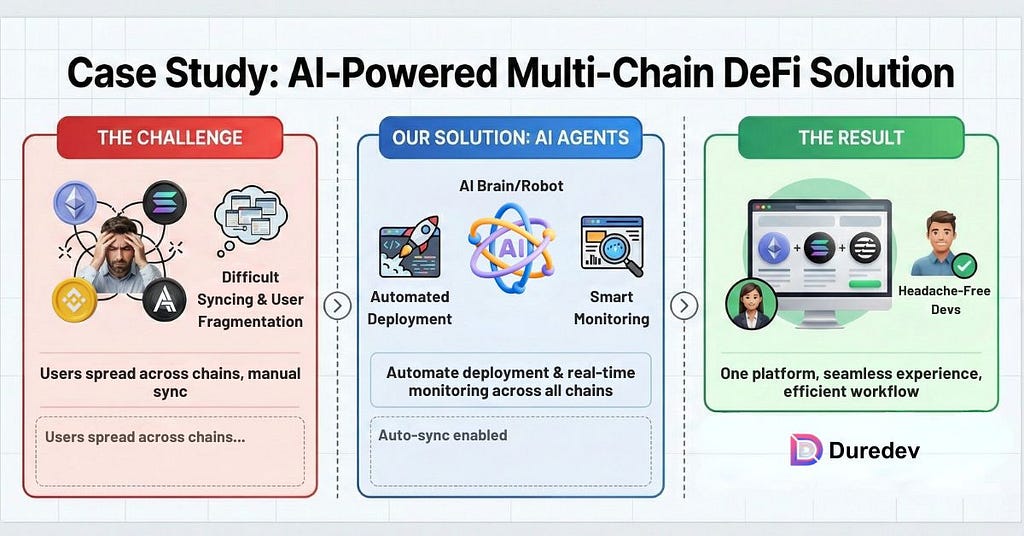
Users were distributed across Ethereum, Solana, and Aptos. While adoption looked promising, syncing smart contracts across multiple chains quickly became a bottleneck. 😅
What sounded like a growth strategy turned into an operational headache.
At Duredev, we often see this pattern when teams move from single-chain products to cross-chain DeFi platforms.
🌐 Why Multi-Chain DeFi Looks Simple (But Isn’t)
On paper, multi-chain means more users, more liquidity, and better reach. In reality, each blockchain behaves like a different system altogether.
Ethereum, Solana, and Aptos differ in:
Smart contract standards
Deployment pipelines
Upgrade mechanisms
Monitoring and debugging tools
This is why many teams struggle with cross chain app development once they move beyond MVPs.
In the case study we analyzed, developers faced recurring issues:
Feature updates deployed on one chain but delayed on others
Configuration mismatches between networks
Manual monitoring across dashboards
Rising maintenance costs
The biggest challenge wasn’t writing smart contracts — it was maintaining consistency across chains.
This is where many multi-chain products slow down or silently fail.
🤖 The Role of AI Agents in Cross-Chain DeFi
Instead of adding more tools, the solution explored a smarter layer: AI agents.
AI agents can act as intelligent coordinators for cross chain smart contract management, helping teams automate tasks that usually require constant human oversight.
In multi-chain DeFi systems, AI agents can:
Automate deployments across multiple chains
Monitor smart contract behavior in real time
Detect inconsistencies between chain states
Trigger alerts or rollbacks when anomalies appear
This transforms chaotic workflows into predictable, developer-friendly systems.
💡 From Automation to Intelligence
Traditional automation follows rules. AI agents understand patterns.
That difference matters in multichain DeFi development, where systems are dynamic and conditions change frequently.
The goal becomes clear:
One platform. Multiple chains. A seamless user experience. A headache-free workflow for developers. 💡
This is the direction modern Web3 infrastructure is moving toward.
Users don’t care which chain they’re on. They care about speed, reliability, and trust.
As DeFi matures, platforms that rely on manual multi-chain coordination will struggle to keep up. Intelligent systems powered by AI agents will define the next generation of decentralized products.
This shift is already visible across:
DeFi protocols
Infrastructure layers
Enterprise blockchain platforms
At Duredev, this evolution is central to how we build AI + Web3 systems.
🧩 Why Teams Choose Duredev
Choosing the right technology partner is critical for multi-chain success.
Teams work with Duredev because we focus on:
Practical cross-chain multichain app development
Reduced operational complexity
Secure, auditable smart contracts
AI-enabled monitoring and automation
You can learn more about our approach and team through about Duredev or start a conversation directly via contact Duredev.
🚀 Final Takeaway
Multi-chain DeFi is hard — not because the idea is flawed, but because coordination is complex.
AI agents offer a realistic way forward by:
Reducing human error
Automating cross-chain workflows
Making multi-chain systems sustainable
As DeFi moves toward a truly multi-chain future, platforms that combine AI intelligence with decentralized infrastructure will lead the way.
And that’s exactly what Duredev is building for the next generation of Web3.
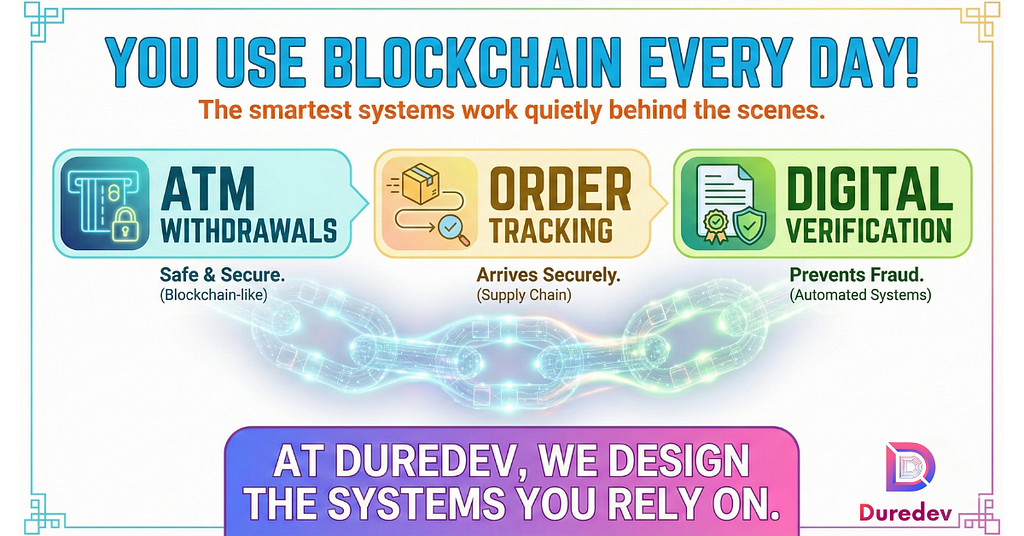
Think you don’t use blockchain? Think again… You’re using it every single day — without even realizing it.
💳 ATM withdrawals rely on secure, ledger-based systems to protect your money 📦 Online order tracking depends on tamper-proof records to ensure delivery accuracy 📝 Digital document verification uses automated validation to prevent fraud
The smartest systems don’t announce themselves. They work quietly behind the scenes, ensuring security, transparency, and trust.
At Duredev, we design blockchain-powered digital systems that users rarely notice — but businesses rely on every single day.
Think You Don’t Use Blockchain? Think Again…
🔗 Why Blockchain Development Services Matter for Businesses Today
Blockchain is no longer limited to cryptocurrency. Today, blockchain development services are becoming core infrastructure for businesses that handle sensitive data, transactions, and multi-party processes.
Companies now look for solutions that:
Reduce fraud
Improve transparency
Automate trust
Remove manual verification
That’s why demand for a reliable blockchain development company has increased across industries like finance, logistics, and enterprise platforms.
🧠 Custom Blockchain Development for Real-World Use Cases
Every business has different workflows. Off-the-shelf solutions often fail to match real operational needs.
The result is faster execution, fewer errors, and reduced operational costs. Duredev focuses on smart contracts that are secure, auditable, and aligned with real business logic.
💰 Blockchain in Finance and Lending Platforms
Finance is one of the biggest adopters of blockchain technology.
With blockchain for finance and lending, platforms can offer:
Transparent transaction records
Automated loan agreements
Secure data sharing
Reduced dependency on intermediaries
Businesses building blockchain-based financial platforms gain higher user trust and operational efficiency. At Duredev, finance-focused blockchain solutions are designed to meet compliance and scalability requirements from day one.
📦 Blockchain Supply Chain Solutions for Transparency
Supply chains involve multiple stakeholders, which often leads to delays, disputes, and data mismatches.
Blockchain supply chain solutions solve this by creating a single, immutable source of truth. Businesses can:
📈 Final Thoughts: Blockchain Is Already Part of Your Business
Blockchain is no longer futuristic — it’s already embedded in modern digital systems.
From decentralized business applications to blockchain-powered digital systems, companies that invest in the right infrastructure today gain long-term advantages in trust, efficiency, and scalability.
If you’re planning to build or upgrade a secure digital platform, exploring blockchain consulting services early can save time, cost, and complexity later.
And that’s where Duredev helps businesses build systems that work — quietly, reliably, and every day.
Web3 wallets sit at the heart of the decentralized web. They act as your personal gateway to blockchain networks, cryptocurrencies, NFTs, and decentralized apps (dApps). Unlike traditional bank accounts controlled by banks, Web3 wallets give users direct control over their digital assets. Businesses entering the Web3 space need to grasp these tools to build secure, user-friendly products that attract customers.
What Exactly Is a Web3 Wallet?
A Web3 wallet is digital software or hardware that stores private keys — the secret codes that prove ownership of assets on a blockchain. These keys let you sign transactions, send crypto, or interact with dApps without relying on middlemen. Wallets come in forms like software apps on your phone (hot wallets), hardware devices (cold wallets), or browser extensions.
Think of a Web3 wallet as your house key in the physical world. It unlocks access to your property, but you hold the key. Lose it, and you lose access. Businesses developing these wallets must prioritize security features like multi-signature approvals, where multiple keys approve big transactions.
Web3 Wallet development Services play a key role here. Companies offer these services to create custom wallets that meet specific business needs, such as integration with enterprise systems or support for multiple blockchains.
How Web3 Wallets Differ from Traditional Wallets
Traditional wallets, like those from PayPal or bank apps, store account details on centralized servers. Banks manage your funds and handle security. Web3 wallets work differently — they hold your private keys locally on your device or hardware.
This shift means users bear full responsibility for their assets. No customer service resets your password if you forget it. For businesses, this opens doors to wallet development that emphasizes user education and recovery options, like social recovery where trusted contacts help regain access.
Wallet development requires attention to user experience. Developers build intuitive interfaces that hide blockchain complexities, such as gas fees or network congestion, while keeping core functions accessible.
The Core Components of a Web3 Wallet
Every Web3 wallet includes key building blocks. First, the seed phrase — a 12–24 word backup code generated when you create the wallet. Write it down offline and never share it. Second, private and public keys: the public one receives funds, like a bank account number; the private one signs transactions.
Wallets also support standards like ERC-20 for tokens on Ethereum or BEP-20 on Binance Smart Chain. Advanced wallets handle multiple chains via bridges, allowing asset transfers between networks.
Businesses benefit from wallets that integrate analytics. Track transaction history, portfolio value across chains, or even staking rewards in one dashboard.
Types of Web3 Wallets Available Today
Web3 wallets split into categories based on use case and security level.
Hot Wallets: Software-based, always online. Examples include MetaMask (browser extension) or Trust Wallet (mobile app). Ideal for daily transactions but riskier due to internet exposure.
Cold Wallets: Offline hardware like Ledger or Trezor. They sign transactions via USB without exposing keys online. Perfect for long-term storage.
Custodial vs. Non-Custodial: Custodial wallets (e.g., Coinbase Wallet in basic mode) hold your keys for you — convenient but less control. Non-custodial ones (most Web3 wallets) give you full ownership.
Smart Wallets: Next-gen options using account abstraction. They replace seed phrases with email logins or passkeys, simplifying onboarding.
For smart contract development services, businesses turn to experts who build programmable wallets. These execute rules automatically, like time-locked funds for payroll.
Why Web3 Wallets Matter for Businesses
Web3 wallets enable true ownership in a digital economy. Businesses use them to pay suppliers in stablecoins, avoiding bank fees and delays. E-commerce sites accept crypto payments directly into non-custodial wallets.
In supply chain, wallets track goods via NFTs. A manufacturer mints an NFT for a product batch; the wallet verifies authenticity at each step. This builds trust without third-party verification.
DeFi platforms rely on wallets for lending, borrowing, or yield farming. Users connect their wallet to protocols like Aave, deposit assets, and earn interest. Businesses launching DeFi products need wallets that support these interactions smoothly.
Real-World Use Cases Driving Adoption
Gaming studios integrate Web3 wallets for play-to-earn models. Players own in-game items as NFTs, trade them across games. Axie Infinity showed this potential, with wallets handling millions in daily transactions.
Enterprises use wallets for tokenized assets. Real estate firms fractionalize properties into tokens; investors buy shares via wallet. This democratizes access to high-value investments.
Freelance platforms like Braintrust pay creators in crypto. Wallets receive instant, borderless payments, cutting out intermediaries.
Non-profits distribute aid via wallets. Funds reach recipients directly, reducing corruption risks.
Security Challenges and Best Practices
Security remains a top concern. Hacks stole $3.7 billion in crypto in 2022 alone, per Chainalysis. Phishing attacks trick users into revealing seed phrases.
Businesses counter this with multi-factor authentication (MFA), biometric locks, and hardware integration. Wallets now scan for malicious dApps before connecting.
Best practices include:
Use hardware for large holdings.
Verify transactions twice.
Avoid public Wi-Fi for signing.
Enable transaction simulations to preview outcomes.
Developers add features like dust attack protection, which flags tiny suspicious deposits.
The Role of Interoperability in Web3 Wallets
Blockchains operate in silos — Ethereum, Solana, Polygon each have unique standards. Wallets bridge them with cross-chain support.
Tools like WalletConnect let one wallet interact with dApps on any chain. Bridges like Wormhole move assets between networks.
For businesses, interoperability means global reach. A wallet supporting 10+ chains attracts diverse users.
Regulatory Considerations for Web3 Wallets
Governments scrutinize Web3. The EU’s MiCA framework requires wallets to report suspicious activity. U.S. rules demand KYC for custodial services.
Non-custodial wallets face lighter rules but must comply with anti-money laundering (AML) if handling fiat ramps.
Businesses plan for compliance from day one. Build-in features like address screening or tax reporting tools.
Building Scalability into Web3 Wallets
As Web3 grows, wallets must handle high traffic. Layer-2 solutions like Optimism reduce fees and speed up Ethereum transactions.
Wallets optimize with batching — group multiple actions into one signature. Account abstraction (ERC-4337) allows gasless transactions, paid by sponsors.
Developers test for peak loads, ensuring wallets perform during market booms.
User Experience: Making Wallets Accessible
Complex interfaces deter mainstream users. Modern wallets simplify with one-click swaps, fiat on-ramps, and social logins.
Track metrics like daily active users (DAU), total value locked (TVL), and transaction volume. Retention rates show UX quality.
Businesses aim for 30% month-one retention.
Common Pitfalls to Avoid
Rushing launches without audits leads to exploits. Ignoring mobile users misses 70% of crypto holders.
Overcomplicating features confuses beginners.
Ready to Build Your Web3 Wallet?
Web3 wallets form the foundation of decentralized finance, gaming, and enterprise blockchain. They offer control, speed, and new revenue streams for businesses.
Partner with Codezeros for expert Web3 Wallet development Services. Our team delivers secure, scalable solutions customized to your needs. Contact Codezeros today to start your project and step into the future of digital assets.
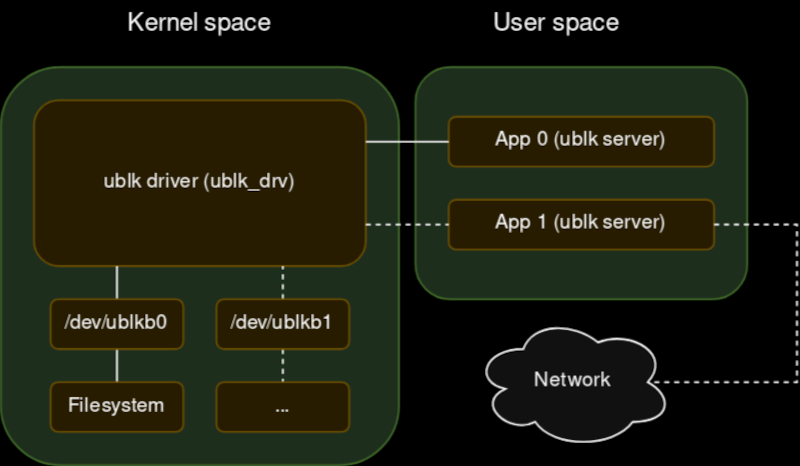
Your new project really could use a block device for Linux. File systems are easy to do with FUSE, but that’s sometimes too high-level. But a block driver can be tough to write and debug, especially since bugs in the kernel’s space can be catastrophic. [Jiri Pospisil] suggestsUblk, a framework for writing block devices in user space. This works using the io_uring facility in recent kernels.
This opens the block device field up. You can use any language you want (we’ve seen FUSE used with some very strange languages). You can use libraries that would not work in the kernel. Debugging is simple, and crashing is a minor inconvenience.
Another advantage? Your driver won’t depend on the kernel code. There is a kernel driver, of course, named ublk_drv, but that’s not your code. That’s what your code talks to.
The driver maintains the block devices and relays I/O and ioctl requests to your code for servicing. There are several possible use cases for this. For example, you could dream up some exotic RAID scheme and expose it as a block device that multiplexes many devices. The example in the post, for example, exposes a block device that is made up of many discrete files on a different file system.
Do you need this? Probably not. But if you do, it is a great way to push out a block driver in a hurry. Is it high-performance? Probably not, just like FUSE isn’t as performant as a “real” file system. But for many cases, that’s not a problem.
Congressional appropriators are one step closer to reaching a comprehensive spending deal for the rest of the fiscal year before a stopgap spending bill expires at the end of the month.
Members of the House and Senate appropriations committees released a four-bill “minibus” of fiscal 2026 spending bills on Tuesday.
Congress is roughly halfway to passing a spending plan for the rest of FY 2026. The current continuing resolution expires on Jan. 30.
The latest “minibus” covers annual appropriations for the departments of Defense, Homeland Security, Labor, Health and Human Services, Education, Transportation and Housing and Urban Development, as well as some smaller related agencies.
House Appropriations Committee Chairman Tom Cole (R-Okla.) said in a statement that the spending package delivers “results without waste.”
“At a time when many believed completing the FY26 process was out of reach, we’ve shown that challenges are opportunities. It’s time to get it across the finish line,” Cole said.
Here are a few highlights from the spending package:
3.8% pay raise for air traffic controllers
The spending deal would give the Federal Aviation Administration a $1.58 billion budget for fiscal 2026, as well as funding to hire 2,500 new air traffic controllers
The FAA is about 3,500 air traffic controllers short of its staffing goals. Many current air traffic controllers are working six days a week, including mandatory overtime.
As part of this budget plan, the FAA would receive $140 million to implement a 3.8% pay raise for air traffic controllers, as well as supervisors and managers who oversee air traffic.
The Trump administration approved a 3.8% pay raise for federal law enforcement personnel, which went into effect at the start of January. Air traffic controllers were not on the Office of Personnel Management’s list of positions receiving a higher pay raise.
The spending bill states that the 3.8% pay raise “shall be implemented for all such employees only to the extent that the administrator determines, in his sole discretion, that improvements in workforce scheduling, staffing utilization, or other operational efficiencies are achieved that contribute to addressing workforce shortfalls and enhancing aviation safety.”
If the FAA administrator determines these conditions, the pay raise would retroactively go into effect for the first pay period in January 2026.
Spending cuts for a smaller federal workforce
Republican appropriators applauded overall spending cuts in the spending bill that funds the Transportation Department, HUD and related agencies.
GOP lawmakers on the House Appropriations Committee wrote that the spending deal “codified DOGE recommendations to reduce the federal bureaucracy” of Transportation, HUD and related agencies by 29%.
More specifically, GOP lawmakers said the spending package reflects a 24% reduction in HUD staffing achieved partially through layoffs last year.
Lawmakers said a smaller HUD workforce will save $348 million in salaries and related expenses.
Republican appropriators said the spending deal reflects the Transportation Department “right-sizing” its workforce through a 5% staffing reduction, “all without compromising transportation safety.”
President Donald Trump told reporters at a White House press briefing on Monday that his administration “slashed tremendous numbers of people off the federal payroll” during his first year in office.
Trump said downsizing the federal workforce was necessary, because “they had 10 people for every job,” and that terminated federal employees have moved on to higher-paying jobs in the private sector.
“I don’t feel badly, because they’re getting private sector jobs, and they’re getting sometimes twice as much money, three times as much money,” Trump said. “They’re getting factory jobs, they’re getting much better jobs and much higher pay.”
Higher HHS spending, proposed cuts rejected
The spending bill gives the Department of Health and Human Services $116.8 billion in discretionary spending — a $210 million increase in discretionary spending. By contrast, the Trump administration proposed a nearly 20% cut to HHS discretionary spending this year.
The congressional spending deal rejects the administration’s calls for deep cuts within HHS. The administration sought a 50% spending cut for the Centers for Disease Control and Prevention. Instead, the compromise reached by lawmakers essentially keeps CDC funded at current levels, and includes funding increases for some of its pandemic preparedness programs.
The spending package would give $7.4 billion to the Substance Abuse and Mental Health Services Administration (SAMHSA) a $65 million increase over current funding levels.
The bigger budget reflects increased spending to address a rise in opioid overdoses, especially from fentanyl, as well as boosts to substance abuse disorder prevention and mental health services.
Lawmakers rejected a 15% cut to SAMHSA funding proposed by the Trump administration. The spending deal also rejects the administration’s plan to reorganize SAMHSA into the Administration for a Healthy America (AHA), a new office envisioned by HHS Secretary Robert F. Kennedy, Jr.
Democrats on the appropriations committees said the spending deal ensures SAMHSA remains its “own, independent agency to help ensure substance use and mental health remain a priority at HHS” and “includes new guardrails to ensure SAMHSA funds are allocated as intended.”
NPR reported last week that HHS briefly terminated $2 billion in addiction and mental health grants, but quickly walked back those cuts.
Education Department budget remains intact
Lawmakers are largely rejecting the administration’s proposal to dismantle the Education Department, and move many of its functions to other federal agencies.
The spending bill gives the department $79 billion in discretionary spending — a roughly flat budget compared to current spending levels.
The Trump administration proposed cutting the Education Department by $12 billion, or about 15% of its current discretionary budget.
The Education Department has already signed six interagency agreements to transfer some of its programs and employees to HHS and the departments of Labor, Interior and State.
Education Secretary Linda McMahon told employees last November that the department is soft-launching plans to reassign its work to other parts of the federal government, before calling on Congress to permanently shutter the agency.
Senate Appropriations Committee Vice President Patty Murray (D-Wash.) said in a statement that “Congress will not abolish the Department of Education, and the people’s representatives will have the final say on how taxpayer dollars get spent.”
Budget boost for Social Security
The Social Security Administration would see a higher budget under this spending plan.
Lawmakers propose giving SSA $15 billion for its administrative budget in fiscal 2026 — a $554 million increase compared to current spending levels.
Lawmakers from both parties agreed that the funding will help the agency improve customer service for the public. Democratic appropriators urged SSA to use these increased funds to resume hiring.
SSA currently has about 50,000 employees in total, according to the latest data from the Office of Personnel Management. The agency lost more than 7,000 employees through voluntary incentives last year. It also relocated many of its employees from its headquarters and regional offices to field offices.
SSA Commissioner Frank Bisignano told staff at an all-hands meeting last week that the agency is continuing to hire, according to several employees in attendance. Those employees, however, said the agency still faces a hiring freeze.
Labor Dept. federal contractor watchdog spared from elimination
The spending bill provides $13.7 billion in discretionary spending to the Labor Department — a slight increase compared to its current $13.5 billion discretionary budget.
The department’s Office of Federal Contract Compliance Programs would receive a $101 million budget, about a 9% cut to current spending levels. OFCCP ensures federal contractors aren’t discriminating against their employees.
OFCCP, however, would remain largely intact, after the Trump administration proposed major staffing cuts. An earlier funding proposal from House Republicans also proposed fully eliminating OFCCP.
The agency sent layoff notices to 90% of its staff, but rescinded those layoffs last August. Instead of being reinstated to their jobs at OFCCP, the agency said impacted employees would be “reassigned to a new position” at the Labor Department.
Small agencies marked for closure stay open
The spending bill also includes funding for small, independent agencies marked for elimination by an executive order last year.
Lawmakers propose giving the Institute of Museum and Library Services a $292 million budget — a $3 million cut compared to current spending levels. The spending bill also proposes $3 million in funding for the Interagency Council on Homelessness.
President Trump signed an executive order last March, eliminating these agencies and five others “to the maximum extent consistent with applicable law.”
A federal judge in Rhode Island ordered a permanent injunction last November, putting the Trump administration’s plans to shutter these small agencies on hold.
House Appropriations Committee Ranking Member Rosa DeLauro (D-Conn.) said in a statement that the funding package “continues Congress’s forceful rejection of extreme cuts to federal programs proposed by the Trump administration.”
“Where the White House attempted to eliminate entire programs, we chose to increase their funding. Where the administration proposed slashing resources, we chose to sustain funding at current levels,” DeLauro said.
Check Point dug into the details of VoidLink and found a sophisticated and quickly developed malware that was mostly generated using AI and putting a spotlight on what the future of cyber threats looks like.
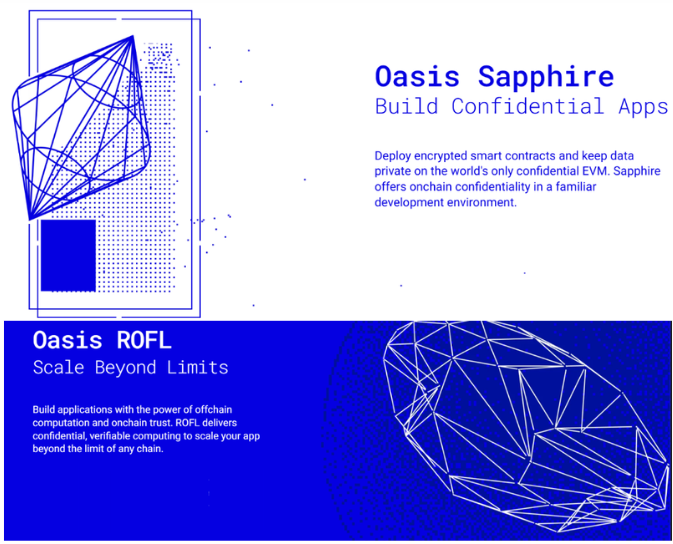
Together, Sapphire + ROFL form a full stack for building private, AI-ready web3 applications.
The crypto landscape today is flooded with web3 and AI dApps (decentralized applications). You need to choose the right chain and the right tools to develop and deploy your dApp, as it can make all the difference in attracting the right attention from the end-users. The choices are too many, and they often distract more than add value. It is also hard to come by solid, reliable information to make a decision.
I believe in Oasis as a pioneer of smart privacy for web3 and AI. Let me tell you point by point why I became a believer.
The Tech Stack: Sapphire EVM
In the blockchain trilemma scene, privacy has always taken the backseat, as most protocols emphasize decentralization and scalability. And then there is the debate and confusion of how to frame the rising privacy narrative — is it privacy coin or privacy blockchain?
Oasis has emerged as a pioneer in the field of smart privacy. It is a modular L1 blockchain that aims to finally complete the blockchain picture — decentralization, scalability, and privacy (and security) together.
Privacy-preserving techniques have garnered much attention in recent times. Long before zero-knowledge proofs (ZKPs), fully homomorphic encryption (FHE), and secure multiparty computation (sMPC) became trending, Oasis had adopted trusted execution environments ( TEEs) for end-to-end encryption and confidential computation.
In Oasis Sapphire, you get the world’s first and only production-ready confidential EVM. Its key features help you build better dApps that are privacy-first.
EVM compatibility
Private storage
Encryption precompiles
Free view calls
Web2 authentication
ROFL (runtime off-chain logic)
So, as a web3 developer, you get to work with smart privacy, cross-chain simplicity, and low technical overhead. How it differs from most other projects also offering privacy solutions is that you get the best of both worlds here — transparent when you need it, confidentiality when it matters. Further, you can build with full spectrum of confidentiality customization — 100% public to 100% private or anywhere in between.
But what happens if you have already built your dApp on another EVM chain? It is unfeasible to dismantle everything there and start rebuilding from scratch for the sake of privacy. Acknowledging this dilemma, Oasis offers the services of the Oasis Privacy Layer ( OPL).
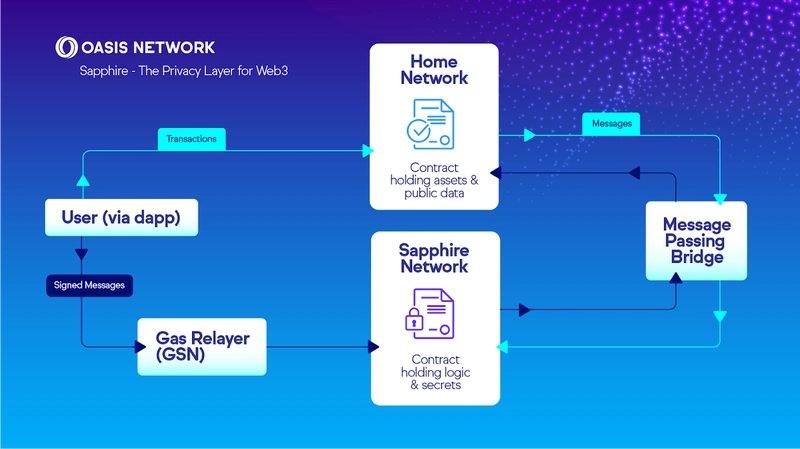
OPL is simple to use — a few hundred lines of code, practically a plug-and-play solution. Behind the scenes, it uses a message passing bridge and a gas relayer.
It gives the flexibility to leverage Sapphire’s features and functionalities for your dApp right from your home network, paying transaction fees with your chain’s native token. What you assuredly get from this setup:
Customizable privacy
Cross-chain convenience
Productive transparency
Low complexity
Access to cryptographic primitives
Learn more about OPL’s technical advantage and utility here, and start building.
The Framework: ROFL
Now, Sapphire is the runtime on-chain logic, but computation-heavy dApps, with end-to-end encryption and/or powered by AI, are a huge challenge. When you add the criteria that the privacy you get and the computations you process should be verifiable and trustless, the feasibility of doing everything on-chain plummets.
The challenges mount when dealing with cryptoAI, as it has two main problems — crypto’s limited application layer and AI’s trust issues. Off-chain computation is a viable answer in this situation. Oasis has thus developed the ROFL framework, essentially working like a decentralized TEE cloud with on-chain privacy and verifiability.
ROFL’s 5-part architecture involves a hardware layer, an application layer, a remote attestation layer, a blockchain layer, and a user interaction layer. Key features include:
Uncapped computational power
Tamper-proof processing
Verifiable execution
Decentralized key management solution
Direct access to confidential virtual machines
The reason ROFL is so crucial and pivotal to the next-gen private and trustless web3 and AI dApps can be simply summed up by what it doesn’t need, which you will definitely appreciate.
No chain dependency
No coding language dependency
No prior TEE experience
Start exploring the scope of ROFL with these resources:
The applicability of the Sapphire + ROFL solution, with its impact and scope, is limitless. The features and primitives that ROFL unlocks are also significant.
Already, multiple live collaborations have transpired.
Zeph — developing AI companions empowered by DeAI and DeCC
Tamarin — empowering secure and private cross-border healthcare data analysis
Tradable — trading with privacy-preserving AI insights
Flashback — privacy-first AI training that lets users own and monetize their data
Plurality — confidential reputation scoring and AI context flow
Talos — combining DAO 2.0 and DeFAI in the form of a new model for on-chain sovereign intelligence
zkAGI — building PawPad, a privacy-preserving platform for trustless trading agents
Heurist — enabling privacy-first MCP servers for AI agents
Huralya — building private AI wellness assistants
Carrotfunding — servicing on-chain prop trading, introducing a new model for parallel verification of the risk and evaluation engine
Talos and Carrotfunding here deserve special focus, standing out as pathbreaking case studies redefining DeFi.
Final words
The takeaway from all this is that what Oasis offers to blockchain and web3 developers is not just some concept — it’s something real and tangible. In a space where half-baked or well-intentioned ideas sound promising but often don’t deliver in their execution, a working blueprint for next-gen dApp builders stands out.
So, if you want to deploy your dApp in a web3 universe where privacy, scalability, trustlessness, and AI-ready performance all matter equally, take a moment to explore Oasis — and help shape what comes next.
Originally published at https://dev.to on January 20, 2026.
Explore the wide range of mobile app development trends of 2026!
Mobile App Development Trends
The mobile app ecosystem is always a highly competitive landscape where innovations are happening every now and then. They are now acting as a core engine that drives the growth of startups, user engagement, and competitive advantage. Recently, with the AI technology boom, various mobile apps have been personalized with lightning-fast experiences, and they have shaped into a demand.
For the budding startups who want to succeed in the digital market, it is the right time to know about the upcoming mobile app development trends to watch out for in 2026. This blog helps you explore the top mobile app development trends that prepare startups, founders, and digital-first businesses for success. Scroll till the end to know more…
Mobile App Utilization — A Statistical Report
Presently, mobile apps are no longer just a tool; they have turned into an architecture of modern life. They are now paving the way for the modern digital era that helps users to work, shop, connect, and unwind. As per the statistical report, smartphone users now spend nearly 5 to 6 hours per day.
Also, on average, every user interacts with 30 to 40 mobile applications every month. This is solid proof that mobile applications are playing a huge part in the lives of every global user.
Mobile apps are created for social media, messaging, healthcare, gaming, etc. Among those, the social media and entertainment apps are driving the highest app engagement. Global mobile app revenue exceeds nearly $500 billion annually.
Every year, mobile applications are revolutionizing the market with innovations. In that sense, in this blog, I have listed the top mobile app development trends to watch out for in 2026. The next section is all about that. Go ahead.
Mobile App Trends To Watch In 2026
The road to 2026 paved the way for innovations and quiet revolutions in the overall digital space. They are evolving from reactive tools into intuitive companions. In the year 2026, mobile app development is expected to face multiple technological progress that makes a shift. Some of them are listed here,
AI-First Mobile Applications
By 2026, AI will no longer be an added feature that will be core architecture for modern mobile applications. From the hyper-personalized content feeds to the intelligent recommendations and predictive search, the AI will make huge changes in the creation of mobile applications. AI will help digital entrepreneurs to shape the experiences in real time that learns the user experience, workflow adjustments, and notifications based on intent rather than commands.
The on-device AI and edge computing will also play a key role, enabling faster responses, improved privacy, and reduced dependency on cloud processing. The AI mobile-first apps unlock various use cases and benefits that include,
Personalized user experience based on the niche and user preferences.
Predictive insights that anticipate the user’s needs before actions
Long-term improvement can be done when innovations are evolved.
Cross-Platform Development
The mobile applications can be developed with cross-platform compatibility to enable businesses to build a single application that possesses a shared codebase for iOS, Android, and web. Cross-platform development helps entrepreneurs to create platforms that can be monitored and maintained seamlessly. This reduces the overall development and maintenance cost for the budding startups and enterprises.
Specialized tech stack frameworks like Flutter, React Native, and Xamarin are utilized to create their cross-platform mobile applications. The single interface is valuable for fast-growing startups that need scalability without any complex technical assistance.
Consistent user experience is offered for multiple devices.
The deployment can be done with simplified AI model integration.
The platform can be updated and upgraded with simple technical methods.
5G Optimized Mobile Apps
With the widespread adoption of 5G networks, mobile apps are being developed to compete with them to harness ultra-low latency, faster data speeds, and real-time responsiveness. The creation of 5G optimized mobile applications helps to unlock immersive experiences such as cloud gaming, real-time AVR navigation, live video collaboration, etc. Industries such as healthcare, logistics, fintech, and entertainment are utilizing the high-speed 5G mobile applications to deliver mission-critical features without performance bottlenecks.
With the 5G optimization, the mobile apps can support instant data transmission, seamless streaming, and edge-computing capabilities. Some of the key advantages of creating 5G optimized mobile applications are,
Near-zero latency for users to make real-time interactions flawlessly.
Data is shared and transferred with media-rich and AI-powered features.
The 5G optimized mobile applications enhance the overall user experience even during peak usage.
Blockchain-Enabled Mobile Applications
The blockchain networks are now powering the new layer of trust for the creation of potential mobile applications. From decentralized identity verification and secure digital wallets, the blockchain integration for the mobile apps provides tamper-proof data storage. The blockchain-backed mobile apps are utilized in various industries like fintech, gaming, supply chain, and digital content ownership. The blockchain networks in the mobile applications enhance the security, reduce the intermediaries, and enable true user ownership.
By embedding the blockchain networks within the mobile applications, it gives the users greater control over the data and ownership. Also, crypto payments, smart contracts, decentralized identity, tokenization, and NFT ownership can be integrated seamlessly. Key benefits of the blockchain-enabled mobile applications include,
Enhanced security through the cryptographic verification
Transparent and tamper-proof transactions
The blockchain network offers user authentication and identity management seamlessly.
Wearables, Foldables, and Multi-device
The modern mobile ecosystem is no longer limited to smartphones; rather, it is shaping the user interaction within digital applications. They are now turning into seamless, adoptive, and context-aware across multiple devices.
Wearables — Wearables such as smart watches and fitness trackers enable real-time interactions. Also, they deliver the notifications, health insights, and micro-actions on the go.
Multi-Device Support — The foldable devices tie everything together, enabling the mobile app users to start an action on one device and continue it on another without any friction.
Foldable Devices — The mobile applications introduce dynamic screen transitions that allow the apps to shift smoothly between the compact and expanded layouts. This opens new possibilities for multitasking, immersive content consumption, and productivity-driven experiences seamlessly.
Sustainable & Performance-Efficient App Development
Sustainability emerges as the strategic priority in mobile app development, which turns into responsible resource usage. The sustainable apps are lightweight and optimized with relevant code, reduced battery consumption, and minimal data usage. Instead of prioritizing the features, the sustainable mobile apps deliver high performance with minimal resource consumption.
They reduce both the operational costs and environmental impacts. With the lightweight architecture, the overall energy demands across devices are low. Some of the key principles of sustainable app development are,
The optimized codebases reduce the computational overhead
The energy-efficient processing helps mobile and other edge devices.
Is Creating A Mobile Application Still Profitable?
Yes, creating a mobile app in 2026 will pave the way for innovations and opportunities. Gaining profits in the current competitive era is not just about launching a mobile app, but it is about building the right mobile application for the right audience. Let’s get the latest breakdown of the profit possibilities of creating a mobile application,
Market reality
The global mobile app utilization continues to rise year after year, with a significant increase in user interaction. From the payments sector to healthcare, every niche is creating mobile applications with perfect infrastructure. For every user-friendly service, revenue can be generated seamlessly.
Profit Model Expansion
Subscription-based profit models offer predictable recurring revenue based on the mobile app. The in-app purchases and premium features drive value from engaged users. The revenue models of each niche and the field have expanded to thrive on layered monetization.
Lower Development Cost
Unlike other business models, crafting a mobile application is paving the way for more startups to gain more profits with a minimal investment. The mobile app development process is lean and strategy-driven, where profitability has become easily achievable much earlier.
To Conclude,
The mobile app landscape in 2026 is reshaping the rules of digital engagement. From AI-first experiences and 5G-optimized performance to privacy-centric design, sustainable app development, etc, the mobile app development trends will reshape the future. The apps that win in 2026 will be the ones built with scalability in mind, engineered for real-world performance, and designed to adapt as user expectations continue to rise. Embrace innovation with purpose, the right tech stack, and focus relentlessly on user experience.
If you’re thinking about starting a decentralized exchange for more than a month, then you’ve probably checked out blockchain networks like Ethereum, BNB Chain, or Polygon, and more. But, TON (The Open Network) is another platform that’s been steadily improving in this highly competitive space.
This network is backed by Telegram and made for fast speeds, low costs, and widespread use. TON is becoming a real option for DeFi creators. If you’re planning to create a DEX in 2026, using TON could give you an advantage.
Remember: Before you build, understand the platform.
TON is a layer-1 blockchain originally developed by Telegram, now maintained by the open-source TON Foundation. It’s optimized for mobile-first use, ultra-fast execution, and low network fees. It has over 900,000 daily active wallets and has seen a sharp rise in DeFi-related developer activity in the past year.
For founders, this means you’re not only using a powerful blockchain but also building within a growing group of users who are already using it.
So, before looking for the DEX development service, decide early on what type of DEX you want to start. Will you create a DEX based on AMM, like Uniswap or PancakeSwap?
Now, some of you might think, “Can TON’s design handle advanced trading systems in addition to simpler automated market makers (AMMs)?”
Actually, TON can do both, but AMMs are quicker to set up and work better with the current ways to manage money.
Also, consider whether you want to include:
Liquidity farming
Native staking
NFT integration
On-chain analytics for traders
The model you choose will define your feature set, tech stack, and liquidity plan.
3. Pick the Right Clone or Framework
If you are using a pre-made DEX script to launch fast, check that it works with TON Virtual Machine (TVM) and the smart contract framework that TON supports.
TON is different from Ethereum and doesn’t use Solidity. It has its own language, FunC, for smart contracts. Make sure your code works with TON. Ensure that you have hired a Defi development company that can change it to work well.
Don’t just aim to replicate Ethereum DEX designs. Understand how TON works to avoid problems later when launching and checking your DEX. Partner with the team that can build a DEX on Ton blockchain.
4. Create and Check Smart Contracts
After your contract logic is ready, you can launch it and make it live. But TON smart contracts work differently from those on EVM chains, so make sure that the DEX development company tests well before deployment.
So, hire a DEX development team that specializes in using tools like:
TON CLI and TON Dev Tools.
Testnet environment for stress testing pools and trades.
Explorer integration to verify live transaction data
If you’re working with external contributors or validators, test interaction flows like liquidity provision, swap execution, and token listing approvals.
5. Focus On Creating a Simple, Mobile-Friendly DEX
Here’s where TON really differs from other chains. Its community is largely Telegram-based and mobile-heavy.
Your DEX website should be simple, work well on phones, and load quickly. It’s good if it works with TON wallets like Tonkeeper or Tonhub, which are popular with Telegram users.
So, ask your DEX development company to implement intuitive layouts on your DEX. And, aim to make trading easy and clear for people using phones.
6. Launch and Get People to Use It
After launching, focus on getting more money into your DEX and getting more users.
To get people to use your decentralized exchange, think about connecting with other projects on TON or using Telegram Mini Apps to get new users at the initial stages.
By mid-2026, the total value locked in TON’s DeFi world was more than $170 million, and it keeps growing every month. So, stepping into this space now will be the smarter choice.
Final Thoughts
So, building a DEX platform on the TON blockchain will be a good idea, but one thing you need to keep in mind is “hiring a reliable decentralized exchange development company”. Why? Because the TON network and its smart contracts framework are different from existing platforms, only experienced companies that know how to build DEX on Ton Blockchain can offer you a bug-free protocol.
It may come as no surprise that a huge percentage of developers don’t trust AI-generated code, but many also say it’s becoming more difficult to check for errors created by coding assistants.
As AI coding assistants take over an ever-increasing amount of programming work, human coding teams are struggling to find the time to spot the errors, development leaders say. Coding assistants are improving the quality of their output, but they have also tended to become more verbose — writing more lines of code to fix a problem — making it harder to spot errors when they pop up, according to coding experts.
As a result, a major problem with AI-generated code is arising: developers sometimes spending more time reviewing AI output than they would have spent writing the code themselves.
While AI coding assistants have become ubiquitous, developers shouldn’t trust them, says Alex Lisle, CTO of deepfake detection platform Reality Defender.
All the software engineers Lisle works with use coding assistants in some capacity, but the company’s developers keep a close eye on their output, he says. “The truth of the matter is most of my developers don’t use AI-generated code for more than boilerplate and fixing a few little things,” he says. “We don’t trust AI-generated code at all.”
The responsibility for the quality of the code resides with the developer using the coding assistant, Lisle adds.
Cranking out code
The volume of code that can be generated by AI tools creates its own problems, Lisle contends.
“It’s kind of like having a junior developer who can write a very large amount of code very quickly,” he explains. “The problem with that is it doesn’t understand the code and the broader context. It often does the opposite of what you ask it to do.”
Overreliance on AI-generated code can lead to a code base that’s impossible to understand, Lisle says.
“The problem is as soon as you start leveraging it in a broader context, it creates an incredibly unstable and unknowable code,” he adds. “You can get an AI to generate hundreds of thousands of lines of code, but it’s very difficult to maintain, very difficult to understand, and in a production environment, none of that is suitable.”
Microsoft-focused coding firm Keypress Software Development Group has had mixed results with AI coding assistants, says Brian Owens, president and senior software architect there.
AI-generated code often requires only minimal review for small, self-contained use cases, but for production-grade applications, the output can be inconsistent and problematic, he says.
“We’ve found that AI tools will occasionally ignore key aspects of the existing codebase or fail to align with established coding standards and architectural patterns,” Owens says. “That creates additional work for our team in the form of review, refactoring, and rework to ensure the code is production ready.”
Owens has found that using a coding assistant may not save time over a human developer writing the code. “In some cases, the time spent validating and correcting AI-generated code can offset the expected efficiency gains — and occasionally takes more time than if a developer had written the code without AI assistance,” he says.
Major lack of trust
A recent survey of more than 1,100 IT professionals by code quality tool provide Sonar backs up the trust concerns voiced by some development leaders. While 72% of those surveyed say they use coding assistants every day, 96% say they don’t fully trust AI-generated code.
At the same time, less than half of developers say they always check their AI-generated code before committing it, with nearly four in 10 saying that reviewing AI-generated code requires more effort than code written by their human coworkers.
As the quality of coding assistants improves, developers are finding it more difficult to find errors, says Chris Grams, vice president of corporate marketing at Sonar — and not because they aren’t there.
“As these coding models get better and better, you have a little bit of a needle-in-a-haystack problem, where there may be fewer and fewer issues overall, but those issues are going to a big security issue that’s well hidden and hard to find and could be the thing that takes down an application,” he says.
While many software development leaders say they don’t trust AI-generated code, the issue may be more nuanced, says Mark Porter, CTO at data analytics solutions provider dbt Labs.
Coding assistants are widely used at dbt Labs, he says, and trusting their output depends on the context.
“Trusting AI written code is much like trusting human-written code,” he adds. “In general, I look for the same trust signals in AI-generated code as any other code. If it was created via a high-integrity process, I trust it just like I would trust human code.”
The review bottleneck
But AI-generated code can be faulty in different ways than human-written code, with AI often adding complexity and creating overly confident comments, Porter says. The trust equation must adapt to these unique challenges.
Reviewing AI code also creates its own challenges, adding to the developer’s reviewing time, even as it saves coding time, he says. “The output volume is high, so it shifts the bottleneck from producing code to reviewing it,” he adds.
Human reviews also need to maintain expert-level familiarity with the codebase, Porter says, which can be mitigated through software engineering best practices.
“There are certainly unique challenges to reviewing AI-written code,” he adds. “I think the question of trusting AI code is missing the point a bit; what I’m thinking about is how to build processes and guidelines and training that support my engineers using AI to assist them in writing efficient and correct code that is also maintainable — and that’s the future of AI in coding, in my opinion.”
엣지 AI와 관련해 레드햇의 엣지 프로젝트 관리 부문 시니어 디렉터 조슈아 데이비드는 “글로벌 시장은 현재 가파른 성장 궤도에 올라 있다”라고 말했다. 실제로 엣지 AI 시장 규모는 2034년까지 1,430억 달러에 이를 것으로 예상되고 있다.
엣지 AI의 성장세는 업계 전반이 머신러닝(ML) 모델에 데이터를 학습시키는 AI 학습 중심에서 벗어나, 운영 환경에서 모델을 실제로 활용해 지식을 적용하거나 예측을 수행하는 추론 중심으로 이동하는 흐름과 맞물려 있다.
엔터프라이즈 데이터 관리·통합 기업 인포매티카의 제품 관리 부문 부사장 수밋 아그라왈은 “강력하면서도 에너지 효율적인 AI 프로세서의 발전과 사물인터넷(IoT) 기기의 확산이 이러한 흐름을 가속하고 있다. 복잡한 AI 모델을 엣지 디바이스에서 직접 실행할 수 있는 환경을 가능하게 하고 있다”라고 설명했다.
이와 관련해 모건스탠리 블로그는 AI 산업이 “새롭고, 잠재적으로 훨씬 더 큰 단계인 AI 추론으로 접어들고 있다”라고 언급하며, 이 단계의 핵심 특징으로 소비자용 애플리케이션과 기업 전반에 걸쳐 AI 모델이 광범위하게 채택된다는 점을 짚었다.
엣지 컴퓨팅은 퍼블릭 클라우드와는 다른 장점을 제공한다. 퍼블릭 클라우드는 확장성과 사용 편의성 측면에서 강점이 있지만, 추론 관점에서는 한계도 분명하다. 지연 시간이 늘어나고 데이터 프라이버시 우려가 커지며, 연산 처리와 데이터 유입·유출 과정에서 비용 부담이 증가한다는 점이 대표적이다. 반면 AI를 엣지에서 실행하면 이러한 문제 상당 부분을 해소할 수 있다. 데이비드는 “엣지 AI는 지연 시간 감소, 비용 절감, 보안과 프라이버시 강화 등 여러 핵심적인 이점을 제공한다”라고 설명했다.
아마존이 최근 일부 ML 학습 작업에 주로 사용되는 GPU 이용 요금을 15% 인상한 사례처럼, 중앙 집중형 학습을 중심으로 한 클라우드 AI 비용은 예측하기 어려운 방향으로 흘러가고 있다. IDC는 2027년까지 CIO의 80%가 AI 추론 수요를 충족하기 위해 클라우드 업체의 엣지 서비스를 활용할 것으로 전망했다.
다만 이러한 전환이 순탄하게 이뤄지지는 않을 전망이다. 실시간 성능에 대한 높은 요구, AI 스택이 차지하는 큰 시스템 자원 부담, 파편화된 엣지 생태계는 여전히 주요 과제로 남아있다.
이 글에서는 엣지 AI를 둘러싼 기술 개발 현황을 살펴보고, 엣지 환경에서 AI를 실행하기 위한 새로운 기술과 운영 방식, 그리고 AI 시대에 컴퓨팅의 미래가 어떻게 진화할지 전반적으로 짚어본다.
엣지 AI 성장을 이끄는 요인
데이비드는 “엣지 AI 확산의 가장 큰 동인은 실시간 데이터 처리에 대한 요구”라고 설명했다. 중앙화된 클라우드 기반 AI 워크로드에 의존하는 대신, 엣지에서 직접 데이터를 분석하면 데이터가 생성되는 지점에서 즉각적인 의사결정을 내릴 수 있다는 점이 핵심이라는 분석이다.
여러 전문가도 같은 의견을 내놓고 있다. 인포매티카의 아그라왈은 “엣지 AI에 대한 관심이 폭발적으로 증가하고 있다”라고 전하며, 특히 산업 현장이나 자동차 분야처럼 찰나의 판단이 중요한 환경에서는 지연 시간 감소가 가장 큰 장점으로 작용하고 있다고 진단했다.
또한 클라우드로 데이터를 보내지 않고도 ML 모델에 개인적이거나 기업 고유의 맥락 정보를 제공하려는 수요 역시 커지고 있다. 오픈소스 애플리케이션 플랫폼 제공사 템포럴 테크놀로지의 시니어 스태프 소프트웨어 엔지니어이자 AI 기술 책임자인 요한 슐라이어-스미스는 “프라이버시는 매우 강력한 동인”이라면서, 의료나 금융처럼 규제가 엄격한 산업에서는 민감한 정보를 로컬에서 처리하는 것이 규제 준수를 위해 필수적이라고 분석했다.
수세(SUSE)의 엣지 사업 부문 부사장 겸 총괄 책임자 키스 바실 역시 “엣지 AI에 대한 관심은 분명히 증가하고 있다”라고 밝혔다. 그는 제조 분야를 대표적인 사례로 꼽으며, 기업이 생산 라인을 운영하는 대형 서버부터 소형 센서에서 발생하는 데이터를 처리하는 영역까지 다양한 사용례에 엣지 AI 도입을 검토하고 있다고 설명했다.
로크웰 오토메이션에 따르면 제조 기업의 95%가 향후 5년 내에 AI/ML, 생성형 AI, 인과 기반 AI에 이미 투자했거나 투자를 계획하고 있다. 또 2024년 인텔의 CIO 보고서에서는 제조 분야 리더의 74%가 AI가 매출 성장에 기여할 잠재력이 있다고 답했다.
로컬 AI 연산의 가장 큰 효과는 비용 절감이다. 아그라왈은 “전송해야 할 데이터 양이 줄어들면서 비용과 대역폭을 크게 최적화할 수 있다”라고 설명했다.
특정 워크로드를 엣지에서 처리하는 방식은 비용 절감뿐만 아니라 에너지 소비 감소와도 밀접하게 연결된다. 2025년 1월 아카이브(Arxiv)에 발표된 논문 ‘하이브리드 엣지 클라우드의 에너지 및 비용 절감 효과 정량화’에서는 순수 클라우드 처리 방식과 비교해, 에이전트 기반 AI 워크로드에 하이브리드 엣지 클라우드를 적용할 경우 조건에 따라 최대 75%의 에너지 절감과 80%를 웃도는 비용 절감 효과를 거둘 수 있다고 분석했다.
해당 논문의 저자인 시아바시 알라무티는 “엣지 처리는 로컬 컴퓨팅의 맥락을 직접 활용해 연산 복잡도를 낮추고, 클라우드 규모에서 발생하는 막대한 에너지 수요를 피할 수 있다”라고 진단했다.
로컬 AI를 가능하게 하는 기술
엣지 AI 성장을 이끄는 요인은 분명해 보이지만, 이를 실제로 구현하기 위해서는 어떤 기술이 필요할까? 자원이 제한된 엣지 환경에서 AI 연산을 실행하려면 소규모 언어 모델, 경량 프레임워크, 최적화된 배포 방식이 결합돼야 할 가능성이 크다.
소규모 언어 모델(SLM)
지금까지 대부분의 기업은 앤트로픽의 클로드, 구글의 제미나이, 오픈AI의 GPT 모델과 같은 범용 서비스 기반의 LLM을 활용해 AI를 중앙에서 운영해 왔다. 그러나 최근 AI 모델 기술이 발전하면서 이런 구조에도 변화가 나타나고 있다.
특히 자체 배포가 가능한 SLM은 특정 사용례에서 클라우드 AI 플랫폼에 대한 의존도를 낮추고 있다. 템포럴 테크놀로지의 슐라이어-스미스는 “SLM의 성능이 빠르게 향상되고 있다”라며, 최근 기술 진전의 사례로 오픈AI의 GPT-OSS와 계층적 추론 모델을 언급했다.
최적화 전략
로컬 AI의 시스템 부담을 줄이는 것은 연산 능력과 대역폭이 제한된 엣지 디바이스 환경에서 특히 중요하다. 이에 따라 SLM을 최적화하는 기술이 엣지 AI 구현을 뒷받침하는 핵심 영역으로 떠오르고 있다.
대표적인 전략 가운데 하나는 모델 압축 기법인 양자화다. 양자화는 모델 크기와 연산 요구량을 줄이는 방식으로, 엣지 환경에 적합한 형태로 AI 모델을 경량화한다. 아그라왈은 “이러한 기법을 통해 NPU, 구글의 엣지 TPU, 애플의 뉴럴 엔진, 엔비디아 젯슨 디바이스와 같은 특화 하드웨어에서 SLM을 실행할 수 있다”라고 설명했다.
자체 완결형 패키지 역시 엣지 AI를 대규모로 운영하는 데 도움이 될 수 있다. 데이비드는 운영체제, 하드웨어 드라이버, AI 모델을 하나로 묶은 즉시 배포 가능한 베이스 이미지가 엣지 AI 상용화를 현실화하는 접근 방식이라고 설명했다.
아그라왈은 “llama.cpp와 GGUF 모델 포맷 같은 프로젝트는 다양한 소비자용 디바이스에서 고성능 추론을 가능하게 하고 있다. MLC LLM과 웹LLM(WebLLM) 역시 웹 브라우저와 다양한 네이티브 플랫폼에서 AI를 직접 실행할 수 있는 가능성을 확장하고 있다”라고 말했다.
클라우드 네이티브 호환성
엣지 AI가 클라우드 네이티브 생태계 및 쿠버네티스와의 호환성을 확보하는 것 역시 중요한 과제로 떠오르고 있다. 쿠버네티스가 이미 엣지 환경으로 빠르게 확산되고 있기 때문이다. 대표적인 사례로는 ‘자체 호스팅 AI를 위한 오픈소스 표준’으로 소개되는 케이서브(KServe)가 있다. 케이서브는 쿠버네티스 환경에서 엣지 추론을 지원하는 프레임워크다.
또 다른 핵심 기술로는 클라우드 네이티브 컴퓨팅 재단(CNCF)이 운영하는 샌드박스 프로젝트 아크리(Akri)가 꼽힌다. 수세의 바실은 “아크리는 엣지 환경에서 다양한 동적 디바이스와 간헐적으로 연결되는 리프 디바이스를 쿠버네티스에서 쉽게 활용할 수 있도록 만든다”라고 설명했다. 아크리를 활용하면 IP 카메라, 센서, USB 디바이스 등 다양한 엔드포인트를 쿠버네티스 리소스로 노출할 수 있어, 해당 하드웨어에 의존하는 엣지 AI 워크로드를 보다 손쉽게 배포하고 쿠버네티스에서 모니터링할 수 있다.
개방형 표준
마지막으로 엣지 AI 확산 과정에서 개방형 산업 표준이 중요한 역할을 할 것으로 보인다. 바실은 “빠르게 확장되고 있는 엣지 AI 하드웨어와 소프트웨어 환경은 심각한 상호운용성 문제를 안고 있다”라고 설명했다. 그는 리눅스 재단이 주도하는 마고(Margo)와 같은 프로젝트가 산업용 엣지 자동화 분야에서 표준을 정립하는 데 중요한 역할을 할 것으로 내다봤다.
이와 함께 ONNX도 온디바이스 AI 추론을 위한 경쟁 프레임워크 간 상호운용성 문제 해결에 도움이 될 표준으로 주목받고 있다.
엣지 AI의 현실적 장벽
기술 자체는 이미 마련돼 있지만, 엣지 AI를 실제로 운영하는 방식은 아직 초기 단계에 머물러 있다. 개념 증명 수준에서 벗어나 엣지 AI 애플리케이션을 본격적인 운영 환경으로 옮기기까지는 여러 과제를 극복해야 한다.
아그라왈은 “가장 근본적인 한계는 엣지 디바이스가 지닌 자원 제약”이라고 지적했다. 그는 “메모리와 연산 능력이 제한적이기 때문에, 막대한 연산 자원을 요구하는 크고 복잡한 AI 모델을 배포하는 데 어려움이 따른다”라고 말했다.
자원이 제한된 하드웨어 환경에 맞게 모델 크기를 최적화하면서도, 사용자가 기대하는 고성능 상위 모델 수준의 정확도를 유지해야 한다는 점 역시 여전히 해결해야 할 과제다.
또한 엣지 AI 운영에 대한 실무 경험도 아직 충분히 축적되지 않았다. 데이비드는 “특화된 엣지 디바이스는 하드웨어 구성이 복잡하고, 대부분 즉시 사용 가능한 상태로 동작하지 않는다는 점이 주요 장애물”이라고 설명했다. 그는 최전방 엣지 환경에서 모델을 배포하고 모니터링하며 관리할 수 있는 엔드투엔드 플랫폼이 부족해, 현재로서는 복잡한 수작업 방식에 의존할 수밖에 없는 상황이라고 지적했다.
바실은 “엣지 AI의 주요 과제는 파편화된 생태계”라고 덧붙였다. 그는 “표준화되고 성숙한 클라우드 컴퓨팅 환경과 달리, 엣지 AI는 하드웨어와 소프트웨어, 통신 프로토콜 전반에 걸쳐 공통된 프레임워크가 부족하다”라고 설명했다. 이러한 산업 전반의 파편화는 디바이스별로 경쟁적인 소프트웨어와 기술을 양산하고, 그 결과 엣지 환경에서는 호환성 문제와 개별 맞춤형 해결책이 뒤따르게 된다.
마지막으로 분산된 AI 모델 네트워크를 관리하는 문제도 복잡한 운영 과제로 꼽힌다. 아그라왈은 “수많은 디바이스에 배포된 모델을 대상으로 보안 업데이트와 버전 관리, 성능 모니터링을 동시에 수행하는 것은 매우 어려운 작업”이라며 “엣지 AI를 효과적으로 확장하기 위해 기업이 반드시 해결해야 할 과제”라고 설명했다.
이러한 장벽을 극복하기 위해 전문가들은 몇 가지 실천 방안을 제시했다.
연결성이 낮은 환경에서의 추론과 같이 엣지 AI가 적합한 경우에 한해 도입.
비기술 분야 리더를 대상으로 비즈니스 가치를 지속적으로 전달.
전면적인 엣지 또는 클라우드 배포 대신 하이브리드 전략을 고려.
아키텍처 차원에서 소프트웨어 계층을 특정 하드웨어 의존성으로부터 분리.
엣지 환경의 제약에 최적화된 모델을 선택.
업데이트, 모니터링, 유지보수를 포함한 전체 모델 수명 주기를 초기 단계부터 구상.
중앙 집중형에서 분산 지능으로
엣지 AI에 대한 관심이 빠르게 높아지고 있지만, 대안형 클라우드로의 전환 흐름과 마찬가지로 전문가들은 로컬 처리가 중앙 집중형 클라우드에 대한 의존도를 의미 있게 낮추지는 않을 것으로 보고 있다. 슐라이어-스미스는 “엣지 AI가 본격적으로 주목받는 시점은 오겠지만, 도입 속도는 클라우드에 비해 뒤처질 것”이라고 설명했다.
엣지 AI는 퍼블릭 클라우드를 대체하기보다는 새로운 역량을 더해 보완하는 방향으로 발전할 가능성이 크다. 바실은 “기존 인프라를 대체하는 것이 아니라, 엣지에 AI를 배치해 더 똑똑하고 효율적이며 반응성이 높은 환경을 만드는 방식이 될 것”이라고 말했다. 이는 기존 운영체제를 사용하는 엔드포인트를 보완하거나, 온프레미스 서버 운영을 최적화하는 형태로 이어질 수 있다.
전문가들은 엣지 디바이스의 역할과 역량이 단기간 내 크게 강화될 것이라고 의견을 모았다. 아그라왈은 “하드웨어와 최적화된 모델, 배포 플랫폼이 빠르게 발전하면서 사물인터넷, 모바일 디바이스, 일상적인 애플리케이션 전반에 AI가 더욱 깊이 통합되는 모습을 보게 될 것”이라고 전망했다.
이어 그는 “앞으로 엣지 AI는 빠른 성장을 앞두고 있으며, 분산되고 사용자 중심적인 지능으로의 근본적인 전환을 이끌 것”이라고 내다봤다. dl-ciokorea@foundryco.com
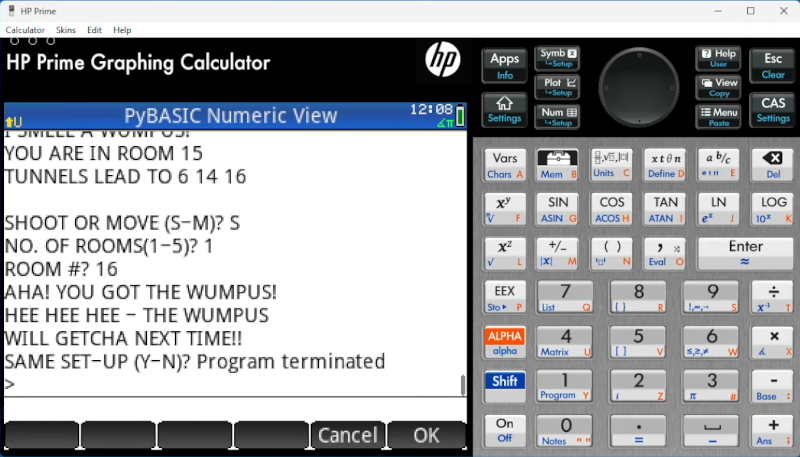
We are always amused that we can run emulations or virtual copies of yesterday’s computers on our modern computers. In fact, there is so much power at your command now that you can run, say, a DOS emulator on a Windows virtual machine under Linux, even though the resulting DOS prompt would probably still perform better than an old 4.77 MHz PC. Remember when you could get calculators that ran BASIC? Well, [Calculator Clique] shows off BASIC running on a decidedly modern HP Prime calculator. The trick? It’s running under Python. Check it out in the video below.
Think about it. The HP Prime has an ARM processor inside. In addition to its normal programming system, it has Micropython as an option. So that’s one interpreter. Then PyBasic has a nice classic Basic interpreter that runs on Python. We’ve even ported it to one or two of the Hackaday Superconference badges.
If you have a Prime, this is a great way to make it even easier to belt out a simple algorithm. Of course, depending on your age, you might prefer to stick with Python. Fair enough, but don’t forget the many classic games available for Basic. Adventure and Hunt the Wumpus are two of the sample programs included.
It has been nearly three years now since Destiny maker (and Sony subsidiary) Bungie formally announced a revival of the storied Marathon FPS franchise. And it has been about seven months since the game's originally announced release date of September 23, 2025, was pushed back indefinitely after a reportedly poor response to the game's first Alpha test.
But today, in a post on the PlayStation Blog, Bungie revealed that the new Marathon would finally be hitting PS5, Windows, and Xbox Series X|S on March 5, narrowing down the monthlong March release window announced back in December.
Today's preorder trailer revealing the Marathon release date.
Unlike Destiny 2, which transitioned to a free-to-play model in 2019, the new Marathon sells a Standard Edition for $40 or a $60 Deluxe Edition that includes some digital rewards and cosmetics. That mirrors the pricing of the somewhat similar Arc Raiders, which recently hit 12 million sales in less than 12 weeks.

 Login
Login