Reading view

There are new articles available, click to refresh the page.

Binance Plans to Reintroduce Stock Trading Four Years After Removal

Binance is exploring plans to bring back stock trading on its platform four years after discontinuing the feature, according to a report from The Information.

The world’s largest crypto exchange removed stock tokens in 2021 amid regulatory scrutiny, but now appears ready to re-enter equity markets as competitors push toward unified investment platforms.

The timing aligns with a broader industry shift toward “everything exchanges” that combine crypto and traditional assets under a single platform.

Coinbase began rolling out stock trading to select users earlier this month while positioning itself against traditional brokerages and rival Robinhood, which has offered blended stock and crypto trading for years.

JUST IN: Binance considers bringing back stock trading, The Information reports.

— Watcher.Guru (@WatcherGuru) January 23, 2026

Exchanges Race to Build Unified Platforms

Binance’s potential return to stock trading comes as multiple crypto platforms accelerate efforts to merge digital assets with conventional financial products.

Coinbase CEO Brian Armstrong defended his company’s push into equities in a recent Fortune interview, arguing the exchange is positioned to lead as financial assets migrate to blockchain infrastructure.

We have deep crypto expertise. We have the most trusted brand in crypto,” Armstrong said, adding that Coinbase aims to bridge traditional finance and crypto while advancing tokenized equities.

The exchange currently offers stocks through Apex Fintech Solutions with plans to expand access to all customers in the coming weeks, though fully tokenized equities remain years away pending SEC coordination.

Austria’s Bitpanda also announced Wednesday it will launch a unified investing platform on January 29, bringing stocks, ETFs, crypto, and precious metals together under one app.

The expanded platform will offer more than 10,000 stocks and ETFs at a flat €1 trading fee with zero custody fees and no payment for order flow.

Infrastructure Moves Toward On-Chain Markets

Traditional market operators are also simultaneously advancing blockchain-based trading systems.

Earlier this week, the New York Stock Exchange unveiled plans to develop a platform for 24/7 trading and on-chain settlement of tokenized securities, combining its Pillar matching engine with blockchain-based post-trade systems across multiple blockchains.

For more than two centuries, the NYSE has transformed the way markets operate,” said Lynn Martin, President of NYSE Group.

She said the exchange is now leading the industry toward fully on-chain solutions that combine trust, regulatory rigor, and modern technology.

Yesterday, January 22, Binance founder Changpeng “CZ” Zhao also told a World Economic Forum panel in Davos that he is negotiating with over a dozen governments to tokenize state-owned assets as the next major step in crypto adoption.

🚀 Binance’s @cz_binance confirms talks with governments to tokenize national assets on-chain, calling it the next phase after exchanges and stablecoins. #Crypto #Tokenizationhttps://t.co/1mv1mt5WwR

— Cryptonews.com (@cryptonews) January 22, 2026

Zhao positioned tokenization as the third stage following exchanges and stablecoins, explaining that governments want to directly capture financial upside from their own assets rather than outsourcing value creation to private intermediaries.

Regulatory Clarity Fuels Institutional Momentum

Last month, the Securities and Exchange Commission (SEC) issued a rare no-action letter to the Depository Trust and Clearing Corporation, allowing it to proceed with a controlled tokenization program covering U.S. Treasuries, ETFs, and Russell 1000 equities.

The service is scheduled to launch in late 2026 and will operate on approved blockchains with tokenized assets carrying the same legal rights as traditional securities.

Market data and institutional research suggest this regulatory momentum is already translating into measurable growth.

Earlier this month, venture capital firm Andreessen Horowitz identified stablecoins, real-world asset tokenization, and privacy infrastructure as key forces shaping crypto in 2026.

These assertions come as monthly transfer volumes for tokenized equities are down roughly 17% over 30 days to about $2.05 billion, according to rwa.xyz.

However, the number of Monthly Active Addresses is up nearly 98%, with over 98,167 addresses active in the past month alone.
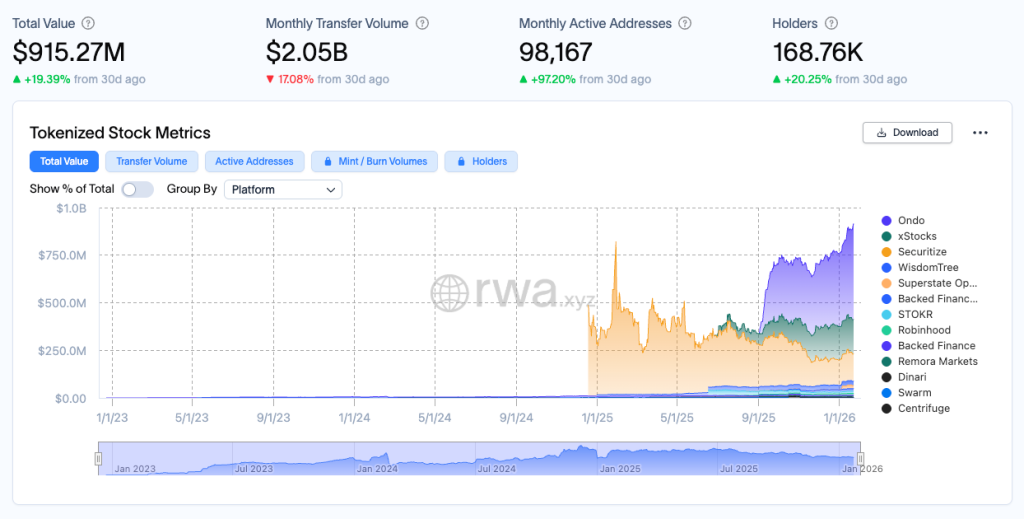
Binance Stock Trading - Tokenized Stock Metrics Chart RWA.xyz
Source: RWA.xyz

David Duong, Coinbase’s head of investment research, also recently said regulatory clarity improvements and deepening institutional participation are creating favorable conditions ahead.

We expect these forces to compound in 2026 as ETF approval timelines compress, stablecoins take a larger role in delivery-vs-payment structures, and tokenized collateral is recognized more broadly,” Duong wrote in a year-end outlook.

Meanwhile, Binance confirmed today that it submitted a Markets in Crypto-Assets license application in Greece as crypto firms across Europe rush to secure regulatory approval before June 2026 transitional deadlines expire.

The post Binance Plans to Reintroduce Stock Trading Four Years After Removal appeared first on Cryptonews.

Binance Leads Push To Offer Tokenized US Stocks Outside Traditional Markets

Major cryptocurrency exchanges are reportedly positioning to bring tokenized stock trading onto the blockchain, signaling a renewed push to merge traditional financial markets with digital assets. 

According to a report published Friday by The Information, platforms such as Binance are exploring ways to offer crypto tokens that track publicly listed US companies, effectively creating new channels for equity exposure through tokenized instruments.

Binance And OKX Explore Tokenized Stocks

The report says Binance is considering reintroducing stock tokens to its platform, several years after pulling similar products in 2021 amid regulatory uncertainty. 

The plan, cited by a person familiar with the matter, reflects a broader shift within the industry as exchanges revisit tokenized equities under evolving market and compliance frameworks. 

OKX is also said to be evaluating the possibility of offering tokenized stocks, according to Haider Rafique, the company’s global managing partner and chief marketing officer.

Binance has framed the move as part of its long-term strategy to connect traditional finance with the crypto ecosystem. In a statement to CoinDesk, a Binance spokesperson said the exchange is focused on expanding user choice while maintaining strict regulatory standards. 

The company noted that it began supporting tokenized real-world assets (RWAs) last year and recently launched what it described as the first regulated traditional finance perpetual contracts settled in stablecoins. 

Exploring tokenized equities, the spokesperson said, is a natural progression as Binance continues to build infrastructure, collaborate with established financial institutions, and develop new products for users and the wider industry.

Binance and OKX are not alone in this effort. Several major crypto firms, including Robinhood (HOOD), Gemini (GEMI), and Kraken, have already rolled out tokenized stock offerings in Europe. Meanwhile, Robinhood and blockchain startup Dinari are seeking regulatory approval to introduce similar products in the United States.

Tokenized Shares Gain Increased Interest

Robinhood took a significant step in June of last year when it launched trading in tokens linked to publicly listed companies and announced plans to expand into tokenized shares of private firms. 

As part of the rollout, the company distributed tokens pegged to OpenAI. According to Robinhood’s terms and conditions, those tokens function as derivative contracts backed by the firm’s ownership of fund units in a special-purpose vehicle that holds OpenAI convertible notes. 

Coinbase (COIN), on the other hand, is reportedly in discussions with the US Securities and Exchange Commission (SEC) about launching tokenized securities that would grant investors the same legal rights and benefits as conventional shares

Several issuers involved in the space say they are closely adhering to established rules around securities law, anti-money laundering requirements, bankruptcy protections, and investor safeguards.

Industry leaders argue that, when structured properly, tokenization can strengthen rather than weaken investor protections. Ian De Bode, chief strategy officer at Ondo Finance, said that a careful approach to tokenized securities can enhance safeguards while unlocking efficiencies that traditional markets struggle to achieve.

Binance

Featured image from OpenArt, chart from TradingView.com 

Asset Manager F/m Seeks SEC Approval to Tokenize Treasury ETF Shares

By: Amin Ayan

F/m Investments has asked the United States Securities and Exchange Commission to allow it to tokenize shares of its flagship Treasury exchange-traded fund.

Key Takeaways:

  • F/m wants SEC approval to tokenize ownership of its $6B Treasury ETF.
  • Tokenized shares would be identical to existing ETF shares, not a new asset.
  • The move signals growing adoption of tokenization in regulated funds.

The $18 billion asset manager filed an application on Wednesday seeking exemptive relief that would permit ownership records for the F/m US Treasury 3 Month Bill ETF (TBIL) to be maintained on a permissioned blockchain.

The fund, which holds roughly $6 billion in assets, would continue to operate as a conventional ETF regulated under the Investment Company Act of 1940.

F/m Calls Proposal First-of-Its-Kind Bid to Tokenize ETF Shares

In a press release announcing the filing, F/m described the proposal as the first attempt by an ETF issuer to obtain US regulatory approval specifically for tokenized shares of a registered investment company.

Under the plan, blockchain-based shares would carry the same CUSIP identifier as existing TBIL shares and offer identical rights, fees, voting privileges and economic exposure.

According to the firm, the initiative is not intended to create a new digital asset. Instead, tokenization would function as an alternative method for recording ownership, alongside traditional book-entry systems used by brokerages and custodians.

The filing places F/m alongside a growing number of traditional asset managers experimenting with tokenization.

Franklin Templeton has already launched blockchain-enabled US government money market funds, moving share ownership records onchain while maintaining compliance with federal securities laws.

F/m’s proposal extends that model to a listed Treasury ETF, potentially expanding access to tokenized fixed-income products within regulated markets.

F/m Investments becomes first ETF issuer to file w/ SEC for tokenized ETF shares…

Would be for the F/m US Treasury 3 Month Bill ETF (TBIL).

"Tokenization is coming to securities markets whether we f #Bitcoin Macro hedge play heating up 💎 pic.twitter.com/vjJzL89iB8

— yusef crypto 🔝 (@yusefkassar) January 21, 2026

F/m also drew a sharp distinction between its approach and crypto-native instruments such as stablecoins or unregistered tokens.

The company emphasized that tokenized TBIL shares would remain subject to independent board oversight, daily portfolio disclosure, third-party custody and audits, as well as the investor protections embedded in the 1940 Act.

If approved, the structure would allow TBIL to trade through both traditional brokerage channels and digital-native, token-aware platforms using a single share class. F/m said the fund’s investment strategy and portfolio composition would remain unchanged.

NYSE’s Tokenization Push Signals Shift Beyond Pilot Projects

The application arrives as tokenization gains traction across financial markets.

Just days earlier, the New York Stock Exchange revealed plans for a new trading venue designed to support around-the-clock trading and onchain settlement of tokenized stocks and ETFs, underscoring the industry’s push beyond pilot projects toward broader adoption.

Market forecasts suggest the opportunity could be significant. Standard Chartered previously projected that tokenized real-world assets could reach a $2 trillion market capitalization by 2028.

In a recent research, Web3 digital property firm Animoca Brands said that tokenization of RWAs could unlock a $400 trillion traditional finance market.

Last month, Libeara, the blockchain infrastructure platform backed by Standard Chartered’s venture arm SC Ventures, rolled out a new tokenized gold investment fund in Singapore, bringing one of the world’s oldest safe-haven assets onto digital rails.

The fund, launched in partnership with FundBridge Capital, allows professional investors to gain exposure to gold through blockchain-based tokens issued on Libeara’s ledger.

The post Asset Manager F/m Seeks SEC Approval to Tokenize Treasury ETF Shares appeared first on Cryptonews.

Binance Founder CZ Confirms Government Talks to Tokenize National Assets On-Chain

Founder of Binance Changpeng “CZ” Zhao has stated that several governments are currently engaged in deliberations on tokenizing their assets on blockchain networks.

In a panel at the World Economic Forum in Davos, Zhao said that he is negotiating with over a dozen governments to tokenize their state-owned assets, as the next big step in crypto adoption after exchanges and stablecoins.

.@cz_binance on what’s working in crypto – and what’s next – at @wef Davos 🔥

What's proven at scale: exchanges & stablecoins.

The next frontier:
> State-level tokenization of assets
> Crypto as the invisible payment rail
> AI agents transacting autonomously, using crypto as… pic.twitter.com/PG3eoNBMRV

— YZi Labs (@yzilabs) January 22, 2026

Zhao positioned tokenization as the next stage of crypto adoption following what he characterized as the initial two industries that have already been put to the test on a global scale: exchanges and stablecoins.

Tokenization Shifts Upstream as Governments Target Liquidity and Control

CZ noted that most other crypto sectors remain comparatively small or experimental.

Tokenization, however, is now being approached by governments as a way to directly capture financial upside from their own assets, rather than outsourcing value creation to private intermediaries.

He explained that governments want to tokenize large asset bases, realize gains earlier through improved liquidity and market access, and reinvest those proceeds into domestic market development and infrastructure.

The discussion places state-led tokenization in a different category from earlier private-sector efforts to tokenize real-world assets.

National assets such as government bonds, commodities like oil or gold, and public real estate can be represented as blockchain-based tokens that enable fractional ownership, continuous trading, faster settlement and automated payments through smart contracts.

For governments, this structure also offers transparency and direct control over issuance and distribution, while keeping financial returns within the public sector.

Zhao’s comments come as several countries and financial institutions are already moving in this direction.

Pakistan’s finance ministry announced plans this month to tokenize up to $2 billion in domestic sovereign debt as part of a broader effort to modernize public debt markets and attract retail participation.

In Europe, the DLT Pilot Regime of the European Union already offers a regulatory framework to trade and settle tokenized securities, and the UK already appoint a dedicated official to support the country’s transition to blockchain-based financial infrastructure.

🇬🇧 UK appoints digital lead to coordinate financial market tokenization, signaling institutional interest in blockchain-based infrastructure.#uk #tokenizationhttps://t.co/SAU9U8go3N

— Cryptonews.com (@cryptonews) October 8, 2025

Tokenization Gains Ground as NYSE and DTCC Move Forward

Traditional market infrastructure is also gaining steam with the NYSE on January 19 confirming that it is in the process of building a platform to facilitate the trade of tokenized stocks and exchange-traded funds with 24/7 trading and on-chain settlement, pending regulatory approval.

Zhao publicly welcomed the move, calling it bullish for crypto and exchanges.

This is bullish for crypto, and crypto exchanges. https://t.co/zqCOlbBW7V

— CZ 🔶 BNB (@cz_binance) January 19, 2026

Regulatory signals in the United States have also shifted as the Securities and Exchange Commission In December issued a rare no-action letter to the Depository Trust and Clearing Corporation, allowing it to proceed with a controlled tokenization program covering US Treasuries, ETFs and Russell 1000 equities.

👨🏻‍⚖️ The SEC has given a key green light to the Depository Trust and Clearing Corporation’s (DTCC) push into blockchain-based markets. #SEC #Cryptohttps://t.co/LOvN1BzjZ1

— Cryptonews.com (@cryptonews) December 12, 2025

The service is scheduled to launch in late 2026 and will operate on approved blockchains, with the DTCC emphasizing that tokenized assets will carry the same legal rights and investor protections as traditional securities.

Zhao also linked the rise of tokenization to other structural trends as he highlighted payments as another area where crypto is already functioning at scale, particularly through stablecoins.

He further noted that the next stage would be “invisible payments,” where users transact in fiat while crypto rails operate in the background.

Market data suggests tokenization is already gaining traction as tokenized gold products added nearly $2.8 billion in net value in 2025, with total market capitalization rising 177% year over year and trading volumes reaching levels comparable to major global gold investment vehicles.

Analysts see this as evidence that on-chain markets are beginning to absorb liquidity that traditionally flowed through conventional financial products.

The post Binance Founder CZ Confirms Government Talks to Tokenize National Assets On-Chain appeared first on Cryptonews.

Coinbase CEO Calls 4 Billion People “Unbrokered” and Wants to Fix It

Coinbase CEO Brian Armstrong unveiled a sweeping vision to democratize global capital markets through blockchain tokenization, targeting roughly 4 billion adults worldwide who lack access to equity and bond investments despite the accelerating divergence between capital and labor income growth.

The exchange published a comprehensive policy paper titled “From the Unbanked to the Unbrokered: Unlocking Wealth Creation for the World,” arguing that technological barriers and cost structures have systematically excluded two-thirds of the global adult population from wealth-building opportunities.

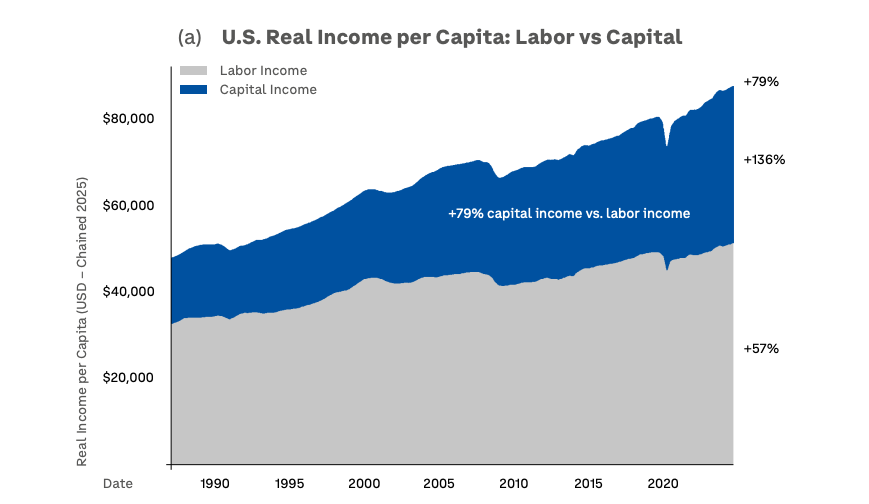
In the United States, labor income has grown by 57% since 1987, while capital income has surged by 136%, creating what Armstrong describes as a structural impediment to broad-based prosperity.

Source: Coinbase

Capital Chasm Widens Across Geographic Lines

The paper identifies participation in capital markets as fundamentally determined by wealth and geography rather than merit or savings discipline.

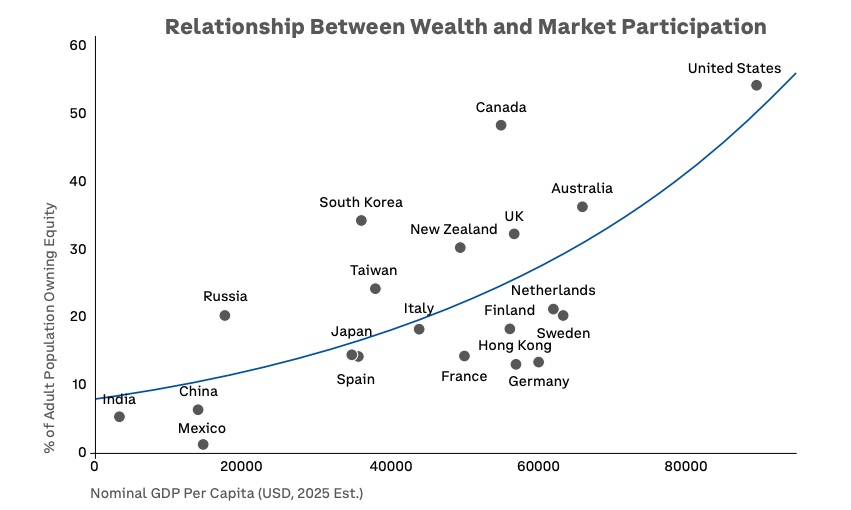
Roughly 4 billion adults do not participate in equity and bond markets, with engagement rates ranging from 55-60% in the United States to below 10% in China and India.

Source: Coinbase

I think about a talented worker in Lagos or Jakarta who has the drive and ability to build a better life for themselves and their family—but who faces near-total exclusion from the same capital markets available to a wealthy investor in New York,” Armstrong wrote, emphasizing that geography rather than ability determines who gets access.

Beyond national participation rates, the research highlights severe home bias among existing investors.

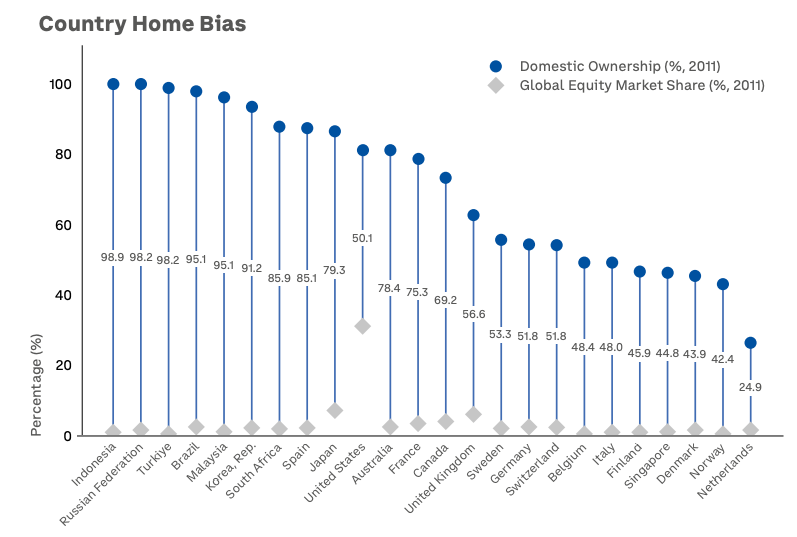
Data shows domestic equity holdings far exceeding countries’ share of global market capitalization, with investors in Indonesia, Russia, and Turkey allocating over 95% of portfolios to local markets despite representing fractions of global equity value.

Source: Coinbase

Tokenization as an Infrastructure Solution

The policy blueprint positions blockchain-based tokenization as the primary mechanism to collapse legacy cost structures that price out small savers.

Traditional financial infrastructure operates on fixed compliance costs, custody fees, settlement delays, and minimum account thresholds that render participation uneconomic for anyone below certain wealth levels.

According to the paper, recent studies estimate that tokenized equity trading could reduce investor transaction costs by more than 30%, with efficiency gains expanding over time as atomic settlement eliminates multi-day reconciliation cycles.

Permissioned systems inevitably replicate existing power dynamics, allowing infrastructure owners to limit competition,” Armstrong wrote, comparing blockchain protocols to TCP/IP internet infrastructure that enables open innovation without gatekeeping.

Policy Roadmap Targets Regulatory Coordination

Coinbase outlined five policy pillars necessary to realize tokenized capital markets at scale.

The recommendations particularly prioritize base-layer neutrality, treating blockchain protocols as impartial infrastructure where compliance is concentrated at the application layers rather than at the protocol level.

The five policy pillars include:

  • Uphold base-layer neutrality with compliance at application layers
  • Create clear pathways for tokenizing traditional assets
  • Foster integration with traditional finance institutions
  • Recognize self-custody rights with blockchain transparency oversight
  • Modernize safeguards through exchange controls rather than wallet bans

Modern blockchain analytics tools enable the detection and tracing of suspicious patterns with unprecedented precision, challenging historical assumptions that bearer instruments inherently facilitate illicit finance.

Everything Exchange Strategy Takes Shape

Armstrong defines success as a small saver anywhere on earth being able to convert spare earnings into fractional ownership of productive global assets as easily as sending a text message.

When a farmer in a country without a functional stock exchange can own shares in the same companies as a hedge fund manager in New York, both on the same neutral infrastructure at basis-point costs, then the capital chasm will have truly narrowed,” he wrote.

The policy release comes as Coinbase began rolling out traditional stock trading to select users, positioning the exchange to compete directly with Robinhood, Charles Schwab, and Fidelity.

🚀 Coinbase rolls out stock trading to select users as CEO Brian Armstrong pursues "everything exchange" vision combining crypto and traditional equities.#Coinbase #Stockhttps://t.co/hTsBWCELvu

— Cryptonews.com (@cryptonews) January 16, 2026

Earlier this month, Armstrong outlined three 2026 priorities, including building an “everything exchange” globally across crypto, equities, prediction markets, and commodities, scaling stablecoins and payments, and bringing users on-chain through the Base blockchain.

Goal is to make Coinbase the #1 financial app in the world,” he posted. The exchange currently offers stocks through conventional methods using Apex Fintech Solutions, with plans to expand access to all customers within weeks.

David Duong, Coinbase’s head of investment research, also said regulatory clarity improvements and deepening institutional participation create favorable conditions ahead.

We expect these forces to compound in 2026 as ETF approval timelines compress, stablecoins take a larger role in delivery-vs-payment structures, and tokenized collateral is recognized more broadly,” Duong wrote, as Armstrong projected up to 10% of global GDP could run on crypto rails by decade’s end.

The post Coinbase CEO Calls 4 Billion People “Unbrokered” and Wants to Fix It appeared first on Cryptonews.

Why Gold Ownership Still Feels Exclusive And How Tokenization Changes That

The secret that’s unlocking gold for everyone

Remember the first time you thought about buying gold? Maybe you imagined walking into a vault, handling heavy bars, or worrying about where to safely store them. For most people worldwide, owning physical gold has always felt like something reserved for the wealthy or those with access to specialized facilities. The barriers seemed too high, the risks too great, and the process too complicated.

But what if I told you that technology is completely changing this centuries-old story?

Gold Tokenization
How Tokenization Changes That

The Traditional Gold Ownership Problem

Let’s be honest: physical gold ownership has never been truly accessible to everyone. You need significant capital to buy meaningful amounts, secure storage facilities that cost money, insurance policies that add up, and constant worry about theft or loss. Even if you manage to acquire gold, selling it quickly when you need cash involves finding buyers, verifying authenticity, and dealing with dealers who take their cut.

These aren’t small inconveniences. They’re genuine barriers that have kept millions of people from participating in one of history’s most reliable stores of value.

Enter Gold Tokenization: Breaking Down the Walls

This is where gold tokenization transforms everything you thought you knew about gold investment.

Imagine owning a fraction of a gold bar, stored securely in a vault, without ever touching it. Imagine buying or selling that gold with a few clicks on your phone, 24/7, without visiting a dealer. Imagine having complete transparency about your holdings through blockchain technology that can’t be manipulated.

That’s exactly what gold tokenization service platforms are making possible today.

Gold tokenization converts physical gold into digital tokens on a blockchain. Each token represents actual gold stored in certified vaults, giving you real ownership without the traditional headaches. Think of it as owning shares in gold, except these digital certificates are secured by cutting-edge technology that makes fraud nearly impossible.

How Modern Gold Investment Models Work

The benefits of tokenized gold over physical gold become crystal clear when you see how it actually works:

You can start with minimal amounts (whether it’s $10 equivalent in your local currency), buying fractional ownership that would be impossible with physical bars. Your gold-backed tokens live in a digital wallet, accessible anytime, anywhere. No storage fees are eating into your returns, no insurance premiums to maintain, and no anxiety about security.

When you need liquidity, you simply sell your tokens on digital platforms, often within minutes. Compare that to calling multiple dealers, scheduling appointments, and waiting days for payments with physical gold. Blockchain solutions for gold investment have created a transparent system where every transaction is recorded permanently. You can verify your gold’s existence, its purity, and even track its custody history. This level of transparency was unthinkable in traditional gold markets.

Real Benefits That Matter to You

Let me break down what this actually means for your investment strategy:

Accessibility is no longer a barrier: Whether you’re a student saving small amounts monthly or an investor diversifying your portfolio, gold ownership is now within reach regardless of where you live. The exclusivity that kept gold in the hands of the privileged is disappearing.

Liquidity becomes your advantage: Need emergency funds? Sell your gold-backed tokens instantly instead of scrambling to find buyers for physical gold. The digital marketplace operates continuously, giving you control when you need it most.

Diversification gets easier: You can spread small investments across different gold products, storage locations, or even combine gold with other tokenized assets, creating a balanced portfolio that was once only available to institutional investors.

Security improves dramatically: No more worrying about break-ins or natural disasters destroying your physical holdings. Your gold sits in professional vaults while your digital proof of ownership is secured by blockchain technology.

The Future of Gold Investment with Tokenization

We’re witnessing the early stages of a fundamental shift. The future of gold investment with tokenization isn’t just about making things easier; it’s about democratizing wealth preservation. Traditional financial institutions worldwide are taking notice. Banks and investment firms across different regions are launching their own gold tokenization services. Regulations are evolving globally to protect investors while encouraging innovation. The infrastructure is being built for a world where physical and digital gold ownership coexist seamlessly.

Young investors who grew up with cryptocurrency find tokenized gold familiar yet stable. It combines the security of precious metals with the convenience of digital assets. For older generations, it removes the physical burden while maintaining the fundamental value they’ve always trusted in gold.

Your Next Step Toward Accessible Gold Ownership

The exclusivity of gold ownership is ending. Technology has opened doors that were previously locked to most people. Whether you’re looking to preserve wealth, hedge against economic uncertainty, or simply diversify your investments, tokenized gold offers a practical path forward. The question isn’t whether you can afford to own gold anymore. The question is: are you ready to embrace this new way of investing?

Gold tokenization isn’t replacing traditional gold; it’s expanding access to it. The barriers that once kept you out are crumbling. The vaults that seemed unreachable are now as close as your smartphone.

To understand the complete landscape of this revolutionary approach and make informed decisions about your investment future, read the full gold tokenization guide and discover how you can start your journey toward accessible, secure gold ownership today.


Why Gold Ownership Still Feels Exclusive And How Tokenization Changes That was originally published in Coinmonks on Medium, where people are continuing the conversation by highlighting and responding to this story.

NYSE Unveils Blockchain Platform For 24/7 Stock Trading – What You Need To Know

On Monday, the New York Stock Exchange (NYSE) unveiled its latest plan to develop a tokenized securities platform, utilizing blockchain technology to facilitate 24/7 stock trading, now seeking regulatory approval.

New Digital Trading Venue At NYSE

According to Monday’s announcement, the proposed digital platform will offer a tokenized trading experience that includes around-the-clock operations, instant settlements, dollar-sized orders, and stablecoin (dollar-pegged cryptocurrencies) funding options. 

By integrating the NYSE’s “advanced Pillar matching engine” with blockchain-based post-trade systems, the firm disclosed that the new platform will support multiple chains for settlement and custody, streamlining the trading process significantly.

Once regulatory approvals are secured, this platform will reportedly create a new venue at the NYSE for trading tokenized shares. These shares will not only be fungible with traditional securities but will also comprise tokens that are issued natively as digital assets. 

Interestingly, tokenized shareholders will retain their rights, including eligibility for dividends and participation in company governance, much like traditional shareholders. The trading venue aims to align with established market structure principles and will provide non-discriminatory access to all qualified broker-dealers.

The launch of this tokenized securities platform is part of the Intercontinental Exchange’s (ICE) broader digital strategy, which includes preparing its clearing infrastructure for continuous trading and potentially integrating tokenized collateral. 

Competition Heats Up

ICE is collaborating with major financial institutions like BNY Mellon and Citigroup to facilitate tokenized deposits across its clearinghouses. This effort will help clearing members manage funds and fulfill margin requirements outside of regular banking hours.

Lynn Martin, President of NYSE Group, emphasized the significance and innovation surrounding this development, stating: 

For more than two centuries, the NYSE has transformed the way markets operate. We are leading the industry toward fully on-chain solutions grounded in unmatched protections and high regulatory standards.

The company’s President further stated that the New York Stock Exchange aims to combine trust with “state-of-the-art technology,” effectively reinventing market infrastructure to meet the evolving demands of a digital future.

Michael Blaugrund, Vice President of Strategic Initiatives at the Intercontinental Exchange, echoed Martin’s sentiment, noting: 

Since its founding, ICE has propelled markets from analog to digital. Supporting tokenized securities is a pivotal step in our strategy to operate on-chain market infrastructure for trading, settlement, custody, and capital formation in the new era of global finance.

In parallel to these developments, the NYSE’s main competitor, Nasdaq, along with the CME Group, has intensified efforts to provide institutional investors with a regulated mechanism to measure cryptocurrency markets. 

They recently reintroduced the Nasdaq Crypto Index, renamed as the Nasdaq-CME Crypto Index (NCI), designed to support products such as exchange-traded funds (ETFs) and structured funds. This move aims to establish clearer rules and governance for index-based cryptocurrency exposure.

NYSE

Featured image from DALL-E, chart from TradingView.com 

NYSE Moves Toward On-chain Markets With Tokenized Securities Platform

The New York Stock Exchange (NYSE), part of Intercontinental Exchange (ICE), has unveiled plans to develop a platform for trading and on-chain settlement of tokenized securities, marking a step toward digitizing core market infrastructure.

The exchange said it will seek regulatory approvals before launching the platform, which is designed to support tokenized trading alongside traditional securities markets.

A Platform Built for 24/7 Tokenized Trading

NYSE’s proposed digital platform is designed to allow continuous 24/7 trading with near-instant settlement, orders denominated in dollar amounts, and stablecoin-based funding.

The architecture combines the exchange’s Pillar matching engine with blockchain-based post-trade systems, allowing settlement and custody across multiple blockchains.

Subject to regulatory clearance, the platform will be part of a new NYSE venue supporting both tokenized shares that are fungible with traditionally issued securities and tokens natively issued as digital securities. Tokenized shareholders would retain the same economic and governance rights as conventional shareholders, including dividends and voting rights.

Market Structure and Regulatory Alignment

NYSE said the venue has been designed to align with established principles of market structure, including non-discriminatory access for all qualified broker-dealers.

This approach shows the exchange’s intention to integrate tokenization within existing regulatory and operational frameworks rather than positioning it as a parallel, lightly regulated market.

By adding tokenized securities into a familiar exchange model, NYSE seems to combine blockchain efficiencies with the protections and standards expected of a regulated U.S. exchange.

Tokenization as Part of ICE’s Broader Digital Strategy

The initiative forms part of ICE’s wider digital asset strategy, which includes preparing its clearing infrastructure to support round-the-clock trading and the potential use of tokenized collateral. ICE is working with banks, including BNY and Citi, to support tokenized deposits across its clearinghouses.

These efforts are intended to help clearing members manage funding outside traditional banking hours, meet margin requirements more efficiently, and operate across jurisdictions and time zones with fewer frictions.

Industry Leaders Indicate a Shift to On-chain Infrastructure

“For more than two centuries, the NYSE has transformed the way markets operate,” said Lynn Martin, President of NYSE Group. She said the exchange is now leading the industry toward fully on-chain solutions that combine trust, regulatory rigor, and modern technology.

Michael Blaugrund, Vice President of Strategic Initiatives at ICE, describes tokenized securities as a major step toward operating fully on-chain market infrastructure spanning trading, settlement, custody, and capital formation.

Currently ICE operates six clearinghouses globally—including the world’s largest energy clearinghouse and the largest for credit default swaps—has positioned the move as a continuation of its long-running push to modernize global financial markets for a digital era.

NYSE Owner ICE in Talks to Invest in MoonPay

In December, it emerged ICE was negotiating an investment in crypto payments firm MoonPay as part of a funding round that could value the company at approximately $5 billion.

🚀 NYSE owner ICE in talks to invest in MoonPay at $5B valuation as crypto payments firm expands custody services with NY approval.#NYSE #ICEhttps://t.co/8ADQ3tuJJr

— Cryptonews.com (@cryptonews) December 18, 2025

The post NYSE Moves Toward On-chain Markets With Tokenized Securities Platform appeared first on Cryptonews.

Coinbase Says ‘No’ to CLARITY Act, Citing Crypto Restrictions

Bitcoin Magazine

Coinbase Says ‘No’ to CLARITY Act, Citing Crypto Restrictions

Coinbase CEO Brian Armstrong said the exchange cannot support the Senate Banking Committee’s latest draft of the CLARITY Act, warning that the bill, as written, would leave the U.S. crypto industry worse off than the current regulatory status quo.

In a post on X, Armstrong cited several concerns, including what he described as a de facto ban on tokenized equities, new restrictions on decentralized finance that could grant the government broad access to users’ financial data, and provisions that weaken the Commodity Futures Trading Commission while expanding the Securities and Exchange Commission’s authority.

“After reviewing the Senate Banking draft text over the last 48hrs, Coinbase unfortunately can’t support the bill as written,” Armstrong posted.

He also criticized draft amendments that would eliminate rewards on stablecoins, arguing they would allow banks to suppress emerging competitors.

“We’d rather have no bill than a bad bill,” Armstrong said on X, adding that Coinbase would continue pushing for a framework that treats crypto on a level playing field with traditional financial services.

BREAKING: Coinbase CEO Brian Armstrong says Coinbase "can't support" the crypto market structure legislation as currently written 👀

"We'd rather have no bill than a bad bill." pic.twitter.com/3BCgWw0kM9

— Bitcoin Magazine (@BitcoinMagazine) January 14, 2026

The comments come a day before the Senate Banking Committee is expected to mark up the CLARITY Act on Thursday, January 15. 

The legislation is trying to clarify U.S. digital asset market structure by defining categories such as digital commodities, investment contracts, and payment stablecoins, while dividing oversight between the SEC and CFTC.

Coinbase’ issues with stablecoin rewards

Stablecoin rewards have emerged as a flashpoint in negotiations. Coinbase had reportedly warned lawmakers it may withdraw support for the bill if it restricts yield programs tied to stablecoins like USD Coin. 

Coinbase shares in interest income generated from USDC reserves and uses part of that revenue to offer incentives to users, including rewards of roughly 3.5% for Coinbase One customers.

Stablecoin-related revenue may have reached $1.3 billion in 2025, making the issue central to Coinbase’s business model. 

Banking groups argue that yield-bearing stablecoins could draw deposits away from traditional banks, while crypto firms counter that banning rewards would stifle innovation and push users toward offshore platforms.

“I’m actually quite optimistic that we will get to the right outcome with continued effort,” Armstrong later posted on X. “We will keep showing up and working with everyone to get there.”

Michael Saylor, executive chairman of Strategy, retweeted Armstrong’s post, showing his own support with the decision. 

This post Coinbase Says ‘No’ to CLARITY Act, Citing Crypto Restrictions first appeared on Bitcoin Magazine and is written by Micah Zimmerman.

Coinbase is About to Launch Prediction Markets and Tokenized Stocks: Report

Bitcoin Magazine

Coinbase is About to Launch Prediction Markets and Tokenized Stocks: Report

Coinbase is reportedly preparing to launch its own prediction markets, powered by U.S.-based operator Kalshi, in a move that could expand the types of assets available on the exchange amid cooling investor interest in cryptocurrencies, according to reporting from Bloomberg and CNBC.

The announcement is expected to come next week, coinciding with Coinbase’s “Coinbase System Update” showcase on Dec. 17. While the exchange declined to confirm specifics, it encouraged users to tune into the livestream for updates.

Rumors of the new prediction markets have been circulating for nearly a month. In mid-November, tech researcher Jane Manchun Wong shared a screenshot of what appeared to be Coinbase’s prediction markets dashboard. 

The Information first reported the planned launch on Nov. 19, and Bloomberg later cited a source saying the event would also feature the rollout of tokenized stocks.

Coinbase as an ‘everything’ exchange

Coinbase’s moves align with CEO Brian Armstrong’s long-stated vision of building an “everything exchange” — a single platform offering access to crypto tokens, tokenized equities, and event-based contracts. 

Armstrong told investors in May that Coinbase aims to become a leading financial services app within the next decade.

The exchange is accelerating these initiatives amid rising competition from firms such as Robinhood, Gemini, and Kraken

Over the past year, these platforms have expanded tokenized stock offerings outside the U.S. and explored prediction markets, reflecting growing demand for alternative trading instruments.

The timing also comes as investor sentiment toward digital assets has cooled. A wave of liquidations in highly leveraged positions in mid-October triggered a crypto market pullback, prompting some investors to shift capital into safer assets. 

For Kalshi, the partnership marks another step in its strategy to integrate event contracts into mainstream trading platforms. 

Earlier this year, the company embedded its prediction markets into Robinhood, and it is reportedly in discussions with other brokers, including those in crypto, to expand its reach.

Prediction markets let users speculate on outcomes ranging from elections to sports games, and they have grown increasingly popular over the past year. Traditional exchanges and crypto platforms alike are now exploring them as a new way to engage traders. 

Gemini recently received approval to roll out its own prediction markets, while Crypto.com has partnered with the Trump Media & Technology Group on similar initiatives.

Coinbase’s planned in-house tokenized stock offerings would put it on par with competitors like Robinhood and Kraken, which currently offer similar products outside the U.S.

This post Coinbase is About to Launch Prediction Markets and Tokenized Stocks: Report first appeared on Bitcoin Magazine and is written by Micah Zimmerman.

❌