Reading view

There are new articles available, click to refresh the page.

Why MSCI’s Upcoming Decision on Bitcoin Treasury Companies Matters

By: Juan Galt

Bitcoin Magazine

Why MSCI’s Upcoming Decision on Bitcoin Treasury Companies Matters

In a move that could shape corporate Bitcoin adoption, index provider MSCI is set to decide whether to exclude companies holding significant Bitcoin reserves from its global benchmarks. The outcome, due January 15, may influence billions in forced selling and set precedents for how Wall Street views Bitcoin as a treasury asset.

MSCI Inc., a New York-based publicly traded company listed on the NYSE with a market capitalization of $43.76 billion and a stock price of $565.68 as of January 2, is a key player in the investment world. It curates over 246,000 equity indexes daily, with more than $18.3 trillion in assets under management benchmarked to them. These indices serve as blueprints for funds and portfolios, helping investors gain exposure to specific market segments.

Unlike the NASDAQ, which operates as both a stock exchange where companies list and trade and a composite index tracking those listings, MSCI focuses solely on index creation. The S&P 500, managed by S&P Dow Jones Indices, is similarly an index but targets the 500 largest U.S. companies by market cap. MSCI’s offerings, such as the MSCI World Index covering developed markets, provide broader global and thematic coverage, influencing trillions in investment decisions.

The issue began on October 10, 2025, when MSCI issued a consultation proposal to exclude companies with 50% or more of their assets in digital assets like Bitcoin or other cryptocurrencies from its Global Investable Market Indexes. The rationale: such firms operate more like funds than traditional businesses. The proposal named 39 companies, including Bitcoin holders like Strategy and Metaplanet. The announcement triggered an immediate market reaction, with Bitcoin experiencing a sharp intraday plunge of roughly $12,000 on the same day, marking the start of a broader price correction.

Broader awareness grew in late November 2025, when JPMorgan analysts highlighted the risks in a report, estimating $2.8 billion in outflows from Strategy alone and up to $8.8 billion if other index providers followed suit. This may have amplified selling pressure on affected stocks and contributed to Bitcoin’s ongoing pullback amid a broader market downturn. Estimates of total forced selling, if implemented, range from $10 billion to $15 billion over a year, per Bitcoin for Corporations (BFC) analysis.

The consultation period, open for stakeholder feedback, closed on December 31, 2025. BFC, a coalition accelerating corporate Bitcoin adoption, mobilized quickly. They launched a website detailing the proposal’s flaws, including a technical appendix outlining potential market impacts. BFC drafted a letter opposing the change, gathering over 1,500 signatures in two weeks and delivering it to MSCI on December 30. Eight of the 39 affected companies are BFC members.

After initial outreach, BFC held a call with MSCI’s head of research and leadership. “We had a very constructive conversation,” said George Mekhail, BFC’s executive director. “I think they were very much still in a listening and learning posture. I think a lot of this just really has to do with a lack of education and understanding of Bitcoin itself, as well as these Bitcoin treasury companies and the significance of their operating businesses.”

Mekhail noted the proposal appeared driven by genuine analytical concerns rather than malice, triggered by Metaplanet’s recent preferred share issuance, not Strategy’s larger holdings. A key gap: MSCI made no distinction between Bitcoin and other cryptocurrencies, treating all digital assets alike. This has fostered temporary alignment between Bitcoin advocates and the broader crypto sector in opposition, highlighting an ongoing education gap between the Bitcoin industry and Wall Street institutions.

Next, MSCI announces its decision on January 15, 2026. If approved, exclusions take effect February 1. Mekhail outlined three scenarios: implementation (worst case, forcing sales), a delay for further review (most likely, per his assessment), or full withdrawal (best case). Polymarket bettors currently give a 77% chance of Strategy’s delisting from MSCI by March 31.

Most financial fallout would hit Strategy, which holds the vast majority of affected Bitcoin treasuries. Founder Michael Saylor’s firm has engaged MSCI directly, issuing its own letter and working behind the scenes. Other opposition includes letters from Strive Asset Management and investor Bill Miller.

Industry pushback has been robust and visible, with no major groups publicly supporting the proposal. This asymmetry underscores Bitcoin’s organized, motivated constituency versus dispersed critics, echoing dynamics in recent political shifts like the 2024 U.S. election.

A withdrawal would boost corporate Bitcoin strategies; implementation could deter treasuries. As Mekhail put it, “The most bullish outcome is that they take it to heart and they withdraw the proposal.” The decision tests Wall Street’s adaptation to Bitcoin’s role in balance sheets.

Bitcoin Magazine is wholly owned by BTC Inc., which operates Bitcoin For Corporations, a platform focused on corporate adoption of Bitcoin. BFChas a variety of relationships with Bitcoin businesses, including some of those mentioned in this article. 

This post Why MSCI’s Upcoming Decision on Bitcoin Treasury Companies Matters first appeared on Bitcoin Magazine and is written by Juan Galt.

9 Ways MSCI’s Proposed Digital Asset Rule Could Undermine Index Neutrality

By: Nick Ward

Bitcoin Magazine

9 Ways MSCI’s Proposed Digital Asset Rule Could Undermine Index Neutrality

A major rule change is being considered by MSCI, one of the most influential index providers in global markets. If adopted, it would materially alter how public companies that hold digital assets—particularly Bitcoin—are classified and included in major equity indexes.

For companies, investors, asset managers, and anyone who depends on index-based benchmarks, this proposal raises fundamental questions about how markets define operating businesses and what role balance sheets should play in index eligibility.

Join the call for MSCI to withdraw its digital asset exclusion rule.

Here’s what’s at stake—and why it matters.

1. MSCI Is Proposing a New 50% Balance-Sheet Threshold

At the center of the proposal is a simple rule:

If digital assets make up 50% or more of a company’s total assets, that company would be excluded from MSCI’s Global Investable Market Indexes.

MSCI’s rationale is that crossing this threshold allegedly changes the company’s “primary business,” making it more fund-like rather than operational.

This single ratio would override all other indicators of what the company actually does.

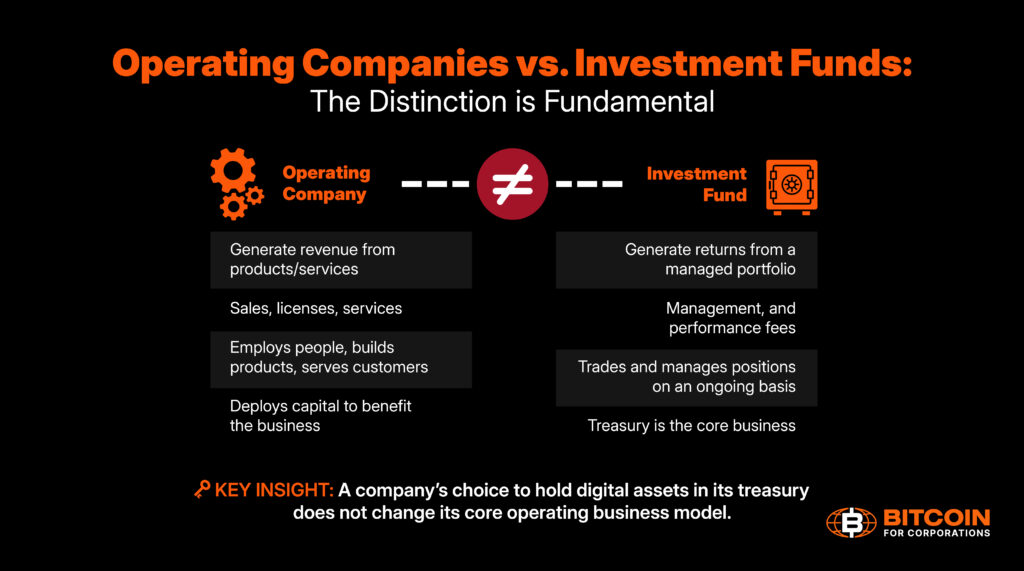
2. The Proposal Misclassifies Operating Companies as Investment Funds

The core objection is straightforward:
holding Bitcoin on a balance sheet does not transform an operating company into an investment fund.

  • Operating companies generate revenue from products and services
  • They employ people, invest in R&D, and serve customers
  • Treasury assets exist to support long-term capital strategy

By contrast, investment funds exist solely to manage portfolios for return.

Treating these two structures as equivalent—based on a balance-sheet ratio alone—collapses a distinction that has long been foundational to corporate and securities law.

If your organization relies on clear, fundamentals-based definitions of operating companies, this misclassification matters. Bitcoin For Corporations is asking MSCI to withdraw the proposal and engage on a more principled framework. You can add your name to the open letter here.

3. Treasury Strategy Does Not Redefine Core Business Activity

A company can change how it stores excess capital without changing what it does.

  • A manufacturer that holds cash remains a manufacturer
  • A software firm holding foreign currency remains a software firm
  • A company holding Bitcoin as treasury reserve remains an operating company

Treasury allocation is a capital management decision, not a change in business model.

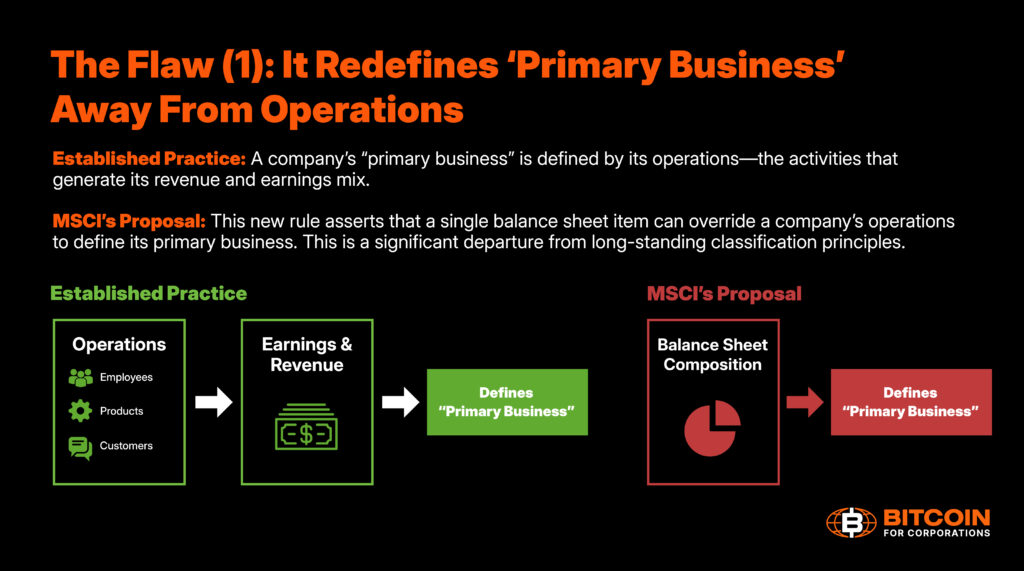
4. This Would Be a Radical Departure From Decades of Index Practice

Historically, index classification has been driven by operational reality, not asset composition alone.

Primary business determination has relied on:

  • Revenue sources
  • Earnings contribution
  • Ongoing commercial activity

This proposal replaces that holistic approach with a single market-price-driven metric on the asset side of the balance sheet—something never applied consistently across asset classes before.

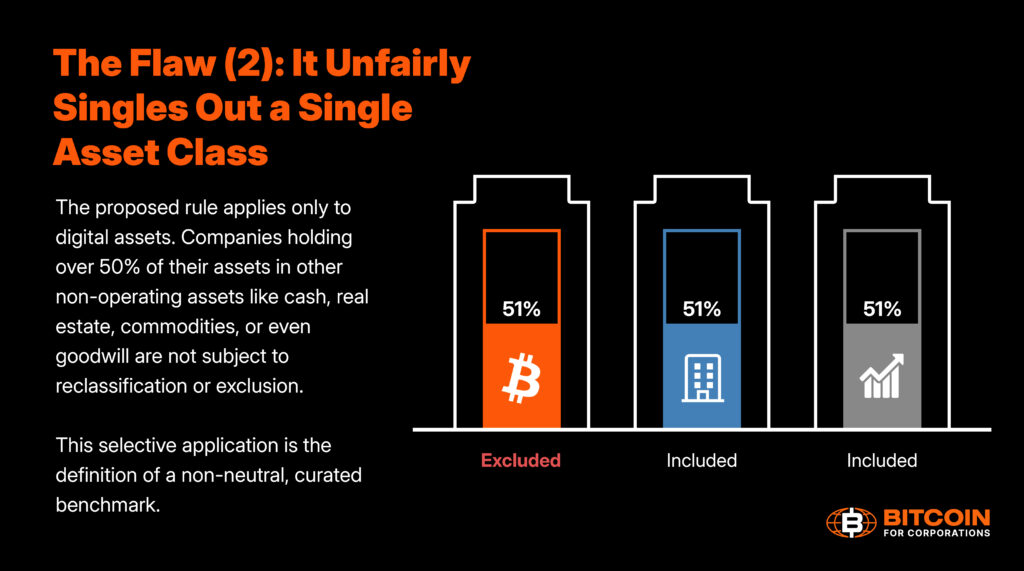
5. Digital Assets Are Being Singled Out—Uniquely

Under the proposal:

  • A company with 51% of assets in Bitcoin → excluded
  • A company with 51% in real estate → included
  • A company with 51% in equities or commodities → included

No equivalent rule exists for other treasury assets.

This lack of neutrality directly conflicts with the principles that global indexes are supposed to uphold.

6. The Proposal Conflicts With Core Index Principles

MSCI’s benchmarks are built on three foundational ideas:

  • Neutrality – no asset-class favoritism
  • Representativeness – reflecting real economic activity
  • Stability – avoiding unnecessary churn

A rule that reclassifies companies based on volatile market prices undermines all three.

7. The Rule Would Introduce Structural Instability Into Indexes

Consider a company with:

  • 45% of assets in digital form → eligible
  • No operational change
  • Normal market appreciation pushes it to 51%

Under the proposal, that company would suddenly be excluded—despite:

  • No change in revenue
  • No change in operations
  • No change in business strategy

This creates a scenario where companies could flip in and out of indexes purely due to price movement, forcing unnecessary rebalancing, costs, and tracking error for index-linked funds.

This kind of mechanical instability would impose real costs on index-tracking funds, issuers, and long-term investors—without improving market clarity. That’s why companies and market participants are urging MSCI to withdraw the proposal and revisit it with industry input. Join the call for MSCI to withdraw this rule proposal, and add your signature to the open letter here.

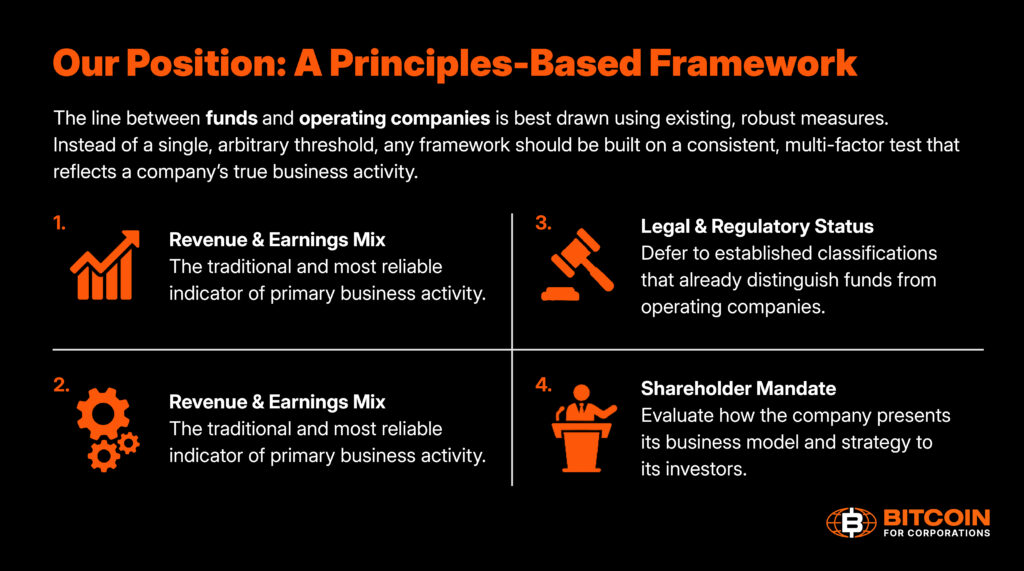
8. A More Robust Alternative Already Exists

The issue is not classification—it’s how classification is done.

A principles-based, multi-factor framework would evaluate:

  • Revenue and earnings mix
  • Legal and regulatory status
  • Core corporate activities (employees, R&D, capex)
  • Public disclosures and stated strategy

This approach reflects the entire business, not a single fluctuating ratio.

9. The Coalition’s Ask Is Clear and Constructive

Market participants are calling for a two-step solution:

  1. Withdraw the current proposal due to its structural flaws
  2. Engage with the market to develop a neutral, principles-based framework that preserves index integrity

The goal is not special treatment—but consistent treatment aligned with long-standing market norms.

Why This Matters

Indexes are not academic exercises. They:

  • Guide trillions of dollars in capital allocation
  • Shape passive investment flows
  • Influence cost of capital for public companies

If index rules become arbitrary, unstable, or asset-specific, they stop reflecting the real economy—and start distorting it.

Final Thought

If your organization depends on fundamentals-based equity benchmarks, this proposal affects you—whether or not you hold digital assets today.

Indexes only work when they remain neutral, stable, and grounded in operating reality. Market participants are asking MSCI to withdraw the proposed digital asset rule and work toward a principles-based alternative.If you or your organization depend on fair and consistent equity benchmarks, adding your signature to the open letter helps ensure those standards are preserved.

Index integrity relies on clear principles, not price-driven thresholds.

Engagement now helps ensure global benchmarks remain neutral, stable, and representative for everyone who relies on them.

Disclaimer: This content was prepared on behalf of Bitcoin For Corporations for informational purposes only. It reflects the author’s own analysis and opinion and should not be relied upon as investment advice. Nothing in this article constitutes an offer, invitation, or solicitation to purchase, sell, or subscribe for any security or financial product.

This post 9 Ways MSCI’s Proposed Digital Asset Rule Could Undermine Index Neutrality first appeared on Bitcoin Magazine and is written by Nick Ward.

Bitcoin Coalition Pushes Back Against MSCI Proposal Targeting Bitcoin-Heavy Companies

Bitcoin Magazine

Bitcoin Coalition Pushes Back Against MSCI Proposal Targeting Bitcoin-Heavy Companies

Bitcoin For Corporations (BFC), in coordination with its member companies, formally challenged MSCI’s proposed rule to exclude companies from the MSCI Global Investable Market Indexes if digital assets represent 50% or more of total assets. 

The rule would apply to companies whose primary business is classified as digital-asset treasury activity.

BFC argues the proposal misclassifies operating companies by prioritizing balance-sheet holdings over actual business operations.

“MSCI has long defined companies by what they do, not by what they hold. This proposal abandons that principle for a single asset class,” said George Mekhail, managing director of BFC. “A shareholder-approved treasury decision shouldn’t override that reality.”

The coalition identified three structural issues with the proposal. First, it redefines primary business based on asset composition rather than revenue-generating operations. Second, it singles out digital assets while other asset classes face no similar treatment. 

Third, it ties index inclusion to volatile market prices, creating unpredictable membership changes.

BFC warned that the proposal could lead to passive fund outflows, higher capital costs, and increased volatility for companies, all unrelated to operational performance. 

The group urged MSCI to withdraw the threshold, maintain an operations-based classification, ensure asset-class neutrality, and engage with market participants on a business-aligned framework.

1/ JUST IN: @BitcoinForCorps (BFC) is formally calling on MSCI to withdraw its proposed 50% digital-asset exclusion rule.

The proposal directly affects how operating companies are treated in global indexes.

Here's everything you need to know: 🧵👇 pic.twitter.com/mfBCML5AgW

— Bitcoin For Corporations (@BitcoinForCorps) December 8, 2025

Strive echoes the sentiment 

Strive Asset Management, co-founded by Vivek Ramaswamy, also formally urged MSCI last week to reconsider its proposal to exclude companies with bitcoin holdings exceeding 50% of total assets from major equity benchmarks. 

In a letter to MSCI CEO Henry Fernandez, Strive warned that the rule could produce inconsistent results due to differing accounting standards under U.S. GAAP and IFRS.

Strive, the 14th-largest corporate bitcoin holder with over 7,500 BTC, argued that the 50% threshold is “unjustified, overbroad, and unworkable.” Its executives highlighted that many bitcoin treasury companies operate real businesses in sectors such as AI data centers, structured finance, and cloud infrastructure. 

They compared the proposed treatment of bitcoin to other assets, noting that energy companies with large oil reserves or gold miners are not excluded from indexes.

The firm also cited market volatility, derivatives exposure, and accounting differences as factors that could make index inclusion unpredictable. 

Strive warned that strict rules could drive innovation abroad, giving international firms a competitive advantage.

MSCI plans to announce its decision on January 15, 2026. Strive’s intervention reinforces the broader industry call for operations-based classification, asset-class neutrality, and fair treatment of companies holding significant bitcoin as part of their treasury strategy.

MSCI could exclude Strategy

Perhaps the company most affected by this would be Strategy, the tech- and Bitcoin-focused software company famous for its bold Bitcoin reserve strategy. Strategy and Chairman Michael Saylor recently pushed back against concerns that MSCI could exclude the company from major equity indices, which analysts warn might trigger billions in passive outflows. 

Saylor emphasized that Strategy is not a fund or holding company but an operating business with a $500 million software division and a $7.7 billion Bitcoin-backed credit program. 

He highlighted products like Stretch ($STRC), a Bitcoin-backed credit instrument, and stressed that Strategy actively creates, structures, and operates financial products rather than passively holding assets. 

Disclaimer: Bitcoin For Corporations And Bitcoin Magazine both operate under the parent company of BTC Inc.

This post Bitcoin Coalition Pushes Back Against MSCI Proposal Targeting Bitcoin-Heavy Companies first appeared on Bitcoin Magazine and is written by Micah Zimmerman.

❌