
Reading view

There are new articles available, click to refresh the page.

Developing in Web3: Deploying Privacy-First dApps with Sapphire + ROFL
TL;DR

  • Sapphire provides confidential EVM smart contracts. OPL lets existing dApps add privacy without migrating chains.
  • ROFL enables verifiable, privacy-preserving off-chain computation.
  • Together, Sapphire + ROFL form a full stack for building private, AI-ready web3 applications.

The crypto landscape today is flooded with web3 and AI dApps (decentralized applications). You need to choose the right chain and the right tools to develop and deploy your dApp, as it can make all the difference in attracting the right attention from the end-users. The choices are too many, and they often distract more than add value. It is also hard to come by solid, reliable information to make a decision.

I believe in Oasis as a pioneer of smart privacy for web3 and AI. Let me tell you point by point why I became a believer.

The Tech Stack: Sapphire EVM

In the blockchain trilemma scene, privacy has always taken the backseat, as most protocols emphasize decentralization and scalability. And then there is the debate and confusion of how to frame the rising privacy narrative — is it privacy coin or privacy blockchain?

Oasis has emerged as a pioneer in the field of smart privacy. It is a modular L1 blockchain that aims to finally complete the blockchain picture — decentralization, scalability, and privacy (and security) together.

Privacy-preserving techniques have garnered much attention in recent times. Long before zero-knowledge proofs (ZKPs), fully homomorphic encryption (FHE), and secure multiparty computation (sMPC) became trending, Oasis had adopted trusted execution environments ( TEEs) for end-to-end encryption and confidential computation.

In Oasis Sapphire, you get the world’s first and only production-ready confidential EVM. Its key features help you build better dApps that are privacy-first.

  • EVM compatibility
  • Private storage
  • Encryption precompiles
  • Free view calls
  • Web2 authentication
  • ROFL (runtime off-chain logic)

So, as a web3 developer, you get to work with smart privacy, cross-chain simplicity, and low technical overhead. How it differs from most other projects also offering privacy solutions is that you get the best of both worlds here — transparent when you need it, confidentiality when it matters. Further, you can build with full spectrum of confidentiality customization — 100% public to 100% private or anywhere in between.

Deployed already? Use the OPL hack

But what happens if you have already built your dApp on another EVM chain? It is unfeasible to dismantle everything there and start rebuilding from scratch for the sake of privacy. Acknowledging this dilemma, Oasis offers the services of the Oasis Privacy Layer ( OPL).

OPL is simple to use — a few hundred lines of code, practically a plug-and-play solution. Behind the scenes, it uses a message passing bridge and a gas relayer.
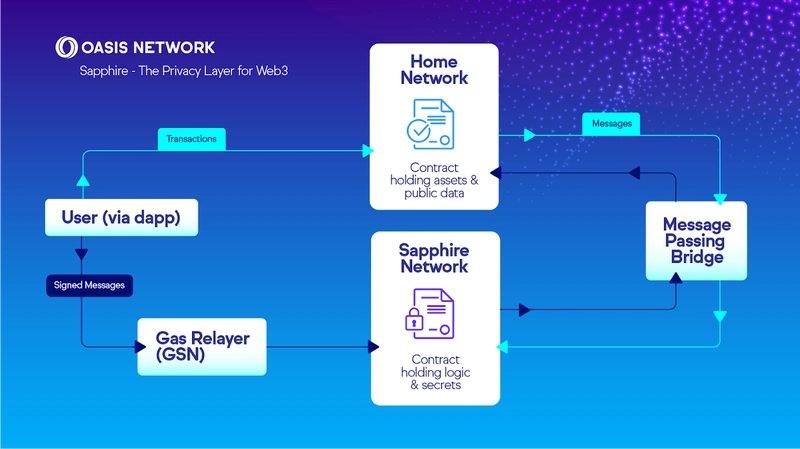
It gives the flexibility to leverage Sapphire’s features and functionalities for your dApp right from your home network, paying transaction fees with your chain’s native token. What you assuredly get from this setup:

  • Customizable privacy
  • Cross-chain convenience
  • Productive transparency
  • Low complexity
  • Access to cryptographic primitives

Learn more about OPL’s technical advantage and utility here, and start building.

The Framework: ROFL

Now, Sapphire is the runtime on-chain logic, but computation-heavy dApps, with end-to-end encryption and/or powered by AI, are a huge challenge. When you add the criteria that the privacy you get and the computations you process should be verifiable and trustless, the feasibility of doing everything on-chain plummets.

The challenges mount when dealing with cryptoAI, as it has two main problems — crypto’s limited application layer and AI’s trust issues. Off-chain computation is a viable answer in this situation. Oasis has thus developed the ROFL framework, essentially working like a decentralized TEE cloud with on-chain privacy and verifiability.

ROFL’s 5-part architecture involves a hardware layer, an application layer, a remote attestation layer, a blockchain layer, and a user interaction layer. Key features include:

  • Uncapped computational power
  • Tamper-proof processing
  • Verifiable execution
  • Decentralized key management solution
  • Direct access to confidential virtual machines

The reason ROFL is so crucial and pivotal to the next-gen private and trustless web3 and AI dApps can be simply summed up by what it doesn’t need, which you will definitely appreciate.

  • No chain dependency
  • No coding language dependency
  • No prior TEE experience

Start exploring the scope of ROFL with these resources:

Real-World Integrations

The applicability of the Sapphire + ROFL solution, with its impact and scope, is limitless. The features and primitives that ROFL unlocks are also significant.

Already, multiple live collaborations have transpired.

  1. Zeph — developing AI companions empowered by DeAI and DeCC
  2. Tamarin — empowering secure and private cross-border healthcare data analysis
  3. Tradable — trading with privacy-preserving AI insights
  4. Flashback — privacy-first AI training that lets users own and monetize their data
  5. Plurality — confidential reputation scoring and AI context flow
  6. Talos — combining DAO 2.0 and DeFAI in the form of a new model for on-chain sovereign intelligence
  7. zkAGI — building PawPad, a privacy-preserving platform for trustless trading agents
  8. Heurist — enabling privacy-first MCP servers for AI agents
  9. Huralya — building private AI wellness assistants
  10. Carrotfunding — servicing on-chain prop trading, introducing a new model for parallel verification of the risk and evaluation engine

Talos and Carrotfunding here deserve special focus, standing out as pathbreaking case studies redefining DeFi.

Final words

The takeaway from all this is that what Oasis offers to blockchain and web3 developers is not just some concept — it’s something real and tangible.
In a space where half-baked or well-intentioned ideas sound promising but often don’t deliver in their execution, a working blueprint for next-gen dApp builders stands out.

So, if you want to deploy your dApp in a web3 universe where privacy, scalability, trustlessness, and AI-ready performance all matter equally, take a moment to explore Oasis — and help shape what comes next.

Originally published at https://dev.to on January 20, 2026.


Developing in Web3: Deploying Privacy-First dApps with Sapphire + ROFL was originally published in Coinmonks on Medium, where people are continuing the conversation by highlighting and responding to this story.

Verifiable On-Chain Prop Trading & the Emergence of Trustless Market Infra: A Case Study

TL;DR

  • Prop trading relies on opaque risk engines that traders cannot verify.
  • This creates structural incentives for payout denial and abuse.
  • Carrotfunding introduces parallel verification with Oasis ROFL to audit AWS-based execution.
  • The result is a hybrid architecture that brings verifiable compute, privacy, and trustless settlement to prop trading.

Introduction

Decentralized trading is one of the most popular applications of cryptocurrency technology. Have we become stagnant in our approach? For example, proprietary (prop) trading, despite being a $60 billion industry, faces a verification crisis common in the modern financial landscape.

Aspiring traders seek capital from centralized institutions. However, an opaque “black box” operational model widens the gap between the industry’s assurances that skill earns reward of capital and the reality where proving performance and worthiness is erratic and arbitrary.

The web2 paradigm adjudicates trader performance and rewards on private servers that are not auditable. Moreover, the evaluating firms profit more when traders fail, as it means there is less capital disbursement.

Decentralized finance (DeFi) has blockchain’s built-in transparency to solve the blind spots of the traditional web2 approach. However, adoption has been low over the years because on-chain trading has failed to match the speed and complex solutions that traditional institutional finance (TradFi) offers.

In this post, I will refer to the Carrotfunding case study to examine how it can serve as an example of an emergent trustless market infrastructure. I will first demonstrate the gaps in the incumbent systems, and then show how a framework like Oasis ROFL can elevate the process by bringing decentralization, verifiability, and privacy to the table.

Black Box Evaluation Engine

The evaluation engine is the backbone of any prop trading firm. This software logic monitors trader activity, calculates real-time equity, enforces parameters and limitation criteria, and, finally, approves or denies payout requests. Private cloud infrastructure, like AWS, Azure, etc hosts such a risk engine with its access and management entirely in the firm’s discretion.

Sounds simple and is “trusted”, right? But the traders can never verify the validity of the metrics on which they are observed and evaluated. Let’s now take a look at how ambiguity in rules and retroactively applied rules can result in most payout denials.

Consistency Rule Exploitation

A common practice among firms is that a trader’s most profitable day cannot exceed a certain percentage of their total profit. This creates an untenable bind for traders when centralized databases can arbitrarily change risk parameters and payout criteria without explicitly detailing them beforehand.

B-Book Model

  • A-Book is when the broker passes a trade to the market involving live liquidity providers and earns a commission.
  • B-Book is when the broker keeps the trade internal, where the firm acts as the counterparty to every trade. The broker here keeps the deposit if the trader loses money, and pays out of pocket if the trader wins.

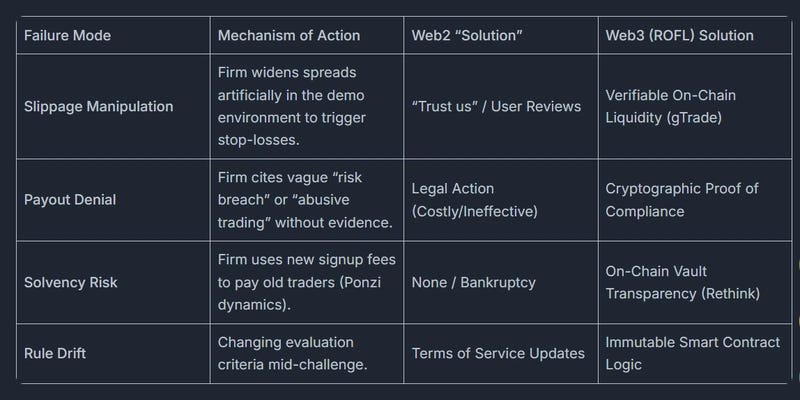
The B-Book model creates an incentive system where a profitable trader becomes a liability. So, the incentive is on the firm to disqualify traders and disadvantage them, and without a verifiable infrastructure, regulators cannot do much.

Liquidity Illusion in Tokenization

Blockchain technology’s initial solution of tokenizing trader performances is more theoretical than practical. Tokenization of trading activities can lead to an illusion of liquidity unsupported by reality. So, tokenization that lacks a robust legal and technical framework can result in zombie assets — tokens exist on-chain, but there is no genuine liquidity market or a reliable mechanism for value accrual.

Carrotfunding Case Study: Architecture and Implementation

Carrotfunding, even before integrating Oasis ROFL, had already implemented web3 solutions for its prop trading venture. Its on-chain liquidity adopts the Arbitrum’s gTrade solution for trade execution, while utilizing Rethink Finance for on-chain investment vehicles with gamification mechanics and vault transparency for capital safety.

This takes care of the execution layer and the capital layer, but what happens to the verifiable compute and security layer? This is the domain of Oasis ROFL, and deserves a closer look.

Parallel Verification Model (Phase 1)

In this phase, Carrotfunding continues to use AWS infrastructure for its platform and strengthens it with parallel verification with an ROFL-based auditor. The workflow unfolds in five stages.

  1. A trader executes a trade on the gTrade platform via the Carrotfunding interface.
  2. This bifurcates into two distinct paths: (a) Legacy: The trade data goes to Carrot’s AWS execution engine. (b) ROFL: The data simultaneously goes to the ROFL node network.
  3. The computation takes place independently. (a) AWS calculates the impact on the trader’s account, for example, the trader’s daily profit and loss statement. (b) ROFL, running inside a trusted execution environment (TEE), performs the same evaluation using the same code logic.
  4. ROFL provides attestation and verifiability through comparison. This is based on the cryptographic proof generated from its calculation and submitted on-chain, where both the AWS and the ROFL results are matched.
  5. The finality of the process is provided by ROFL. If the two results match, no problem. If they differ, then ROFL’s result, having cryptographically verifiable proof, is accepted over the AWS result, which might be potentially compromised or based on an erroneous database.

The “Trustless AWS” Paradigm

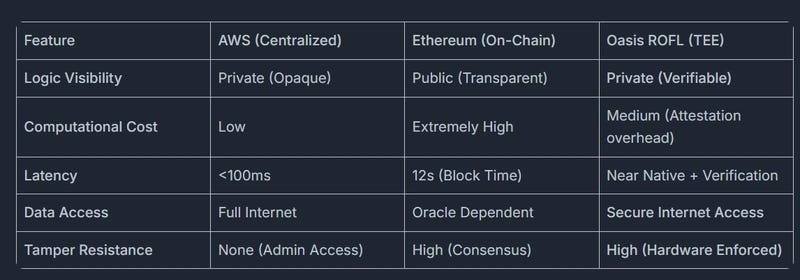
We can call this architecture “Trustless AWS”. ROFL, often described as a decentralized TEE cloud, enables the best of both worlds in terms of developer experience — the benefits of a centralized cloud, involving deployment of Docker containers and running complex logic, while also having the advantages of the security properties of a blockchain.

A comparison of the computational models will clarify further.

Proxy-Based Frontend Hosting

Carrotfunding utilizes the ROFL primitive called proxy-based frontend hosting. Typically, a decentralized application (dApp)’s smart contract logic is on-chain, but the website, which is the frontend, is still hosted in a centralized cloud provider, for example, AWS. So, if the cloud server goes down, the UI is also down.

With ROFL, Carrotfunding can host the frontend inside the TEE. As a result, the node can automatically provision TLS certificates using a built-in ACME client inside the secure enclave. There is also end-to-end security as a user’s connection via SSL terminates only inside the TEE. This protects user privacy, shielding IP addresses and login patterns from the node operator and infrastructure provider.

Secret Management and Proprietary IP

For any prop trading firm, keeping its internal risk algorithms secret is how it stays competitive. Full transparency of blockchain technology is counterproductive in this regard. The smart privacy feature of Oasis technology ensures that both transparency and confidentiality can co-exist.

So, with the code running inside the TEE, Carrotfunding can keep its algorithms private. Here, the hash of the code is accessible publicly for verification, but the source code remains encrypted, out of public viewing scope, and unrevealed to the node operator.

Security: Threat Model and Defense

Integrating TEE often opens up the question of security, as the SGX/TDX technology can succumb to various vulnerabilities.

  • Side-Channel Attacks: This is mitigated in two ways. The ROFL framework ensures that the latest microcode patches from Intel are used. So, any node that is found without a TEE trusted computing base (TCB) update is rejected by Oasis’s confidential runtime on-chain logic, Sapphire’s registry. Also, using “data-oblivious” code helps block pattern analysis of memory access.
  • Oracle Manipulation: This is mitigated by simultaneous TLS connections to multiple independent data providers for the price feed, computed inside the enclave for the median price, used to evaluate instead of relying entirely on a single on-chain oracle update.
  • Key Leakage: This is mitigated by a decentralized key management system where the master key is sharded across multiple nodes. So no single node ever possesses the full key. Also, ROFL enables ephemeral keys so that they exist only in volatile memory and will be wiped and lost whenever the enclave restarts or if any tampering is ever attempted.

In addition, the adoption of consensus as a verifier by a Byzantine Fault Tolerance (BFT) network like Oasis ensures that all potential gaps in remote attestations of the TEEs are addressed.

The Verifiability X-factor

This is crucial in understanding the role Oasis ROFL plays in upgrading the risk engine of Carrotfunding from what traditional models can provide. Any user can, therefore, audit the system by using the command:

oasis rofl build -verify
  • Reproducible builds allow users to download the source code, compile it locally using the deterministic build environment provided by Oasis, and obtain the MRENCLAVE hash.
  • Users can then query the Sapphire runtime for an on-chain check if their generated hash matches the one registered by active nodes. If yes, it is the immutable proof that the code on GitHub is the code running on the server.

From Prop Trading to Autonomous Agents (Phase 2)

Integrating Oasis ROFL to verify the AWS risk engine by Carrotfunding is just the stepping stone to a paradigm shift in prop trading. It aims to evolve into a self-sustaining infrastructure that can ultimately replace the AWS system altogether.

This full decentralization mode becomes viable only after there is sufficient stability and enough node operators in place to guarantee 99.99% uptime. With the transition to a ROFL-first architecture, the Carrotfunding platform can then use only ROFL nodes to authorize Rethink Finance’s capital layer for fund release.

The evolution of the platform’s architecture and functionality into autonomous trading agents is also part of the future roadmap. This envisions a marketplace for verifiable intelligence, where the AI agents compete for capital in a trustless environment, protected by the privacy guarantees of Oasis and the settlement assurances of Arbitrum.

Decentralized Identity (DID) is another key area to explore since ROFL can process sensitive personal data (KYC documents) inside the enclave to verify a trader’s identity and reputation score.

Conclusion

The study suggests that DeFi can hold its own against TradFi, which had a historical monopoly in the prop trading market. Now, there is a live example of how the limitations of web2 finance, where asset management meant opaque computation logic, can be improved with web3’s verification layer to prove the process.

By removing trust assumptions and plugging the trust gap, Carrotfunding has engineered a system that aligns the incentives of traders, capital providers, and the platform itself. We now await the full decentralization and agentic future for on-chain prop trading, redefining the standards of transparency, security, and efficiency for the next-gen trustless digital asset market.

Resources referred:

Originally published at https://dev.to on January 19, 2026.


Verifiable On-Chain Prop Trading & the Emergence of Trustless Market Infra: A Case Study was originally published in Coinmonks on Medium, where people are continuing the conversation by highlighting and responding to this story.
❌