Someone listening to last week’s GeekWire Podcast caught something we missed: a misleading comment by Alexa during our voice ordering demo — illustrating the challenges of ordering by voice vs. screen. We followed up with Amazon, which says it has fixed the underlying bug.
On this week’s show, we play the audio of the order again. Can you catch it?
Plus, Microsoft announces a “community first” approach to AI data centers after backlash over power and water usage — and President Trump scooped us on the story. We discuss the larger issues and play a highlight from our interview with Microsoft President Brad Smith.
Amazon is automatically upgrading Prime members to Alexa+, prompting Reddit complaints about consent and opt-out controls, along with performance gripes.
Amazon is automatically upgrading Prime members to Alexa+, prompting Reddit complaints about consent and opt-out controls, along with performance gripes.
This week on the GeekWire Podcast: Amazon and Microsoft are racing to define the next era of consumer AI, on multiple fronts. We discuss Amazon’s attempt to upgrade Alexa into a true generative AI home chatbot — complete with a new web portal and updated Alexa app — while Microsoft tries to win over retailers with a new Copilot Checkout feature.
Plus, we explore Google’s upcoming “AI Inbox” for Gmail, which promises to act like an executive assistant for your email. We talk about our smart bird feeder experiment that resulted in “fuzzy birds,” due to improper focal length. And we share our initial experience with AI automation on the Windows PC desktop using Vy from Seattle startup Vercept.
Finally, we offer a Netflix recommendation, Cover-Up, the documentary about legendary investigative journalist Seymour Hersh. We couldn’t help but wonder: what would uncover if he could digitize all those notes and put them through an AI model?
Anyone can now try Alexa+, Amazon’s generative AI assistant, through a free early access program at Alexa.com. The website frees the AI, which Amazon released via early access in February, from hardware and makes it as easily accessible as more established chatbots, like OpenAI's ChatGPT and Google's Gemini.
Until today, you needed a supporting device to access Alexa+. Amazon hasn’t said when the early access period will end, but when it does, Alexa+ will be included with Amazon Prime memberships, which start at $15 per month, or cost $20 per month on its own.
The above pricing suggests that Amazon wants Alexa+ to drive people toward Prime subscriptions. By being interwoven with Amazon’s shopping ecosystem, including Amazon's e-commerce platform, grocery delivery business, and Whole Foods, Alexa+ can make more money for Amazon.
Amazon says expanding Alexa further beyond the home will be a big focus in 2026. (Amazon Image)
Amazon is expanding its consumer AI ecosystem beyond the smart speaker — bringing Alexa+ to the web, revamping its mobile app, and offering its first update on Bee since acquiring the wearable AI startup six months ago.
The announcements, timed to CES in Las Vegas, mark Amazon’s latest effort to catch up in the consumer AI race. While the company’s cloud unit has established itself as a major AI infrastructure and enterprise services provider, Amazon has struggled to match the momentum of OpenAI, Google, and the rapidly growing field of consumer AI startups.
New this morning, Amazon released a streamlined Alexa mobile app that makes the AI assistant the primary focus. The redesigned interface features an “Ask Alexa” prompt anchored at the bottom of the screen, personalized suggestions, and quick access to devices and favorites — a cleaner look that prioritizes the AI assistant over other features.
Amazon is rolling out a new Alexa app that focuses on the chat experience. (GeekWire Screenshots)
Amazon says Alexa+, its upgraded AI assistant, is now available in the browser via alexa.com to all customers in its early access program. As previously reported by GeekWire, the web interface extends Alexa beyond voice commands, enabling document uploads, web-based chat integration, and point-and-click control over reminders, calendars, and smart home devices.
Alexa+ uses generative AI to offer smoother conversations and better answers than its predecessor, along with new agentic capabilities such as booking tickets and reservations.
Amazon is competing against consumer AI rivals such as ChatGPT and Gemini, which have become everyday tools for millions of people. It’s looking to leverage its more than 600 million Alexa-enabled devices, and areas of differentiation such as smart-home controls and device integrations.
The company had an initial false start with a more limited conversational Alexa feature called “Let’s Chat,” first shown publicly in September 2023, but never fully released. Working on Let’s Chat led to “some realizations about how big of an effort we needed to put in with Alexa+,” said Daniel Rausch, vice president of Alexa and Echo, in a recent interview with GeekWire.
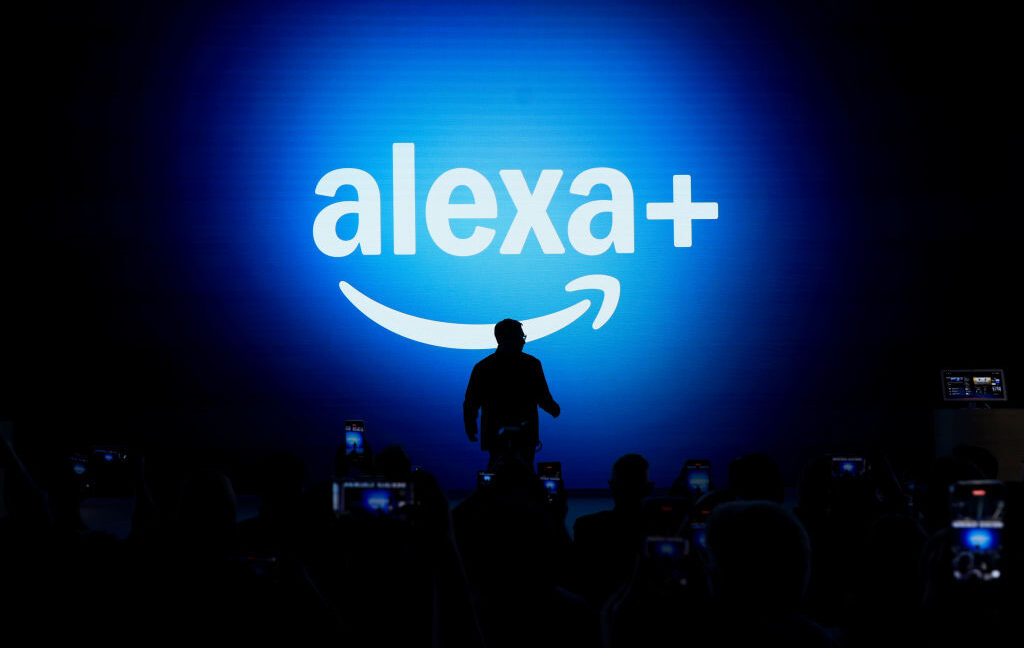
Daniel Rausch, Amazon’s vice president of Alexa and Echo, at the Alexa+ launch event.
Alexa+ started rolling out in March 2025. According to the company, tens of millions of customers are now using Alexa+, with engagement rates two to three times higher than prior Alexa versions.
Rausch said 76% of what customers do with Alexa+ “is not possible with any other AI,” citing scenarios that go beyond chat, such as controlling devices, managing home and family logistics, and completing multi‑step tasks across different services and screens.
Amazon is also betting on hardware to extend its AI ambitions beyond the home.
In a post Monday, Bee co-founder Maria de Lourdes Zollo gave the first public update since Amazon acquired the San Francisco startup last year. Bee makes a $49.99 wearable device that records and transcribes conversations, creating summaries, insights, and suggested actions.
The Bee “Pioneer Edition” wrist device. (Bee Photo)
Since joining Amazon, Bee has shipped four major features in 90 days, Zollo wrote, including Voice Notes for capturing thoughts on the go, Actions that connect conversations to email and calendar, and Daily Insights that surface patterns across weeks of interactions.
Zollo described the acquisition as a path toward “ambient AI” — technology that understands and assists users everywhere, “across every surface throughout your day.”
Amazon declined to share details on any plans to integrate Bee with Alexa, leaving open the question of how the wearable fits into the company’s broader AI assistant strategy.
The announcements build on Amazon’s push to bring Alexa+ to third-party hardware, including Sonos and Bose speakers, LG and Samsung smart TVs, and BMW cars.
Rausch said taking Alexa+ further beyond the home will be a big push for Amazon in 2026. He hinted at more to come, including new “personal mobile devices” from Amazon designed to help customers bring Alexa+ with them throughout the day.
Amazon’s new Alexa.com portal brings the AI-powered Alexa+ assistant to the desktop browser.
Amazon is quietly rolling out the last big pillar of its AI-powered Alexa+ vision: the Alexa.com website, bridging the gap between its Echo devices, mobile app, and consumer desktops.
The web portal means users can now interact with Alexa through a keyboard and mouse: accessing and continuing past Alexa chats, starting new ones, going back and forth between voice conversations in the living room and typed chats in the home office, etc.
(Alexa.com is available initially to a subset users in the Alexa+ early access program, with access likely to expand in the coming weeks, so if you’re not seeing it yet, stay tuned.)
I’ve been trying it out, and I’m already finding it quite useful as an extension of the Alexa experience. In addition to expanding the chat functionality to the browser, the web interface offers fine-grained control over reminders, calendar appointments, uploaded files, and smart home devices.
For example, I was able to edit a family reminder: changing the assigned person, adjusting the date and time, setting it to repeat weekly, and adding a flag for Alexa to follow up until it’s complete. All of this happened through simple clicks, much easier than talking Alexa through the details, in my experience.
Point-and-click control over reminders in the Alexa.com web portal.
The rollout of Alexa+ earlier this year also introduced the ability to email or upload documents to Alexa for summarization and reference. This made Alexa a lot more useful on its own. Now, with the online portal, it’s much easier to upload, access and delete files.
There’s also some nice smart home integration, with the ability to control lights and plugs, for example. You can also view your Ring cameras through the Alexa.com smart-home section. It’s similar to the Alexa app, but nice to be able to access on the computer.
In short, it’s a level of point-and-click precision that voice commands and the mobile app can’t offer. Within a few minutes of using Alexa.com, I had this sense of liberation, being able to interact with Alexa in the same way as anything else on the computer. What a concept!
That said, I couldn’t help but wonder how much I’ll actually use it.
Three years after the launch of ChatGPT, my AI routines have become relatively entrenched. I’m having a hard time envisioning going to Alexa.com on my computer to start a chat rather than Gemini, NotebookLM, Claude, Perplexity or other AI tools that have become daily habits.
Then again, for me, those tools are about work and individual tasks. Alexa is really the digital hub for my family. The introduction of better AI with Alexa+ has improved that experience over the past few months, and the web portal adds a whole new dimension. Family is why I’ll use it.
The Alexa+ integration goes even further for me since I’ve been talking to Alexa more and more via my Amazon Echo Buds on my phone when I’m out and about, although this is probably more illustrative of me being an edge case than anything else.
Amazon CEO Andy Jassy outlines the company’s AI strategy at an Amazon event earlier this year, with Alexa+ serving as the consumer-facing layer of the strategy. (Amazon Photo)
Within Amazon, Alexa+ sits at the top of the AI stack that Amazon CEO Andy Jassy talks about. It’s the consumer-facing layer for a company that has made a much bigger mark in AI with its cloud infrastructure and platforms. Alexa’s web launch fills a gap that’s been glaring for a while.
The more Amazon can unify everything inside the web portal, the more useful it will be. No doubt I’ll come up with other feature requests as I continue to use it.
But for now, the simple act of using an AI-powered Alexa in a web browser is so mind-blowing, in such a basic way, that it’s hard not to wonder how much further along Amazon would be in the world of consumer AI if it had been able to make this happen a long time ago.
Story updated to correct reference to Ring cameras, which are accessible via Alexa.com.

 Login
Login