Reading view

There are new articles available, click to refresh the page.

XRP Trend Still Coherent On Binance As CVD Correlation Remains Supportive

XRP is attempting to stabilize above the $1.90 level after slipping below the $2.00 mark, a breakdown that has fueled fresh uncertainty across the market. With momentum weakening and volatility picking up, traders are now watching whether this pullback becomes a temporary reset or the start of a deeper downside move.

Analysts remain divided on the outlook, as some argue XRP is entering a bearish continuation phase, while others believe the market is simply clearing leverage before a rebound. Either way, the coming sessions are shaping up to be decisive for short-term direction.

A report from Arab Chain adds an important layer of context by focusing on Binance flow dynamics. According to the report, data from Binance’s XRP platform shows the 30-day correlation between price and CVD (Cumulative Volume Delta) sitting near 0.61, which signals a moderate to strong positive relationship between price action and net volume flows. In simple terms, XRP’s recent moves have not been disconnected from trading activity.

Instead, price changes appear to be relatively supported by actual volume behavior rather than isolated technical noise.

This matters because when price and CVD remain positively linked, the market is often viewed as structurally aligned, suggesting trend confirmation rather than a random bounce. For XRP, this correlation could become a key signal as bulls fight to defend $1.90.

XRP’s CVD Confirmation Score Shows Base-Building, Not Capitulation

Arab Chain explains that while the 30-day price–CVD correlation remains positive, the latest CVD reading is still relatively negative, signaling that accumulated selling pressure has not yet flipped into net buying dominance. This is a critical nuance.

Rather than acting like a simple “buy” or “sell” trigger, the metric functions as a confirmation score, meaning it evaluates whether price action is internally supported by volume flows instead of offering a clean entry signal. In other words, it helps traders judge the quality of the trend and whether market behavior is coherent beneath the surface.

Binance XRP CVD Confirmation Score | Source: CryptoQuant

The real value of this framework is its ability to detect divergence early. If XRP’s price attempts to recover while correlation deteriorates, or if CVD stays negative during upside moves, it would suggest hidden weakness and a higher probability that rallies are being sold into. That kind of imbalance often appears before sharp reversals, especially in uncertain conditions where liquidity is thin and momentum-driven positioning dominates.

In the current context, however, the market is sending a more balanced message. The persistence of a positive correlation despite ongoing price weakness implies that XRP may be entering a base-building phase, where selling pressure is being absorbed gradually rather than accelerating into aggressive distribution.

Trend Weakness Keeps Bulls On Defense

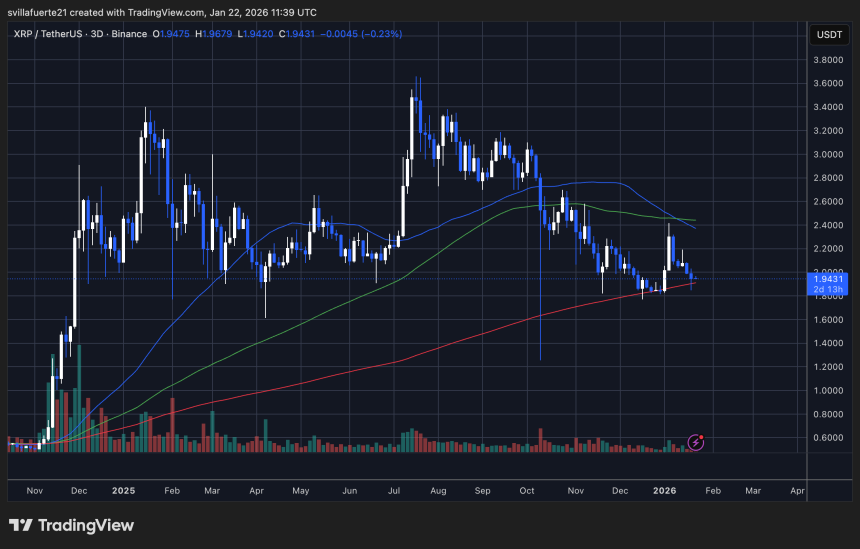
XRP is trading near $1.91 on the 3-day chart after failing to reclaim the $2.00 level, keeping the market in a fragile short-term position. The structure shows that XRP topped above $3.50 during the mid-2025 rally, but the move has since unraveled into a steady downtrend defined by lower highs and repeated breakdowns. After the sharp leg lower in October, the price attempted to stabilize, but the recovery lacked follow-through and has gradually faded into a tighter compression zone.
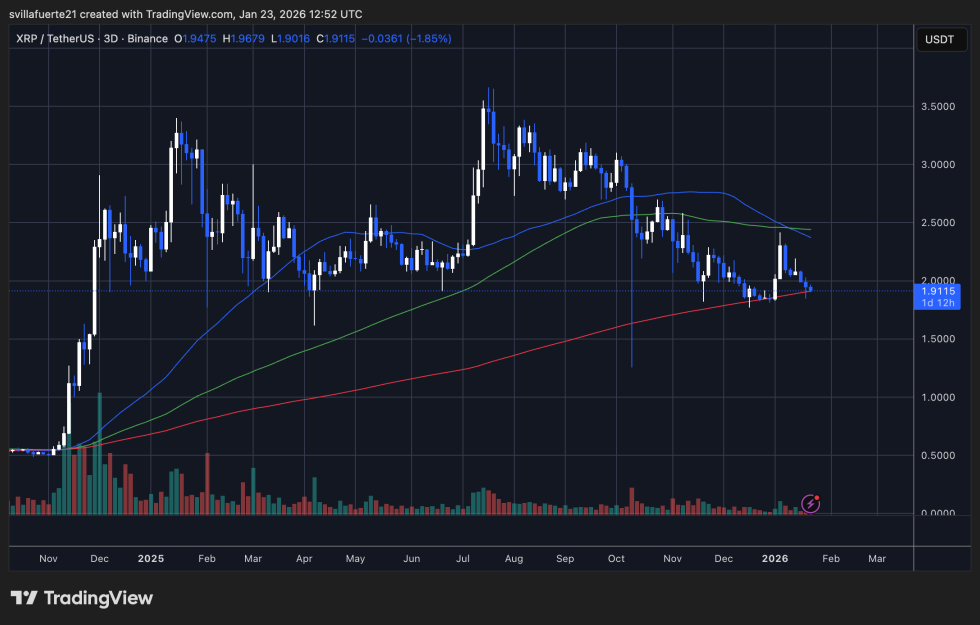
XRP testing critical demand level | Source: XRPUSDT chart on TradingView

From a trend perspective, XRP remains capped below its major moving averages. The blue average is sloping downward and sits above price near the mid-$2 range, reinforcing a bearish bias and limiting upside attempts. The green average is also flattening and rolling over, confirming that momentum has weakened across multiple timeframes. Meanwhile, XRP is now leaning directly on the red long-term average, which is rising toward the current price and acting as a key support reference around the $1.85–$1.90 region.

Price action over the last several candles suggests a base-building process, but it is still premature to call a reversal. Bulls need to defend this support zone and reclaim $2.00–$2.10 to shift momentum back in their favor. If XRP loses the rising long-term average, downside risk increases toward $1.70 and potentially the mid-$1.50 area, where demand previously stepped in.

Featured image from ChatGPT, chart from TradingView.com 

Bitcoin Indicator Falls Back To Post-Bear Market Levels: Investors Approach A Key Decision Point

Bitcoin is trading below the $90,000 level once again, as the market continues to drift through a phase defined by indecision, rising caution, and growing fear. After repeated failures to reclaim this psychological threshold, price action has started to reflect a lack of conviction on both sides, with buyers hesitating to step in aggressively and sellers pressing every rebound attempt. While the broader trend has not fully collapsed, the inability to hold key levels is increasing uncertainty around Bitcoin’s next major move.

Top analyst Darkfost argues that on-chain signals are starting to mirror conditions typically seen near the end of prolonged drawdowns. According to his analysis, Bitcoin’s unrealized profits and losses are sliding back toward levels that have historically appeared only at the exit of bear markets, when the market has already absorbed a deep reset in sentiment. This shift suggests that stress is building under the surface, even if price has not yet entered a full capitulation phase.

Since Bitcoin’s last all-time high, Darkfost notes that many late-arriving investors have moved into uncomfortable territory, facing mounting downside pressure as the market cools. As a result, unrealized profits are shrinking, unrealized losses are expanding, and the overall balance continues to deteriorate—an environment that often forces traders into a decisive choice between holding through volatility or exiting under stress.

Decision Point For Bitcoin Investors

Darkfost highlighted a chart based on an adjusted version of NUPL (Net Unrealized Profit/Loss), designed to capture investor stress more accurately during shifting market regimes. Instead of relying solely on the standard market cap, the model incorporates the realized capitalization of both Short-Term Holders (STHs) and Long-Term Holders (LTHs), then compares that blended realized foundation against Bitcoin’s traditional market cap.

Bitcoin Adjusted Net Unrealized Profit/Loss NUPL | Source: CryptoQuant

The result is a clearer view of how much profit or loss sits “on paper” across the market, filtered through a more structural lens. To reduce noise and better define trend shifts, the metric is smoothed using an average, producing what Darkfost refers to as aNUPL.

The key takeaway is that Bitcoin is approaching levels that have historically forced investors into a binary decision. When unrealized profits compress and unrealized losses expand to these ranges, holders typically face two outcomes: hold and continue accumulating, or capitulate and lock in losses. That difference in behavior becomes critical because it shapes liquidity, sentiment, and the next directional trend.

If long-term participants absorb the pressure and keep holding, the market can stabilize and rotate back into recovery. But if selling accelerates from stressed cohorts, the decline can deepen into a broader bear phase. This is why tracking realized and unrealized profit dynamics remains essential, especially during periods of uncertainty.

Bitcoin Consolidates After Sharp Weekly Breakdown

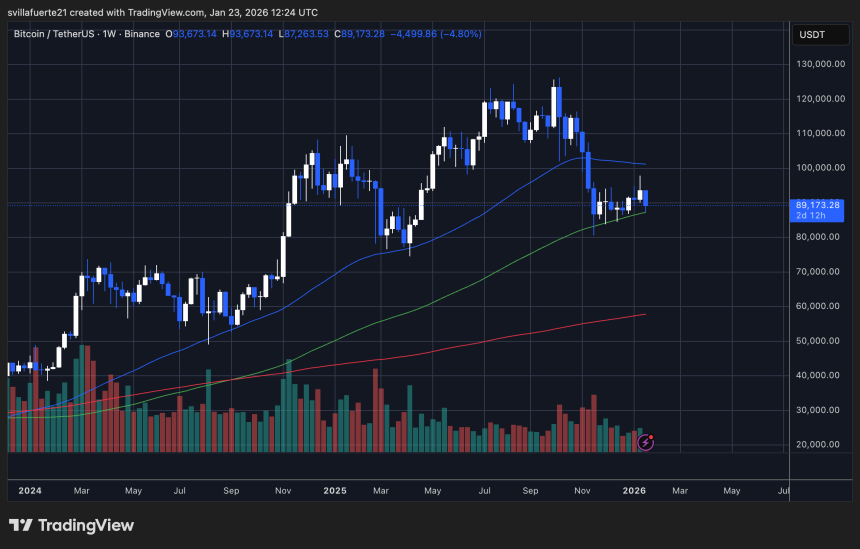
Bitcoin is trading around $89,000 on the weekly chart after a steep selloff that pushed the price out of its prior distribution zone. The latest candle reflects heavy downside pressure, with BTC dropping roughly 4.8% on the week and struggling to stabilize near a key pivot that has repeatedly acted as support and resistance throughout the cycle.

BTC testing critical demand | Source: BTCUSDT chart on TradingView

After failing to hold above the psychological $90,000 threshold, the market is now trapped in a tight consolidation range, suggesting traders are waiting for confirmation before committing to a larger move.

From a trend standpoint, Bitcoin remains vulnerable as it trades below the blue moving average, which is now acting as overhead resistance near the low-$100K region. The rejection from that dynamic level aligns with the broader structure: BTC topped near the mid-$120K range, then entered a sharp corrective leg that reset momentum into early 2026. While the green moving average continues to slope upward and is approaching the current price zone, the market has not yet shown the strength needed to reclaim its former trend trajectory.

Importantly, the weekly structure is now compressing. If buyers can defend the $88K–$90K region and push BTC back above $92K–$95K, it would signal a recovery attempt toward the moving average band. However, a sustained failure here increases the risk of a deeper retracement toward the low-$80K zone, where prior demand previously emerged.

Featured image from ChatGPT, chart from TradingView.com 

Institutional-Scale Ethereum Lockup: Bitmine Crosses 1.94M ETH Staked Mark

Ethereum has slipped below the critical $3,000 level, adding fresh pressure to a market that is already showing clear signs of hesitation. After weeks of choppy price action, ETH is now entering a more fragile phase where failed recoveries are starting to shift sentiment. With sellers gaining control and bullish momentum fading, several analysts are warning that this breakdown could open the door for a deeper correction if demand does not return quickly.

The timing is important. Ethereum is moving through a pivotal zone where short-term price direction could shape the broader narrative for 2026. If ETH continues to trade below $3,000 and lower support levels fail to hold, the market may transition into a prolonged risk-off regime. On the other hand, a fast recovery back above this psychological threshold could signal that the breakdown was only a liquidity sweep, setting up a rebound toward higher resistance.

Despite a weakening price structure, on-chain activity suggests large players remain active. Market data shows that Bitmine staked another 171,264 ETH, worth roughly $503.2 million, just a few hours ago. The move adds to the firm’s growing exposure and reinforces the idea that institutional-scale actors are still positioning aggressively, even as Ethereum faces one of its most decisive moments of the year.

Bitmine Ethereum Transfers | Source: Arkham

Bitmine’s ETH Staking Signals Long-Term Conviction Despite Short-Term Weakness

According to data from Arkham, Bitmine has now staked a total of 1,943,200 ETH, worth roughly $5.71 billion, marking one of the most aggressive Ethereum accumulation and yield-positioning moves currently visible on-chain.

Staking at this scale removes a significant amount of ETH from liquid circulation, effectively shifting supply away from exchanges and into long-term validator positions. In practical terms, it suggests Bitmine is not positioning for a short-term flip, but rather treating Ethereum as a strategic asset that can generate native yield while potentially appreciating over time.

This activity stands out because it is happening while Ethereum is under pressure after losing the $3,000 level. At the moment, the market is stuck in a fragile, risk-sensitive phase, where traders are reacting quickly to breakdowns and failed recoveries. Momentum has weakened, liquidity remains thin, and analysts are increasingly warning that a deeper correction could unfold if key supports continue to fail.

However, Bitmine’s staking expansion provides a counter-signal: large players appear willing to keep committing capital even as sentiment deteriorates. That divergence highlights the current split in the market—short-term participants are defensive, while longer-term allocators are still building exposure. If price stabilizes, this kind of staking-driven supply reduction can become a structural tailwind.

Ethereum Downtrend Pressure Builds

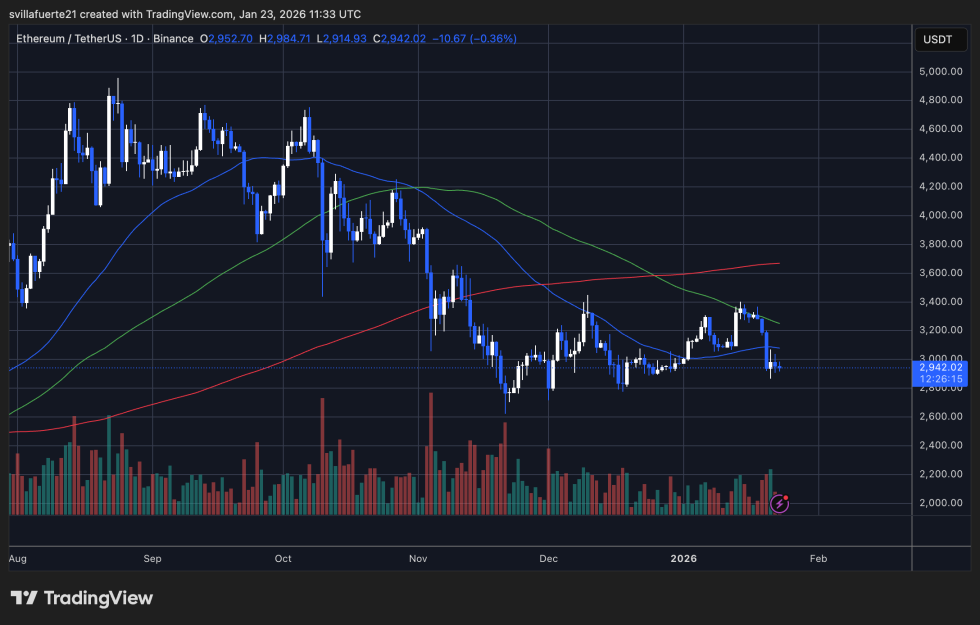
Ethereum is trading near $2,940 after losing the key $3,000 psychological level, putting the market back into a fragile position. The chart shows ETH has been trending lower since the October peak, with a clear sequence of lower highs and heavy sell-side volatility that accelerated into November. Although ETH managed to stabilize into a broad consolidation range between roughly $2,850 and $3,250, the most recent breakdown suggests buyers are struggling to defend support when momentum fades.

ETH testing key support | Source: ETHUSDT chart on TradingView

From a trend perspective, Ethereum remains capped beneath its major moving averages. Price is trading below the green long-term average and the blue mid-term average, both of which are sloping downward and acting as dynamic resistance.

The recent rebound attempt toward the $3,300–$3,400 zone failed right under the green line, reinforcing that sellers are still controlling rallies. Meanwhile, the red long-term average sits higher near the mid-$3,000s, highlighting that ETH remains far from reclaiming a macro bullish structure.

Volume has increased on the sharp red candles compared to the slower grind higher, which often signals distribution rather than healthy accumulation. If ETH cannot reclaim $3,000 quickly, downside risk opens toward the $2,850 range floor. A clean recovery back above $3,150–$3,250 would be needed to reduce bearish pressure and reset the near-term trend.

Featured image from ChatGPT, chart from TradingView.com 
Bitcoin Stuck In Bear Mode For 83 Days: Trend Pulse Confirms Structural Weakness

Bitcoin continues to struggle as it attempts to reclaim the $90,000 level, with traders facing a market defined by hesitation rather than conviction. After yesterday’s bearish breakdown below $90K, price action has slipped back into indecisive territory, raising fresh questions about whether this pullback is a temporary shakeout or the start of a deeper corrective phase.

According to top analyst Axel Adler, a macro indicator called Trend Pulse helps explain why momentum has faded. Adler notes that since January 19, the market has remained in Bear Mode, with the Bull phase absent for 83 consecutive days. Two separate charts reinforce this shift, showing that both short-term momentum and quarterly performance have turned negative at the same time.

Bitcoin Trend Pulse | Source: CryptoQuant

Trend Pulse recently shifted from Neutral to Bear, driven by a double-negative setup: the 14-day return has flipped red, and the SMA30 versus SMA200 trend signal is also negative. Meanwhile, Bitcoin’s quarterly return sits at -19%, confirming macro weakness, but without the kind of extreme that often signals a definitive bottom.

Bitcoin Remains Stuck In Bear Mode As Macro Signals Stay Negative

Adler notes that Bitcoin’s last Bull Mode signal was printed on November 2, 2025, when BTC traded near $110,000—roughly 83 days ago. Since then, the market has failed to regain structural strength. Even the Neutral stretch between December 30 and January 18 proved too short and too weak to restore the long-term trend, leaving Bitcoin vulnerable once selling pressure returned.

Adler explains that the first trigger for improvement is the 14-day return moving back above 0, which would shift the regime from Bear to Neutral. However, a full transition back into Bull Mode requires a second condition: SMA30 breaking above SMA200. Given the current divergence between the two averages, that crossover would likely demand 3–4 weeks of sustained upside rather than a short-lived bounce.

The Bitcoin Price Performance chart adds macro context by tracking quarterly return (90D) as a sentiment proxy. Historically, readings above +75% align with euphoria, while values below 0% signal pessimism, and drops below -30% reflect capitulation.

Bitcoin Price Performance | Source: CryptoQuant

Bitcoin’s quarterly return sits near -19%, negative but far from deep bear-market extremes. Yet the 7-day change (-6.8%) suggests downside momentum is accelerating after the $90K breakdown.

Together, Trend Pulse and quarterly returns point to moderate pessimism without final capitulation, leaving the market at a decision point.

BTC Moving Averages Cap Recovery

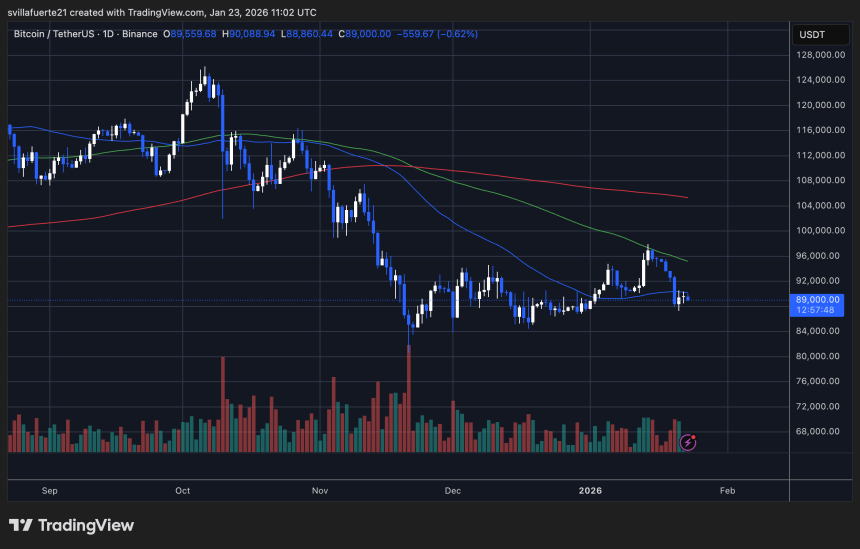
Bitcoin is trading near $89,000 after failing to hold above the $90,000 psychological level, reinforcing the market’s current indecision. The chart shows BTC printing a lower-high structure since the early November peak, followed by a sharp selloff that reset price into a wide consolidation range. After bottoming in late November, Bitcoin rebounded but struggled to build sustained momentum, repeatedly stalling on push attempts toward the mid-$90K zone.

BTC consolidates in a range | Source: BTCUSDT chart on TradingView

From a trend perspective, BTC remains pressured beneath its key moving averages. Price is trading below the green long-term average and the blue mid-term average, both of which are now sloping downward, signaling that broader momentum continues to lean bearish.

The most recent rejection occurred as BTC briefly pushed into the $95K–$97K area, only to roll over and break back down toward the range lows. Meanwhile, the red long-term average remains well above price near the low-$100Ks, highlighting how far BTC would need to recover to reestablish a stronger macro uptrend.

Volume has picked up on selloffs relative to bounces, suggesting that downside moves are still being met with more urgency. For bulls, reclaiming $90K and then holding above $92K–$94K is key. Otherwise, the chart keeps risk open for a deeper pullback toward the mid-$80K region.

Featured image from ChatGPT, chart from TradingView.com 

XRP Distribution Phase Continues, But Funding Rates Suggest Shorts Are Overextended

XRP is testing demand below the $2 mark as the crypto market struggles to find stability amid rising uncertainty. After weeks of choppy price action and failed recovery attempts, traders are watching whether buyers can defend this zone or if another wave of selling pressure will push XRP into a deeper pullback. The broader market environment remains fragile, and risk appetite has weakened, keeping volatility elevated across major altcoins.

XRP is currently trading around 47% below its last all-time high from July 2025, highlighting how far the price has retraced since peak bullish momentum. However, this move is not necessarily abnormal. After an exceptional rally of more than 600% since November 2024, the market has naturally shifted into a phase of distribution and correction, as early buyers take profits and late entrants are forced to de-risk. This type of cooldown is often needed to reset positioning and rebuild a healthier structure for the next trend.

The current range suggests XRP is transitioning into a more balanced market where demand and supply are attempting to re-align. If buyers continue to step in near key support levels, the correction could evolve into a longer consolidation phase.

Negative Funding Rates Hint At A Potential XRP Reversal

Darkfost argues that what stands out in the current XRP setup is the timing of the bearish consensus. Instead of forming near the top, bearish positioning intensified only after XRP had already suffered a drawdown of more than 50%. Suggesting traders may be leaning short late in the correction cycle. On Binance, funding rates have remained mostly negative since December, reflecting a market dominated by leveraged short exposure rather than confident dip-buying.

XRP Ledger Funding Rates | Source: CryptoQuant

Historically, markets tend to punish late consensus. While a buildup of shorts can add near-term selling pressure and keep price capped during weak conditions, it also creates latent buying pressure through forced covering. If XRP starts to reclaim key levels, short liquidations and rapid position unwinds can accelerate upside moves. Turning bearish positioning into fuel for a rebound.

Darkfost notes that this pattern has already appeared twice since 2024. During the August–September 2024 period, and again throughout the April 2025 correction, funding rates flipped negative for a sustained stretch before price stabilized and pushed higher. In both cases, the reversal was accompanied by improving sentiment and a return of funding rates toward neutral and then positive territory.

With funding still tilted bearish and positioning crowded to one side, the current context suggests XRP may be approaching another inflection point. If demand re-enters the market, the imbalance in shorts could support a sharp recovery.

XRP Consolidates Below $2 As Bears Lose Momentum

XRP’s 3-day chart shows the downside momentum has clearly slowed from the attempt to stabilize the price after an extended corrective phase. XRP currently trades near $1.94, holding above a local support zone that formed after the sharp sell-off in Q4 2025. While sellers remain active, the downside momentum has clearly slowed compared to the aggressive breakdown that pushed the market from the $2.60–$2.80 region into the current demand area.

XRP testing critical demand level | Source: XRPUSDT chart on TradingView

From a trend perspective, XRP is still capped by declining moving averages. The shorter-term curve is sloping downward and acting as dynamic resistance near the $2.10–$2.30 range. Each rebound attempt has struggled to reclaim these levels. Reinforcing that the market remains in a broader downtrend despite the recent bounce.

However, the current price structure suggests sellers are losing control, as the market has stopped printing lower lows and is shifting into a tight consolidation range.

If XRP reclaims $2, it could open the door for a stronger recovery move toward the $2.30–$2.50 zone. On the downside, losing the $1.85 floor would likely trigger renewed selling pressure and extend the correction.

Featured image from ChatGPT, chart from TradingView.com 

Ethereum Approaches A “Never Broken” Support Line: Accumulators Step In

Ethereum is once again under pressure as it struggles to regain solid ground around the $3,000 level, reflecting a broader wave of uncertainty across the crypto market. With sentiment turning increasingly fragile, many altcoins remain stuck in corrective mode, and bulls are now forced to defend key support zones to prevent deeper downside. In this environment, Ethereum’s ability to push higher is becoming a critical signal for whether the market can stabilize or if the current bearish trend will extend.

Despite the weakness, on-chain data suggests that ETH may be nearing an important turning point. According to CryptoQuant, Ethereum is approaching a major support line that has historically acted as a strong floor during periods of heavy volatility.

The report highlights that the realized price of Ethereum accumulation addresses continues to climb and is now approaching the current market price, indicating that long-term accumulation remains active even as short-term traders hesitate.

This dynamic matters because accumulation-based cost levels often represent zones where large investors defend their positions aggressively. If ETH holds above this rising support range, the market may be setting the foundation for a broader recovery.

Ethereum Whale Cost Basis Signals a Potential Bottom Zone

CryptoQuant’s report suggests Ethereum may be approaching one of its most important structural support zones, anchored by the realized price of accumulation addresses. This metric tracks the average on-chain cost basis of entities that consistently accumulate ETH, and it often behaves as a “defense line” for whales who build long-term positions.

According to the analysis, this realized price level has historically acted as a reliable floor, with Ethereum never breaking below this range during prior drawdowns, even when broader market conditions turned sharply risk-off.

That historical behavior matters because it implies that accumulation whales tend to protect their cost basis aggressively, either by adding exposure near support or by reducing sell pressure when the price approaches their entry zone. In practice, this can limit downside momentum and create a stabilization area where volatility compresses before the next trend decision.

Ethereum Realized Price For Accumulation Addresses | Source: CryptoQuant

Based on the current trajectory, the report argues that even if ETH sees another leg down, the most probable “bottom zone” sits near $2,720. From current levels, that would represent an additional pullback of roughly 7%, keeping the move within a controlled correction rather than a full breakdown. If buyers defend this area, Ethereum could begin rebuilding a base for a renewed push back above $3,000.

ETH Price Slips Back Toward $3,000 As Bulls Struggle To Reclaim Control

Ethereum (ETH) continues to trade under heavy pressure as price struggles to stabilize around the $3,000 zone. The chart shows ETH printing another sharp rejection after failing to hold the recent rebound, reinforcing that the market remains in a corrective phase rather than a clean recovery. Even though buyers are attempting to defend current levels, momentum still looks weak, with each bounce being met by renewed selling.

ETH consolidates in a pivotal demand level | Source: ETHUSDT chart on TradingView

From a technical perspective, ETH is trading below its key moving averages, which highlights how resistance continues to stack above the price. The broader structure suggests a downtrend that is transitioning into consolidation, but without a confirmed breakout, the risk remains tilted to the downside.

The recent push toward the mid-$3,200 region failed to flip that zone into support, and the pullback toward $2,980 signals that bulls are still struggling to build sustainable demand.

Volume remains relatively muted compared to the larger selloffs seen earlier in the cycle, which supports the idea that this is a grinding distribution phase rather than full panic capitulation. For a bullish shift, ETH needs to reclaim $3,200–$3,300 and hold above it. Until then, the $2,900–$3,000 area remains the key line of defense.

Featured image from ChatGPT, chart from TradingView.com 
Bitcoin Supply In Profit Stalls At 71%: Still Not Enough For A Sustainable Recovery

Bitcoin is facing a critical test as volatility returns and price action remains unstable around the $90,000 level. Bulls are attempting to defend this psychological zone after recent turbulence, but confidence across the market is still fragile. With uncertainty dominating short-term sentiment, many traders are treating every bounce as a potential trap rather than the start of a confirmed recovery.

According to top analyst Darkfost, the market is still missing a key ingredient for a sustainable bullish continuation: a broad base of investors sitting in profit. He argues that despite Bitcoin’s resilience, there are not yet enough participants in positive territory to build the kind of structural comfort that fuels long-lasting uptrends.

This matters because latent profits are not inherently bearish. In healthy conditions, when most holders are in profit, the market tends to stabilize. Investors feel less pressure to sell, panic fades, and holding becomes easier. That environment often supports stronger trend development and reduces the risk of sharp downside reactions.

Still, Darkfost warns that profit dynamics only help up to a point. When unrealized gains become extreme across the entire market, they can eventually turn into overhead supply, triggering corrective phases.

Bitcoin’s Profit Structure Still Isn’t Bullish Enough

Profit distribution across holders can become a double-edged sword for Bitcoin. When the supply in profit climbs above 95% and approaches 100%, unrealized gains stop being supportive and begin turning into overhead pressure. At those extremes, investors have little incentive to hold through volatility, and even small shocks can trigger profit-taking that fuels corrective phases.

From a structural perspective, Darkfost argues the market needs to reclaim the 75% supply-in-profit threshold to rebuild a healthier foundation. Historically, Bitcoin has tended to sustain bullish conditions when this metric holds above that level, as most participants remain comfortable and less reactive to downside volatility.

Bitcoin Percent Supply In Profit | Source: CryptoQuant

Right now, however, the market sits near 71%, after dropping as low as 64%. Darkfost notes that readings this low have often appeared near the early stages of bear markets, even when the headline drawdown looks relatively contained. In this case, the decline of roughly 31% was enough to push a large portion of recent buyers underwater, suggesting many entered late in the move.

The recent rebound briefly lifted supply in profit back to 75%, but it failed to hold. That rejection likely reflects investors using the bounce to exit at breakeven or reduce losses. Going forward, reclaiming 75%–80% would signal stabilization, while further weakness could amplify panic-driven selling.

Volatility Keeps Bulls on the Defensive

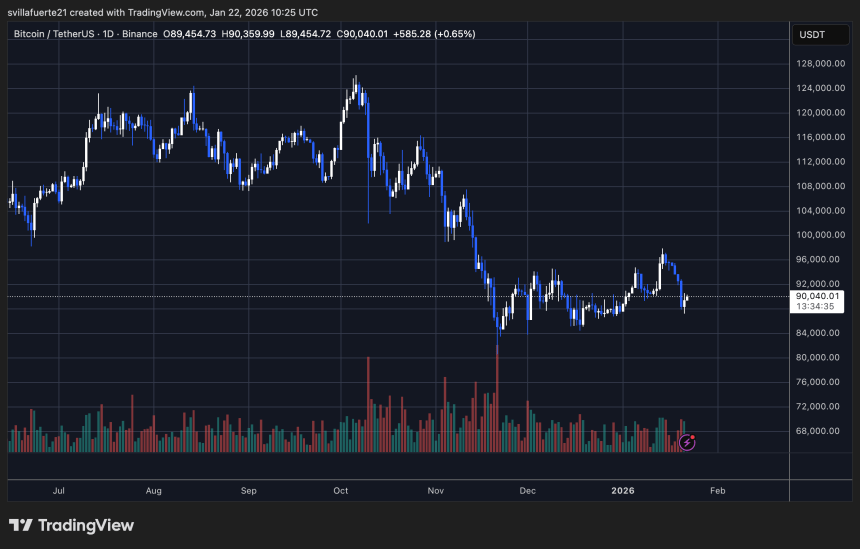
Bitcoin is attempting to stabilize near the $90,000 mark after a volatile correction that reshaped the market structure over the past few months. The chart shows BTC printing a major peak around $125,000 before rolling over into a sharp selloff. Accelerating into November and eventually finding a local floor near the mid-$80,000s. That drop marked a decisive break in momentum and triggered a shift toward a lower range, where price has struggled to regain prior support levels.

BTC testing critical demand level | Source: BTCUSDT chart on TradingView

Since the rebound off the lows, Bitcoin has moved into a consolidation phase, repeatedly testing resistance around $92,000–$95,000 but failing to generate sustained continuation. Each recovery attempt has been met with selling pressure, suggesting that short-term supply is still active near former breakdown zones. The latest bounce back toward $90,000 signals buyers are defending the level. But the structure still looks fragile without a clean breakout.

Volume also reflects uncertainty, with higher activity during selloffs and more muted participation during rebounds. Bulls likely need to hold $88,000–$90,000 and reclaim the $92,000 region with conviction.

Featured image from ChatGPT, chart from TradingView.com 

Bitcoin Whales Keep Buying Through Volatility As Retail Steps Away

Bitcoin is facing renewed volatility after a sharp drop from the $97,000 region to nearly $87,000 in just a few days, shaking market confidence and forcing bulls into defense mode. The pullback comes as geopolitical tension between the United States and the European Union escalated this week, with trade-war rhetoric returning to the spotlight and uncertainty rising around potential retaliatory measures tied to broader disputes, including the situation surrounding Greenland.

Despite the downside pressure, on-chain behavior suggests the market structure is not collapsing, but shifting. Since January, Bitcoin whales have continued to accumulate through corrective phases, absorbing spot supply even as price action weakened.

At the same time, retail investors appear to be stepping back after the drawdown, reducing activity and participation across the market. This divergence highlights a familiar dynamic: short-term fear tends to push smaller traders out, while larger holders use volatility to build exposure at discounted levels.

With price now stabilizing near a major psychological zone, Bitcoin is entering a critical stretch where demand must return to confirm whether this move was a temporary shakeout or the start of deeper weakness.

Whales Keep Accumulating as Bitcoin Fights to Hold $90K

Bitcoin is now attempting to hold above the $90,000 level as volatility remains elevated and traders look for signs of stabilization after the recent swing lower. Price action has become increasingly reactive to macro headlines, and the $90K zone is acting as a key psychological threshold that could determine whether the market consolidates or extends the correction.

In this environment, short-term sentiment can flip quickly, especially as liquidity thins and intraday moves become sharper across both spot and derivatives markets.

However, a CryptoQuant report suggests the underlying structure has not broken down. Even after geopolitical risks intensified and broader risk appetite deteriorated, whale holdings have not declined on a monthly basis.

Instead, large holders have continued increasing exposure, reinforcing the view that the current phase reflects structural accumulation rather than broad distribution. This matters because sustained whale buying during drawdowns typically implies supply is being absorbed at lower levels, reducing the probability of a cascading sell-off driven purely by spot sellers.

Bitcoin Total Whale Holdings | Source: CryptoQuant

In practical terms, the market has shaken, but whale conviction has not. While retail participants often reduce exposure during periods of uncertainty, larger investors tend to operate with longer time horizons, stepping in when volatility forces weak hands out.

If this accumulation trend persists, it can help establish a stronger base below price and create conditions for a more stable recovery once demand improves. For now, Bitcoin’s next move depends on whether $90K holds under continued macro pressure.

Price Action Details: Consolidation Continues

Bitcoin is attempting to stabilize near the $90,000 level after last week’s volatility sent price sharply lower from the prior range above $100,000. The weekly chart shows BTC holding a higher-low structure since the November breakdown, but momentum remains fragile as sellers continue to defend overhead resistance zones. After reclaiming the mid-$80,000s, price pushed back toward $90,000, yet the latest weekly close suggests hesitation and a lack of strong follow-through from buyers.

BTC testing key demand level | Source: BTCUSDT chart on TradingView

From a trend perspective, BTC is trading below the short-term moving average, which has rolled over and now acts as dynamic resistance. The rebound has been constructive, but it remains corrective until the price can break and hold above that blue trend line. Meanwhile, the longer-term averages are still rising, reflecting that the broader cycle is not broken, but that the market is transitioning into a slower consolidation phase.

Volume also confirms this uncertainty. Sell-side spikes marked the initial breakdown, while recent recovery candles have not shown the same level of aggressive demand. For bulls, holding the $88,000–$90,000 zone is critical to prevent a deeper pullback. A clean weekly close above $92,000 would improve the short-term outlook and open the door for a stronger recovery leg.

Featured image from ChatGPT, chart from TradingView.com 

Bitcoin’s Power Shift: New Whales Now Control The Market

Bitcoin has slipped below the $90,000 level as markets react to rising macroeconomic tension between the United States and the European Union, with fresh concerns tied to geopolitical friction around Greenland. The renewed risk-off tone pressured equities and crypto alike, reinforcing Bitcoin’s sensitivity to global headlines when uncertainty spikes and investors reduce exposure across high-beta assets.

Beyond price action, on-chain data suggests a deeper shift is taking place inside the Bitcoin market. A report by analyst MorenoDV highlights that, for the first time in history, “new whales” now account for a larger share of Bitcoin’s Realized Cap than long-term “OG” whales. Realized Cap tracks the aggregate cost basis of coins based on their last on-chain movement, meaning this change signals that a substantial portion of BTC supply has recently changed hands at higher prices.

Bitcoin Realized Cap: New vs Old Whales | Source: CryptoQuant

This transfer of influence matters because it reshapes short-term supply dynamics. When newer large holders dominate realized capital, market behavior can become more reactive, with marginal supply increasingly controlled by investors who entered later in the cycle and may be more sensitive to volatility. As Bitcoin battles to reclaim $90,000, this evolving whale structure may help explain why rebounds feel less stable and why selling pressure can reappear quickly during macro-driven pullbacks.

New Whales Now Dictate Bitcoin’s Short-Term Direction

Realized Cap measures Bitcoin’s aggregate cost basis by valuing coins at the price of their last on-chain movement. When this metric shifts toward new whales—short-term holder whales holding more than 1,000 BTC with UTXO age below 155 days—it signals that a meaningful share of supply has recently changed hands at elevated prices. In other words, market control is moving away from experienced, cycle-tested holders and toward capital that arrived late in the trend.

This transition helps explain Bitcoin’s current behavior. The realized price of new whales sits near $98,000, while spot price continues trading below that level. As a result, this cohort is estimated to be carrying roughly $6 billion in unrealized losses. These losses are not just paper drawdowns—they shape decision-making and increase sensitivity to volatility, especially during sharp corrections.

Short/Long-Term Whale Realized Price | Source: CryptoQuant

On-chain realized PnL data suggests that since the market peak, new whales have driven the bulk of realized losses. During the recent drawdown, they repeatedly sold into weakness and used brief rebounds to exit positions. Reflecting risk management rather than conviction.

Old whales tell the opposite story. With a realized price around $40,000, long-term whales remain deeply profitable. Their activity has been limited relative to the flows coming from new whales. For now, Bitcoin’s direction is being dictated by this newer, more fragile whale cohort.

Bitcoin Breaks Below Key Support

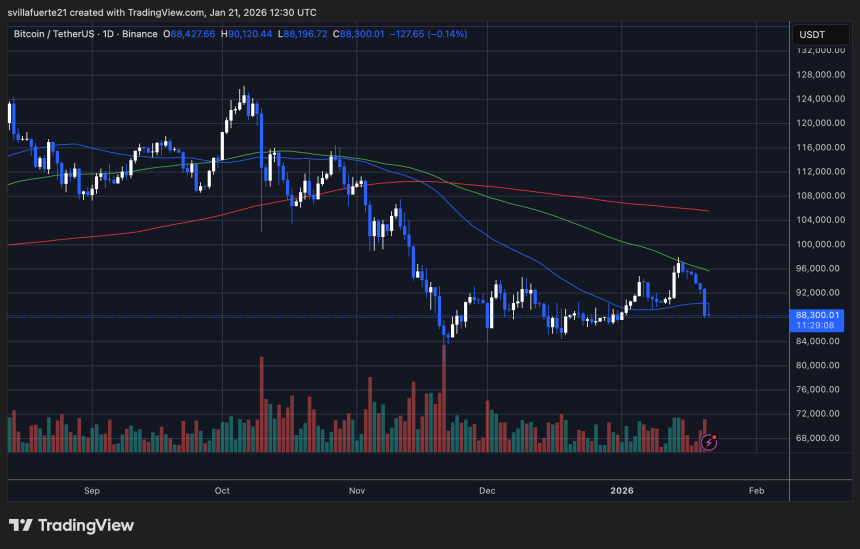
Bitcoin is showing renewed weakness after losing the $90,000 psychological level, with price now trading near $88,300 on the daily chart. The structure reflects a clear downtrend from the late-2025 highs, followed by a failed attempt to recover. After a sharp drop in November, BTC stabilized and built a short consolidation base, but the rebound into early January lacked follow-through and quickly turned into another rejection.

BTC testing support level | Source: BTCUSDT chart on TradingView

From a technical perspective, BTC remains trapped below its major moving averages, which are now acting as dynamic resistance. The shorter-term average has rolled over sharply, while the broader trend line above continues to slope downward. Signaling that momentum remains capped, and sellers are still in control on rallies. The recent bounce toward the mid-$90K region was rejected aggressively, confirming that overhead supply remains heavy and buyers are not yet strong enough to flip the trend.

Volume patterns support this narrative. The biggest spikes occurred during the selloff leg, showing forced activity and distribution. While the most recent recovery attempts have been met with weaker participation. As long as Bitcoin stays below the $90K–$92K zone, price action suggests the market is still searching for a stable bottom. The downside risk remains elevated if fear accelerates across the broader crypto market.

Featured image from ChatGPT, chart from TradingView.com 

Bitcoin Fresh Buyers Fight To Stay Above Water: Stabilization Or Capitulation?

Bitcoin has slipped below the $90,000 psychological level, and bulls are now trying to defend the $88,000 mark to prevent a deeper correction. After days of heavy volatility across crypto markets, BTC is trading in a fragile zone where short-term sentiment can shift quickly, especially as traders react to macro uncertainty and weakening momentum. With price hovering near key on-chain levels, the next move could define whether this drop becomes a brief shakeout or the start of another leg lower.

Analyst Axel Adler highlighted that Bitcoin is currently testing one of its most important short-term “defense lines.” His Bitcoin Support and Resistance chart compares spot price with the realized cost basis of different short-term holder (STH) cohorts, turning these levels into dynamic support and resistance zones.

According to the data, BTC is trading right around the cost basis of the two freshest buyer groups: STH 0D-1D at roughly $89,800 and STH 1W-1M near $90,000. In other words, investors who entered the market over the past few weeks are sitting at breakeven, making this area highly sensitive.

Above current levels, resistance appears stacked. The 1M-3M cohort sits near $92,500 and is already underwater, meaning it may sell into rebounds, while the aggregated STH realized price around $99,300 remains a major ceiling.

STH MVRV Near a Statistical Extreme

Adler adds that another key metric reinforcing this fragile setup is Short-Term Holder MVRV (STH MVRV), which measures the ratio between Bitcoin’s market price and the cost basis of short-term holders. In simple terms, when STH MVRV drops below 1.0, it signals that this cohort is, on average, holding unrealized losses and is increasingly vulnerable to panic-driven selling.

According to Adler, current STH MVRV stands at 0.897, meaning short-term holders are clearly underwater. More importantly, the metric is approaching the lower boundary of its 155-day statistical range, where the Mean minus one standard deviation sits near 0.875. With only around 2.5% remaining before reaching that statistical minimum, Bitcoin is entering a zone that historically aligns with market exhaustion and local bottom formation.

Bitcoin STH MVRV 155 days Range | Source: CryptoQuant

Adler notes that in many past observations, price stabilization occurred when the metric touched or approached this lower band, as buyers stepped in and selling pressure weakened. However, the market remains at a critical decision point. A clean break below 0.875 would signal extreme oversold conditions and raise the risk of short-term holder capitulation.

Together, both charts frame the same battlefield. The $89.8K–$90K region is the key defense zone for fresh buyers, while $92.5K now acts as resistance. With MVRV pressing toward a statistical extreme, Bitcoin is approaching a make-or-break moment between stabilization and deeper downside.

Bitcoin Bears Pressure Key Support Zones

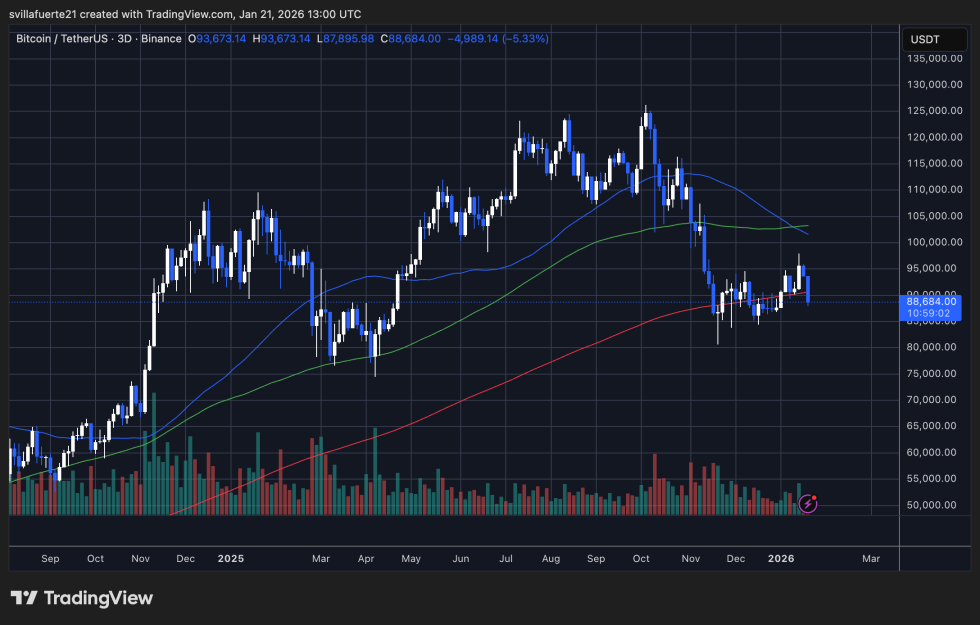
Bitcoin (BTC) is facing renewed downside pressure after failing to reclaim the $90,000 region, with the latest pullback pushing price toward the $88,600 area. The 3-day chart shows BTC slipping back into the lower part of its recent range, reflecting a fragile market structure where rallies are being sold and buyers remain hesitant to step in aggressively.

BTC consolidaes around critical level | Source: BTCUSDT chart on TradingView

From a trend perspective, BTC is trading below its key moving averages, with the faster lines curling downward and acting as dynamic resistance. The most notable barrier sits around the $100,000–$105,000 zone, where the broader trend indicators remain overhead and signal that the market is still in recovery mode rather than a confirmed uptrend. Even the recent bounce attempts have struggled to sustain momentum, highlighting that demand has not returned with enough force to absorb selling pressure.

At the same time, BTC continues to hold above the red long-term moving average, which is still rising and represents the broader bull market foundation. This keeps the larger structure intact, but the price action suggests that bulls must defend the $88,000–$90,000 area to prevent further weakness.

If BTC stabilizes and reclaims $90K, it could open the door for a push back into the mid-$90K range. However, if selling accelerates below $88K, the market risks revisiting deeper support levels from the late-2025 consolidation.

Featured image from ChatGPT, chart from TradingView.com 
Ethereum Supply Tightens On Binance As Reserves Hit Lowest Level Since 2016

Ethereum has slipped below the $3,000 level again as selling pressure returns across the broader crypto market, keeping bulls on the defensive after a brief recovery attempt. The move back under this psychological zone suggests that traders remain cautious, with downside volatility re-emerging as risk appetite fades and liquidity thins near key support levels.

However, while price action looks heavy in the short term, on-chain data is flashing a different signal beneath the surface. According to Arab Chain, Ethereum reserves held across centralized exchanges have dropped to around 16.2 million ETH, marking their lowest level since 2016. That milestone matters because it highlights a steady, long-duration trend of withdrawals rather than a sudden one-off event.

In practical terms, fewer coins sitting on exchanges typically means less immediate supply available for spot selling, especially during periods of market stress. This behavior can reflect a shift away from short-term trading and toward longer-term holding, self-custody, or deployment in DeFi.

Ethereum remains vulnerable as price struggles below $3,000. Still, the persistent reserve decline suggests that supply conditions may be tightening in the background, setting the stage for a sharper reaction if demand returns.

Binance Reserves Keep Falling

The CryptoQuant analysis also points to a similar reserve drawdown on Binance, reinforcing the broader exchange supply contraction narrative. Since the beginning of 2026, Binance’s Ethereum reserves have dropped from roughly 4.168 million ETH to around 4.0 million ETH, signaling steady withdrawals even as the price remains under pressure. This matters because Binance is often the main liquidity hub for ETH spot and derivatives, so shifts in its reserve balance can reflect real changes in market positioning.

Ethereum Exchange Reserve Binance | Source: CryptoQuant

What stands out is that this decline is happening without a meaningful rebound in inflows. In other words, ETH is not rotating back onto exchanges aggressively, suggesting sellers are not rushing to increase liquid supply at current levels. That dynamic typically aligns with a market where investors prefer holding behavior over active distribution. Either moving ETH to cold storage or deploying it across DeFi.

While reserves falling does not guarantee an immediate rally, it can change the supply-demand equation over time. With fewer coins sitting on exchanges, the market becomes more reactive if demand returns suddenly, as there is less readily available ETH to absorb buy pressure.

If Ethereum manages to reclaim key resistance levels, this supply tightening could amplify upside follow-through.

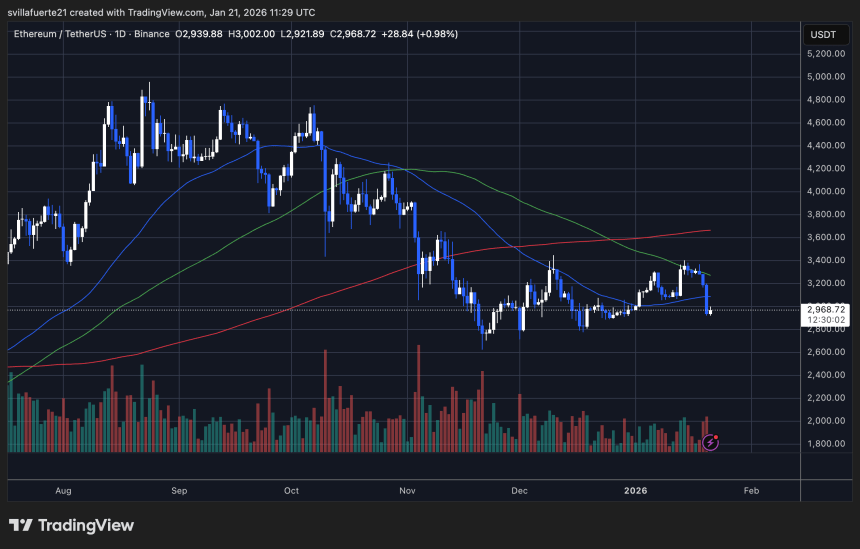
Ethereum Loses $3,000 as Bears Regain Control

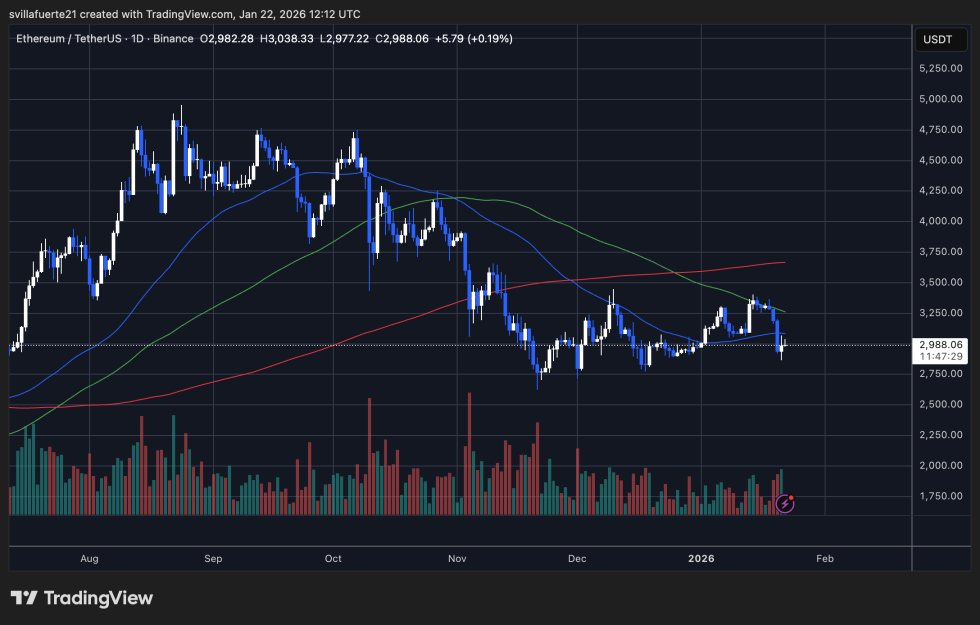
Ethereum is showing renewed weakness after failing to hold above the key $3,000 level, with price now hovering near $2,970 on the daily chart. After briefly stabilizing earlier this month, ETH attempted a rebound toward the $3,300–$3,400 supply zone. But momentum faded quickly as sellers stepped back in and pushed the market lower.

ETH testing critical support | Source: ETHUSDT chart on TradingView

From a technical perspective, Ethereum remains trapped below its major moving averages, reinforcing the bearish structure. The recent rejection near the descending trend of the 200-day average signals that upside attempts are still being capped by overhead resistance. Keeping bulls on the defensive. At the same time, the breakdown below $3,000 shifts market sentiment back into risk-off mode. Especially as crypto traders remain sensitive to broader macro uncertainty.

The current price action also reflects a fragile recovery attempt rather than a confirmed reversal. ETH’s latest drop places focus on the $2,850–$2,900 region as the next support area. An area where buyers previously stepped in during earlier selloffs. If this zone fails to hold, the market could revisit deeper levels from the previous correction phase.

For bulls to regain control, Ethereum must reclaim $3,000 quickly and build stronger demand above that threshold.

Trump Tariffs Fuel Bitcoin’s Risk-Off Correction: Exchange Netflows Hint At Short-Term Selling

Bitcoin slipped below the $90,000 level as global markets reacted to rising macroeconomic tension between the United States and the European Union. Investors are closely watching the latest trade headlines, as renewed tariff threats increase uncertainty around global growth, corporate earnings, and inflation dynamics. When friction between major economies escalates, risk appetite typically fades, and crypto tends to feel the impact fast as traders reduce exposure and cut leverage.

According to an analysis by XWIN Research Japan, Bitcoin’s recent weakness fits a broader pattern that has been developing since 2025. The report argues that the Trump administration’s renewed tariff push has acted as a consistent downside pressure for BTC, mainly because tariffs influence multiple pillars of the macro environment at once. Higher tariffs can squeeze company margins, disrupt supply chains, and push inflation expectations higher, which complicates the outlook for interest rates and monetary policy.

In this environment, Bitcoin has continued to behave more like a macro-sensitive risk asset than a defensive hedge. Instead of attracting safe-haven flows, BTC has often moved in sync with equities during trade-driven risk-off waves. As a result, even brief bursts of bullish momentum have struggled to hold when economic uncertainty rises and capital rotates into safer positioning.

Tariff Risk Keeps Bitcoin Tied to Macro Conditions

The XWIN Research Japan report explains that several Bitcoin pullbacks between 2025 and 2026 aligned with periods of rising economic uncertainty driven by tariff hikes and trade frictions. During these episodes, BTC declined alongside equities, reinforcing that the market still treats Bitcoin as a macro-sensitive risk asset rather than a defensive hedge. Instead of decoupling during stress, Bitcoin often reacts like a high-beta instrument when traders rush to reduce volatility in their portfolios.

Bitcoin Exchange Netflow | Source: CryptoQuant

Economic risk tends to hit Bitcoin quickly because investor behavior adjusts fast. As uncertainty around growth and interest rates increases, capital typically shifts toward short-term protection. In that process, Bitcoin is frequently viewed as a liquid asset that can be sold temporarily to lower portfolio risk, rather than a long-term store of value that benefits from risk-off flows. This dynamic can amplify downside moves even when long-term fundamentals remain intact.

Exchange Netflow provides a supplementary layer of evidence. During correction phases, brief spikes in exchange inflows often appear, consistent with tactical repositioning and short-term profit protection. However, these inflows have not persisted, suggesting the absence of sustained structural selling pressure.

For now, the base scenario remains that tariff-driven economic risk is weighing on Bitcoin. If exchange inflows become sustained and supply-demand conditions weaken further, that assessment would need to be reassessed.

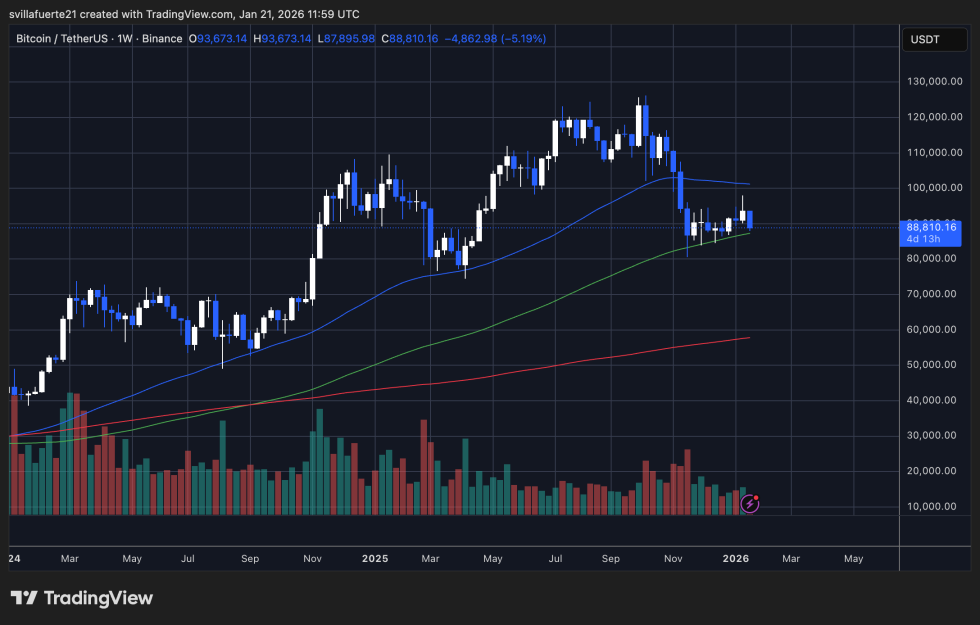
BTC Holds Its Ground After Breaking Below $90K

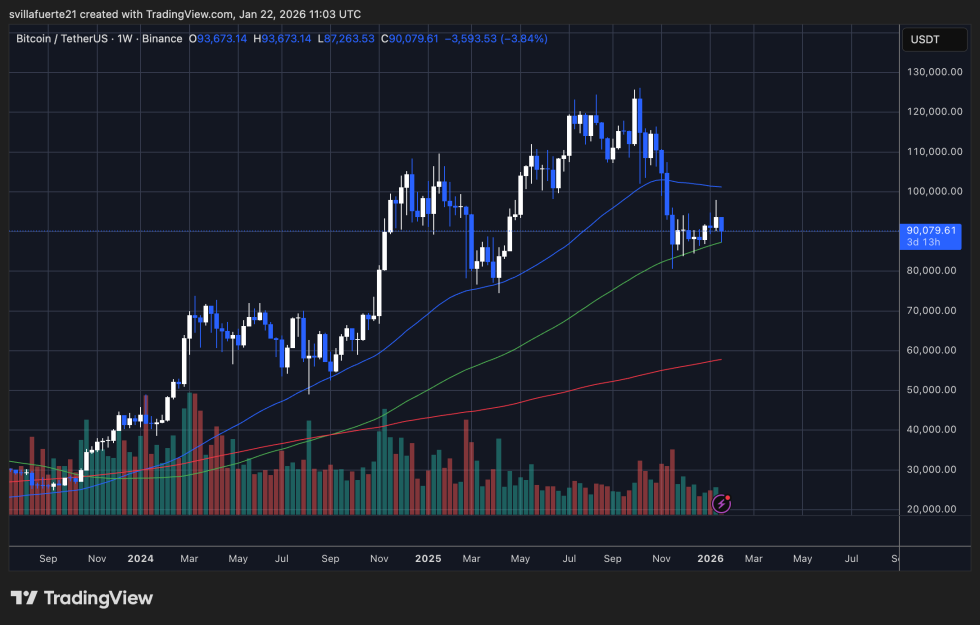
Bitcoin is trading around $88,800 on the weekly chart after a sharp selloff that briefly pushed price below the $90,000 psychological level. This drop marks a clear shift in momentum, as BTC failed to hold the mid-range structure that supported price action throughout the late-2025 consolidation phase. The weekly candle shows heavy downside pressure, with sellers rejecting attempts to stabilize above $92,000 and forcing a retest of lower demand.

BTC testing critical demand level | Source: BTCUSDT chart on TradingView

Technically, Bitcoin remains trapped between key moving averages. Price is still below the blue long-term trend line, which has acted as dynamic resistance since the breakdown from the $100,000+ region. At the same time, BTC is holding above the green moving average, suggesting that while the market is weak, longer-term buyers are still defending the broader uptrend structure.

This creates a fragile equilibrium: as long as Bitcoin holds above the current support zone, bulls can attempt to rebuild a base and reclaim $90,000-$92,000. However, if volatility expands and the market loses the green trend line, it would expose BTC to a deeper correction toward the mid-$80,000s, where previous demand briefly stepped in during the prior drawdown.

Featured image from ChatGPT, chart from TradingView.com 

Bitcoin Recovers In January: Funding Divergence Points To A Spot-Driven Market

Bitcoin is trying to hold above the $91,000 level as the market searches for support, but demand remains fragile after weeks of volatility. While the recent decline has pressured sentiment, a CryptoQuant report suggests January is still shaping up as a recovery phase rather than a full breakdown. The analysis points to cautious optimism driven by institutional and whale-level accumulation, while retail participation remains hesitant and risk-averse.

According to Binance-related data, Bitcoin’s spot price action and funding rates have started to diverge in early 2026, signaling a spot-driven market environment. This setup is often viewed as constructive because it implies the latest move is being supported more by real spot buying than by excessive leverage in derivatives. In practice, a spot-led trend tends to reduce the risk of sudden liquidation cascades, which have recently amplified downside moves across the crypto market.

Bitcoin Binance Divergence BTC-USDT and Funding Rate | Source: CryptoQuant

CryptoQuant notes that spot-driven conditions can also create more durable rallies, since they attract organic inflows and allow price to climb without relying on unstable speculative positioning. Historical comparisons to the 2021 and 2024 cycles show similar divergences between spot strength and muted funding rates often preceded extended upside expansions, ranging from 20% to 50%.

Is the Four-Year Bitcoin Cycle Breaking Down?

The CryptoQuant report raises a bigger question that many investors are now debating: is the traditional four-year Bitcoin cycle starting to fade? As the market matures, analysts argue that the old post-halving pattern may no longer apply in the same way. Since 2024, spot Bitcoin ETFs and corporate treasuries have been absorbing a growing share of supply, potentially creating steadier demand and reducing the boom-and-bust dynamics that defined prior cycles.

This argument gained traction in 2025. Despite being a post-halving year, Bitcoin failed to deliver the type of parabolic rally seen in previous cycles, while altcoins also struggled to produce a true “altseason.” That divergence has led some analysts to conclude that halvings are becoming less dominant as a driver, especially now that Bitcoin trades as a $2T+ macro asset.

Instead, market direction may be increasingly shaped by global liquidity conditions, including Federal Reserve policy, M2 growth, geopolitical risk, and large-scale institutional flows. Analysts like Raoul Pal have framed this as a shift toward longer liquidity cycles that could last five years or more, reinforcing the idea that the four-year framework may be outdated.

The report also highlights Binance as a critical reference point. Historically favored by whales, Binance remains a major leading indicator for broader crypto market positioning and flows.

Bitcoin Weekly Chart Signals Fragile Recovery

Bitcoin is attempting to stabilize after weeks of heavy selling pressure, but the weekly structure still reflects a market fighting to reclaim lost ground. BTC is trading near $91,075 after printing a sharp weekly pullback, reinforcing that volatility remains elevated even as price tries to base. The recent rebound from the sub-$85,000 region shows buyers stepping in aggressively, yet the recovery still looks fragile while broader macro uncertainty keeps risk appetite limited across crypto.

BTC consolidates around key level | Source: BTCUST chart on TradingView

From a technical perspective, Bitcoin is hovering around the zone where previous support has flipped into resistance. Price is currently sitting near the rising 100-week moving average (green), which is acting as a key pivot for bulls. Holding above this level would signal that demand is strong enough to absorb supply during dips. However, the 50-week moving average (blue) has rolled over and remains above price, highlighting that the broader trend has not fully reset bullish momentum.

The 200-week moving average (red) continues to trend higher far below current levels, confirming the long-term uptrend remains intact. For now, the market likely needs a clean weekly reclaim above $95,000 to shift sentiment. Until then, this bounce risks being treated as corrective rather than trend-confirming.

Featured image from ChatGPT, chart from TradingView.com 

Binance Order Flow Suggests Ethereum Is In Correction Mode: Demand Still Missing

Ethereum is trying to stabilize above the $3,100 level after failing to break the $3,400 resistance, as the broader crypto market struggles to recover momentum. While bulls managed to defend key support in recent sessions, price action remains fragile and highly reactive, with sellers still showing up on rallies. ETH is stuck in a tight range, and traders are watching closely to see whether this pullback turns into a deeper correction or simply a reset before the next move higher.

A report from Arab Chain highlights that Binance data is signaling a sensitive phase for Ethereum at the start of 2026. According to the analysis, ETH is trading near the $3,200 zone, but market flow conditions remain tilted to the downside.

The Accumulated Order Flow (CVD) indicator sits at approximately -3,676, suggesting that net selling pressure is still dominating short-term activity. In simple terms, more aggressive sell orders are hitting the market than buy orders, even as price attempts to hold recent levels.

This divergence between price stabilization and negative flow reflects a market that is not collapsing, but also not attracting strong demand yet. As Ethereum defends support, the next test will be whether buyers can reclaim $3,300 and challenge the $3,400 ceiling again, or if weakness drags price back toward deeper support zones.

Ethereum Holds Despite Negative Binance Order Flow

Arab Chain notes that even though Ethereum’s CVD remains negative, the relationship between price and liquidity flows is not fully broken. According to the report, the 30-day correlation between ETH price and CVD sits near 0.62, which is a relatively constructive reading. This pattern suggests that price action partially aligns with volume behavior, even though liquidity currently tilts toward selling rather than fresh buying.

In other words, Ethereum is not trading in a vacuum—flows still matter—and the market is reacting in a way that reflects real positioning.

Binance ETH CVD Momentum & Price Correlation | Source: CryptoQuant

From a broader perspective, ETH’s gradual decline to its current levels signals a correction phase following its previous upside surge. Historically, this is the type of environment where short-term investors take profits and reduce exposure, while larger players begin to rebalance portfolios and slowly rebuild positions. Instead of an immediate trend reversal, the market often transitions into sideways price action as both sides test liquidity.

The key issue is that CVD remains negative, meaning demand has not yet become strong enough to flip the short-term flow structure. However, Ethereum’s ability to hold above the $3,000 level points to underlying support that is limiting downside acceleration.

This mismatch—weak momentum in volume flows but stable price behavior—often precedes quieter consolidation periods that can later set the foundation for stronger upside once liquidity conditions improve.

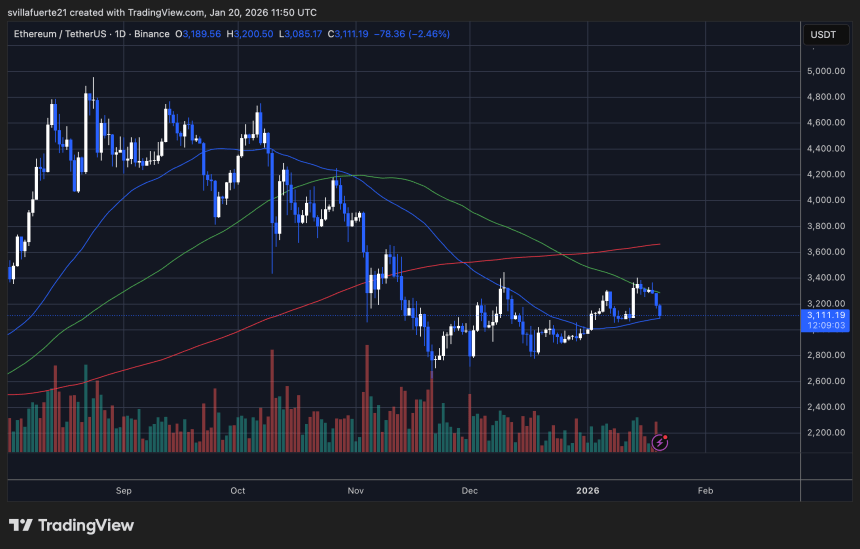
EETH Bulls Fight to Reclaim $3,100

Ethereum is trying to stabilize above the $3,100 level after a sharp rejection from the $3,400 supply zone, with price now trading near $3,111. The chart shows ETH still recovering from the broader downtrend that started after the November breakdown, but the structure remains fragile as sellers continue defending every attempt to push higher.

ETH testing key MA | Source: ETHUSDT chart on TradingView

From a technical perspective, the $3,300–$3,400 region stands out as the key resistance cluster. Price has repeatedly failed in this area, and the latest rejection confirms it remains a major distribution level. At the same time, Ethereum is holding above its short-term moving average near $3,050–$3,100. Suggesting buyers are still active, defending the current range.

However, ETH remains capped below the mid-term moving averages, which are trending lower and acting as dynamic resistance. This keeps the market in a “recovery inside a downtrend” setup unless bulls can flip those levels back into support. Volume has also remained relatively muted during the rebound, signaling that the move still lacks aggressive follow-through.

Ethereum appears stuck in consolidation. With $3,000 as the critical floor and $3,400 as the breakout trigger needed to shift market sentiment.

Featured image from ChatGPT, chart from TradingView.com 
Bitcoin’s Pullback Feels Brutal, But History Says It Could Drag On For Months

Bitcoin has slipped below the $92,000 level after a sharp decline that began on Sunday, signaling that downside pressure is still shaping market conditions. Despite the drop, bulls are trying to defend current levels and regain control, with many traders watching for a rebound that could restore confidence across the broader crypto market. The move comes at a sensitive moment, as risk appetite remains fragile and short-term volatility continues to shake out leveraged positioning.

Top analyst Darkfost highlighted that the market is now 109 days removed from Bitcoin’s last all-time high, placing the current drawdown into a wider cycle context. In previous major corrections, Bitcoin spent far longer in recovery mode, including 236 days between March 2024 and November, followed by another 154-day correction window between December 2024 and May 2025. Compared to those periods, the current pullback may still be early in its timeline, even if price action already feels aggressive.

Bitcoin Days Since last ATH | Source: CryptoQuant

What makes this correction stand out is the intensity of the pain across the market. Realized losses have stacked up, capitulation has been more visible, and short-term holders appear increasingly stressed, creating the sense that this decline is heavier than past resets. Even so, history suggests Bitcoin can remain in a choppy recovery phase for months without breaking the broader cycle structure.

Capitulation Builds, But the Cycle May Still Be Intact

Bitcoin’s recent decline has not been a “clean” pullback. Realized losses have stacked up, capitulation has looked aggressive, and short-term holders remain under heavy pressure as the market punishes late entries and weak conviction. Liquidation data has also shown how leverage has amplified the downside, with forced selling accelerating drops that might have otherwise played out more gradually. That backdrop is exactly why the correction feels so violent, even compared to past drawdowns.

However, Darkfost argues this phase still fits within the broader rhythm of Bitcoin’s cycle. His key point is that extended corrections are not unusual, even when they feel unusually painful in real time. From that perspective, the market could easily spend more months digesting losses and rebuilding positioning without signaling a full structural breakdown.

Where this cycle becomes more complex is the macro timing. Unlike previous cycles, Bitcoin’s post-bear all-time high and the halving narrative have overlapped with a new variable: ETF-driven demand. That shift changes how drawdowns develop, because deeper pools of institutional capital can absorb supply differently than retail-led rallies. If this institutional trend continues, Bitcoin may be transitioning into a structurally different market regime, with longer consolidations and less predictable “four-year cycle” behavior.

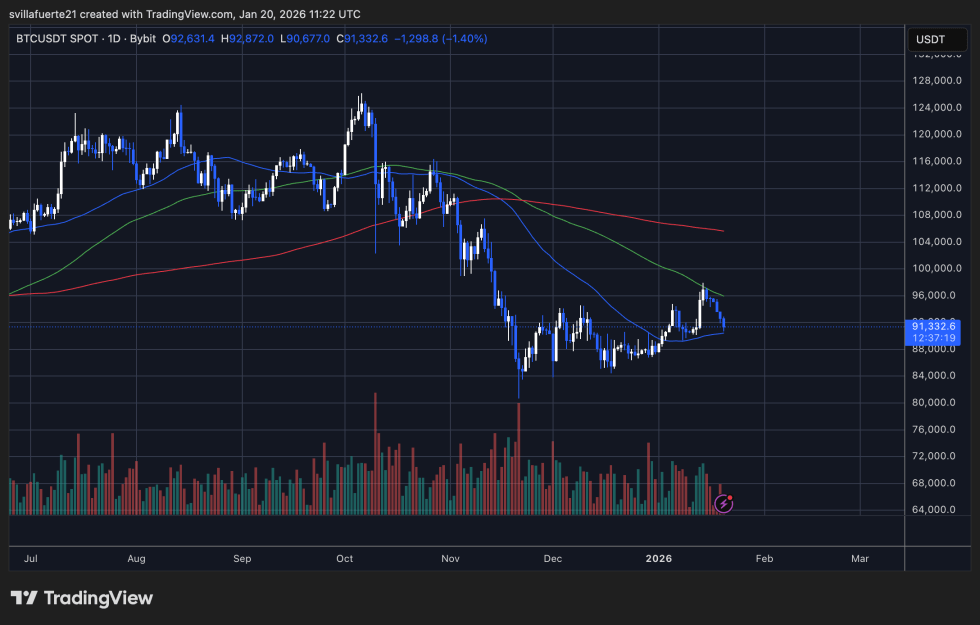
Bitcoin Slips Below Key Averages as Bulls Defend $90K Support

Bitcoin is back under pressure after failing to hold above the $92,000 zone, with the chart showing price sliding toward $91,300 as selling accelerates. The move keeps BTC trapped below major moving averages, reinforcing the idea that this rebound is still fragile and highly reactive to headline-driven volatility. After the January recovery attempt, the rejection near the descending resistance structure highlights that sellers remain active on rallies, limiting bullish follow-through.

BTC testing key demand level | Source: BTCUSDT Chart on TradingView

Technically, the market continues to trade beneath the 50-day and 100-day trend lines, while the longer-term averages remain overhead, acting as dynamic resistance. This structure suggests BTC is still in a corrective phase rather than a confirmed trend reversal, despite short-term optimism earlier this month. Volume also shows a lack of sustained demand expansion, supporting the view that buyers are defending levels, but not fully regaining control.

The $90,000–$88,000 range now stands out as a critical support area, as it has acted as a base during recent consolidation. A clean breakdown below it could reopen downside risk toward the December lows, while a hold could keep the market building a recovery structure. For bulls, the first step is stabilizing above $92,000 again, then reclaiming the mid-$90,000s to shift momentum back in their favor.

Featured image from ChatGPT, chart from TradingView.com 

XRP Leverage Builds Without Overheating: Open Interest Climbs And Volatility Spikes

XRP lost the $2 level after the broader crypto market suffered sharp declines on Monday, dragging price action back into a fragile zone. While the move rattled traders, Binance derivatives data suggests the sell-off has not triggered an extreme leverage unwind yet. Instead, the market appears to be entering a transitional phase where risk is rising, but speculative behavior remains relatively controlled.

Open interest metrics show a delicate balance between positioning and price weakness. Total XRP open interest on Binance climbed to roughly $566.48 million, pushing above the 30-day average near $528.84 million. This spread implies that fresh positions are still being added despite the downturn, but the pace looks measured rather than euphoric. In other words, traders are stepping in cautiously, not flooding the market with aggressive leverage.

The 30-day rolling Z-Score framework helps contextualize this shift. With open interest expanding while volatility stays contained, XRP may be building the conditions for a larger move ahead. For now, however, price remains vulnerable, and the next direction will likely depend on whether liquidity returns or fear deepens.

Open Interest Volatility Rises as XRP Builds Toward a Bigger Move

Arab Chain’s CryptoQuant read shows the most important shift isn’t the headline open interest figure, but the instability underneath it. The 30-day standard deviation of XRP open interest (oi_std30) has climbed to roughly $65.7 million, marking its highest level since November. That matters because it signals open interest is starting to swing more aggressively around its average, a pattern that often shows up before price leaves a tight range and enters expansion mode.

XRP Open Interest Z-Score | Source: CryptoQuant

At the same time, the leverage signal still looks contained. The Z-Score holds near 0.57, signaling an elevated but not extreme level. In practical terms, positioning is growing, but it doesn’t look like the market is overheating or entering the kind of reckless leverage phase that typically leads to instant liquidation cascades. That combination—rising volatility in positioning while the Z-Score remains moderate—suggests momentum is building without a clear directional commitment yet.

This puts XRP in a “risk-on, but cautious” environment. Traders are adding exposure, volatility is creeping higher, and the setup is becoming more reactive. From here, oi_std30 becomes a key metric to track alongside price structure, because whichever way price breaks, the market is increasingly positioned for a larger move.

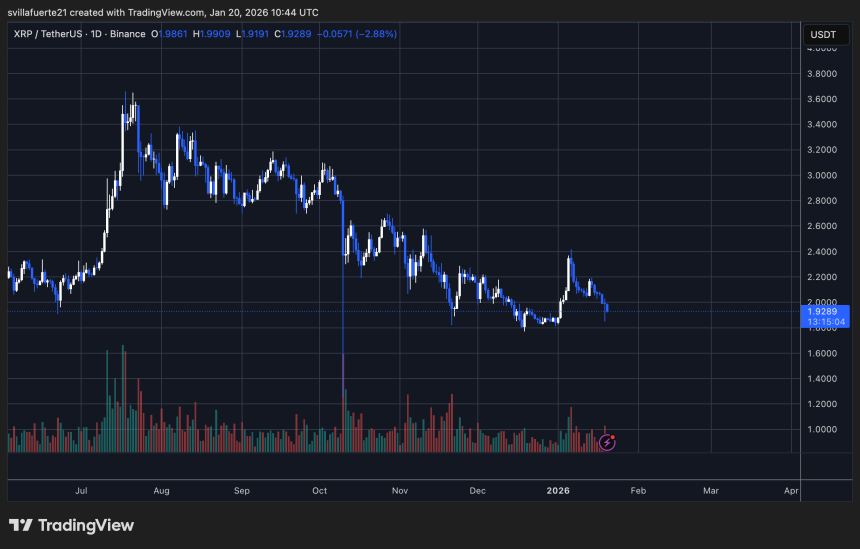
XRP Slides Back Toward $1.90 as Bears Keep Control

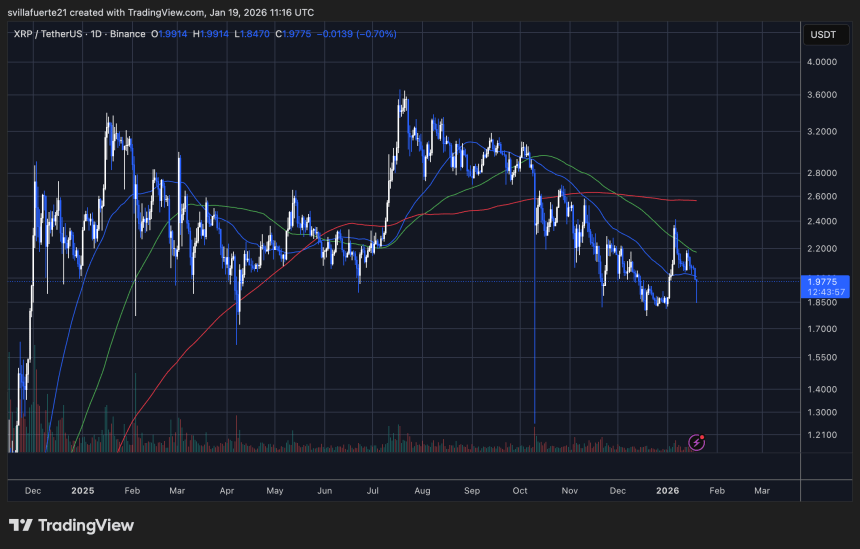
XRP remains under heavy pressure, with the chart showing price slipping back toward the $1.90 zone after failing to hold the $2 level. The market is printing a clear sequence of lower highs and lower lows, confirming that the broader trend is still bearish despite several short-lived rebounds over recent weeks. Each time XRP attempts to recover, sellers quickly step in and cap momentum before it can reclaim key resistance levels.

XRP testing critical demand | Source: XRPUSDT chart on TradingView

The latest move highlights this weakness. XRP briefly pushed higher in early January but immediately rolled over, showing that demand is still too soft to sustain a breakout. The $2.00 region has now flipped into overhead resistance, and price will likely need a strong bullish catalyst to break back above it with conviction.

From a structure perspective, the current support area sits around $1.85–$1.90, which has acted as a short-term floor during the recent consolidation. If this zone fails, XRP could quickly revisit lower liquidity pockets, extending the downtrend.

Volume also reflects uncertainty. Activity remains erratic despite occasional, isolated spikes. This suggests the market is still reacting to fear-driven flows rather than steady accumulation. Price stalls in a fragile consolidation phase. And bulls need to reclaim above $2 to shift the short-term narrative back in their favor.

Featured image from ChatGPT, chart from TradingView.com 

ONDO’s Silent Accumulation: Whales Absorb The 1.94B Unlock While Price Bleeds

ONDO has lost over 65% of its value since October as heavy selling pressure continues to dominate the altcoin market. While Bitcoin has shown relative stability at key levels, many mid-cap tokens like ONDO have struggled to find consistent demand. This drawdown has pushed sentiment toward the bearish side, especially as traders remain cautious around liquidity events and token unlocks.

Still, some analysts argue that the current dip is not purely a sign of weakness. A CryptoQuant report explains that the headlines may scream “price drop,” but the on-chain data is pointing toward “opportunity” instead. The focus is now on ONDO’s massive 1.94 billion token unlock scheduled for January 18, 2026. Historically, unlocks can trigger panic selling, as investors anticipate higher circulating supply and additional distribution pressure.

However, this time may be different. The report suggests that larger market participants are actively positioning through the decline, using the fear as a liquidity window. Rather than treating the unlock as a reason to exit, the data hints that “smart money” is stepping in to absorb supply while retail confidence remains fragile. That sets the stage for a critical test.

Smart Money Absorption Signals Are Building

The CryptoQuant report outlines why larger investors appear to be ignoring the noise around ONDO’s decline. The first signal is the “whale shield.” Despite the sharp correction since the December 2024 peak, Spot Average Order Size continues to be dominated by “Big Whale Orders,” shown through consistent green dots on the chart. This implies institutions are using weakness to absorb liquidity, with the $0.35–$0.40 zone acting as a primary accumulation range.

Ondo Spot Average Order Size | Source: CryptoQuant

Second, ONDO has officially entered a Taker Buy Dominant phase. The 90-day Cumulative Volume Delta (CVD) remains positive and continues rising, showing that market buy pressure has outweighed market sells for months. This is important because takers represent aggressive participants who buy at the ask without waiting for better entries.

The report frames this alignment as “taker alpha.” When large whale orders and aggressive taker buying strengthen while the price falls, it often reflects absorption. If this continues through the unlock, ONDO could be building a coiled-spring setup for a 2026 RWA breakout.

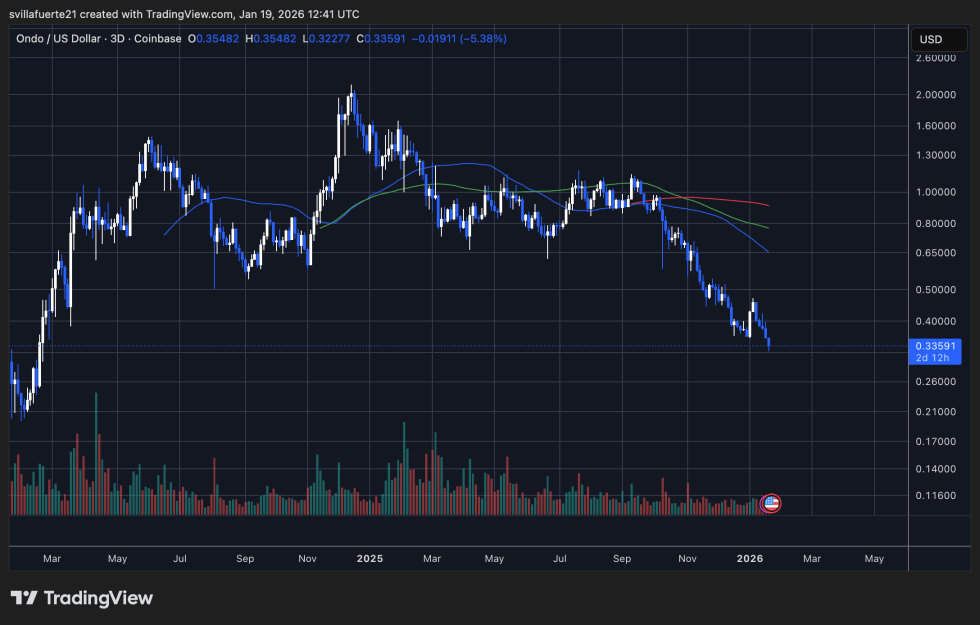
ONDO Extends Downtrend as Bulls Defend Key Demand Zone

ONDO remains under heavy pressure after a prolonged decline that has erased most of its 2025 upside. The 3-day chart shows a clear breakdown from the former consolidation range near $0.90–$1.00, where price repeatedly failed to reclaim momentum during the second half of the year. Once sellers forced a decisive move lower, the market quickly transitioned into a steep downtrend marked by weak bounces and consistent lower highs.

ONDO testing fresh demand level | Source: ONDOUSDT chart on TradingView

At the time of writing, ONDO is trading near $0.33 after slipping below the $0.40 handle, a psychological level that previously acted as temporary support. This drop places the token deep below its key moving averages, with the shorter trend lines rolling over and acting as overhead resistance. The failed recovery attempts throughout late 2025 confirm that sellers have stayed in control, while buyers have struggled to generate enough volume to shift the trend.

However, price is now approaching a potential demand zone around $0.30–$0.35, where volatility historically increases and dip buyers may try to step in. If this area fails, the chart suggests downside could accelerate. Still, a strong defense could open the door for a stabilization phase before any meaningful rebound.

Featured image from ChatGPT, chart from TradingView.com 
Trade War Headlines Trigger $800M In Liquidations Overnight: Longs Get Wiped Out Across Crypto Markets

The crypto market faced a sharp selloff overnight as renewed trade conflict fears between the United States and the European Union shook global risk sentiment. Bitcoin and major altcoins reversed recent gains, with traders reacting to fresh tariff headlines and the possibility of escalating economic retaliation on both sides of the Atlantic. While crypto is often viewed as a separate market, this move once again showed how quickly digital assets can behave like high-beta risk trades when macro uncertainty spikes.

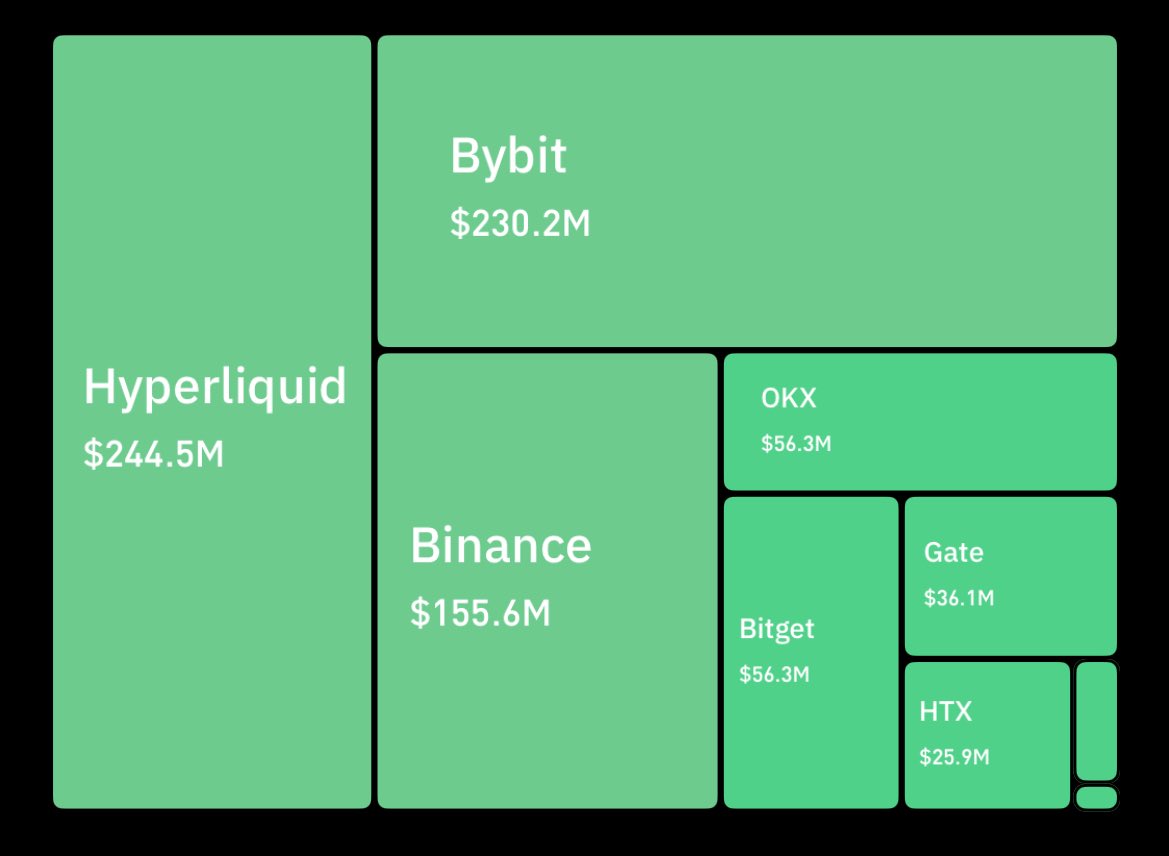
According to analyst Darkfost, the liquidation impact was immediate and aggressive. More than $800 million worth of leveraged positions were wiped out in a matter of hours, including roughly $768 million in long liquidations. The scale of long closures suggests that traders were positioned for continuation to the upside, but were caught offside as prices rolled over sharply.

Crypto Market Liquidations by Exchange | Source: Coinglass

What stood out most was where the damage occurred. Darkfost noted that Hyperliquid recorded the largest share of forced liquidations, with $241 million, while Bybit followed closely with $220 million. The wave of liquidations appears partly tied to the announcement of new tariffs targeting Europe, which triggered an equally fast response from EU policymakers, reigniting the broader “trade war” narrative across markets.

CME Opens the Door to Fresh Volatility

Darkfost warns that the timing of this selloff matters as much as the liquidation size. As soon as CME trading opened, Bitcoin saw a sharp downside move, suggesting that institutional flows and macro-linked positioning played a direct role in the shakeout. In past risk-off episodes, the CME open has often acted like a volatility trigger, especially when markets are already fragile, and leverage is elevated across major exchanges.

This is why the next few hours are critical. The same type of move could easily repeat at the opening of the US markets, where liquidity conditions and headline sensitivity tend to amplify reactions. If sellers press again, the market could see another cascade of forced closures, particularly in high-beta altcoins that remain vulnerable after the overnight wipeout.

The message is straightforward: stay cautious and avoid overexposure to leverage while the macro backdrop remains unstable. Liquidations can create sharp bounces, but they can also reset momentum quickly if fear spreads across risk assets.

Darkfost adds that attention should remain on incoming political updates. The market is now trading the narrative, not just the chart. Further statements could arrive at any moment, and as history has shown, Trump often delivers market-moving headlines right in the middle of the weekend.

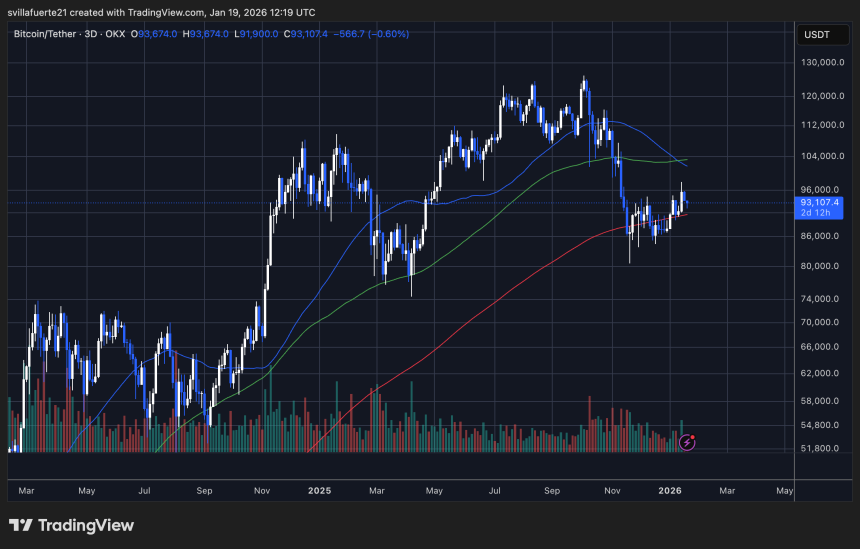
Bitcoin Holds Fragile Rebound As Crypto Tests Macro Nerves

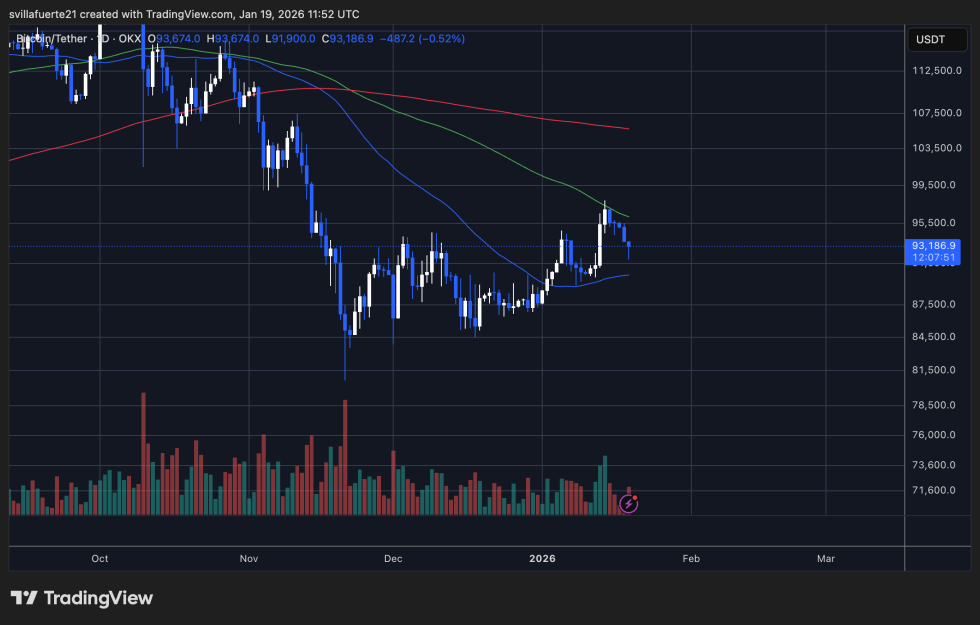
Bitcoin is trading near $93,100 after a sharp rejection from the $96,000–$97,000 supply zone. The chart shows BTC still struggling below key moving averages, with momentum capped by the declining blue trendline overhead. This reinforces the idea that the latest upside attempt was more of a rebound than a clean trend reversal.

BTC consolidates in a long range | Source: BTCUSDT chart on TradingView

Structurally, price is forming higher lows after the violent breakdown from the $110,000 area. However, the rebound remains vulnerable as long as BTC stays trapped beneath resistance and fails to reclaim the mid-$90,000s with conviction. The recent candles also highlight hesitation, with wicks suggesting aggressive selling into strength.

The red long-term moving average is rising near the low-$90,000s, acting as a potential dynamic support zone. If Bitcoin holds above that level, it keeps the recovery structure intact and prevents a deeper reset toward prior liquidity pockets.

This matters for the broader crypto market. When BTC remains range-bound under resistance, altcoins usually struggle to sustain rallies and become more sensitive to liquidation-driven volatility. Risk appetite can return quickly, but it requires Bitcoin to break above resistance and hold. Until then, crypto remains in a fragile stabilization phase, not a confirmed bullish continuation.

Featured image from ChatGPT, chart from TradingView.com 

Bitcoin Cycle Isn’t Over: Realized Price Bands Show Holder Stress Above Key Levels

Bitcoin saw a sharp pullback this week, dropping below the $92,500 mark after failing to hold above $95,500. While the decline reignited bear market fears across crypto, bulls are now trying to stabilize price and defend the current range before selling pressure accelerates further. The move came as markets reacted to renewed macro uncertainty, with tariff headlines out of Europe adding fresh risk-off pressure across global assets.

The latest narrative centers on potential EU retaliatory measures against the United States, including tariffs and trade restrictions aimed at countering political threats tied to NATO tensions. Even without immediate implementation, the headlines were enough to tighten liquidity and trigger fast deleveraging, pushing Bitcoin lower as traders reduced risk exposure.

Despite the drop, analyst MorenoDV argues the market is not collapsing into a cycle end, but instead entering a phase of “risk redistribution.” His view is based on Bitcoin’s Realized Price by UTXO age bands, a framework that helps map where psychological pressure is building across different holder groups. Rather than tracking trend direction, the metric highlights which cohorts are comfortable, which are underwater, and where latent selling pressure could emerge.

In MorenoDV’s view, Bitcoin is rotating stress between cohorts, not breaking structurally.

Realized Price Bands Show Where Bitcoin’s Stress Is Building

Bitcoin’s current drawdown is not creating uniform stress across the market. Instead, pressure is building unevenly across different holder cohorts, based on their realized price levels. In the current setup, spot price sits near $95,583, while the 1w–1m cohort realized price is $89,255 and the 1m–3m cohort is $93,504.

Bitcoin Realized Price UTXO Age Bands | Source: CryptoQuant

That means newer short-term holders are still in profit, which is an important stabilizing factor. When the most recent buyers are rewarded rather than punished, downside follow-through tends to weaken, because fear does not compound at the margin.

However, the pressure is concentrated in older short-term cohorts. The 3m–6m realized price stands at $114,808, and the 6m–12m cohort sits near $100,748, placing both groups underwater. This suggests Bitcoin has not been aggressively redistributed at lower levels, since a large portion of mid-term holders remains trapped above spot. The market is showing discomfort, but not capitulation, with losses being absorbed through patience rather than forced selling.

If Bitcoin begins reclaiming the 6m–12m realized price, that cohort’s stress could ease quickly. Still, sustainability depends on psychology. Mid-term holders must view this phase as a temporary drawdown, not a structural breakdown. If that belief breaks, selling pressure can appear even stronger.

Bitcoin Slides Below Key Support As Bulls Defend the Range

Bitcoin is under pressure again after failing to hold above the mid-$95,000 zone, with price now trading near $93,000. The chart shows a sharp rejection from the recent local high, followed by a clean move lower that has erased a large portion of the latest rebound. This shift suggests that upside momentum remains fragile, even after the market briefly reclaimed higher levels earlier in January.

BTC testing pivotal level | Source: BTCUSDT chart on TradingView

From a structure perspective, BTC is now back inside the broader consolidation range that formed after the late November sell-off. The recent bounce looked constructive at first, but the inability to sustain follow-through above resistance has brought sellers back into control. Volume has picked up on the decline, which typically reflects stronger conviction compared to slow pullbacks.

Bitcoin is also trading below its major moving averages on this timeframe, reinforcing the idea that the broader trend remains heavy until bulls reclaim key levels. In the near term, the market must hold support in the low-$92,000 to $93,000 region to avoid another liquidation-driven drop.

If bulls can stabilize price here, BTC may attempt another push toward $95,000. However, repeated rejections increase the risk of a deeper breakdown.

Featured image from ChatGPT, chart from TradingView.com 

XRP Longs Get Wiped: Binance Leads $5M Liquidation Wave

XRP is attempting to reclaim the $2 mark after a sharp breakdown that briefly dragged the price toward the $1.85 level. While bulls are trying to stabilize the move, the broader market remains under pressure as macroeconomic uncertainty rises and analysts continue to warn that crypto could be entering a deeper bear market phase. In this environment, volatility is being amplified by leverage, and XRP’s derivatives market has become a clear battleground.

A CryptoQuant report highlights how January 18 delivered one of the most painful sessions for leveraged XRP traders this month. Data from the XRP Exchange Liquidation Metrics shows a major wave of forced liquidations hitting long positions across major exchanges, signaling that many traders were positioned too aggressively into the downside move. Unlike trading volume or open interest, liquidation data reflects positions being closed involuntarily, meaning traders were wiped out rather than choosing to exit.
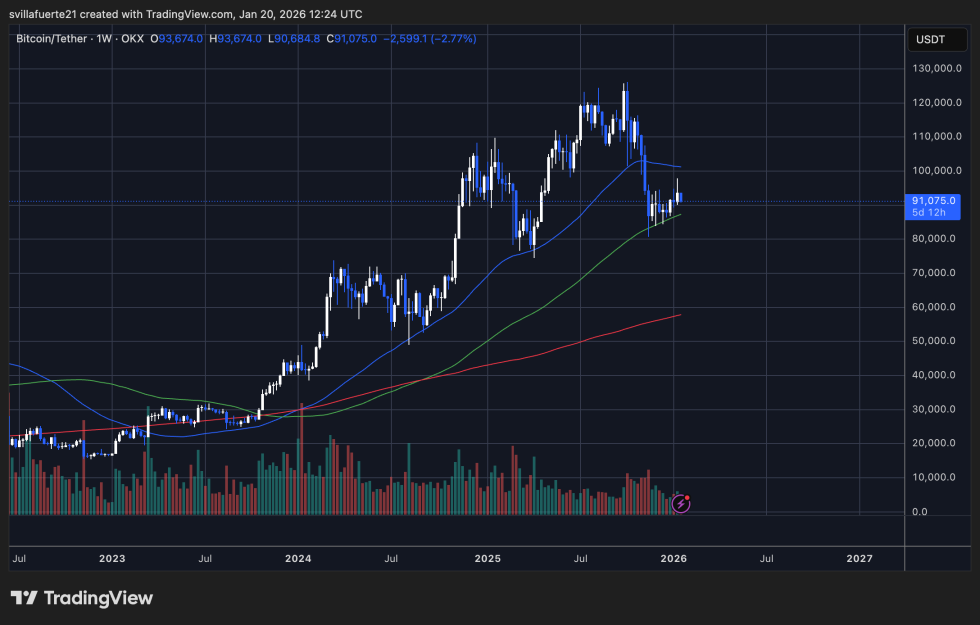
XRP Exchange Liquidation Metrics | Source: CryptoQuant

Total long liquidations reportedly exceeded $5 million on the day, marking a standout liquidation cluster for January. Binance played a dominant role in the flush, accounting for roughly $1.05 million in long liquidations, reinforcing its position as a key venue driving XRP’s short-term volatility.

Macro Headlines Triggered the XRP Leverage Flush

The CryptoQuant report suggests that XRP’s liquidation spike on January 18 was not purely technical, but part of a broader macro-driven risk-off move that hit the entire crypto market at once. Instead of a slow bleed, the sell-off looked like a synchronized shock, where traders across multiple assets were forced to reduce exposure as uncertainty surged in global markets.

According to the report, the trigger came from geopolitical and trade-war rhetoric. Financial Times reported that European capitals may respond to US pressure over Greenland by considering tariffs worth up to €93 billion ($107.7B), or even restricting US companies’ access to the EU market. Even without immediate policy action, the headline alone was enough to revive fears of renewed transatlantic escalation.

Markets typically treat these events as liquidity threats. When tariffs and retaliation enter the narrative, traders begin pricing in slower growth, tighter financial conditions, and more volatility. Crypto, still behaving as a high-beta risk asset, tends to react fast.

Bitcoin’s drop from above $95,000 to below $93,000 added fuel to the fire, reinforcing downside momentum across altcoins. In XRP, that pressure quickly turned into forced selling, as leveraged longs were liquidated into a falling market rather than exiting voluntarily.

XRP Struggles Below $2 After Sharp Rejection

XRP is attempting to stabilize after a violent downswing that pulled the price back into the $1.85–$2.00 zone. The daily chart shows a clear rejection from the recent rebound high near $2.40, followed by an aggressive selloff that erased most of the breakout attempt. XRP is now trading around $1.97, hovering just below the psychological $2 level. Which has turned into a short-term momentum pivot.

XRP consolidates around key price level | Source: XRPUSDT chart on TradingView

From a market structure perspective, the trend remains pressured. Price continues to trade under the major moving averages, with the faster average rolling over and acting as dynamic resistance. The mid-term curve is also sloping downward, reinforcing the idea that rallies are still being sold rather than held. This aligns with a broader pattern of lower highs since the October peak. Suggesting that the market is still in a corrective phase.

The wick structure and repeated failed pushes toward the $2.20–$2.40 region show sellers defending that supply zone aggressively. At the same time, buyers are taking action near $1.85, forming a visible demand floor that has held through recent volatility.

For bulls, reclaiming $2.10–$2.20 is the first step toward recovery. Otherwise, another breakdown toward $1.85 remains a valid risk.

❌