
❌

Reading view

There are new articles available, click to refresh the page.

DOJ Targets Crypto Fraud in β€˜America First’ Blitz as AI Scams Spike 450%

The U.S. Department of Justice is intensifying its efforts on crypto-related fraud as it escalates to execute what the authorities refer to as an β€œAmerica First” enforcement agenda in response to a surge of digital asset-related frauds driven more by artificial intelligence.

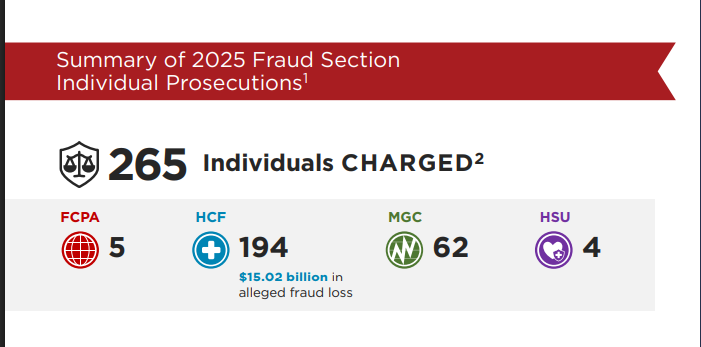
The shift was outlined in the DOJ Criminal Division Fraud Section 2025 Year in Review, published on Thursday, indicating prosecutors accused 265 defendants with a cumulative alleged loss on fraud cases of over $16 billion, nearly twice the amount reported the previous year.
Source: DOJ Criminal Division Fraud Section

Although the cases were in medical care, consumer protection, corporate fraud, and market manipulation, the DOJ said that cryptocurrency was increasingly becoming a type of payment rail, laundering, or asset category due to illicit funds.

In some significant cases, authorities seized crypto alongside cash, real estate, and luxury goods, showing the strong integration of digital assets into conventional fraudulent actions.

DOJ Health Care Fraud Crackdowns Lead to Major Crypto Seizures

One of the most prominent cases cited involved a $1 billion amniotic wound allograft fraud scheme that allegedly generated more than $600 million in improper Medicare payments.

Prosecutors charged Tyler Kontos, Joel Kupetz, and Jorge Kinds with targeting elderly and terminally ill patients for medically unnecessary procedures.

As part of the investigation, law enforcement seized more than $7.2 million in assets, including bank accounts and cryptocurrency.

The DOJ also highlighted the National Health Care Fraud Takedown carried out last year, the largest in the department’s history.

That operation charged 324 individuals across 50 federal districts for schemes involving more than $14.6 billion in intended losses.

Authorities confiscated more than $245 million in assets in the sweep, including significant amounts of cryptocurrency.

Simultaneously, the regulators prevented over $4 billion of fraudulent Medicare payments prior to their disbursement, indicating a more active, data-driven enforcement strategy.

Behind these cases is the DOJ Fraud Section, which operates through four specialized units that increasingly intersect with crypto-related crime.

Its units include foreign bribery, market and consumer fraud, healthcare fraud, and health and safety crimes, areas where digital assets and blockchain-based laundering are now frequently involved.
Source: DOJ Criminal Division Fraud Section

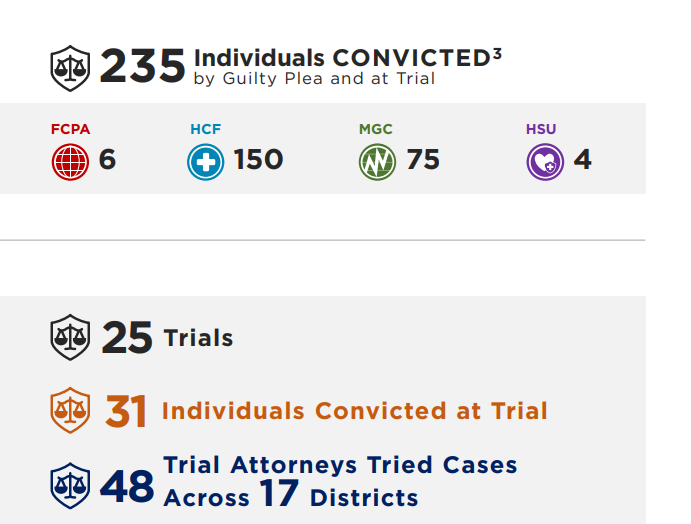
Prosecutors reported securing 235 convictions in 2025, including 25 trials across 17 federal districts.

AI-Assisted Scams Drive Sharp Rise in Crypto Fraud Losses

This enforcement surge comes as reported crypto fraud losses continue to climb. The FBI’s Internet Crime Complaint Center recorded more than 41,500 crypto investment scam complaints in 2024, with reported losses exceeding $5.8 billion.

Federal data shows total crypto scam losses reached roughly $9.3 billion last year, with older Americans disproportionately affected.

πŸ‘Ύ The FBI recorded $9.3 billion losses spread across various crypto-related investment scams, extortion, ATM and kiosks, among others, in 2024.#FBI #CryptoFraud #CryptoScamhttps://t.co/1Eb8KStAHk

β€” Cryptonews.com (@cryptonews) April 24, 2025

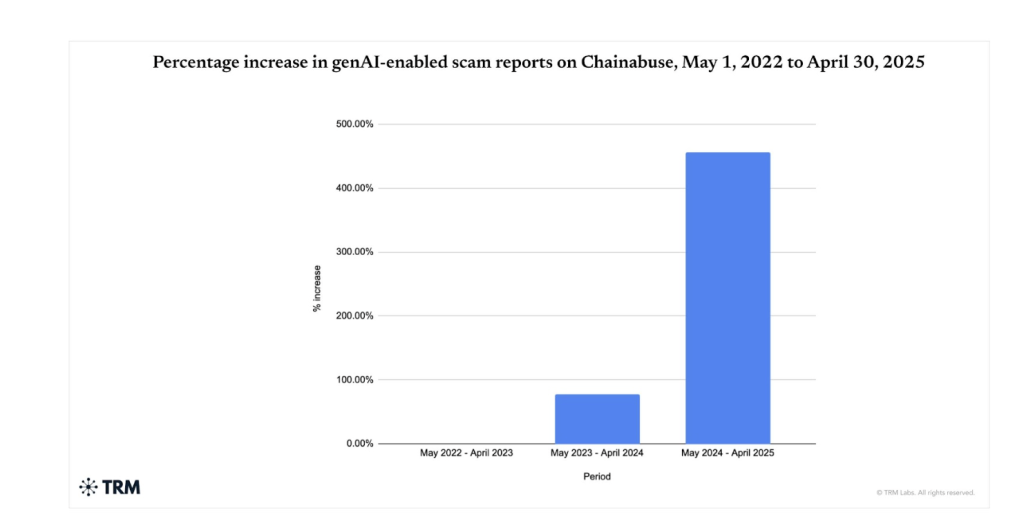
In 2025, blockchain analytics firms reported that average scam payments rose more than 250%, while AI-assisted scams have surged by more than 450%, as criminals deployed deepfake audio, synthetic identities, and automated phishing at scale.
Source: TRM Labs

In response, the DOJ and other agencies have launched coordinated initiatives aimed at transnational fraud networks, particularly so-called β€œpig butchering” scams linked to criminal groups operating in Southeast Asia.

A multi-agency strike force announced late last year has already seized and forfeited more than $401 million in cryptocurrency, including the largest bitcoin seizure in U.S. history.

Separately, the FBI’s Operation Level Up has notified thousands of potential victims and helped prevent hundreds of millions of dollars in additional losses.

Lawmakers have also moved to tighten the legal framework, as bipartisan bills introduced in Congress seek harsher penalties for AI-assisted fraud and stronger coordination across federal agencies to combat crypto-related scams.

In addition, two U.S. senators introduced the SAFE Crypto Act aimed at tightening the government’s response to cryptocurrency-related fraud.

The post DOJ Targets Crypto Fraud in β€˜America First’ Blitz as AI Scams Spike 450% appeared first on Cryptonews.

Top 3 Crypto Scams-Popular cryptocurrency scams

Topic : Top 3 Crypto Scams-Popular cryptocurrency scams

We are acquainted with cryptocurrency. However, few of us have heard about crypto scams. Crypto scams happen every year, and they indulge in fraud and have cheated investors in terms of billions of dollars. Over the previous year, cryptocurrency investors have been rewarded with tremendous returns.

Β Ethereum has been a 20-bagger in the last year or two, according to Peter Lynch, with other altcoins providing even greater returns.

Β Not to mention the meteoric ascent of nonfungible tokens (NFTs) in 2021. the value of crypto assets has skyrocketed, and these have brought everyday investors flocking to the cryptomarkets to get rich fast. This greed without proper research has been their undoing.

Β Scam artists and swindlers are also drawn to precious properties like moths to lightbulbs. Furthermore, unlike assets held in a bank or brokerage account, there is no FDIC or SIPC coverage to protect your money from hackers, thieves, and other tech-savvy criminals. Here, in this article, we will talk about the top crypto scams.Β 

1. SaveTheKids/Faze Saga(2021)Β 

In 2021, social media celebrities or influencers were among the most vocal and loud supporters of cryptocurrencies. Many of these influencers exploited their position and fame unfairly to support pump and dump scams, whether consciously or inadvertently.Β 

Proponents of this technique generally artificially inflate the price of a cryptocurrency by deceptive advertising and continuous promotion to sell their coins and pocket the gains as investors watch their money disappear. The save the kids token fraud was a perfect example of this philosophy in action.Β 

In June, members of the e-sports team FaZe clan began pushing a charity-based cryptocurrency called SaveTheKids. Members of the FaZe clan went all out to promote this token, including official promotional films and even their image on the SaveTheKids official website.Β 

Shortly after the token’s formal introduction and launch, the bulk of the token’s initial investors, who initially held the vast majority of the tokens, sold their tokens, and the coin quickly plunged in, value-creating losses of billions of dollars for those from the common public who bought into this cryptocurrency.Β 

Some eagle-eyed internet detectives began seeing a trend in which the FaZe clan would support cryptocurrency, only for it to plummet quickly after introduction.Β 

Following the probes’ findings, the FaZe clan banned several of its members. The suspended members were thought to have some shady dealings with the initial investors in the crypto.Β 

2.) Singapore exchange Bittrue hacked for over $4 million (2019)Β 

The security system of Bitrue was compromised and broken in to obtain access to the funds. $4.2 million in user funds were stolen from Bitrue, a Singapore-based cryptocurrency exchange, in June. It was a massive compromise of security and user funds.Β 

Nobody could have priorly thought that such a breach could happen, and even the company felt their security system was rock solid where no violations would be possible.Β 

According to the business magazine, a massive total of 9.3 million XRP (value $4 million) and 2.5 million ADA (of $231,800) , two hundred thirty-one thousand and eight hundred dollars were moved off its network. According to a corporate statement on Twitter, hackers were able to breach the exchange’s security system by exploiting β€œa hole in our Risk Control team’s 2nd review process.” 

Bitrue has also announced that it will refund consumers’ lost monies and revise its security methods. Bitrue claims it is dealing with the Huobi, Bittrex, and ChangeNOW exchanges and that money have been blocked and the accounts associated with this hack have also been frozen.Β 

Bitrue announced earlier this year(2022) that a 51% assault had impacted it on the Ethereum Classic cryptocurrency, in which a hacker attempted to take 13,000 ETC but was blocked by its system, and the attempted theft was stopped.Β 

3.) The quadriga scam-Top 3 Crypto Scams

Quadriga Scam:Β The crypto trading platform, whose founder is notoriously thought to have staged his death and was thought to be actually alive, was formerly Canada’s biggest and most reputable cryptocurrency exchange.Β 

However, it was eventually discovered that it had been conducted illegally and involved fraud from the very outset, and its creators were skilled in operating numerous scams.

The access to the private keys was with the founder only, who held C$250 million in cryptocurrency from its members when he mysteriously died, except that most think that he is still alive. Some are still clamoring for his corpse to be exhumed to provide proof of his actual death.Β 

Conclusion of Top 3 Crypto Scams-Popular cryptocurrency scams

We have seen three various types of crypto fraud. One thing is for sure. However secure we might make our systems, hackers are also updating themselves to gain entry into crypto exchanges.

Β 

Hence, the crypto exchanges have a complex and difficult challenge on them to keep on innovating system security to keep the fraudsters aloof or to make their systems impregnable to keep the clients’ money secured.With this we have concluded our topic Top 3 Crypto Scams-Popular cryptocurrency scams

The post Top 3 Crypto Scams-Popular cryptocurrency scams appeared first on Darkweb24.net.

❌