Within minutes of the shooting, the Trump administration and right-wing influencers began disparaged the man shot by a federal immigration officer on Saturday in Minneapolis.
The ruling in federal court in Minnesota lands as Immigration and Customs Enforcement faces scrutiny over an internal memo claiming judge-signed warrants aren’t needed to enter homes without consent.
EXPERT PERSPECTIVE — Iran is experiencing its most consequential period of internal unrest in years. Nationwide demonstrations driven by economic collapse, social grievance, and political frustration have been met with force, mass arrests, and near-total information control. The scale and coordination of the response suggest a regime that feels threatened but not unmoored, confident in its ability to absorb pressure while preventing fragmentation.
This moment has reignited debate in Washington about escalation, leverage, and the possibility—explicit or implicit—of regime collapse. That debate is familiar. The United States has confronted similar moments before, most notably in Afghanistan and Iraq, where early assumptions about pressure, legitimacy, and endurance proved wrong.
This article is not an argument for restraint or intervention. It is a warning drawn from experience: without understanding how competition unfolds below the level of open conflict - the gray zone - pressure alone does not produce favorable outcomes. Iran today sits at the center of a problem the United States has repeatedly misunderstood - not the use of force, but what comes before and after it.
Afghanistan and Iraq: Where Strategy Slipped
In Afghanistan, the United States removed the Taliban from power quickly. In Iraq, Saddam Hussein’s regime collapsed even faster. In both cases, the decisive phase of the conflict ended early. What followed was the harder contest—one defined less by firepower and more by local power structures, informal authority, and external interference operating quietly and persistently.
In Afghanistan, as I witnessed firsthand, regional actors adapted faster than Washington. Iran, Pakistan, Russia, and later China treated the conflict as a long game. They invested in relationships, cultivated influence, and positioned themselves for the post-U.S. environment years before the withdrawal. The result was not an immediate defeat on the battlefield, but a strategic hollowing-out of the state.
Iraq followed a similar trajectory. Iranian-aligned militias embedded themselves within neighborhoods, religious institutions, and political parties. Over time, they became inseparable from the state itself. U.S. military dominance did not prevent this. In fact, it often obscured it, until the architecture of influence was already in place.
The lesson from both cases is straightforward: control of territory is temporary; control of networks endures.
Iran Is Not Afghanistan or Iraq — But the Pattern Rhymes
Iran today is often discussed as if pressure will produce rapid political change. That assumption ignores how power is organized inside the Islamic Republic.
Iran’s security model is deliberately social. The Basij is not simply a paramilitary force; it is embedded across society—universities, workplaces, neighborhoods, religious institutions. Its purpose is not only repression, but surveillance, mobilization, and ideological reinforcement. This structure was built to survive unrest, sanctions, and isolation.
Externally, Iran has exported the same logic. In Iraq, allied militias function simultaneously as armed actors, political movements, and social providers. In Afghanistan, Iran preserved influence across regime changes, maintaining access to key actors even after the fall of the Republic. These are not improvisations; they are the product of decades of learning.
It is worth remembering that Iran was not a spectator during the U.S. presence in Afghanistan and Iraq. It observed American methods up close—what worked, what failed, and where patience outperformed power. Tehran adapted accordingly.
Why Escalation Without Preparation Backfires
Moments of internal unrest often create pressure for external action. Yet Afghanistan and Iraq show that collapse—real or perceived—creates its own risks.
Removing a regime does not dismantle informal power structures. It often accelerates their consolidation. Networks that survive pressure are the ones that define what comes next. Iran’s internal system is designed precisely for this kind of stress: decentralized, redundant, and socially embedded.
There is also a strategic paradox at play. External pressure can validate internal narratives of siege and foreign threat, strengthening coercive institutions rather than weakening them. Information controls, security mobilization, and proxy signaling are not reactions; they are rehearsed responses.
This is why simplistic comparisons—whether to Eastern Europe, Latin America, or past protest movements, are misleading. Iran’s political ecosystem is closer to the environments the United States faced in Kabul and Baghdad than many in Washington are willing to admit.
Who’s Reading this? More than 500K of the most influential national security experts in the world.
None of this suggests that Iran is immune to pressure or that its current trajectory is stable. Economic distress, generational change, and legitimacy erosion are real. But history cautions against assuming that pressure equals control or that unrest equals opportunity.
The more relevant question for U.S. policymakers is not whether Iran is vulnerable, but whether the United States is prepared to operate effectively in the space that follows vulnerability.
That preparation requires understanding how authority is distributed beneath formal institutions, recognizing how coercive and social systems reinforce one another, and anticipating how regional actors adapt during periods of instability.
These are the same lessons Afghanistan and Iraq offered lessons learned too late.
Iran’s current unrest has reopened a familiar debate in Washington about pressure, leverage, and escalation. But Afghanistan and Iraq should have settled that debate long ago. The United States did not lose those conflicts because it lacked military power; it lost because it underestimated how authority, loyalty, and influence actually function inside contested societies.
Iran is not a blank slate, nor is it a fragile state waiting to collapse under external strain. It is a system built to absorb pressure, manage unrest, and outlast moments of crisis. Any approach that treats unrest as an opportunity without first understanding what follows it risks repeating the same strategic error the United States has already made—twice.
The choice facing U.S. policymakers is therefore not whether to act, but how to act without misunderstanding the terrain. Escalation without preparation does not produce control; it produces consequences that others are better positioned to manage. If Washington has truly learned from Afghanistan and Iraq, it will recognize that the most dangerous moment is not the collapse of order, but the false confidence that comes before it.
History will not judge the United States on whether it applied pressure. It will judge whether it understood what that pressure would unleash.
The Cipher Brief is committed to publishing a range of perspectives on national security issues submitted by deeply experienced national security professionals. Opinions expressed are those of the author and do not represent the views or opinions of The Cipher Brief.
Have a perspective to share based on your experience in the national security field? Send it to Editor@thecipherbrief.com for publication consideration.
Read more expert-driven national security insights, perspective and analysis in The Cipher Brief.
US Customs and Border Protection is paying General Dynamics to create prototype “quantum sensors,” to be used with an AI database to detect fentanyl and other narcotics.
The alleged risks of being publicly identified have not stopped DHS and ICE employees from creating profiles on LinkedIn, even as Kristi Noem threatens to treat revealing agents’ identities as a crime.
Internal ICE planning documents propose spending up to $50 million on a privately run network capable of shipping immigrants in custody hundreds of miles across the Upper Midwest.
OPINION — “We [the U.S.] began as a sliver of a country and next thing you know we're a continental power, and we did not do that primarily through our great diplomacy and our good looks and our charm. We did that primarily by taking the land from other people.”
That was Michael O’Hanlon, the Brookings Institution’s Director of Research in the Foreign Policy program, speaking January 12, about his new book, To Dare Mighty Things: U.S. Defense Strategy Since the Revolution, on a panel with retired-Gen. David Petraeus and Historian Robert Kagan.
O’Hanlon continued, “Now, this is not a revisionist history that's meant to beat up on the United States for having become a world power, because if we hadn't done that, if we hadn't become this continental power, then we could never have prevailed in the World Wars…The world would have been a much worse place and we could never have played the role we did in the Cold War and at least up until recent times, the post-Cold-War world. So generally speaking, I'm glad for this American assertiveness, but to me, it's striking just how little we understand that about ourselves.”
Listening to that event eight days ago at Brookings, and looking around at what the Trump administration is doing at home and abroad today, I thought elements of what I heard from these three were worth repeating and reviewing.
For example, O’Hanlon pointed out a great amount of U.S. grand strategy and national security thinking took place during historic periods considered times of American isolationism and retrenchment.
O’Hanlon said, “A lot of the institutional machinery, a lot of the intellectual and leadership development capability of the United States began in this period starting in the late 19th century and accelerating into the inner [World] War years [1918-to-1941]. And without that, we would not have had the great leaders like [Gen. Dwight D.] Eisenhower, and [Gen. George C.] Marshall, trained in the way they were. I think that made them ready for World War II.”
He added, “We would not have had many of the innovations that occurred in this period of time -- so whether it's [Rear Admiral William A.] Moffett and [Navy] air power and [aircraft] carrier power, [Army Brig. Gen.] Billy Mitchell and the development of the Army Air Corps, [Marine Maj. Gen. John A.] Lejeune and the thinking about amphibious warfare. A lot of these great military leaders and innovators were doing their thing in the early decades of the 20th century and including in the inner war years in ways that prepared us for all these new innovations, all these new kinds of operations that would prove so crucial in World War II.”
“To me it's sort of striking,” O’Hanlon said, “how quickly we got momentum in World War II, given how underprepared we were in terms of standing armies and navies and capabilities. And by early 1943 at the latest, I think we're basically starting to win that war, which is faster than we've often turned things around in many of our conflicts in our history.”
Kagan, a Brookings senior fellow and author of the 2012 book The World America Made, picked up on American assertiveness. “Ideologically, the United States was expansive,” Kagan said, “We had a universalist ideology. We got upset when we saw liberalism being attacked, even back in the 1820s. You know, a lot of Americans wanted to help the Greek rebellion [against the Ottoman Empire]. The world was very ideological in the 19th century and we saw ourselves as being on the side of liberalism and freedom versus genuine autocracies like Russia and Austria and Prussia. And so we always had these sympathies. Now everybody would say wait a second it's none of our business blah blah blah blah, but nevertheless the general trend was we cared.”
Kagan went on, “People keep doing things out there that we're finding offensive in one way or another. And so we're like wanting to do something about it. So then we get dragged into, [or] we drag ourselves into these conflicts and then we say, ‘Wait a second, we're perfectly safe here [protected east and west by the Atlantic and Pacific Oceans]. Why are we involved in all this stuff?’ And then we want to come back. And so this tension between our essential security on the one hand and…our kind of busy bodyness in the world has just been has been a constant -- and I think explains why we have vacillated in terms of our military capability.”
Petraeus, began by saying, “I'm a soldier not a historian here,” and then defended some past U.S. interventions as “basically when we've been attacked,” citing Pearl Harbor and ships being sunk in the Atlantic. He added, “Sometimes it's and/or when we fear hostile powers especially, if they're aligned as it was during the Cold War with the communists, or now arguably with China and/or Russia or both taking control of again Eurasia, Southeast Asia, East Asia.”
Petraeus admitted, “We have sometimes misread that. You can certainly argue that Vietnam was arguably more nationalist [North Vietnamese seeking independence from France] maybe than it was communist. But that I think still applies. I think one of the motivations with respect to [Venezuelan President Nicolas] Maduro is that they [the Maduro Venezuelan leadership] were more closely than ever aligning with China, Iran to a degree, Russia and so forth. And we've seen that play out on a number of occasions as well.”
The Cipher Brief brings expert-level context to national and global security stories. It’s never been more important to understand what’s happening in the world. Upgrade your access to exclusive content by becoming a subscriber.
Petraeus, who played several roles in Iraq, said the U.S. had “to be very measured in what your objectives are if you're going to use force, and…try to avoid boots-on-the-ground. If they're going to be on the ground, then employ advise, assist, and enable operations where it's the host nation forces or partner forces that are on the front lines rather than Americans.”
Looking back, Petraeus said, “I think we were unprepared definitely intellectually for these operations after toppling regimes in Iraq and Afghanistan and not just [in] the catastrophically bad post-conflict as phase,” citing “horrific decisions to fire the entire Iraqi military without telling them what their future was. And then firing the Baath Party down to the level of bureaucrats. That meant that tens of thousands [of Iraqis] without an agreed reconciliation process are literally cast out. And by the way, they're the bureaucrats that we needed to actually help us run a country [Iraq] we didn't sufficiently understand.”
Describing another lesson learned, Petraeus said, “In looking back on Afghanistan, trying to distill what happened, what we did wrong, what we did right, I really concluded that we were never truly committed to Afghanistan nation building. Rather, we were repeatedly committed to exiting. And that was a huge challenge [for the 20 years the U.S. was there], because if you tell the enemy that you're going to draw down on a given date, during the speech in which you announce a buildup, really undermines the enemy's sense of your will in what is a contest of wills at the end of the day. Not saying that we didn't want to draw down, but to do it according to the right conditions. And of course then the other challenge was that the draw-down became much more based on conditions in Washington than it did on conditions in Afghanistan, which is again another pretty fatal flaw.”
Kagan gave his view on past American interventions with U.S. troops in foreign countries, and tied them sharply to today’s situation, not only in Caracas, but also in Washington. “You know, the United States did not go to war in Iraq to promote democracy despite the vast mythology that has grown up about that,” Kagan began.
He then continued, “It was primarily fear of security. Saddam was a serial aggressor. He certainly was working on weapons of mass destruction. Rightly or wrongly that was the primary motive [of the George W. Bush administration]. But then Americans, as always the case, and you know, all you have to do is look at what we did in Germany after World War II, what we did in Japan after World War II. Americans never felt very comfortable about moving into some country, taking it over for whatever reason and then turning it over to some dictator. We wanted to be able to say that we left something like democratic governance behind. Until now that has been such a key element of our self-perception and our character.”
Need a daily dose of reality on national and global security issues? Subscriber to The Cipher Brief’s Nightcap newsletter, delivering expert insights on today’s events – right to your inbox. Sign up for free today.
Kagan said the Bush administration then sent U.S. troops into Iraq “was not because we were dying to send troops into Iraq, but because we had concluded you cannot control countries from the air. And so we're now [with Venezuela] we’re back in that mode.”
But here, Kagan gave his view of an important change from the past. He said, “So here's what's different. We did not want to leave in Iraq Saddam's number two. Go ahead, take over. In Venezuela, we've gone after a regime head…[but] this isn't regime change. This is decapitation and now we've turned it over to the next, you know, part of the Maduro regime and said you take care of it. We'll run it, but you take care of it. That is a departure from American history and I think it is directly a consequence of the fact that for the first time I can say without any doubt we do not have a president who believes in the American principles of liberalism, but is actively hostile to them here in the United States as well as internationally. He is on the side of anti-liberalism. He is on the side of authoritarianism, both here and abroad. That, to my mind, it's not do we intervene in Latin America, Yes, we do, but for what purpose? And I think that is the huge break [from the past] that we're witnessing right now.”
To my mind and others, Kagan has it right. President Trump, facing political problems at home – affordability, the Epstein files, the upcoming November House and Senate elections – has tried to show expanding power abroad. Based on past success in Iran bombing nuclear sites and removing Maduro from Venezuela, Trump wants to absorb Greenland, send U.S. forces into Mexico after drug cartels, and threaten attacking the faltering regime in Iran.
Let me add a final element to Trump’s current eagerness to show power abroad. The one thing he doesn’t want is the death of any U.S. military personnel he sends into harm’s way. Trump and his top aides have repeatedly pointed out, whether it was in blowing up narco-trafficking boats or the Iran bombing or the Maduro snatch, no American lives were lost.
The Cipher Brief is committed to publishing a range of perspectives on national security issues submitted by deeply experienced national security professionals. Opinions expressed are those of the author and do not represent the views or opinions of The Cipher Brief.
Have a perspective to share based on your experience in the national security field? Send it to Editor@thecipherbrief.com for publication consideration.
Read more expert-driven national security insights, perspective and analysis in The Cipher Brief, because national security is everyone’s business.
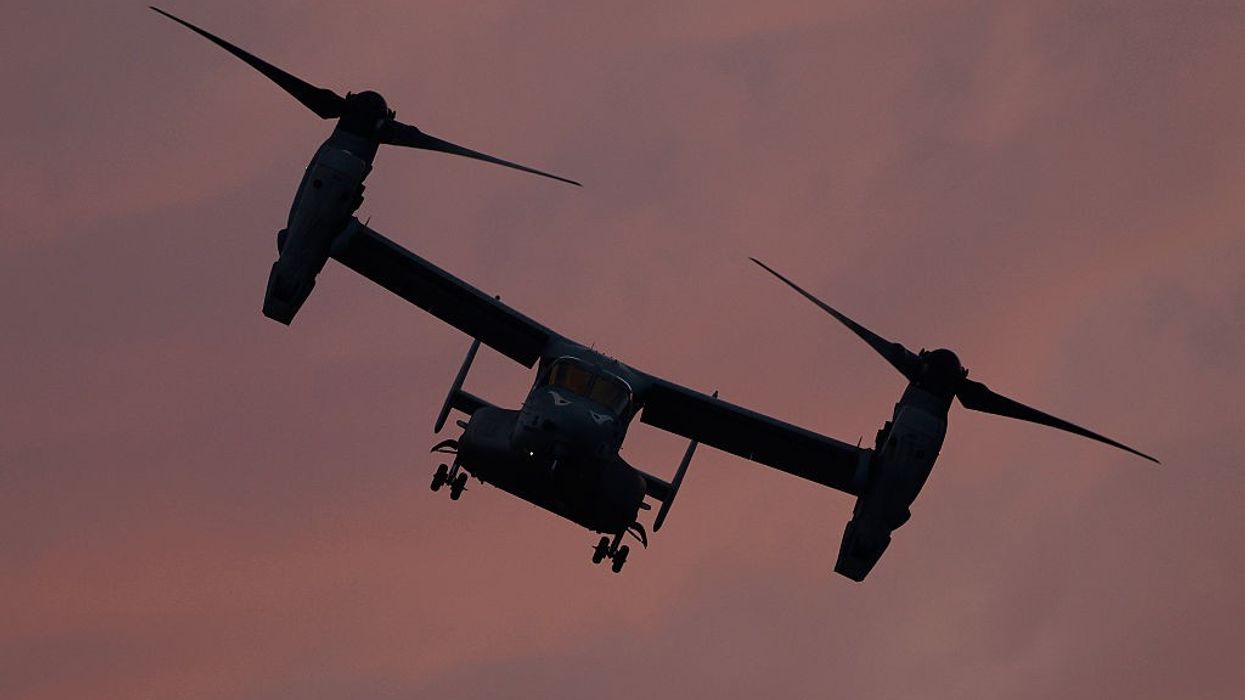
DEEP DIVE — It is one of the most lauded defense developments in recent decades, providing preeminent capability to U.S. military personnel worldwide, but that prowess evidently comes with a steep cost that military leadership allowed to grow for years.
Critics have long asserted that the military failed to adequately address a mounting series of safety issues with the V-22 Osprey aircraft, even as service members died in preventable crashes. The Naval Air Systems Commandreview and Government Accountability Officereport paint a scathing portrait of systemic failures by the Joint Program Office overseeing V-22 variants for the Air Force, Marine Corps, and Navy.
The Marine Corpsoperates approximately 348 MV-22s, the Air Force 52 CV-22s, and the Navy 29 CMV-22s, with the program of record at around 464 total across services. Japan operates 17 MV-22s, with deliveries complete or near-complete.
The Deadly Track Record
Some 30 U.S. Marines lost their lives in threeseparate crashes during the testing and development phase throughout the 1990s, giving the Osprey the nickname “The Widow Maker.” Since its introduction in 2007, at least 35servicemembers have died in 10 fatal crashes.
“Initially, the V-22 suffered from Vortex Ring State, which produced crashes during development. The problem was diagnosed and remediated, and the loss rate went down dramatically,” John Pike, a leading defense, space and intelligence policy expert and Director of GlobalSecurity.org, tells The Cipher Brief. “Subsequent losses have been ‘normal accidents’ due to the usual mechanical and human failings.”
The GAOfound that serious Osprey mishaps in 2023 and 2024 exceeded the previous eight years and generally surpassed accident rates of other Navy and Air Force aircraft. In August 2023, three Marines died in Australia. In 2022, four U.S. soldiers were killed in a NATO training mission, and five Marines were killed in California.
Unresolved Problems
The NAVAIR reportrevealed that “the cumulative risk posture of the V-22 platform has been growing since initial fielding,” and the program office “has not promptly implemented fixes.” Of 12 Class A mishaps in the past four years, seven involved parts failures already identified as major problems but not addressed.
Issues with hard-clutch engagement (HCE) caused the July 2022 California crash that killed five. The problem occurs when the clutch connecting the engine to the propeller gearbox slips and reengages abruptly, causing a power spike that can throw the aircraft into an uncontrolled roll.
There were eight Air Force servicemembers killed in the November 2023 crash off Yakushima Island when a catastrophic propeller gearbox failed due to cracks in the metal pinion gear, and the pilot continued flying despite multiple warnings, contributing to the crash.
This manufacturing issuedates to 2006, but the Joint Program Office didn’t formally assess the risk until March 2024 – nearly two decades later. A NAVAIR logbook reviewfound that over 40 safety-critical components were operating beyond their airworthiness limits, and that 81 percent of ground accidents were due to human error.
A Broken System: Poor Communication Between Services
The GAO also found that the three services don’troutinely share critical safety information. Aircrews haven’t met regularly to review aircraft knowledge and emergency procedures. The servicesoperate with significantly different maintenance standards, with three parallel review processes and no common source of material.
The GAOidentified 34 unresolved safety risks, including eight potentially catastrophic risks that have remained open for a median of 10 years. The V-22 has the oldestaverage age of unresolved catastrophic safety risks across the Navy’s aircraft inventory.
Fixes May Take a Decade
The Navy reportindicated fixes won’t be complete until 2033-2034. Officials now say the fleet won’t return to unrestricted operationsuntil 2026 – a year later than planned. The V-22 program plans to upgrade gearboxes with triple-melted steel, reducing inclusions by 90 percent.
Under current restrictions, overwater flights are prohibited unless within 30 minutes of a safe landing spot, severely limiting their use by the Navy and Marine Corps.
Subscriber+Members get exclusive access to expert-driven briefings on the top national security issues we face today. Gain access to save your virtual seat now.
Osprey's Unmatched Capabilities
The Osprey still offers a game-changing advantage for U.S. troops, despite its troubled past, according to its supporters.
As it currently stands, the entire fleet operates under restrictions that prevent overwater flights unless within 30 minutes of a safe landing spot, significantly limiting its utility for Navy and Marine Corps missions.
In 1979 to 1980, American hostages were taken in Iran during Operation Eagle Claw, which gave rise to the Osprey. As five of the eight Navy helicopters that arrived at Desert One were inoperable, it was clear that rapid troop movement in harsh environmental conditions was urgently needed.
After development began in 1985, the Osprey entered service in 2007, replacing the Vietnam-era CH-46 Sea Knight.
Compared to fixed-wing transports, the Osprey can land troops just where they are needed. Airdrops with parachutes tend to scatter paratroops all over the place; see ‘Saving Private Ryan,’” Pike explained. “And compared with other rotary wing aircraft, the Osprey is much faster and has a much longer range.”
The Osprey shifts from helicopter to airplane mode in under 12 seconds, reaches speeds of 315 mph, has an operational range of 580 miles, and carries 10,000 pounds – or 24 troops. It’s used for missions ranging from combat operations to the occasional transport of White House staff. During a dust storm in Afghanistan in 2010, two CV-22 helicopters rescued 32 soldiers in under four hours from a distance of 800 miles.
Chronic Readiness Problems
Yet these performance advantages have been undercut by persistent readiness shortfalls.
The NAVAIR reportnoted that mission-capable rates between 2020 and 2024 averaged just 50 percent for the Navy and Air Force, and 60 percent for Marines. The Ospreyrequires 100 percent more unscheduled maintenance than the Navy averages and 22 maintenance man-hours per flight hour versus 12 for other aircraft.
In addition, Boeing settled a whistleblower lawsuit in 2023 for $8.1 million after employees accused the company of falsifying records for composite part testing. Boeing, in its defense,claimed that the parts were “non-critical” and did not impact flight safety.
Conflicting Views on Safety
“The Osprey does not have a troubled safety record. Per a recent press release, the V-22 mishap rate per 100,000 flight hours is 3.28, which is in line with helicopters with similar missions.” a government source who works closely with the Osprey fleet but is not authorized to speak on the record contended to The Cipher Brief. “Like anything measured statistically, there are periods above and below the mean. Just because humans tend to conclude because of apparent clusters doesn’t necessarily mean there is a pattern or connection – think of how some people say that ‘celebrities die in threes.’”
The source vowed that “the design issues, such as certain electrical wiring rubbing against hydraulic and oil lines, were fixed before fleet introduction.”
“The problems with the test plan were a product of pressure applied to accelerate a delayed and overbudget program and were not repeated when the aircraft was reintroduced,” the insider pointed out. “Those mishaps, combined with the distinctive nature of the V-22, mean that any subsequent incident, major or minor, is always viewed as part of the ‘dangerous V-22’ narrative. A U.S. Army Blackhawk crash in November killed five but barely made the news. A Japanese Blackhawk crash killed ten soldiers in April, but the Japanese didn’t ground their Blackhawks.”
That perception, however, has done little to quiet families who argue that known risks went unaddressed.
Amber Sax’s husband, Marine Corps Capt. John J. Sax died in the 2022 California crash caused by hard clutch engagement, a problem the Marine Corps had known about for over a decade. “Their findings confirm what we already know: More needs to be done, and more needs to be done,” Saxsaid. “It’s clear in the report that these risks were not properly assessed, and that failure cost my husband his life.”
Sign up for the Cyber Initiatives Group Sunday newsletter, delivering expert-level insights on the cyber and tech stories of the day – directly to your inbox. Sign up for the CIG newsletter today.
An Uncertain Future
As the military confronts those findings, the future of the Osprey fleet is not completely clear. In 2018, the Marine Corps Aviation proposaloutlined a sustainability plan for the Osprey to at least 2060.
“The quality of maintenance training curricula, maturation, and standardization has not kept pace with readiness requirements,” the reportstated. “Current maintenance manning levels are unable to support demands for labor. The current V-22 sustainment system cannot realize improved and sustained aircraft readiness and availability without significant change. Depot-level maintenance cannot keep up with demand.”
Despite extensive recommendations – NAVAIRunderscored 32 actions to improve safety – Vice Adm. John Dougherty reaffirmed commitment to the aircraft. Pike believes it’s a matter of when, not if, the Osprey returns to full operations.
“Once the issues are fixed, everyone will resume their regular programming,” he asserted.
Officials and insiders alike expect that process to translate into tangible fixes.
“I would expect that to lead to some type of corrective action, whether it’s a new procedure or replacing a defective part,” the insider added. “After that, I would expect a long career for the aircraft in the Marine Corps, Navy, and Air Force, as it’s an irreplaceable part of all three services now and gives a unique capability to the American military.”
Whether that optimism proves warranted depends on whether military leadership finally addresses the systemic failures the latest reports have laid bare – failures that cost 20 service members their lives in just the past five years.
The Cipher Brief is committed to publishing a range of perspectives on national security issues submitted by deeply experienced national security professionals. Opinions expressed are those of the author and do not represent the views or opinions of The Cipher Brief.
Have a perspective to share based on your experience in the national security field? Send it to Editor@thecipherbrief.com for publication consideration.
Read more expert-driven national security insights, perspective and analysis in The Cipher Brief because National Security is Everyone’s Business
OPINION — U.S. defense planning rests on the assumption that wars are fought abroad, by expeditionary forces, against defined adversaries. For decades, those assumptions held. But today, many of the most consequential security challenges facing the United States violate all three. They occur closer to home, below the threshold of armed conflict, and in domains where sovereignty is enforced incrementally.
The shift has exposed a chronic mismatch between how the United States defines its defense priorities and how it allocates resources and respect. While defense discourse continues to stubbornly emphasize power projection and high-end conflict, many of today’s challenges revolve around the more modest and rote enforcement of U.S. territorial integrity and national sovereignty - functions that are vital to U.S. strategic objectives yet lack the optical prestige of winning wars abroad.
Sitting at the center of this gap between prestige and need is the U.S. Coast Guard, whose mission profile aligns directly with America’s most important strategic objectives - the enforcement of sovereignty and homeland defense - yet remains strategically undervalued because its work rarely resembles the celebrated and well-funded styles of conventional warfighting. In an era of increased gray-zone competition and persistent coercion, the failure to properly appreciate the Coast Guard threatens real strategic fallout.
In the third decade of the 21st century, U.S. defense planning remains heavily oriented toward expeditionary warfighting and high-end kinetic conflict. Budget conversations still revolve around Ford-class supercarriers, F-35 fighters, and A2/AD penetration. This orientation shapes not only force design and budget allocations, but also institutional prestige and political capital. The services associated with visible combat power, with the Ford-class and the F-35, continue to dominate strategic discourse—even as many of the most persistent security challenges confronting the United States unfold close to home, in the gray-zone, without the need for fifth-generation air power or heavy armor.
The Cipher Brief brings expert-level context to national and global security stories. It’s never been more important to understand what’s happening in the world. Upgrade your access to exclusive content by becoming a subscriber.
At the most basic level, any nation’s military exists primarily to defend territorial integrity, enforce sovereignty, and protect the homeland. Power projection, forward presence, and deterrence abroad are important—but they are secondary functions derived from the primary purpose of homeland defense. Yet U.S. defense discourse often treats homeland defense as a background condition when it should be revered as the first priority. The result is a blind spot in how security resources are evaluated and allocated.
The Coast Guard operates at a unique point where law enforcement, military authority, and sovereign enforcement all converge. On any given day, the Coast Guard may board foreign-flagged vessels suspected of sanctions violations, police maritime borders against illicit trafficking, secure ports that underpin global supply chains, and maintain a persistent presence in contested spaces, like the Arctic, without inviting escalation. The Coast Guard is equipped to intercept illegal fishing fleets, escort commercial shipping through sensitive waterways, and assert jurisdiction in legally ambiguous areas. These activities rarely resemble traditional warfighting, they rarely result in a Hollywood blockbuster, and they can be accomplished without nuclear-powered submarines or intercontinental ballistic missiles. But these are not peripheral activities—they are arguably amongst the most important daily functions the U.S. military undertakes.
Distinct among the military branches, the Coast Guard operates under a legal framework that is uniquely suited to today’s security environment. Under Title 14 status, the Coast Guard falls within the Department of Homeland Security, conducting law enforcement and regulatory missions on a daily basis. Yet, when needed, the service can transition to Title 10 status, under the Department of Defense, and operate as an armed service when required. This agility allows the Coast Guard to remain continuously engaged across the spectrum of competition, whether enforcing U.S. law in peacetime, managing escalation in gray-zone encounters, or integrating seamlessly into military operations. Few other elements of U.S. power can move so fluidly between legal regimes.
Still, despite such strategic relevance, the Coast Guard suffers from a persistent optical problem. U.S. defense culture has long privileged services and missions associated with visible, kinetic combat—those that lend themselves to clear narratives of victory, sacrifice, and heroism. The Coast Guard’s work rarely fits that cinematic mold. Its success is measured not in territory seized or targets destroyed, but in disruptions prevented, borders enforced, and crises that never materialize. Inherently quiet work with outcomes that reflect a force operating exactly as designed, although without generating institutional prestige or political support. In a system that rewards the loudest and the brightest, the Coast Guard’s quiet enforcement of sovereignty is easy to overlook.
Need a daily dose of reality on national and global security issues? Subscriber to The Cipher Brief’s Nightcap newsletter, delivering expert insights on today’s events – right to your inbox. Sign up for free today.
Continuing to overlook the value of the Coast Guard carries strategic consequences. Specifically, persistent underinvestment in the Coast Guard weakens maritime domain awareness, reduces sustained presence in key waterways, and narrows the set of tools available to manage gray-zone competition. As adversaries increasingly rely on legal ambiguity, deniable actors, and incremental pressure to test U.S. resolve, gaps in enforcement become opportunities. In this environment, the absence of credible, continuous sovereignty enforcement invites probing behavior that becomes harder to deter over time.
Advocacy for the Coast Guard does not require reassigning prestige, or elevating one service at the expense of others. It is merely an argument for strategic alignment. If territorial integrity, sovereignty enforcement, and homeland defense are truly core national-security priorities, then the institutions most directly responsible for those missions should be treated accordingly. As competition increasingly unfolds in the gray-zone between peace and war, the United States will need forces designed not only to win conflicts—but to prevent them from starting in the first place.
The Cipher Brief is committed to publishing a range of perspectives on national security issues submitted by deeply experienced national security professionals.
Opinions expressed are those of the author and do not represent the views or opinions of The Cipher Brief.
Have a perspective to share based on your experience in the national security field? Send it to Editor@thecipherbrief.com for publication consideration.
Read more expert-driven national security insights, perspective and analysis in The Cipher Brief, because national security is everyone’s business.
WEEKEND INTERVIEW — In an era when foreign adversaries can shape public sentiment with a well-timed meme and a handful of AI-driven accounts, the U.S. government is racing to redefine what national power looks like in the information age.
At the center of that effort is Shawn Chenoweth, the country’s first Director of Cognitive Advantage - a role designed to help the United States compete in the domain where modern influence, persuasion, and political outcomes are increasingly decided.
What, exactly, does a Director of Cognitive Advantage do? It’s not a title most Americans encounter, and it sits far outside the familiar contours of diplomacy, military force, or economic leverage. But as Chenoweth explains, the contest for influence no longer stays neatly within those lanes either.
His focus is often on the gray space - where information, perception, culture, and behavior collide, and where adversaries like China, Russia, Iran, and North Korea are operating with staggering resources and strategic focus.
In this Cipher Brief conversation, Chenoweth breaks down how cognitive operations actually work, why the U.S. has struggled to keep pace, and what it means to give the President an “information option” that’s not simply kinetic or economic.
He offers rare, candid insight into how technology, AI, and social platforms—from TikTok to algorithmically driven personas—are reshaping the battlespace faster than policymakers can write doctrine.
Our conversation is a deep dive into one of the least understood - but perhaps most consequential - fronts of modern national security. Our conversation has been lightly edited for length and clarity.
Shawn Chenoweth is the Director of Cognitive Advantage at the US National Security Council.
The Cipher Brief: How do you explain the role of the director of Cognitive Advantage?
Chenoweth: When you look at traditional elements of military power, you probably think of the DIME construct.It's not a perfect construct, but it's pretty good. DIME, is broken down into Diplomatic, Information, Military and Economic, and it's very clear who owns the Diplomatic, Military, and Economic components. But there hasn't been, at least in several decades, a good example of where people have really come to the president and the administration with an "I" option, for Information. And it's a shame because when you actually look at the DIME construct, you don't want to break it into stove pipes. We should think of it as a cell. Each of those elements acts as part of a functioning cell, and removing any of those elements means you have an imperfect or failing cell.
So, I was asked to help put the "I" back in DIME so that we can provide additional options and advantages across the other elements of DIME to national power and provide the president with opportunities to accomplish the Administration’s objectives that aren't just warheads on foreheads or threatening economics or expending political leverage. We can enhance those things, but we can also gain advantages by using cognitive effects through the information environment.
Kelly: Let’s set the stage a bit further. If you were to explain to the average American what is happening in terms of cognitive warfare in the gray zone – the area where conflict occurs below the level of warfare - how would you describe it?
Chenoweth: I think if you look through your military histories, philosophers, politicians, political science, it's all pretty clear. You can pick out the elements. They all have one underlying thread, which is that political victory is the one that matters at its core. That's really what we're talking about. Nothing's changed. How human beings are connected, how technology is affected has certainly changed. But what we really care about is what people do in the real world and the geophysical world, the world we live in.
So, the point of a cognitive advantage is to leverage that so that human beings are taking behaviors favorable to outcomes, to national objectives, which most of the time are also - in the case of the United States - favorable in their own right. So it's core. And that is what we're driving to get: those advantages in what people do in the real world through their sensing, to make decisions that come back to the real world and have the effects that you want.
Kelly: Can you give an example of what that would look like?
Chenoweth: Let's say you're negotiating for a piece of land or a base that you need for overflight intel collection. You're going to conduct a trade-off in negotiations. Maybe it's going to look like, - if you pay more, you'll get more - based off what the value proposition is. But very rarely is it that blatant and simple. So, what you want to be able to do is understand, what advantage would we need in the negotiation? What's actually driving this other party other than maybe just cost or just danger? What’s the risk calculus?
There are cultural nuances that affect things: their understanding of influence, political implications. So, the point would be to understand why they would be interested in this in the first place? What advantage does it give them? What are the cultural nuances? Why wouldn't they do this in the first place? Why aren't they taking this action and what can we do to make sure that the outcome is what we want?
There are other areas where that applies across the spectrum.
Let's say we're conducting counter-terrorism operations, and we know an objective tends to use a particular cafe. Well, what if they were using a different one that day? What can we do to influence them to go to a place that's more favorable for options to decrease our own risk calculus, either because we want to conduct a kinetic strike or make an arrest? Maybe we can't find them. So, what if we use that for our intel collection and our methods to basically make them come up on comms and change their behavior so it's easier to find them, collect on them, and build the data so that we can conduct physical actions to stop or disrupt them? And you can kind of see how that applies across the board.
If you know more than the person you're dealing with, chances are that you're going to be better at accomplishing your outcome. It’s very similar with the werewolf theory. It's a game where two people are chosen to be the werewolf of the village and everyone else in the group doesn't know who the werewolf is. Most of the time the people who are the werewolves win the game because they have an information advantage over everyone else playing the game. So, it's a human norm.
And again, I point out that nothing's new under the sun. It's just that we haven't really thought through the implications of what it means in the information age that we live in - where everyone is connected through software defined radios. We're a long way away from direct sensing where it's communication and things happening in the real world. Now we have sort of indirect sensing where you're fed data feeds and everything else. We can affect cognitive behavior in ways we never imagined, and we really haven't thought through just as we can reach people and sell items. And if I want to find a person whose favorite color is red, who's a military age male who's really into Magnum PI, I can find that person thanks to their radio, and I can craft messages specifically for someone who fits that demographic and move them in a particular direction. That's the first time in history that that's been the case.
Kelly: You have a background that combines both government and private sector experience. Given that technology is being rapidly developed in the private sector, how do you think that background gives you an advantage in this role?
Chenoweth: There are a lot of people who've served in the military and have been contractors but just by happenstance, I happen to have been in a lot of critical locations at critical times. I think one of the advantages that has brought me is that I saw the frustration within the military when the contracting apparatus didn't work. I was also empowered by industry to go and fix a lot of those structures and enable the government to do it, and now I'm getting afforded the opportunity to work on policy to make the system really hum.
I think the advantage with that is that when it comes to the information space, there's no control. And I try to emphasize this to any policy maker or power broker or decision maker that I can find. You can put an armored brigade in an intersection - fully equipped, fully supported – and a U.S. Armored Brigade could own that intersection. There are things you can control. But when it comes to the information space, there is no control. It is constantly shifting, constantly changing. You have a binary decision. You are either going to participate, preferably at a level that matters, or not, and whatever's going to happen is going to happen.
So, you could find yourself in an advantageous information space in the morning, lose it by the late morning, get a stalemate in the afternoon, and win it back in the afternoon – just to lose it again at the end of the day. And when you wake up the next morning, you're going to have to do it all over again. There is no, "We have information dominance and we're done and we can crack our beers and go on with other things."
That's not how this works because every day new information is being injected into the system. People are changing and developing new opinions. Things are occurring and people are going to react to those things, change their opinions, adapt, age out, age in, so those cultural references may change. It's a constant flux. One of the things that from the U.S. government side we're getting our head around is that we need an information carrier group constantly operating afloat in the information environment, effectively. One that’s engaged 24/7 to affect these changes.
The Cipher Brief is partnering with the Information Professionals Association and the National Center for Narrative Intelligence to bring you Pinnacle 2026: Gray Zone Convergence: Cognitive Security at the Intersection of Influence, Innovation, and Shared Interests. Register for the February 9-10 conference now to secure your spot.
Kelly: It's not just the United States that has gotten pretty good at understanding the impact of cognitive advantage. We see these tactics from China and Russia being used with stunning success. In this role, how focused are you on their activities when it comes to doing the exact same thing that you're tasked with doing?
Chenoweth: They absolutely practice these activities. I call them the ‘CRINKETT’. Every challenge we're generally dealing with falls in the CRINKETTS. It's China, Russia, Iran, North Korea, Terrorists and Trans[national] criminals. And particularly for the nation states, this is exactly how they want to compete.
From their perspective, there are two ways to deal with the United States: asymmetrically and stupidly, largely because of our economic and military power. They get that. They're not interested in a kinetic fight; that is an awful prospect. So the way they want to do this is in gray zone activities, in the information space, in the cognitive domain.
And they outspend us. I'm not going to say necessarily outperform, but I'll say if you want to compete at a level that matters, they outspend us, period. Iran probably spends around $1.8 billion plus-minus a year, maybe more with their proxies and everything else they do in this particular space. Russia - post Ukraine invasion, spends about $2.6 billion, something like that. China - 48 plus billion dollars a year. The U.S., if I take all of the activities from the DoD, the State Department and everything else, and you put those together, you might approach $1.2 billion.
It doesn't mean we're executing those funds either. It just means that that's what we've allocated. When you think about how we outspend to have an advantage on the other parts of DIME, we're hideously underperforming here. And again, all props to the administration. They're acutely aware of this and the support I've had at the National Security Council and across the elements of government - the departments and agencies - has been stellar. And we're going to continue to work on this and get it right because we have three and a half more years of President Trump's administration to get this right, do the reps and sets, and make this a durable policy so that the American people can start enjoying those benefits that come when we're really focused on this space.
Kelly: What does success look like for you in this role and how do you measure it?
Chenoweth: Measurement has always been a funny thing. People will constantly tell me how hard it is to measure these activities. And what I’ve found time and time again is that we're actually pretty good at these activities. The issues with the measurements are, again, participating at a scale that matters. We need to measure behavior change, and in order to do that, we need to have clear objectives. What are we after?
The big part of that is who is the target audience that has the agency to do the thing we want? We spend a lot of time making plans and CONOPS [Concept of Operations] on sub-target audiences that don't actually have the agency – in hopes that they affect agency - and that's perfectly fine. But why are we doing assessments against this? We spend a lot of time and money generating assessments to target audiences that don't have the agency you want. So, let's focus on the target audience that has the agency and let's do this at scale.
For example; I'm in the DC area and I can go down to the Potomac River, drop a bucket of water in the river, and I have objectively molecularly increased the amount of water in the Potomac. There isn't a sensor on this planet that is going to detect that molecular change.
The fact is that you might be having an effect, but you don't have a sensor that is going to pick that up. So, you need to increase your scale or customize your sensing system to the effect you're having. That tends to be where the assessments fall apart.
I’ve heard all the time for decades now that assessments are so hard. I don't find that to be true. What I find is that you've sacrificed assessments for effect, which is fine. It's risk calculus. If I had a low amount of resources and I decided to put as much into the effect I've wanted, that's fine. But at the end of the day, you're looking for the real behavior change in the targeted audience that matters. What are the sensors you have on that and what are you doing to collect that data: public opinion, research surveys, building the networks. We're going to see this exacerbate further as the AI revolution continues at pace.
Kelly: How is technology impacting what you're trying to do, your mission, and then how are you also working with the private sector because the private sector is controlling so much of the technology and the innovation that the government needs to work with. So how are you doing that?
Chenoweth: One of the challenges I see emerging from AI is that there's sort of an assumption that AI will fix all your woes. I've seen the best tools out there do one thing: they model the data they have, and that's the core issue. We don't have the data. So again, I'm back to there's not a whole lot of new things under the sun. And the AI models are really good, and it can allow you to find new insights from the data that you have, but new data needs to be created. So, sacrificing collection methodologies and new approaches to gather the data at the foot of a model is terrible.
The AI snake oil salesman I would deal with in industry all the time would come in and say, ‘Oh, you're interested in that? I could absolutely model you the thing.’ Cool. How does that work? ‘Well, all you have to do is provide me the data and we'll put all this together and give you the insights.’ I'm like, whoa. We don't have the data either. No one has the data. That's kind of the problem. So, let's be honest about what we're doing.
AI is going to be a great boon for industry and for the government and everyone else under the sun. It's going to obviously have impact, but I think as that moves forward, we need to start looking at how we actually employ it. Building an agent or a token for every worker so that they're augmented by an AI that does the thing that they themselves may not be good at or saving them time is going to be amazing, but it needs to be undergirded by being able to detect what's actually happening out in the real world. And those two things are not necessarily - not interrelated. As I said, most things are kind of a whole cell that operate in one unit, and we can't necessarily bifurcate these things and then expect good outcomes.
Former Senior CIA Executive Dave Pitts wrote a three-part series exclusively for The Cipher Brief on what the U.S. can do to become more competitive in the Gray Zone. Subscriber+Members can read it here. Need access? We can help with that.
Kelly: So you have a mission that is difficult to measure, is hugely impactful, adversaries are using it as well against American citizens effectively, and in some cases, those adversaires are dedicating a lot more resources to this. If you could explaine to the average U.S. citizen how they might be targeted by cognitive operations that are conducted by U.S. adversaries, what would you tell them to look for?
Chenoweth: You need to be mindful of sources obviously. When I look at the construct of how we approach cognitive warfare, I think one of the biggest problems I've had for at least the last 10 years has been the construct of dis- and misinformation. My issue isn't the dis- and misinformation construct. It's the overuse of it.
Disinformation and misinformation are things. They have meaning. But they mean something that is true and people use it for things that are not true. For example, disinformation are lies. The person projecting the information knows it's a lie. They're doing it to accomplish an objective. The bigger problem of disinformation is misinformation. Those are people who are sharing those lies, not knowing they are lies, or taking things out of context like satire, et cetera, and propagating as if it were truth. Those are what those are.
But not everything we have to deal with falls into that construct. There are two other portions to this that we have to be mindful of.
One is missing information, which used to mean that the target audience wasn't informed enough to make a correct decision, favorable to them or anyone else. ‘It's a tragedy that your family member died and you should mourn their loss, but stop touching the body. That's how you're spreading Ebola’, right? Pretty straightforward, pretty simple.
Now that we're dealing with nation states with deep pockets, that's been flipped up on its head and they're practicing active missing information, where they will provide wire services into a country saying, ‘Congratulations, you can use our wire service for free and we'll provide you all the stuff, and that's your biggest cost except for labor. Isn't that wonderful? The catch is that you just have to use our wire service’.
If you think [contextual] stories are going to get into the press through those channels, good luck. This isn't happening in the third world. These are happening in major countries and places that would shock you.
Imagine something like, ‘If you run this story, all our connected businesses that are connected through us or other means are going to pull their advertising budget from you.’ So again, good luck talking about the story in your environment. No one's going to touch it. No influencer wants a piece of it because they're going to lose their incentive structure and their revenue stream. It's things like that.
On the other side of the coin, and the bigger problem, is the rhetoric information. These are the things that aren't necessarily true or false. They are framed by your value system, how you view things, what you think truth actually is.
There are people out there who will say, I think a communist socialist form of government that is highly authoritarian is more stable and therefore better than a liberal democracy. There are people who believe that, and just by saying, well, history would prove you otherwise, it's not a good enough argument. You need to engage with those people at a scale that matters and be prepared to win the argument.
We've seen this time again on the counter-terrorism front where we would shut down the comms of a nobody, and suddenly that person would come back with the reputation that was so valuable, and now they're a terrorist thought leader because the Western world thought that they were so dangerous they needed to be shut down instead of just accepting the fact, that maybe we should just engage with this guy because no one's ever heard of him and maybe we should just point out that he's a moron.
There are ways to deal with this, and just because we don't like something doesn't mean it's a lie to the person that's spreading it. They might believe it. Before we just title something disinformation and say, well, it's a lie and we can ignore it — that is not adequate in the modern era where everyone is connected because, again, this person has connective tissue to the internet. They have web platforms. They can be just as connected as a government if they should choose to be and if they have the popularity, because at its core, regardless of whether or not you're a government or a celebrity or anything else, you are fighting for attention.
Kelly: It’s sometimes difficult for busy Americans to navigate the information space today and know what to believe without inviting some serious time into the source. Do you look at part of your mission in this role as helping people understand more of the context they need in order to make good decisions?
Chenoweth: I've been more on the side dealing with foreign audiences. But even in that regard, I think that it really matters to ask what are the things that we know to be what we feel are objective truths and things that matter? Things that we want target audiences to know because we know it would be better for them and better for our objectives?
And then what are the things where we just want to make sure that if a debate needs to be had, we facilitate the debate so that the target audience, particularly with an American target audience - which again, it's not my forte, we don't do that in government or shouldn't — that needs to be facilitated by Americans pointing out to each other that we do need to have these debates and come to kind of consensus, understanding that there will be disagreements.
Kelly: Do you think your job is going to be even more important in the future or maybe less?
Chenoweth: I've never thought the job wasn't important. I think the thing I'm enjoying right now is that everyone's kind of getting their head around what this means. The overused expression that ‘We need to do some things on Facebook,’ when you would have policymakers say, ‘Well, I'm concerned that that would destroy Amazon and internet commerce’ and your head would explode as you're trying to explain, ‘That's just not how the internet works, man.’
We can be comfortable operating on these platforms and doing things that we need to do without destroying internet commerce or the internet. And now I think a lot of policy makers and industry are all connected. They're a lot more comfortable doing these things. Now is the time when we need to get to where the resources and the permissions really match the ability to get us where we need to be.
I've generally not found too many authority problems. I generally find permissions problems. I find that when it comes to authorities, you almost always find that every organization actually has a framework that allows them to do things. It's just that someone somewhere in the chain can say no and is all too comfortable saying no, because, particularly in the past administration, they were very comfortable at avoiding risk and not as comfortable at managing risk. And that is a dynamic that we have to change. The world is a risky place, and we need to be out there participating in it, throwing our elbows around and managing the risk, not avoiding it.
Kelly: How hard of a job is it to give the U.S. the cognitive advantage in today’s world?
Chenoweth: It's hard, tremendously hard because you're talking about changing culture. I don't think the activity itself and the policy and the things that can be done are hard. I think the hard part will be changing the culture and changing people's mindsets.
We've talked about the fact that there used to be three domains: physical domain, information domain and cognitive domain. We have to explore the information domain and actually call it what it is. There is the physical domain, the geophysical domain. But I like the ‘kill web’ approach. A good kill web will constitute a kill chain that is disrupted, and we have to get out of just a kill chain. We need to get into a kill web mentality when it comes to cognitive effects.
Kelly: Explain what you mean by a “kill web”?
Chenoweth: You have your geophysical world where things exist in the real world, the place where we all live. When it comes to the information domain, though, it used to consolidate a bunch of things.
The reality is that when we break that down into a kill web, you're looking from your physical domain up to your logic layer. The internet is not some amorphous cloud that wanders around. It's composed of a system of systems that live in the real world. It's data centers, servers, modems, et cetera. Where does that infrastructure actually exist? Sometimes the files are in the computer. So, we need to be mindful of where does that work? How does the internet, how do these structures work, the mobile networks, et cetera.
From there, it then creates the digital layer, where all the trons are that exist. You can have effects, that's where your real cyberspace comes into play. That's how the mobile devices work, but that is just data.
Then it goes up to the persona entity level. These are the real human beings, sometimes fake human beings, they're personas, organizations but entities that potentially could be targeted or addressed or engaged, et cetera.
And then there's the cognitive space. The trick in the cognitive space is what happens in the mind. And that mind is influenced by the sensing that goes up through that chain when they process it. You're able to interdict on its way up or influence, and you're able to influence on the way down when a decision is made.
For example, when something happens in the real world, it's communicated to a decision maker, but it's going to go through the logic layer transmitted through sensors, computers, emails, phones, et cetera, to people and entities who are going to process it themselves, communicate it to a decision maker who's going to make a decision based off that information, or an individual or a bunch of individuals.
They're all going to make decisions on how to react to that or not react to that. And that's going to go back down to the physical world when they say, ‘I don't really like what is happening’, or maybe ‘I do like what's happening. Let's do the thing’. They're going to communicate that down to ‘Yes, launch the missiles’, or ‘Let's have a protest’. So, you can affect the chain up. You can affect the chain down, but that's how it works.
We as the United States have a pipe that exists inside that kill web structure - so does everyone else. And it doesn't matter if you're a nation state or a family or an individual. You have your sensing sources.
As I mentioned earlier, the direct conversations between people in the real world - even now, you and I are communicating completely over that entire structure - and that structure could be affected on the way up as we're communicating to when this is finally produced and goes back out to the real world where suddenly I have AI effects on me and I'm saying things I never meant to say, but the rest of the world's now interpreting that.
I didn't say that, that wasn't my cognitive decision, but you intercepted on the way down and now you would inadvertently affect everyone else's cognitive approach to what I'm communicating.
Kelly: What does the future from a technology and AI standpoint really look like?
Chenoweth: It's having fundamental changes. It's going to be interesting to see what happens in the entertainment industry as AI takes over and suddenly people can have more access. We've seen how the music industry went through huge change just on streaming music. We're about to witness what this is going to look like from our more traditional platforms. We've seen how things move from streaming. I think there is a level of adaptation that's going to go with that.
One of the things that needs to be addressed is how exactly we're going to engage. There is a point where we need to be comfortable with giving sort of guidance to the AIs - human in the loop - but if you think that you're going to be able to review every single message that needs to go out in an AI-driven world, you're out of your mind.
So, you need to be able to be comfortable generating for your target audience profiles and give sort of thematic guidance and let the AI do some level of engagements against foreign audiences to steer conversations in a particular direction, or at least identify where a conversation might be going so you can intervene when it looks like decisions are being made in a bad way, and then find out if that is an open and honest cultural nuance thing where it is about engagement or if it's being steered by your opponent.
I think that we are not far, and we're probably already in a game, where there are AIs versus AIs as we speak in the information environment.
Read more expert-driven national security insights, perspective and analysis in The Cipher Brief because National Security is Everyone’s Business.
OPINION — U.S. defense planning rests on the assumption that wars are fought abroad, by expeditionary forces, against defined adversaries. For decades, those assumptions held. But today, many of the most consequential security challenges facing the United States violate all three. They occur closer to home, below the threshold of armed conflict, and in domains where sovereignty is enforced incrementally.
The shift has exposed a chronic mismatch between how the United States defines its defense priorities and how it allocates resources and respect. While defense discourse continues to stubbornly emphasize power projection and high-end conflict, many of today’s challenges revolve around the more modest and rote enforcement of U.S. territorial integrity and national sovereignty—functions that are vital to U.S. strategic objectives yet lack the optical prestige of winning wars abroad.
Sitting at the center of this gap between prestige and need is the U.S. Coast Guard, whose mission profile aligns directly with America’s most important strategic objectives—the enforcement of sovereignty and homeland defense—yet remains strategically undervalued because its work rarely resembles the celebrated and well-funded styles of conventional warfighting. In an era of increased gray-zone competition and persistent coercion, the failure to properly appreciate the Coast Guard threatens real strategic fallout.
In the third decade of the 21st century, U.S. defense planning remains heavily oriented toward expeditionary warfighting and high-end kinetic conflict. Budget conversations still revolve around Ford-class supercarriers, F-35 fighters, and A2/AD penetration. This orientation shapes not only force design and budget allocations, but also institutional prestige and political capital. The services associated with visible combat power, with the Ford-class and the F-35, continue to dominate strategic discourse—even as many of the most persistent security challenges confronting the United States unfold close to home, in the gray-zone, without the need for fifth-generation air power or heavy armor.
The Cipher Brief brings expert-level context to national and global security stories. It’s never been more important to understand what’s happening in the world. Upgrade your access to exclusive content by becoming a subscriber.
At the most basic level, any nation’s military exists primarily to defend territorial integrity, enforce sovereignty, and protect the homeland. Power projection, forward presence, and deterrence abroad are important—but they are secondary functions derived from the primary purpose of homeland defense. Yet U.S. defense discourse often treats homeland defense as a background condition when it should be revered as the first priority. The result is a blind spot in how security resources are evaluated and allocated.
The Coast Guard operates at a unique point where law enforcement, military authority, and sovereign enforcement all converge. On any given day, the Coast Guard may board foreign-flagged vessels suspected of sanctions violations, police maritime borders against illicit trafficking, secure ports that underpin global supply chains, and maintain a persistent presence in contested spaces, like the Arctic, without inviting escalation. The Coast Guard is equipped to intercept illegal fishing fleets, escort commercial shipping through sensitive waterways, and assert jurisdiction in legally ambiguous areas. These activities rarely resemble traditional warfighting, they rarely result in a Hollywood blockbuster, and they can be accomplished without nuclear-powered submarines or intercontinental ballistic missiles. But these are not peripheral activities—they are arguably amongst the most important daily functions the U.S. military undertakes.
Distinct among the military branches, the Coast Guard operates under a legal framework that is uniquely suited to today’s security environment. Under Title 14 status, the Coast Guard falls within the Department of Homeland Security, conducting law enforcement and regulatory missions on a daily basis. Yet, when needed, the service can transition to Title 10 status, under the Department of Defense, and operate as an armed service when required. This agility allows the Coast Guard to remain continuously engaged across the spectrum of competition, whether enforcing U.S. law in peacetime, managing escalation in gray-zone encounters, or integrating seamlessly into military operations. Few other elements of U.S. power can move so fluidly between legal regimes.
Still, despite such strategic relevance, the Coast Guard suffers from a persistent optical problem. U.S. defense culture has long privileged services and missions associated with visible, kinetic combat—those that lend themselves to clear narratives of victory, sacrifice, and heroism. The Coast Guard’s work rarely fits that cinematic mold. Its success is measured not in territory seized or targets destroyed, but in disruptions prevented, borders enforced, and crises that never materialize. Inherently quiet work with outcomes that reflect a force operating exactly as designed, although without generating institutional prestige or political support. In a system that rewards the loudest and the brightest, the Coast Guard’s quiet enforcement of sovereignty is easy to overlook.
Need a daily dose of reality on national and global security issues? Subscriber to The Cipher Brief’s Nightcap newsletter, delivering expert insights on today’s events – right to your inbox. Sign up for free today.
Continuing to overlook the value of the Coast Guard carries strategic consequences. Specifically, persistent underinvestment in the Coast Guard weakens maritime domain awareness, reduces sustained presence in key waterways, and narrows the set of tools available to manage gray-zone competition. As adversaries increasingly rely on legal ambiguity, deniable actors, and incremental pressure to test U.S. resolve, gaps in enforcement become opportunities. In this environment, the absence of credible, continuous sovereignty enforcement invites probing behavior that becomes harder to deter over time.
Advocacy for the Coast Guard does not require reassigning prestige, or elevating one service at the expense of others. It is merely an argument for strategic alignment. If territorial integrity, sovereignty enforcement, and homeland defense are truly core national-security priorities, then the institutions most directly responsible for those missions should be treated accordingly. As competition increasingly unfolds in the gray-zone between peace and war, the United States will need forces designed not only to win conflicts—but to prevent them from starting in the first place.
The Cipher Brief is committed to publishing a range of perspectives on national security issues submitted by deeply experienced national security professionals. Opinions expressed are those of the author and do not represent the views or opinions of The Cipher Brief.
Have a perspective to share based on your experience in the national security field? Send it to Editor@thecipherbrief.com for publication consideration.
Read more expert-driven national security insights, perspective and analysis in The Cipher Brief, because national security is everyone’s business.
Over the past decade, US immigration agents have shot and killed more than two dozen people. Not a single agent appears to have faced criminal charges.
“I would never wish death upon anyone, but I have read some obituaries with great satisfaction.” - Winston Churchill
OPINION -- I associate myself with at least the latter part of that quote from Winston Churchill with regard to Aldrich Ames. To my knowledge, I met Ames on only one occasion. It was during a cocktail party in 1989 or 1990 when he oversaw the CIA operations group responsible for what was then Czechoslovakia. I have no clear recollection of that event, but I was later told that fellow traitor Robert Hanssen was also in attendance. If so, to paraphrase Shakespeare: ‘Hell was empty and the devils were there’.
While I can recall little about meeting Ames at that party, my colleagues and I lived – and still live – with the consequences of his betrayal. The loss of an agent is a very personal thing for those responsible for securely handling him or her. I saw that impact up close early on in my career.
Toward the end of my training as an operations officer in late 1982, I was summoned to the office of the then-chief of Soviet Division (SE). In that era, a summons to a meeting with any Division Chief - much less the head of what was then the most secretive operational component – could be unnerving for any junior officer. The initial moments of my appointment with then-C/SE, Dave Forden, were appropriately unsettling. He began by asking me whether I had stolen anything lately. Having never purloined anything ever, I was taken aback. After I answered no, he asked if I could pass a polygraph exam. Again surprised, I responded that I could the last time I took one. ‘Good’, Forden said, ‘you are coming to SE to replace Ed Howard in Moscow’. Howard, whom I had met during training, had been fired from CIA for a variety of offenses. He later defected to the USSR, betraying his knowledge of CIA operations and personnel to the KGB.
After completing training, I reported to SE Division. Shortly thereafter, I was told I would not be going to Moscow after all. Instead, I was informed, I would be going to Prague. Initially, I was a bit disappointed not to have a chance to test my skills against our principal adversary. In hindsight, however, that change in plan was fortuitous. While I could not know it at the time, my SE colleagues who went to Moscow would be there during the grim mid-1980’s period in which our agents were being rolled-up by the KGB. Many CIA officers involved with those cases would have to live for years thereafter wondering what had happened to their agents and whether anything they had done had contributed to their arrests and executions. My colleagues’ ordeals would only end with the revelation that one of our own was a spy.
But Ames was more than a spy. He was a killer. His career floundering and burdened by growing debt, Ames decided to solve his money problems by selling the identities of several low-level CIA agents to the KGB. Consequently, on April 16, 1985 he walked into the Soviet Embassy and passed on the following note: "I am Aldrich H. Ames and my job is branch chief of Soviet (CI) at the CIA. […] I need $50,000 and in exchange for the money, here is information about three agents we are developing in the Soviet Union right now.” He attached a page from SE Division's phone list, with his name underlined, to prove he was genuine. Within weeks, fearful that Soviet spy John Walker had been fingered by a CIA agent within the KGB, and worried that he might likewise be exposed, Ames decided to comprise all of the CIA and FBI Soviet sources he knew of. “My scam,” he later said, “was supposed to be a one-time hit. I was just going to get the fifty thousand dollars and be done with it, but now I started to panic.”
The Cipher Brief brings expert-level context to national and global security stories. It’s never been more important to understand what’s happening in the world. Upgrade your access to exclusive content by becoming a subscriber.
Accordingly, on June 13, 1985, Ames passed the Soviets what he called “the Big Dump.” That tranche of documents contained the identities of at least 11 CIA agents. Brave men who had risked all in deciding to serve freedom’s cause, many of them would be arrested, interrogated and ultimately executed.
Ames’s rationalization of this act says everything about the kind of man he was. “All of the people whose names were on my list knew the risks they were taking when they began spying for the CIA and FBI,” he said, before adding that, "They knew they were risking prison or death.”
He would repeatedly seek to justify his actions by claiming that his espionage for the USSR was morally equivalent to what Western services had long done against their adversaries. Oleg Gordievsky, a British spy within the KGB and one of the few agents betrayed by Ames who escaped, rightly rejected any such equivalency. "I knew,” he said, that “the people I identified would be arrested and put in prison. Ames knew the people he identified would be arrested and shot. That is one of the differences between us.”
Sentenced to prison, Ames would spend almost 32 years of his life behind bars. I like to think that punishment was worse than death. One hopes he whiled away hours in his cell thinking of what he’d done and the lives he took. He expressed contrition during the plea bargain and sentencing process to ensure leniency for his wife, Rosario, saying, for example, that, "No punishment by this court can balance or ease the profound shame and guilt I bear."
But I very much doubt the sincerity of such statements because he showed no signs of having a troubled conscience thereafter. Instead, in statements while incarcerated, Ames was at pains to give his actions a veneer of ideological justification. "I had,” he said, “come to believe that the espionage business, as carried out by the CIA and a few other American agencies, was and is a self-serving sham, carried out by careerist bureaucrats who have managed to deceive several generations of American policy makers and the public about both the necessity and the value of their work.”
“There is an actuarial certainty that there are other spies in U.S. national security agencies and there always will be.” That statement by former CIA Chief of Counterintelligence Paul Redmond in the wake of the Ames and Hanssen cases reflects a grim reality of the intelligence profession.
Nonetheless, when I joined CIA, it was accepted wisdom that the Agency had never had, and could never have, a spy in its ranks. With the benefit of hindsight, it is hard to understand how such a naïve conviction could have taken hold given the repeated penetration of our predecessor organization, the Office of Strategic Services (OSS), and our British counterparts by Soviet intelligence. “There will,” as CIA Chief of CI James J. Angleton said, “always be penetrations…it is a way of life. It should never be thought of as an aberration. Anyone who gets flustered is in the wrong business.”
Perhaps the downplaying of such a possibility was a natural reaction to the overreach of Angleton himself with his ‘HONETOL’ spy hunts which hindered the Agency’s ability to mount operations against the Soviets for years at the height of the Cold War. It was certainly a reflection of institutional arrogance.
Whatever the reason, the idea that a foreign intelligence service could recruit a serving CIA officer as a spy was inconceivable to many. That mindset makes the accomplishment of Redmond and the Agency team led by Jeanne Vertefeuille, concluding that reporting from a Soviet mole – ultimately determined to be CIA officer Aldrich Ames – was the cause of the losses, all the more remarkable.
Need a daily dose of reality on national and global security issues? Subscriber to The Cipher Brief’s Nightcap newsletter, delivering expert insights on today’s events – right to your inbox. Sign up for free today.
The years-long hunt for the agent the KGB called “KOLOKOL” (‘Bell’) ended on February 21, 1994 with the arrest of Ames by the FBI. The assessment of the damage that Ames had inflicted on U.S. national security in exchange for some $2.5 million from Moscow was, not surprisingly, extensive. Even in the analogue era, he was able to pass along voluminous documentary and oral reporting to Moscow. This included reporting on his own debriefing of Vitaliy Yurchenko, who defected briefly to U.S. before returning to the USSR.
But it was the review of Ames’s role in compromising our courageous agents that struck home with us. Their sacrifice is commemorated by the CIA ‘Fallen Agent Memorial’ and other memorials within Agency spaces. And one hopes that someday the Russian people, too, will come to realize that Military/Technical researcherAdolf G. Tolkachev (GTVANQUISH); KGB Line PR officer Vladimir M. Piguzov (GTJOGGER); KGB Line PR officer Leonid G. Poleschuk (GTWEIGH); GRU officer Vladimir M. Vasilyev (GTACCORD); GRU officer Gennadiy A. Smetanin (GTMILLION); KGB Line X officer Valeriy F. Martynov (GTGENTILE); KGB Active Measures specialist Sergey M. Motorin (GTGAUZE); KGB Illegals Support officer Gennadiy G. Varenik (GTFITNESS); KGB Second Chief Directorate officer Sergey Vorontsov (GTCOWL); and the highest-ranking spy run by the U.S. against the USSR; GRU General Dmitry F. Polyakov (TOPHAT, BOURBON and ROAM); sacrificed everything for them and for their country.
“The life of the dead,” Marcus Tullius Cicero wrote, “is placed in the memory of the living.” For my part, I will remember Ames as the base traitor he was and the men he killed as the heroes they were.
The Cipher Brief is committed to publishing a range of perspectives on national security issues submitted by deeply experienced national security professionals.
Opinions expressed are those of the author and do not represent the views or opinions of The Cipher Brief.
Have a perspective to share based on your experience in the national security field? Send it to Editor@thecipherbrief.com for publication consideration.
Read more expert-driven national security insights, perspective and analysis in The Cipher Brief, because national security is everyone’s business.
Hundreds of records obtained by WIRED show thin intelligence on the Venezuelan gang in the United States, describing fragmented, low-level crime rather than a coordinated terrorist threat.
OPINION — The White House this past November issued a Presidential action statement designating certain Muslim Brotherhood “chapters” as terrorist organizations. On Tuesday, the U.S. State Department and U.S. Treasury Department announced the designations of the Lebanese, Jordanian, and Egyptian chapters of the Muslim Brotherhood as terrorist organizations. The Egyptian and Jordanian chapters received a Specially Designated Global Terrorist (SDGT) designation. The Lebanese chapter received both the SDGT designation and a Foreign Terrorist Organization (FTO) designation.
In the spring of 2019, Washington, responding to mounting pressure by Egyptian President Abdel Fattah al-Sisi, decided to brand the Egyptian Muslim Brotherhood (MB) a terrorist organization. There was no mention of “chapters” outside Egypt.
Having followed the MB and interviewed many of its members for years during my government service, I published an article in 2019 questioning the underlying assumptions of the plan. This article is a revised version of my 2019 piece.
I argued in the 2019 piece that the administration’s decision at the time did not reflect a deep knowledge of the origins of the Muslim Brotherhood and its connection to Muslim societies and political Islam.
In the fall of 2025, the leaders of the United Arab Republic, Jordan, Bahrain, and Lebanon pressured the administration to label the MB a terrorist group.
The Cipher Brief brings expert-level context to national and global security stories. It’s never been more important to understand what’s happening in the world. Upgrade your access to exclusive content by becoming a subscriber.
Context
The Egyptian Muslim Brotherhood was founded by schoolteacher Hassan al-Banna in 1928 in response to two fundamental realities: First, Egypt was under the influence of British colonialism embodied in the massive British military presence near the Suez Canal. Second, under the influence of the pro-Western corrupt monarchy lead first by King Fuad and later by his son King Faruk, the MB’s founder believed that Muslim Egypt was drifting away from Islam. Egypt of course is the home of Al-Azhar University, the oldest Muslim academic center of learning in the world.
In addition, Al-Azhar University represents the philosophical and theological thought of the three major Schools of Jurisprudence in Sunni Islam—the Hanafi, the Maliki, and the Shafi’i Schools. The fourth and smallest School of Jurisprudence—the Hanbali—is embodied in the Wahhabi-Salafi doctrine and is prevalent in Saudi Arabia.
Al-Banna’s two founding principles were: a) Islam is the solution to society’s ills (“Islam hua al-Hal”), and b) Islam is a combination of Faith (Din), Society (Dunya) and State (Dawla). He believed, correctly for the most part, that these principles, especially the three Arabic Ds, underpin all Sunni Muslim societies, other than perhaps the adherents of the Hanbali School.
In the past 98 years, the Muslim Brotherhood has undergone different reiterations from eschewing politics to accepting the authority of Muslim rulers to declaring war against some of them to participating in the political process through elections.
Certain MB thinkers and leaders over the past nine decades, including the Egyptian Sayyid Qutb, the Syrian Muhammad Surur, and the Palestinian Abdullah Azzam, adopted a radical violent view of Islamic jihad and either allied themselves with some Wahhabi clerics in Saudi Arabia or joined al-Qa’ida. The organization itself generally stayed away from violent jihad. Consequently, it would make sense to label certain leaders or certain actions as terrorist but not the entire group or the different Islamic political parties in several countries.
Need a daily dose of reality on national and global security issues? Subscriber to The Cipher Brief’s Nightcap newsletter, delivering expert insights on today’s events – right to your inbox. Sign up for free today.
In the early 1990s, the Egyptian MB rejected political violence and declared its support for peaceful gradual political change through elections, and in fact participated in several national elections. While Islamic Sunni parties in different countries adopted the basic theological organizing principles of the MB on the role of Islam in society, they were not “chapters” of the MB.
They are free standing Islamic political groups and movements, legally registered in their countries, which often focus on economic, health, and social issues of concern to their communities. They are not tied to the MB in command, control, or operations.
Examples of these Sunni Islamic political parties include the AKP in Turkey, the Islamic Action Front in Jordan, Justice and Development in Morocco, al-Nahda in Tunisia, the Islamic Constitutional Movement in Kuwait, the Islamic Movement (RA’AM) in Israel, PAS in Malaysia, PKS in Indonesia, the Islamic Party in Kenya, and the National Islamic Front in Sudan.
During my government career, my analysts and I spent years in conversations with representatives of these parties with an eye toward helping them moderate their political positions and encouraging them to enter the mainstream political process through elections. In fact, most of them did just that. They won some elections and lost others, and in the process, they were able to recruit thousands of young members.
Based on these conversations, we concluded that these groups were pragmatic, mainstream, and committed to the dictum that electoral politics was a process, and not “one man, one vote, one time.” Because they believed in the efficacy and value of gradual peaceful political change, they were able to convince their fellow Muslims that a winning strategy at the polls was to focus on bread-and-butter issues, including health, education, and welfare, that were of concern to their own societies. They projected to their members a moderate vision of Islam.
Labeling the Muslim Brotherhood and other mainstream Sunni Islamic political parties as terrorist organizations could radicalize some of the youth in these parties and opt out of electoral politics. Some of the party leaders would become reticent to engage with American diplomats, intelligence officers, and other officials at U.S. embassies.
Washington inadvertently would be sending a message to Muslim youth that the democratic process and peaceful participation in electoral politics are a sham, which could damage American national security and credibility in many Muslim countries.
The Cipher Brief is committed to publishing a range of perspectives on national security issues submitted by deeply experienced national security professionals.
Opinions expressed are those of the author and do not represent the views or opinions of The Cipher Brief.
Have a perspective to share based on your experience in the national security field? Send it to Editor@thecipherbrief.com for publication consideration.
Read more expert-driven national security insights, perspective and analysis in The Cipher Brief, because national security is everyone’s business.
A contract justification published in a federal register on Tuesday says that 31 ICE vehicles operating in the Twin Cities area “lack the necessary emergency lights and sirens” to be “compliant.”
With federal agents storming the streets of American communities, there’s no single right way to approach this dangerous moment. But there are steps you can take to stay safe—and have an impact.
EXPERT OPINION —The Iranian people are saying they want new leadership. And it’s not too hard to understand why so many merchants, university students and young people in Iran are on the streets calling for political change and an end to the current Islamic Republic rule.
It was the merchants in Tehran’s Grand Bazar that initially closed their shops because they couldn’t make a living with soaring inflation and the collapse of the national currency, the rial. Merchants in over 32 cities quickly followed suit, with university students and the public joining in protests calling for change.
This is not new for Iran. In 2009, the government ensured that incumbent Mahmood Ahmadinejad was reelected president, despite the popular opposition leader, Mir-Hossein Mousavi, having widespread support from the public, promising hope and change. The government’s heavy hand in ensuring their man was reelected, regardless of what the public wanted and voted for, understandably angered the public, resulting in Iran’s “Green Movement.” Protesters, who adopted green as the symbol of hope and change, claimed the election was rigged. When they demanded greater democracy, the rule of law, and an end to authoritarian practices, the government responded violently. Peaceful protesters were beaten, with thousands arrested and dozens killed.
In September 2022, Jina Mahsa Amini, a 22-year-old Kurdish Iranian was arrested for improperly wearing her head scarf (hijab). She died in police custody, with eyewitnesses saying she was beaten and died because of police brutality. The death of Amini resulted in nationwide protests, with Iran Human Rights reporting that at least 476 people were killed by security forces. Amnesty International reported that the Iranian police and security forces fired into groups with live ammunition and killed protesters by beating them with batons. Amini’s death gave rise to the global movement of: Women, Life, Liberty.
Since then, Iran has conducted a war against its own people, with widespread arrests of anyone protesting widespread government corruption and human rights abuses.
The Cipher Brief brings expert-level context to national and global security stories. It’s never been more important to understand what’s happening in the world. Upgrade your access to exclusive content by becoming a subscriber.
Today’s protests were sparked by Iran’s severe economic crisis and water shortages, but also by Iran’s humiliating defeat by Israel in its 12-day war of June 2025 and the subsequent U.S. bombing of Iran’s nuclear facilities in Natanz, Fordow, and Isfahan. This was after the people were told that Israel would never dare to attack Iran. But they did, with impunity.
The hundreds of millions of dollars spent on Iran’s nuclear program, building thousands of spinning sophisticated centrifuges, enriching uranium at 60% purity, concealed in deeply buried underground facilities -- and related scientific work— certainly contributed to Iran’s economic collapse. The resultant global sanctions imposed on Iran also contributed to the crumbling of Iran’s economy. Indeed, Iran’s long history of pursuing nuclear weapons and then claiming they ceased such a pursuit, although continuing to enrich uranium while denying IAEA access to suspect nuclear facilities ensured that the global community viewed Iran with deep suspicion and was supportive of the biting sanctions imposed on Iran. Iran’s nuclear pursuits and the resultant sanctions led to Iran’s failed economy. And it was the people who suffered when the rial lost its value.
Iranian President Masoud Pezeshkian acknowledged the legitimacy of the protesters’ complaints, while announcing the appointment of a new central bank chief.
Reportedly, 36 people have been killed during the demonstrations, with hundreds arrested and thousands on the street saying they want change.
Supreme Leader Ayatollah Ali Khamnei, in an address on Saturday, blamed foreign interference and said that “rioters must be put in their place.”
President Donald Trump had warned Iran that if Iran “violently kills peaceful protesters” the U.S. “will come to their rescue.”
What these and previous demonstrations tell us is that the people have suffered enough. They’ve taken to the street because they want change, hope and a leadership that cares for the people. The protesters carry signs saying, “the mullahs must leave Iran.” It’s clear: the government has mismanaged Iran’s economy; has made Iran a pariah nation. The Iranian theocracy, led by supreme leader Ayatollah Ali Khamenei, apparently no longer has the support of the Iranian people.
Is a democratic secular Iran possible?
The author is a former associate director of national intelligence. All statements of fact, opinion or analysis expressed are those of the author and do not reflect the official positions or views of the U.S. government. Nothing in the contents should be construed as asserting or implying U.S. government authentication of information or endorsement of the author’s views.
This column by Cipher Brief Expert Ambassador Joseph DeTrani was first published in The Washington Times
Read more expert-driven national security insights, perspective and analysis in The Cipher Brief

 Login
Login