
 Login
LoginOn a remote Alaskan glacier, a 73-year mission of recovery and respect
Interview transcript:
Carlos Colon The C-124 mishap found on Colony Glacier was a plane that crashed into Mount Gannett in 1952, carrying 52 service members on board that were PCS-ing from McChord Air Force Base to Elmendorf. They encountered weather that they couldn’t navigate and ended up crashing into Mount Gannett. The Department of Defense at the time initiated search and recovery efforts, which they continued for several weeks, but eventually had to abandon because they were not finding any remains. They made it to where they believed the crash happened, but they did not encounter any remains. Then fast-forward to 2012, the Alaska Army National Guard was flying some training missions in their Black Hawks when they encountered what they thought looked like aircraft debris on Colony Glacier. They were able to identify some of the aircraft debris to the missing C-124, and that is when Operation Colony Glacier started. It was originally started by the DPAA, then the authority was transferred to the Armed Forces Medical Examiner in 2015. So AFMES has been involved in the DNA identification of remains since the beginning of the mission. And then in 2017, we started conversations about integrating medical-legal death investigators onto the search-and-recovery teams to help with identification of remains versus debris and helping streamline the search-and-recovery process to support the way we are doing DNA testing here at AFMES.
Terry Gerton Kate, Carlos mentioned that the crash happened 73 years ago. It’s a tough environment there on the glacier, but I imagine there have been advances in identification technology and processes since then. What are you using today to identify the remains?
Kate Grosso Since the recovery operation began, we’ve relied very heavily on DNA identification for the remains that have been recovered. The Armed Forces DNA Identification Laboratory was established in 1991, and they support our current-day operations in addition to the Defense POW Accounting Agency’s past accounting. So they have a tremendous amount of experience in working with remote recovery environments in which we may have remains that may be difficult to identify. We’ve also utilized fingerprint technology, bridge comparisons, in order to do a number of the identifications. Colony Glacier is a very unique preservation environment, and so we are able to get positive DNA and fingerprint identifications on the remains that we’ve been able to recover. So obviously, very different than the environment that we were dealing with in 1952. The advent of these technologies have made it possible for us to be able to do these identifications by DNA and fingerprint.
Terry Gerton Carlos, you’ve been on the glacier. Tell us a little bit about what it’s like there and what’s happening now that has driven acceleration of the mission.
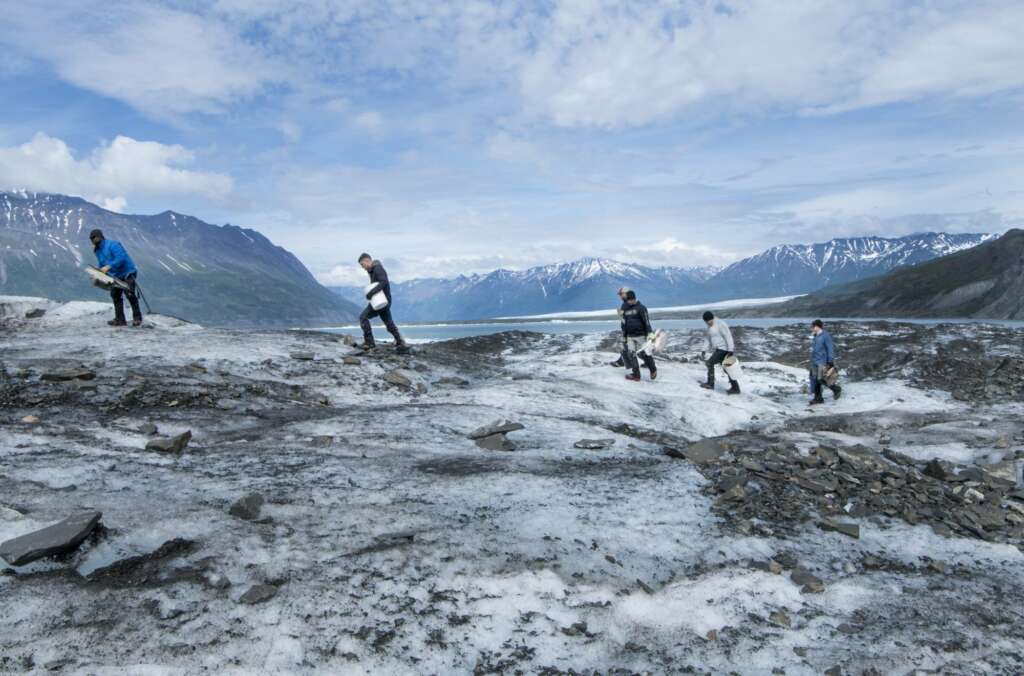
Carlos Colon So the glacier — it’s cold and icy. It’s one of the more challenging and remote areas I’ve had to work in. We get dropped off in the morning, conduct recovery operations all day and then get picked up in the afternoon. It can be pretty dangerous. There’s a lot of crevasses, a lot running water. A glacier makes its own sounds; some are scarier than others. I’ve noticed that it’s been changing a lot throughout the years. At the beginning when I started going, which my first time on the glacier was 2017, there was a large flat area that led to the toe of the glacier. And as time has gone on, it’s slowly receded. And in the past two years, I’ve noticed that it’s no longer there. So it’s a pretty challenging environment to work in. It’s also very beautiful, very peaceful. It is that dichotomy of it being a dangerous place to work and also one of the most beautiful places I’ve been to.
Terry Gerton I would imagine that the constantly changing nature of the glacier and the fact that, as you just said, some of it is disappearing adds a sense of urgency to this recovery mission.
Carlos Colon Yes, we’ve definitely seen the glacier has been changing at a rapid rate, which has led to us taking this on with a little bit more expediency. We’ve really focused on streamlining the way we’re conducting search and recovery, what we prioritize, how things are collected and bagged in order to really take advantage of the time we have on the glacier for for that recovery period. But also, we don’t know how much time we would have left to recover on the glacier. So we’ve really focused on expediting the recovery efforts, which has led to expedited DNA sampling and testing.
Terry Gerton I’m speaking with Kate Grosso and Carlos Colon. They are medicolegal investigators with the Department of Defense. Kate, let me come back to you. I think we’ve laid a picture here of how complicated this operation is, but it also involves multiple agencies. What does coordination look like between the medical examiner system and recovery teams and other DoD components? How do you keep everybody on the same sheet of music in this really challenging environment?
Kate Grosso Well, to be frank, it’s collaborative. There are a number of players involved in these recovery operations. We work very closely with our partners at Air Force Mortuary Affairs operations, with the Alaska Air National Guard, and with the folks that are provided for us who provide force multiplication for our recovery operations on the glacier. It requires a tremendous amount of communication, education and training. And we’ve been very grateful to have excellent support partners, because you’re right, this is a very complicated recovery mission and it requires a very complex and multidisciplinary approach.
Terry Gerton And Carlos, let me come back to you because you mentioned being on the glacier, being on the scene in terms of recovery operations. What about the human dimension? How important is this for the families of the service members that were lost in the crash?
Carlos Colon These family members have been waiting for their loved ones for 73 years. So it’s very important. A lot of them are very active on social media. They communicate with each other. They follow up with AFMAO and with AFME. So we know the importance this has to family members. Another thing about this mission that I’ve noticed is how important it is to the service members that are on the recovery teams. For them, a lot of these team members, or most of them, have not seen human remains or done anything in the mortuary affairs field. They’re selected for the team because of their mountaineering experience. It’s been kind of gratifying to see how involved they get with the mission and how proud they are. We talk a lot about it when we’re out there. It’s kind of a living reminder of, we never leave any of our fallen behind, and them being young service members, it’s been really nice to see them see that in action.
Terry Gerton Carls, I really appreciate that perspective and the impact that this operation has had. How close are you to completing the operation?
Carlos Colon We are currently at 50 out of the 52.
Terry Gerton Wow. And with the urgency that you mentioned earlier, because of the environmental change, those last two must be pretty tough to find. Along those lines, Kate, let me come over to you. We’ve talked about how complex this operation is, how unusual, how technology has advanced. What lessons does the Armed Forces Medical Examiner System take from this to apply to other sorts of recovery operations?
Kate Grosso It’s a really good question. AFMES and the medicolegal investigators at work here, we have a worldwide area of responsibility. So we’re looking at various different environments with lots of different airframes in different circumstances. Working in a glaciated environment has really helped us hone our cold weather response for aviation mishaps. Carlos and I specifically have been all over the world responding to mishap investigations and recoveries, from Norway to Australia. And using the lessons that we’ve learned in a glaciated environment has really given us new perspectives on our current-day operational recoveries.
The post On a remote Alaskan glacier, a 73-year mission of recovery and respect first appeared on Federal News Network.
© The Associated Press
