❌

Reading view

There are new articles available, click to refresh the page.

Tesla Model 3 got outsold by an EV from a Chinese smartphone brand

In what is one of the most important developments in the Chinese auto industry, Xiaomi’s SU7 has outsold Tesla’s Model 3 in 2025. The information comes from the China Passenger Car Association (via scmp.com). The Chinese smartphone maker delivered 258,164 units of its first EV. Meanwhile, Tesla sold only 200,361 Model 3s, marking the first […]

The post Tesla Model 3 got outsold by an EV from a Chinese smartphone brand appeared first on Digital Trends.

Finding A Way To Produce Powerful Motors Without Rare Earths

By: Lewin Day

The electric vehicle revolution has created market forces to drive all sorts of innovations. Battery technology has progressed at a rapid pace, and engineers have developed ways to charge vehicles at ever more breakneck rates. Similarly, electric motors have become more powerful and more compact, delivering greater performance than ever before.

In the latter case, while modern EV motors are very capable things, they’re also reliant on materials that are increasingly hard to come by. Most specifically, it’s the rare earth materials that make their magnets so good. The vast majority of these minerals come from China, with trade woes and geopolitics making it difficult to get them at any sort of reasonable price. Thus has sprung up a new market force, pushing engineers to search for new ways to make their motors compact, efficient, and powerful.

Rare

Many of us first came across neodymium magnets as a simple curiosity. Credit: XRDoDRX, CC BY-SA 3.0

Rare earth materials have become a hot button issue in recent decades, and they’ve also become a familiar part of our lives. If you remember playing with some curiously powerful magnets at some point, you’ve come across neodymiumβ€”a rare earth material of wide application. The element is alloyed with iron and boron to produce some of the strongest magnets readily available on the commercial market. You’ll find them in everything from hard drives to EV motors, and stuck to a great many fridges, where they’re quite hard to peel off. At times, neodymium is also alloyed with other rare earths, like terbium and dysprosium, which can help create powerful magnets that are able to resist higher temperatures without failure.

We come across these magnets all the time, so they might not feel particularly rare. Indeed, the rare earth elementsβ€”of which there are 17 in totalβ€”are actually fairly abundant in the Earth’s crust. The problem is that they are thinly spread, often only found as trace elements rather than in rich ore deposits that are economical to mine. Producing any useful amount of rare earth materials tends to require processing a great deal of raw material at significant cost. As it stands, China has gained somewhat of a monopoly on rare earths, controlling up to 92% of global processing capability and 60 to 70% of mining capacity. In happier times, this wouldn’t be such a problem. Sadly, with the extended battles being fought over global trade at the moment, it’s making access to rare earths both difficult and expensive.

This has become a particular problem for automotive manufacturers. It’s no good to design a wonderful motor that needs lots of fancy rare earth magnets, only to find out a year later that they’re no longer available and that production must shut down. Thus, there is a serious desire on the part of major automakers to produce high-performance motors that don’t require such fancy, hard-to-come-by materials. Even if they come with a small cost penalty in materials or manufacturing, they could save huge sums of money if they avoid a production shutdown at some point in the future. Large manufacturing operations are slow, lumbering things that need to run on long timescales to operate economically, and they can easily be derailed by supply disruptions. Securing a solid motor supply is thus key to companies looking to build EVs en masse in the immediate future.

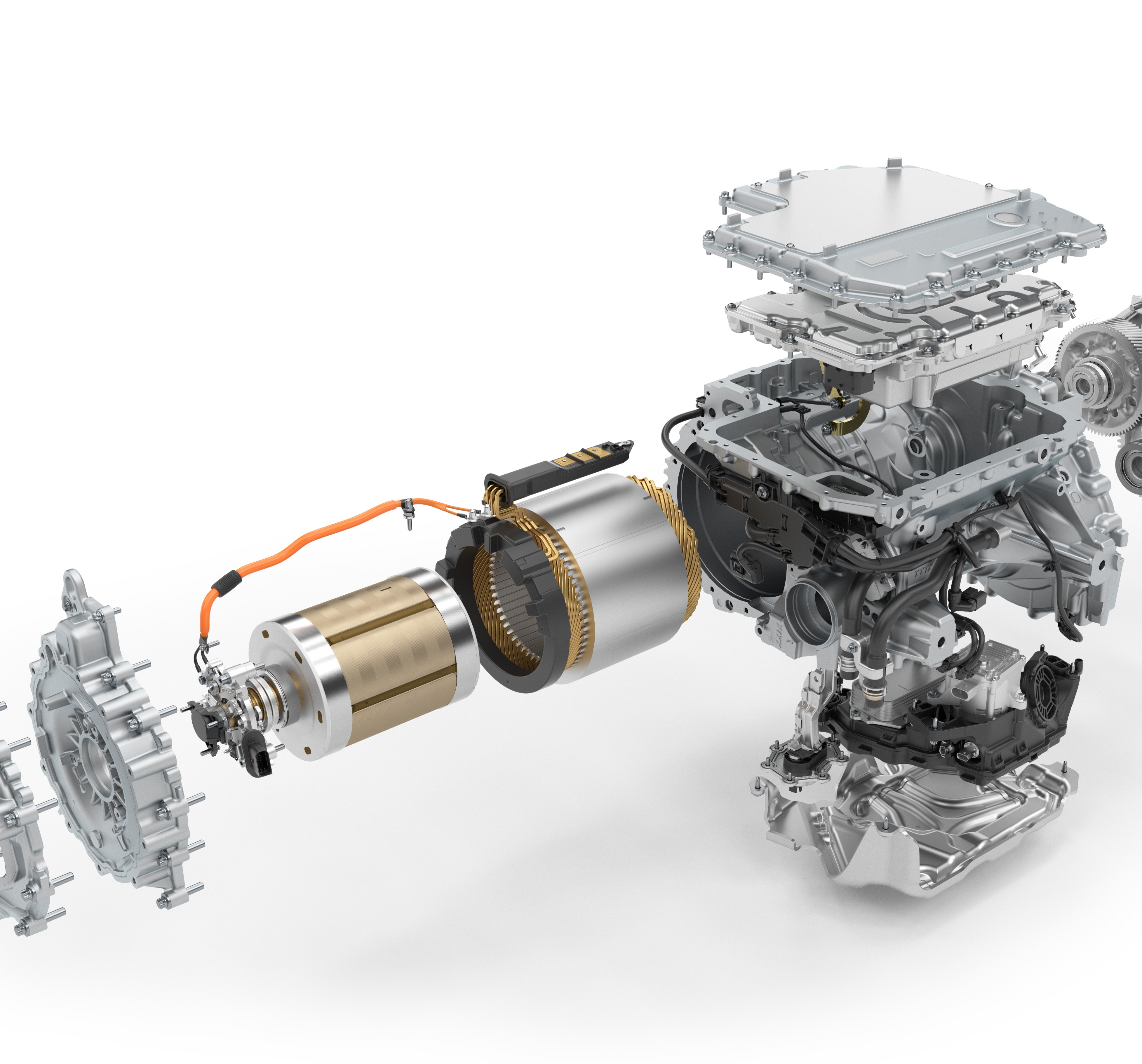
BMW’s new EV motors use electrically-excited coils in the rotor to generate the necessary magnetic field, instead of rare-earth magnets. Credit: BMW

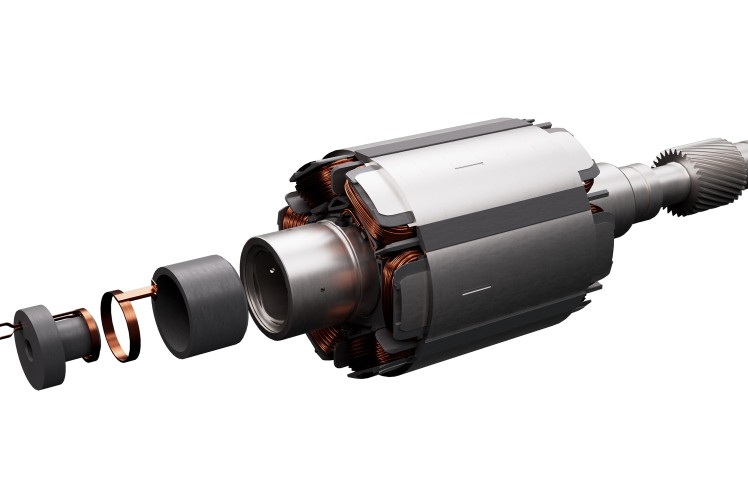
BMW has, to a degree, solved the problem by making differentΒ kinds of motors. Rather than trying to find other ways to make powerful magnets, the German automaker put engineering efforts into developing highly-efficient motors that generate their own magnetic fields via electricity. Instead of using permanent magnets on the rotor, they use coils, which are electrically excited to generate a comparable magnetic field. Thus, rare earth magnets are replaced with coil windings, which are much easier to source. These motors are referred to as Electrically Excited Synchronous Motors (EESM), and are distinct from traditional induction motors as they are creating a magnetic field in the rotor via supplied electric current rather than via induction.

This method of construction does come with some trade offs, of course, such as heat generated by the rotor coils, and the need for slip rings or brushes to transfer power to the coils on the rotor. However, they manage to neatly sidestep the need for rare earth materials entirely. They are also more controllable. Since it’s possible to vary the magnetic field in the rotor as needed, this can be used to make efficiency gains in low-load situations. They’re also less susceptible to damage from overtemperature that could completely destroy the magnets in a permanent magnet motor.

ZF is one of a number of motor manufacturers that has developed a range of EESM motors. Note the coils in the rotor where the permanent magnets would usually go. Credit: ZF

BMW was inspired to take this route because of a spike in neodymium prices well over a decade ago. Today, that decision is bearing fruitβ€”with the company less fearful of supply chain issues and production line stoppages due to some pesky magnets. You’ll find EESM motors in a range of BMW products, from the iX1 to the i7, and even the compact CE 02 scooter. The company’s next generation of electric models will largely use EESM motors for rear-wheel-drive models, while using asynchronous motors up front to add all-wheel-drive to select models. The German automaker is not the only player in this space, either. A range of third-party motor manufacturers have gotten on board the EESM train, as well as other automakers like Nissan and Renault.

Nissan has similarly gotten onboard with EESM technology. Note the contact surfaces for the brushes used to deliver electricity to the coils in the motor.

Don’t expect every automaker to rush into this technology overnight. Retooling production lines to make different types of motors takes time, to say nothing of the supporting engineering required to control the motors and integrate them into vehicle designs. Many automakers will persevere with permanent magnet motors, doing what they can to secure rare earth supplies and shore up their supply chains. However, if the rare earth crisis drags on much longer, expect to see ever more reliance on new motor designs that don’t need rare earth magnets at all.

Defensive Driving: The Need for EV Cybersecurity Roadmaps

As the U.S. looks to bolster electric vehicle (EV) adoption, a new challenge is on the horizon: cybersecurity.

Given the interconnected nature of these vehicles and their reliance on local power grids, they’re not just an alternative option for getting from Point A to Point B. They also offer a new path for network compromise that could put drivers, companies and infrastructure at risk.

To help address this issue, the Office of the National Cyber Director (ONCD) recently hosted a forum with both government leaders and private companies to assess both current and emerging EV threats. While the discussion didn’t delve into creating cybersecurity standards for these vehicles, it highlights the growing need for EV roadmaps that help reduce cyber risk.

Lighting Strikes? The State of Electric Adoption

EV sales in the United States are well ahead of expert predictions. Just five years ago, fully electric vehicles were considered niche. A great idea in theory, but lacking the functionality and reliability afforded by traditional combustion-based cars.

In 2022, however, the tide is turning. According to InsideEVs, demand now outpaces the supply of electric vehicles across the United States. With a new set of tax credits available, this demand isn’t going anywhere but up, even as manufacturers struggle to improve the pace of production.

Part of this growing interest stems from the technology itself. Battery life increases as charging times fall, and the EV market continues to diversify. While first-generation electric vehicle makers like Tesla continue to report strong sales, the offerings of more mainstream brands like Ford, Mazda and Nissan have helped spur consumer interest.

The result? The United States has now passed a critical milestone in EV sales: 5% of new cars sold are entirely electric. If the sales patterns stateside follow that of 18 other countries that have reached this mark, EVs could account for 25% of all cars sold in the country by 2025, years ahead of current forecasts.

Positive and Negative β€” Potential EV Issues

While EV adoption is good for vehicle manufacturers and can ease reliance on fossil fuels, cybersecurity remains a concern.

Consider that in early 2022, 19-year-old security researcher David Colombo was able to hack into 25 Teslas around the world using a third-party, open-source logging tool known as Teslamate. According to Colombo, he was able to lock and unlock doors and windows, turn on the stereo, honk the horn and view the car’s location. While he didn’t believe it was possible to take over and drive the car remotely, the compromise nonetheless showed significant vulnerability at the point where OEM technology overlaps third-party offerings. Colombo didn’t share his data immediately; instead, he contacted TelsaMate and waited until the issue was addressed. Malicious actors, meanwhile, share no such moral code and could leverage this kind of weakness to extort EV owners.

And this is just the beginning. Other possible cyber threat avenues include:

Connected vehicle systems

EV systems such as navigation and optimal route planning rely on WiFi and cellular networks to provide real-time updates. If attackers can compromise these networks, however, they may be able to access key systems and put drivers at risk. For example, if malicious actors gain control of the vehicle’s primary operating system, they could potentially disable key safety features or lock drivers out of critical commands.

Charging stations

Along with providing power to electric vehicles, charging stations may also record information about vehicle charge rates, identification numbers and information tied to drivers’ EV application profiles. As a result, vulnerable charging stations offer a potential path to exfiltrated data that could compromise driver accounts.

Local power grids

With public charging stations using local power grids to deliver fast charging when drivers aren’t at home, attackers could take aim at lateral moves to infect car systems with advanced persistent threats (APTs) that lie in wait until cars are plugged in. Then, malicious code could travel back along power grid connections to compromise local utility providers.

Powering Up Protection

With mainstream EV adoption looming, it’s a matter of when, not if, a major cyberattack occurs. Efforts such as the ONCD forum are a great starting point for discussion about EV security standards. However, well-meaning efforts are no replacement for effective cybersecurity operations.

In practice, potential protections could take several forms.

First is the use of automated security solutions to manage user logins and access. By reducing the number of touchpoints for users, it’s possible to limit the overall attack surfaces that EV ecosystems create.

Next is the use of security by design. As noted by a recent Forbes piece, new vehicles are effectively β€œ20 computers on wheels,” many of which are embedded in hardware systems. The result is the perfect setup for firmware failures if OEMs don’t take the time to make basic security protocols β€” such as usernames and passwords that aren’t simply β€œadmin” and β€œpassword”, and the use of encrypted data β€” part of each EV computer.

Finally, there’s a need for transparency across all aspects of EV supply, design, development and construction. Given the sheer number of components in electric vehicles which represent a potential failure point, end-to-end visibility is critical for OEMs to ensure that top-level security measures are supported by all EV hardware and software components.

Getting from Here to There

As EVs become commonplace, a cybersecurity roadmap is critical to keep these cars on the road up to operator β€” and operational β€” safety standards.

But getting from here to there won’t happen overnight. Instead, this mapping mission requires the combined efforts of government agencies, EV OEMs and vehicle owners to help maximize automotive protection.

The post Defensive Driving: The Need for EV Cybersecurity Roadmaps appeared first on Security Intelligence.

❌