ARK Invest’s new roadmap puts a big number on the table, and it’s hard to ignore. Reports say Cathie Wood’s firm’s “Big Ideas 2026” research paints a scenario where the total value of crypto climbs to about $28 trillion by 2030.
Big Ideas Point To A Shift
According to ARK and its public writeups, that $28 trillion is not blind optimism. The firm breaks the future into three main drivers: Bitcoin, decentralized finance, and tokenized real-world assets.
Reports note Bitcoin could make up roughly 70% of that total, which would mean about $16 trillion in Bitcoin market cap by 2030.
DeFi And Tokenized Assets Take The Stage
DeFi platforms and smart-contract networks are expected to grow a lot. ARK’s scenario puts smart money and on-chain services as a major contributor to market value in the run up to 2030.
The firm also projects tokenized real-world assets — things like tokenized bonds, property shares, and other financial products moved onto ledgers — to climb into the trillions, with some reports pointing toward around $11 trillion for tokenization.
How Bitcoin Fits Into The Picture
Given the share ARK assigns to Bitcoin, the math pushes toward very large per-coin prices if that scenario plays out. Reports say ARK’s base case uses a little over 20 million Bitcoins in supply by 2030 and implies a per-coin price that could sit near the high hundreds of thousands — commonly quoted numbers range up to about $950,000 to $1,000,000 in that framework.
Fast Growth Assumptions
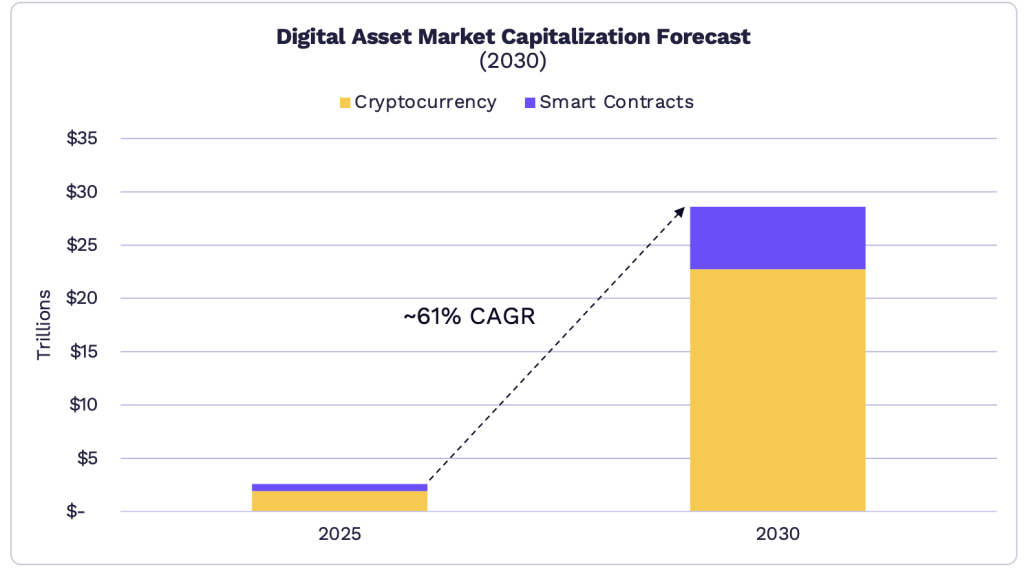
To reach $28 trillion, the forecast depends on very steep growth each year. ARK points to an implied compound annual growth rate near 61% from present levels to 2030. That is aggressive. It would mean rapid gains across many segments of the crypto market, not just a single rally.
Reports and industry analysts warn that the path to that future has a long list of hurdles. Regulation must become clearer in many places. Institutional rails and custody tools need to expand and prove reliable.
Market sentiment has to stay positive long enough for major capital flows to arrive. Any of these things going wrong would change the numbers quickly.
ARK’s “Big Ideas 2026” details a robust vision of a $28 trillion ecosystem driven by Bitcoin, DeFi, and tokenization. Although it holds a rather ambitious 61% growth trajectory riddled with numerous regulatory and market obstacles, the vision reinforces the faith of ARK Invest in the transformation of the digital asset space from being a speculative domain to the nucleus of the global finance system.
Featured image from Unsplash, chart from TradingView
Cathie Wood’s Ark Invest is leaning into a big end-of-decade call on crypto.
In its Big Ideas 2026 report published Wednesday, the firm says digital assets could reach $28 trillion in market value by 2030. That is up from about $3.13 trillion today, a jump of roughly 9x.
The firm framed the estimate around two buckets, smart contract networks and “pure-play digital currencies”, which it describes as stores of value, mediums of exchange, and units of account on public blockchains.
Ark said the market “could grow at an annual rate of ~61% to $28 trillion in 2030”.
Ark also expects Bitcoin to dominate the pie. “We believe Bitcoin could account for 70% of the market,” it said, with the rest led by smart contract networks such as Ethereum and Solana.
Image Source: Ark Invest/ Big Ideas 2026
Ark Sees Bitcoin Market Cap Climbing To $16 Trillion By 2030
Based on Ark’s forecast, Bitcoin’s market cap could rise at a compound annual growth rate of about 63% during the next five years, climbing from nearly $2 trillion to $16 trillion by 2030.
The report also argued that Bitcoin is increasingly behaving like a safe-haven asset, pointing to lower volatility and drawdowns in 2025 that looked shallow versus its own history across 5-year, 3-year, 1-year, and 3-month windows.
Institutional ownership is a big part of that story. Ark said US spot Bitcoin ETFs and public companies held about 12% of total Bitcoin supply, up from 8.7%, after Bitcoin ETF balances rose 19.7% in 2025 from about 1.12M to about 1.29M, and public company holdings jumped 73% from roughly 598,000 to about 1.09M.
Bitcoin’s maturation is showing. ARK's Big Ideas 2026 research details rising adoption, leading risk-adjusted performance, the shallowest drawdowns in its history, and more.
Smart Contract Networks Could Grow At A 54% Annual Pace
Regarding smart contracts, Ark projected that the segment could reach approximately $6 trillion by 2030, growing at a 54% annual rate, as networks generate annualized revenue of around $192B at an average take rate of 0.75%.
It also expects two to three Layer-1 platforms to take the lion’s share, with valuations driven more by monetary premium than discounted cash flows.
Ark’s report kept Ethereum in the lead when it comes to on-chain assets, saying assets on Ethereum now exceed $400B. It also said stablecoins and the top 50 tokens make up about 90% of market value across seven of the eight most popular blockchains.
Ark Sees Long Runway For Tokenization Despite Small Current Share
Ark said meme coins remain a small part of most blockchains, making up about 3% or less of capital outside Solana.
Solana is the exception, where meme coins account for about 21% of assets. The firm also said tokenization of real-world assets could be one of the fastest-growing areas, as off-chain assets offer the biggest opportunity for on-chain growth.
That tokenization thesis is where Ark put another headline number. The firm said tokenized assets could grow from $19B to $11 trillion by 2030, which would still be only about 1.38% of all financial assets, suggesting plenty of runway even in a bullish scenario.
Sovereign debt dominates tokenization today, Ark said, and it expects bank deposits and global public equities to move a bigger share of value on-chain over the next five years.
It tied broad adoption to regulatory clarity and institutional-grade infrastructure, signalling that the plumbing may matter as much as the protocols.
ARK Invest CEO Cathie Wood said she believes bitcoin is nearing the end of its current down cycle, arguing that the asset’s latest four-year drawdown will likely be the shallowest in its history.
“We’re pretty well through the down cycle here,” Wood said in a CNBC interview, pushing back against fears that bitcoin still faces a prolonged correction. She noted that the most recent bull market was muted by historical standards, which she believes has limited the severity of the current pullback.
“I know there’s a lot of fear about the four-year cycle,” Wood said. “We didn’t have much of an upcycle by bitcoin standards, so we think we’re pretty well through the down cycle here.”
Wood acknowledged that bitcoin could continue to test key psychological levels in the near term, potentially trading within an $80,000 to $90,000 range. However, she said ARK expects those levels to hold.
“We may test in this $80,000 to $90,000 range on bitcoin, but we do think that the test will be successful,” she said.
According to Wood, the current market environment reflects a maturing asset rather than structural weakness. She described the present drawdown as “the shallowest four-year cycle decline in bitcoin’s short history,” adding that ARK expects renewed upside once the correction fully plays out.
“And then we’re off again,” she said.
Wood framed bitcoin’s long-term thesis as extending far beyond short-term price cycles, describing it as “three revolutions in one”: a new global, rules-based monetary system competing with fiat currencies, a breakthrough technology, and the leading asset in a new asset class.
“It is a technology revolution,” Wood said, “and it is the leader of a new asset class.”
Recent Bitcoin price action
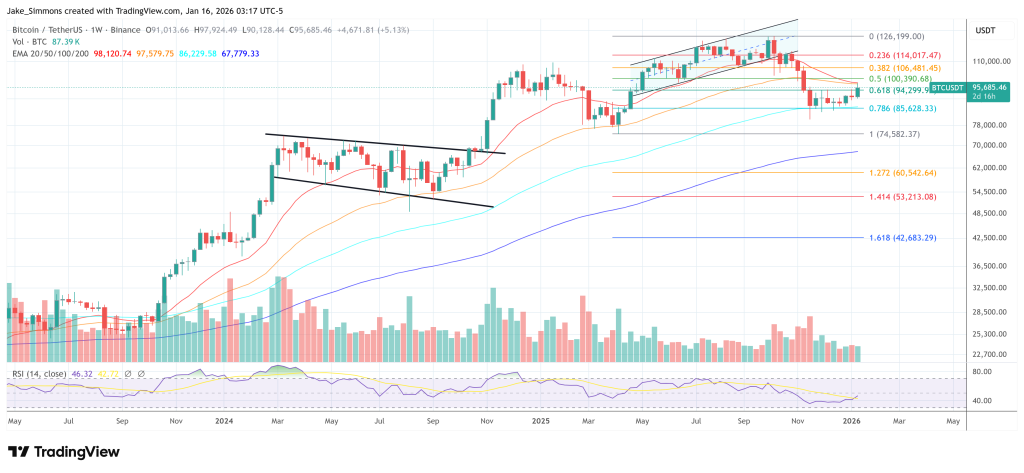
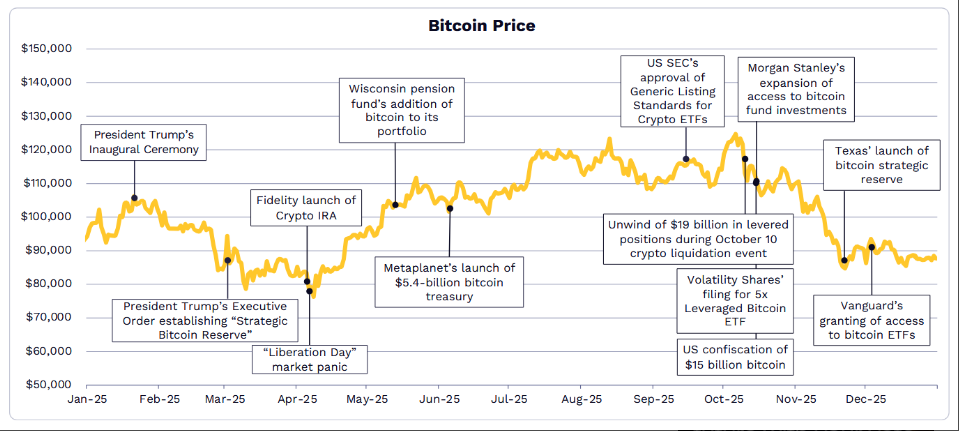
Bitcoin saw a lot of intraday volatility today, swinging thousands of dollars as markets reacted to fresh geopolitical headlines from U.S. President Donald Trump.
The price surged from the $88,000 range in early morning hours to $90,500, slid back into the upper $87,000s, and then rebounded toward $90,000 following Trump’s announcement that he would delay planned tariffs.
In a post on Truth Social, Trump said the decision followed what he described as a “very productive meeting” with NATO Secretary General Mark Rutte, outlining a preliminary framework for a broader deal involving Greenland and the Arctic region.
Citing the talks, Trump said tariffs scheduled to take effect on February 1 would not be imposed, easing near-term trade concerns and helping lift risk assets, including bitcoin, back toward key psychological levels.
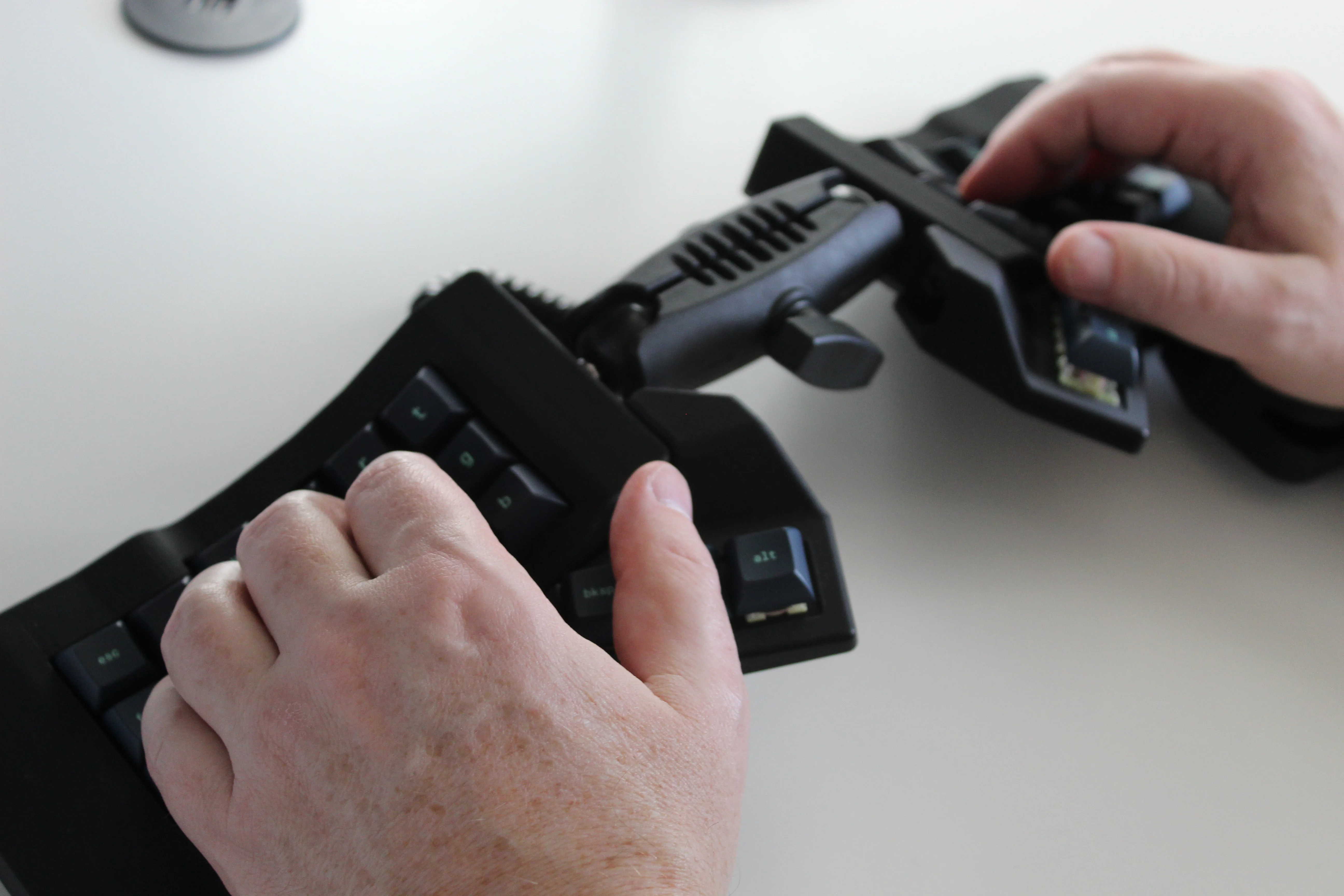
Get a handle on this bad boy! Okay, so those voids are really more for airing out your palms, I’d imagine, because palm sweat sure is real — you should see the pads of my Kinesis. This kind of looks like two sawed-off machine guns kissing, and I mean that in the best possible and non-violent way.
Image by [ntc490] via redditSo, [ntc490] has been on Team Special Keyboard for eight years now and decided it was time to design one. The goal was to make something semi-portable, super ergo, and as easy/cheap to build as possible, which, honestly, that sounds like one of those pick-two situations.
And yet, pricing (oh yeah, this is gonna be A Thing You Can Buy) will be around $115-155, depending upon whether you want the base kit, or the add-ons, too, minus switches and key caps.
So let’s get into the particulars here. As you can see, there are key wells and thumb clusters, inspired by other keyboards including your bog standard Maltrons, Kinesis Advantages and more modern, open-source takes like the Dactyl. [ntc490] loves the key well-thumb cluster combination, and I do, too (hello from the Glove80). And miraculously, the keys are hot-swappable via sockets.
Image by [ntc490] via redditThat novel tenting mechanism is adjustable, rugged, and portable. You can tent it near-vertical, lay it flat, or take it apart if you wish. The thing is modular for future expansion options such as wrist rests and displays.
So please do go visit the thread if this keyboard appeals to you at this price point. I love it, but I would need more rows of keys, personally. The top reddit comment mentions this as well, and [ntc490] says that because the thing is modular, it can easily accommodate more keys in both the wells and the thumb clusters. I seriously want one of these. Just with a few more keys.
Open-Sourcing the Ultimate Portable Split
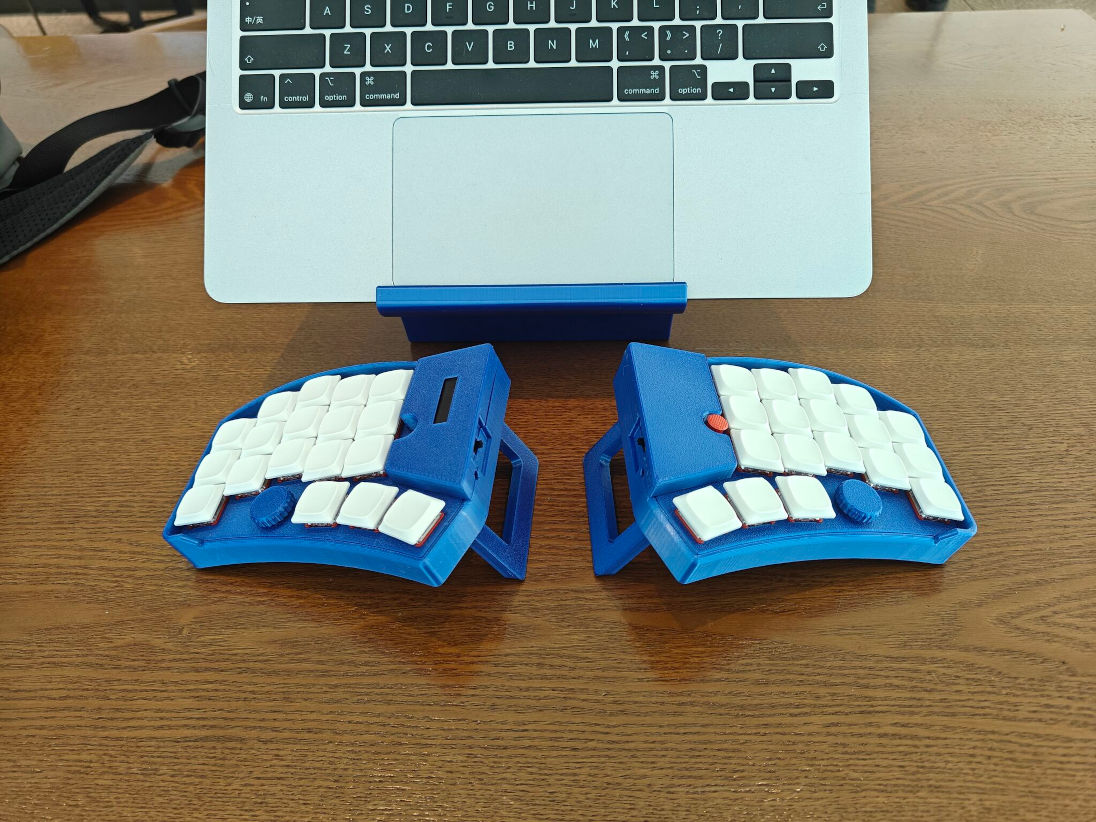
Remember [kleshwong]’s PSKEEB5 from a couple of Keebins ago, right before Christmas? He was going to open-source it if there was enough interest? Well, it seems that [kleshwong] decided to do it anyway and has since provided some new videos if you want to build one for yourself.
Image by [kleshwong] via GitHubThe first one covers the reasoning behind the reconsideration as well as the BOM and the case. The next video is the complete soldering tutorial, which clocks in at a very watchable fifteen minutes. Finally, [kleshwong] spends another fifteen on assembly and flashing the thing.
As a refresher, this thing has some really neat features like swing-out tenting feet, a pair of trackpoints, rotary encoders, and a carrying case that doubles as a laptop stand.
For the internals, any nice!nano-compatible boards will do. You’ll also need Kailh hot-swap sockets, among other things, naturally. If you have any trouble sourcing like the trackpoints for instance, you’re in luck, because [kleshwong] recently opened an online store. Go forth and build the ultimate portable split!
The Centerfold: Glove80 Looks Good In Wood
I’m using my MoErgo Glove80 pretty hardcore these days, driving them all crazy down at the library. But hey, it’s quieter than the big, echo-y Kinesis Advantage, even though they both have browns.
Once I saw the upcoming Go60 by MoErgo, though, I knew I simply needed wooden palm rests for the Glove80. So, over the course of two days, my father-in-law and I fabricated these fetching zebrawood rests, first from pink foam, then from poplar, and finally from book-matched zebra. I think we have a real conversation piece here.
Do you rock a sweet set of peripherals on a screamin’ desk pad? Send me a picture along with your handle and all the gory details, and you could be featured here!
Historical Clackers: a 3D-Printed Index Typewriter!
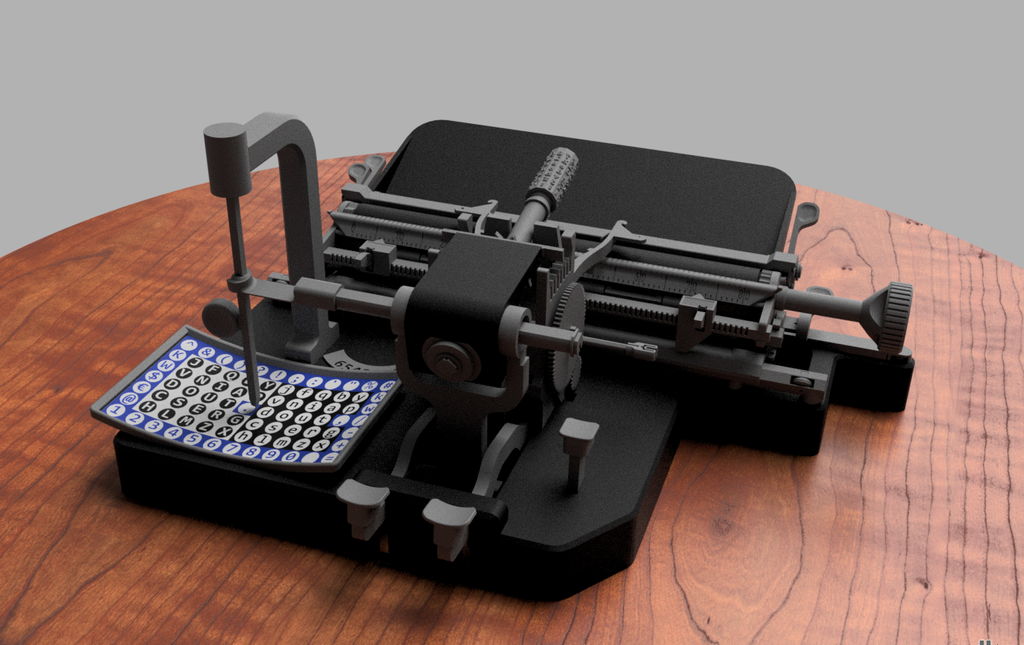
I was sorry to hear that [Keenan Finucan] had to submit this twice in order to get my attention. But here we are, with what is probably the world’s first 3D-printed index typewriter. So, why is this filed under Historical Clackers? Because I said so, and because it’s based on a real antique index typewriter, the AEG Mignon Model 4. This first model of Mignon was designed between 1901-1903 by German company AEG. Mignons were produced until 1932.
Image by [Keenan Finucan] via ThingiverseI suppose I don’t have to explain what an index typewriter is at this point. Besides, it seems pretty obvious in this design, but maybe I’m biased. Essentially it’s like a label maker, the old ka-chunk kind. You squeeze out one character at a time, then you move the index to the next character.
I think this looks fabulous overall, and I rather like the way the index is laid out, which is decidedly non-alphabetical and, surprisingly, does not mirror the AEG index.
[Keenan] reports that thanks to months of work and revisions, this project is as accessible and repeatable as possible. You don’t even need any glue, and non-printed items are at a minimum. You will need a minimum XYZ build volume of 250 x 210 220 mm, TPU or other flexible filament, some springs, a bit of coat hanger wire, and a universal 1/2″ typewriter ribbon, which is pretty widely available.
Finally, $2K Keyboard Computer Is a Return to Form
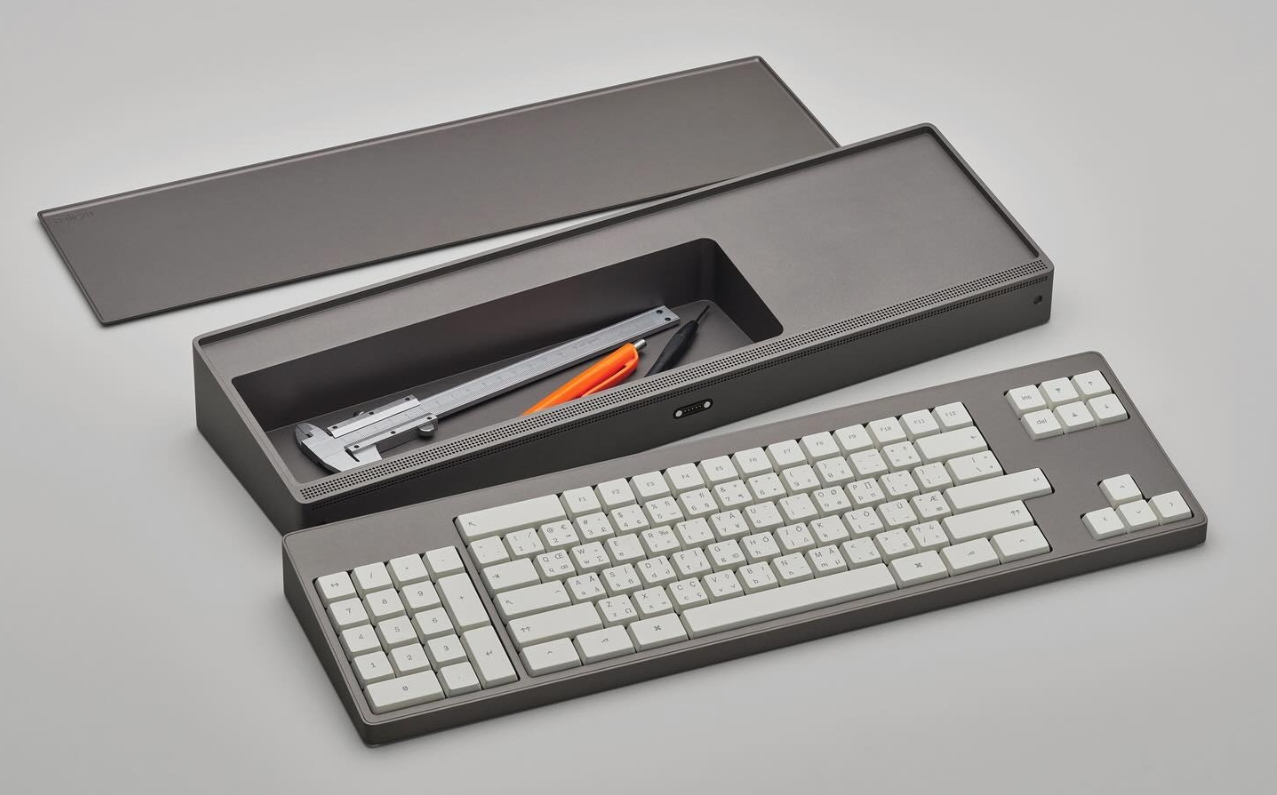
Alright coders, designers, and engineers: this elegant hunk of metal is for you. What we’ve got here is Caligra’s c100 Developer Terminal. Described as a “computer for experts”, this is not meant for scrolling social media, although what developer can get through the day without a reddit break or three?
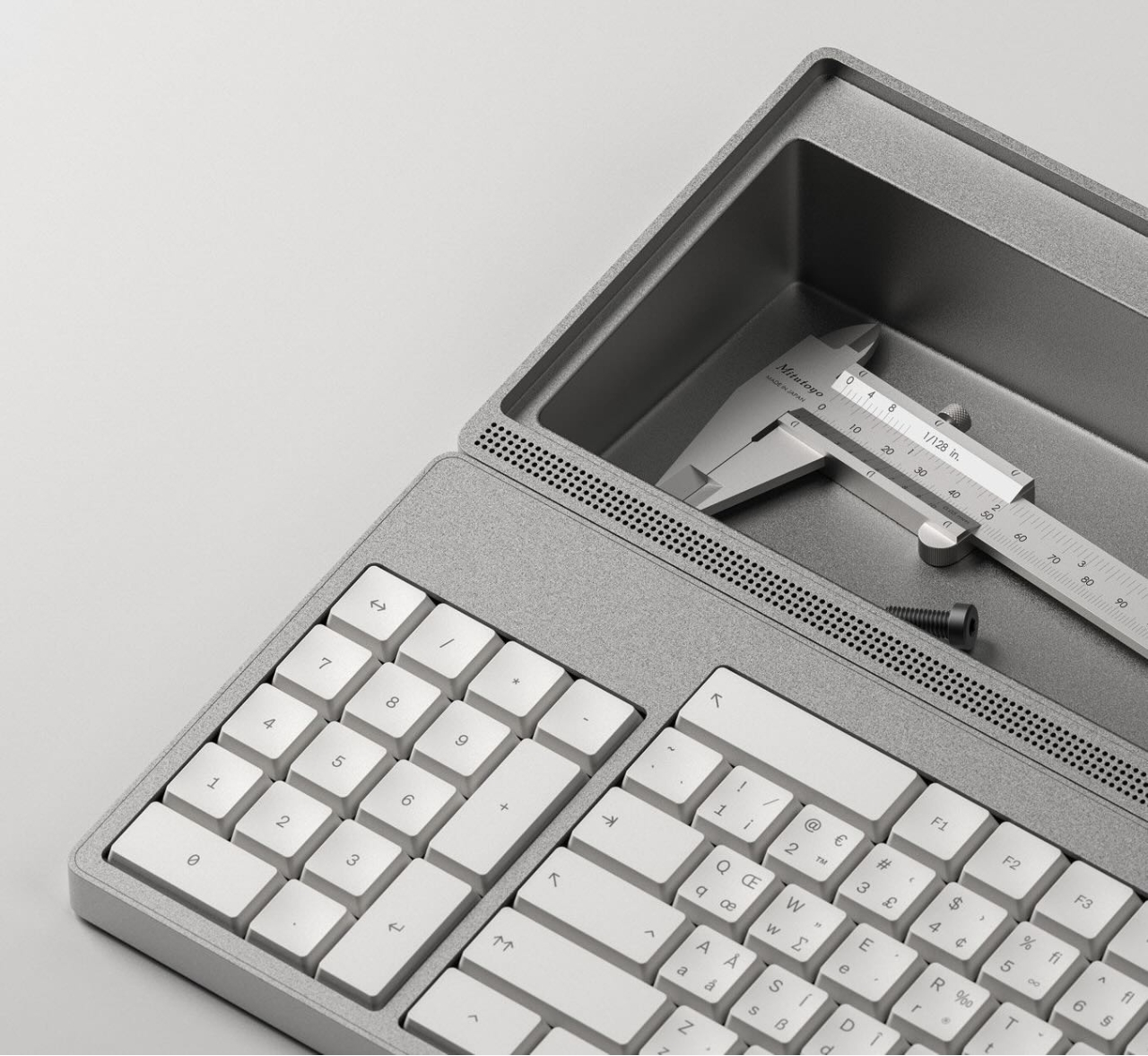
Let’s talk about that body. It’s entirely CNC-milled from a solid block of aluminium, which makes me think of the Icebreaker keyboard we saw here almost exactly a year ago. Both double as handy bludgeoning devices, but this one is decidedly more attractive. The bead-blasted finish of the c100 does simultaneously evoke modern and industrial design, so I’ll agree with Yanko on that note.
The coolest part is half-evident in the picture I chose. There’s a central magnetic pivot structure, and this lets you detach and fold the thing up even smaller, without any external hinges.
I thought the storage compartment gimmicky at first, but I’ve grown to like the idea of having a place for pens and whatnot. Yanko almost threatens to call it subversive in the face of what tech companies probably do not want you doing: opening the thing up. You are supposed to tinker with this one.
For some reason, the num pad is on the left, though I suppose this solves the distance-to-mouse problem. Yanko says the design uses Fitts’ law to accelerate task management, and this is supposed to explain why the keys are clustered the way they are. Basically, the placement of each key has been optimized for both speed an minimal hand movement. The wired mouse looks a bit uncomfortable, however.
This thing ships with Workbench OS, which is Linux-based and built specifically for technical work. There are no pop-ups in Workbench OS, which sounds amazing. So I would think that c100 is for writers, too, provided the keyboard clacks nicely.
If your car still has the factory stereo that feels stuck in 2014, this is one of the cleanest quality-of-life upgrades you can make. The Kenwood DMX4710S 6.8-inch multimedia receiver is $299.99, which is $100 off the $399.99 compared value. The main draw is simple: wired Apple CarPlay and Android Auto so you can get […]
Cathie Wood is arguing that the next phase of US policy and macro could recreate an early-1980s style risk-on regime, one that, in her telling, strengthens the case for bitcoin as a portfolio diversifier even as it complicates the “digital gold” narrative. In a post on X, the ARK Invest CEO said “the next three years could be Reaganomics on steroids,” pointing to deregulation, tax cuts, “sound monetary policy,” and “peace through strength” as ingredients for a stronger dollar and capped gold prices.
Her January 15 “New Year letter,” titled Cathie Wood’s 2026 Outlook: The US Economy Is A Coiled Spring, lays out the mechanics behind that analogy and places crypto explicitly inside the policy and productivity story.
A “Coiled Spring” Macro Thesis
Wood’s central claim is that the US has looked sturdier than it really is because weakness has rotated through rate-sensitive pockets rather than hitting the whole economy at once.
“Despite sustained real gross domestic product (GDP) growth during the past three years, the underlying US economy has suffered a rolling recession and has evolved into a coiled spring that could bounce back powerfully during the next few years. In response to COVID-related supply shocks, the record-breaking 22-fold surge in the Fed funds rate from 0.25% in March 2022 to 5.5% in the sixteen months ended July 2023 pushed housing, manufacturing, non-AI capital spending, and low-to-middle income America into recession.”
She anchors the housing leg with a specific trough: existing home sales fell 40% from a 5.9 million annual rate in January 2021 to 3.5 million in October 2023, which she notes is “a level last seen in November 2010.”
From there, Wood pivots to policy impulse and cash-flow relief. “Thanks to the confluence of deregulation and lower taxes (including tariffs), inflation, and interest rates, the rolling recession which has characterized the last few years in the US could turn quickly and sharply during the next year and beyond. Deregulation is unleashing innovation in every sector, led by the first AI and Crypto Czar, David Sacks, in the AI and digital assets space. Meanwhile, lower taxes on tips, overtime, and social security should hand US consumers significant refunds this quarter, potentially driving real disposable income growth up from ~2% at an annual rate during the second half of 2025 to ~8.3% this quarter.”
She also argues corporate cash flows could be boosted by accelerated depreciation, writing that it could push the effective corporate tax rate “down toward 10%,” with 100% first-year depreciation for equipment, software and domestic R&D made permanent and retroactive to January 1, 2025.
Gold, Bitcoin, And The Dollar
Wood’s inflation case is concrete and component-driven. She points to oil falling from about $124 on March 8, 2022 to a level that’s roughly 53% lower, and down about 22% year-over-year as of ARK’s January 12 data cut. She adds that single-family home sale prices are down about 15% from the October 2022 peak, while existing home price inflation (three-month moving average) decelerated from roughly 24% YoY in June 2021 to about 1.3%.
On labor, she cites non-farm productivity up 1.9% YoY (third quarter), compensation per man-hour up 3.2%, and unit labor cost inflation at 1.2%. She then pushes a real-time check: Truflation at 1.7% YoY as of January 7, nearly 100 bps below CPI-based inflation.
The crypto hook comes through her attempt to split gold’s recent run from bitcoin’s role in portfolios. “During 2025, the gold price appreciated 65% as the price of bitcoin slipped 6%. While many observers have attributed the 166% surge in the gold price from $1,600 to $4,300 since the end of the US equity bear market in October 2022 to the risk of inflation, another interpretation is that global wealth creation… has outpaced the ~1.8% annualized increase in the gold supply globally.”
Wood then leans on supply schedules and correlations. She notes bitcoin’s supply is “mathematically metered” to rise about 0.82% per year for the next two years before slowing to ~0.41%, and argues that diversification — not “digital gold” rhetoric — is the cleaner allocator lens. In ARK’s correlation matrix using weekly returns from 1/1/2020 through 1/6/2026, bitcoin’s correlation is 0.14 to gold, 0.06 to bonds, and 0.28 to the S&P 500; the S&P 500–bonds correlation is shown at 0.27.
Finally, she brings it back to FX: after a year in which the trade-weighted dollar (DXY) fell 11% in the first half and 9% for the full year, Wood argues that higher US returns on invested capital, driven by fiscal, deregulation, and US-led technological breakthroughs, could push the dollar higher, echoing the early Reagan period when “the dollar nearly doubled.”
If Wood’s “Reaganomics on steroids” framing gains traction, the near-term market implication is less about a single bitcoin price target and more about positioning: a regime she expects to feature falling inflation, lower rates, and heavy AI capex (data-center systems investment up 47% to nearly $500 billion in 2025, with a further 20% to roughly $600 billion expected in 2026) is one where allocators may revisit where bitcoin sits on the risk spectrum, and whether its low cross-asset correlation is the more durable thesis than any one-line comparison to gold.
While Wood’s 2026 outlook does not publish a specific Bitcoin price target, ARK has previously outlined 2030 scenarios for BTC of roughly $300,000 (bear), $710,000 (base), and $1.2 million (bull).
Cathie Wood is betting that politics, not just markets, could be the catalyst that pushes the United States into actively buying bitcoin.
The ARK Invest founder said this week that cryptocurrency has become a durable political issue for President Donald Trump, one that could shape policy decisions as the White House looks ahead to the 2026 midterm elections.
In Wood’s view, that dynamic increases the odds that the federal government eventually moves beyond holding seized BTC and begins purchasing BTC outright for a national strategic reserve.
Crypto was “part of the reason he won the presidency,” Wood said on a recent episode of ARK’s Bitcoin Brainstorm podcast. With midterms looming, she argued, Trump has incentives to keep the industry onside and to deliver visible progress.
“The most important one is that he doesn’t want to be a lame duck. He wants to have another one or two productive years, and I think he sees crypto as a path to the future,” Wood said.
The U.S. BTC reserve was created by executive order less than a week into Trump’s second term, alongside a broader digital asset stockpile and a new interagency working group chaired by Special Advisor for AI and Crypto David Sacks.
So far, however, the reserve has been capitalized only with bitcoin seized through criminal forfeitures — assets Trump has pledged not to sell.
“It seems as though there has been reticence about actually buying bitcoin for the strategic reserve,” Wood said. “So far, it’s confiscated [bitcoin].” That posture, she suggested, may not last. “The original intent was to own one million bitcoins, so I actually think they will start buying.”
Crypto has emerged as a more organized political constituency over the past election cycle. Industry-backed political action committees poured money into congressional races, while prominent executives publicly endorsed Trump and, in some cases, donated personally. Wood herself was among those supporters.
The administration has also made a point of signaling engagement with the sector. The White House has hosted crypto-related events, and firms including Coinbase, Tether and Ripple are among those contributing to the construction of a new White House ballroom.
Bitcoin as a ‘scarce value’
On the policy front, Trump has signed executive orders establishing the bitcoin reserve and crypto stockpile, and backed legislative efforts such as the GENIUS Act, which would formalize stablecoin rules.
A July report from Sacks’ working group laid out additional recommendations, including granting the Commodity Futures Trading Commission authority over spot markets in non-security digital assets. It reaffirmed that the bitcoin reserve and crypto stockpile would be administered by the Treasury Department and, at least initially, funded with forfeited assets. The order also directed the Treasury and Commerce Departments to explore “budget-neutral” ways to acquire additional bitcoin.
Wood sees that constraint as the key hurdle, but not an insurmountable one. She framed potential government buying as a market inflection point, especially as bitcoin’s supply tightens. Nearly 20 million of bitcoin’s 21 million cap have already been mined.
“If we get the U.S. not just adding confiscated bitcoin to a strategic reserve but actually out there buying,” Wood said, “that would set off what we’re all waiting for — the scarcity value to reassert itself.”
I first fell in love with red twig dogwoods about 25 years ago when a gardening friend took me to visit another of her friends. The sweet woman pointed out…
According to the tabloids, celebrities are just like us. They run errands, they wait in lines and they also know which strains of cannabis they love best. In the past few years, many of the world’s most iconic stoners have embraced the legalized industry by launching branded pot products. Willie Nelson has Willie’s Reserve, Snoop Dogg has Leafs By Snoop, and more famous faces are getting in on the action every day. But what is Nelson smoking when he hangs up his guitar after a long day? What’s in the blunts that Snoop allegedly smokes up to 80 of a day? With so many different strains now available — bred to highlight various terpenes and capable of inducing a wide array of physical and mental sensations — what are celebrities reaching for when it’s time to toke up?
Willie Nelson
In the case of the most famous pothead on the planet, country legend Willie Nelson claims he has no preference. In a recent interview with Rolling Stone, Nelson suggested that cannabis was like sex — “It’s all good, some is great.” Later in the same article, Nelson’s wife, Annie D’Angelo, did note that Nelson prefers sativas (“He’s already funny, so it just makes him funnier.”) For the “On the Road Again” musician, a practice of smoking what you’ve got does feel rather fitting. Nelson recently made news for admitting he’s no longer smoking, but hasn’t stopped enjoying cannabis.
Miley Cyrus
The superstar pop singer has made no secret of her love affair with weed — a stance that likely shocked some fans who best knew her as a squeaky-clean Disney star. Yes, even Hannah Montana is riding the green rush. During a 2013 trip to Amsterdam, a member of Cyrus’s entourage revealed that Miley’s strain of choice was Super Lemon Haze, a sativa-dominant hybrid known for sparking energy and joy. Given the sunny vibes of her most 2017 album, ‘Younger Now,’ it appears to have done the trick.
Doug Benson
For some of us, the challenge of performing live comedy may seem daunting, but seasoned comic and podcaster Doug Benson is always at ease when he hits the stage. His secret? Being really, really high, of course. Like Nelson, Benson isn’t too picky when it comes to strains, but in a 2013 interview with Cannabis Now, he did express a fondness for the delightfully named Chocolope. A cross of Chocolate Thai and Cannalope Haze, this strain has notes of coffee and is recognized for its ability to induce a happier mindset.
Snoop Dogg
The legendary West Coast rapper has been hyping cannabis since the day he first hit the studio. One could make the argument that Snoop has done more to bring weed to the mainstream than any other celebrity out there. When it comes to what he likes to burn, he’s given a number of different answers over the years. One that Snoop’s mentioned several times is Herijuana. According to Leafly, this hybrid of Petrolia Headstash (a variety of Humboldt County Afghan) and Killer New Haven “was worked by breeders for 15 generations.” The result is a powerful high that is likely best enjoyed by heavyweight consumers like the D-O-double-G.
Seth Rogen
While Seth Rogen has not officially confirmed his favorite strain, there’s reason to believe it might just be Pineapple Express. After all, the strain didn’t actually exist before he and co-writer Evan Goldberg invented the name for their 2008 stoner comedy. Borrowing the name from a weather phenomenon (an atmospheric river that begins in the islands of Hawaii and moves up towards the West Coast), Pineapple Express is now a bona fide strain the combines Trainwreck and Hawaiian for a sativa-forward blend that will get you up and moving if the afternoon starts to drag.
TELL US, what’s your favorite strain?
Originally published in Issue 39 of Cannabis Now. LEARN MORE
Traeger is launching a fully reimagined Ironwood and Ironwood XL. The grills encompass outdoor cooking through new features, advancements, and upgrades.
Winter Ornamentals – Bark Book Excerpt by Dan Hinkley Like the last and messy hours of a party gone on too long, the soggy, cool days of late autumn cast about the garden a mood of the season’s demise. Yet as the last colored leaves, varnished with the first rains of winter, fall earthward, the deciduous trees bare their sinewy […]

 Login
Login
 How Bitcoin Fits Into The Picture