❌

Reading view

There are new articles available, click to refresh the page.

TSMC says AI demand is β€œendless” after record Q4 earnings

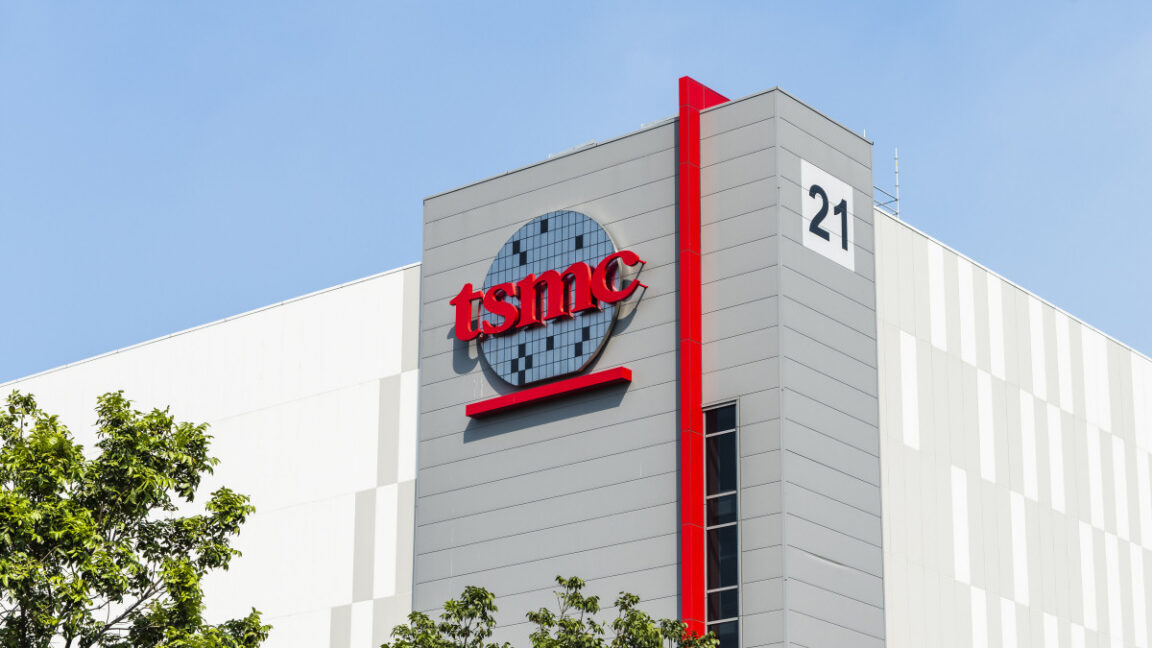
On Thursday, Taiwan Semiconductor Manufacturing Company (TSMC) reported record fourth-quarter earnings and said it expects AI chip demand to continue for years. During an earnings call, CEO C.C. Wei told investors that while he cannot predict the semiconductor industry's long-term trajectory, he remains bullish on AI.

TSMC manufactures chips for companies including Apple, Nvidia, AMD, and Qualcomm, making it a linchpin of the global electronics supply chain. The company produces the vast majority of the world's most advanced semiconductors, and its factories in Taiwan have become a focal point of US-China tensions over technology and trade. When TSMC reports strong demand and ramps up spending, it signals that the companies designing AI chips expect years of continued growth.

"All in all, I believe in my point of view, the AI is realβ€”not only real, it's starting to grow into our daily life. And we believe that is kind ofβ€”we call it AI megatrend, we certainly would believe that," Wei said during the call. "So another question is 'can the semiconductor industry be good for three, four, five years in a row?' I'll tell you the truth, I don't know. But I look at the AI, it looks like it's going to be like an endlessβ€”I mean, that for many years to come."

Read full article

Comments

Β© BING-JHEN HONG via Getty Images

Arizona Introduces Bill To Exempt Bitcoin and Crypto From Property TaxesΒ 

Bitcoin Magazine

Arizona Introduces Bill To Exempt Bitcoin and Crypto From Property TaxesΒ 

Arizona state Sen. Wendy Rogers has introduced a package of legislation aimed at reshaping how digital assets are treated under state and local tax law, renewing a broader push by some lawmakers to position Arizona as a jurisdiction with clearer and more favorable rules for cryptocurrencies and blockchain infrastructure.

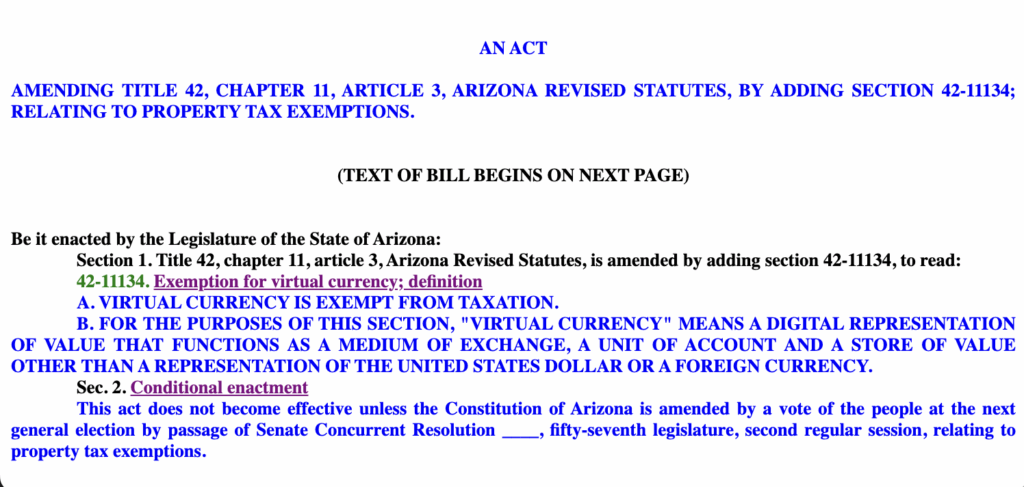
In bills prefiled with the Arizona Senate, Rogers proposed amending state statutes to exempt virtual currency from taxation (SB 1044), prohibiting counties, cities and towns from taxing or fining entities that operate blockchain nodes (SB 1045), and advancing a constitutional amendment to clarify how digital assets fit into Arizona’s property tax framework (SCR 1003).

The measures take different procedural paths. SB 1045, which focuses on protections for blockchain node operators, could move through the legislature and become law if approved by lawmakers and signed by the governor.Β 

By contrast, SB 1044 and SCR 1003 are tied together and would ultimately require voter approval during the next general election in November 2026.

SCR 1003 proposes amending Arizona’s constitution to explicitly exclude virtual currency from property taxation. SB 1044 would mirror that change in state statutes, adding language that clarifies digital assets are not subject to property tax. Under Arizona law, changes to constitutional tax definitions must be approved by voters, making the ballot measure a central hurdle for the broader tax exemption effort.

SB 1045 addresses a narrower, but increasingly debated issue: the treatment of blockchain nodes at the local level. The bill would bar cities, towns and counties from imposing β€œa tax or fee on a person that runs a node on blockchain technology,” effectively preventing local governments from singling out node operators through taxes or penalties.Β 

Arizona is one of many states embracing bitcoin and crypto

Arizona’s legislative activity around digital assets builds on earlier efforts that have already placed the state among a small group with crypto-specific laws on the books. Arizona is one of the few U.S. states that allows the government to take custody of digital assets deemed abandoned after three years.Β 

That framework emerged from past attempts by crypto advocates to establish a state-level digital asset reserve and has since become part of a wider debate over how much authority states should have to hold or invest in cryptocurrencies such as bitcoin.

Rogers was previously a co-sponsor of a bitcoin reserve bill that was vetoed by Arizona Governor Katie Hobbs in May. Following the veto, Rogers criticized the decision and said she planned to refile similar legislation in a future session.

Arizona’s proposals arrive as states across the country experiment with different approaches to digital asset policy. New Hampshire and Texas have also enacted laws related to digital asset reserves, while other states have focused on narrower tax questions.Β 

Ohio lawmakers advanced a bill that would exempt cryptocurrency transactions under $200 from capital gains taxes, though it has stalled since June.

Β In New York, a proposal to impose a 0.2% excise tax on digital asset transactions was referred to committee earlier this year and has not moved forward.

At the federal level, Sen. Cynthia Lummis of Wyoming introduced draft legislation proposing a de minimis exemption for digital asset transactions and capital gains of $300 or less.Β 

Lummis announced on Friday that she plans to retire from the U.S. Senate in January 2027.

arizona

Bitcoin is trading at $87,341, down 3% over the past 24 hours. Its 24-hour trading volume is $46β€―B. The price is 3% below its 7-day high of $90,031 and 1% above its 7-day low of $86,806.

With a circulating supply of 19,966,021 BTC (out of a maximum 21 million), Bitcoin’s market cap stands at approximately $1.74β€―T, reflecting a 3% drop in the last 24 hours.


This post Arizona Introduces Bill To Exempt Bitcoin and Crypto From Property TaxesΒ  first appeared on Bitcoin Magazine and is written by Micah Zimmerman.

Set the table with holiday BOGO’s & more at Ponderosa Dispensaries

Happy Holidays, Arizona! With Green Wednesday on the horizon, the celebratory season is just about to kick off, and Ponderosa Dispensary has everything you need to celebrate the holidays the hazy way. They’ve got tons of deals throughout the end of the year for you to enjoy at all of their dispensaries, and that’s on […]

The post Set the table with holiday BOGO’s & more at Ponderosa Dispensaries appeared first on Leafly.

Arizona Bill Would Provide Grants for Magic Mushroom Trials

Legislation proposed in Arizona would provide millions of dollars in grant funding to expand research into psilocybin––the primary psychoactive component in magic mushrooms––as a potential treatment for certain mental health conditions.

The bill, introduced by a Republican lawmaker and backed by Democrats, β€œwould put $30 million in grants over three years toward clinical trials using whole-mushroom psilocybin to treat mental health conditions like depression and PTSD,” the Arizona Mirror reports.Β 

The outlet reports that one of the bill’s biggest backers is Dr. Sue Sisely, an internal medicine physician who believes that psilocybin treatment could be a boon for ailing military veterans.Β 

β€œIt’s curbed their suicidality, it’s put their PTSD into remission, it’s even mitigated their pain syndromes,” Sisely said of patients she has seen benefit from psilocybin, as quoted by the Arizona Mirror. β€œIt’s shown evidence of promoting neurogenesis (the growth and development of nerve tissue). There’s all kinds of great things that are being uncovered, but they’re not in controlled trialsβ€”they’re anecdotes from veterans and other trauma sufferers.” 

According to the Mirror, β€œso far the only controlled trials on psilocybin to treat medical conditions have used a synthetic, one-molecule version of the substance, which is vastly different from a whole mushroom, which contains hundreds of compounds.”

β€œThese agricultural products are very complex, and that is what people are reporting benefit from,” Sisley told the Arizona Mirror. β€œNobody in the world has access to synthetic psilocybin unless you’re in one of these big pharma trials.” 

In the last decade, psilocybin has gone from the fringes to the mainstream, as researchers and policymakers have grown more amenable to mushrooms as an effective treatment for a variety of different disorders.Β 

It has also become the next frontier for drug legalization advocates, as states like Arizona consider measures that would expand its usage.Β 

To the north of the Grand Canyon State, advocates in Utah have launched a campaign to push legislators to legalize psilocybin for clinical and academic purposes.

β€œNumerous robust studies have shown that psilocybin therapy is beneficial in reducing treatment-resistant depression, anxiety, addiction, trauma, obsessive-compulsive disorder, and other mental health disorders. It is more effective than synthetic pharmaceuticals by a large margin. Psilocybin has also shown effectiveness in easing fear and anxiety in people with terminal cancer. For instance, a groundbreaking study performed by John Hopkins Medicine found that psilocybin reported better moods and greater mental health after participating in a single clinical dose,” Utah Mushroom Therapy, the group behind the campaign, says in a statement.

The group is looking to gin up public support for the treatment after the state’s Republican governor, Spencer Cox, signed a bill last year establishing a task force that will study psilocybin as a mental health treatment.

Utah Mushroom Therapy says that, in the wake of the task force, β€œlegalizing and decriminalizing Psilocybin in Utah is now very likely but still needs public support.”

β€œThe use of mushrooms has been documented in 15 indigenous groups in America and various religious communities in Utah. This petition supports those groups who wish to use psilocybin safely, sincerely, and as a necessary part of their religion. The use of psilocybin does not contradict other Utah cultures and is protected by the first amendment as well as the Religious Freedom Restoration Act. This petition is to advocate Utah law to protect the religious rights of Utahns,” the group says.Β 

β€œPsilocybin is a natural, non-toxic substance. Despite this, it is currently a Schedule I substance. Scientists have demonstrated it has profound medicinal value and believe serotonergic hallucinogens assist cognitive processes and should be decriminalized. Psychedelics can change perception and mood, help people soften their perspective and outlook, and process events that may otherwise lead to substance abuse, trauma, and criminal behavior,” it continues.

The post Arizona Bill Would Provide Grants for Magic Mushroom Trials appeared first on High Times.

❌