
❌

Reading view

There are new articles available, click to refresh the page.

ASTER Slumps 75% to New Lows as Hyperliquid Pulls Ahead β€” Is the Perp DEX Race Already Over?

A sharp sell-off in Aster’s token is drawing fresh attention to the decentralized perpetuals trading sector, even as overall derivatives activity remains historically high.

ASTER fell roughly 75% from its peak to trade near new lows this week, showing the growing gap between platforms that are capturing durable trading interest and those struggling to hold on once incentives fade.

The decline has unfolded as Hyperliquid extends its lead over rivals, raising questions about whether the race among perp-focused decentralized exchanges is already tilting decisively in one direction.

Hyperliquid Pulls Ahead as ASTER Selloff Deepens

At the time of writing, ASTER was trading around $0.62, down more than 13% over the past 24 hours. The decline follows weeks of sustained weakness, with the token down over 11% in the last seven days and nearly 74% below its all-time high of $2.41.
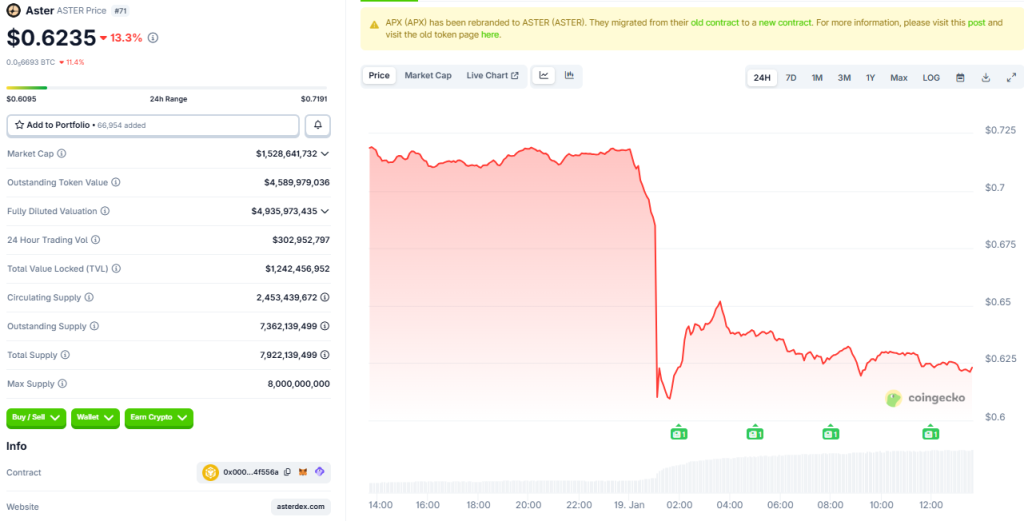
Source: Coingecko

Trading activity surged during the selloff, with 24-hour volume jumping more than 300% to over $300 million, pointing to heightened short-term positioning rather than a recovery in confidence.

Data from DefiLlama shows that the overall activity in the sector continues to explode, with cumulative perp volume exceeding $803 billion over 30 days.

Total perp trading volume over the past 24 hours stood near $19.9 billion, while open interest reached about $20.6 billion.
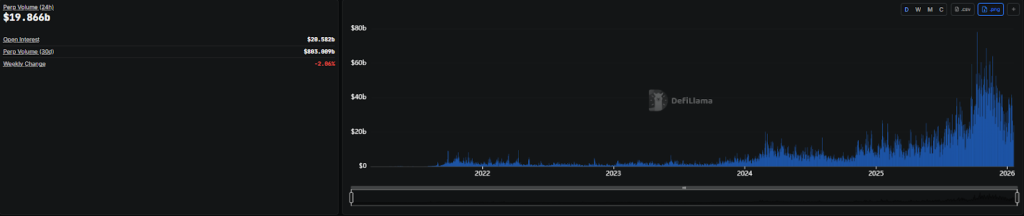
Source: DefiLlama

Market data shows Hyperliquid pulling further ahead in both trading volume and open interest, two metrics that traders tend to treat differently.

Over the past seven days, Hyperliquid processed about $40.7 billion in perpetual futures volume, according to figures compiled from CryptoRank and DefiLlama.

That compared with roughly $31.7 billion on Aster and $25.3 billion on Lighter over the same period.

Hyperliquid reclaims the perps throne

As Lighter’s airdrop is distributed, the platform’s volumes have started to fade – weekly volume has decreased nearly 3x from its peak.@HyperliquidX has captured the lead and is now ranked 1st by volume and open interest.@variational_io… pic.twitter.com/LChbSdaU8a

β€” CryptoRank.io (@CryptoRank_io) January 18, 2026

The divergence becomes more pronounced when looking at open interest, which reflects where traders are willing to keep leveraged positions open rather than simply rotate trades.

Hyperliquid recorded about $9.57 billion in open interest over the past 24 hours, exceeding the combined $7.34 billion held across rival platforms, including Aster, Lighter, Variational, edgeX, and Paradex.

The widening gap suggests traders are increasingly using Hyperliquid as a primary venue to hold leveraged positions, rather than simply rotating capital in search of short-term incentives.

The shift has become more apparent as reward-driven activity cools across the sector.

Buybacks Roll Out as Unlocks Cloud Perp DEX Outlook

Lighter, which saw a surge in trading ahead of its airdrop late last year, has experienced a sharp slowdown since the distribution, with weekly volumes falling significantly from their December highs.

Also, the LIT token has dropped to new lows, losing more than a third of its value over the past month as a significant share of airdropped tokens moved into the market.

In an effort to support its token, Aster recently activated what it calls a Strategic Buyback Reserve.

We're now actively deploying our Strategic Buyback Reserve for $ASTER token repurchases automatically.

Building on our Stage 5 Buyback Program announced last month, this activation allocates 20-40% of daily platform fees into targeted buybacks, responding dynamically to market… https://t.co/cIbles9eHM

β€” Aster (@Aster_DEX) January 19, 2026

The program builds on a broader buyback framework announced in December, under which up to 80% of daily fees can be directed to automatic and discretionary buybacks, all executed on-chain.

However, the scale of upcoming token unlocks remains a central concern for the market.

Aster has significant token unlocks scheduled through 2026, including quarterly releases of roughly 183 million ASTER in January and April, followed by additional large releases mid-year and ongoing monthly emissions.

Although the team previously delayed unlocks to build utility and reduce near-term pressure, the scale of upcoming supply has become a focal point for traders assessing downside risk.

While incentive-driven activity has cooled across the sector, Hyperliquid has continued to attract capital even as its token, HYPE, has weakened alongside the broader market.

The post ASTER Slumps 75% to New Lows as Hyperliquid Pulls Ahead β€” Is the Perp DEX Race Already Over? appeared first on Cryptonews.

Lighter launches LIT token: check out all the details here

  • Half of the token supply is allocated to the ecosystem, with an immediate airdrop converting 2025 points into LIT.
  • LIT is used for staking, access to trading services, and payment for data verification on the platform.
  • Lighter ranks third by recent perpetuals volume, behind Hyperliquid and Aster.

A new token launch is putting fresh focus on how decentralised trading platforms are designing their economic models.

Perpetuals-focused Layer 2 exchange Lighter has rolled out its native cryptocurrency, LIT, positioning it as a core part of its infrastructure rather than a simple governance add-on.

Built on Ethereum, the platform is targeting active derivatives traders while also appealing to builders and long-term backers interested in transparent, onchain systems that mirror aspects of traditional markets.

The launch comes at a time when onchain perpetuals trading is consolidating around a small group of high-volume venues.

Lighter is attempting to differentiate itself by tying token utility directly to trading performance, data verification, and revenue visibility, while operating through a US-registered corporate structure.

Token distribution and airdrop design

The total LIT supply is split evenly between the ecosystem and insiders.

Half of all tokens are allocated to users, partners, and future incentives, while the remaining half goes to the team and investors.

Early participants are being rewarded through an immediate airdrop that converts 12.5 million points earned during 2025 into LIT tokens.

That initial distribution accounts for 25% of the project’s fully diluted value, which represents the maximum supply if all tokens are issued.

The remaining ecosystem allocation is reserved for future rewards, partnerships, and expansion initiatives.

Team and investor tokens are subject to a one-year lockup, followed by linear vesting over three years, according to details shared by the project on X.

Utility beyond governance

Lighter is framing LIT as an operational token embedded in how its exchange functions.

Rather than focusing solely on voting rights or passive rewards, the token underpins access to different levels of trading execution and data verification services on the platform.

Users who want higher-tier services are required to stake increasing amounts of LIT.

These requirements are designed to scale as the network decentralises further, shifting control from a single operator to a broader set of participants.

Fees for market data and price verification are also paid in LIT, with staking acting as a mechanism to ensure data accuracy and reduce risk across the trading system.

Onchain revenue and buyback flexibility

Another feature highlighted by the project is full onchain visibility of revenue generated by its trading platform and future products.

All income is intended to be publicly trackable on the blockchain, allowing users to independently verify performance.

Management has indicated that this revenue could be used either to support ecosystem growth or to buy back LIT tokens from the market.

Any buyback activity would reduce circulating supply, but there is no fixed schedule.

Decisions are expected to depend on market conditions and longer-term strategic considerations, rather than automated rules.

Market position in perpetuals trading

Lighter’s activity places it among the more active decentralised perpetuals venues.

Over the past seven days, Lighter-based perpetuals have averaged $2.7 billion in trading volume, ranking third behind Hyperliquid and Aster, based on data from a Dune-powered tracker.

Hyperliquid’s HYPE token currently carries a market valuation of $6.26 billion, making it one of the largest digital assets globally.

Against that backdrop, Lighter is betting that tightly coupling token utility with execution quality, data integrity, and transparent revenues can help it carve out a durable role in the evolving onchain derivatives landscape.

The post Lighter launches LIT token: check out all the details here appeared first on CoinJournal.

Aster (ASTER) price outlook as whale dumps 3M coins at a loss

  • A large-scale investor has offloaded millions of ASTER tokens, absorbing a 22% loss within two weeks.
  • ASTER price has dropped below key levels, signaling bearish short-term bias.
  • Aster team calms supply-side worries by confirming no plans to sell unlocked tokens.

The digital assets market remained deteriorated on Wednesday, with the global crypto market capitalization at $2.94 trillion after a 0.65% dip in the past 24 hours.

Also, Bitcoin remained somewhat muted in the last day after the recent decline, changing hands at $86,640 following a mere 0.30% decline on its daily chart.

While most altcoins sought footing after the latest broad-based crash, ASTER is experiencing renewed selling momentum as large-scale players exit.

The digital token has lost nearly 10% of its value in the past 24 hours, underscoring overwhelming downward momentum.

According to Lookonchain, one whale has sold 3 million Aster coins, worth approximately $2.33 million today.

The entity executed the transaction when the alt traded at $0.78 per token.

Notably, the whale accumulated these tokens only two weeks ago and has now suffered a roughly 22% loss (or $667,000).

Such moves are often more than just a trade gone wrong.

Generally, whale investors have high risk tolerance and intend to hold for the long term, possibly until the asset turns bullish.

So, when a large-scale investor surrenders at a loss, it can signal a lack of conviction in short-term price rebounds.

Furthermore, the exit has coincided with ASTER’s significant price decline, magnifying prevailing bearish sentiments.

ASTER price analysis

Aster’s native token is changing hands at $0.7475 after losing more than 8% of its value in the last 24 hours.

The daily trading volume has increased by nearly 45%, signaling increased activity from participants likely exiting before further declines.

Meanwhile, ASTER has breached the crucial support zone at $0.81 – $0.82 and is ready to turn it into an overhead supply region.

That suggests immense bearishness, with any potential rebound to $0.80 likely to encounter heavy selling pressure.

Sellers are targeting the barrier at $0.72, where ASTER briefly paused during the previous dip.

Failure to attract adequate buying activity at this mark could expose the altcoin to further declines to the psychological zone at $0.70 in the near term.

Meanwhile, ASTER should reclaim $0.82 to flip to bullish.

Surpassing $0.85 with massive volumes could support breakouts to $0.90 and clear the path to $1.

Aster team boosts community confidence

Amidst the devastating downward pressure, the DEX has shifted attention to supply dynamics.

Early today, December 17, the team took it to X to address these concerns, confirming the completion of December’s Community & Ecosystem token unlock.

They have moved the unlocked assets to an address that now holds 235.2 million Aster coins after three months of coin releases.

Notably, Aster emphasized that it has no immediate plans to spend the unlocked ASTER and that the team will communicate in advance in case of future deployment plans.

While the announced transfer doesn’t add new supply to the circulating tokens, it comes amid amplified uncertainty, with traders worrying about additional selling pressure as key holders surrender.

Β 

The post Aster (ASTER) price outlook as whale dumps 3M coins at a loss appeared first on CoinJournal.

Doubled Smoked Ham

By: Charlie

Double smoking a ham might seem like extra work, but it’s actually one of the easiest ways to elevate a holiday meal. You’re taking a fully cooked ham and smoking it to add layers of flavor that oven-baking just can’t achieve. The diamond scoring creates pockets for the glaze to settle and caramelize into a […]

The post Doubled Smoked Ham appeared first on Simply Meat Smoking.

Must-know ways to overcome the much-dreaded β€˜freeze’ response

By: slandau

EXECUTIVE SUMMARY:

Despite CISOs’ formidable training efforts on behalf of teams, a commonly overlooked phenomenon is the human tendency to freeze amidst a crisis. Building your incident response operations around this ingrained aspect of psychology can help prevent your teams from seizing up during intense and urgent situations.

In the event of an intrusion or ransomware attack, how exactly will your security team respond? Will they take an aggressive approach, pass the potato, or involuntarily experience fear-based paralysis?

While CISOs commonly contend that their staff has the expertise and training required to fight off a cyber attack, there’s still a chance that staff will freeze up when the pressure is on.

Fight, flight, freeze

Director of Human Science at Immersive Labs, Bec McKeown, says that β€œYou may have a crisis playbook and crisis policies, and you may assume those are the first things you’ll reach for during an incident. But that’s not always the case because the way [in which] your brain works isn’t just fight or flight. It’s fight, flight or freeze.”

According to Chief Information Security Officers, freezing during a high-stakes moment isn’t so unusual. But when a security staff member or team freezes, rather than acts, it can give hackers an edge, enabling them to inflict further damage or export additional data. At the end of the day, it can also culminate in higher regulatory penalties and loss of business.

Preventing freeze

Given the very real possibility of a β€˜freeze’ reaction and its negative repercussions, analysts and long-time CISOs suggest that security leaders spend time implementing new practices that can reduce the chances of occurrence. In addition, CISOs should know how to identify and dissolve the freeze response if it does occur during a security incident.

In-depth insights

Any person or team can experience what is known as β€˜cognitive narrowing,’ where they are so focused on the present situation that they cannot contextualize the event. In short, cognitive narrowing prevents people from thinking in the way that they usually do, creating the β€˜freeze’ response. It’s just part of human nature.

Cyber security leader Neil Harper, who now serves as a board director with ISACA, observed a team freeze in response to a ransomware attack. Says Harper, β€œThey literally did not know what to do, even though they had some experience with [incident response] walkthroughs…They were in panic mode.”

In some instances, teams that freeze are afraid that their actions will come across as overreactions. In other cases, teams are paralyzed by the fear of being blamed. In yet other situations, no team members have had real-world cyber event experience, meaning that no one feels sufficiently confident to lead an attack response.

Actionable takeaways

Prevent the freeze effect. Here’s how:

1. Examine your drills and add components that can better enable teams to prepare for real cyber attacks. As you team moves through drills, bring up new things that aren’t normally in your playbook. For example, ahead of time, discretely request for an employee to deliberately make a wrong move during the drill. This will help your team work through an unexpected or deteriorating situation.

2. Try out a countdown clock during drills. This forces teams to make progress against adversaries under intense pressure – the kind of pressure that they would feel during a real cyber security incident. While it might feel like an uncomfortable exercise, it builds muscle memory that can help incident responders swiftly squash an actual cyber attack.

3. Consider involving enterprise executives in cyber security drills, as they too are liable to experience the β€˜freeze’ phenomenon during an incident. For example, you may see your CFO withhold financial information that is needed as an incident unfolds.

4. If possible, you may want to hire cyber security staff members who have experience working through breaches and hacks. Alternatively, consider a contract with an outside incident response team that does this type of work on a routine basis.

5. Further, consider creating channels that would allow for security employees to suggest creative solutions to problems during a live incident. Employees should feel comfortable enough to suggest solutions under even the most stressful of security situations.

For more cyber security insights, please see CyberTalk.org’s past coverage. Lastly, unpack transformative insights,Β and learn about how to make your organization more agile and secure when you subscribe to theΒ Cybertalk.org newsletter.

The post Must-know ways to overcome the much-dreaded β€˜freeze’ response appeared first on CyberTalk.

❌