Reading view

There are new articles available, click to refresh the page.

Flight Engineers Give NASA’s Dragonfly Lift

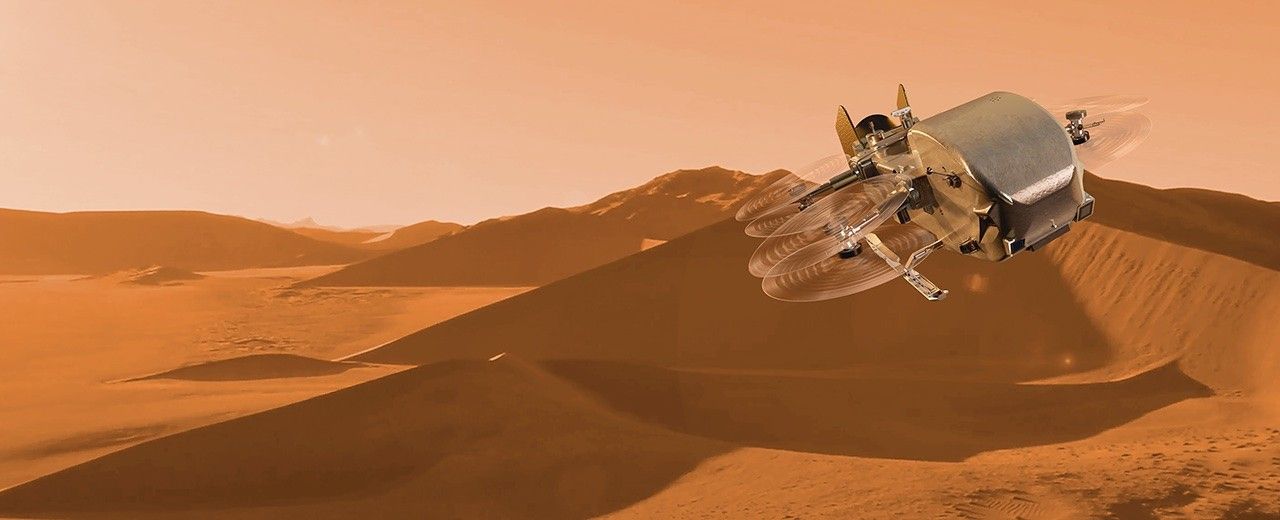
In sending a car-sized rotorcraft to explore Saturn’s moon Titan, NASA’s Dragonfly mission will undertake an unprecedented voyage of scientific discovery. And the work to ensure that this first-of-its-kind project can fulfill its ambitious exploration vision is underway in some of the nation’s most advanced space simulation and testing laboratories.
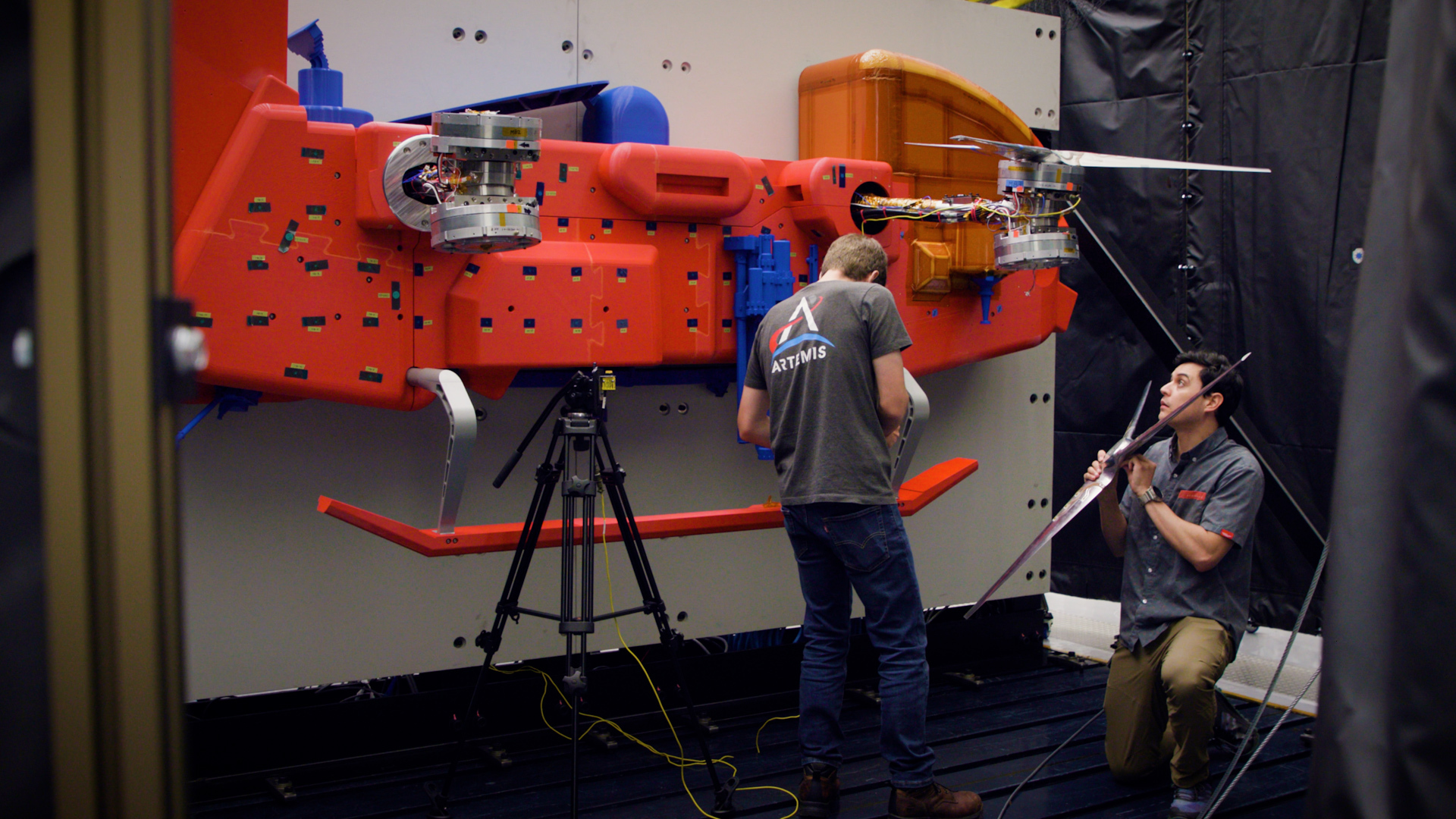
Two men in dark shirts work on a red car-sized rotorcraft protype in a testing chamber.
From left, Johns Hopkins APL engineers Tyler Radomsky and Felipe Ruiz install a rotor on the Dragonfly test model at the Transonic Dynamics Tunnel at NASA’s Langley Research Center in Virginia.
NASA

Set for launch in in 2028, the Dragonfly rotorcraft is being designed and built at the Johns Hopkins Applied Physics Laboratory (APL) in Laurel, Maryland, with contributions from organizations around the world. On arrival in 2034, Dragonfly will exploit Titan’s dense atmosphere and low gravity to fly to dozens of locations, exploring varied environments from organic equatorial dunes to an impact crater where liquid water and complex organic materials essential to life (at least as we know it) may have existed together.

Aerodynamic testing

When full rotorcraft integration and testing begins in February, the team will tap into a trove of data gathered through critical technical trials conducted over the past three years, including, most recently, two campaigns at the Transonic Dynamics Tunnel (TDT) facility at NASA’s Langley Research Center in Hampton, Virginia.
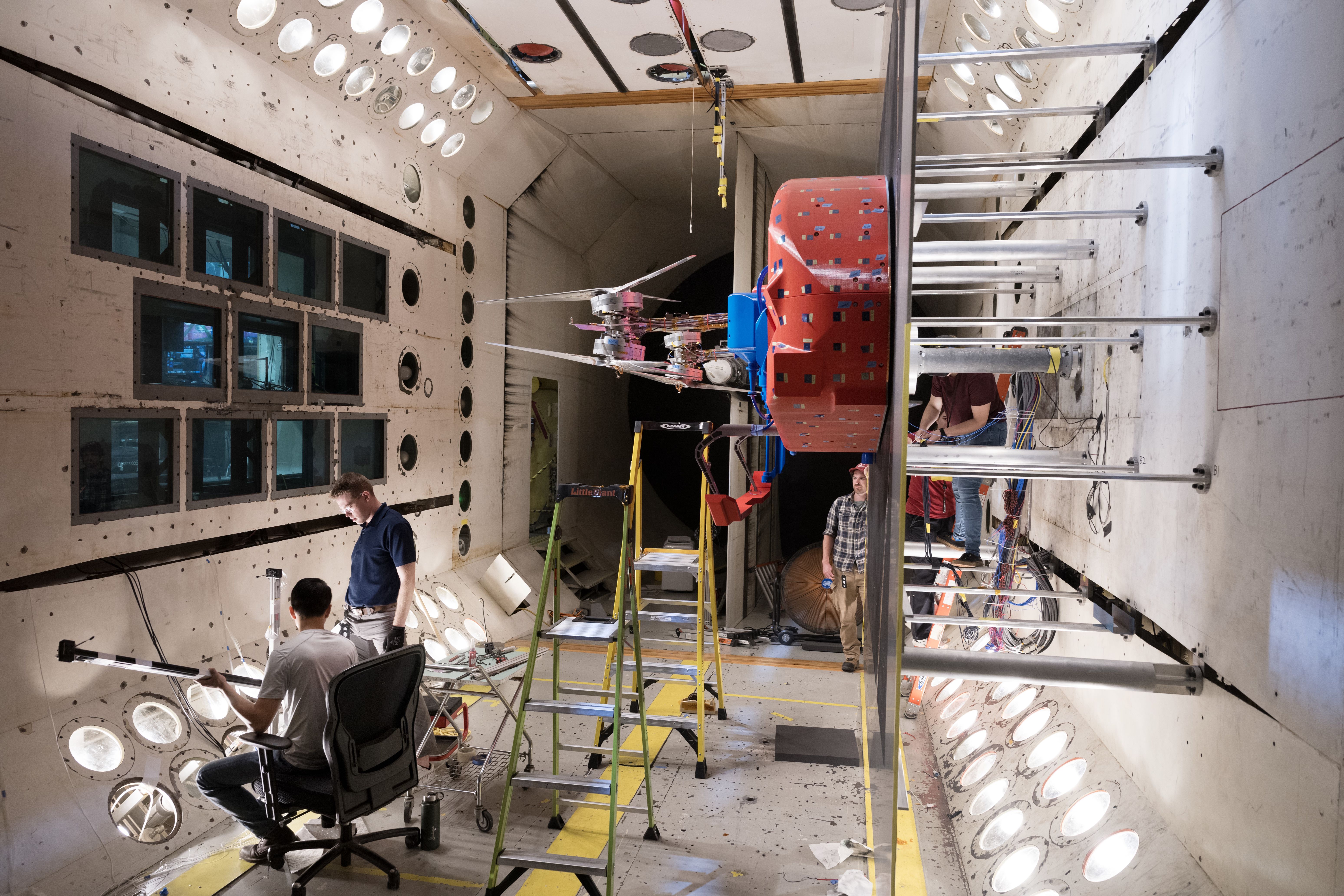
Five people in a large white room work in and around a red car-sized rotorcraft prototype mounted on a wall.
From left, Charles Pheng, Ryan Miller, John Kayrouz, Kristen Carey and Josie Ward prepare for the first aeromechanical performance tests of the full-scale Dragonfly rotors in the Transonic Dynamics Tunnel at NASA’s Langley Research Center in Virginia.
NASA

The TDT is a versatile 16-foot-high, 16-foot-wide, 20-foot-long testing hub that has hosted studies for NASA, the Department of War, the aircraft industry and an array of universities.

Over five weeks, from August into September, the team evaluated the performance of Dragonfly’s rotor system – which provides the lift for the lander to fly and enables it to maneuver – in Titan-like conditions, looking at aeromechanical performance factors such as stress on the rotor arms, and effects of vibration on the rotor blades and lander body. In late December, the team also wrapped up a set of aerodynamics tests on smaller-scale Dragonfly rotor models in the TDT.

“When Dragonfly enters the atmosphere at Titan and parachutes deploy after the heat shield does its job, the rotors are going to have to work perfectly the first time,” said Dave Piatak, branch chief for aeroelasticity at NASA Langley. “There’s no room for error, so any concerns with vehicle structural dynamics or aerodynamics need to be known now and tested on the ground. With the Transonic Dynamics Tunnel here at Langley, NASA offers just the right capability for the Dragonfly team to gather this critical data.”

Critical parts

In his three years as an experimental machinist at APL, Cory Pennington has crafted parts for projects dispatched around the globe. But fashioning rotors for a drone to explore another world in our solar system? That was new – and a little daunting.

“The rotors are some of the most important parts on Dragonfly,” Pennington said. “Without the rotors, it doesn’t fly – and it doesn’t meet its mission objectives at Titan.”
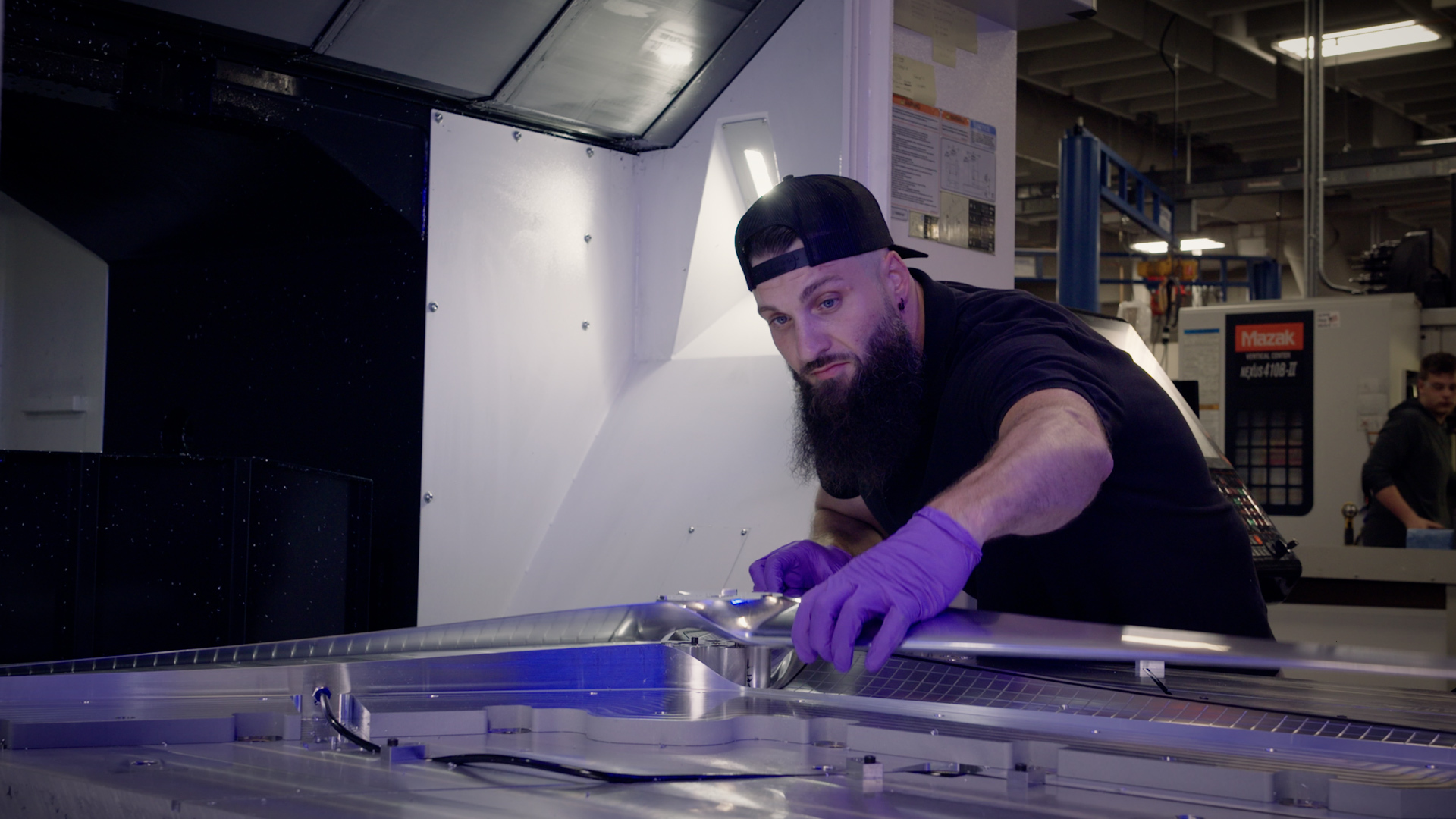
A man wearing dark clothes and purple gloves works on a silver rotor on a table.
Experimental machinist Cory Pennington examines a freshly milled, full-scale Dragonfly rotor in the machine shop at the Johns Hopkins Applied Physics Laboratory (APL) in Laurel, Maryland.
NASA/Johns Hopkins APL

Pennington and team cut Dragonfly’s first rotors on Nov. 1, 2024. They refined the process as they went: starting with waterjet paring of 1,000-pound aluminum blocks, followed by rough machining, cover fitting, vent-hole drilling and hole-threading. After an inspection, the parts were cleaned, sent out for welding and returned for final finishing.

“We didn’t have time or materials to make test parts or extras, so every cut had to be right the first time,” Pennington said, adding that the team also had to find special tools and equipment to accommodate some material changes and design tweaks.

The team was able to deliver the parts a month early. Engineers set up and spin-tested the rotors at APL – attached to a full-scale model representing half of the Dragonfly lander – before transporting the entire package to the TDT at NASA Langley in late July.

“On Titan, we’ll control the speeds of Dragonfly’s different rotors to induce forward flight, climbs, descents and turns,” said Felipe Ruiz, lead Dragonfly rotor engineer at APL.

“It’s a complicated geometry going to a flight environment that we are still learning about. So the wind tunnel tests are one of the most important venues for us to demonstrate the design.”

And the rotors passed the tests.

“Not only did the tests validate the design team’s approach, we’ll use all that data to create high-fidelity representations of loads, forces and dynamics that help us predict Dragonfly’s performance on Titan with a high degree of confidence,” said Rick Heisler, wind tunnel test lead from APL.

Next, the rotors will undergo fatigue and cryogenic trials under simulated Titan conditions, where the temperature is minus 290 degrees Fahrenheit (minus 178 degrees Celsius), before building the actual flight rotors.

“We’re not just cutting metal — we’re fabricating something that’s going to another world,” Pennington said. “It’s incredible to know that what we build will fly on Titan.”

Collaboration, innovation

Elizabeth “Zibi” Turtle, Dragonfly principal investigator at APL, says the latest work in the TDT demonstrates the mission’s innovation, ingenuity and collaboration across government and industry.

“The team worked well together, under time pressure, to develop solutions, assess design decisions, and execute fabrication and testing,” she said. “There’s still much to do between now and our launch in 2028, but everyone who worked on this should take tremendous pride in these accomplishments that make it possible for Dragonfly to fly on Titan.”

When NASA's Dragonfly begins full rotorcraft integration and testing in early 2026, the mission team will tap into a trove of data gathered through critical technical trials conducted over the past three years, including, most recently, a testing campaign in at the Transonic Dynamics Tunnel (TDT) Facility at NASA’s Langley Research Center in Hampton, Virginia.
NASA/Johns Hopkins APL

Dragonfly has been a collaborative effort from the start. Kenneth Hibbard, mission systems engineer from APL, cites the vertical-lift expertise of Penn State University on the initial rotor design, aero-related modeling and analysis, and testing support in the TDT, as well as NASA Langley’s 14-by-22-foot Subsonic Tunnel. Sikorsky Aircraft of Connecticut has also supported aeromechanics and aerodynamics testing and analysis, as well as flight hardware modeling and simulation.

The Johns Hopkins Applied Physics Laboratory (APL) in Laurel, Maryland, leads the Dragonfly mission for NASA in collaboration with several NASA centers, industry partners, academic institutions and international space agencies. Elizabeth “Zibi” Turtle of APL is the principal investigator. Dragonfly is part of NASA’s New Frontiers Program, managed by the Planetary Missions Program Office at NASA Marshall Space Flight Center in Huntsville, Alabama, for the agency’s Science Mission Directorate in Washington.

For more information on NASA’s Dragonfly mission, visit:

https://science.nasa.gov/mission/dragonfly/

by Mike Buckley
Johns Hopkins Applied Physics Laboratory


MEDIA CONTACTS:

Karen Fox / Molly Wasser
Headquarters, Washington
240-285-5155 / 240-419-1732
karen.c.fox@nasa.gov / molly.l.wasser@nasa.gov

Joe Atkinson
NASA’s Langley Research Center, Hampton, Virginia
757-755-5375
joseph.s.atkinson@nasa.gov

Mike Buckley
Johns Hopkins Applied Physics Laboratory, Laurel, Maryland
443-567-3145
michael.buckley@jhuapl.edu

Scientists rule out a hidden ocean on Titan, but there’s still hope for discovering life under the ice

An image from NASA’s Cassini spacecraft shows Titan in front of Saturn and its rings. (Credit: NASA / JPL-Caltech / SSI)

A fresh analysis of tidal perturbations on Titan challenges a long-held hypothesis: that the cloud-shrouded Saturnian moon harbors an ocean of liquid water beneath its surface ice. But the scientists behind the analysis don’t rule out the possibility that smaller pockets of subsurface water could nevertheless provide a home for extraterrestrial life.

“The search for extraterrestrial environments is fundamentally a search for habitats where liquid water coexists with sustained sources of energy (chemical, sunlight, etc.) over geological time scales. Our new results do not preclude the existence of such environments within Titan, but rather, further support their plausibility,” University of Washington planetary scientist Baptiste Journaux, a co-author of the study published in Nature, told GeekWire in an email.

Journaux acknowledged that the results don’t match up with conventional wisdom. He said they represent a “true paradigm shift” in how scientists think Titan is put together.

University of Washington planetary scientist Baptiste Journaux. (UW Photo)

“When the first indications from the new data analysis suggested the absence of a global ocean within Titan, the result prompted extensive discussion, careful double- and triple-checking, and contacting colleagues outside the team for critical feedback, even before submission for anonymous peer review,” he said. “We were all surprised, to say the least.”

The hypothesis about Titan’s hidden ocean goes back to NASA’s Cassini mission, which gathered data about Saturn and its moons between 2004 and 2017. “The Cassini spacecraft’s numerous gravity measurements of Titan revealed that the moon is hiding an underground ocean of liquid water,” according to the current version of NASA’s webpage about Titan.

Journaux and his colleagues used improved, up-to-date techniques to put Cassini’s radiometric measurements through a fresh round of analysis — and came to a different conclusion.

The earlier round of research proposed that there was a layer of liquid water potentially measuring hundreds of miles in thickness, sandwiched between Titan’s outer shell of low-pressure ice and a denser layer of high-pressure ice. That hypothesis was based on the best information available at the time about how tidal stresses propagated through Titan’s interior.

In contrast, the newly published research finds insufficient evidence for a liquid layer that large. Instead, it suggests that there’s an upper layer of low-pressure ice, roughly 106 miles (170 kilometers) thick, which transitions into a 235-mile-thick (378-kilometer-thick) layer of high-pressure ice.

Pockets of slush and liquid water could exist within and between layers of ice, or between the deepest layer of ice and Titan’s core. That gives Journaux cause for hope.

Based on an analysis of tidal dissipation patterns observed on Titan, researchers concluded that the Saturnian moon has upper layers of low-pressure ice (shown in white and orange) with layers of high-pressure ice (shown in green, blue and purple) deeper down. Pockets of liquid water and slush (shown in fuchsia) could exist within and between the layers. (Petricca et al. / Nature)

“Even a conservative melt fraction of 1% of the hydrosphere (to account for the observed tidal dissipation) would still correspond to total volumes of liquid water inside Titan comparable to that of the entire Atlantic Ocean, implying the presence of vast potential habitable spaces,” Journaux said.

Journaux pointed out that ice tends to exclude salts and other dissolved materials as it freezes, which means “these slushy, near-melting environments would be enriched in dissolved species and nutrients for life to feed on, as opposed to a dilute open ocean.”

“For these reasons, there is strong justification for continued optimism regarding the potential for extraterrestrial life on Titan,” he said.

Such life would probably be most similar to the types of organisms found in sea-ice ecosystems on Earth. “This realization helps constrain the range of plausible life forms and signatures to target, thereby sharpening and strengthening our search strategies,” Journaux said.

Titan’s interior is by no means the Saturnian moon’s only region of interest: Titan also has lakes of liquid ethane and methane, plus an atmosphere that’s rich in hydrocarbons. If life exists on the surface, most astrobiologists say it would be nothing like life as we know it today.

NASA’s Dragonfly mission, which is due to lift off from Earth in 2028 and touch down on Titan in 2034, could provide new insights about the moon’s surface conditions and its interior structure.

Looking beyond Titan, there are several other icy moons in our solar system that are thought to harbor hidden reservoirs of water, including the Saturnian moon Enceladus and three of Jupiter’s moons: Europa, Callisto and Ganymede. Those three Jovian worlds will get a close look from the European Space Agency’s Juice spacecraft (launched in 2023) and NASA’s Europa Clipper (launched in 2024).

Journaux hopes the results announced today will help other scientists get a better sense of what they should be looking for on all of these icy moons. “As our understanding of their interiors will become much more accurate and refined with upcoming missions … this result shows us how we can, with new measurements, place much stronger and more precise constraints on the types of habitable environments that may exist,” he said.

Flavio Petricca of NASA’s Jet Propulsion Laboratory is the corresponding author of the study published in Nature, “Titan’s Strong Tidal Dissipation Precludes a Subsurface Ocean.” In addition to Journaux, co-authors include Steven D. Vance, Marzia Parisi, Dustin Buccino, Gael Cascioli, Julie Castillo-Rogez, Brynna G. Downey, Francis Nimmo, Gabriel Tobie, Andrea Magnanini, Ula Jones, Mark Panning, Amirhossein Bagheri, Antonio Genova and Jonathan I. Lunine.

NASA Study Suggests Saturn’s Moon Titan May Not Have Global Ocean

By: scarney1

6 min read

Preparations for Next Moonwalk Simulations Underway (and Underwater)

Artist's rendering of NASA's Cassini spacecraft observing a sunset through Titan's hazy atmosphere. Against the blackness of space, the moon is backlit, with a ring of white and a ring of blue light marking its outer edge, with the Sun as a point of bright light peeking from the upper-right edge of the disc. Cassini is dimly lit in the foreground partially blocking the moon, a dull gold with a large white antenna dish, and three spindly protrusions coming out of its center at 90-degree angles to each other.
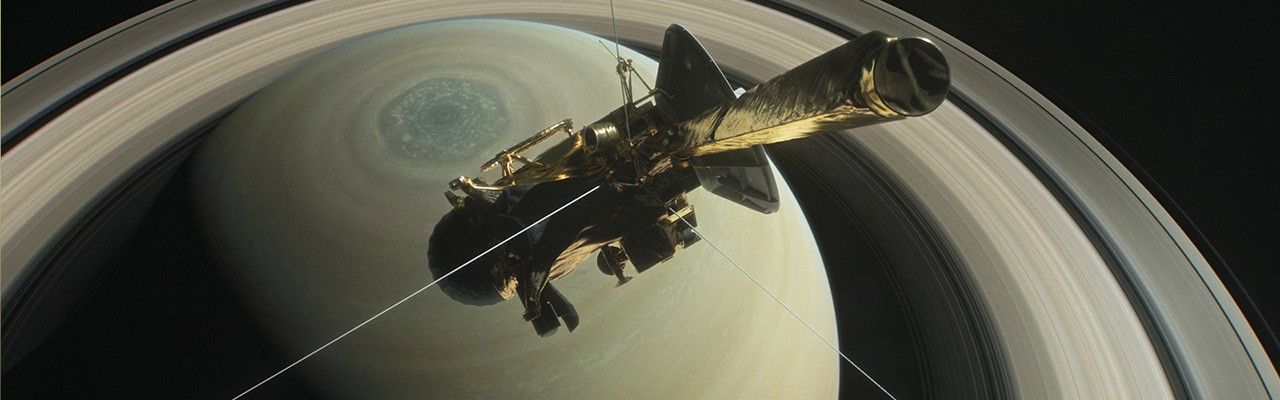
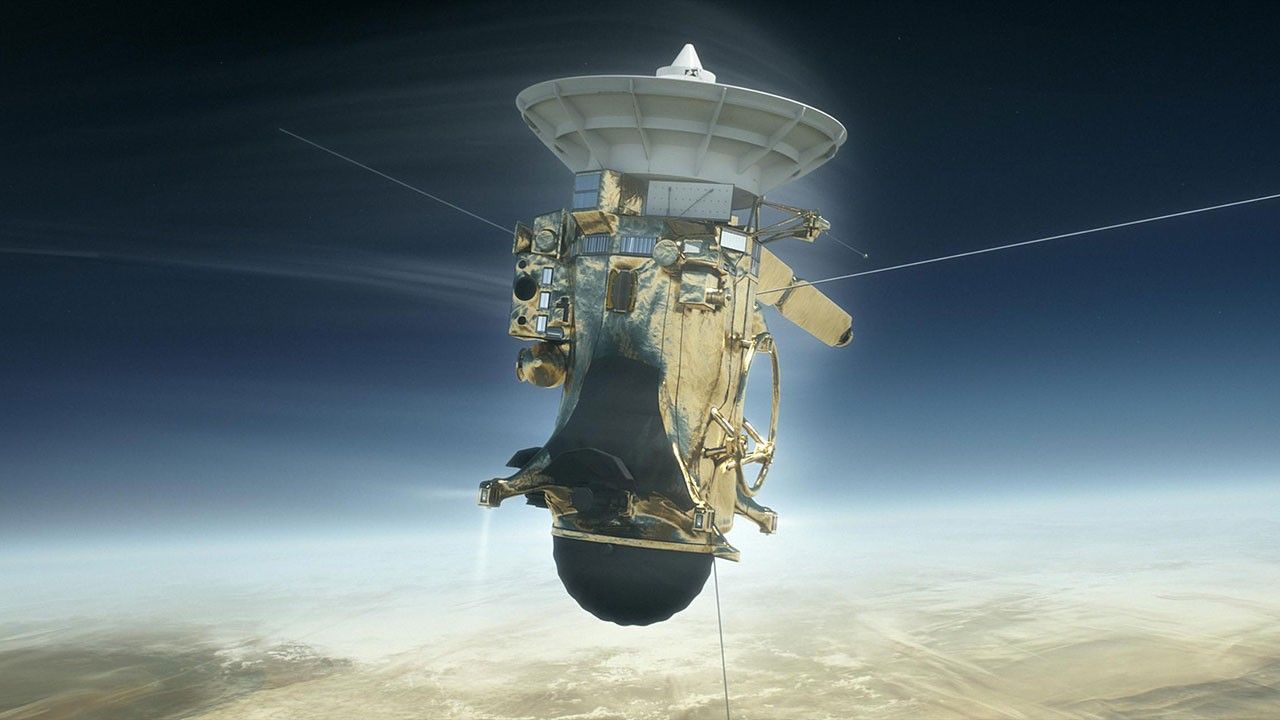
This artist’s concept depicts NASA’s Cassini spacecraft performing one of its many close flybys of Titan, Saturn’s largest moon. By analyzing the Doppler shift of radio signals traveling to and from Earth, the mission precisely measured Titan’s gravity field.
NASA/JPL-Caltech

A key discovery from NASA’s Cassini mission in 2008 was that Saturn’s largest moon Titan may have a vast water ocean below its hydrocarbon-rich surface. But reanalysis of mission data suggests a more complicated picture: Titan’s interior is more likely composed of ice, with layers of slush and small pockets of warm water that form near its rocky core.  

Led by researchers at NASA’s Jet Propulsion Laboratory in Southern California and published in the journal Nature on Wednesday, the new study could have implications for scientists’ understanding of Titan and other icy moons throughout our solar system. 

“This research underscores the power of archival planetary science data. It is important to remember that the data these amazing spacecraft collect lives on so discoveries can be made years, or even decades, later as analysis techniques get more sophisticated,” said Julie Castillo-Rogez, senior research scientist at JPL and a coauthor of the study. “It’s the gift that keeps giving.” 

To remotely probe planets, moons, and asteroids, scientists study the radio frequency communications traveling back and forth between spacecraft and NASA’s Deep Space Network. It’s a multilayered process. Because a moon’s body may not have a uniform distribution of mass, its gravity field will change as a spacecraft flies through it, causing the spacecraft to speed up or slow down slightly. In turn, these variations in speed alter the frequency of the radio waves going to and from the spacecraft — an effect known as Doppler shift. Analyzing the Doppler shift can lend insight into a moon’s gravity field and its shape, which can change over time as it orbits within its parent planet’s gravitational pull. 

This shape shifting is called tidal flexing. In Titan’s case, Saturn’s immense gravitational field squeezes the moon when Titan is closer to the planet during its slightly elliptical orbit, and it stretches the moon when it is farthest. Such flexing creates energy that is lost, or dissipated, in the form of internal heating. 

When mission scientists analyzed radio-frequency data gathered during the now-retired Cassini mission’s 10 close approaches of Titan, they found the moon to be flexing so much that they concluded it must have a liquid interior, since a solid interior would have flexed far less. (Think of a balloon filled with water versus a billiard ball.)  

New technique 

The new research highlights another possible explanation for this malleability: an interior composed of layers featuring a mix of ice and water that allows the moon to flex. In this scenario, there would be a lag of several hours between Saturn’s tidal pull and when the moon shows signs of flexing — much slower than if the interior were fully liquid. A slushy interior would also exhibit a stronger energy dissipation signature in the moon’s gravity field than a liquid one, because these slush layers would generate friction and produce heat when the ice crystals rub against one another. But there was nothing apparent in the data to suggest this was happening. 

So the study authors, led by JPL postdoctoral researcher Flavio Petricca, looked more closely at the Doppler data to see why. By applying a novel processing technique, they reduced the noise in the data. What emerged was a signature that revealed strong energy loss deep inside Titan. The researchers interpreted this signature to be coming from layers of slush, overlaid by a thick shell of solid ice. 

Based on this new model of Titan’s interior, the researchers suggest that the only liquid would be in the form of pockets of meltwater. Heated by dissipating tidal energy, the water pockets slowly travel toward the frozen layers of ice at the surface. As they rise, they have the potential to create unique environments enriched by organic molecules being supplied from below and from material delivered via meteorite impacts on the surface.  

“Nobody was expecting very strong energy dissipation inside Titan. But by reducing the noise in the Doppler data, we could see these smaller wiggles emerge. That was the smoking gun that indicates Titan’s interior is different from what was inferred from previous analyses,” said Petricca. “The low viscosity of the slush still allows the moon to bulge and compress in response to Saturn’s tides, and to remove the heat that would otherwise melt the ice and form an ocean.” 

Potential for life 

“While Titan may not possess a global ocean, that doesn’t preclude its potential for harboring basic life forms, assuming life could form on Titan. In fact, I think it makes Titan more interesting,” Petricca added. “Our analysis shows there should be pockets of liquid water, possibly as warm as 20 degrees Celsius (68 degrees Fahrenheit), cycling nutrients from the moon’s rocky core through slushy layers of high-pressure ice to a solid icy shell at the surface.” 

More definitive information could come from NASA’s next mission to Saturn. Launching no earlier than 2028, the agency’s Dragonfly mission to the hazy moon could provide the ground truth. The first-of-its-kind rotorcraft will explore Titan’s surface to investigate the moon’s habitability. Carrying a seismometer, the mission may provide key measurements to probe Titan’s interior, depending on what seismic events occur while it is on the surface. 

More about Cassini 

The Cassini-Huygens mission was a cooperative project of NASA, ESA (European Space Agency), and the Italian Space Agency. A division of Caltech in Pasadena, JPL managed the mission for NASA’s Space Mission Directorate in Washington and designed, developed, and assembled the Cassini orbiter. 

To learn more about NASA’s Cassini mission, visit:

https://science.nasa.gov/mission/cassini/

News Media Contacts 

Ian J. O’Neill 
Jet Propulsion Laboratory, Pasadena, Calif. 
818-354-2649 
ian.j.oneill@jpl.nasa.gov 

Karen Fox / Alana Johnson 
NASA Headquarters, Washington
202-358-1600 / 202-358-1501 
karen.c.fox@nasa.gov / alana.r.johnson@nasa.gov 

2025-142

Announcing the 2021-22 Synack Acropolis, Legends and Featured Envoy Mentors

Trust. Honor. Excellence. These words are the foundational pillars for the Synack Acropolis and Synack Red Team. This past year, these core principles ushered in two new initiatives to address the rising cybersecurity talent gap and opportunity problems: Artemis Red Team and SRT Mentorship Program.

The Artemis Red Team is focused on creating the world’s best cybersecurity community for women, trans, non-binary and other gender minorities. The community’s purpose is to deliver opportunities for them to feel supported and expand their careers with like-minded excellence. Part of that mission is a commitment to helping researchers become their best by learning from the best, hence the formation of the SRT Mentorship program. Everyone has something to share, thus anyone can be a mentor. The SRT Mentorship program codifies this ideal by ensuring that mentors are recognized and turns what has historically been a purely philanthropic endeavor into an effective side-hustle earning researchers of all shapes and sizes additional opportunities, special rewards, pay incentives and recognition at the upper-echelons of the Synack Acropolis as an SRT Envoy or, even better, Mentor of the Year.

Together these programs amplify flames of curiosity, courage and camaraderie that have long existed in the hacker ethos, and the researchers who contribute their time, knowledge and passion will play an influential role in shaping the future of cybersecurity.

2021-22 Acropolis Winners

It is with great honor, pride and respect that Synack announces the following top award winners for this year’s recognition program:  

The awards from left to right are SRT of the Year, Rookie of the Year, Guardian of Trust and Mentor of the Year.

In addition, the following researchers have opted-in to showcase their recognition for dedication and commitment to excellence this past year:

TITAN


OLYMPIAN


HERO


CIRCLE OF TRUST


SRT ENVOY MENTORS

Lifetime Achievement Program

The SRT Legends program is a lifetime achievement program that focuses SRT long-term goals directly towards addressing the cybersecurity talent-gap. The goal is for SRT to share their diverse skills with more than just a single program or customer. To achieve SRT Legend status, it takes time, dedication and a commitment to quality. This year Synack recognizes three new researchers to this hallowed class:


What’s Next

Who will claim next year’s coveted top spots? Who knows…it could be you! Take your first steps and apply to the Synack Red Team today, or reach out to @SynackRedTeam, @ryanrutan or on LinkedIn.

— Ryan Rutan

Sr. Director of Community, Synack Red Team

The post Announcing the 2021-22 Synack Acropolis, Legends and Featured Envoy Mentors appeared first on Synack.

Our Cyber Heroes: Announcing the 2020-21 Top Hackers on the Synack Acropolis

Back in July 2021, the Synack Red Team ushered in the close of the 2020-21 Synack Recognition period.  This wildly popular program is a set of goals given to all researchers from July 1st to June 30th, every year, helping them understand what success looks like on the Synack platform. In exchange for researchers hitting their goals, they are awarded limited-edition prizes for their engagement. For SRT that opt-in, their accomplishments are put on display for the world to see on the Synack Acropolis.

world-map

SRT Legends Program

This year’s recognition program featured the launch of a new lifetime achievement component called SRT Legends. To qualify for the SRT Legends program, researchers must earn lifetime distinction across at least 1 of 5 criteria designed to test a researcher’s skill and adaptability, while quantifying their impact in the cybersecurity industry at large.  

This program includes the following criteria as measured exclusively on the Synack platform:

  • # of Unique Targets with Accepted Findings > 250
  • # of Unique Companies with Accepted Findings > 100 
  • # of Accepted Vulnerabilities > 1500
  • # of Accepted Critical Vulnerabilities (CVSS 9.0+) > 250
  • $1 Million or more in lifetime earnings on the platform

As researchers ascend to the heights of an SRT Legend, the mark they leave on the world around them becomes ever more clear. Their exceptional commitment helps us all be more safe and secure, making them truly legendary hackers!

Announcing the inaugural 2021 class of publicly recognized SRT Legends:


2020-21 Recognition Winners

It is with great honor, pride, and respect that Synack announces the following top award winners for this year’s recognition program:  


In addition, the following researchers have earned distinguished recognition for their dedication and commitment to excellence this past year:


TITAN


OLYMPIAN


HERO


CIRCLE OF TRUST


award coins

srt hoodie

Many of the researchers listed above will be enjoying special opportunities on the platform over the next year, as well as dawning their much beloved, limited-edition SRT hoodies (above) in the coming months, or kicking back in a well-deserved #HackerThrone! The 2021-22 Synack Recognition Program is already underway with new prizes and recognition opportunities already on the horizon. Who will rise to the top and claim next year’s coveted top spots? Who knows … it could be you! — Take your first steps and apply to the Synack Red Team today, or reach out to @SynackRedTeam or @ryanrutan on Twitter.


The post Our Cyber Heroes: Announcing the 2020-21 Top Hackers on the Synack Acropolis appeared first on Synack.

❌