Reading view

There are new articles available, click to refresh the page.

Coinbase CEO Shares 6 Takeaways From WEF Davos 2026 – Details

While Binance co-founder and former CEO Changpeng “CZ” Zhao made the headlines following his interview at the just-concluded World Economic Forum, where he called a Bitcoin supercycle in 2026, his crypto counterpart and Coinbase CEO, Brian Armstrong, has come forward with feedback from the global event held in Davos, Switzerland.

Coinbase CEO Praises Trump-Led White House As Most Crypto-Forward Government 

In a January 24 post on the social media platform X, Armstrong shared a few key “themes and takeaways” from the latest edition of WEF. After admitting that the conference offered a productive time of meeting people one-on-one, the Coinbase CEO revealed that the major focus was on pushing crypto adoption globally.

Starting his list of takeaways, Armstrong highlighted that everyone was talking about tokenization, which is beginning to expand to every asset class in the world. The crypto leader said to expect some major progress in the tokenization sector in 2026, especially as the Fortune 500 business leaders continuously lean in.

Secondly, the Coinbase CEO shared that crypto legislation and the CLARITY Act were another area of focus, as the government of the day looks to make the United States the crypto capital of the world. According to Armstrong, most of the bank CEOs he met at the WEF in the past week are actually pro-crypto.

Armstrong wrote on X:

One CEO of a top 10 global bank told me crypto is their number one priority, and they view it as existential.

Furthermore, the Coinbase CEO lauded the Trump administration as the most crypto-forward government in the world at the moment. Armstrong acknowledged their progress with the crypto market structure, stating that these clear rules are crucial for global competitiveness and will put money back in people’s pockets.

In what seemed like a cheeky tone, Armstrong mentioned that ESG (Environmental, Social, and Governance) and DEI (Diversity, Equity, and Inclusion) topics didn’t come up throughout the forum. According to the crypto founder, the week felt productive, as it centered around real, global progress — all thanks to BlackRock CEO and new WEF co-chair Larry Fink.

The Coinbase leader touted crypto and AI (artificial intelligence) as the most talked-about technologies in today’s world. Highlighting their compatibility, Armstrong stated that AI agents will eventually default to using stablecoins for payments, as they cannot be KYC’d like human beings.

Finally, Armstrong revealed that the Coinbase, Circle, and Bermuda partnership to build a fully on-chain economy was announced at WEF Davos 2026. “Excited to make progress on this and create a compelling case study for other nations to follow,” the crypto CEO concluded.

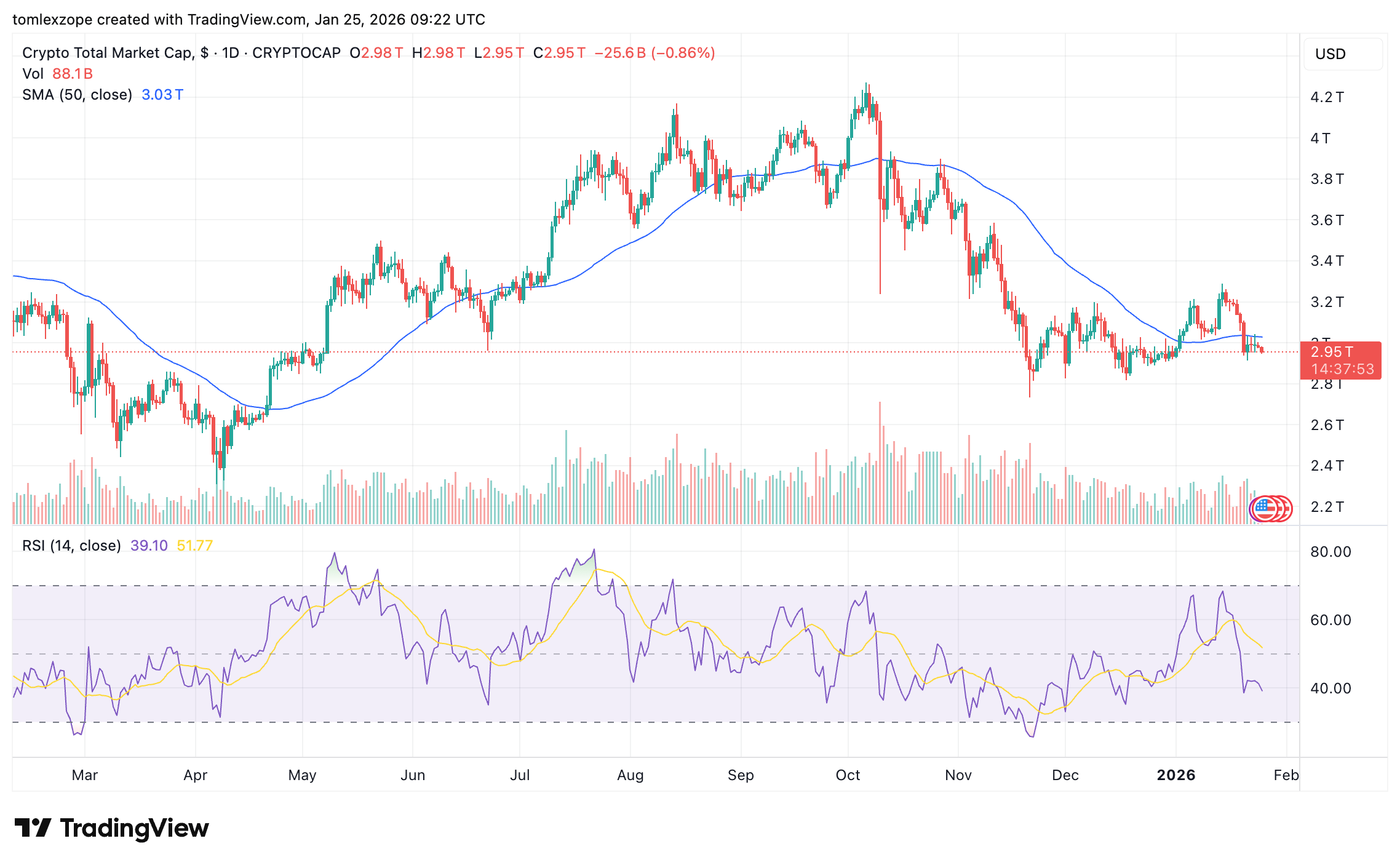
Total Crypto Market Cap At $3.09 Trillion

As of this writing, the global cryptocurrency market has a total capitalization of $3.086 trillion, with Bitcoin retaining its spot as the world’s largest cryptocurrency.

Coinbase

What’s The Beef Between Cardano And XRP? Here’s Why The Communities Are Clashing

A disagreement over US crypto regulation has spilled into public view, drawing the Cardano and XRP communities into an unexpected clash. The reason is the Digital Asset Market Clarity Act, a proposed bill intended to define how digital assets are regulated in the United States. 

The disagreement started after Charles Hoskinson openly criticized Brad Garlinghouse over his stance on the legislation, which led to pushback from prominent XRP community members. This comes just after reports have suggested growing frustration among lawmakers toward Coinbase over disagreements tied to the Clarity Act.

Hoskinson’s Criticism And Garlinghouse’s Position In Full Context

The tension came to the surface during a livestream in January 2026, where Hoskinson criticized Garlinghouse’s apparent support for advancing the Clarity Act despite its shortcomings. In the video, Hoskinson expressed skepticism about the bill’s direction and origins, remarking sarcastically, “And what we got is Elizabeth Warren wrote the bill, that’s leadership we can believe in.”

He went on to challenge the idea that passing an imperfect bill is preferable to continued uncertainty, pointing directly to the position of Ripple CEO Brad Garlinghouse. Hoskinson questioned whether handing regulatory power to the same institutions that previously sued, subpoenaed, or shut down crypto businesses could truly be considered progress.

Hoskinson’s remarks did not go unanswered. Vet, a notable XRP community member and XRP Ledger dUNL validator, reposted the video on X and criticized Hoskinson’s approach. Vet questioned why Hoskinson chose to publicly attack Garlinghouse instead of contributing constructively to the legislative process, writing, “How about focusing on helping shape the Clarity Bill instead of crashing out on Brad for no reason, Charles?”

Why The Clarity Act Matters To Both Communities

The Clarity Act is one of a few bills introduced during the current crypto-positive Trump administration that aims to bring structure to a regulatory environment that has been uncertain for years. The Clarity Act, in particular, was introduced to bring clarity around whether digital assets should be treated as securities or commodities and which agencies should oversee them. 

The bill represents a necessary step toward legal certainty and institutional participation. Supporters of XRP tend to see engagement with lawmakers as a practical route forward after years of legal battles. However, others like Charles Hoskinson are of a different notion. 

The Clarity Act is not without its issues. Sources close to the White House say the administration is considering pulling its support for the Clarity Act if Coinbase does not return to negotiations over stablecoin yield provisions. However, Coinbase CEO Brian Armstrong noted that Coinbase is actively working to find common ground with banks on yield-related issues.

A similar Act, called the Guiding and Establishing National Innovation for US Stablecoins Act, or the “GENIUS Act,” was signed into law in 2025 by President Donald Trump as part of efforts to create better regulatory clarity towards stablecoins in the United States. 

Interestingly, Ripple CEO Brad Garlinghouse was part of the crypto industry leaders that expressed support for the Genius Act after it was signed into law.

XRP

‘Bitcoin Has No Issuer’: Coinbase CEO Clashes With French Central Banker at Davos

Bitcoin Magazine

‘Bitcoin Has No Issuer’: Coinbase CEO Clashes With French Central Banker at Davos

Coinbase CEO Brian Armstrong challenged skepticism earlier today toward Bitcoin from the head of France’s central bank during a World Economic Forum panel in Davos.

Armstrong took a public stand on stage arguing that the asset’s lack of centralized control makes it more independent than traditional monetary authorities.

The exchange unfolded after Banque de France Governor François Villeroy de Galhau questioned Bitcoin’s credibility, saying he places more trust in independent central banks with democratic mandates than in what he described as “private issuers” of Bitcoin. 

François Villeroy de Galhau said “I trust more independent central banks with a democratic mandate than private issuers of Bitcoin”.

Armstrong leaned in and hit back, saying, “bitcoin is a decentralized protocol. There’s actually no issuer of it. So in the sense that central banks have independence, Bitcoin is even more independent. There’s no country or company or individual who controls it in the world.”

“Bitcoin doesn’t have a money printer,” Armstrong said. “It’s more independent”

The discussion took place during a panel focused on tokenization at the WEF Annual Meeting, an event where conversations more commonly center on blockchain infrastructure and central bank digital currencies rather than BTC itself.

Framing Bitcoin as a monetary counterweight, Armstrong argued that competition between state-issued currencies and decentralized alternatives is healthy. 

He said BTC’s fixed supply and lack of a “money printer” provide a check on government overspending, likening its role during periods of uncertainty to gold’s historical function.

Villeroy de Galhau maintained that trust ultimately comes from central bank independence paired with accountability to citizens.

JUST IN: Coinbase CEO calls out Franch Central Bank governer:

“Bitcoin doesn't have a money printer. It's more independent” pic.twitter.com/2eW02mEaCy

— Bitcoin Magazine (@BitcoinMagazine) January 21, 2026

Coinbase CEO: Bitcoin to $1,000,000

At events centered around the conference, Armstrong also reiterated his long-held prediction that BTC could reach $1 million by 2030, arguing that its fixed 21 million supply and rising global demand matter more than short-term volatility, even as prices hovered near $89,000 and the broader crypto market lost $160 billion in a day. 

Speaking at Bloomberg House during the World Economic Forum in Davos, Armstrong urged investors to focus on long-term trends and said he remains optimistic about U.S. crypto legislation. 

Armstrong also said Coinbase can no longer support the current Senate Banking Committee crypto market structure bill, calling it worse than the status quo and harmful to innovation and competition.

For context, the U.S. Senate committee postponed debate last week on the landmark crypto “Clarity Act” after Armstrong said the company could not support the bill, dealing a major blow to its prospects. 

In essence, the legislation would establish a regulatory framework for cryptocurrencies by defining when tokens are securities or commodities and clarifying the SEC’s authority, marking the culmination of years of industry lobbying for clearer rules. 

This post ‘Bitcoin Has No Issuer’: Coinbase CEO Clashes With French Central Banker at Davos first appeared on Bitcoin Magazine and is written by Micah Zimmerman.

Coinbase CEO Calls 4 Billion People “Unbrokered” and Wants to Fix It

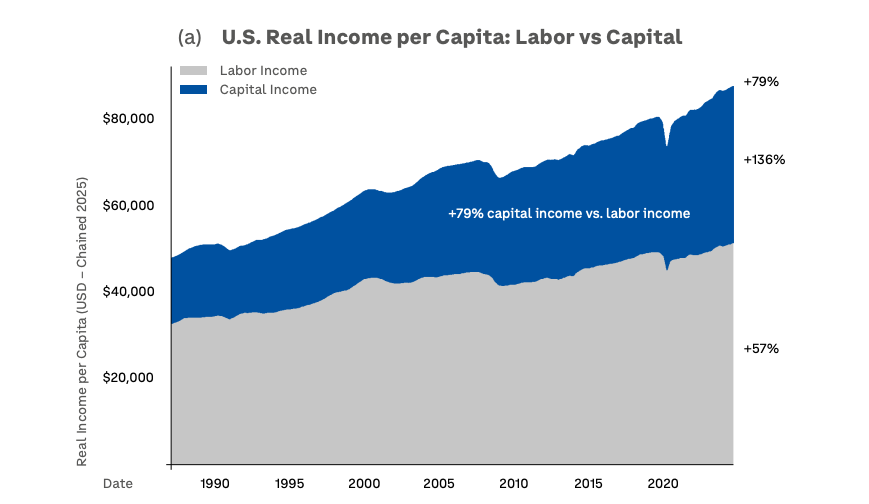
Coinbase CEO Brian Armstrong unveiled a sweeping vision to democratize global capital markets through blockchain tokenization, targeting roughly 4 billion adults worldwide who lack access to equity and bond investments despite the accelerating divergence between capital and labor income growth.

The exchange published a comprehensive policy paper titled “From the Unbanked to the Unbrokered: Unlocking Wealth Creation for the World,” arguing that technological barriers and cost structures have systematically excluded two-thirds of the global adult population from wealth-building opportunities.

In the United States, labor income has grown by 57% since 1987, while capital income has surged by 136%, creating what Armstrong describes as a structural impediment to broad-based prosperity.

Source: Coinbase

Capital Chasm Widens Across Geographic Lines

The paper identifies participation in capital markets as fundamentally determined by wealth and geography rather than merit or savings discipline.

Roughly 4 billion adults do not participate in equity and bond markets, with engagement rates ranging from 55-60% in the United States to below 10% in China and India.

Source: Coinbase

I think about a talented worker in Lagos or Jakarta who has the drive and ability to build a better life for themselves and their family—but who faces near-total exclusion from the same capital markets available to a wealthy investor in New York,” Armstrong wrote, emphasizing that geography rather than ability determines who gets access.

Beyond national participation rates, the research highlights severe home bias among existing investors.

Data shows domestic equity holdings far exceeding countries’ share of global market capitalization, with investors in Indonesia, Russia, and Turkey allocating over 95% of portfolios to local markets despite representing fractions of global equity value.

Source: Coinbase

Tokenization as an Infrastructure Solution

The policy blueprint positions blockchain-based tokenization as the primary mechanism to collapse legacy cost structures that price out small savers.

Traditional financial infrastructure operates on fixed compliance costs, custody fees, settlement delays, and minimum account thresholds that render participation uneconomic for anyone below certain wealth levels.

According to the paper, recent studies estimate that tokenized equity trading could reduce investor transaction costs by more than 30%, with efficiency gains expanding over time as atomic settlement eliminates multi-day reconciliation cycles.

Permissioned systems inevitably replicate existing power dynamics, allowing infrastructure owners to limit competition,” Armstrong wrote, comparing blockchain protocols to TCP/IP internet infrastructure that enables open innovation without gatekeeping.

Policy Roadmap Targets Regulatory Coordination

Coinbase outlined five policy pillars necessary to realize tokenized capital markets at scale.

The recommendations particularly prioritize base-layer neutrality, treating blockchain protocols as impartial infrastructure where compliance is concentrated at the application layers rather than at the protocol level.

The five policy pillars include:

  • Uphold base-layer neutrality with compliance at application layers
  • Create clear pathways for tokenizing traditional assets
  • Foster integration with traditional finance institutions
  • Recognize self-custody rights with blockchain transparency oversight
  • Modernize safeguards through exchange controls rather than wallet bans

Modern blockchain analytics tools enable the detection and tracing of suspicious patterns with unprecedented precision, challenging historical assumptions that bearer instruments inherently facilitate illicit finance.

Everything Exchange Strategy Takes Shape

Armstrong defines success as a small saver anywhere on earth being able to convert spare earnings into fractional ownership of productive global assets as easily as sending a text message.

When a farmer in a country without a functional stock exchange can own shares in the same companies as a hedge fund manager in New York, both on the same neutral infrastructure at basis-point costs, then the capital chasm will have truly narrowed,” he wrote.

The policy release comes as Coinbase began rolling out traditional stock trading to select users, positioning the exchange to compete directly with Robinhood, Charles Schwab, and Fidelity.

🚀 Coinbase rolls out stock trading to select users as CEO Brian Armstrong pursues "everything exchange" vision combining crypto and traditional equities.#Coinbase #Stockhttps://t.co/hTsBWCELvu

— Cryptonews.com (@cryptonews) January 16, 2026

Earlier this month, Armstrong outlined three 2026 priorities, including building an “everything exchange” globally across crypto, equities, prediction markets, and commodities, scaling stablecoins and payments, and bringing users on-chain through the Base blockchain.

Goal is to make Coinbase the #1 financial app in the world,” he posted. The exchange currently offers stocks through conventional methods using Apex Fintech Solutions, with plans to expand access to all customers within weeks.

David Duong, Coinbase’s head of investment research, also said regulatory clarity improvements and deepening institutional participation create favorable conditions ahead.

We expect these forces to compound in 2026 as ETF approval timelines compress, stablecoins take a larger role in delivery-vs-payment structures, and tokenized collateral is recognized more broadly,” Duong wrote, as Armstrong projected up to 10% of global GDP could run on crypto rails by decade’s end.

The post Coinbase CEO Calls 4 Billion People “Unbrokered” and Wants to Fix It appeared first on Cryptonews.

Scoop: White House Rift With Coinbase Puts Crypto Clarity Act On Shaky Ground

The Clarity Act is meant to give the US crypto market something it has lacked for years: a clear legal framework defining how digital assets are regulated, who oversees them, and how crypto companies can operate without constant regulatory uncertainty. That goal is now reportedly under pressure. 

Rumors are that a growing rift between the White House and Coinbase has raised the possibility that the administration could pull its support for the bill, putting one of the most closely watched pieces of crypto legislation at risk.

White House Frustration With Coinbase

According to reporting shared on X by Eleanor Terrett, sources close to the White House say the administration is considering pulling its support for the Clarity Act if Coinbase does not return to negotiations over stablecoin yield provisions. The issue centers on finding an arrangement that satisfies both crypto firms and traditional banks, particularly community banks that lawmakers see as a core stakeholder in the bill.

The source described Coinbase’s recent move as a unilateral action that caught the White House off guard, characterizing it as a rug pull against both the administration and the entire crypto industry. Officials reportedly pushed back against the idea that a single company could speak for the entire sector, stressing that the legislation reflects the policy agenda of US President Donald Trump and not the priorities of Coinbase CEO Brian Armstrong.

The Clarity Act is designed to define regulatory boundaries between US agencies and provide clearer rules for crypto markets, including how stablecoins and yield-bearing products are treated. 

Behind the dispute is a broader struggle between the White House and Coinbase over how crypto yield products should coexist with banking regulations. The White House’s position, as described by Terrett, is that reaching consensus with banks is essential for the bill to move forward.

Brian Armstrong Pushes Back On Rug Pull Claims

Coinbase is the largest crypto exchange and crypto custodian in the US, and this has naturally placed the company at the center of negotiations with the Trump administration. The scoop from Eleanor Terrett’s source is that White House officials think Coinbase CEO Brian Armstrong is not cooperating, as the bill is President Trump’s bill at the end of the day, not Armstrong’s.

However, the Coinbase CEO publicly rejected the notion that relations with the White House have soured. Responding directly to the report on X, Armstrong said the administration has been super constructive and confirmed that Coinbase is actively working to find common ground with banks on yield-related issues.

He added that the company is in the process of figuring out a deal with community banks, which is the important focus of the bill. Negotiations are currently open, and Armstrong noted that further details would be shared soon. 

Nonetheless, the standoff leaves the Clarity Act in a delicate position, as both sides attempt to shape the future of US crypto regulation without fracturing industry-wide support.

Featured image from Coinbase, chart from TradingView

Coinbase CEO Denies Rift With White House Over Crypto Market Bill – Details

Coinbase CEO Brian Armstrong has denied existing tension between the exchange and the White House over the content of the crypto market structure bill, i.e., the Digital Asset Market Clarity Act. This development follows a series of contentious moments surrounding the highly anticipated crypto market structure bill, beginning with Armstrong raising concerns over its provisions, which the crypto exchange would rather protest than support.

Crypto Market Bill Still On, Bank Negotiations Ongoing — Coinbase CEO

In a surprising move on January 15, Armstrong announced a public support withdrawal for the Clarity Act. The key crypto figure argued that the current content of proposed legislation was introducing a regulatory structure that would produce a net negative effect on the crypto industry. In particular, Armstrong raised alarm on opposition to stablecoin yield sharing, among other issues, before emphasizing the preference of “no bill than a bad bill.”

Following this event, journalist Eleanor Terrett reported that the White House became furious over Armstrong and Coinbase’s public criticism, which they described as a “rug pull”. In particular, she claimed the Donald Trump-led administration has threatened to withdraw support for the Clarity Act if the crypto exchange fails to return to the negotiation table with satisfactory solutions to the stablecoin yield dilemma. 

However, Armstrong has come out to counter this narrative of a potential fallout between Coinbase and the US government. Rather, Armstrong stated the crypto exchange has only directed to negotiate a deal with banks on how stablecoin yield sharing can fit with the present financial system. 

Notably, the US banking industry has pushed against allowing stablecoin operators to share yield with users, which they project could potentially cause a deposit flight even at interest rates as low as 5%. Armstrong states Coinbase is now exploring a potential deal that could benefit all entities involved following what he described as a “super constructive” meeting with the White House, thereby countering the report of escalating tensions.

Terrett Fires Back At Coinbase Boss

In another X post, Terrett hit back at the Coinbase CEO, claiming her initial report remains accurate. The renowned journalist explains that Armstrong’s rebuttal on supports her earlier claim that the White House has now hinged their support of the Clarity Act to Coinbase’s ability to secure a deal with the banks on the implementation of stablecoin yield sharing.

For context, the Clarity Act is designed to clearly define how digital assets are regulated in the United States and which agencies oversee different parts of the crypto market. It is a crucial piece of legislation, the approval of which is expected to improve investor protection and encourage adoption.

Coinbase

Coinbase CEO Claims Big Banks Are Aiming To ‘Kill Competition’ With Latest Crypto Market Bill Draft

Cryptocurrency exchange Coinbase (COIN) recently retracted its support for the latest iteration of the crypto market structure bill, known as the CLARITY Act, just 24 hours before a crucial markup was scheduled. 

This signals significant concerns about the bill’s alignment with the interests of cryptocurrency firms compared to traditional banking institutions, not only for the exchange but also for broader market participants.

Coinbase CEO’s Concerns Over Fair Competition

On Friday, Coinbase CEO Brian Armstrong elaborated on the rationale behind the exchange’s withdrawal in an appearance on FOX Business, expressing his frustration with the notion that banks could use regulatory means to stifle competition in their favor. 

“It just felt deeply unfair to me that one industry [banks] would come in and get to do regulatory capture to ban their competition,” Armstrong stated. He also underscored the importance of a level playing field, asserting that competition should thrive without undue interference from powerful financial entities.

Coinbase CEO emphasized that his concerns resonate with “much of the industry,” highlighting his obligation to advocate for customers who he believes are being shortchanged by the provisions of the proposed market legislation. 

“I declined to opine on the exact—whether the hearing, the markup should happen or not… But I did feel like I had to speak up on behalf of our customers and all Americans here,” he articulated.

Debate Heats Over CLARITY Act

Central to the ongoing debate surrounding the CLARITY Act is a critical disagreement between banks and crypto firms regarding the fate of stablecoin holders and whether they should be entitled to receive reward payments. 

Armstrong has previously raised alarms that the bill might prohibit tokenized equities, impose restrictions on decentralized finance (DeFi), and expand governmental access to financial data, thereby compromising individual privacy. 

Furthermore, he warned that the legislation could shift regulatory authority away from the Commodity Futures Trading Commission (CFTC) and towards the Securities and Exchange Commission (SEC), sidelining competition within the crypto space.

Armstrong Critiques Banking Lobbying Tactics

Armstrong noted the irony in the current situation, pointing out that while banks are indeed leveraging the advantages of cryptocurrency, their lobbying efforts seem aimed at restricting competing firms. 

“Many of these banks are actually very smart,” he acknowledged, referencing the commercial side of banking that is increasingly engaging with crypto. “They’re actually doing deals with Coinbase. We’re powering a lot of crypto and stablecoin infrastructure for them on the commercial side.”

Despite his criticisms of the banking sector’s lobbying tactics, Armstrong expressed optimism that legislators could ultimately resolve the outstanding issues within the crypto market structure bill:

And then their lobbying arm comes to D.C. and thinks of it as very zero-sum and is trying to kill the competition. So, I suspect, like many things, if we get the principles in the room, we can actually get this figured out and make a good deal.

Coinbase

Featured image from DALL-E, chart from TradingView.com 

Ripple CEO Comments On Latest CPI Data – Here’s What He Said

Ripple CEO Brad Garlinghouse has commented on the latest CPI data, which shows that inflation has remained steady in the U.S. Garlinghouse highlighted the potential impact that the pro-crypto policies may have had on the soft inflation data. 

Ripple CEO Highlights Crypto Impact On CPI Data

In an X post, the Ripple CEO noted that the latest CPI data shows a 3.5% reduction in financial services costs for consumers. He then raised the possibility that this decline could be partly due to the Trump administration’s pro-crypto policies. The administration has created a regulatory environment for the crypto industry that may have made financial services more accessible, reducing their cost.   

Notably, the CPI data came in line with expectations, which was a positive for Bitcoin and the broader crypto market. The CPI came in at 2.7% year-over-year (YoY), in line with expectations. The core CPI came in at 2.6% YoY, lower than expectations of 2.7%, signaling that inflation in the country has remained steady. 

Following the release of the CPI data, Bitcoin broke $92,000 and since surged to a new yearly high above $97,000. Major altcoins like Ethereum, Ripple-linked XRP, Solana, and Dogecoin have also recorded significant gains. The inflation data is bullish for the market as it could, in the long run, influence the Fed to make more rate cuts if inflation holds steady rather than trends upwards. 

Polymarket data show an increase in the number of rate cuts the Fed could make following the release of the CPI data. There is now a 27% chance of three rate cuts this year, while a 21% chance of two. Previously, crypto traders were betting on only two rate cuts this year. Trump is also expected to nominate a rate-cut advocate as the next Fed chair, which would be positive for lower interest rates. 

Ripple CEO Also Comments On Crypto Legislation

The Ripple CEO also commented on the CLARITY Act’s markup, just before its postponement. He noted that the markup was long overdue, but that it is a massive step forward in providing workable frameworks for crypto while continuing to protect consumers. Garlinghouse further remarked that he and his company know firsthand that clarity beats chaos and that the bill’s success is crypto’s success. 

The Ripple CEO also mentioned that they will continue to move forward with a fair debate and remain optimistic that issues can be resolved through the markup process. The Senate Banking Committee has since postponed the markup after Coinbase withdrew its support for the bill due to concerns about DeFi and stablecoin yield provisions. Meanwhile, Garlinghouse has yet to comment on the postponement, while Coinbase CEO Brian Armstrong believes that progress with the bill hasn’t stalled despite the setback. 

Ripple

Coinbase CEO Brian Armstrong Accuses Banks of Undermining Trump’s Crypto Agenda 

Bitcoin Magazine

Coinbase CEO Brian Armstrong Accuses Banks of Undermining Trump’s Crypto Agenda 

Coinbase CEO Brian Armstrong has accused major U.S. banks of attempting to sabotage President Donald Trump’s pro-crypto agenda, warning that proposed changes to a Senate market structure bill could stifle innovation, ban entire categories of digital assets and strip Americans of the ability to earn yield on stablecoins.

In a wide-ranging interview with Fox Business anchor Maria Bartiromo on Mornings With Maria, Armstrong said the latest draft of legislation emerging from the Senate Banking Committee represents a “giveaway to the banks” that risks regulatory overreach and undermines recent bipartisan progress on crypto policy.

“After reviewing the Senate Banking draft over the last 48 hours, Coinbase unfortunately can’t support this bill as written,” Armstrong said, citing provisions that would effectively ban tokenized securities, impose broad prohibitions on decentralized finance (DeFi), weaken the Commodity Futures Trading Commission (CFTC), and eliminate rewards on stablecoins.

While praising the Senate’s broader efforts — including work led by Senators Tim Scott and Cynthia Lummis — Armstrong said the draft text circulated earlier this week raised “dangerous” issues that would be harder to fix once the bill reached the Senate floor.

Stablecoins at the center of the crypto conflict

At the center of the dispute is stablecoin rewards. Armstrong argued that recent legislation, including the GENIUS Act signed into law under President Trump, explicitly enabled stablecoin issuers to pay yield, a feature he described as critical to giving Americans better returns on their money.

“The banks are really coming and trying to undermine the president’s crypto agenda,” Armstrong said. “They’re trying to protect their own profit margins, taking money out of the pockets of hardworking, average Americans and putting it into the coffers of big banks hitting record profits.”

Armstrong contrasted stablecoins — which under the GENIUS Act must be backed 100% by short-term U.S. Treasuries — with traditional fractional-reserve banking, arguing that stablecoins carry less systemic risk. “There is no fractional reserve with these stablecoins,” he said. “They should not be subject to the same regulation as banks.”

Bartiromo pressed Armstrong on whether crypto platforms should face the same regulatory burdens as banks, including deposit insurance and investor protections.

Armstrong responded that such frameworks exist primarily to manage risks created by fractional-reserve lending, noting that FDIC insurance only covers deposits up to $250,000.

“If customers want to opt in to lending out their funds, they can do that,” he said. “You don’t need a bank license to do that. What requires a bank license is lending out people’s money without their permission.”

Armstrong also pushed back on claims that stablecoins threaten community banks, calling the argument a “red herring” advanced by large financial institutions. He said there is no evidence that community banks are losing deposits to stablecoins, adding that consolidation driven by big banks has posed a far greater threat since the Dodd-Frank era.

The Coinbase CEO also criticized Senate language that would subordinate the CFTC to the Securities and Exchange Commission (SEC), requiring crypto assets to pass through the SEC before potentially falling under CFTC jurisdiction.

 “I can’t imagine why the Senate Ag Committee would make the CFTC a subsidiary of the SEC,” he said, pointing to the House-passed CLARITY Act, which clearly delineates oversight between digital commodities and securities.

Looking ahead, Armstrong said he remains optimistic that lawmakers can revise the Senate bill to align with President Trump’s crypto agenda. However, he issued a clear warning: “It’s better to have no bill than a bad bill.”

“If it prohibits entire categories of new products like tokenized equities, I’d rather have no bill,” Armstrong said. “We’re not going to cement something into law if it harms ordinary Americans and bans competition.”

This post Coinbase CEO Brian Armstrong Accuses Banks of Undermining Trump’s Crypto Agenda  first appeared on Bitcoin Magazine and is written by Micah Zimmerman.

Crypto Regulation Rift Widens As Republicans Reject Market Structure Bill

A planned Senate Banking Committee legislation markup has been postponed, as Coinbase CEO Brian Armstrong has withdrawn his support for a market structure bill which seeks to codify federal regulations over crypto, stablecoins, and DeFi markets.

Based on reports, this unexpected withdrawal sharpened existing tensions between senators on debates of this bill and lawmakers who were trying to revamp critical phrases.

Republicans’ Concerns In Oversight

The Republicans in the Senate, under the leadership of Sen. Tim Scott, have strongly countered. They have expressed reservations about whether it is intended to help ordinary investors or just a few companies.

While some representatives expressed their concerns that broad oversight authority could stymie growth in addition to proposed net yields for stablecoins, reports have indicated that Republicans want more defined enforcement authority in opposition to broad regulatory language.

Crypto builders need clear rules of the road.

Over the past five years, Republicans, Democrats, and the Trump Administration have worked closely with members across the crypto industry to protect decentralization, support developers, and give entrepreneurs a fair shot.

​At its…

— Chris Dixon (@cdixon) January 15, 2026

Bitcoin Unfazed By The Standoff

Despite the confusion, crypto prices remained firm. Bitcoin held its ground and climbed 1.5%. The top crypto asset retained its grip on the $96,000 level, while other top cryptocurrencies like Ethereum and USDT likewise notched similar gains in the last 24 hours, based on the latest market tracking figures.

Meanwhile, investors followed speeches and congress sessions. Market volatility heightened. Some investors opted to go to the sideline position as lobbyists and exchanges sought to shape the draft that will come next.

After reviewing the Senate Banking draft text over the last 48hrs, Coinbase unfortunately can’t support the bill as written.

There are too many issues, including:

– A defacto ban on tokenized equities – DeFi prohibitions, giving the government unlimited access to your financial…

— Brian Armstrong (@brian_armstrong) January 14, 2026

As a response to the new draft bill issued by the Senate, several industry representatives vocally objected to its provisions and expressed their belief that it could have a negative impact on tokenized equities and Decentralized Finance.

In fact, there are enough concerns in the blockchain sector raised by Armstrong, that he stated he would prefer to see no bill than see a bad bill passed, indicating that even some members of his industry agree with Republican concerns regarding possible overreach by Congress.

These industry groups said they will likely withdraw their support unless the Senate makes the necessary changes to allow for continued innovation and cross-border competition regarding blockchain technology.

Negotiations Continue To Take Place Behind Closed Doors

Some Senate leaders still want to move toward a committee vote, even though disagreement remains deep. Republican and Democratic legislators are currently negotiating or trading potential amendments on issues such as stablecoin legislation, DeFi protections and investor protections in an effort to reach an agreement on an acceptable version of the bill by both parties.

Democrats have identified a need to address regulatory issues regarding ethics, potential Money Laundering, and DeFi over-regulation as top priorities. On the other side of the aisle, the Republican Party continues to push for legislation that clearly defines the guardrails for federal regulators regarding blockchains.

As a result of ongoing negotiations, there is currently no set timeline for a Senate floor vote on the new legislation.

Featured image from Unsplash, chart from TradingView

Senate Banking Committee Postpones CLARITY Act Markup After Crypto Industry Backlash

Bitcoin Magazine

Senate Banking Committee Postpones CLARITY Act Markup After Crypto Industry Backlash

The Senate Banking Committee postponed its planned markup of the Digital Asset Market CLARITY Act, capping what had been expected to be a pivotal week for U.S. crypto policy with an anticlimactic halt amid growing industry opposition and unresolved political disputes, according to reporting from Crypto in America. 

The decision came after tensions escalated throughout the week as crypto companies and trade groups voiced frustration over late-stage amendments to the 278-page market structure bill. 

Critics argued the changes tilted the legislation further in favor of banks and traditional finance, particularly by tightening restrictions around stablecoin rewards and tokenization.

Compounding the uncertainty, Democrats on the committee continued to press for stronger ethics provisions that would bar senior government officials — including the president — from personally profiting from crypto ventures. Those provisions have repeatedly stalled in negotiations with the White House, contributing to the impasse.

NEW: 🇺🇸 US Senate Banking Committee postpones Bitcoin and crypto market structure legislation markup after Coinbase and others withdrew their support for the bill 👀 pic.twitter.com/XEQT7p2geR

— Bitcoin Magazine (@BitcoinMagazine) January 15, 2026

The immediate catalyst for the CLARITY Act postponement arrived around 4:00 p.m. Jan. 14, when Coinbase CEO Brian Armstrong announced that the exchange was withdrawing its support for the bill. Coinbase had been one of the most influential industry backers of a comprehensive market structure framework, investing heavily in lobbying efforts on Capitol Hill.

“We appreciate all the hard work by members of the Senate to reach a bipartisan outcome, but this version would be materially worse than the current status quo,” Armstrong wrote in a post on X. “We’d rather have no bill than a bad bill.”

In a follow-up post, Armstrong said he remained optimistic that lawmakers could still reach an acceptable compromise and pledged that Coinbase would continue engaging with policymakers on the CLARITY Act.

The withdrawal was a major setback. The loss of support from one of crypto’s most prominent policy voices risked signaling to undecided senators that the bill lacked sufficient industry consensus, raising the likelihood the committee would delay or abandon the markup altogether.

While the markup was ultimately postponed, Coinbase’s decision did not trigger a complete industry retreat. Several major firms and advocacy groups — including a16z, Circle, Paradigm, Kraken, Ripple, Coin Center, and the Digital Chamber — publicly reaffirmed their support for moving forward with a markup.

“It is easy to walk away when a process gets difficult,” Kraken co-CEO Arjun Sethi said in a post on X. “What is hard and what actually matters is continuing to show up, working through disagreements, and building consensus in a system designed to require it.”

In a brief statement announcing the postponement, Senate Banking Committee Chairman Tim Scott (R-SC) said that “everyone remains at the table working in good faith,” but he did not offer a new date for the markup or specify which issues would need to be resolved before it could be rescheduled.

The Senate is out of session next week for the Martin Luther King Jr. Day recess and is set to return the following week.

The Senate Agriculture Committee, which shares jurisdiction over parts of the bill — particularly spot market oversight and the Commodity Futures Trading Commission’s role — is expected to hold its own markup on the CLARITY Act later this month after postponing an earlier session. 

It remains unclear whether Banking’s delay will affect Agriculture’s timeline.

What is the CLARITY Act? 

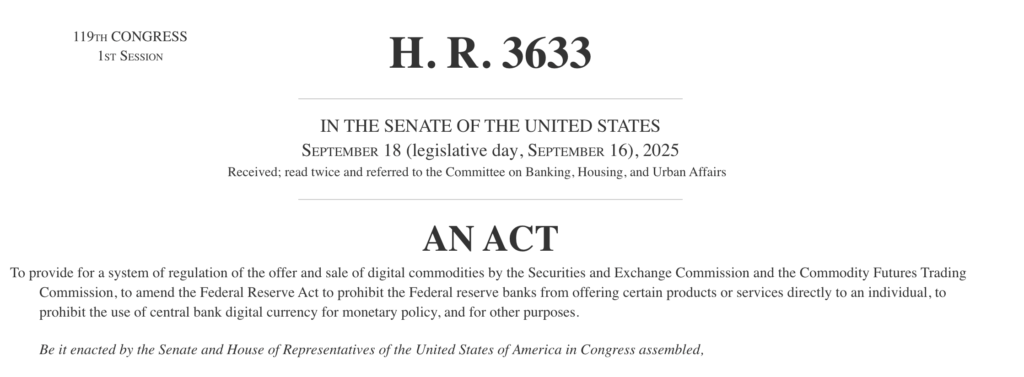
The CLARITY Act, which uses House-passed H.R. 3633 as its base text, is designed to establish a comprehensive federal framework for digital asset markets. 

The legislation seeks to divide oversight between the Securities and Exchange Commission and the CFTC, set standards for payment stablecoins, clarify rules for decentralized finance, and protect software developers who do not control customer funds.

Supporters, primarily Republicans, argue the bill would replace regulatory uncertainty with clear rules, strengthen anti-fraud and illicit finance authorities, and bring crypto activity back onshore. Committee fact sheets describe it as the “strongest illicit finance framework Congress has ever considered” for digital assets.

Critics, however, contend the bill weakens investor protections and risks creating new loopholes. 

Former SEC Chief Accountant Lynn Turner warned earlier this week that the CLARITY Act draft lacks Sarbanes – Oxley–level safeguards, such as mandatory audited financial statements, internal control certifications, and robust Public Company Accounting Oversight Board oversight — deficiencies he said could enable another FTX-style collapse.

Stablecoin rewards have emerged as one of the most contentious issues in the CLARITY Act. Banking groups argue that yield-bearing stablecoins could siphon deposits from traditional banks, while crypto firms counter that broad bans on rewards would stifle innovation and push users toward offshore platforms.

clarity act
CLARITY Act

This post Senate Banking Committee Postpones CLARITY Act Markup After Crypto Industry Backlash first appeared on Bitcoin Magazine and is written by Micah Zimmerman.

Coinbase Says ‘No’ to CLARITY Act, Citing Crypto Restrictions

Bitcoin Magazine

Coinbase Says ‘No’ to CLARITY Act, Citing Crypto Restrictions

Coinbase CEO Brian Armstrong said the exchange cannot support the Senate Banking Committee’s latest draft of the CLARITY Act, warning that the bill, as written, would leave the U.S. crypto industry worse off than the current regulatory status quo.

In a post on X, Armstrong cited several concerns, including what he described as a de facto ban on tokenized equities, new restrictions on decentralized finance that could grant the government broad access to users’ financial data, and provisions that weaken the Commodity Futures Trading Commission while expanding the Securities and Exchange Commission’s authority.

“After reviewing the Senate Banking draft text over the last 48hrs, Coinbase unfortunately can’t support the bill as written,” Armstrong posted.

He also criticized draft amendments that would eliminate rewards on stablecoins, arguing they would allow banks to suppress emerging competitors.

“We’d rather have no bill than a bad bill,” Armstrong said on X, adding that Coinbase would continue pushing for a framework that treats crypto on a level playing field with traditional financial services.

BREAKING: Coinbase CEO Brian Armstrong says Coinbase "can't support" the crypto market structure legislation as currently written 👀

"We'd rather have no bill than a bad bill." pic.twitter.com/3BCgWw0kM9

— Bitcoin Magazine (@BitcoinMagazine) January 14, 2026

The comments come a day before the Senate Banking Committee is expected to mark up the CLARITY Act on Thursday, January 15. 

The legislation is trying to clarify U.S. digital asset market structure by defining categories such as digital commodities, investment contracts, and payment stablecoins, while dividing oversight between the SEC and CFTC.

Coinbase’ issues with stablecoin rewards

Stablecoin rewards have emerged as a flashpoint in negotiations. Coinbase had reportedly warned lawmakers it may withdraw support for the bill if it restricts yield programs tied to stablecoins like USD Coin. 

Coinbase shares in interest income generated from USDC reserves and uses part of that revenue to offer incentives to users, including rewards of roughly 3.5% for Coinbase One customers.

Stablecoin-related revenue may have reached $1.3 billion in 2025, making the issue central to Coinbase’s business model. 

Banking groups argue that yield-bearing stablecoins could draw deposits away from traditional banks, while crypto firms counter that banning rewards would stifle innovation and push users toward offshore platforms.

“I’m actually quite optimistic that we will get to the right outcome with continued effort,” Armstrong later posted on X. “We will keep showing up and working with everyone to get there.”

Michael Saylor, executive chairman of Strategy, retweeted Armstrong’s post, showing his own support with the decision. 

This post Coinbase Says ‘No’ to CLARITY Act, Citing Crypto Restrictions first appeared on Bitcoin Magazine and is written by Micah Zimmerman.

Coinbase May Drop Support for CLARITY Act Over Stablecoin Conflicts

Bitcoin Magazine

Coinbase May Drop Support for CLARITY Act Over Stablecoin Conflicts

Coinbase, one of the largest U.S.-based crypto exchanges, may withdraw its support for the CLARITY Act if the bill imposes restrictions on stablecoin reward programs, according to a Bloomberg report. 

The warning comes as Congress prepares to mark up the legislation in the Senate this week, setting up a potential clash between regulators and one of crypto’s most prominent companies.

For Coinbase, stablecoin rewards are not a minor perk — they are a core part of its revenue model. The exchange shares in interest income generated from reserves backing USD Coin (USDC), the widely used stablecoin issued by Circle, in which Coinbase owns a minority stake. Part of that income is used to offer incentives to users, including roughly 3.5% rewards for Coinbase One customers. 

These programs encourage users to keep USDC on the platform, creating a predictable revenue stream even when trading activity slows. Bloomberg estimates that stablecoin-related revenue may have reached around $1.3 billion in 2025.

The heart of the debate is whether these rewards resemble traditional banking products, such as interest-bearing accounts, or whether they are consumer incentives that belong in a crypto-specific regulatory framework. 

Some banking groups argue that allowing yield on stablecoins could pull deposits away from traditional banks, potentially reducing lending to households and small businesses. 

The act is expected to be marked up this week on January 15. This ongoing issue could have broad effects on the bitcoin and crypto space. 

Coinbase: Stablecoin rewards are under threat

Coinbase and other crypto advocates counter that treating rewards like bank interest would stifle innovation, make U.S. platforms less competitive globally, and risk pushing users offshore.

Coinbase’s stance illustrates the broader tension between lawmakers seeking investor protection and companies trying to maintain viable business models in the emerging crypto sector. 

While the CLARITY Act aims to clarify market structure rules for digital assets — defining categories like digital commodities, investment contracts, and payment stablecoins— it also signals Congress’s growing interest in stablecoin oversight and decentralized finance.

The timing is significant. The Senate Banking Committee will soon review the bill, and its final provisions could shape the future of U.S. crypto policy. Coinbase’s potential withdrawal of support is somewhat of a negotiation tactic and it reflects how critical stablecoin yield programs have become for regulated exchanges. 

Limiting these incentives could reduce adoption of U.S.-based platforms and slow mainstream engagement with digital currencies.

The dispute also highlights the human element of regulation. Companies like Coinbase are balancing compliance, investor expectations, and global competitiveness, while lawmakers weigh the need for oversight against the risk of stifling innovation.

Coinbase has not made an official statement, but insiders speaking to Bloomberg suggest the exchange is carefully evaluating whether the final text will allow it to continue offering rewards while staying aligned with U.S. law.

This post Coinbase May Drop Support for CLARITY Act Over Stablecoin Conflicts first appeared on Bitcoin Magazine and is written by Micah Zimmerman.

2012 Video Resurfaces of Coinbase CEO Brian Armstrong Pitching What Became America’s Largest Bitcoin Exchange

Bitcoin Magazine

2012 Video Resurfaces of Coinbase CEO Brian Armstrong Pitching What Became America’s Largest Bitcoin Exchange

A video has surfaced showing Coinbase CEO Brian Armstrong rehearsing a pitch in 2012, years before the company became the largest Bitcoin exchange in the U.S.

In the recording, Armstrong lays out a simple argument: Bitcoin is a digital currency that can move money instantly anywhere in the world. But it’s hard to use. Tools were clunky, backups were tricky, and users could easily lose their funds. 

Coinbase, he said, would fix that. The platform would act as a hosted wallet, letting anyone access their money from any device without worrying about security or backups.

Armstrong compares his plan to what iTunes did for music. He emphasizes the early growth: sign-ups and transactions increasing “20 % a day,” and $65,000 in Bitcoin payments were processed in just five weeks.

The pitch is short, under three minutes, and candid. Armstrong discussed fees, competition, and the potential of Bitcoin as a global payment system. It’s a glimpse at the early vision of a company few outside crypto had heard of.

In 2012, Brian Armstrong recorded himself rehearsing his pitch for Coinbase.

Today, they're the largest Bitcoin exchange in the US ✨ pic.twitter.com/Ta4bKz0hYd

— Bitcoin Magazine (@BitcoinMagazine) December 4, 2025

Coinbase: Don’t get ‘left behind’

It’s safe to say that Armstrong’s idea was a success. More than a decade later, Coinbase is the top U.S. exchange, handling billions in Bitcoin transactions and shaping how Americans interact with digital assets. 

That scrappy 2012 rehearsal captures the first hints of a company that would grow into a crypto powerhouse.

Just yesterday, Armstrong sat beside BlackRock CEO Larry Fink and said that all major U.S. banks that ignore stablecoins risk being “left behind.” 

Speaking at the New York Times DealBook Summit, Armstrong said that several top banks are running pilot programs with Coinbase for stablecoins, crypto custody, and trading.

Armstrong acknowledged a split within traditional finance: some institutions’ lobbying arms resist crypto, while innovation teams explore it. 

“This is the classic innovator’s dilemma,” he said, noting banks must choose between embracing or fighting new technology. On concerns about capital flowing to stablecoins, Armstrong said banks are mainly focused on protecting profit margins.

Fink, once a bitcoin skeptic, said he now sees a “huge use case” for Bitcoin and worries the U.S. is falling behind in stablecoin innovation. 

Armstrong has championed crypto to the U.S. government. He has lobbied and pushed for clearer regulations for the crypto industry.

Armstrong supported legislation like the CLARITY Act to set legal clarity. He launched grassroots efforts, including Stand With Crypto. He has also spent millions on campaigns through PACs like Fair Shake. 

This post 2012 Video Resurfaces of Coinbase CEO Brian Armstrong Pitching What Became America’s Largest Bitcoin Exchange first appeared on Bitcoin Magazine and is written by Micah Zimmerman.

❌