Hiring the right minds and skill sets in marketing in today’s age is vital to laying the right foundations for any company, let alone a crypto company.
Cryptocurrency exchanges continue to be one of the most profitable segments of the digital asset economy. The combination of market maturity, institutional adoption, and regulatory clarity has made exchange platforms viable fintech products for startups, brokerage firms, and enterprise operators.
This guide explains the full process of launching a crypto exchange in 2026— from infrastructure and compliance to liquidity and go-to-market strategy.
1. Define Your Exchange Model
The first step is choosing your platform type. Common models include:
Merkle Manufactory, the company behind the crypto-oriented social media protocol Farcaster, plans to return $180 million in venture funding to investors.
Key Takeaways:
Merkle Manufactory plans to return $180 million in venture funding while Farcaster continues operating.
Farcaster has been acquired by Neynar, which will take over development as the founding team steps back.
The protocol is shifting away from a social-first model toward infrastructure and developer-focused use cases.
Several investors, including former Coinbase executive Balaji Srinivasan, separately confirmed the plan to return the capital.
Romero: Farcaster Not Shutting Down as Merkle Plans to Repay $180M
“Farcaster is not shutting down,” Romero wrote, pushing back on rumors surrounding the platform’s status.
He said the protocol remains operational, citing roughly 250,000 monthly active users in December and more than 100,000 funded wallets.
Romero added that Merkle intends to repay the full amount raised over the past five years, saying the firm sought to be a responsible steward of investor capital.
The announcement comes shortly after Farcaster was acquired by Neynar, a venture-backed startup that has long built infrastructure within the Farcaster ecosystem.
Under the deal, Neynar will assume control of Farcaster’s smart contracts, code repositories, mobile application, and Clanker, an AI-driven token launchpad.
Given some rumors, wanted to post a few clarifications:
Farcaster is not shutting down. The protocol works and will continue to work. There were 250,000 MAU in December and over 100,000 funded wallets. The acquirer, Neynar, is a venture-backed startup and plans to shift…
Romero and fellow co-founder Varun Srinivasan, along with parts of the Merkle team, will step away from day-to-day development.
“This wasn’t an easy decision,” Romero wrote earlier this week. “But after five years, it’s clear Farcaster needs a new approach and leadership to reach its full potential.”
Farcaster was launched with the ambition of decentralizing social media by allowing users to control their identities and data rather than relying on centralized platforms.
The project drew significant attention in 2024 when it raised $150 million from major crypto venture firms, including Paradigm and Andreessen Horowitz’s crypto arm.
Despite early enthusiasm, Romero acknowledged that the platform struggled to achieve sustainable growth as a social-first product.
In December, the team shifted its focus toward in-app wallets and trading features in an effort to drive engagement, signaling a strategic pivot away from competing directly with mainstream social networks.
Neynar, which provides developer tools and APIs for applications built on Farcaster, said it plans to steer the protocol in a more builder-centric direction.
The company is expected to roll out a new roadmap focused on infrastructure and developer adoption rather than consumer-facing social features.
Offline Web3 Messaging Apps Gain Momentum
The controversy around Farcaster comes as Web3-style social media and messaging tools are gaining traction as governments increasingly restrict internet access during periods of political unrest.
In Uganda, Bitchat surged to the top of local app store rankings after authorities cut internet and mobile services ahead of a disputed election.
Downloads in the country have nearly quadrupled in recent months, with similar spikes reported in Iran as users seek ways to communicate during state-imposed blackouts.
The app operates without internet or cellular connections, relying instead on Bluetooth mesh technology that allows messages to hop between nearby devices.
Supply is not designed for price. It is designed for roles.
In [Part I], we dismantled a common assumption: that Web3 payments require a native stablecoin.
We established that InterLink doesn’t “mint” stability through a dollar peg. Instead, it enforces stability through settlement rules, identity verification, and controlled distribution.
Once you accept that premise, a deeper question emerges:
If InterLink isn’t optimizing for price stability through a stablecoin, what exactly are its token numbers optimizing for?
This is where most analyses break down — and where design, not speculation, becomes decisive.
AI-generated image for illustrative purposes. Not a real photograph.
🎰 The “Price-First” Trap: A Legacy of Gambling
The crypto industry has spent a decade perfecting the art of gambling. Now, it’s time to start perfecting the art of survival.
Most token supplies are designed backwards — starting from price expectations rather than system behavior.
They collapse into “Price Anxiety,” obsessing over whether a supply is scarce enough to pump or when the next unlock will hit. This is the manufacture of early hype through artificial scarcity.
InterLink does not play the price-first game. Its numbers are built to withstand time — not to excite markets today.
🔋 Supply as Capacity, Not Scarcity
Here is the inversion most people miss: Token supply does not set price. It sets access.
InterLink’s dual-token structure is built on this very principle.
ITLG: A participation container. 🥣
ITL: A settlement and utility asset. ☕🍞
These quantities aren’t signals to traders; they are load-bearing limits forhuman behavior.
Asking if 100 billion ITLG is “too much” misses the point. The real question is:
How many humans, actions, and years must this system absorb without breaking?
🌊 Why ITLG Must Be Large: The Participation Container
ITLG’s supply is intentionally expansive because its role is expansive. ITLG is not “money” in the traditional sense;
A small supply would create scarcity at the participation layer, immediately giving an advantage to those with capital (gatekeeping).
Instead, InterLink allows ITLG to be abundant before it becomes valuable.
That value is earned later — through verification.
⚙️ The Filter: Raw ITLG vs. Verified ITLG
Raw ITLG is easy to earn. Verified ITLG is not.
Between the two sits a sophisticated qualification layer:
Human Credit Score (HCS) ⏳ A filter for genuine human behavior.
Consistency ⏱️ Reward for the “time-spent” variable.
Security Groups 🛡️ Network-level trust participation.
Activity ≠ Ownership. Only verified behavior converts participation into on-chain assets.
Supply is abundant. Value is conditional.
⚓ Why ITL Must Be Limited: The Trust Anchor
If ITLG is about inclusion, ITL is about trust.
Settlement assets cannot be infinite. A currency that anyone can mint freely isn’t a currency — it’s noise.
Therefore, ITL is: 🚫
Not mined directly.
Not freely issued.
Not accessible without verified participation.
Every unit of ITL originates from qualified ITLG activity. It is allocated, not exchanged.
💡 Done.T’s Note
ITL is a defensive outcome — strictly capped at 10% of the total ITLG supply.
It is not designed to flood the market, but to anchor it. Because of this 10% constraint, every unit of ITL is released Slowly. Deliberately. Defensively.
Price prediction is the wrong lens. The real question isn’t how high it goes, but how long it holds.
🏁 Conclusion: Defensive Design
InterLink’s numbers are defensive by design.
They don’t manufacture scarcity for the sake of a chart; they reservescarcity for the precise layer where it is required for trust.
Participation is open.
Ownership is earned.
Settlement is protected.
InterLink’s token numbers do not predict price.
They enforce who is allowed to matter — over time.
🔜 Continue to Part III: 🔗 Retail vs. Institutions: Who Actually Holds the Power in InterLink?
About the Author
Done.T is a Web3 analyst specializing in the InterLink ecosystem. He unpacks the underlying logic of the Human Node economy, translating complex system design into actionable, data-driven insights for a global audience.
Disclaimer: This article provides a strategic analysis of InterLink’s publicly available infrastructure and documentation. It is not financial advice. Readers should conduct their own due diligence.
Private key management is the most critical aspect of security for enterprise-grade crypto wallets. Losing control of a private key can result in permanent financial loss, reputational harm, and regulatory penalties. In contrast to retail wallets, enterprise wallets must deal with large amounts of assets, multiple users, complicated workflows, and being in compliance with many regulations, meaning key management takes on an even greater importance.
The following are the recommended key management strategies for enterprise-grade crypto wallets.
1. Self-Custody and Non-Custodial Architecture
Enterprises should focus on self-management of private keys as opposed to using third-party custody solutions.
Advantages of self-custody:
Total ownership/control of digital assets
Decreased counterparty risk
Increased regulatory transparency
By using a self-custody model, enterprises avoid the risks associated with the potential failure of an exchange or service provider.
2. Use of Hardware Security Modules (HSMs)
HSMs provide a standard method of generating, storing, and securing cryptographic keys inside secure and tamper-evident environments.
Advantages for enterprises:
The keys will never be stored outside of the hardware environment
HSMs protect from both physical and remote attacks
HSMs meet security certification requirements (e.g., FIPS 140–2/3).
HSMs are in use by most banks and other financial institutions to provide cryptographic key management.
3. Multi-Signature (Multi-Sig) Wallets
Three types of wallets to consider are multi-signature, multi-party computation, and cold wallet/hot wallet segregation.
A Multi-signature wallet is another type of wallet that requires the approval of multiple private keys to execute a transaction.
Why do Businesses use Multi-Signature Wallets?
The reason is that they eliminate a single point of failure.
Prevent insider threats.
They enable businesses to implement role-based transaction approvals.
For example, if there is a 3 of 5 multi-signature wallet, this means the finance, security, and compliance teams must approve a transaction.
4. Multi-Party Computation (MPC)
A Multi-Party Computation (MPC) Wallet is a modern way to think of multi-signature wallet technology. Instead of having one key, it creates the key by splitting it up and distributing the shares across many encrypted systems.
The benefits of Multi-Party Computation are:
At no time do you have a single key.
They have a much greater ability to resist key theft.
They allow you to process transactions faster than multi-signature wallets.
They are designed for businesses that require high levels of daily volume.
Institutions that are in the business of storing Crypto are starting to prefer the use of multi-party computation.
5. Cold Wallet/Hot Wallet Segregation
The best practices for businesses when it comes to separating their wallets by how they will be used and how they will be exposed to risk are:
Cold wallets for long-term storage.
Hot wallets for operational liquidity (online).
Rebalance funds between wallets.
By doing so, businesses are able to limit their risk of exposure to the financial markets while also being able to continue to operate at optimal levels of efficiency by doing so as well.
6. Role-Based Access Control (RBAC)
Not all employees should have access to private keys or be able to sign transactions.
RBAC provides:
Separation of duties
Control over who can sign
Reduction of insider threat
Access should be granted based on roles rather than the individual.
7. Backup and Recovery Securely
Enterprises should be prepared for disaster recovery without sacrificing security.
Best Practices Include:
Encrypted backups of keys
Distributed storage in multiple geographic locations
Shamir’s secret sharing for recovery
Approval processes for recovery heavily regulated
Backups should not jeopardize the confidentiality of the key.
8. Audit Logging and Monitoring
Every action related to a key should be logged and monitored.
Audit logs should provide:
Created and used keys
Approved transactions
Attempts to access and change keys
This will facilitate compliance, forensic investigations, and audits within the organization.
9. Compliance and Regulatory Expectations
Regional and industry regulations dictate how enterprise wallets are to comply.
Key requirements include:
AML and transaction monitoring
Secure custody standards
Regular third-party security audits
Private key management regulatory compliance
10. Security Audits and Penetration Testing
The evolution of threats requires that private key management systems continuously evaluate the security of their systems.
Best Practices Include:
Independent security audits
Penetration testing
Code reviews for cryptographic logic
Continuous monitoring for vulnerabilities
As threats change, so must security systems.
Summary
The success of enterprise-grade cryptocurrency wallet development depends on robust private key management. The ability to protect digital asset portfolios at scale using self-custody models, Hardware Security Modules (HSMs), multi-signature or Multi-Party Computation (MPC), cold-storage solutions with strict physical access control, and other best practices for comprehensive remote management provides the opportunity to build a secure and scalable foundation for your organization’s digital assets.
I’ve lived through enough crypto cycles to know every big drawdown gets a convenient story. After the autumn 2025 sell-off, it was: “Relax, it’s healthy.” When Volodymyr Nosov, founder and president of WhiteBIT Group, said the same thing in his January 2026 Benzinga interview, I heard someone speaking from inside the rails I actually use, not a distant PR script.
This is my view from the desk: where his roadmap overlaps with my numbers and how that shapes my positioning into 2026.
“In 2026, we will see even greater regulatory clarity.”
My filter on those comments starts with regulation and how I already size around it. Most major jurisdictions are locking in rules for digital assets and stablecoins. Over the last two years, I’ve shifted my regulated exposure from roughly 5–10% to about 40% of my crypto. Today that means around one-third of BTC and ETH in spot ETFs and supervised custodians, plus a short list of compliant exchanges.
That leaves the book near 65/35. Roughly 65% sits in low-velocity, mostly regulated exposure, I’m prepared to hold through macro noise. The remaining 35% is a higher-beta sleeve I rotate through narratives, perp,s and alts.
“Such corrections are a healthy mechanism.”
His “healthy mechanism” line on the autumn correction matches what I saw on the blotter. I turned that move into cutting a BTC swing long at about -6.3%, then flipping short for roughly +3.8%. After that, I re-entered lower and pulled another +4.6% on the bounce.
I ran the same structure on ETH and overheated L1s. In the end, roughly 40% of my yearly PnL came from trading inside a single cleanup — in a market where 20–30% drawdowns are baked into the design, not proof the system is dying.
“The market today is far more resilient than it was several years ago.”
What really separates this cycle from older ones is what doesn’t break underneath those moves. Fiat rails stayed open. Major venues stayed online. Withdrawals worked.
So the stress sat in positions instead of in the plumbing. My response was mechanical. I cut net long exposure from around 130% to 80%. I dropped alts from roughly 40–45% of the book to under 20%. I rotated that risk into BTC, ETH and a small basket of infrastructure names. I kept leverage in the 1–3x range and treated 20–30% drawdowns in quality assets as rebalancing events, not existential threats.
“The RWA market will continue its rapid development.”
The roadmap lines up again on tokenization. Nosov puts the tokenized asset market in the $10–15 trillion range over the next five years. I express that view through a tight RWA sleeve: around 5% of NAV in tokenized treasuries, one on-chain credit pool, and a small FreeBnk (FRBK) position I built around its listing on WhiteBIT.
I scaled in during the first days of trading and took roughly +32% on the active part of the move. After that, I left a smaller bag as a longer-horizon RWA bet. I also used the “FreeBnk Party” promo mainly to watch how real users behaved around a fresh listing.
“Our team will take part in the tokenization of their stock market.”
The Saudi agreement takes that theme from thesis to plumbing. Tokenizing a roughly $2.7 trillion stock market, wiring WBT and Whitechain into that flow, and building CBDC rails for a currency with around $1 trillion in broad money, backed by national data centres and mining, is the kind of infrastructure play that justifies keeping a core WBT slice of around 7–8% of my long-term book.
At today’s ~$12.2 billion market cap, according to CoinDesk, that position is sized as a high-conviction but not unchecked bet. I still price in tail risks like banking cut-offs or permanent regulatory exile, but as lower-probability, longer-dated outcomes for a platform that now has a state as partner.
“One of the key factors is security.”
All of this sits on top of a security model that stays more conservative than the narratives. I cap any single exchange at around 20–25% of my liquid book and keep 70–80% of my net worth in cold storage.
On WhiteBIT, that means hardware keys, withdrawal whitelists and tight API permissions. It also means a hard split between “vault” accounts and “execution” accounts that only hold a week or two of trading float. New, complex protocols that haven’t survived a real scare sit at a 1–2% position cap until they prove they can take a hit.
“We see strong demand and significant potential.”
The last overlap is in everyday usage. WhiteBIT Nova card numbers are some of the clearest adoption data in Nosov’s comments: average monthly spend of around €750, mostly groceries, cafés and subscriptions across Italy, Spain, Ireland, Poland and the Netherlands. Only a minority of users even ask for a physical card.
That pattern rhymes with my own behaviour. I use crypto cards as rails for travel and recurring bills, so roughly 20–30% of my monthly fiat spend now runs through channels that plug straight into my trading stack. That cuts FX and banking fees and lets me keep an extra 10–15% of working capital in crypto instead of constantly off-ramping.
Wrapping up the takes
Wrap that into W Group — exchange, processor, chain, marketplace, fintech and media — and you get what matters to me: surface area that keeps balances from leaking out when volatility hits.
Going into 2026, I’m betting on a more regulated, institution-heavy cycle where corrections clean the system, so I want risk in compliant infrastructure, tokenization rails and real payment flows.
As long as that story matches how I actually run my book — lower leverage, real volume through crypto cards, infra and RWA sized for years — I’m fine with one plan: stay exposed to the trend, not parked in cash.
Remember the first time you thought about buying gold? Maybe you imagined walking into a vault, handling heavy bars, or worrying about where to safely store them. For most people worldwide, owning physical gold has always felt like something reserved for the wealthy or those with access to specialized facilities. The barriers seemed too high, the risks too great, and the process too complicated.
But what if I told you that technology is completely changing this centuries-old story?
How Tokenization Changes That
The Traditional Gold Ownership Problem
Let’s be honest: physical gold ownership has never been truly accessible to everyone. You need significant capital to buy meaningful amounts, secure storage facilities that cost money, insurance policies that add up, and constant worry about theft or loss. Even if you manage to acquire gold, selling it quickly when you need cash involves finding buyers, verifying authenticity, and dealing with dealers who take their cut.
These aren’t small inconveniences. They’re genuine barriers that have kept millions of people from participating in one of history’s most reliable stores of value.
Enter Gold Tokenization: Breaking Down the Walls
This is where gold tokenization transforms everything you thought you knew about gold investment.
Imagine owning a fraction of a gold bar, stored securely in a vault, without ever touching it. Imagine buying or selling that gold with a few clicks on your phone, 24/7, without visiting a dealer. Imagine having complete transparency about your holdings through blockchain technology that can’t be manipulated.
That’s exactly what gold tokenization service platforms are making possible today.
Gold tokenization converts physical gold into digital tokens on a blockchain. Each token represents actual gold stored in certified vaults, giving you real ownership without the traditional headaches. Think of it as owning shares in gold, except these digital certificates are secured by cutting-edge technology that makes fraud nearly impossible.
How Modern Gold Investment Models Work
The benefits of tokenized gold over physical gold become crystal clear when you see how it actually works:
You can start with minimal amounts (whether it’s $10 equivalent in your local currency), buying fractional ownership that would be impossible with physical bars. Your gold-backed tokens live in a digital wallet, accessible anytime, anywhere. No storage fees are eating into your returns, no insurance premiums to maintain, and no anxiety about security.
When you need liquidity, you simply sell your tokens on digital platforms, often within minutes. Compare that to calling multiple dealers, scheduling appointments, and waiting days for payments with physical gold. Blockchain solutions for gold investment have created a transparent system where every transaction is recorded permanently. You can verify your gold’s existence, its purity, and even track its custody history. This level of transparency was unthinkable in traditional gold markets.
Real Benefits That Matter to You
Let me break down what this actually means for your investment strategy:
Accessibility is no longer a barrier: Whether you’re a student saving small amounts monthly or an investor diversifying your portfolio, gold ownership is now within reach regardless of where you live. The exclusivity that kept gold in the hands of the privileged is disappearing.
Liquidity becomes your advantage: Need emergency funds? Sell your gold-backed tokens instantly instead of scrambling to find buyers for physical gold. The digital marketplace operates continuously, giving you control when you need it most.
Diversification gets easier: You can spread small investments across different gold products, storage locations, or even combine gold with other tokenized assets, creating a balanced portfolio that was once only available to institutional investors.
Security improves dramatically: No more worrying about break-ins or natural disasters destroying your physical holdings. Your gold sits in professional vaults while your digital proof of ownership is secured by blockchain technology.
The Future of Gold Investment with Tokenization
We’re witnessing the early stages of a fundamental shift. The future of gold investment with tokenization isn’t just about making things easier; it’s about democratizing wealth preservation. Traditional financial institutions worldwide are taking notice. Banks and investment firms across different regions are launching their own gold tokenization services. Regulations are evolving globally to protect investors while encouraging innovation. The infrastructure is being built for a world where physical and digital gold ownership coexist seamlessly.
Young investors who grew up with cryptocurrency find tokenized gold familiar yet stable. It combines the security of precious metals with the convenience of digital assets. For older generations, it removes the physical burden while maintaining the fundamental value they’ve always trusted in gold.
Your Next Step Toward Accessible Gold Ownership
The exclusivity of gold ownership is ending. Technology has opened doors that were previously locked to most people. Whether you’re looking to preserve wealth, hedge against economic uncertainty, or simply diversify your investments, tokenized gold offers a practical path forward. The question isn’t whether you can afford to own gold anymore. The question is: are you ready to embrace this new way of investing?
Gold tokenization isn’t replacing traditional gold; it’s expanding access to it. The barriers that once kept you out are crumbling. The vaults that seemed unreachable are now as close as your smartphone.
To understand the complete landscape of this revolutionary approach and make informed decisions about your investment future, read the full gold tokenization guide and discover how you can start your journey toward accessible, secure gold ownership today.
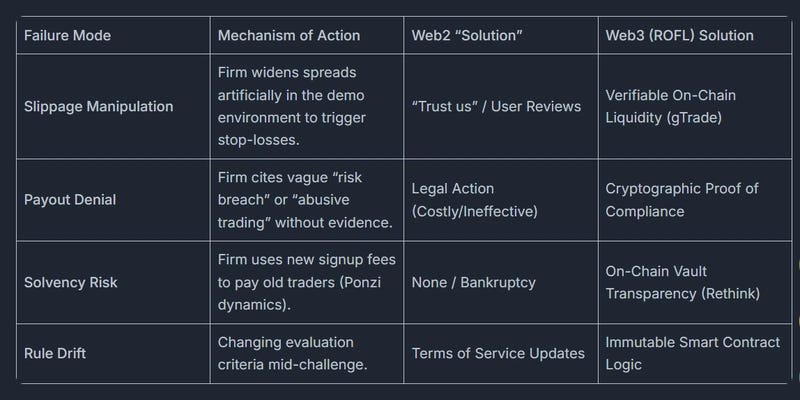
Prop trading relies on opaque risk engines that traders cannot verify.
This creates structural incentives for payout denial and abuse.
Carrotfunding introduces parallel verification with Oasis ROFL to audit AWS-based execution.
The result is a hybrid architecture that brings verifiable compute, privacy, and trustless settlement to prop trading.
Introduction
Decentralized trading is one of the most popular applications of cryptocurrency technology. Have we become stagnant in our approach? For example, proprietary (prop) trading, despite being a $60 billion industry, faces a verification crisis common in the modern financial landscape.
Aspiring traders seek capital from centralized institutions. However, an opaque “black box” operational model widens the gap between the industry’s assurances that skill earns reward of capital and the reality where proving performance and worthiness is erratic and arbitrary.
The web2 paradigm adjudicates trader performance and rewards on private servers that are not auditable. Moreover, the evaluating firms profit more when traders fail, as it means there is less capital disbursement.
Decentralized finance (DeFi) has blockchain’s built-in transparency to solve the blind spots of the traditional web2 approach. However, adoption has been low over the years because on-chain trading has failed to match the speed and complex solutions that traditional institutional finance (TradFi) offers.
In this post, I will refer to the Carrotfunding case study to examine how it can serve as an example of an emergent trustless market infrastructure. I will first demonstrate the gaps in the incumbent systems, and then show how a framework like Oasis ROFL can elevate the process by bringing decentralization, verifiability, and privacy to the table.
Black Box Evaluation Engine
The evaluation engine is the backbone of any prop trading firm. This software logic monitors trader activity, calculates real-time equity, enforces parameters and limitation criteria, and, finally, approves or denies payout requests. Private cloud infrastructure, like AWS, Azure, etc hosts such a risk engine with its access and management entirely in the firm’s discretion.
Sounds simple and is “trusted”, right? But the traders can never verify the validity of the metrics on which they are observed and evaluated. Let’s now take a look at how ambiguity in rules and retroactively applied rules can result in most payout denials.
Consistency Rule Exploitation
A common practice among firms is that a trader’s most profitable day cannot exceed a certain percentage of their total profit. This creates an untenable bind for traders when centralized databases can arbitrarily change risk parameters and payout criteria without explicitly detailing them beforehand.
B-Book Model
A-Book is when the broker passes a trade to the market involving live liquidity providers and earns a commission.
B-Book is when the broker keeps the trade internal, where the firm acts as the counterparty to every trade. The broker here keeps the deposit if the trader loses money, and pays out of pocket if the trader wins.
The B-Book model creates an incentive system where a profitable trader becomes a liability. So, the incentive is on the firm to disqualify traders and disadvantage them, and without a verifiable infrastructure, regulators cannot do much.
Liquidity Illusion in Tokenization
Blockchain technology’s initial solution of tokenizing trader performances is more theoretical than practical. Tokenization of trading activities can lead to an illusion of liquidity unsupported by reality. So, tokenization that lacks a robust legal and technical framework can result in zombie assets — tokens exist on-chain, but there is no genuine liquidity market or a reliable mechanism for value accrual.
Carrotfunding Case Study: Architecture and Implementation
Carrotfunding, even before integrating Oasis ROFL, had already implemented web3 solutions for its prop trading venture. Its on-chain liquidity adopts the Arbitrum’s gTrade solution for trade execution, while utilizing Rethink Finance for on-chain investment vehicles with gamification mechanics and vault transparency for capital safety.
This takes care of the execution layer and the capital layer, but what happens to the verifiable compute and security layer? This is the domain of Oasis ROFL, and deserves a closer look.
Parallel Verification Model (Phase 1)
In this phase, Carrotfunding continues to use AWS infrastructure for its platform and strengthens it with parallel verification with an ROFL-based auditor. The workflow unfolds in five stages.
A trader executes a trade on the gTrade platform via the Carrotfunding interface.
This bifurcates into two distinct paths: (a) Legacy: The trade data goes to Carrot’s AWS execution engine. (b) ROFL: The data simultaneously goes to the ROFL node network.
The computation takes place independently. (a) AWS calculates the impact on the trader’s account, for example, the trader’s daily profit and loss statement. (b) ROFL, running inside a trusted execution environment (TEE), performs the same evaluation using the same code logic.
ROFL provides attestation and verifiability through comparison. This is based on the cryptographic proof generated from its calculation and submitted on-chain, where both the AWS and the ROFL results are matched.
The finality of the process is provided by ROFL. If the two results match, no problem. If they differ, then ROFL’s result, having cryptographically verifiable proof, is accepted over the AWS result, which might be potentially compromised or based on an erroneous database.
The “Trustless AWS” Paradigm
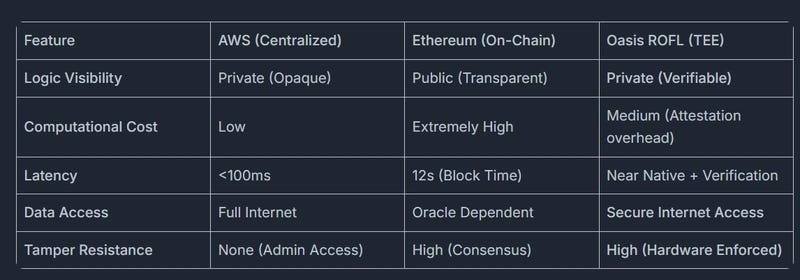
We can call this architecture “Trustless AWS”. ROFL, often described as a decentralized TEE cloud, enables the best of both worlds in terms of developer experience — the benefits of a centralized cloud, involving deployment of Docker containers and running complex logic, while also having the advantages of the security properties of a blockchain.
A comparison of the computational models will clarify further.
Proxy-Based Frontend Hosting
Carrotfunding utilizes the ROFL primitive called proxy-based frontend hosting. Typically, a decentralized application (dApp)’s smart contract logic is on-chain, but the website, which is the frontend, is still hosted in a centralized cloud provider, for example, AWS. So, if the cloud server goes down, the UI is also down.
With ROFL, Carrotfunding can host the frontend inside the TEE. As a result, the node can automatically provision TLS certificates using a built-in ACME client inside the secure enclave. There is also end-to-end security as a user’s connection via SSL terminates only inside the TEE. This protects user privacy, shielding IP addresses and login patterns from the node operator and infrastructure provider.
Secret Management and Proprietary IP
For any prop trading firm, keeping its internal risk algorithms secret is how it stays competitive. Full transparency of blockchain technology is counterproductive in this regard. The smart privacy feature of Oasis technology ensures that both transparency and confidentiality can co-exist.
So, with the code running inside the TEE, Carrotfunding can keep its algorithms private. Here, the hash of the code is accessible publicly for verification, but the source code remains encrypted, out of public viewing scope, and unrevealed to the node operator.
Security: Threat Model and Defense
Integrating TEE often opens up the question of security, as the SGX/TDX technology can succumb to various vulnerabilities.
Side-Channel Attacks: This is mitigated in two ways. The ROFL framework ensures that the latest microcode patches from Intel are used. So, any node that is found without a TEE trusted computing base (TCB) update is rejected by Oasis’s confidential runtime on-chain logic, Sapphire’s registry. Also, using “data-oblivious” code helps block pattern analysis of memory access.
Oracle Manipulation: This is mitigated by simultaneous TLS connections to multiple independent data providers for the price feed, computed inside the enclave for the median price, used to evaluate instead of relying entirely on a single on-chain oracle update.
Key Leakage: This is mitigated by a decentralized key management system where the master key is sharded across multiple nodes. So no single node ever possesses the full key. Also, ROFL enables ephemeral keys so that they exist only in volatile memory and will be wiped and lost whenever the enclave restarts or if any tampering is ever attempted.
In addition, the adoption of consensus as a verifier by a Byzantine Fault Tolerance (BFT) network like Oasis ensures that all potential gaps in remote attestations of the TEEs are addressed.
The Verifiability X-factor
This is crucial in understanding the role Oasis ROFL plays in upgrading the risk engine of Carrotfunding from what traditional models can provide. Any user can, therefore, audit the system by using the command:
oasis rofl build -verify
Reproducible builds allow users to download the source code, compile it locally using the deterministic build environment provided by Oasis, and obtain the MRENCLAVE hash.
Users can then query the Sapphire runtime for an on-chain check if their generated hash matches the one registered by active nodes. If yes, it is the immutable proof that the code on GitHub is the code running on the server.
From Prop Trading to Autonomous Agents (Phase 2)
Integrating Oasis ROFL to verify the AWS risk engine by Carrotfunding is just the stepping stone to a paradigm shift in prop trading. It aims to evolve into a self-sustaining infrastructure that can ultimately replace the AWS system altogether.
This full decentralization mode becomes viable only after there is sufficient stability and enough node operators in place to guarantee 99.99% uptime. With the transition to a ROFL-first architecture, the Carrotfunding platform can then use only ROFL nodes to authorize Rethink Finance’s capital layer for fund release.
The evolution of the platform’s architecture and functionality into autonomous trading agents is also part of the future roadmap. This envisions a marketplace for verifiable intelligence, where the AI agents compete for capital in a trustless environment, protected by the privacy guarantees of Oasis and the settlement assurances of Arbitrum.
Decentralized Identity (DID) is another key area to explore since ROFL can process sensitive personal data (KYC documents) inside the enclave to verify a trader’s identity and reputation score.
Conclusion
The study suggests that DeFi can hold its own against TradFi, which had a historical monopoly in the prop trading market. Now, there is a live example of how the limitations of web2 finance, where asset management meant opaque computation logic, can be improved with web3’s verification layer to prove the process.
By removing trust assumptions and plugging the trust gap, Carrotfunding has engineered a system that aligns the incentives of traders, capital providers, and the platform itself. We now await the full decentralization and agentic future for on-chain prop trading, redefining the standards of transparency, security, and efficiency for the next-gen trustless digital asset market.
Ever missed a 10x meme coin pump because your wallet lagged? Or paid insane fees just to move assets around? Yeah, we’ve all been there. In 2026, Solana is still the king of speed and low-cost chaos — but only if your wallet keeps up. That’s where HOT Wallet changes everything.
Why Solana Still Rules in 2026
Solana is built for speed: sub-second finality, dirt-cheap fees, and a massive ecosystem of DeFi and meme coins. After the insane 2024–2025 memecoin boom, it became the go-to chain for traders and builders. New to Solana? Check out our quick intro video — it explains exactly why everyone’s obsessed with this chain.
Meet HOT Wallet: Your Solana Powerhouse
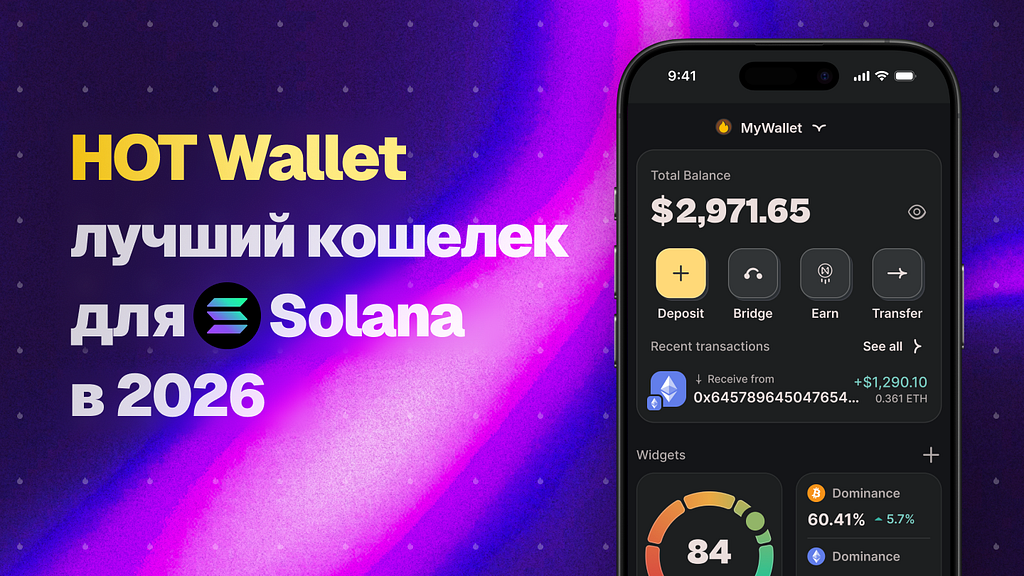
HOT Wallet(developed by HOT Labs) is a non-custodial, chain-abstraction MPC wallet powered by HOT Protocol. No seed phrases to manage. Full control over your assets across chains. Available on mobile, browser extension, and Telegram Mini App — swap, bridge, stake SOL, claim airdrops, run missions, and trade wild meme coins like TRUMP, BONK, WIF, Fartcoin — all in one smooth interface.
How to Swap Tokens & Meme Coins on Solana (Super Fast)
Want the best prices every time? Here’s the 4-step flow: - Open the Swaps section in HOT Wallet - Select Solana network - Pick your token pair - On the Review screen — tweak and confirm
Quick settings breakdown: Provider — Powered by Jupiter, Solana’s top DEX aggregator. Always routes you the best rate across multiple DEXs. Slippage — Crank it up for volatile new meme coins so your trade doesn’t fail. Priority Fee — Add a small boost to jump the queue during crazy pumps. We show in our short tutorial video how HOT Walletconsistently beats other Solana wallets on price.
Bridging to Solana? Done in Seconds
Moving assets in? Follow these steps: - Go to the Bridge section - Pick your source network and token - Choose Solana as destination - Select provider on Review screen: HOT Bridge — our fast native cross-chain solution Li.Fi— one of the strongest cross-chain aggregators in crypto
Why HOT Wallet Is the #1 Choice for Solana in 2026
Here’s what sets us apart: - MPC security — military-grade with 2FA and rotatable seed phrases - Best-rate swaps — top liquidity, minimal slippage - Built-in bridges — widest cross-chain routes of any wallet - Storage cleanup — easily remove dust tokens and free space - Multi-platform — Android, iOS, browser, Telegram Mini App - SOL staking — earn rewards in-app, no lock-up - Web3 browser — jump into dApps without leaving the wallet - Multi-chain hub — EVM + non-EVM in one place - Custom gas — optimize for speed or savings - 24/7 human support — real people, not bots
Ready to Level Up on Solana?
HOT Wallet isn’t just another wallet — it’s your edge in the 2026 memecoin wars, airdrop seasons, and DeFi grind.
While the dollar was designed for a world of nation-states, human intermediaries, and territorial boundaries, the rise of AGI and global platforms demands something else:borderless continuity, algorithmic coordination, and machine-speed settlement.
This friction cannot be resolved through policy alone. As production migrates into digital and algorithmic environments, we must ask a fundamental question:
What kind of monetary system can function natively within this new architecture?
To find the answer, we must stop viewing money as a mere commodity and start seeing it as a structural coordination layer.
AI-generated image for illustrative purposes. Not a real photograph.
⚠️ Why “Digital” Alone Is Not Enough
It is tempting to assume that existing digital assets like Bitcoin or Ethereum will automatically fill this void.
However, many current crypto-assets remain structurally disconnected from real-time production. They are excellent at moving or storing value, but they often lack the “sensory” capacity to measure the quality of participation or the consistency of contribution within a network.
The next evolutionary stepisn’t just a “digital currency” — it is a Monetary Protocol. A system that doesn’t just denominate value, but serves as the nervous system that coordinates it.
📋 Five Requirements for a Post-Industrial Monetary Layer
For any system to emerge as a viable alternative in this gravitational shift, it must satisfy five structural criteria:
Production-Coupled Issuance 🧲: Value must be linked to verified participation.
Identity-Aware Design 🛡️: The ability to distinguish humans from AI agents without centralized surveillance.
Native Digital Settlement ⚡: Programmable settlement that operates at the speed of the networks it serves.
Adaptive Governance 💠: Rules dictated by network trust and data, not political cycles.
Transition Compatibility 🌉: The ability to operate alongside and enhance existing financial rails rather than seeking their immediate destruction.
📑 A Case Study in Structural Innovation: InterLink
While several projects are exploring these frontiers, InterLink represents one of the most compelling models for how a monetary protocol can be architected from the ground up.
✅ Separation of Roles: ITLG vs. ITL
Most monetary systems fail by forcing a single asset to be both a store of value and a medium of exchange, often leading to a “velocity trap.” InterLink resolves this by separating ITLG (Qualification) from ITL (Utility).
ITLG is not something you buy; it is earned through consistent participation and serves as your verified “standing” within the protocol.
By separating status from liquidity, the system ensures that value accrual does not hinder the speed of commerce.
✅ Human Nodes: Presence as the New Production
In the industrial era, production was measured by physical output.
In the era of global platforms, production is Presence, Availability, and Coordination. InterLink’s “Human Node” model captures this shift by recording behavioral continuity rather than hardware power or capital leverage.
This moves the needle from “Proof of Wealth” to “Proof of Presence,” offering a more equitable framework for the Global South.
✅ Trust as an Algorithmic Variable (HCS)
Trust is often a vague social concept, but InterLink implements it as a computed variable. The Human Credit Score (HCS) evaluates longitudinal patterns of activity. Two users might hold the same balance, but their “weight” in the network is determined by their history of reliable behavior.
In this model, fairness is not an empty promise; it is an algorithmic output.
🕊️ Settlement Without Conflict
InterLink avoids the common pitfall of unnecessary confrontation with the state. Instead of trying to replace national currencies or regulated stablecoins, it seeks to operate beneath them as a coordination layer.
By providing a verified trust-infrastructure, it becomes a tool that existing financial systems can use to qualify and filter digital participation.
🏁 Final Reflection: From Currency to Infrastructure
We are not witnessing a total collapse of existing currencies, but rather the emergence of a parallel trust layer designed for the complexities of digital production.
In this new environment, the decisive question is no longer what the money is called, but what system grants the right to generate and settle it.
Money has evolved beyond being a simple unit of account; it has become infrastructure.
Protocols like InterLink provide an essential roadmap for how this infrastructure might look as we move into a world where trust is algorithmic and production is digital.
The shift is no longer a distant possibility — it is an architectural inevitability.
About the Author
Done.T is a Web3 analyst specializing in the InterLink ecosystem. He unpacks the underlying logic of the Human Node economy, translating complex system design into actionable, data-driven insights for a global audience.
Disclaimer: This content is for educational purposes only and does not constitute financial advice. All insights and interpretations reflect the author’s independent analysis of the InterLink ecosystem and its architectural role in the evolving monetary landscape, based on publicly available technical data and documentation.
Creating ERC20 tokens has traditionally required deep Solidity knowledge and complex deployment scripts. The @escapehub/token-creator SDK changes that by providing a simple, framework-agnostic JavaScript library for deploying feature-rich tokens across 40+ EVM chains.
This guide shows you how to integrate the SDK into React, Vue, and Svelte applications — complete with wallet connections, vanity address mining, and multi-step token configuration wizards.
The SDK is framework-agnostic. Here’s the core pattern used across all frameworks:
Installation
npm install @escapehub/token-creator ethers
Token Deployment
import { deployToken, createDefaultConfig, getChainConfig } from '@escapehub/token-creator';
import { BrowserProvider } from 'ethers';
// Get ethers signer from your wallet provider
const provider = new BrowserProvider(walletClient, walletClient.chain.id);
const signer = await provider.getSigner();
The @escapehub/token-creator SDK abstracts away the complexity of ERC20 token deployment while giving you full control over token features. Whether you're building with React, Vue, or Svelte, the integration pattern is straightforward:
Install the SDK
Create a wrapper (hook/composable/store) for state management
Use createDefaultConfig() to build your token config
Call deployToken() with an ethers signer
The demos provide production-ready starting points with wallet connections, multi-step wizards, and vanity mining already implemented.
 Login
Login