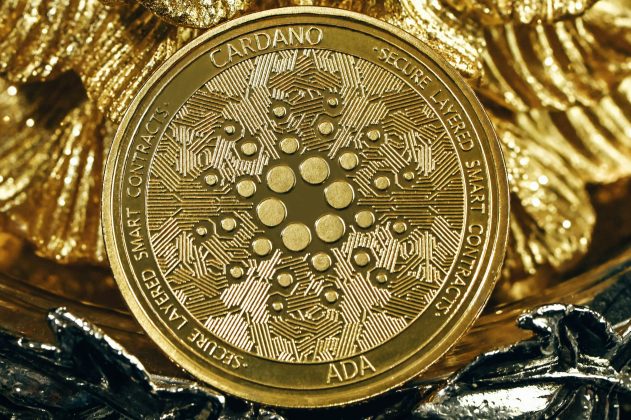
Cardano founder Charles Hoskinson said he will fly to Japan this week for a multi-city community tour focused on Midnight, the privacy-focused network being developed in Cardano’s orbit, while hinting that new “commercially critical integrations” and major launch partners are nearing the finish line.
In a Jan. 22 video recorded from Colorado, Hoskinson framed the trip as both a reconnection with what he called Cardano’s “most critical component” and a staging ground for the next execution phase he wants the ecosystem to pursue: making leading applications meaningfully more competitive by combining Cardano and Midnight capabilities.
Midnight, Privacy, And A Cardano DeFi Push
Hoskinson said the tour will span Sapporo, Osaka, Fukuoka, Naha, and Tokyo, covering “the entire Japanese archipelago” over roughly two weeks. He described the agenda as part Midnight introduction, part Cardano status update, and part technical pitch for what builders can do when the two stacks interoperate.
“As many of you know, Japan is why Cardano exists. There would be no Cardano if there was no Charles and there would be no Cardano if there was no Japan,” Hoskinson said. “I went to Japan in 2015 and with our partners from Emurgo amongst others we were able to go about all of Japan and convinced them that Cardano needs to exist. So they put up the money we built it and the Japanese community still is the largest and strongest Cardano community in the entire world with more than half the supply there.”
That legacy, in Hoskinson’s telling, makes Japan a natural first stop for positioning Midnight not as a side project but as a strategic lever for Cardano adoption.
Hoskinson said that “about [the] middle part of this year” he intends to “aggressively push for the top 15 Cardano dapps to go through a overhaul and get some additional resources.” His stated goal is not incremental polish, but step-function improvements in usage and distribution.
“In my view the best place to take it is to focus on the DeFi ecosystem and the Cardano dapp ecosystem and ask the question how do we make those Cardano dapps more competitive? How do we 10x their TVL and their transactions?” he said. “Get them listed on major exchanges and get them where they need to go.”
The connective tissue, he argued, is Midnight’s privacy mandate, paired with new infrastructure components he referenced, including “new bridges,” “new stablecoins,” and “new oracles.” The pitch is that dapps cannot win on throughput and fees alone; they need new product surfaces that attract users and transactions from other ecosystems.
“My view is Midnight is going to be an indispensable component in that because it’s not good enough just to make them better, faster, and cheaper,” Hoskinson said. “The dapps have to offer new things and being able to combine Cardano technology and Midnight technology together. What that means is that we can actually offer privacy to the masses to Solana, to Ethereum, to Bitcoin and other places.”
Hoskinson also linked the push to Cardano’s broader engineering roadmap, citing Hydra progress while using a roads-and-traffic analogy to argue that application demand, not base-layer capability, needs to be the next constraint to break.
After Tokyo, Hoskinson said he will head to Hong Kong for Consensus, where he plans to keynote and “have some cool announcements for Midnight along with some big big partners” tied to the network’s mainnet launch. He stressed he would not disclose counterparties until agreements are finalized, saying he expects people to be “very happy” with upcoming “commercially critical integrations.”
Cardano’s (ADA) current price may look tempting, especially as it sits deep in oversold territory, but cheap doesn’t always mean opportunity. When momentum is absent and structure remains weak, early buyers often find themselves stuck watching price drift sideways for weeks. For ADA, the real question isn’t how low it has gone; it’s whether it has the strength to escape.
Trapped In the Red Zone: Pressure, Not Opportunity
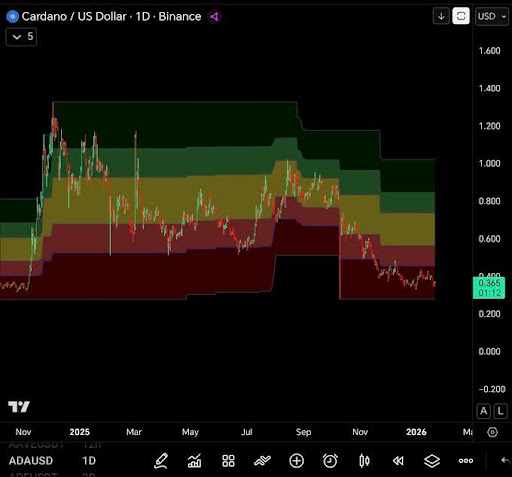
Trend Rider, in a recent update shared on X, explained that ADA’s daily chart has been flashing signals that many traders interpret as a “perfect bottom.” With the price sitting at the lower end of the bands and deep in the red, the temptation to buy looks obvious. However, Rider cautioned that low prices alone are not a guarantee that a move higher is ready to begin.
According to the analysis using the Rider Algo, Cardano is currently pinned inside a dark red zone. While some see this area as a solid floor, Trend Rider views it as a zone of heavy pressure and exhaustion, where price often drifts sideways for extended periods, leaving traders stuck in unproductive consolidation.
Rider emphasized that trying to catch absolute bottoms rarely works out, often resulting in either catching a falling knife or watching capital remain stagnant while other assets show clearer momentum. As a result, Rider’s focus is not on buying at the lowest possible price, but on waiting for confirmation that strength is returning as the key is not support, but escape.
Trend Rider expects Cardano to demonstrate the ability to climb out of the red zone with conviction. Specifically, the analyst is watching for a decisive breakout and a daily close above the $0.45 level. Until that happens, the bears still control the market structure. For now, Rider’s plan is to enter at a higher price with confirmed momentum than gamble on a “perfect bottom” and hope it holds. Currently, trading is about correct timing, not arriving first.
Cardano Buyers Defend $0.33–$0.36
From Marcus Corvinus’s analysis, Cardano is currently reacting from a key demand zone between $0.33 and $0.36, an area where buyers have previously stepped in to defend the price. This zone is now under close watch as it could once again play a crucial role in determining the next move.
Corvinus noted that if the demand zone holds and bullish momentum begins to build, ADA could see a more sustained bounce, potentially opening the way toward the next major resistance level around $0.53. As things stand, this area is shaping up to be a decision point for the market. Continued buyer defense could help rebuild structure and gradually shift pressure back to the upside.
Cardano and its vibrant ecosystem are becoming more decentralized as several moves are consistently being made to improve the leading blockchain network. One of these efforts is clearly indicated by the steady expansion of ADA delegation to multiple community DReps across the sector.
More Cardano Delegation To DReps
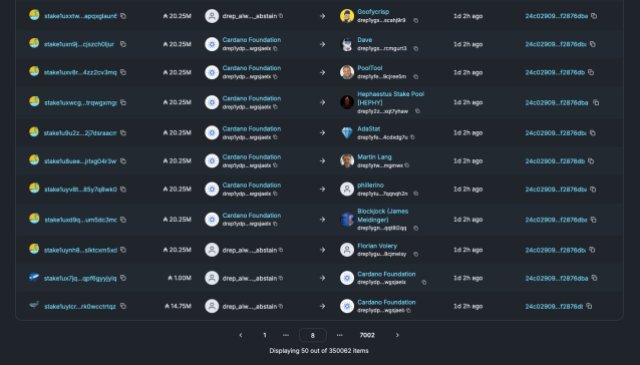
In a bold and exciting move, the Cardano Foundation has taken another step forward toward deeper and robust decentralization. The Foundation’s goal for deeper decentralization is being carried by expanding its ADA delegation to about 11 community DReps, which strengthens on-chain governance and community participation.
The recent delegation activity was disclosed on Cexplorer, the biggest and most featured OG blockchain explorer, via the social media platform X. The action is in line with Cardano’s changing governance structure, where elected representatives hold a growing amount of decision-making authority instead of fundamental entities.
As reported by the popular explorer, the Cardano Foundation has delegated over 220 million ADA to the 11 community DReps. By expanding its ADA delegation, the foundation is reaffirming its dedication to openness, diversity, and long-term network resilience, thereby making Cardano more decentralized.
These are the most crucial pillars in the move as the network persistently shifts toward a full community-driven ecosystem. According to the explorer, the Foundation has also self-delegated about 171 million ADA, moving it from an auto-abstain in order for all funds to actively participate in governance.
Delegation Operations Snags A Notable Supply
Following the move, the amount of ADA that has been utilized for delegation activity has increased sharply. A massive wave of ADA delegation signals a growing acceptance of on-chain governance across the broader Cardano ecosystem.
Cexplorer reported that the number has seen steady growth over the past several months. Current data shows that over 36.9% of circulating ADA has been delegated to Cardano DReps, which reflects mounting conviction in the network’s model.
Furthermore, it is a sign that more participants are willing to play a crucial role in shaping the blockchain’s future. Thus, decision-making power is shifting from concentrated entities to community voices as more holders pledge their tokens to designated representatives.
When compared to the stake pool, the explorer data shows that roughly 56% of ADA in circulation is delegated to the area. In the meantime, for delegators to be able to take out their staking rewards, they are expected to delegate to a DRep.
After a recent voting operation, Cardano’s future direction is now quite clear. Over 700 community members and 200 DReps participated in the voting process to decide where the ecosystem should be by 2030.
At the end, 67.80%, representing over 3.77 billion ADA, voted yes to the proposal that the network is moving in the right direction. Meanwhile, the rest, representing 491 million ADA, voted No to the proposal.
The Cardano Foundation said it has hit the first milestone in its updated governance roadmap, expanding delegation to a new set of community representatives as the ecosystem leans further into on-chain decision-making. The move matters because it shifts meaningful voting weight toward delegated representatives (DReps) whose mandates emphasize adoption and day-to-day network operations rather than purely technical development.
Cardano Foundation Expands DRep Delegation
In a post on X and an accompanying blog update, the Foundation said it has delegated an additional 220 million ADA to 11 selected DReps, roughly 20 million ADA each, focused on the pillars of Adoption and Operations. The Foundation framed the step as a continuation of earlier delegations to “Developer & Builder DReps,” and said the new allocation brings total delegation to community DReps to 360 million ADA.
Alongside the additional community delegation, the Foundation said it is revising how it handles its remaining stake in governance. “Rather than leaving a portion of our funds on auto-abstain as initially planned, we will self-delegate the remaining balance (approximately 171 million ADA),” the Foundation wrote. “While this exceeds our initial estimate, it ensures no ADA remains passive and still results in a net reduction of our overall voting power by approximately 43 million ADA, with the clear majority of our holdings now empowering community DReps.”
The Foundation emphasized that the delegations are intended to distribute voting power without imposing direction. “This delegation is not a blind bet, rather it’s a show of trust in a proven history of sound decision-making,” it said. “As always, it’s also a show of good faith: These new delegations come without any expectation regarding voting outcomes. We will not direct these DReps on how to vote, nor will we provide a voting manual.”
That posture, explicitly accepting dissent from its own views, was positioned as a feature rather than a risk. The Foundation said it expects “differing opinions” between the newly selected DReps and the Foundation itself, describing that divergence as evidence of “a healthy, decentralized governance system.”
The Foundation’s rationale for targeting adoption and operations reads as a governance design choice: broaden the expertise mix beyond protocol engineering. “To build a resilient governance system, we need more than just technical expertise—We need business acumen and operational stability,” it wrote, arguing that Adoption DReps can represent real-world utility, onboarding, and enterprise needs, while Operations DReps reflect the practical constraints faced by stake pool operators, toolmakers, and infrastructure providers.
In the published list, the Adoption cohort includes figures tied to community growth and product-building across the ecosystem, from regional community leadership to DeFi and stablecoin infrastructure, while the Operations cohort highlights long-running infrastructure roles such as block explorer analytics, stake pool operations, and SPO tooling.
The Foundation said all eleven delegations were completed in a single on-chain transaction, linking to the Cardano Explorer entry, and noted the delegations are effective immediately. It also encouraged the broader community to “follow and interact with these DReps,” including engaging with their voting rationales and participating in governance actions.
A disagreement over US crypto regulation has spilled into public view, drawing the Cardano and XRP communities into an unexpected clash. The reason is the Digital Asset Market Clarity Act, a proposed bill intended to define how digital assets are regulated in the United States.
The disagreement started after Charles Hoskinson openly criticized Brad Garlinghouse over his stance on the legislation, which led to pushback from prominent XRP community members. This comes just after reports have suggested growing frustration among lawmakers toward Coinbase over disagreements tied to the Clarity Act.
Hoskinson’s Criticism And Garlinghouse’s Position In Full Context
The tension came to the surface during a livestream in January 2026, where Hoskinson criticized Garlinghouse’s apparent support for advancing the Clarity Act despite its shortcomings. In the video, Hoskinson expressed skepticism about the bill’s direction and origins, remarking sarcastically, “And what we got is Elizabeth Warren wrote the bill, that’s leadership we can believe in.”
He went on to challenge the idea that passing an imperfect bill is preferable to continued uncertainty, pointing directly to the position of Ripple CEO Brad Garlinghouse. Hoskinson questioned whether handing regulatory power to the same institutions that previously sued, subpoenaed, or shut down crypto businesses could truly be considered progress.
Hoskinson’s remarks did not go unanswered. Vet, a notable XRP community member and XRP Ledger dUNL validator, reposted the video on X and criticized Hoskinson’s approach. Vet questioned why Hoskinson chose to publicly attack Garlinghouse instead of contributing constructively to the legislative process, writing, “How about focusing on helping shape the Clarity Bill instead of crashing out on Brad for no reason, Charles?”
Why The Clarity Act Matters To Both Communities
The Clarity Act is one of a few bills introduced during the current crypto-positive Trump administration that aims to bring structure to a regulatory environment that has been uncertain for years. The Clarity Act, in particular, was introduced to bring clarity around whether digital assets should be treated as securities or commodities and which agencies should oversee them.
The bill represents a necessary step toward legal certainty and institutional participation. Supporters of XRP tend to see engagement with lawmakers as a practical route forward after years of legal battles. However, others like Charles Hoskinson are of a different notion.
The Clarity Act is not without its issues. Sources close to the White House say the administration is considering pulling its support for the Clarity Act if Coinbase does not return to negotiations over stablecoin yield provisions. However, Coinbase CEO Brian Armstrong noted that Coinbase is actively working to find common ground with banks on yield-related issues.
A similar Act, called the Guiding and Establishing National Innovation for US Stablecoins Act, or the “GENIUS Act,” was signed into law in 2025 by President Donald Trump as part of efforts to create better regulatory clarity towards stablecoins in the United States.
Interestingly, Ripple CEO Brad Garlinghouse was part of the crypto industry leaders that expressed support for the Genius Act after it was signed into law.
Bullish sentiment is gradually returning to the broader cryptocurrency space, and Cardano (ADA) is seeing growing institutional interest and adoption. Even though its price remains in a consolidation phase, several moves are being made to showcase Cardano’s relevance in the global finance sector.
CME To Broaden Crypto Offering With Cardano Futures
One of the most recent announcements making the headlines in the cryptocurrency sector is the Chicago Mercantile Exchange (CME) Group’s move to expand its crypto portfolio, choosing Cardano as one of the major coins. The CME is preparing to increase the scope of its crypto derivatives offering and take a further step toward the institutionalization of digital asset markets, with the introduction of futures contracts for Cardano (ADA) and Chainlink (LINK).
By adding ADA and LINK futures to its platform, CME is strengthening the function of regulated derivatives as an entry point for institutional involvement in the developing cryptocurrency ecosystem. This action demonstrates the rising significance of other blockchain networks in global finance. It also reflects the growing demand from professional traders seeking regulated exposure outside of Bitcoin and Ethereum, the two largest crypto assets.
According to Lucas Macchiavelli, a Cardano ambassador and blockchain strategist, this could be the strongest institutional validation in ADA’s history, and it might be the largest sign of approval the leading altcoin has ever gotten. Macchiavelli added that this is not just another listing since the move expands the network’s role in digital finance operations.
The strategist’s claims major hinges on the fact that the CME Group is the largest derivatives exchange in the world, which is increasingly used by banks, hedge funds, asset managers, and institutional investors across the globe. Currently, this goes beyond Cardano.
Macchiavelli stated that this kind of action sends a signal to the entire cryptocurrency market, improving price discovery, deepening capital access, increasing institutional visibility, and making it easier for traditional finance to participate. “This is how crypto keeps moving into the financial mainstream,” the expert added.
Data On The ADA Stays Written
Crypto expert Dave stated that Cardano is exceptionally well-suited to real-world use cases like traceability because once data is written on the network, it stays written. There is no rewriting history, no ambiguity, just facts that are retained exactly as they were recorded.
Such performance underscores its immutability, which is backed by over 8 years of continuous reliability. Cardano network has been continuously operating, developing, and securing genuine worth while being enhanced between. This is key when trust, verification, and accountability are required in real-world governance by compliance and regulation.
According to the expert, the network quietly stands apart in a world of transparency and reliability. With this, ADA goes beyond the status of a store of value. It is also considered a store of truth, continuity, and real utility.
Longtime Slashdot reader hackingbear shares a report from the Washington Times: Breaking with the United States, Canada has agreed to cut its 100% tariff [back to 6.1%] on Chinese electric cars in return for lower tariffs on Canadian farm products, Prime Minister Mark Carney said Friday after meeting Chinese President Xi Jinping in Beijing. He said there would be an initial annual cap of 49,000 vehicles on Chinese EV exports to Canada, growing to about 70,000 over five years. Prior to the 100% tariff, China exported about 41,000 vehicles to Canada in 2023. In exchange, China will reduce its total tariff on canola seeds, a major Canadian export, from 84% to about 15%, he told reporters. Carney said China has become a more predictable partner to deal with than the U.S, the country's neighbor and longtime ally.
[hackingbear writes: "After helping the U.S. arrest Huawei CFO Meng Wanzhou, who was later released without admitting guilty by the Biden administration after bickering with China, Canada had followed the U.S. in putting tariffs of 100% on EVs from China and 25% on steel and aluminum under former Prime Minister Justin Trudeau, Carney's predecessor."] China responded by imposing duties of 100% on Canadian canola oil and meal and 25% on pork and seafood. It added a 75.8% tariff on canola seeds last August. Collectively, the import taxes effectively closed the Chinese market to Canadian canola, an industry group has said.
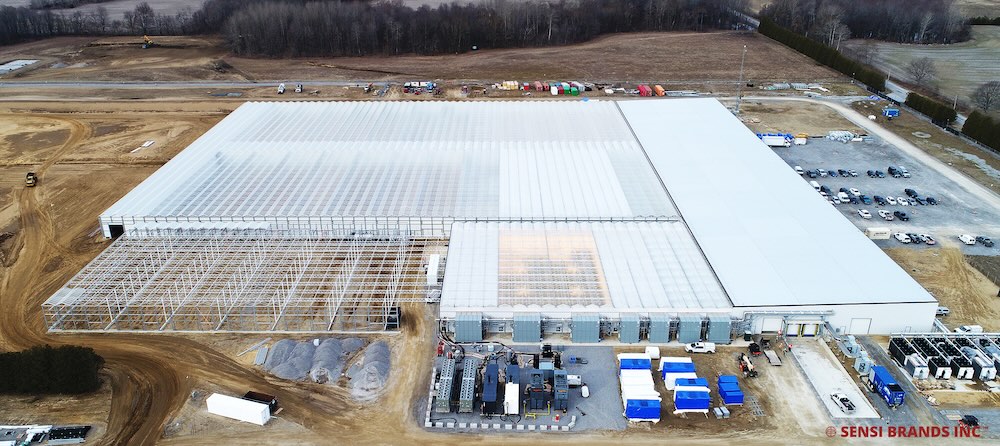
Tony Giorgi, CEO of Canada-based Sensi Brands Inc., discusses the company’s growth and strategies in an interview with Eugenio Garcia, founder and CEO of Cannabis Now. Launched in January of 2020, Sensi Brands has achieved significant success with innovative products like multi-pack and infused pre-rolls, leading to a significant market penetration in Canada. The company operates five distribution paths, including wholesale distribution, CPG brands distribution, medical cannabis clinic, national medical cannabis marketplace, and a retail farm gate store. Despite market challenges, Sensi Brands recently acquired a state-of-the-art facility capable of producing 110,000 kilos annually, aiming for global expansion, particularly in the U.S., EU and AUS markets.
As we kick off 2026, Giorgi offers business advice to fellow entrepreneurs and delves into the Sensi Brands work culture, along with the company’s big goals for the future.
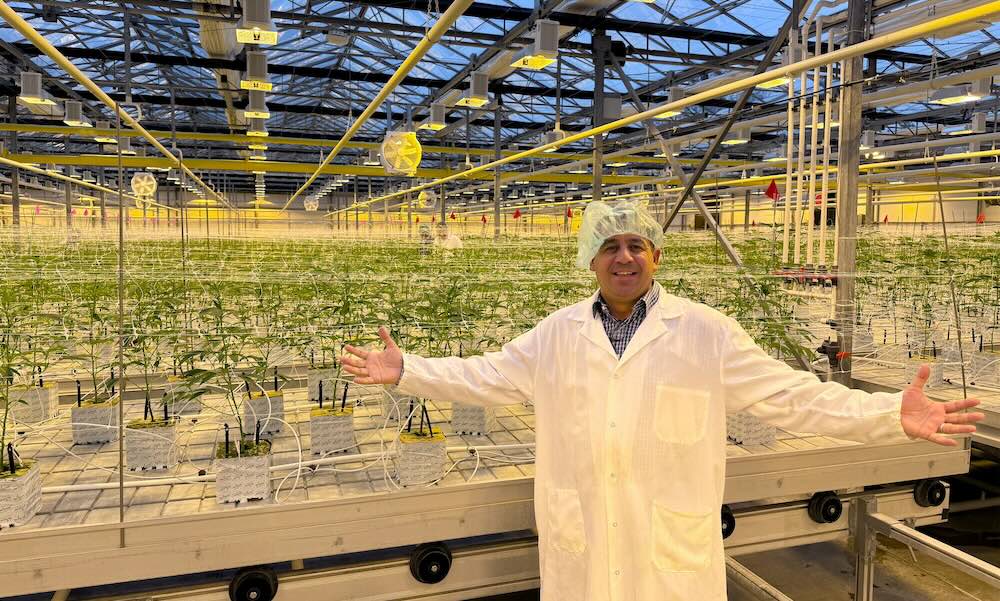
CEO Tony Giorgi oversees a newly planted crop of Sensi Brands Inc.’s latest proprietary genetics.
Eugenio Garcia: To start, tell us about your background as an entrepreneur.
Tony Giorgi: I’ve earned a bit of a reputation here in Canada for being a serial startup specialist, taking companies from ideation to full production and commercial operations. I have been part of 6 successful start-ups over the last 30 years. The first four were in technology. The largest transaction was a company called Q9 Networks, where we built highly secure and system-redundant data centers housing the computing infrastructure and data for the likes of banks and government, supporting their mission-critical data applications. That company sold to Bell Canada in 2012 for $1.2 billion.
Post that, I co-founded a digital transformation company called K2 Digital targeting the financial services vertical. I got introduced to the senior leadership team of MedReleaf. MedReleaf was one of Canada’s first medical cannabis companies…I had met them in 2015, and by 2016 the master grower had resigned his role and we started up what became the Flowr Corporation out of Kelowna, BC.
And so, the Flwr Corporation was my first foray into cannabis. We built the largest indoor facility in the country. It quickly became renowned for being one of the best-quality facilities in the country. I took the company public in September of 2018 and at that point I stepped down to go focus on building what now is today known as Sensi Brands.
EG: And what’s been your approach to building Sensi Brands?
TG: Sensi Brands started off in 2020. We took a very unique approach to the market because, if you recall, everybody that got into the cannabis industry—whether it was south of the border or whether it was in Canada—everybody took the approach of wanting to become the largest cultivator or the largest extractor. The example that we always give is that we’d be sitting here in our offices, and the next licensed producer would go on LinkedIn and say, “Woo hoo. We just got our license, and we’re launching a soccer mom brand.” And we went to look at what a soccer mom brand is, and they were underpinning it with a 22% indica strain that would put a soccer mom through the soccer parking lot. There’s a whole evolution and strategy and process to developing a brand. And unfortunately, in the cannabis industry, the entire process was completely orphaned. People were just making stuff up, and their brands were failing. There were no real brands that were gaining market share, or any type of loyalty to the brand because of the poor execution of those brands.
So we launched Station House, our first brand. We pioneered the first multi-pack pre-roll in Canada that was offered in 6, 12, 18 and 24 pack configurations. When we launched, nobody at the time was doing multi-packs. In fact, the majority of licensed producers were using undesirable product or oversupply for the purposes of putting up KPI numbers for yields, which would then inevitably be either destroyed, burnt or would be milled and used for pre-rolls.
EG: What is it that makes those pre-rolls so compelling for consumers?
TG: We took a very serious approach to pre-rolls, perfecting how to make them. None of the automation equipment, even to this day, scales appropriately to be cost-effective on making pre-rolls. We’ve tested a vast majority of the pre-roll automation technology and realized that we needed to come up with our own automation process. We believe we make the best pre-rolls today. But not only that, we use the best paper. We only use single-strain whole flower. We don’t blend lots. We don’t use trim or any other waste material. It’s all high-quality, single-strain flower that we then mill to multiple specifications so that we know that the granular mill inputs fit much tighter together, which gives us a better burn. And on top of all that, everything is quality assured and hand-finished by our employees. You’re getting the best quality burning pre-roll underpinned with the best quality cannabis input. With that strategy and launching it into a multi-pack, we very quickly became the number one multi-pack player in the country.
EG: Well,you look like a man who should be smiling, and also a man who’s been working really hard at something really special, with a crackerjack team. Before you were a serial entrepreneur, where did you get your foundation for business? Did it come naturally? Did you have a mentor? Was it schooling?
TG: Honestly, my family. I would say that my business acumen is all grassroots street smarts, negotiation. I’ve been working since I was 13 years old—got my first paper route at 10, you know, I did the whole McDonald’s and Burger King and fast food, but it was just always hustling, always negotiating.
I’m a salesman at heart. So when I started building my first company, it was really through a sales-driven lens. And then, of course, over the last 30 years, I’ve been able to really sharpen my skills in terms of business acumen and learning how to run a very effective business.
EG: Is there a secret sauce to it all?
TG: Look, we’re immigrants—we love to work. We don’t know anything different. And so we work hard, long days. At the end of the day, it’s just learning those skill sets and how to run a business over time. There are three pillars that I would highly encourage any business person across any business and industry to focus on. It all comes down to three things: Innovate. Make sure that you’ve got the best products that you’re proud to stand behind, that will be highly desired. Automate. Make sure that you automate the shit out of everything, so that you reduce your cost structures as low as you possibly can, and outshine everybody. And lastly, you execute. I’ve kind of lived by those three pillars, and that’s kind of what’s made Sensi Brands, in my opinion, one of the best standing cannabis companies in Canada today.
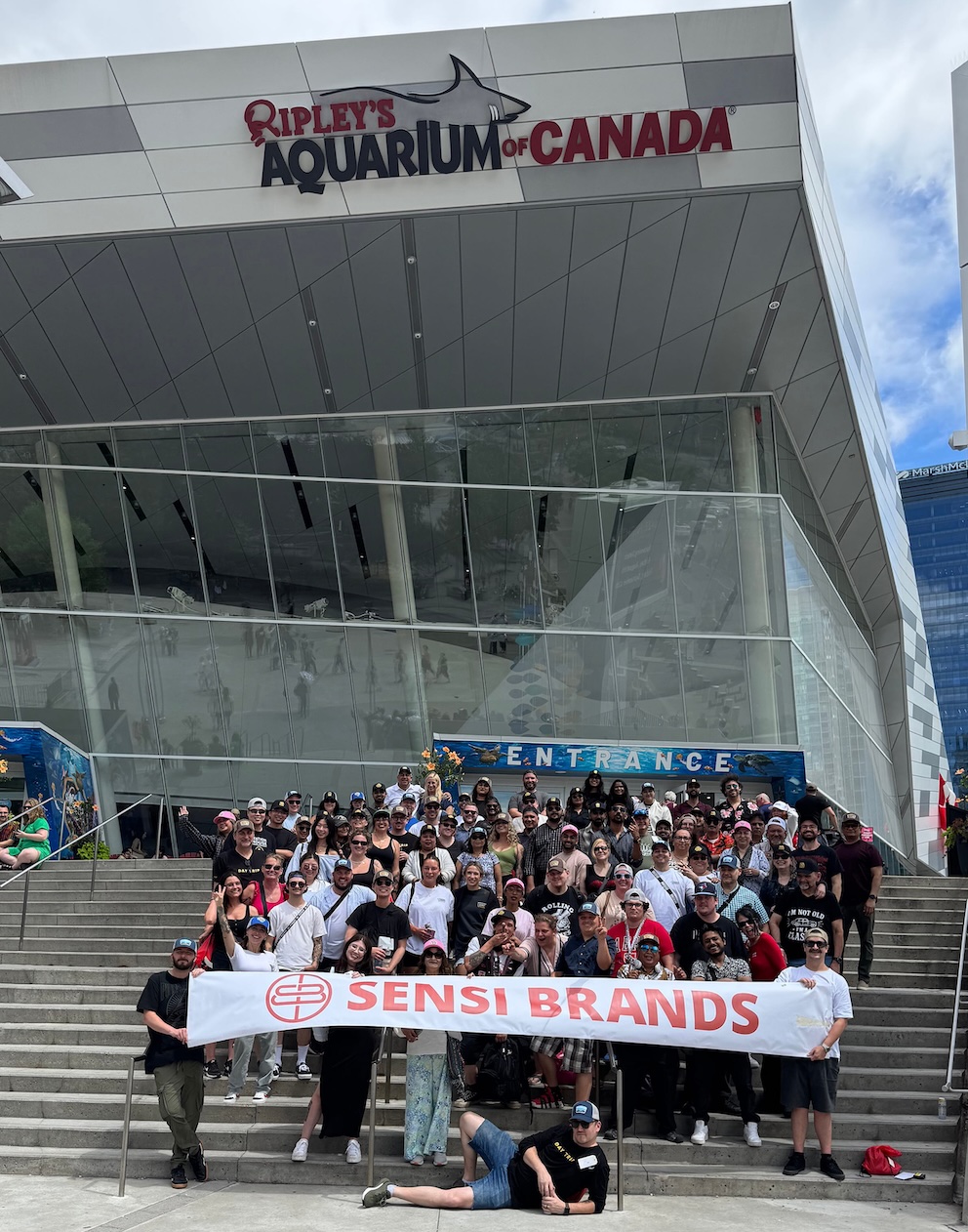
Sensi Brands employees on a team outing.
EG: You’ve talked about the long days it takes to build a company at this scale—what kind of culture have you built at Sensi Brands, and how do you keep your team energized and invested?
TG: We’ve built an incredible culture—culture’s everything. The company is made up of family and friends. The theory was, “How cool would it be if we could build a company that attracted people that I genuinely like spending time with so that when I walk into the office every day I get a big smile on my face because I’m working with the people that I genuinely love, that genuinely make me laugh, and are playing at the top of their game in their respective discipline.”
EG: Love that.What are you smoking on there? And how important is it for you to actually understand the product that you’re producing? Because, quite frankly, a lot of people in your position, and it’s not a negative, but they don’t understand the product, and they don’t consume the product.
TG: I love the question. I’m a big, big believer that you need to eat your own dog food and experiment with your product. Years ago, I was an experimental weed smoker. When I launched the Flwr Corporation, I went all in. So I’m a certified cannabis sommelier—and have my level one and level two sommelier certification. Today, I consume daily and intimately understand the effects of our products. In fact, our entire senior leadership team is certified as cannabis sommeliers and we are all active consumers.
And to answer the first part of your question, I am religiously loyal to Amnesia Haze and Ghost Train Haze—as my favorite strains. I only smoke sativa-dominant cultivars. To me, indicas are very sedative and chilled experiences, whereas a sativa actually inspires and energizes me. I’m all in to making sure that I understand our product as well, or as better, than our competitions, which I think gives us a competitive advantage. I take pride in leading our discussions in the R&D room. Today, we proudly distribute 365+ SKUS across Canada, and I have been part of formulating every single product, from our pre-rolls and how we infuse and coat them, to all of our vape formulations, to personally leading the launch of our THC oral pouches—one of the first to market. I would not have been able to contribute to our product innovations without being a consumer and have experience with the product.”
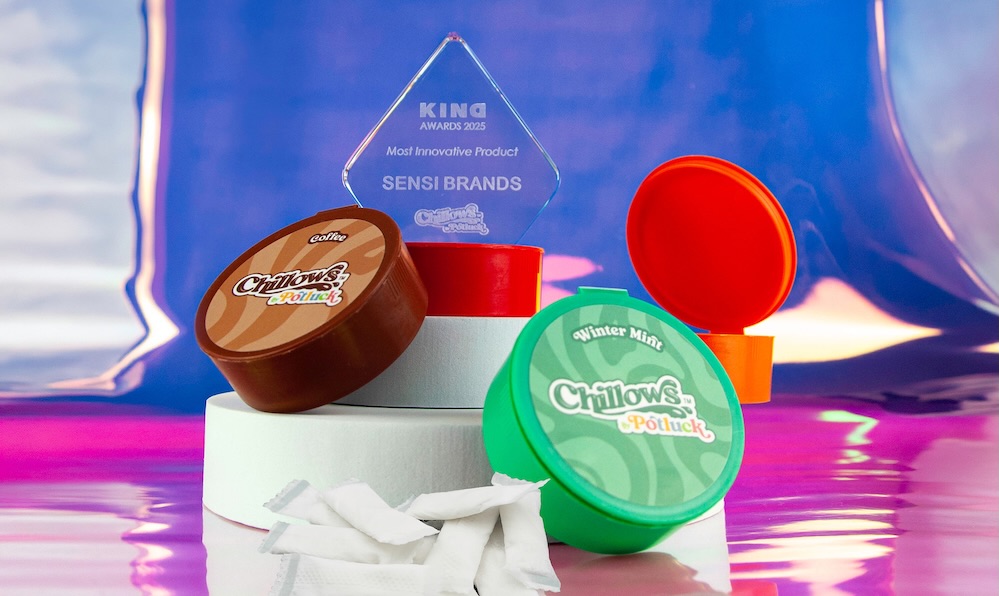
Sensi Brands has launched the one of the world’s first oral THC pouch, a testament to their innovation and continued drive to continue pushing boundaries.
EG:I know that Canada has very serious restrictions on packaging, on advertising. How have you guys transcended that obstacle and effectively marketed your products to have the success that you’ve had in retail?
TG: I think it comes down to, again, innovating products that resonate with consumers. In terms of marketing, we are very restricted by HealthCanada Regulations, so we tend to lean on the quality of product. We’ve also done an incredible job in all of our trade marketing materials, digital promotions, as well as executing at the major trade conferences.
EG: You mentioned the massive export business you have with Australia. How big is the international potential and focus for you guys?
TG: So, couple things: One, we have been working with a tolling partner over the past couple of years, and been distributing and selling product into Australia. Now that we have our own EU GMP (European Union Good Manufacturing Practice) license, we are now able to sell directly into international markers. We recently signed a $5 million deal today for product going into Germany. The EU markets are sizable with expansion into UK, Poland, Spain with France around the corner. The EU market is massive, and we think with the quality of our supply, we should be able to sell well into those markets.
We’re looking to enter the US market. I don’t want to say too much more on that, because I want to get further down into the process before we divulge. But we are definitely targeting the US, entering with our brands Station House and Potluck.
A bird’s-eye view of Sensi Brands’ new state-of-the-art facility.
Eugenio Garcia: In the next three to five years, where do you see Sensi Brands landing—and how do you view the broader global cannabis landscape: accelerating opportunity or continued pushback?
TG: Where we’re going to be is hard to tell. But the goal is that we’re going to be one of the last few standing. I think we built up an incredible company. Our pipeline of new products is extensive, and we’re excited for some of the new products that we’re launching. I think the walls are going to come down to the US. It looks like Mr. Trump intimated that he’s starting to remove those barriers. And I think once the US opens, it’s going to create a massive opportunity for the entire cannabis industry as whole to which I hope that Sensi Brands and our brands will participate in, so huge expectations with the US opportunity and same goes for the European markets and international markets.
At some point, I think there’s going to be a lot of consolidation. It’s already happening…We hope to be one of the companies that has a meaningful market share and recognized as a global and trusted brand of cannabis products.
Our dream and goal is to be able to walk into a German dispensary or an Australian dispensary, or a Spain dispensary and see Potluck and Station House products available for sale and being promoted in those markets in particular.
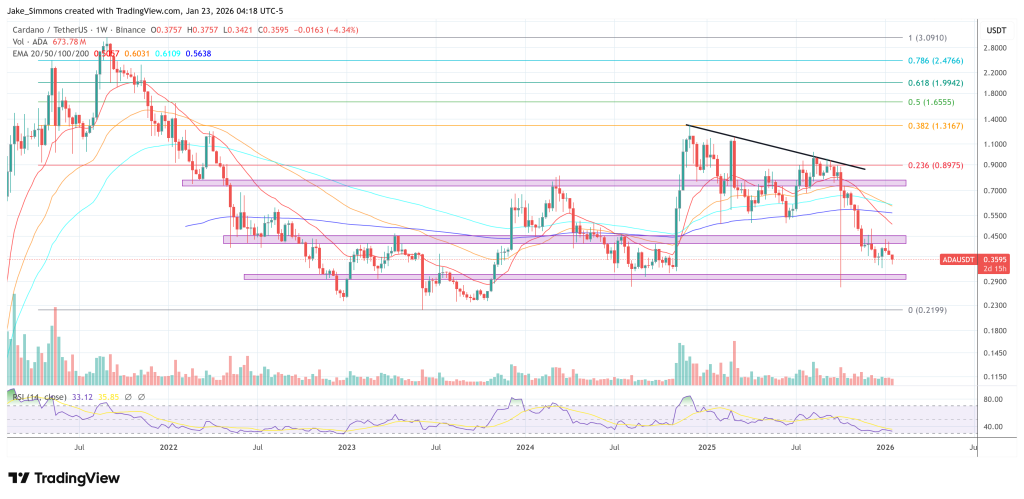
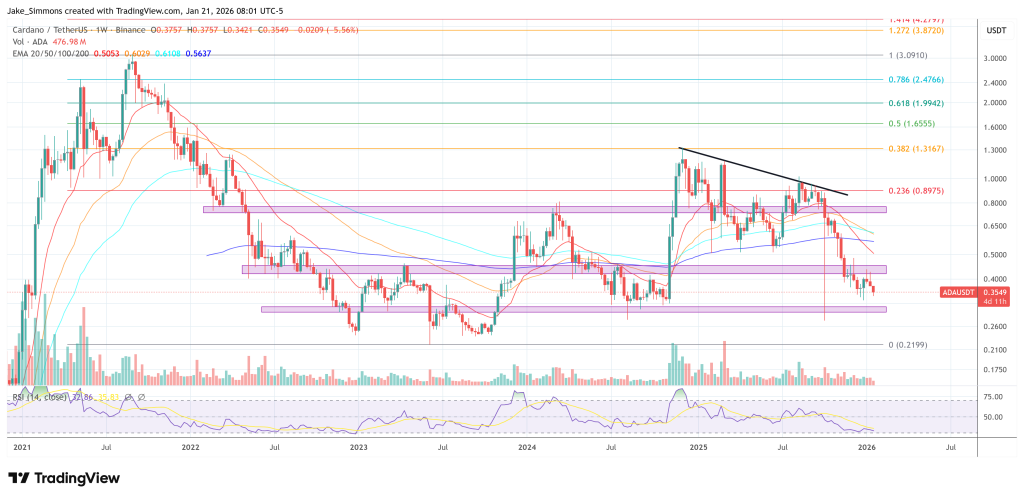
Cardano price dropped to $0.37 after another rejection around $0.40.
The technical picture points to a potential downside continuation to $0.32.
The ADA price was down 4% in the past 24 hours.
Cardano’s ADA token is down and faces a brutal supply wall near $0.40, where relentless selling pressure threatens to derail bulls’ hopes of an extended upside.
The token changed hands nearly 4% in the red on Friday, hovering around $0.38 as short-term downside risks persist for top coins. As the chart below shows, ADA traded to a daily low of $0.379.
Cardano price hits supply wall near $0.40
Cardano’s price action has recently encountered a formidable supply wall around the $0.40 threshold, a level that has repeatedly acted as a barrier to upward momentum.
The 50-day exponential moving average sits at $0.41, and acts as a stubborn ceiling that has informed multiple price rejections.
Meanwhile, the Relative Strength Index (RSI) on the daily chart currently lingers below the neutral mark. In technical analysis, this highlights a potential extension towards the oversold territory with a sloping outlook.
Another indicator, the ADX, shows a reading of 19.5 and points to bearish strength.
The negative directional dominance favours sellers.
The MACD similarly shows bearish divergence under the zero line, while Bollinger Bands contract toward the lower rail. It all adds up to a token facing huge downside volatility.
The $0.40 zone is therefore just another key resistance level, but a zone of notable supply overhang.
Cardano shows weakness amid broader headwinds
Cryptocurrencies ended the past year largely bearish amid broader market headwinds.
This saw Bitcoin struggle to defend key levels and fall to lows of $80,000 before bouncing. BTC, however, has retreated from above $97,500, and this looks to have capped momentum for top altcoins.
QCP analysts recently noted that while the macro environment could boost bulls, volatility might remain elevated. Both Bitcoin and Ethereum thus show a risk-off outlook unless the market sees cleaner spot bids.
Vaulta is among the altcoins to falter amid this downturn, and Cardano’s on-chain metrics, like dormant supply activation, point to similar sell-off pressure.
Recent rejections from the 50-day EMA also come after prices fell sharply from above $0.82 on October 10, 2025. The moving average now sits at $0.41 and recently triggered a decline to lows of $0.37.
Currently, ADA is back at the fragile $0.38 support, and with funding rates flipping negative, shorts may have an upper hand.
This classic bearish signal signals that retail optimism is evaporating. However, the 26% decrease in daily volume betrays weak conviction, and price may probe the key supply zone again.
If ADA price doesn’t reclaim $0.40 with a volume surge, it risks a 10% breakdown that could bring multi-month support lows of $0.32.
Leading derivatives exchange CME plans to add futures contracts tied to Cardano (ADA), Chainlink (LINK), and Stellar (XLM) to continue growing its roster of regulated crypto derivatives.
CME Adds New Altcoins To Crypto Derivatives Lineup
On Thursday, Chicago-based derivatives exchange CME Group announced a new expansion of its lineup of regulated crypto derivatives with the upcoming inclusion of Cardano, Chainlink, and Stellar futures.
According to the announcement, the new crypto additions are expected to launch on February 9, 2026, although they are still pending regulatory review. In addition, they will offer both micro-sized and larger-sized contracts for the three cryptocurrencies.
For the standard Cardano futures, the contract will cover 100,000 ADA, while the micro-sized ADA futures will consist of 10,000 tokens. In addition, the Chainlink and Stellar’s large-sized futures will be set at 5,000 LINK and 250,000 XLM, respectively, while the small-sized contracts will cover 250 LINK and 12,500 XLM.
The upcoming Cardano, Chainlink, and Stellar futures contracts build on the derivatives exchange’s existing crypto suite, which includes four of the largest cryptocurrencies by market capitalization.
In 2017, CME first launched Bitcoin (BTC) futures, followed by the introduction of Ethereum (ETH) futures in 2021. In the first half of 2025, the Chicago-based exchange added Solana (SOL) and XRP futures to its lineup, introducing options for both cryptocurrencies later in the year.
Giovanni Vicioso, CME Group Global Head of Cryptocurrency Products, highlighted the industry’s expansion and development over the past few years, affirming that “given crypto’s record growth over the last year, clients are looking for trusted, regulated products to manage price risk as well as additional tools to gain exposure to this dynamic market.”
“With these new micro- and larger-size Cardano, Chainlink and Stellar futures contracts, market participants will now have greater choice with enhanced flexibility and more capital-efficiencies,” he added.
Cardano, Chainlink, Stellar Price Reaction
Despite the positive development, the trajectory of ADA, LINK, and XLM remained mostly unchanged, with the three altcoins continuing their intraday correction. Chainlink and Stellar both saw 4% declines from their Thursday highs, falling to the $13.60 and $0.225 levels.
LINK has momentarily lost the $13.80 level as support and is attempting to hold the current area to prevent further bleeding. Similarly, XLM was also rejected from the Wednesday highs and bounced from the $0.230 before continuing its descent toward its two-day low.
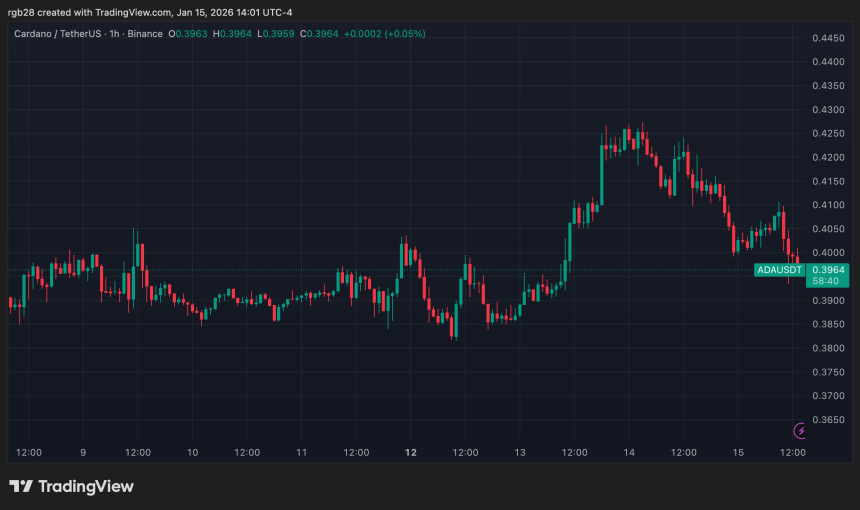
Meanwhile, ADA was attempting to reclaim the $0.41 area ahead of the announcement, briefly bouncing from the recent pullback. Notably, Cardano surged over 10% from the recent lows toward the crucial $0.42-$0.43 area.
However, the altcoin was rejected from this zone on Wednesday, retracing nearly 9% from the local highs to retest the $0.40 level. On Thursday morning, the cryptocurrency bounced from this area, but ultimately resumed its correction as the day progressed.
As a result, Cardano has retraced most of this week’s gains, currently trading around the $0.391 mark.
With the latest move and partnership from Cardano, the financial sector could be set for a major shift. A new financial audit has been launched from the recent partnership that aims at bolstering accountability in the broader finance landscape, which reflects the blockchain’s focus on transparency.
New Audit On Cardano To Boost Financial Oversight
Recently, the Cardano Foundation announced a new partnership with global professional services firm Grant Thornton as they step toward enhancing transparency and institutional credibility. By joining forces, both leading firms have collectively launched a new comprehensive financial audit.
The partnership was disclosed by the Cardano Foundation on their official page on the social media platform X. According to the Foundation, this audit is cryptographically secured and attested directly on-chain using their Virtual LEI (vLEI).
This new audit is being described as a global first for financial trust and transparency in the blockchain industry. Powered by Reeve, this new gold standard is the Cardano Foundation’s enterprise-grade financial data management solution.
By hiring one of the top audit firms in the world, the foundation is demonstrating its dedication to regulatory-ready standards and accountability, which are essential elements for drawing in long-term investors and enterprise adoption. In a world driven by data, trust, and verification, the Foundation claims that accountability is everything, and Cardano is at the forefront of this narrative.
Frederik Gregaard, the Chief Executive Officer (CEO) of the Foundation, stated that this audit was executed in two on-chain transactions. “For me personally, it closes one chapter and opens a much larger one. A future where financial trust is native to infrastructure, not bolted on through intermediaries,” the CEO added.
Institutions Are Choosing The Blockchain
Cardano’s position as a blockchain project focused on rigor and trust is evidenced by its growing adoption on the institutional level. A few days ago, one of the world’s largest companies, Google, took a bold step by investing in the blockchain’s infrastructure.
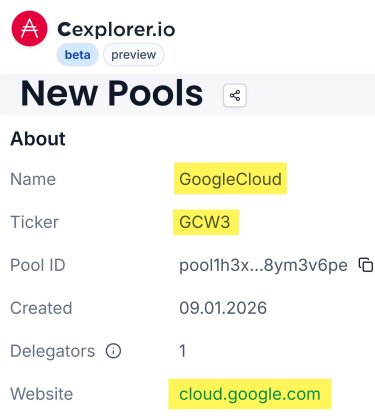
According to the report from ADA Advocate, the Google Cloud stake pool can now be found on the network and the newly launched Midnight chain. Google’s involvement and recognition of Cardano’s security and stability is a significant advancement in the use of blockchain technology by actual business behemoths.
Amid the rising demand, the price of Cardano has begun to display bullish momentum, pushing back above $0.4. Market expert and veteran financial trader, Matthew Dixon, highlighted that ADA currently holds tremendous upside potential with 5 waves up from the low, as either an A wave or wave 1.
More than two times the potential is given by even the most cautious interpretation of an A wave, and much more if wave 1. As a result, the expert has placed the altcoin among his favorites for Q1 2026.
The Cardano Foundation is backing an on-chain “info action” that would route up to $75 million from Cardano’s treasury into a new, Draper Dragon-managed ecosystem fund targeting a total $80 million raise, with a mandate to invest in Cardano-native startups while sending proceeds back to the treasury over time.
If approved, the vehicle, dubbed the Cardano x Draper Dragon Ecosystem Fund (the “DDC Fund”), would run for at least six years, deploy venture-style capital across early-stage teams and ecosystem growth programs, and report performance via a public dashboard and quarterly disclosures, the Foundation said in a forum post published roughly a day before the announcement.
Cardano Moves To Turn Its Treasury Into A VC Engine
The proposal is designed as a budget info action that would authorize three treasury withdrawal tranches over 438 epochs: a fixed $15 million first tranche, followed by two tranches targeting $30 million each in years two and four. The withdrawals are denominated in ADA and capped at 175 million ADA in aggregate, with per-tranche caps of 50 million ADA for the first and 85 million ADA for the second and third.
The remaining $5 million to reach the $80 million headline size is expected to come from qualified external limited partners (eLPs), a structure the post frames as both incremental capital and a way to “prov[e] the value proposition of Cardano investments to a larger audience.”
Cardano’s pitch is that the fund turns the treasury from a passive pool into a compounding capital vehicle. “The goals of this proposal are straightforward and ambitious: Deliver a return multiple back to the Treasury; make Cardano self-sustaining while increasing the ecosystem’s total value locked (‘TVL’), on-chain activity, and developer participation; and transform the Treasury from a passive reserve into an active growth engine that compounds Cardano ecosystem value,” the post said.
Under the proposed structure, Draper Dragon acts as general partner and controls investment decisions. An affiliate adviser, described as an “exempt reporting adviser regulated by the Securities Exchange Commission”, would provide due diligence and advisory support. The Cardano Foundation positions itself as an enabler rather than an investment decision-maker, taking responsibility for orchestrating the legal setup and administering the proposal under the Cardano constitution.
To route economics back to the treasury, the plan creates a Cayman Islands special purpose vehicle (SPV) that would serve as the fund’s limited partner on behalf of the treasury. The SPV is described as “ownerless” and intended to exist solely for the economic benefit of the treasury, with an initial three-director setup that includes an independent director, a Foundation director, and a community-elected “Community SPV Director.”
Targets Of The DCC Fund
The DDC Fund’s financial targets are framed in institutional VC terms: a roughly 3x gross multiple on invested capital and a 25%+ IRR, benchmarked against institutional blockchain and crypto venture funds, with the post stressing projections are illustrative and not performance guarantees.
On the ecosystem side, the ambition is explicit: contribute to increasing Cardano TVL from “the current $300M to $3B+,” split between $1.5B+ in RWA and $1.5B+ in DeFi, while also pushing higher on-chain usage, network revenue, and developer participation.
The treasury-funded $75 million would be allocated across direct investments, growth capital, and educational support, plus fund and administration costs. Direct investments are slated to take the largest share ($50 million), while growth capital ($11.5 million) and educational support ($6 million) fund marketing, liquidity initiatives, exchange introductions, and Draper University programming such as accelerators and hacker houses.
Because withdrawals are voted through governance over time, the plan bakes in a 20% buffer for ADA price fluctuations, and allows the GP discretion to time conversions to USD or stablecoins and to defer capital calls for up to six months. Excess value from a rising ADA price is meant to reduce later tranches; shortfalls can be handled via the buffer, deferrals, top-up governance actions, or adjustments within the tranche and aggregate caps.
The post also outlines failure modes. If treasury withdrawals repeatedly fail, specifically, “at least three successive Treasury withdrawals fail to pass within a calendar year”, the GP may wind the fund down and liquidate assets in a controlled process.
Transparency is promised via a public KPI dashboard and quarterly fund reports, plus AMAs and roundtables, but with a clear boundary: deal terms, valuations, and certain portfolio information would remain confidential, consistent with “standard” venture fund practice.
Welcome to Edition 8.24 of the Rocket Report! We're back from a restorative holiday, and there's a great deal Eric and I look forward to covering in 2026. You can get a taste of what we're expecting this year in this feature. Other storylines are also worth watching this year that didn't make the Top 20. Will SpaceX's Starship begin launching Starlink satellites? Will United Launch Alliance finally get its Vulcan rocket flying at a higher cadence? Will Blue Origin's New Glenn rocket be certified by the US Space Force? I'm looking forward to learning the answers to these questions, and more. As for what has already happened in 2026, it has been a slow start on the world's launch pads, with only a pair of SpaceX missions completed in the first week of the year. Only? Two launches in one week by any company would have been remarkable just a few years ago.
As always, we welcome reader submissions. If you don't want to miss an issue, please subscribe using the box below (the form will not appear on AMP-enabled versions of the site). Each report will include information on small-, medium-, and heavy-lift rockets, as well as a quick look ahead at the next three launches on the calendar.
New launch records set in 2025. The number of orbital launch attempts worldwide last year surpassed the record 2024 flight rate by 25 percent, with SpaceX and China accounting for the bulk of the launch activity, Aviation Week & Space Technology reports. Including near-orbital flight tests of SpaceX’s Starship-Super Heavy launch system, the number of orbital launch attempts worldwide reached 329 last year, an annual analysis of global launch and satellite activity by Jonathan’s Space Report shows. Of those 329 attempts, 321 reached orbit or marginal orbits. In addition to five Starship-Super Heavy launches, SpaceX launched 165 Falcon 9 rockets in 2025, surpassing its 2024 record of 134 Falcon 9 and two Falcon Heavy flights. No Falcon Heavy rockets flew in 2025. US providers, including Rocket Lab Electron orbital flights from its New Zealand spaceport, added another 30 orbital launches to the 2025 tally, solidifying the US as the world leader in space launch.
ADA is trading at $0.40 after losing 5.5% of its value in the last 24 hours.
The altcoin could rally towards $0.50 if the bullish trend resumes.
ADA could slip below $0.40
The cryptocurrency market is undergoing a correction following a strong start to the week. Bitcoin has dropped below $92k, while Ether is trading below $3,100 per coin.
ADA, the native coin of the Cardano blockchain, has lost 5% of its value in the last 24 hours and is now trading above $0.40. However, it could still rally higher in the near term amid strong fundamentals.
The rally could be fueled by growing Open Interest. According to CoinGlass, ADA’s OI now stands at $796 million, up from the $662 million recorded a week ago. The growing OI hints at the possibility of ADA’s price rallying higher in the near term.
The confidence encourages retail investors to lean into risk, which contributes to buying pressure.
ADA eyes $0.50 despite market correction
The ADA/USD 4-hour chart remains bullish and efficient despite the recent bearish performance. At press time, ADA has dropped below the 50-day Exponential Moving Average (EMA) of $0.43 and is now trading at $0.403.
Despite that, the coin’s short-term outlook remains bullish, supported by the Moving Average Convergence Divergence (MACD) indicator, which has maintained a positive divergence over the past few days.
The RSI of 64 also shows buying pressure has resumed, with the coin set to enter the overbought region if the bullish bias remains.
If the bulls regain control, ADA could rally past the 100-day EMA resistance at $0.505. An extended rally could see ADA challenge the 200-day EMA zone at $0.593.
However, if the correction persists, ADA could retrace below the $0.40 level and retest the $0.3827 support.
A rendering of Ring’s new Mobile Security Trailer deployed in a parking lot, showing its solar-powered base and 360-degree camera designed to monitor commercial sites such as retail centers, construction projects, and outdoor events. (Ring Image)
Amazon’s Ring is rolling out a $5,000 solar-powered surveillance trailer for parking lots, construction sites, and events — part of a broader expansion beyond the doorbell and into commercial security.
The new Ring Mobile Security Trailer, announced Tuesday morning at CES, is designed to be an alternative to the heavy-duty rigs often seen at industrial sites. It uses a 360-degree camera with 4k resolution, which the company says ensures high-definition visibility without blind spots.
Ring, acquired by Amazon in 2018, has renewed its focus on security under Ring founder Jamie Siminoff, who returned to the tech giant last year after his 2023 departure.
The move puts Ring in more direct competition with commercial security players like Verkada and Motorola Solutions, which sell cloud-connected cameras and mobile surveillance systems, and traditional industrial providers such as Bosch and Hikvision known for rugged security gear.
Ring’s strategy appears to be leveraging its brand recognition in residential security and Amazon’s infrastructure — including Amazon Sidewalk connectivity and AWS cloud services — to undercut competitors on price as part of a larger system that bridges home and business security.
Set for release this spring, Ring’s trailer can run on line power with battery backup or operate fully off-grid via solar panels. It comes with built-in LTE connectivity, meaning it requires no external internet infrastructure to work. It can also be detached and mounted in a truck bed or used as a standalone station, making it adaptable for temporary deployments like festivals.
It’s part of Ring’s new “Jobsite” security portfolio, which also includes a new Ring Elite camera line designed for large-scale business settings like logistics yards and campuses.
Separately, Ring introduced “Fire Watch,” a new feature developed in partnership with the non-profit Watch Duty. It provides real-time wildfire alerts directly within the Ring app and allows camera owners to voluntarily share periodic snapshots with first responders.
Apart from its new commercial offerings, the company announced several new residential security features and products.
“Unusual Event Alert” uses AI to learn a home’s routine patterns to filter out false alarms.
“Active Warnings” use computer vision to identify potential threats and play automated audio messages to deter intruders.
An updated Ring Car Alarm, available for pre-order today for $50, uses GPS and Sidewalk connectivity to track vehicles and send motion alerts even when parked remotely.
The new Ring Appstore marketplace will let third-party developers build specialized apps that integrate with Ring cameras and data.
A new line of sensors priced between $30 and $70 connects via Amazon Sidewalk to operate without Wi-Fi or hubs, covering security, safety, and smart controls.
Ring announced that the Sidewalk network itself is expanding globally, launching in Canada and Mexico in the coming months before reaching Europe, Australia, and Japan later this year.

 Login
Login