While SOL has pulled back slightly in recent days, on-chain activity is heating up as a new wave of AI-focused tokens drives fresh interest across the Solana ecosystem.
Leading the charge is Bags, a viral new launchpad built on Solana that has quickly become a favorite among users of the generative AI platform Claude.
Similar to Pump.fun, Bags lets users launch tokens with ease, but its growing focus on AI-themed coins has sparked a surge in demand.
This rise in activity and niche specialization could support a bullish Solana price prediction, especially as AI and crypto continue to converge.
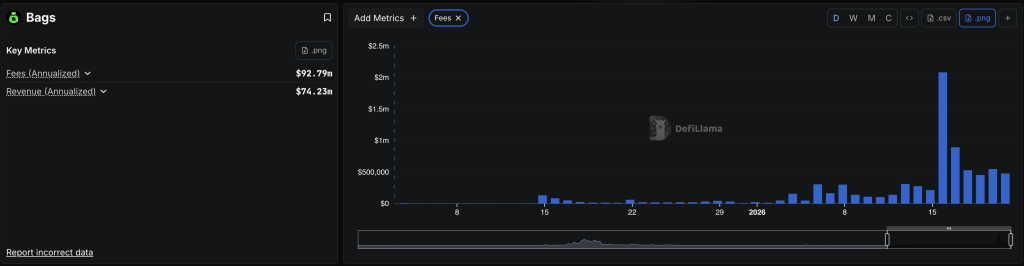
Data from DeFi Llama shows that Bags fees spiked to their highest level on record at $2 million just 6 days ago, and have stood above $400,000 every day since then.
Meanwhile, Jupiter data indicates that the protocol has captured a 23.2% market share in the launchpad market in the past 7 days, surpassing well-established rivals like Meteora and LetsBonk.fun.
Solana (SOL) benefits directly from Bags’ popularity as it results in higher transaction volumes for the network and a direct increase in fees.
Solana Price Prediction: SOL Accumulation Persists and Needs to Break Above $160 to Start Rallying
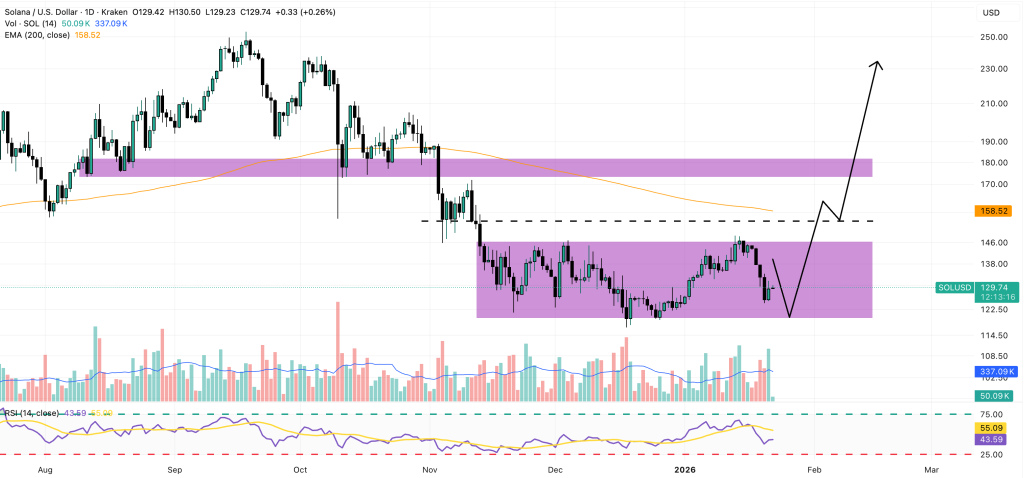
SOL has been consolidating for months now, moving between $120 and $146 as the crypto market has struggled to find direction lately.
This top altcoin has dropped in 4 out of the last 6 trading sessions, and could be eyeing the $120 support once again as market sentiment remains depressed.
Nonetheless, a spike in network transaction volumes due to the growing popularity of protocols like Bags and Pump.fun could drive up SOL’s demand in the near term.
To confirm a bullish outlook, the price has to break out of its consolidation pattern and preferably move above $160 to reverse its downtrend.
In that case, SOL could rise to $200 shortly if bullish momentum gains enough traction.
Other Solana-based solutions like Bitcoin Hyper ($HYPER) could soon jump into the spotlight in the same way as Bags. This crypto presale aims to launch the first real Bitcoin L2 and has raised more than $30 million to get it done.
Bitcoin Hyper ($HYPER) Presale Brings Solana-Level Speed to Bitcoin for The First Time
Bitcoin Hyper ($HYPER) is a high-potential presale that brings Solana’s speed and low fees to Bitcoin, making it faster, cheaper, and far more usable.
Built as a next-gen Layer 2, Bitcoin Hyper unlocks real DeFi and payments for BTC, giving developers the tools to launch efficient, scalable apps directly in the Bitcoin ecosystem.
For the first time, BTC holders can stake, lend, earn yield, and trade their assets without needing to bridge out or leave the security of the Bitcoin blockchain.
Bitcoin Hyper solves the key limitations of Bitcoin, bringing smart contract support and high-speed transactions to the world’s most recognized crypto network.
The presale has already raised over $30 million, and early $HYPER buyers are currently earning up to 38% APY through staking.
Seeker users can now claim and stake SKR tokens in Solana Mobile’s ecosystem, unlocking rewards, governance, and app participation. Solana Mobile has started distributing SKR, the native token of its mobile ecosystem, to users and developers tied to the Seeker…
The Injective community has okayed a governance proposal that shifts INJ into a more aggressive deflationary phase. A governance proposal that lowers the INJ token’s long-term supply and modifies the network’s token economics has been passed by the Injective community.…
A sharp sell-off in Aster’s token is drawing fresh attention to the decentralized perpetuals trading sector, even as overall derivatives activity remains historically high.
ASTER fell roughly 75% from its peak to trade near new lows this week, showing the growing gap between platforms that are capturing durable trading interest and those struggling to hold on once incentives fade.
The decline has unfolded as Hyperliquid extends its lead over rivals, raising questions about whether the race among perp-focused decentralized exchanges is already tilting decisively in one direction.
Hyperliquid Pulls Ahead as ASTER Selloff Deepens
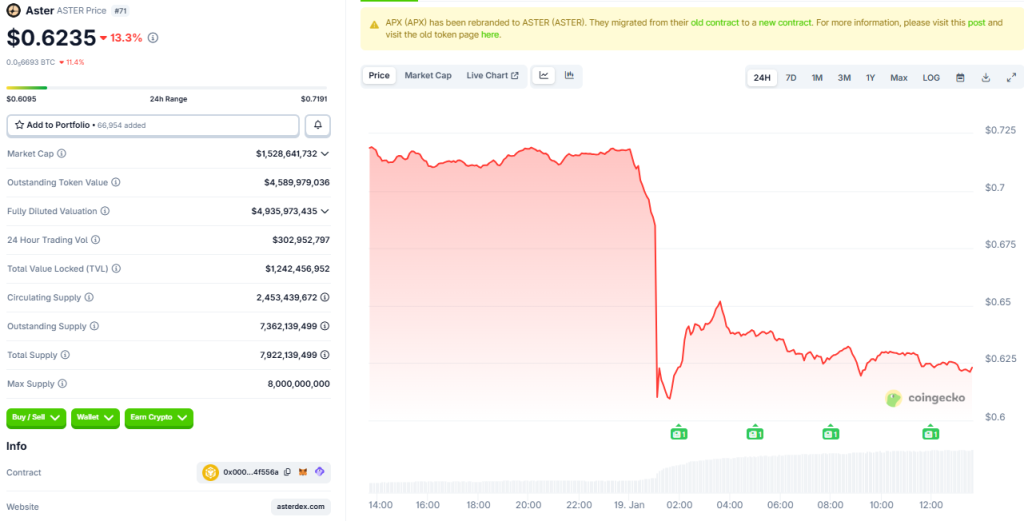
At the time of writing, ASTER was trading around $0.62, down more than 13% over the past 24 hours. The decline follows weeks of sustained weakness, with the token down over 11% in the last seven days and nearly 74% below its all-time high of $2.41.
Trading activity surged during the selloff, with 24-hour volume jumping more than 300% to over $300 million, pointing to heightened short-term positioning rather than a recovery in confidence.
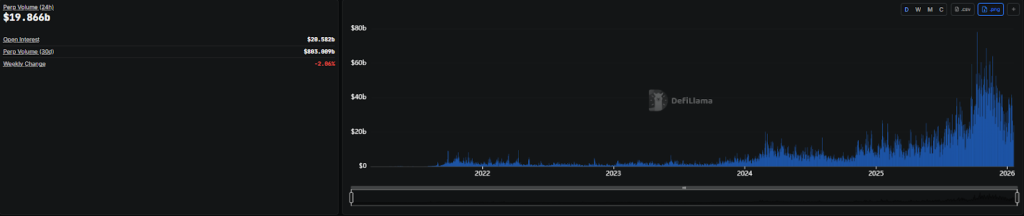
Data from DefiLlama shows that the overall activity in the sector continues to explode, with cumulative perp volume exceeding $803 billion over 30 days.
Total perp trading volume over the past 24 hours stood near $19.9 billion, while open interest reached about $20.6 billion.
Market data shows Hyperliquid pulling further ahead in both trading volume and open interest, two metrics that traders tend to treat differently.
Over the past seven days, Hyperliquid processed about $40.7 billion in perpetual futures volume, according to figures compiled from CryptoRank and DefiLlama.
That compared with roughly $31.7 billion on Aster and $25.3 billion on Lighter over the same period.
Hyperliquid reclaims the perps throne
As Lighter’s airdrop is distributed, the platform’s volumes have started to fade – weekly volume has decreased nearly 3x from its peak.@HyperliquidX has captured the lead and is now ranked 1st by volume and open interest.@variational_io… pic.twitter.com/LChbSdaU8a
The divergence becomes more pronounced when looking at open interest, which reflects where traders are willing to keep leveraged positions open rather than simply rotate trades.
Hyperliquid recorded about $9.57 billion in open interest over the past 24 hours, exceeding the combined $7.34 billion held across rival platforms, including Aster, Lighter, Variational, edgeX, and Paradex.
The widening gap suggests traders are increasingly using Hyperliquid as a primary venue to hold leveraged positions, rather than simply rotating capital in search of short-term incentives.
The shift has become more apparent as reward-driven activity cools across the sector.
Buybacks Roll Out as Unlocks Cloud Perp DEX Outlook
Also, the LIT token has dropped to new lows, losing more than a third of its value over the past month as a significant share of airdropped tokens moved into the market.
In an effort to support its token, Aster recently activated what it calls a Strategic Buyback Reserve.
We're now actively deploying our Strategic Buyback Reserve for $ASTER token repurchases automatically.
Building on our Stage 5 Buyback Program announced last month, this activation allocates 20-40% of daily platform fees into targeted buybacks, responding dynamically to market… https://t.co/cIbles9eHM
The program builds on a broader buyback framework announced in December, under which up to 80% of daily fees can be directed to automatic and discretionary buybacks, all executed on-chain.
However, the scale of upcoming token unlocks remains a central concern for the market.
Aster has significant token unlocks scheduled through 2026, including quarterly releases of roughly 183 million ASTER in January and April, followed by additional large releases mid-year and ongoing monthly emissions.
Although the team previously delayed unlocks to build utility and reduce near-term pressure, the scale of upcoming supply has become a focal point for traders assessing downside risk.
While incentive-driven activity has cooled across the sector, Hyperliquid has continued to attract capital even as its token, HYPE, has weakened alongside the broader market.
Creating ERC20 tokens has traditionally required deep Solidity knowledge and complex deployment scripts. The @escapehub/token-creator SDK changes that by providing a simple, framework-agnostic JavaScript library for deploying feature-rich tokens across 40+ EVM chains.
This guide shows you how to integrate the SDK into React, Vue, and Svelte applications — complete with wallet connections, vanity address mining, and multi-step token configuration wizards.
The SDK is framework-agnostic. Here’s the core pattern used across all frameworks:
Installation
npm install @escapehub/token-creator ethers
Token Deployment
import { deployToken, createDefaultConfig, getChainConfig } from '@escapehub/token-creator';
import { BrowserProvider } from 'ethers';
// Get ethers signer from your wallet provider
const provider = new BrowserProvider(walletClient, walletClient.chain.id);
const signer = await provider.getSigner();
The @escapehub/token-creator SDK abstracts away the complexity of ERC20 token deployment while giving you full control over token features. Whether you're building with React, Vue, or Svelte, the integration pattern is straightforward:
Install the SDK
Create a wrapper (hook/composable/store) for state management
Use createDefaultConfig() to build your token config
Call deployToken() with an ethers signer
The demos provide production-ready starting points with wallet connections, multi-step wizards, and vanity mining already implemented.
Solana’s price has delivered a slight rebound as the broader crypto market gradually shifts towards a bullish outlook. Although the price of SOL may be demonstrating strength once again, its future trajectory is largely tied to the performance of the leading network in the days ahead.
Network Performance Becomes The Key Catalyst For Solana’s Price
Following a slight bounce on Monday, Solana is back above the $140 price mark. However, on-chain data suggests that the altcoin is nearing a turning point where its next significant price change may depend more on how well its network functions going forward than on market sentiment.
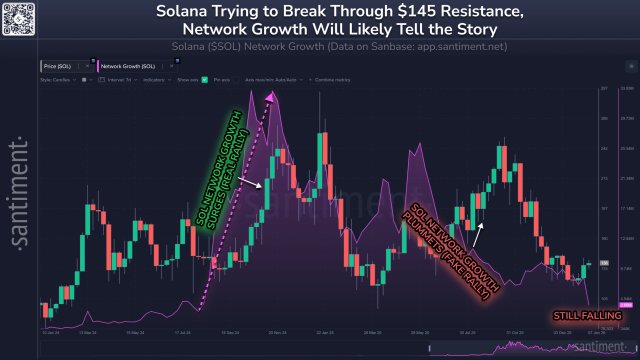
This thesis was outlined by Santiment, a leading market intelligence and on-chain data platform, after examining the correlation between SOL’s current price movement and its network activity. With price spikes coinciding with reduced network activity, the focus is now on the blockchain’s ability to maintain that momentum.
Santiment highlighted that as ongoing market volatility cools off, the price of SOL experienced a leg up as high as $144, drawing dangerously close to breaking past its $145 resistance level. While the price remains below the key resistance level, the altcoin awaits its next major catalyst in order to clear this level.
According to the on-chain platform, this will mostly depend on whether SOL network growth can start to increase once more, drawing attention to its fading new wallet creation. Data shows that the number of new wallet addresses created in a weekly timeframe has dropped significantly over the last few weeks.
In contrast to the prior optimistic moments, when new addresses were generated at record rates, accompanied by soaring trading and meme-coin activity, the slowdown represents a significant change.
As of November 2024, the number of weekly wallet addresses created was approximately 30.2 million. Fast forward to today, and the figure has fallen sharply, sitting at about 7.3 million. This massive drop in wallet creation signals a growing cooling phase in user onboarding across the SOL network.
SOL Maintaining Large Daily Transactions
New wallet addresses may have reduced significantly, but Solana’s transaction scale remains robust. Despite fluctuations in the overall market momentum, SOL maintains a remarkably high level of daily transactions, demonstrating the power of its network.
In a recent report from Solana Daily on the X platform, it was revealed that the network has persistently carried out more than 60 million transactions every day for the past 750 days. This consistency demonstrates the chain’s widespread use in Decentralized Finance (DeFi), Non-Fungible Tokens (NFTs), payments, and high-throughput applications that depend on its affordability and speed.
An interesting aspect of this growth is that the network has maintained zero uptime within the timeframe, reinforcing its position as a reliable hub for on-chain activity. Currently, Solana is supported by real usage rather than just speculative spikes, which increases network efficiency.
Monero (XMR) is leading the crypto market bounce by breaking out of a macro resistance level and breaching above the $600 barrier for the first time. A legendary trader has suggested that the cryptocurrency is mirroring silver’s historical breakout and could see a massive price discovery rally.
Monero Soars To New Highs
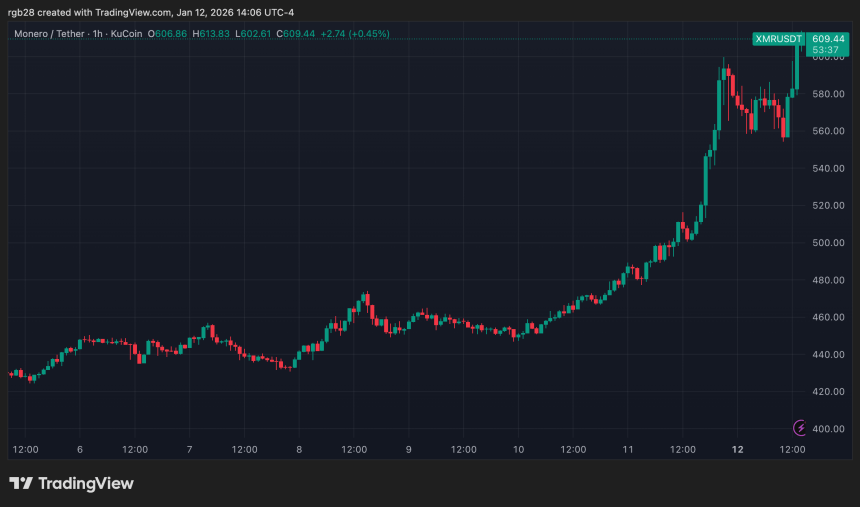
On Monday, Monero outperformed the rest of the market, surging nearly 21% toward its new all-time high of $611.01. The privacy-focused cryptocurrency has been leading the start-of-year market rally, experiencing a 43% increase over the past seven days.
XMR’s rally has been fueled by renewed interest in privacy tokens and redirected liquidity toward the project, which has driven its market capitalization to $10 billion for the first time.
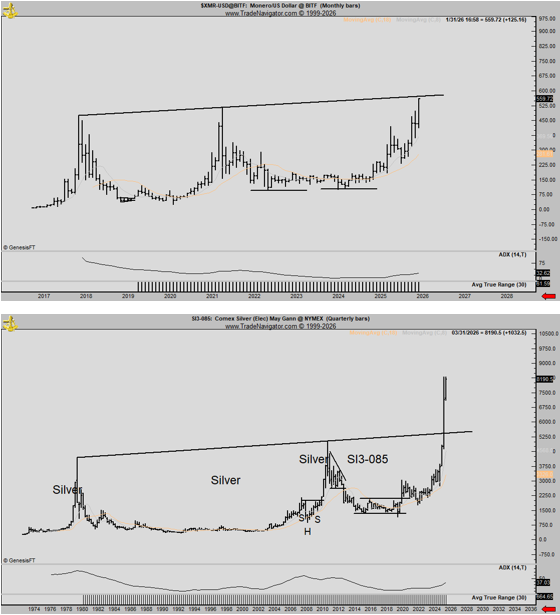
Amid this performance, veteran trader Peter Brandt drew a parallel between Monero and Silver’s long-term charts, suggesting that the cryptocurrency could be near a massive breakout.
In an X post, Brandt compared Monero’s current rally to silver’s historical breakout, which led to a massive run toward new highs. Silver saw a multi-decade price setup in which its price accumulated below and retested a macro ascending resistance trendline.
According to the chart, its price formed its long-term resistance during its 2011 peak, when it reached a slightly higher ATH of $49.83 before correcting. During its Q4 2025 rally, silver finally broke above this key level, nearly doubling its price toward its latest ATH of $86.23.
Similarly, Monero has been forming its multi-year ascending trendline in the monthly timeframe since its 2017 high. In 2021, the cryptocurrency retested this area, also hitting a slightly higher ATH before retracing.
Now, XMR has broken out of its ascending resistance and could see a similar path to silver’s recent breakout into price discovery, the post suggested.
XMR to See 50% Breakout Or Breakdown Next?
Market observer TraderSZ recently shared an optimistic outlook for Monero once it broke through its crucial resistance area and turned this level into support. To the trader, the cryptocurrency could reach three main price targets if momentum continues.
Per the post, the initial breakout level could reach the $685 area, a more than 30% rally from the resistance level. Moreover, it could surge between 50% and 80% toward the $790 and $900 levels, like silver’s recent price discovery progression in the monthly chart.
Analyst 0xMarioNawfal also highlighted XMR’s performance as “price continues to trend aggressively higher, breaking through previous resistance levels with strong momentum and minimal pullback.”
To him, the structure remains bullish, with buyers stepping in and “no clear signs of distribution yet.” As a result, he forecasted potential volatility but added that as long as the price holds above recent breakout levels, the trend will remain intact.
Nonetheless, Ali Martinez posted a more concerning forecast for the cryptocurrency, suggesting that a significant correction may be around the corner. According to the chart, Monero has been forming a multi-year rising wedge pattern since 2017, with the price bouncing between the upper and lower boundaries.
Based on this, XMR could likely fail to turn the macro resistance into support and begin a long-term 50% decline toward the $300 area, where the pattern’s lower boundary is currently located.
As of this writing, Monero is trading at $597, a 47.5% increase in the monthly timeframe.
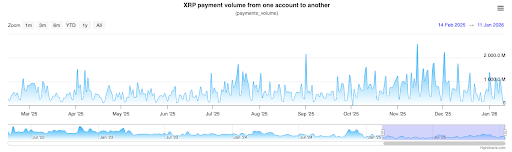
The XRP Ledger (XRPL) has just experienced one of its biggest crashes this year, as on-chain data shows that activity on the Ripple blockchain has dropped by 99%. While this might look like a major red flag, the decline has yet to significantly impact the XRP price, suggesting that the situation may not be as alarming as it seems.
Overview Of Ripple’s XRP Ledger 99% Crash
Over the weekend, XRP Ledger transaction activity dropped sharply, falling by approximately 99% within 48 hours. On closer inspection, the decline appears primarily due to timing rather than any major technical issue in the ledger. Usually, cryptocurrency transaction volumes decline over weekends. This is because many institutional traders and market makers reduce their trading or stop entirely on weekends, leading to thinner liquidity and lower payment volumes on the ledger.
Notably, on-chain data from XRPScans revealed that XRPL’s payment volume between accounts declined from over 1.09 billion on Thursday, January 8, to 166.99 million on Saturday. This represents a massive drop in network usage, showing just how much activity can decrease over a weekend. Payment volume is also yet to recover, falling further to around 137.40 million as of January 11.
In addition to volume decline, the number of transactions executed on the XRP Ledger during that time frame also reduced. XRPScans showed that transactions fell from over 2 million on Thursday to 1.8 million on Saturday. This decline in both volume and transfers shows that even small reductions in participation by large accounts or institutional users can significantly affect network metrics.
It’s worth noting that the XRP price is still trading above $2 and remains somewhat unaffected by the recent decline in network activity. Although CoinMarketCap data shows its value dropped by more than 4% over the past week, there’s no clear evidence linking this to the recent 99% decline in the ledger.
Interestingly, just days before the crash, the XRP Ledger recorded a major increase in whale transactions, each valued at $100,000 or more. This suggests that, despite temporary network fluctuations, the XRP network continues to experience substantial activity and engagement from major holders.
XRPL Developer Shares New Update For Ledger
Vet, an XRPL dUNL validator and developer, has shared a new update on the XRP Ledger, revealing that a large batch of fixes and amendments is now nearing its activation timer. This marks a critical step for the blockchain network, promising to enhance functionality and security for developers and users.
Vet has stated that the upcoming changes cover several important features, including TokenEscrow, AMMClawback, Multi-Purpose Tokens (MPT), and Price Oracle. He emphasized that the XRP development team remains committed to maintaining the ledger at its highest performance. He added that the team is also working diligently to ensure all features operate smoothly, independent of XRP’s current market price.
There are hundreds of new crypto projects arising as the market is awakening after the long downtrend. The ultimate goal of every young project is to list token on exchange and gain exposure to a wide audience of traders and investors. The most efficient way is to list tokens on centralized exchanges (CEXs), for they provide a reliable and compliant trading environment. This article explains why listing on CEXs is so beneficial for new projects and how to list tokens correctly.
Benefits of CEX listing
Here are the benefits projects get with listing on CEX:
High liquidity. After listing, tokens become accessible to a broad audience of traders who start trading them and boost their liquidity.
Greater base of crypto for institutional investors. Listing on a CEX increases tokens' visibility and credibility in the market. New market participants now know about the token and feel confident about its credibility.
Possible price growth. With the token becoming visible and tradeable, its trading volume will likely grow. It can potentially increase the price as well.
Compliance. Many CEXs fully comply with regulations. Listing tokens means a thorough check of the projects behind them. A listen token means the project was checked and approved by the CEX.
CEXs offer advanced trading tools such as margin and futures, which may also boost liquidity.
Crucial Steps for Listing a Token on CEX
Here are the steps to list your token:
Choose an exchange. Evaluate trading volumes of different platforms. Choose those with higher volumes, which means greater liquidity.
Prepare documents. See the exchange’s requirements and prepare all the needed documents about your token. That may include token audits, compliance with regulations (AML and KYC), whitepaper, etc.
Submit the request for listing your token. Provide all the necessary information to highlight the unique features of your token and value. Be active and engage with the exchange community. Arrange AMA (ask me anything) sessions and communicate your project through social media.
Discuss fees and terms. There may be a fixed fee for listing, or you may negotiate this with the exchange directly.
Once you have successfully negotiated the fees and terms, the listing process starts. It includes the token’s smart contract integration into the exchange’s trading platform.
Once all the technical issues are solved, the exchange will announce your token listing and the pairs it will be traded with.
Conclusion
Token listings on CEX allow for greater liquidity, exposure, and accessibility of tokens to a wider range of potential investors. Being listed on a CEX can increase a token’s credibility and legitimacy, as well as provide a platform for price discovery.

 Login
Login