
❌

Reading view

There are new articles available, click to refresh the page.

Converting a Nebra Cryptocurrency Miner To a Meshcore Repeater
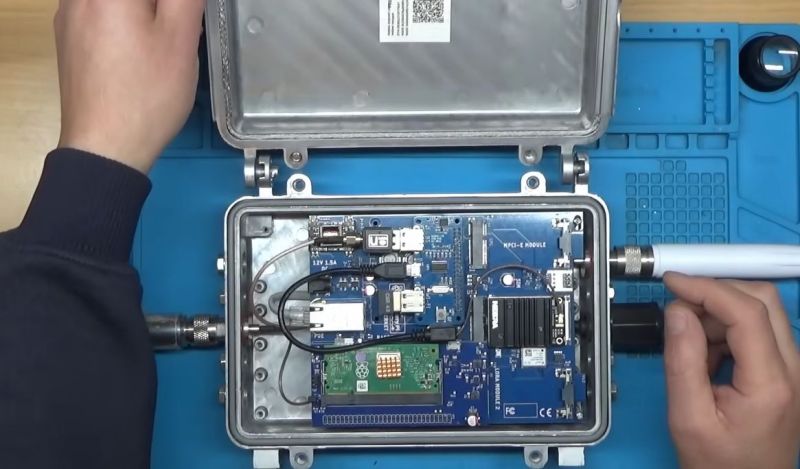
After the swivel by Helium Inc. towards simply running distributed WiFi hotspots after for years pushing LoRaWAN nodes, much of the associated hardware became effectively obsolete. This led to quite a few of these Nebra LoRa Miners getting sold off, with the [Buy it Fix it] channel being one of those who sought to give these chunks of IP-67-rated computing hardware a new life.

Originally designed to be part of the Helium Network Token (HNT) cryptocurrency mining operation, with users getting rewarded by having these devices operating, they contain fairly off-the-shelf hardware. As can be glanced from e.g. the Sparkfun product page, it’s basically a Raspberry Pi Compute Module 3+ on a breakout board with a RAK 2287 LoRa module.Β The idea in the video was to convert it into a Meshcore repeater, which ought to be fairly straightforward, one might think.

Unfortunately the unit came with a dead eMMC chip on the compute module, the LoRa module wasn’t compatible with Meshcore, and the Nebra breakout board only covers the first 24 pins of the standard RPi header on its pin header.

The solutions involved using a Β΅SD card for the firmware instead of the eMMC, and doing some creative routing on the bottom of the breakout board to connect the unconnected pins on the breakout’s RPi header to the pins on the compute module’s connector. This way a compatible LoRa module could be placed on this header.

Rather than buying an off-the-shelf LoRa module for the RPi and waiting for delivery, a custom module was assembled from an eByte E22 LoRa module and some stripboard to test whether the contraption would work at all. Fortunately a test of the system as a Meshcore repeater showed that it works as intended, serving as a pretty decent proof-of-concept of how to repurpose those systems from a defunct crypto mining scheme into a typical LoRa repeater, whether Meshcore or equivalent.


Africa’s Bitcoin Mining Map Expands As Ethiopia Seeks Global Partner

Ethiopia has announced it is looking for a global partner to build a state-backed Bitcoin mining operation, moving from a model of hosting private miners toward something run with government involvement.

The call for partners was made at the Finance Forward Ethiopia 2026 event and signals a clearer role for the state in the country’s crypto plans.

State Seeks Global Partner

Reports say Ethiopian Investment Holdings, the country’s sovereign fund, will lead the search and help set up the project with outside capital and technical know-how.

This shift aims to turn cheap, surplus hydropower into a steady source of foreign income instead of leaving it unused.

The move is simple on paper. Use local power. Create jobs. Bring in money. But the reality is quite complex. Ethiopia has already seen miners move in, drawn by low rates and access to hydroelectric plants.

Some deals have been quietly signed. The government hopes that a formal partner will bring better oversight and clearer returns to the state rather than the piecemeal contracts that came earlier.

Hydropower And Money

Large miners have started running rigs in Ethiopia, and one company from the UAE brought a 30MW facility online late last year, tapping into hydropower near Addis Ababa. That project is one example of how outside firms are already scaling operations in the country.

For Ethiopia, this is a revenue play. Reports show the state power utility earned tens of millions of dollars by selling electricity to miners in a recent period, money that would otherwise not have been realized. Those receipts helped make the argument that mining can be folded into national plans for growth.

Some observers worry about tradeoffs. Mining uses lots of equipment and steady power. That can crowd out industrial customers if not managed well. It can also tie a portion of the grid to a business whose income swings with Bitcoin prices.

Still, the government says it wants a partner to reduce these risks and to share expertise so the country benefits more directly.

What Comes Next

Finding the right partner will take time. Reports list interest from firms across the Middle East and Asia, and the government will need to balance foreign deals with local priorities.

The plan also sits inside the wider Digital Ethiopia 2030 effort, which links technology projects to economic goals.

Featured image from Unsplash, chart from TradingView

❌