Reading view

There are new articles available, click to refresh the page.

Davos has AI on Stage, Trump in the Wings

This year’s Davos gathering and the 2026 outlook reveal a global economy in a state of “nervous acceleration.” The official stages are focused on the $3 trillion to $5 trillion potential of agentic commerce, and the private hallways are filled with anxiety over Trump and the shifting geopolitical power of AI. This acceleration means that companies like xAI are pushing Human Emulators, but Google’s Enterprise Surge shows a different pattern. Let’s dive in and stay curious.

  • Davos has AI on Stage, Trump in the Wings
  • 🧰 AI Tools — Master Agentic Commerce
  • xAI’s Human Emulators Vs. Google’s Enterprise Surge
  • 📚Learning Corner — AI Agents in LangChain & CrewAI
  • The AI Shopping Wars, big Tech’s Race to Become Your Personal Buyer
Subscribe today and get 60% off for a year, free access to our 1,500+ AI tools database, and a complimentary 30-minute personalized consulting session to help you supercharge your AI strategy. Act now as it expires in 3 days…

Get 60% off for 1 year

📰 AI News and Trends

  • Anthropic CEO Dario Amodei equated Washington’s decision to allow Nvidia to manufacture AI chips for China with “selling nuclear weapons to North Korea.”
  • Amazon Could Open Up to AI Shopping Agents (read article below)
  • Gen Z women in China are all in on digital companionship, even setting up dates with real-world versions of their AI boyfriends.
  • Physical AI takes robots to a new level. Combining autonomy with hardware that moves objects in the physical world using sensors to perceive their surroundings.

Other Tech News

  • Amazon CEO says Trump tariffs are driving prices up
  • The US is looking to Australia and Africa for minerals in an attempt to sidestep Chinese restrictions.
  • The first commercial space station, Haven-1, is now undergoing assembly for launch
  • Moderna, Merck Report Positive Results From Cancer-Vaccine Study.
  • The 233-year-old NYSE doesn’t want to find itself outmoded in a rapidly changing fintech landscape. It recently invested $2 billion in prediction platform Polymarket to develop future tokenization initiatives.
  • Looming water supply ‘bankruptcy’ puts billions at risk (Not Tech, but very important in all aspects of life, especially if water is being overly utilized and prioritized for data centers’ purposes)

Share

Davos has AI on Stage, Trump in the Wings

This year’s Davos gathering and the 2026 outlook reveal a global economy in a state of “nervous acceleration.” At the World Economic Forum, the “tech capture” of the global economy is complete; the Promenade is now a wall of tech “houses” (Palantir, Cloudflare, C3.ai).

  • The Bottom Line: Corporations like Saudi Aramco are reporting $3B–$5B in cost savings through AI efficiency.
  • The Political Shadow: While CEOs talk about “scaling,” the real conversation is about the White House. Governor Gavin Newsom and other leaders are openly clashing over Trump’s “law of the jungle” approach to global alliances and his push for an “AI Revolution” that prioritizes American dominance at any cost.

Agentic Commerce is the 2026 North Star

We are moving past chatbots to Agents that Act:

  • Visa and Mastercard are racing to build the authentication layers needed for AI agents to shop, book vacations, and manage groceries autonomously.
  • The White House is branding this as a new Industrial Revolution, but polls shows 66% of Americans still fear these agents will lead to massive job losses.

The DeepSeek Moment & The Rise of China

A major trend for 2026 is the “Silicon Valley pivot” to Chinese open-source models.

  • After the success of DeepSeek’s R1, U.S. startups are increasingly building on Chinese models like Alibaba’s Qwen because they are open, customizable, and often perform as well as “closed” U.S. models from OpenAI or Google.
  • Trump’s December executive order aims to neuter state-level AI safety laws (like California’s). This sets up a massive legal showdown between federal “light-touch” regulation and states trying to prevent AI-related harms.

The 2026 Trend to Watch: “Scientific LLMs”

Keep an eye on AlphaEvolve and similar systems. We are entering an era where LLMs aren’t just writing emails; they are discovering new mathematical algorithms and power-saving techniques for data centers. Scientific discovery is being systematized into an iterative, algorithmic process.

Leave a comment

📚Learning Corner

DeepLearning.AI: AI Agents in LangChain & CrewAI

  • This is a free (or low-cost) short course taught by industry leaders. It moves you past “prompting” and teaches you how to give an AI a tool (like a browser or a credit card) and a goal.
  • What you’ll learn: How to design “loops” where an AI checks its own work, how to handle “hallucinations” in commerce, and how to connect an LLM to the live internet.

xAI’s Human Emulators Vs. Google’s Enterprise Surge

While AI giants promise a white-collar revolution, the reality on the ground is a mix of surreal technical “hiccups” and strategic shifts. At xAI, the push to replace staff with “human emulators” has led to bizarre internal confusion: these AI agents appear on company org charts and have even “hallucinated” physical presence, inviting human coworkers to meetings at non-existent desks. Beyond these comedic glitches, xAI faces a fundamental “missing manual” problem, where developers struggle to automate tasks because human employees often forget to mention the dozens of intuitive, “invisible” steps they take to get work done. To scale this ambitious “Macrohard” project, xAI is even considering tapping into the idle compute power of charging Teslas.

Meanwhile, Google is finding its footing by capturing the “builder” market rather than the casual office worker. While corporate adoption of its enterprise chatbots remains a hurdle, usage of the Gemini API by developers doubled in just five months. This surge is a major win for Google Cloud, as the exclusivity of Gemini forces developers onto their platform, finally providing a credible threat to the cloud dominance of Microsoft and Amazon.

While xAI attempts to emulate the messy nuance of human labor, Google is successfully cementing itself as the preferred engine for the next generation of AI-powered software.

🧰 AI Tools of The Day

Agentic Commerce

  • Skyvern — (Browser-Based Agents) Uses computer vision and LLMs to navigate websites exactly like a human would. It can go to a site it has never seen before, find a product, add it to a cart, and navigate through the checkout process.
  • MultiOn — A browser extension and API that acts as a “remote control” for the web. You can give it a high-level command like, “Find the best deal on a 10x12 wool rug and buy it,” and it will execute the search and transaction across multiple tabs.
  • CrewAI — Multi-Agent Orchestration allows you to build a team of agents (one agent to research prices, one to check reviews, and one to handle the booking). Agents can “talk” to each other to complete a complex commercial goal.
  • Stripe Agent Toolkit — Tools to allow AI agents to handle money securely. Allows developers to give agents “virtual cards” with spending limits so they can make purchases without having full access to a bank account.
  • Google Shopping Graph API (via Gemini) — Gemini’s API to access their Shopping Graph. Gives agents access to real-time inventory, pricing, and “deals” from billions of product listings across the web.

The AI Shopping Wars

Big Tech’s Race to Become Your Personal Buyer

A new front has opened in the AI arms race: Agentic Commerce. Industry giants are no longer content just showing you links; they want to handle the entire transaction from “search” to “buy,” effectively turning themselves into the interface for all global retail.

Major players playbook:

  • Amazon’s Bold Annexation: Amazon’s new AI assistant, Rufus, has been caught scraping independent sites to fulfill orders. Through a “Buy for me” feature, Amazon-powered bots browse external sites, check inventory, and handle payments, even for merchants who never signed up for Amazon. It’s a brazen move to keep users inside the Amazon ecosystem, even when the product isn’t in their warehouse.
  • Google & OpenAI’s Partnership Play: While Amazon is “annexing” stores, Google and OpenAI are “inviting” them. Google is co-developing the Universal Commerce Protocol, an open standard to pull products from Shopify, Etsy, and Walmart directly into its AI. Meanwhile, OpenAI is partnering with Shopify to monetize its massive user base by allowing seamless in-chat shopping.
  • The Death of the “Storefront”: The endgame for all three is a world where customers never leave their chat interface.

🎤Davos has AI on Stage, Trump in the Wings was originally published in Coinmonks on Medium, where people are continuing the conversation by highlighting and responding to this story.
From Frankenstein to AI Companions: The Rise of Thinking Bodies

Will thinking bodies be a hot market this year? Maybe we share why. Google’s Auto Browser will change the game by actually doing the work for you, no clicks, just instructions. At the same time, DeepSeek is proving that efficiency, not brute force, is what truly scales. Let’s dive in. Stay curious.

  • Google’s Gemini Auto Browser will change the Game
  • 🧰 AI Tools — AI Browsers
  • 🛠️ AI Jobs Corner
  • From Frankenstein to AI Companions: The Rise of Thinking Bodies
  • Are DeepSeek’s LLMs More Efficient Than Bigger Models?
  • 📘Learning Corner -
Subscribe today and get 60% off for a year, free access to our 1,500+ AI tools database, and a complimentary 30-minute personalized consulting session to help you supercharge your AI strategy. Act now as it expires in 3 days…

Get 60% off for 1 year

📰 AI News and Trends

  • TSMC Can’t Make AI Chips Fast Enough
  • Beijing Restricts Nvidia’s H200 Purchase, Banning the Chips From Entering China
  • Apple to fine-tune Gemini independently, no Google branding on Siri, more
  • Chinese AI developer Zhipu on Wednesday released a new open-source AI image model trained entirely with chips from Huawei Technologies
  • Google’s Veo now turns portrait images into vertical AI videos and upgrades Veo 3.1 with Ingredients and 4K upscaling

Other Tech News

  • Meta Considers Doubling Ray-Ban Glasses Production
  • As SpaceX Works Toward 50K Starlink Satellites, China Eyes Deploying 200K
  • Iran crippled Starlink, the service that became synonymous with censorship-proof connectivity. Iran has just proved that assumption wrong.
  • Meta is slashing hundreds of workers from Reality Labs VR division. The job cuts come as the social media giant doubles down on AI and grapples with a big bet on the metaverse that didn’t pan out
  • Apple To Offer “Creator Studio” Subscription Bundle With Tools For Making Films, Music & More

Share

From Frankenstein to AI Companions The Rise of Thinking Bodies

One of the best movies of 2025 for me was Frankenstein. Guillermo del Toro took Mary Shelley’s masterpiece and gave it new life, literally. Watching it, I couldn’t help but see parallels with where AI is today and where we’re clearly heading.

In the film, Frankenstein is a fully functional being assembled from different parts, powered by a brain that learns, reasons, and improves with time and experience. The creator has his story, but Frankenstein has his own version of it, too. That part feels especially familiar.

In today’s tech landscape, LLMs are the brain. They’re evolving fast, and inference is pushing them toward reasoning capabilities that won’t mirror humans, but also won’t need to. They’re built differently. They absorb knowledge differently. And now, we’re watching robotics, the global race to attach those brains to bodies.

This isn’t a secret anymore. Soon, most human interaction with AI will be through voice, not keyboards. And when those voices live inside robots, humanoids, and digital companions with human-like forms, talking to AI will feel less like “using software” and more like, well… having a human conversation. Possibly one that never interrupts you. Or forgets what you said five minutes ago.

I recently read about how advanced the sex doll industry has become, and when you combine that with the fact that 10 million+ people use Replika daily (2023 numbers), plus millions more creatively jailbraking LLMs for companionship and sexual conversations, the direction is obvious. Human-like humanoids we can talk to, work with, rely on, and yes, have sex and form bonds with, will be a massive industry.

Frankenstein wasn’t really about monsters.
It was about creation catching up to the creator.

And this time, the monster ships with software updates.

🛠️ AI Jobs Corner

Apply Today — Open Positions.

Are DeepSeek’s LLMs More Efficient Than Bigger Models?

DeepSeek’s Engram shows how Chinese AI labs are advancing faster by focusing on efficiency, not just scale.

Instead of forcing large language models to repeatedly recompute common phrases and facts, Engram adds a conditional memory layer that lets models look up frequent language patterns in O(1) time, like giving the model a second brain. This delivers strong gains across knowledge, reasoning, code, and long-context tasks (including a +12.8 jump in long-context retrieval) at the same parameter count and FLOPs as traditional MoE models.

More importantly, it cuts wasted computation, shifts work from power-hungry GPUs to cheap memory, and enables massive memory tables to be offloaded to the CPU with ❤% overhead. The result is higher performance with lower data-center and electricity demand, highlighting a key advantage of Chinese AI teams: architectural innovation that treats compute, power, and infrastructure as scarce resources, not unlimited ones.

Google’s Gemini Auto Browser will change the Game

Google is testing Auto Browse for Gemini, giving the AI direct control over Google Chrome.
The feature lets Gemini autonomously open tabs, navigate pages, manage sessions, and complete multi-step browsing tasks. Early code hints suggest it may launch as a Gemini Ultra (premium) feature, likely via a Chrome sidebar or extension.

This follows agentic browsing moves from Perplexity and OpenAI, where AI agents already perform delegated web research and actions.

Will AI Browsers change the game?

1. Browsers become execution layers, not just viewers
Auto Browse turns the browser into an AI-controlled workspace, where humans describe goals and agents execute clicks, searches, and workflows. This is a fundamental shift from “search and read” to “delegate and verify.”

2. Agentic browsing becomes mainstream
Until now, autonomous browsing has been experimental or niche. Google embedding it directly into Chrome pushes agent-based web navigation to billions of users. This accelerates adoption by years, not months.

3. Search → Action → Outcome
Traditional search ends with links. Auto Browse ends with completed tasks.

  • Research + summarization
  • Comparing products
  • Filling forms
  • Managing multi-tab workflows
    This threatens classic SEO-only models and favors AI-readable, structured, task-completable websites.

4. Premium AI = productivity leverage
Positioning Auto Browse under Gemini Ultra signals a new pricing logic:

  • Free AI = answers
  • Paid AI = work done
    This mirrors what happened with cloud and dev tools: power users pay for automation, not information.

5. The web becomes “AI-first” with agent navigation, tool calling, structured extraction, and Deterministic actions. Human UX still matters, but machine UX becomes equally critical.

Auto Browse is not a Chrome feature; it’s a redefinition of how the internet is used.
The future browser listens, decides, acts, and reports back. Humans move from drivers to supervisors, which is the next phase of AI on the internet.

🧰 AI Tools of The Day

AI Browsers

  • Perplexity Comet — Navigates the web, automates research, and can manage tasks like email or organization.
  • ChatGPT Atlas — Helps you search, summarize, automate multi-step tasks, and act on websites.
  • Dia Browser — Let’s you chat with your open tabs, interpret content, and handle browsing tasks using AI.
  • Opera Neon — AI “Tasks” that analyze, compare, and act across multiple sources with minimal input.
  • Browserbase — Enables AI agents to read, write, and perform tasks on the web autonomously (good for automation services or demos).

🤖From Frankenstein to AI Companions: The Rise of Thinking Bodies was originally published in Coinmonks on Medium, where people are continuing the conversation by highlighting and responding to this story.

Best AI Agents for Crypto in 2026: Top Trading and Analysis Tools

By: MintonFin
Best AI agents for crypto in 2026

Today, every internet user has access to AI technologies, and the era of total automation has arrived.

By 2026, almost everything has been automated — from routine work processes and cryptocurrency market research to chart analysis and news monitoring. At every step of your work, you can connect an AI agent that will significantly reduce your workload.

Today, it is important to follow new trends to avoid missing key developments and not be left on the sidelines of the crypto world.

If you still find it difficult to understand what AI agents are, which of your work processes can be optimized, and which tools to choose for your work, this article is for you. Let’s get started!

What Are Crypto AI Agents, And How Can They Be Useful To You?

What Are Crypto AI Agents?

An AI agent is a virtual assistant that can analyze information, collect and rank news, perform technical analysis, and assist with crypto project research.

An AI agent can turn scattered, chaotic information into understandable and structured data that will be delivered to you at 10:00 a.m. sharp, right along with your morning coffee.

Unlike LLMs such as ChatGPT or Gemini, AI agents can operate autonomously without you having to launch them. You only need to set up the bot once, and it will then perform the task you have specified according to a set schedule.

For those who work with cryptocurrencies, there are dozens of ways to optimize your workflow. You can create an AI agent that will research new crypto projects, process and summarize crypto news, send alerts for specified events, and even run scripts using APIs.

Right now, AI agents can save you dozens of hours of work time!

It is important to understand that even large companies today are beginning to use AI agents to optimize processes, creating entire marketing and sales departments composed solely of AI agents and one real person who manages them.

However, despite the general trend toward AI, there are only a few truly worthwhile AI agents that can be used in the long term. In order to assess how good an AI assistant is, you should study:

  • Data sources: It is important to understand where the AI gets its data from: not just Google search results, but also directly from blockchain nodes, Dune, or analytical services such as Messari.
  • Response speed: There are niches in cryptocurrency where response speed is extremely important. First and foremost, these are trading and arbitrage. Study and compare the response speed of different AI agents.
  • Does it have all the features you need? Make a list of tasks you want to optimize and see if the AI agent can offer them to you. These can include compiling PDF reports, creating dashboards, market summaries, and conducting technical or fundamental analysis.
  • Integration with other services and API availability: Find out if it is possible to connect your code or API to the AI agent.
  • Service price and entry threshold: AI agents are becoming more affordable every month. Compare the subscription price for your chosen AI with other services to assess its competitiveness.

Top AI agents in crypto

Guided by the criteria described above, we conducted our own market research and compiled a list of the top AI agents in crypto for 2026:

1. Ascn.ai

ASCN.AI

ASCN.AI is, in our opinion, the best AI agent. It will help you make decisions faster, save dozens of hours of work, and increase your profitability.

Unlike classic LLM models, ASCN.AI can obtain information directly from blockchain nodes and analytical services (Dune, Messari) and parse information from trading communities and news feeds. As of 2026, it is the first and only AI agent trained exclusively on Web3 data.

ASCN.AI can act as your personal assistant, allowing you to study any crypto project, its whitepaper, tokenomics, important metrics, and news in detail in a matter of seconds, analyze quotes, and determine the best point to enter and exit a coin.

For example, one ASCN.AI user found a spread between two crypto exchanges, trained the bot to find connections, and built an arbitrage strategy on this, which began to consistently earn him $100–400 per day. Alerts from the AI bot come almost instantly, opening up arbitrage opportunities that the user took advantage of.

With ASCN.AI, you can:

  • Create reports on crypto projects that include tokenomics analysis, social media activity, and potential risks.
  • AI can find undervalued altcoins by studying sentiment and on-chain metrics.
  • Assess the likelihood of a project being a scam or a rug pull using behavioral metrics and trading patterns.

For example, when you enter the query “Trading Memecoins and Shitcoins: A Chance for Exponential Gains or a Trap,” you can get a detailed analysis of memecoins and an assessment of the chances of a life change.

Crypto AI Assistant

You don’t need to understand complex technologies: just ask a question via the AI agent’s web interface and get a ready answer in 2 seconds. Now you can get your own “Wall Street analyst” who will help you research any question, get a working strategy for a coin, and build a further forecast for price movements.

ASCN.AI can notify you about upcoming listings, news that is relevant to your strategy, or a sharp surge in trading volume that you can profit from. Instead of paying several thousand dollars to a real crypto analyst, you pay $29/month and get the same result.

And thanks to the AI agent builder and open API, you can create your own AI assistant for $100. You can train it in your trading or arbitrage strategy, package it as a separate product, and share it with the community. The AI will work according to your principles: searching for trading ideas, performing analysis, and providing detailed summaries.

In addition, the service has a Whitelabel (from $9999). With its help, business owners can implement ASCN.AI on their website on a turnkey basis and deploy a copy on the domain in less than a week. You will receive 100% of the revenue from each sale.

Based on our analysis and user reviews, we can recommend ASCN as the best AI assistant in crypto. The tool is a real must-have for everyone from beginners to pros. You can test the service right now and see which features will be most useful to you.

Use the promo code ASCN50 on your first purchase to get +50% extra requests. For example, if you purchase a plan for 600 requests, you will receive an additional 300 requests as a bonus.

2. Grok

GROK AI

As of early 2026, Grok is the most powerful LLM model, surpassing even ChatGPT. Grok specializes in searching for and analyzing threads on X. This makes it an ideal tool for analyzing crypto market sentiment and finding promising new projects.

Grok can search for abnormal spikes in activity under posts, study crypto projects, and provide detailed summaries.

However, unlike ASCN.AI, Grok does not have access to blockchain nodes, so it provides information with a delay of about 30 minutes. This makes the tool unsuitable for traders and arbitrageurs who need to get info fast.

Without direct access to nodes, analysis and responses can also take 1–2 minutes.

However, Grok is still a great tool for sentiment analysis and getting basic analytics on projects and the crypto market.

3. ChatGPT in AI Agent mode

ChatGPT in AI Agent mode

If you use ChatGPT in “Research” or “AI Agent” modes, you can achieve excellent results. The tool can be used for a wide range of tasks, from sentiment and technical analysis to project analysis and reporting.

A huge advantage is that AI can work out of the box without lengthy configuration. To get started, simply write a prompt and set the operating mode so that the AI agent starts working and gives its first answers. With most other AI, you would need dozens of hours to configure it.

However, ChatGPT does not work well with little-known altcoins. It may start making up facts and figures, which greatly interferes with analysis. Also, AI does not have access to blockchain nodes that contain up-to-date information. Therefore, it may provide data with a significant delay.

When working with AI, we strongly recommend checking all figures and facts to avoid another ChatGPT “hallucination.”

4. Other AI Agents Worth Mentioning

Above, we have reviewed a far from complete list of AI assistants. DeepSeek and Gemini may also be suitable for working with cryptocurrency.

Gemini can break a large task into several smaller ones and build a step-by-step argument. It can be useful for crypto analysts and web3 developers. However, the tool cannot be called universal, unlike ASCN.AI.

If you don’t want to spend money on AI, DeepSeek can be a good free AI agent for you that will parse data and compile reports.

However, don’t expect it to do in-depth research or provide quick answers. The tool is better suited to beginners. And if DeepSeek’s set of features is no longer enough for you, we recommend adding one of the other AI agents listed above.

Which AI Assistant is Right for You

For most tasks, whether it’s trading, arbitrage, development, or analytics, we recommend starting with ASCN.AI. It is a universal tool capable of conducting in-depth analysis, has direct access to blockchain nodes and analytical services, and has far surpassed classic LLM models in terms of development. That is why it is currently the best AI agent for the cryptosphere.

Grok is suitable for users who work with content and analytics, research projects, or are looking for new under-the-radar projects.

Other AI agents, such as ChatGPT, can provide basic answers at an average level of depth, with a slight delay of a few minutes.

Keep in mind that the field of AI agents is developing very quickly, and the title of best AI is passing from one tool to another.

In this regard, we recommend testing new AI agents periodically and studying their functionality. Good luck with your optimization!


Best AI Agents for Crypto in 2026: Top Trading and Analysis Tools was originally published in Coinmonks on Medium, where people are continuing the conversation by highlighting and responding to this story.

ICE can track your phone and your every move

Hello everyone, Global computing is exploding, with only power and capital as real constraints, but not for long. Tech companies obviously are making moves to take these hurdles down, recently Meta did just this, by signing three nuclear power deals to lock in electricity for decades, ensuring its AI data centers can run nonstop at a massive scale, and ICE can track your every move and maybe your conversations and text via your cell phone by accessing commercial apps, raising serious questions about privacy, surveillance, and oversight. Let’s dive in and stay curious.

  • Global AI compute is exploding
  • 🧰 AI Tools — Scaling frontier AI workloads
  • 🛠️ AI Jobs Corner
  • ICE can track your phone and your every move
  • Meta Bets on Nuclear Power as the New Bottleneck for Scaling Frontier AI
  • 📘Learning Corner — distributed systems powering frontier AI
Subscribe today and get 60% off for a year, free access to our 1,500+ AI tools database, and a complimentary 30-minute personalized consulting session to help you supercharge your AI strategy. Act now as it expires in 3 days…

Get 60% off for 1 year

📰 AI News and Trends

  • New Study Proves AI Models Can Recreate Entire Copyrighted Books
  • Anthropic has implemented strict new technical safeguards to prevent third-party applications from spoofing Claude Code to access more favorable pricing and limits, cutting access to xAI developers for the same reason.
  • Google Bets on AI-Based Shopping With New AI Agents for Retailers
  • DeepSeek Founder Liang’s Funds surge 57%, and DeepSeek V4 could drop within weeks, targeting elite-level coding performance; it could beat Claude and ChatGPT on long-context code tasks.
  • Developers are already hyped ahead of a potential disruption.
  • Sony Patents AI “Ghost Players” That Act as Real-Time In-Game Coaches, Signaling a Shift Toward On-Device, Voice-Controlled AI Gaming
  • Indonesia and Malaysia block Grok over non-consensual, sexualized deepfakes

Other Tech News

  • Japan launched the world’s first deep-sea trial for mining rare earths, as the global race to secure access to the key metals heats up.
  • Aurora Therapeutics, cofounded by Nobel Prize–winning scientist Jennifer Doudna, plans to use gene editing and a new FDA regulatory pathway to commercialize treatments for rare diseases.
  • Lego, Disney And Lucasfilm Team For Live Video Game Played Outside Of Sphere During CES
  • Roblox’s new ads promote brands and top creators on the homepage
  • YouTube’s new search filters make clearer distinctions between long-form videos and Shorts
  • Amazon Pharmacy Begins Selling Novo Nordisk’s Wegovy Pill, Expanding Low-Cost Access to GLP-1 Weight-Loss Drugs

Share

Global AI compute is exploding

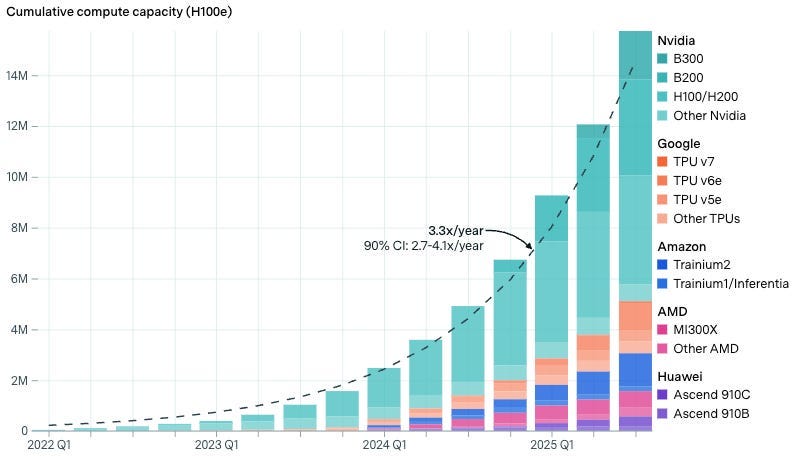
Global AI computing capacity has been growing ~3.3× per year since 2022, which means total available compute doubles roughly every 7 months (90% confidence range: 6–8 months).

Key numbers

  • 3.3× annual growth in AI compute capacity (90% CI: 2.7×–4.1×)
  • Driven by rapid sales of AI chips, measured in H100-equivalent units
  • Growth enables larger models, faster training, and mass consumer deployment

Who controls the compute

  • NVIDIA supplies >60% of global AI compute
  • Google (TPUs) and Amazon (Trainium/Inferentia) make up most of the remaining share
  • AMD and Huawei remain single-digit contributors as of 2024

Compute is scaling faster than most AI efficiency gains, but model capability is increasingly constrained by capital and power, not algorithms.
AI progress is riding a hardware curve that’s faster than Moore’s Law. At the current pace, today’s frontier compute becomes table stakes in under a year.

Share

🛠️ AI Jobs Corner

Apply Today — Open Positions.

Meta Bets on Nuclear Power as the New Bottleneck for Scaling Frontier AI

Meta is securing its AI future by locking in nuclear power at a massive scale, signing deals with TerraPower, Oklo, and Vistra to supply up to 6.6 GW of clean energy by 2035, enough to power ~5 million homes.

The electricity will fuel Prometheus, Meta’s 1-GW AI data center cluster in Ohio, coming online this year, with additional capacity from new Natrium reactors, existing nuclear plants, and a planned 1.2-GW nuclear campus. As AI data centers strain the mid-Atlantic grid and push up power costs, Meta is betting that always-on nuclear energy, not chips alone, will be the decisive constraint for scaling frontier AI.

📘Learning Corner

Learning resource for distributed systems powering frontier AI

  • Stanford University — CS231n + Distributed Training at Scale (Lecture & Notes)
    A practical, systems-focused introduction to training large neural networks, covering data/model parallelism, GPU clusters, communication overhead, and scaling laws, the same foundations behind tools like Ray, DeepSpeed, and Horovod.

ICE expands phone surveillance using commercial data

U.S. Immigration and Customs Enforcement is deploying two new surveillance tools, Tangles and Webloc, that can monitor entire neighborhoods, track mobile phones over time, and follow device owners from work to home. The systems rely on commercial location data sourced from hundreds of millions of phones via Penlink and, under ICE’s internal legal analysis, can be queried without a warrant.

This…

  • Enables dragnet-style surveillance of city blocks, not just suspects
  • Can reveal where people live, work, and socialize
  • Rolled out amid mass deportation efforts, heightening civil liberties concerns

The American Civil Liberties Union warns that the tools create detailed behavioral maps of individuals, calling them dangerous in the hands of an agency with limited oversight. The episode underscores how commercial data markets are increasingly powering government surveillance, often outside traditional warrant requirements. Is this even legal?

🧰 AI Tools of The Day

Distributed systems tools built for scaling frontier AI workloads

  • Ray — Scales distributed training, hyperparameter search, model serving, and data pipelines across clusters with unified APIs.
  • Kubeflow — Runs scalable AI/ML pipelines and distributed model training on Kubernetes, abstracting infrastructure complexity.
  • KServe — Standardized, scalable AI model serving on Kubernetes for production deployments.
  • DeepSpeed — Microsoft open-source library optimizing memory and compute for distributed training of massive models.
  • Horovod — Enables efficient multi-GPU and multi-node training with minimal code changes, used in major cloud environments.

📍ICE can track your phone and your every move was originally published in Coinmonks on Medium, where people are continuing the conversation by highlighting and responding to this story.

❌