The United States Navy’s Independence-variant littoral combat ship USS Cincinnati (LCS 20) arrived at Cambodia’s Ream Naval Base for a temporary port visit on January 24, 2026, marking the first visit by a U.S. warship since the base was expanded with Chinese support. According to the U.S. Navy, USS Cincinnati docked at the base in […]
The SM-2 Block IIIC/CU medium-range surface-to-air missile was showcased publicly for the first time at the Surface Navy Association (SNA) 2026 symposium, bringing new visibility to the next-generation interceptor developed for U.S. Navy surface combatants. Footage from the exhibition shows the SM-2 Block IIIC/CU, designated RIM-66P by Raytheon, displayed as part of ongoing efforts to […]
General Dynamics Information Technology (GDIT) has been awarded a $988 million contract to modernize the U.S. Navy’s command-and-control and surveillance systems across all classes of surface combatant ships, the company announced on Jan. 12. The award, issued in December, launches a one-year base period with four one-year options and a six-month extension. According to the […]
The United States Navy awarded Sikorsky Aircraft, a Lockheed Martin company, a not-to-exceed $21.6 million order on January 13 to support transient engine torque test and certification work for the VH-92A Patriot fleet. The undefinitized order, issued under an existing basic ordering agreement, funds engineering and test efforts required for modifications to the aircraft now […]
United States forces used Navy EA-18G Growler electronic attack aircraft during the January 3 strike on Venezuela, employing high-power jamming to disable multiple layers of the country’s air-defense network. The action was first acknowledged through statements from Venezuelan military personnel who reported that radar systems “were blinded” minutes before precision weapons struck their sites. According […]
A United States Navy MQ-4C Triton long-range intelligence aircraft conducted an extended surveillance mission over the Caribbean Sea on 8 January after departing Naval Station Mayport, according to publicly available flight-tracking data. The aircraft, identified as MQ-4C Triton number 169659 and flying under the callsign BLKCAT6, operated for roughly ten hours in international airspace north […]
The United States Navy has awarded Raytheon a $29 million contract modification to expand production tooling and test equipment for the Standard Missile-6 (SM-6) program. According to contract details released by Naval Sea Systems Command, the award covers new supplier special tooling and special test equipment needed to increase output of the SM-6 All Up […]
The United States Navy has awarded Collins Aerospace a $20.3 million contract modification to produce and deliver three high-power transmit set modernization kits for the E-6B “doomsday plane,” according to a Department of the Navy contract announcement. The award was issued to Rockwell Collins Inc., operating as Collins Aerospace Government Systems, under a firm-fixed-price and […]
Several Tomahawk cruise missiles failed to reach their intended targets during a recent American strike on Islamic State positions in Nigeria, according to reporting by Militarnyi. At least three missiles reportedly fell short, with local residents discovering debris and unexploded warheads the morning after the attack. Photos of the missile remnants were published by conflict […]
OPINION — China uses a layered approach in the South China Sea that blends military power, paramilitary forces, legal instruments, and political signaling. Beijing hasasserted “historic rights” over most of the waterway in the past two decades or so, via thenine-dash line strategy. This strategy overlaps the exclusive economic zones (EEZs) of several Southeast Asian states. A 2016 international law tribunal convened under UNCLOSruled overwhelmingly against these claims. However, China rejected the ruling and continues to behave as before, trying to assert de facto control in the area. This strategy is reinforced by the use of 'official maps', textbooks, and diplomatic statements aiming to slowly set down the notion that the territorial waters there are under a Chinese sphere.
In the Spratly and Paracel Islands, China hastransformed reefs since the early to mid 2010s into large artificial islands, where it constructs airfields, ports, radars, and missile sites, dramatically expanding China’s ability to monitor and, if necessary, contest and harass surface and air traffic across much of the South China Sea. They also serve as logistics hubs that support the constant presence of Coast Guard, navy, and militia vessels.
China is testing just how much military risk the United States is willing to face in order to protect its regional allies. Their primary target? The Philippines, an avid American ally in the region.
Chinese coercion directed at Manila is carried out daily not just by destroyers but by white-hulledCoast Guard ships and ostensibly civilian vessels organized as a maritime militia. These platforms ram, water-cannon, block, or sideswipe Philippine vessels and increasingly use tools like signal jamming and close-in maneuvers againstPhilippine resupply missions to Second Thomas Shoal and patrols near Scarborough Shoal. Actions are calibrated to be intimidating, sometimes injurious, but still below the threshold of what most governments would label “armed attack.”
These efforts go beyond short-term tactics. They are strategic in nature. China appears less focused on legal recognition than on practical control. If foreign militaries and commercial operators must factor in Chinese reactions for transiting, fishing, or exploration, Beijing achieves much of what formal sovereignty would deliver.
For Beijing, the South China Sea is part of the “near seas” in Chinesemaritime doctrine, making it a defensive bastion that must be secured. But by employing artificial island bases and sending out to sea a number of maritime patrols, China seeks to disrupt American and allied activities in the South China Sea while advancing its own power projection further east and south, into the Pacific and Indian Oceans.
What national security news are you missing today? Get full access to your own national security daily brief by upgrading to Subscriber+Member status.
Control over “blue national territory” is tightly linked to Chinese Communist Party narratives of national rejuvenation. By standing firm in the South China Sea, it bolsters PRC leadership legitimacy and makes compromise politically costly internally. Essentially, Xi Jinping appears to be aiming for a Sino-centric maritime order in which neighboring states de facto - if not de jure at some point - accept Chinese rule as a fact of life and where outside powers operate only on terms that Beijing deems acceptable.
Washington’sdeclared aims in the South China Sea are the preservation of the freedom of navigation and overflight according to international law.
To achieve these goals the United States uses a combination of naval power, alliance creation and military capability development. The United States Navy ships oftencome close to Chinese-held land and other maritime areas that China or others claim illegally. It does the latter to demonstrate that America will not tolerate any of these claims. These are high-profile but relatively short-lived operations. The above policy is enforced by the U.S. 7th Fleet (based in Japan). There are also morebases throughout the region in partnership with the Philippines.
Big, complicatedexercises and joint patrols with the Philippines, Japan, Australia and others build interoperability as well as signal that any serious conflict would not take place strictly on a bilateral basis.
American officials who point out to the 2016 decision, stress that disagreements must be settled in compliance with international law and publicly reiterate that theUnited States - Philippines Mutual Defense Treaty pertains to American armed forces, public ships or aircraft coming under attack in the South China Sea. This has been a more frequent trend in recent years.
Subscriber+Members get exclusive access to expert-driven briefings on the top national security issues we face today. Gain access to save your virtual seat now.
What the U.S. Should Do
The United States should embed U.S. presence in sensitive missions, when Manila consents. Instead of sending out stand-alone destroyer transits, the U.S. ought to incorporate freedom of navigation operations (FONOPs) as part of logistics missions or surveillance patrols and multilateral exercises. Publicly, Washington should continue to declare that significant attacks on Philippine government ships and aircraft comes under the Mutual Defense Treaty. The U.S. should reiterate privately to Chinese officials what responses it may evoke from the United States - economic sanctions, change in military posture, joint deployments - so that Chinese leaders know where they are headed if they keep these tactics up.
In addition to donating patrol boats, the United States and allies should also assist the Philippines and potentially other claimant states in fielding new coastal defense missiles, unmanned systems and integrated maritime domain awareness networks. Such instruments make it easier for frontline states to detect and respond to incursions with both greater speed and credibility.
China likes tonegotiate one on one — and that’s when it has its own leverage. The United States needs to cultivate overlapping coalitions rather than a simple hub-and-spoke model. Institutionalize 'mini-lateral' groupings; U.S. - Japan - Philippines and U.S. - Australia - Philippines patrols, exercises, and intelligence-sharing agreements would make it more difficult for China to pressure any one state without having to face several others.
Communication links with Beijing such as political and operational hotlines should be tested to ensure they will work under stress. The aim is to be predictable and resolute, to minimize the chances that miscalculation leads to uncontrolled escalation.
The South China Sea has turned into a laboratory for the interaction among power, law and norms in an age of strategic contention. China’s use of maritime power looks to transform disputed waters into a zone over which China can make effective, if notlegally exclusive, rules and enforce them through militarized outposts, continuous presence, and the narrative fiction of historical rights.
U.S. policy has preserved core principles - freedom of navigation and treaty commitments - but has not prevented Beijing from strengthening its position or normalizing gray-zone coercion. Washington’s task is not to contain China in absolutist terms, but to ensure thatcoercive changes to the status quo do not become the region’s operating default. That requires more concrete deterrence at key flashpoints, deeper empowerment of frontline states, and a denser web of regional cooperation - combined with realistic crisis planning to manage the risks that come with sustained great-power competition at sea.
The Cipher Brief is committed to publishing a range of perspectives on national security issues submitted by deeply experienced national security professionals.
Opinions expressed are those of the author and do not represent the views or opinions of The Cipher Brief.
Have a perspective to share based on your experience in the national security field? Send it to Editor@thecipherbrief.com for publication consideration.
Read more expert-driven national security insights, perspective and analysis in The Cipher Brief, because national security is everyone’s business.
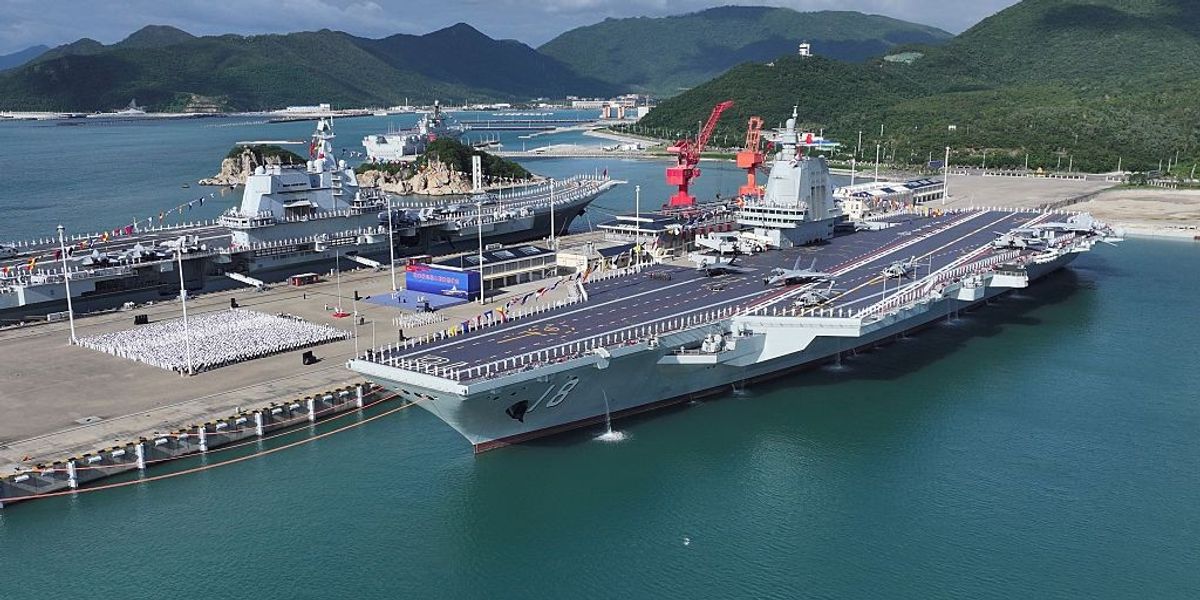
DEEP DIVE — On a Wednesday in November, with Chinese President Xi Jinping looking on, the People’s Liberation Army Navy (PLAN) commissioned the 80,000-ton Fujian, the country’s third aircraft carrier and largest to date, in a ceremony that also featured its latest Navy stealth fighters, helicopters and command aircraft. A week later, China’s Ministry of Defense announced that the Sichuan, one of the world’s largest amphibious assault ships, had completed initial sea trials and would be ready for deployment next year. And last week, Shanghai is hosted “Marintec China,” the largest maritime conference in the world.
These are all signs of China’s continued rise as a maritime power and challenger to U.S. supremacy on the seas. And they have happened at a lightning-fast pace.
China now has “a world-class Navy,” retired Rear Admiral Mike Studeman, a former Commander of the Office of Naval Intelligence,told The Cipher Brief. “It's not, ‘Hey, we're going to achieve this in 2049.’ And it's just not in the numbers, it's in the quality. These ships are modern by any standard.”
The recently commissioned Fujian is the first Chinese carrier (and only the second in the world, after the U.S. Gerald R. Ford) to be equipped with electromagnetic catapults for launching aircraft. As for the new amphibious vessel, the Sichuan,experts have been impressed both by its sophistication and the fact that it was built in just over two years.
Top U.S. Navy officials are taking note. On an Asia-Pacific tour last month, Admiral Daryl Caudle, the U.S. Chief of Naval Operations, acknowledged the new carrier and assault ship and the overall “impressive” growth of China’s Navy.
“How they utilize those aircraft carriers globally is, of course, a concern of mine,” Adm. Caudle said in Japan. As for the Sichuan assault vessel, Adm. Caudle said, “We’ll watch that very closely and see what they’re going to do there. That’s a large ship, very capable.”
Experts say the recent milestones are the latest evidence of gains that have seen China’s Navy surpass the U.S. fleet in overall numbers while boosting the quality of its vessels as well.
“It's impressive,” former Rear Admiral, Mark Montgomery, told The Cipher Brief. “They're building a hundred merchant ships for every one we build, and two warships for every one we build. And they have quantitatively exceeded the size of our U.S. naval ship numbers.”
Montgomery was quick to add that China’s advances “don’t mean they have a more capable Navy” than the U.S. In terms of the quality of submarines and destroyers and carriers – “your choice, ship class after ship class,” as he put it – the U.S. remains without peer. But Montgomery and others say that China has rapidly narrowed the quality gap, and already changed the strategic equation for any potential conflict over the South China Sea or Taiwan.
China is “building a lot of ships, but the technological sophistication of those vessels has also significantly increased,” said Matthew Funaiole, Senior Fellow at the China Power Project at the Center for Strategic and International Studies (CSIS). “They're really trying to compete with other countries – and they obviously have their sights set on the U.S. in terms of maritime dominance in the region.”
The Trump Administration issued an executive order in April to jumpstart the U.S. shipbuilding industry and restore “American maritime dominance,” but experts say the U.S. has work to do to match the urgency of the Chinese buildup.
“The shipbuilding capacity in China now dwarfs that of the United States,” Emmanouil Karatarakis wrote in a recent analysis for The Cipher Brief. Citing estimates that China's overall shipbuilding capability (armed and unarmed) is now hundreds of times larger than the U.S.'s, he added, “This imbalance has far-reaching implications for long-term strategy and wartime readiness.”
Subscriber+Members are invited to join in an exclusive virtual conversation on Monday, December 8 at 2:30p ET on Russia’s Gray Zone Operations in Europe with former leaders from the Department of Defense, CIA, NATO and the British Foreign Office. Members receive links to register via email.
As with many elements of China’s rise as a global power, this one began in the early 1990s. At the time, China’s Navy was deployed primarily to guard its coastline – and while precise figures are hard to come by, estimates of its 1990 force range from 350-400 vessels, most of which were small patrol craft. Back then, the PLAN had no modern destroyers or submarines, and when China first put a carrier to water – in 2012 – it was a retrofitted Soviet vessel (the ship had actually been built in the 1980s, in the then-Soviet republic of Ukraine).
Today, China’s Navy boasts more than 1,000 vessels, including roughly 370 warships and submarines in what the Pentagon calls China’s “battle force” capability. The bulk of this rags-to-riches rise in maritime assets has come during the tenure of Xi Jinping.
“Xi Jinping has always been clear-eyed about the fact that a great power is a maritime power,” RADM Studeman said. “He personally understands that China, in order to be the leading power in the world, needs to have a maritime capability bar none. And that's the course they're on.”
Beijing has taken advantage of a booming commercial shipbuilding industry and the fact that – unlike in the U.S. – the civilian and military sectors in China are intertwined. Shipbuilding was included in the 10 core technologies in Beijing’s “Made in China 2025” industrial strategy, a blueprint for competing with global leaders in key industrial sectors.
A CSIS report offered staggering evidence of China’s maritime rise: the country’s share of global shipbuilding has jumped from 5% in 1999 to roughly 50%, while the U.S. now builds fewer than 1% of commercial ships globally. China’s largest state-owned shipbuilder built more commercial vessels by tonnage in 2024 than the entire U.S. shipbuilding industry had built since the end of World War II.
As for warships, China is now on track to have a 425-ship fleet by 2030, while the U.S. Navy currently has fewer than 300 deployable battle-force vessels – a total which experts worry may drop as aging ships are retired faster than new ones are put to water. “The growing size and sophistication of China’s Navy, combined with Beijing’s increasing assertiveness,” the CSIS report said, “poses major challenges to U.S. and allied military readiness and deterrence in the Indo-Pacific.”
Strategic implications
Experts say there are two basic strategic aims behind China’s maritime growth: preparing for potential conflict in the region, and adding a critical element for the country’s projection of global power and influence.
For the latter goal, the Fujian adds a major “chess piece,” as RADM Studeman put it, helping the PLAN expand its growing “blue-water” capabilities and extend its reach well beyond China’s Southeast Asian neighbors.
“They have been going up into the Bering Sea and parts of the Arctic and Antarctic,” Studeman said. “And they've been able to expand their footprint and develop their capabilities in an evolutionary way, which has been remarkable to see.”
The new carrier group might also be used in a maritime blockade of Taiwan, global humanitarian missions, and show-of-force deployments far from China’s shores.
“China wants to have the ability to operate globally,” Funaiole told The Cipher Brief. “I don’t think they want to do the same things the U.S. does, which is to have forward-positioned fleets all over the world. But they do want the ability to operate in different regions that are further and further away from the Chinese mainland, and you need to have a blue-water Navy in order to do that. It's the key to power projection.”
As far as a potential Taiwan conflict is concerned, the Sichuan – the newly-minted amphibious vessel, would be the more important “chess piece.” It’s an assault ship built to provide launch platforms for large combat drones, helicopters, and amphibious equipment, according to China’s Ministry of Defense.
“The carriers are less important for a Taiwan contingency than a lot of the other assets,” Funaiole said. “The amphibious ships are critical for that being successful.”
RADM Montgomery echoed the point, calling the new carrier group “a muscle flex and power projection,” while noting that the Sichuan and other assets would bring more concrete benefits in a regional conflict.
“The rest of their Navy [beyond the carrier group] isn't a muscle flex,” he said. “This is actually building a capability and capacity to push the United States farther and farther away from the area of crisis and contingency, whether in the East China Sea around the Senkaku [Islands] with Japan, in Taiwan, or in the South China Sea. The idea is to keep our Navy as far away as possible with a mix of missiles, aircraft, submarines, surface ships, all of that.” Those elements have been developed “at close to breakneck speed,” Montgomery said. “They've done a fantastic job of identifying, developing, resourcing and fielding a Navy air and missile force that places the US Navy and US Air Force at risk.”
U.S. Navy commanders have also warned that in the event of a Pacific war, China would be better equipped to replace lost ships – by virtue of geography and its more efficient shipbuilding. Taiwan war scenarios have shown that China would be able to absorb far heavier warship losses than the U.S.
Save your virtual seat now atTheCyber Initiatives GroupWinter Summit on December 10 from 1p – 4p ET for expert-led conversations on cyber, AI and the future of national security.
Can the U.S. turn the tide?
The White House’s April order, issued under the heading “Restoring America’s Maritime Dominance,” marked a recognition of China’s rise and a high-profile effort to reverse the erosion of U.S. shipbuilding. As The Cipher Brief hasreported, the order mandates a whole-of-government push to jump-start the domestic shipbuilding industry.
The order called for the creation of an “Office of Shipbuilding” within the National Security Council, and said that within 210 days, the Assistant to the President for National Security Affairs “shall submit a Maritime Action Plan (MAP) to the President…to achieve the policy set forth in this order.”
That 210-day deadline has passed (November 5 was the 210th day), and there has been no public announcement of such a plan. The White House did not respond to requests for comment.
RADM Studeman acknowledged that even in the best-case scenario, these goals would take years to achieve, but added that he was disappointed by a slow pace of progress since the order was signed.
“I expected to see more frankly,” he said. “I think that they're incredibly good ideas that were in that directive, and unless it's going on very quietly, I haven't seen enough progress in each of the areas.”
RADM Montgomery agreed.
“I know it's expectation management, but I'm disappointed,” he said, adding that he worries that future U.S. budgets may not provide the funds he believes are needed to kickstart the warship-building industry.
“China has modernized shipyards, as have Japan and Korea, who equally outpace us,” Montgomery said. “We do not have modernized shipyards for a number of reasons. We have not properly invested in that. Our labor costs are significantly higher, and that's particularly true in shipbuilding and defense manufacturing.”
He and others hold out hope that investments and expertise from Korea and Japan will help boost the U.S. output. The authors of the CSIS report urged a blend of punitive measures against China and long-term investments in U.S. and allied shipbuilding capacity. “U.S. Navy leaders have begun intensive outreach to allies like Japan and South Korea to support U.S. shipbuilding efforts,” the report stated, “an effort that President Trump has indicated he supports. However, much work remains to be done.”
“You need basically startup VC capital to get things going on it,” Funaiole said. “And it's not just the technical part or the physical infrastructure. We also have a lack of expertise and shipbuilding in this country. And so there also needs to be personnel training investments and exchange programs with other countries as well and specialization into new areas.”
Experts agree on this much: failure to address these issues risk damage to U.S. national security.
“As tensions rise,” the CSIS report said, “leaders in Beijing may calculate that China’s superior shipbuilding capacity would be a material benefit to outlasting adversaries in a protracted military conflict.”
Read more expert-driven national security insights, perspective and analysis in The Cipher Brief because National Security is Everyone’s Business.

 Login
Login The United States Navy’s Independence-variant littoral combat ship USS Cincinnati (LCS 20) arrived at Cambodia’s Ream Naval Base for a temporary port visit on January 24, 2026, marking the first visit by a U.S. warship since the base was expanded with Chinese support. According to the U.S. Navy, USS Cincinnati docked at the base in […]
  The SM-2 Block IIIC/CU medium-range surface-to-air missile was showcased publicly for the first time at the Surface Navy Association (SNA) 2026 symposium, bringing new visibility to the next-generation interceptor developed for U.S. Navy surface combatants. Footage from the exhibition shows the SM-2 Block IIIC/CU, designated RIM-66P by Raytheon, displayed as part of ongoing efforts to […]
  General Dynamics Information Technology (GDIT) has been awarded a $988 million contract to modernize the U.S. Navy’s command-and-control and surveillance systems across all classes of surface combatant ships, the company announced on Jan. 12. The award, issued in December, launches a one-year base period with four one-year options and a six-month extension. According to the […]
  The United States Navy awarded Sikorsky Aircraft, a Lockheed Martin company, a not-to-exceed $21.6 million order on January 13 to support transient engine torque test and certification work for the VH-92A Patriot fleet. The undefinitized order, issued under an existing basic ordering agreement, funds engineering and test efforts required for modifications to the aircraft now […]
  United States forces used Navy EA-18G Growler electronic attack aircraft during the January 3 strike on Venezuela, employing high-power jamming to disable multiple layers of the country’s air-defense network. The action was first acknowledged through statements from Venezuelan military personnel who reported that radar systems “were blinded” minutes before precision weapons struck their sites. According […]
  A United States Navy MQ-4C Triton long-range intelligence aircraft conducted an extended surveillance mission over the Caribbean Sea on 8 January after departing Naval Station Mayport, according to publicly available flight-tracking data. The aircraft, identified as MQ-4C Triton number 169659 and flying under the callsign BLKCAT6, operated for roughly ten hours in international airspace north […]
  The United States Navy has awarded Raytheon a $29 million contract modification to expand production tooling and test equipment for the Standard Missile-6 (SM-6) program. According to contract details released by Naval Sea Systems Command, the award covers new supplier special tooling and special test equipment needed to increase output of the SM-6 All Up […]
  The United States Navy has awarded Collins Aerospace a $20.3 million contract modification to produce and deliver three high-power transmit set modernization kits for the E-6B “doomsday plane,” according to a Department of the Navy contract announcement. The award was issued to Rockwell Collins Inc., operating as Collins Aerospace Government Systems, under a firm-fixed-price and […]
  Several Tomahawk cruise missiles failed to reach their intended targets during a recent American strike on Islamic State positions in Nigeria, according to reporting by Militarnyi. At least three missiles reportedly fell short, with local residents discovering debris and unexploded warheads the morning after the attack. Photos of the missile remnants were published by conflict […]