Reading view

There are new articles available, click to refresh the page.

Bitcoin Spot ETFs Record $1.33 Billion Outflow In 2026 See-Saw Performance

The Bitcoin Spot ETFs continue to witness a volatile start to 2026, with back-to-back weeks showing sharply contrasting performance. After netting a staggering $1.42 billion in weekly netflows on January 16, market momentum soon swung the opposite way in line with a Bitcoin decline, forcing a net outflow of $1.33 billion over the last week. A similar phenomenon was seen in the first two weeks of the year, after an initial net deposit of $458.77 million by January 2 was followed by a net outflow of $681.01 million by January 9. This investor behavior suggests a highly reactive market with little long-term confidence.

No Positive Performance In Bitcoin Spot ETF Market Onslaught

In analyzing the most recent wave of withdrawals in the Bitcoin Spot ETF market, data from SoSoValue shows that the fourth trading week of January recorded no single day with a positive netflow. The heaviest outflows totaled $708.71 million on January 21, followed by the smallest daily outflow of $32.11 million on January 22.

Looking at individual funds, BlackRock’s IBIT, the market leader, suffered the largest net outflows valued at $537.49 million. As usual, Fidelity’s FBTC ranks a close second with redemptions surpassing deposits by $451.50 million. Other Bitcoin Spot ETFs with heavy net outflows also included Grayscale’s GBTC, Bitwise’s BITB, and Ark Invest’s ARKB, which suffered losses estimated at $172.09 million, $66.25 million, and $76.19 million, respectively. 

Meanwhile, VanEck’s HODL, Valkyrie’s BRRR, and Franklin Templeton’s EZBC also experienced net outflows between $6 million and $11 million. Notably, Grayscale’s BTC, Invesco’s BTCO, WisdomTree’s BTCW, and Hashdex’s DEFI recorded the least activity with zero netflows. At press time, total net assets for the Bitcoin Spot ETFs stand at $115.88 billion, with BlackRock’s IBIT accounting for over 54% of these holdings, as the undisputed market leader. Meanwhile, total cumulative net inflow is presently valued at $56.49 billion.

Related Reading: Monero, Zcash, And Dash Prohibited In India Amid Money-Laundering Crackdown

Ethereum Spot ETFs Register $611M Outflows In Market Bloodbath

According to more data from SoSoValue, the Ethereum Spot ETFs also witnessed massive levels of redemptions in the last trading week, resulting in a net outflow of $611.17 million. Similar to its Bitcoin counterpart, the BlackRock ETHA also produced the largest net withdrawals valued at $431.50 million. Presently, the total net assets for the Ethereum Spot ETFs are valued at $17.70 billion, representing 4.99% of Ethereum’s market cap. Meanwhile, the cumulative total net inflow is valued at $12.30 billion.

Bitcoin Spot ETF

Another Dogecoin ETF Has Gone Live For Trading, How Did It Perform?

The US crypto market has welcomed a new entrant as 21Shares rolls out its Spot Dogecoin ETF, giving investors another avenue to engage with the infamous dog-themed meme coin. Trading kicked off amid a mix of curiosity and caution, with on-chain data already showing how much the DOGE ETF has performed so far. 

21Shares Launches Dogecoin ETF

In a press release on Thursday, January 22, 21Shares announced the official launch of its Spot Dogecoin ETF, TDOG, which began trading on NASDAQ the same day. The new ETF provides investors with direct exposure to Dogecoin through a fully backed, regulated, and transparent vehicle. Each ETF share is also backed 1:1 by DOGE held in institutional-grade custody. 

Notably, the launch of the new TDOG ETF brings the total number of US Dogecoin ETFs to three, joining Grayscale’s GDOG and Bitwise’s BWOW. 21Shares is also the only ETF provider endorsed by House of Doge, the official corporate arm of the Dogecoin foundation, highlighting the global asset manager’s close ties to the meme coin. 

As one of the largest crypto ETF issuers, 21Shares continues to expand its crypto product lineup with the introduction of TDOG. This follows the investment company’s previous ETF offerings, including TSOL, a Solana ETF released in November 2025; ARKB, a Spot Bitcoin ETF launched in January 2024; and TETH, an Ethereum ETF introduced in July of the same year. Together, these products demonstrate 21Shares’ commitment to providing institutional-grade access to high-demand digital assets. 

Federick Brokate, Global Head of Business Development at 21Shares, highlighted DOGE’s large and active global community, calling it a unique digital asset with constantly growing use cases. He added that the new TDOG ETF will give investors regulated, physically backed exposure through a familiar ETF structure they know and trust. 

Marco Margiotta, the CEO of House of Doge, also shared comments on the recently launched 21Shares ETF. He said that TDOG is a step toward making Dogecoin easier to access through traditional financial systems. He also disclosed that House of Doge’s partnership with 21Shares will help more people get involved as the Dogecoin ecosystem grows. 

How 21Shares Dogecoin ETF Has Performed So Far

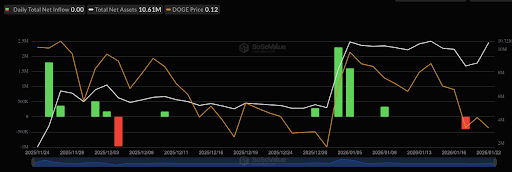
Contrary to expectations, 21Shares’ recently launched Dogecoin ETF saw weak performance on the first day of trading, signaling investors’ lack of interest in the investment product. Data from SoSoValue shows that TDOG experienced no inflows on January 22 and instead declined by about 0.07%. Despite it being the second day of trading, the DOGE ETF has still not registered any flows. 

Dogecoin

This lackluster performance has been observed across all Dogecoin ETFs this week. Grayscales’ GDOG and Bitwise BWOW have reported zero inflows over the last week. The last time GDOG saw positive activity was on January 8, when it received around $333,083 in investments. Before that, the ETF recorded its highest inflows on January 2, totaling roughly $2.3 million. Since its launch in November 2025, GDOG ETF inflows have been unstable, with more days of inactivity than significant investment. 

Dogecoin

Ethereum Loses Structure After $3,220 Rejection — Is This Distribution Or Just The First Crack?

Ethereum has taken a sharp turn after facing a firm rejection at the $3,220 level, with price breaking structure and slipping into a weaker posture. The speed of the drop and lack of strong buying interest raise an important question for traders: Is this merely an early warning sign within a broader uptrend, or the start of a deeper distribution phase that could pressure ETH further in the near term?

Rejection At $3,220 Signals Distribution, Not A Shakeout

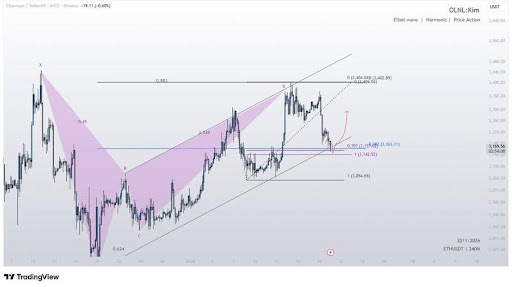
Crypto analyst PEPE is Friend highlighted that Ethereum’s sharp rejection at the $3,220 level was deliberate rather than random. The drop was clean, with key structure breaking down, selling pressure accelerating, and price quickly flushing toward the $3,106 area, aligning with a classic distribution behavior rather than a simple shakeout.

Assessing the current price reaction, there are still no signs of a true reversal. The bounce has been notably weak, trading volume remains thin, and buyers have yet to show a strong commitment. Instead of signaling renewed bullish momentum, the move higher appears to be a technical pullback within a broader weakening structure.

Ethereum

The key technical zone remains well-defined. ETH is trading below the former support band between $3,170 and $3,200. As long as the price stays below this range, any upside move is likely to be viewed as a selling opportunity rather than the start of a sustained recovery. 

When this price action is viewed alongside Ethereum spot ETF data, the picture becomes clearer. While ETF flows remain positive daily, they lack strong momentum or a standout confirmation day. Capital appears to be absorbed rather than aggressively deployed, suggesting institutional demand is not yet strong enough to drive a decisive breakout. Until that changes, sellers are expected to remain in control below the $3,170–$3,200 resistance zone.

Ethereum Slips Below $3,062 As Bears Regain Short-Term Control

In an X post, Kamile Uray noted that Ethereum has closed below the $3,062 level, shifting attention toward the next major downside zone at $2,623. This level is now critical, as holding above it could allow ETH to stabilize and attempt another recovery move.

On the upside, a clean break above the pink-box resistance near $3,445 would activate bullish formations such as a cup-and-handle or an ascending triangle, opening the door for a move toward the $3,894 area.

Further strength would be confirmed if ETH manages to close above the $3,661 high, which would mark the first higher high on the daily chart relative to the previous downtrend, improving the bullish outlook. Still, $3,894 remains a key level, as it aligns with the 0.618 Fibonacci retracement of the last decline.

On the downside, a clear break below the $2,623 low would expose ETH to deeper losses, with the $2,274–$2,104 zone emerging as the next major support area. This region hosts a potential bullish “Libra” reversal setup, and Ethereum could once again attempt a bounce toward its previous all-time high if reversal confirmation appears there.

Ethereum

Bitcoin Adoption In West Virginia Sets A New Regional Benchmark

Bitcoin literacy and community growth are accelerating in West Virginia, and it’s starting to reshape how communities across the state engage with digital finance. What was once viewed as a niche interest among tech enthusiasts is now gaining traction across broader segments of the state’s population. As residents become more curious about digital assets, conversations are shifting from speculation to understanding how BTC works and what it could mean for personal and regional economic resilience.

Bitcoin As A Tool For Regional Economic Growth

West Virginia has been making headlines in the Bitcoin space recently, particularly with fresh legislative moves as of January 2026. MartyParty revealed on X that the biggest current development is Senator Bill 143 (SB143), which was introduced this week by State Senator Chris Rose.

This is officially titled the Inflation Protection Act of 2026, which would allow the state’s Board of Treasury Investment to allocate up to 10% of public funds into precious metals like gold, silver, and platinum. The bill requires any qualifying digital asset to have maintained an average market capitalization of at least $750 billion over the prior year, which qualifies only BTC. In addition, the bill also allows for regulated stablecoins, but only the US federal or state regulators can approve the assets.

Bitcoin

However, the bill frames this as a hedge against inflation and currency depreciation, and empowering the state treasurer to invest in BTC without directly naming it in most of the statute. Although the purpose section explicitly mentions empowering investment in gold, silver, and BTC. These assets would need to be made through qualified custodians, ETFs, or other secure frameworks.

What Pension Funds And Endowments Think About Bitcoin

The Bitcoin price prediction by funds indicates a bullish outlook for 2026. CryptoRank.io has mentioned that the institutional analysts are pricing in a bullish scenario for BTC in 2026. The average target across the forecasts shown is around $150,000 per BTC, implying roughly 75% upside from current levels.

At the same time, longer-term valuation models assume a more gradual growth path. Popular asset manager VanEck predicts BTC could reach approximately $2.9 million by 2050, which equates to around 15% annualized growth broadly in line with the BTC historical long-term performance as a macro asset.

In contrast to institutional forecasts, prediction markets maintain a more conservative outlook. On Polymarket, the pricing base-case range between $110,000 to $130,000. This consensus could shift toward the institutional targets if spot ETF inflows remain strong and if the US regulatory uncertainty continues to decline, including initiatives such as the Blockchain Regulatory Certainty Act.

Bitcoin

Morgan Stanley Seeks SEC Approval for Spot Bitcoin ETF

Bitcoin Magazine

Morgan Stanley Seeks SEC Approval for Spot Bitcoin ETF

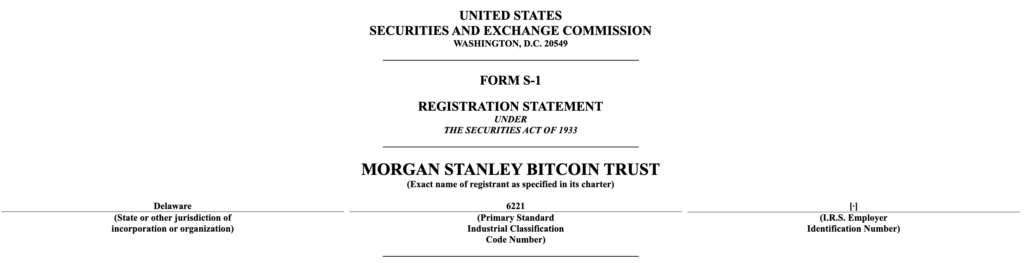
Morgan Stanley has filed with U.S. regulators to launch a spot bitcoin exchange-traded fund, marking the first time a major U.S. bank has sought approval to issue an ETF tied directly to the price of bitcoin.

The filing, submitted to the Securities and Exchange Commission, proposes the Morgan Stanley Bitcoin Trust, an exchange-traded fund designed to track the price of bitcoin, net of fees and expenses. 

If approved, the fund would hold bitcoin directly rather than relying on futures, derivatives, or leverage, according to the registration statement.

The move places Morgan Stanley alongside asset managers that have dominated the bitcoin ETF market since regulators approved the first U.S. spot products in early 2024. 

Those funds now manage more than $120 billion in assets, representing a meaningful share of bitcoin’s total market value. Much of that growth has flowed into bitcoin-only products from firms such as BlackRock and Fidelity.

Morgan Stanley’s entry signals a shift by large banks from distributing third-party crypto products toward issuing their own. 

Until recently, U.S. banks largely limited their role to custody and brokerage services, citing regulatory uncertainty and risk controls. That stance has begun to change as federal agencies clarified how banks can engage with digital assets.

In December, the Office of the Comptroller of the Currency said banks may act as intermediaries for crypto transactions, narrowing the divide between traditional finance and digital markets. The SEC has also adjusted listing standards for spot crypto ETFs, smoothing the approval path for new issuers.

Morgan Stanley steps deeper into bitcoin

The proposed bitcoin trust would be sponsored by Morgan Stanley Investment Management. Shares would be created and redeemed in large blocks by authorized participants, either in cash or in kind. 

The fund’s net asset value would be calculated daily using a pricing benchmark based on activity across major spot bitcoin exchanges. Retail investors would trade shares on a secondary market through standard brokerage accounts.

For Morgan Stanley, the filing builds on steps taken last year to expand crypto access across its wealth management business. In October, the bank widened eligibility for crypto investments to include all clients and account types.

By offering a proprietary bitcoin ETF, the firm can integrate the product directly into client portfolios and retain management fees that might otherwise go to rival issuers.

The move also reflects the economics of the bitcoin ETF market. Spot bitcoin funds have become some of the fastest-growing products in the U.S. ETF industry, with steady inflows even during periods of price volatility. BlackRock’s bitcoin ETF emerged as one of the firm’s top revenue contributors within its first year.

Morgan Stanley also filed paperwork for a similar fund tied to Solana, but bitcoin remains the core focus of institutional demand. Most assets in U.S. crypto ETFs are concentrated in bitcoin products, while funds linked to other tokens have drawn limited capital.

morgan stanley

This post Morgan Stanley Seeks SEC Approval for Spot Bitcoin ETF first appeared on Bitcoin Magazine and is written by Micah Zimmerman.

❌