According to a senior White House crypto adviser, the Bitcoin tied to the Samourai Wallet forfeiture was not liquidated by federal authorities. The assets will remain held by the government under its strategic reserve plan, the adviser said on social media.
White House Advisor Confirms No Sale
Reports have disclosed that about 57.55 BTC — roughly $6.3 million at recent prices — moved through addresses that some observers tracked, which sparked claims the coins had been sold.
The White House adviser, Patrick Witt, stepped in to clear up the matter, saying the Department of Justice confirmed there was no sale.
The coins will be kept in the Strategic Bitcoin Reserve in line with Executive Order 14233, signed in March 2025 by US President Donald Trump. That order directs that seized Bitcoin be held rather than auctioned off.
UPDATE: we have received confirmation from DOJ that the digital assets forfeited by Samourai Wallet have not been liquidated and will not be liquidated, per EO 14233. They will remain on the USG balance sheet as part of the SBR. https://t.co/v2GchC3vk8
Based on reports from blockchain analysts, a transfer to a Coinbase Prime address led to speculation about a disposal. Market watchers noticed the trail and raised alarms because a sale could have put extra downward pressure on prices.
Some traders reacted quickly to the noise. But officials explain that transfers between custody systems do not always mean liquidation. In this case, the DOJ and related agencies say the transfer was an internal custody step and not a sale to private buyers.
Background On The Case
The legal action against the Samourai Wallet developers centered on charges tied to running an unlicensed money-transmitting service and aiding money laundering through mixer tools.
Those charged pleaded guilty. The forfeiture order followed those convictions, and the Bitcoin in question became part of the assets the government controls after the court rulings.
How the government manages such holdings has been a fast-moving policy issue since Executive Order 14233 was issued, which set new rules for seized crypto.
Policy And Market Effects
According to officials, holding seized Bitcoin in a national reserve is meant to avoid sudden market shocks that could follow large government sales.
Some critics argue the reserve gives the government a powerful financial tool, while supporters say it prevents volatile swings.
The announcement eased some short-term market worries because uncertainty about a possible sale had been cited as a potential pressure point for crypto prices.
Reactions From Industry Observers
Based on reports and social posts from crypto advocates, opinions remain split. Some welcomed the clarification as stabilizing.
Others want more transparency on how the Strategic Bitcoin Reserve will be run and when, if ever, coins might leave it.
Lawmakers on both sides of the aisle may ask for hearings or written briefings to get clearer answers about custody practices and future plans.
Featured image from Unsplash, chart from TradingView
Recent allegations regarding the Bitcoin (BTC) sale by the US Marshal Service (USMS) — operating under the Department of Justice (DOJ) — have been addressed by White House crypto advisor Patrick Witt, who confirmed that the digital assets forfeited by Samourai Wallet and its founders have not been liquidated.
DOJ Confirms Samourai Bitcoin Will Not Be Sold
In a post on social media platform X (formerly Twitter), Witt clarified that the DOJ has verified that the digital assets taken from the Samourai Wallet will not be sold, in accordance with Executive Order 14233. He emphasized that these assets will remain on the government’s balance sheet as part of the Strategic Bitcoin Reserve.
Earlier in the month, speculations suggested that the USMS, following directives from the DOJ, had sold approximately 57.55 Bitcoin forfeited in the Samourai Wallet case through Coinbase Prime on November 3, 2025.
The lack of confirmation until now had led experts to assert that such actions would violate EO 14233, signed by President Donald Trump. This order mandates that Bitcoin obtained through criminal or civil forfeiture be retained and added to the US Strategic Bitcoin Reserve, rather than being sold off.
The Bitcoin in question is valued at almost $6.4 million and was seized from the creators of Samourai Wallet. According to US authorities, the cryptocurrency mixer facilitated over $237 million worth of illicit transactions.
Samourai Wallet’s Co-Founders Face Justice
The DOJ had announced in November the sentencing of Keonne Rodriguez and William Lonergan Hill, the co-founders of Samourai Wallet.
Rodriguez, the company’s CEO, and Hill, its Chief Technology Officer, were implicated in a conspiracy involving the operation of a money transmitting business that “knowingly” transmitted proceeds from criminal activities.
The criminal proceeds laundered through their platform originated from various illegal activities, including drug trafficking, darknet marketplace operations, cyber intrusions, fraud, murder-for-hire schemes, and even a child pornography website. Rodriguez received a five-year prison sentence, while Hill was sentenced to four years.
At the time of writing, Bitcoin is trading at $95,300, marking an almost 6% increase over the past seven days. However, it is still unable to regain the key $100,000 level, which has eluded the cryptocurrency since November last year.
Featured image from DALL-E, chart from TradingView.com
Members of the U.S. government have denied reports that bitcoin forfeited by Samourai Wallet developers was liquidated in violation of President Trump’s executive order mandating the retention of government-held bitcoin.
In a brief statement on X on January 16, Patrick Witt, Executive Director of the President’s Council of Advisors for Digital Assets and Deputy Director at the Department of War’s Office of Strategic Capital, said the Department of Justice (DOJ) has confirmed that the forfeited digital assets “have not been liquidated and will not be liquidated” pursuant to Executive Order 14233.
According to Witt, the bitcoin will remain on the U.S. government’s balance sheet as part of the Strategic Bitcoin Reserve (SBR).
“We have received confirmation from DOJ that the digital assets forfeited by Samourai Wallet have not been liquidated and will not be liquidated,” Witt said. “They will remain on the USG balance sheet as part of the SBR.”
The clarification follows reporting by Bitcoin Magazine earlier this month that raised questions about whether the U.S. Marshals Service (USMS), acting under DOJ direction, had sold approximately 57.55 bitcoin — worth roughly $6.3 million at the time — using Coinbase Prime in November 2025.
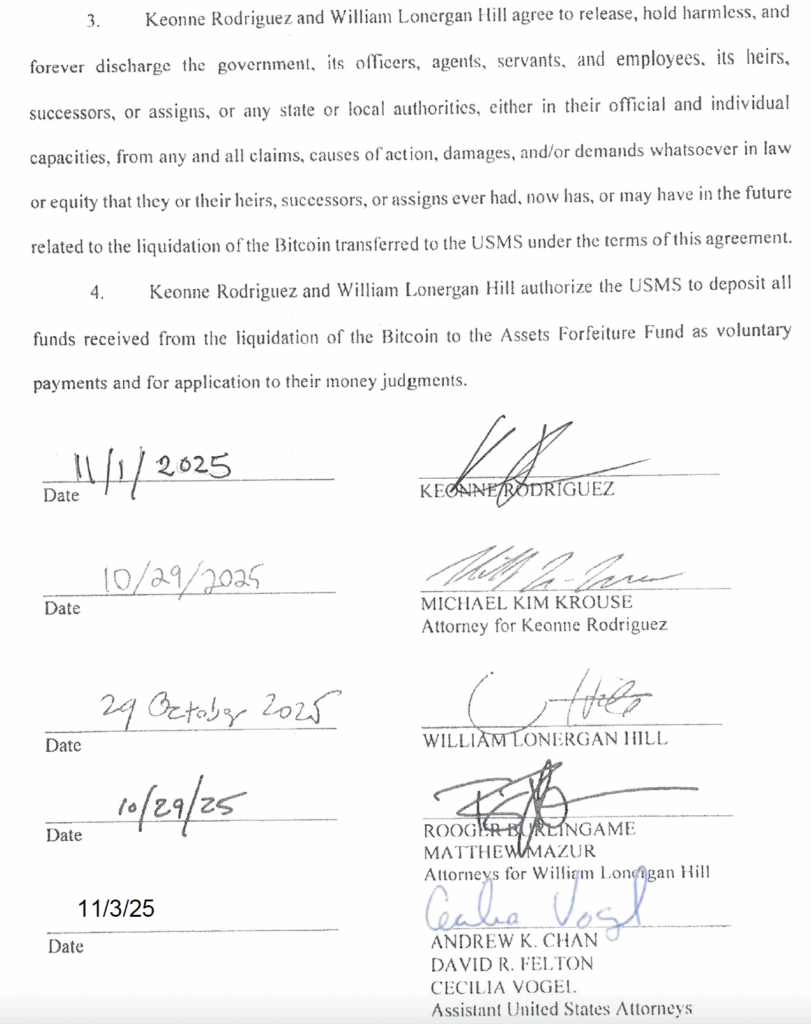
That reporting cited an “Asset Liquidation Agreement” and on-chain data suggesting the forfeited bitcoin may have been transferred directly to a Coinbase Prime address that later showed a zero balance, fueling speculation that the assets had already been sold.
BREAKING: President Trump Executive Director says the government has not sold any bitcoin forfeited by Samourai Wallet and the bitcoin will NOT be sold.
The Samourai BTC will stay in the Strategic Bitcoin Reserve
If true, such a sale would have potentially violated EO 14233, which explicitly states that bitcoin acquired by the U.S. government through criminal or civil forfeiture “shall not be sold” and must instead be retained as part of the Strategic Bitcoin Reserve.
The executive order was designed to reverse the long-standing practice of liquidating seized bitcoin and to formally recognize bitcoin as a strategic reserve asset of the United States.
The Samourai Wallet case has been closely watched within Bitcoin and crypto policy circles, not only because of the forfeiture issue but also due to broader concerns about continued prosecutions of developers of noncustodial software.
Samourai developers Keonne Rodriguez and William Lonergan Hill pleaded guilty and were charged in 2025 to conspiracy to operate an unlicensed money transmitting business, a charge critics argue is incompatible with the noncustodial nature of the software.
Those concerns have been heightened by what many view as inconsistencies between DOJ actions and guidance issued under the Trump administration, including Deputy Attorney General Todd Blanche’s April 2025 memo calling for an end to “regulation by prosecution” of noncustodial crypto tools, according to Bitcoin journalist Frank Corva.
If true, the administration’s confirmation that the Samourai bitcoin remains intact and earmarked for the Strategic Bitcoin Reserve will likely be seen as a win for proponents of the bitcoin industry.
The shadow economy of FPC Morgantown runs on pouches of mackerel. Yes, the fish. Much like any fiat, or precious metal standard there is no intrinsic value to the currency, to the mackerel.
You might be a smart ass thinking to yourself that surely you can eat the mackerel if you wanted and there is some amount of protein that some prison economist has a model for deriving intrinsic value based on caloric density and protein richness. But alas, no.
If you have time to read this article, you have time to sign the petition to free Samourai Wallet developers Keonne Rodriguez and William Hill. Every signature counts. CLICK THE IMAGE ABOVE OR HERE.
Most of the mackerel in circulation is so old that eating it would most certainly result in a visit to the medical station or worse a nasty case of the runs. Trust me when I say the last place you want to have the runs is in a communal toilet block that 100 other guys make use of as well.
So no, the mackerel – also known as Macks – are certainly not for eating. But why mackerel? Why not chicken, salmon, tuna, or like other prisons, stamps? Stamps seem like a more logical choice, they have multiple face value denominations, they are a form of government tender, they have some value on the outside, they are hard to counterfeit, they do not go rancid after time, and in the words of the gentleman I met in the laundry room last night “doggon thangs smell like pussy that gon’ rotten”.
Before we can get into the reason for “The Mack Standard” at FPC Morgantown let us examine more deeply the grey market forces at play by first understanding what the white market looks like.
Each prisoner has two ways to earn dollars while incarcerated. A friend or family member on the outside can “add money to your books” – This means they deposit a sum of money into your prisoner trust fund account held by the BOP on your behalf.
The other way is by earning the dollars through your prison job. Each person in a Federal prison must have a job. The pay for these jobs range from $0.20 to $1.00 an hour, so needless to say if you’re relying on your prison job solely to earn money while inside there is going to need to be some creativity on your part.
What is money actually used for anyway? Where does one spend the money they earn or that friends and family send? Every week there is a designated day that you are allowed to “shop” at the commissary.
You fill out a sheet like you would have found in an old mail order catalog. You mark what item you want and then quantity you want. You then wait in line for over an hour while commissary employees gather the items to be distributed.
You can buy all sorts of items to make your stay in prison more comfortable. Your sentence goes much smoother with limited creature comforts on your side.
For example, you can buy what prisoners call “greys” which is a grey sweatshirt and grey sweatpants so that during off hours you can remove your stiff uncomfortable uniform you can change into something more comfortable.
They sell comfortable sneakers so that during recreation time you can wear something other than your heavy and mightily uncomfortable prison issued work boots. The commissary also sells shelf stable food items and snacks.
Of course, the most important shelf stable item they sell are pouches of mackerel. One pouch goes for $1.40 – They used to be a dollar, but that is inflation for you.
There are several other factors of the white market prison economy to be aware of. These factors really drive the grey market in a prison.
The first is each prisoner has a spending limit imposed on them of $360 per month. It isn’t too difficult to hit that limit.
A tablet for watching rented movies costs $148, a pair of sneakers $70, a pair of more comfortable work boots $100. A pouch of Chicken $4.00.
You have to be quite strategic about what you buy and when in order to make sure you do not run over your allocated spending amount too early in the month.
The second factor is the artificial limits placed on certain items. For example, you can only buy up to 10 pouches of tuna, or only 1 notebook at a time, or only 20 $0.78 stamps, or 10 $1.00 stamps.
Understanding these factors of artificial limits, inflated prices, and suppressed wages we can begin to discover why a grey market exists in every single prison institution, globally.
There exists two primary needs to prisoners participating in the economy. The ability to overcome the artificial limits imposed by the administration and the ability to earn more than is possible by their prison jobs alone.
Quite frankly, it is the same needs and motivations that were readily apparent and well studied by economists during the reign of the Soviet Union. It is the same factors and motivations that ensure a thriving black and grey market in communist Cuba today.
Whenever these types of limits and restrictions are imposed within the otherwise free and unencumbered market by top down administrators, market participants find a work-around.
That is why the black/grey market is the largest market on earth. It has nothing to do with criminality and everything to do with honest actors being pushed out of the permissioned system.
For the guys who don’t have help on the outside, they need to make money on the inside – to supplement the pittance they will earn from their prison job – as such, people run various hustles.
Some guys will do your laundry for you, running what essentially amounts to a wash, dry, and fold service with pickup and delivery. This usually runs for 1 mack per garment with some sort of volume discount for large orders.
Some guys are chefs and will prepare hot food to sell right from their cell like some sort of food stall in a third world bazaar.
You can often smell the (frankly delicious) scents radiating from the chefs makeshift kitchen (by the way, there is a sort of symbiotic relationship with the chef and the laundry man. The chef hoards the iron for use in cooking thereby limiting availability to iron your own clothes. The laundry man has the only other iron, so if you want pressed clothing you must engage his services).
The chef will often have runners that take the hot prepared food from cell to cell, collecting packets of mackerel as payment – a sort of prison equivalent of Uber Eats. I am sure they get some commission for this job they perform.
Of course some guys operate on the wrong side of the “law” and sell contraband items such as cell phones, cigarettes, and vapes though I haven’t seen this personally yet, I have heard of it within the prison.
Apparently the CO’s have heard about it too, as I have experienced two shakedowns (we all are required to leave our living area while a pair of CO’s search our cells and everywhere else in the room including air vents and lighting fixtures).
When sports games are on the TV there will be bookmakers and gamblers trying out their luck at a mackerel windfall. Just like on the outside people will do what they have to do to make a buck – or a mack.
For the guys who do have help on the outside and money flowing onto their books they have slightly different motivations.
Some just want to be able to purchase more than the artificial limits allow for. Some are required by their sentence to pay fines or restitution and if they place too much money on their books, the amount they will be required to repay each month will increase, so it makes financial sense for them to keep their books light on cash, and handle only mackerel. Sort of like the way on the outside a businessman will keep their taxable income as low as possible (think Jeff Bezos famously being paid a salary of $1.00).
And some just want to corner the Keebler Chocolate Cookie market (a very popular item, by the way) and become the go to market maker for that product.
Whatever the motivations or desires, humans make rational decisions in their own economic self interests, being institutionalized in a prison will not change that. In fact, it will amplify it.
Successful hustler will accrue a large amount of macks while in prison. What do they do with it? You may be wondering how they convert some of that to “real money”.
Like every other economy there are currency converters / money changers, and in a prison filled with highly educated white collar criminals, it appears to be a pretty sophisticated operation.
I really haven’t participated in the hustle and bustle. I have only been here long enough to shop at commissary once, and I was able to buy everything I needed without breaking the spending limits or item limits. So while I do not know exactly how this part works I have some inkling of an understanding.
From what I gather converting Macks to Dollars works by the buyer of the macks getting an associate on the outside to send the seller of the macks USD via Cash App or by depositing money onto their books directly using something like Western Union.
Like all economies there is some degree of barter that occurs in the prison system.
Some guys refuse to bother with Macks and instead will trade with higher value chicken, or soda, or flaming hot Cheetos, it all depends on who you are dealing with and what they want. Everything is always open to negotiation.
However, barter soon becomes ineffective at scale and currency must be utilized. Much like all economies, what is used as currency is generally worthless – be it paper, metal, or pukka shells – but there is a sort of shared acceptance (or delusion) that the thing we choose represents some sort of value that we all can agree on.
In FPC Morgantown, that is pouches of Mackerel, and they are worth roughly $1.00
As we close this letter let us return to our original question. Why Macks? Why not stamps?
The short answer is I don’t know. I have theories but I am not certain. My best theory so far is 1) Most people don’t actually want to eat the mackerel, so they stay in circulation longer than something desirable like chicken which more people want to eat; 2) There appears to be no limit on how many mackerel pouches you can buy from the commissary.
From what I gather, stamps are always limited – in fact, most things are – but not mackerel pouches. I think these two observations are what lead my forefather prisoners to found an entire shadow economy based on the Mackerel Standard.
As I write this it is December 26th, The day after Christmas. My 8th night as a prisoner. It hasn’t taken long to start seeing the way things really work, the way the real economy functions, the way humans will adapt to any situation we find ourselves in.
Just like on the outside there are winners and losers, moguls and paupers, blue collar and white collar.
But unlike the outside, there is a shared camaraderie between the classes and strata of prisoner, an “us versus them” undertone, prisoner versus cop.
Merry Christmas everyone. I wish I was there to celebrate with my family and with you.
Please note: You can only send letters (no more than 3 pages long). No packages or other items are allowed. Books, magazines, and newspapers must be sent directly from the publisher or an online retailer like Amazon. All letters must include a full return address and sender name to be delivered.
This is a guest post by Keonne Rodriguez. Opinions expressed are entirely their own and do not necessarily reflect those of BTC Inc or Bitcoin Magazine.
This letter is being syndicated from The Rage. It was originally posted here.
Hello Reader.
I am writing to you from the FPC Morgantown in West Virginia. I surrendered myself on December 19 to begin my 60 month (5 year) sentence.
Surrendering yourself to prison is a fundamentally confusing and unnatural experience. One the one hand you are grateful to have been given a little more time with your loved ones, and more time to prepare. You thankfully get to avoid the dreaded “diesel therapy” (This is when the BOP sends you all across the United States by bus or plane, spending a few weeks in different prison settings, with murderers, rapists, child molesters, and the like before arriving to your final designated institution. All the while because you are unable to take classes you are not earning the possible credits needed to reduce your sentence.) and come in on “your own terms”.
If you have time to read this article, you have time to sign the petition to free Samourai Wallet developers Keonne Rodriguez and William Hill. Every signature counts. CLICK THE IMAGE ABOVE OR HERE.
On the other hand turning yourself in to be incarcerated tugs against every fundamentally primal instinct we have as human beings. The absolutely surreal memory of driving myself to the prison, my wife as my trusted passenger, riding together like we have done so many times before. We both enjoy a banal conversation about the weather that day (snow, rain, and hail all in one drive) to try and mask the fact that I am on my way to give up my liberty, to say goodbye to our family, to begin a long period of incarceration. It is perverse.
At around 1:00 PM on December 19th I pulled into the visitors parking lot. I hugged and kissed my beautiful wife for the last time and walked in the freezing wind and rain to my new home for the foreseeable future.
The officer who met me at the gate was a kindly person. He offered to let me stand in the gatehouse to avoid the blistering cold. He performed a breathalyzer and tried to make me feel at ease with some friendly and casual conversation. A second officer eventually showed up. He searched me, counted the money I brought in with me (bringing in cash was a big mistake I would soon learn), and eventually escorted me into the intake section of the facility.
On the way to the intake section the guard stated matter of factly that it would take until after Christmas for my cash to appear ‘on my books’ – meaning no phone calls and no shopping for over a week. Ah, great. Overall the intake process was quick and efficient. The Corrections Officers (CO’s) and support staff were all professional, some were cordial, some others were even friendly.
I had worn in plain grey sweat pants and a plain grey sweatshirt in the small chance that the intake COs would let me bring those items inside the prison with me. Unfortunately they did not. I was instructed to strip off the clothes until I was fully naked. The clothes were thrown into a plastic bag to be discarded or destroyed. After inspecting my cock, balls, and asshole (sorry, but it is what happened) the CO handed me an oversized pair of khaki pants, a brown shirt with suspicious bleach stains across the front, and a pair of cheap blue slip on shoes.
After getting dressed in the uniform that would scream “newbie!” to everyone who encountered me I was instructed to meet several members of staff.
First on the carousel of rubber stamps was Psychology. I mistook the psychologist for another inmate going through intake. A big man, mean looking, a long scraggly beard down to his chest. If you told me he was on the last 5 years of a 30 year bid I would have said “of course he is”. Anyway he was the psychologist I was instructed to meet. His concern was primarily my mental health and if I was suicidal or not. Like every other member of staff he was respectful and professional.
I was then instructed to meet with the Physician’s Assistant to be medically cleared. Besides a TB test and DNA collection by use of a inner cheek swab, this was as average of a medical exam as one would find in a school nurses office. Once I was through the merry-go-round of clearances I needed to obtain before entering the general population I was introduced to the first inmate I had encountered today.
Shane is an orderly who helps introduce new inmates to their new home. Average height, average build, probably early 60’s, a very friendly Irish face and rosy cheeks. Frankly, he is the perfect person for this role. Shane had collected a jacket, hat, and gloves for me. He was carrying a pillow and bed roll for me, I was carrying a large plastic bag with two spare sets of Intake uniform, two sheets, two towels, two washcloths, two boxers, two pairs of socks, a toilet paper roll, and a small plastic bag filled with basic toiletries. It was explained to me that because I was ordered to surrender on a Friday, I would not get to Laundry for a proper uniform until Monday.
So, I would stick out like a sore thumb until then. Combined with the complications of depositing money onto my account due to a Friday + Holiday surrender it really felt like another farewell gift from Judge Cote who got to turn the screw against me one final time.
Shane pointed out each building on the campus while I tried to keep up with him and retain all this information. I was to be housed in the Bates Unit, apparently this is good fortune because Alexander Unit is filled with rowdy reprobates and has no air conditioning. I will be housed within the B Wing of Bates Unit, which is apparently where they put all the newcomers and younger guys. Older guys and more experienced inmates get assigned to A Wing which is a little quieter.
As we passed every inmate, unmistakable in their khaki uniform and green jacket Shane greeted them by name, they all returned the greeting earnestly. After what felt like 12 left turns we arrived in the B wing, to bunk 25. I was introduced to my cell mate, or “celly” Mike who I was told only arrived here a week ago from a camp in Lexington.
Mike is easily 280-290 lbs so he clearly had the bottom bunk. I would take the top bunk. Trying to take in the sights, sounds, and smells, I noted that I may have been lucky to get Mike as a celly, his cell was fairly tidy, he seemed mature and respectful. I felt at ease with Mike, which is a good thing to feel when you are going to be living with someone in such close quarters. Once Shane dropped me off at bunk 25 he was off. I was left standing like a deer in the headlights.
Nearly immediately Mike was handing me some Cup-O-Noodle Chicken Soups and a water bottle. I didn’t know if this was some sort of loan that would need to be paid back or what, but as I had literally nothing but the newbie uniform I took the handout and made a note to repay him when possible.
Then from across the aisle, Dave introduced himself, – on the outside a former family doctor, on the inside a jovial older man always cracking dry sarcastic jokes – and handed me a can of Coke, some Mrs.. Field’s Chocolate Chip Cookies, some more Cup-O-Noodles and some other goodies. This procession of introductions and offering of gifts continued for nearly half an hour. It became clear these weren’t loans to be repaid but acts of kindness by gentlemen who remembered what their first night in prison was like, and who presumably were helped by someone in a way they are now passing on to me.
Eventually word had got around the camp – they call the gossip network “inmate.com” – that a new guy arrived. Soon I had visitors from other Wings in the Bates Unit.
One gentleman had an entire collection of sweat shirts and sweat pants. He sized me up and handed me a pair as well as some short sleeve and long sleeve grey shirts. Finally he looked at my feet taking note of the cheap flat slip ons that they give you during intake, asked my shoe size, I told him 12.5, after some rummaging he found a pair of sneakers size 11 and handed them to me.
He explained that when someone leaves (either to go home or a transfer to a new institution) he collects the clothing they leave behind, he washes it, and then stores it to hand out to newbies with nothing – otherwise they will be scooped up by less altruistic characters and be sold in the underground economy.
Saying our goodbyes and expressing my sincere gratitude to be able to get out of the uncomfortable temporary uniform and into something way more comfortable I met another prisoner, Omar, a very friendly former pulmonary specialist in his 70s, one of several practicing Muslims and one of several highly skilled doctors. He provided me some toiletries, a bag of instant coffee, a bag of creamer, pens, paper, and his wisdom on navigating this new environment. Very importantly he offered to show me the ropes at dinner time which would be called momentarily.
While we waited to be called for dinner time Omar introduced me to several of his friends, mostly doctors and highly educated scientists. Once dinner was called we made the 10 minute walk from Bates Unit to the “Chow Hall”, they were serving lasagna which was surprisingly good and offered in a generous portion size. It was served with a side of iceberg lettuce and boiled spinach. The lettuce was fine with the bright orange colored (and expired) “French dressing” that was offered in small packets. The boiled spinach needed salt and was quite difficult to eat.
It seemed like I had just sat down to eat when they called over the intercom that dinner was now closed. I will need to eat much quicker than I am used to.
When I returned to my bunk I met another neighbor, Hasan, a young Muslim, well groomed, fit, tidy and friendly. He introduced himself, gifted me a white cotton t-shirt and a pair of grey gym shorts. I hung around on my bunk, not really knowing what to do. I knew there would be a final count – where we need to stand up silently by our beds and be counted by guards – at 9:00PM which would then be lights out until the morning.
I frankly was very tired and wished I could go to sleep right then, but I forced myself to stay awake until after the 9:00PM count occurred. Thankfully they turned the lights off right after the count, after brushing my teeth I climbed into the bunk, ready to call it a night. No one else was on that schedule however, and the housing unit was wide awake, loud, and buzzing with activity.
I would have to get used to the noise. Eventually I fell asleep. I slept fairly well, but woke up early around 2:30 AM. Thanking God that Omar had gifted me coffee, I enjoyed a hot cup when I woke up and throughout the morning.
Over the next several days I would meet new people, learn new tactics for surviving this very alien environment, and make several new friends along the way. While not at all comfortable, it is manageable. While I rather be at home with my wife and family, there are far worse places I could have ended up. I am thankful that all the prisoners here are respectful and downright friendly. I am thankful that the staff and CO’s seem to be also be respectful provided you don’t give them a reason not to be.
This letter recounts the first day on the inside, December 19th. As I write this it is December 24th, Christmas Eve.
Tomorrow will be the 7th day I have spent in FPC Morgantown. I will be having my first visitor, my wife. I am beyond excited to see her. I will continue writing the story as it happens and as I am able.
Please note: You can only send letters (no more than 3 pages long). No packages or other items are allowed. Books, magazines, and newspapers must be sent directly from the publisher or an online retailer like Amazon. All letters must include a full return address and sender name to be delivered.
This is a guest post by Keonne Rodriguez. Opinions expressed are entirely their own and do not necessarily reflect those of BTC Inc or Bitcoin Magazine.
It seems that the U.S. Marshall Service (USMS) has sold the $6.3 million worth of bitcoin that Samourai Wallet developers Keonne Rodriguez and William Lonergan Hill paid the U.S. Department of Justice (DOJ) as a fee that was part of their guilty plea.
In doing so, it has potentially violated Executive Order (EO) 14233, which mandates that bitcoin acquired via criminal or civil asset forfeiture proceedings should be held as part of the United States’ Strategy Bitcoin Reserve (SBR).
If the Southern District of New York (SDNY), the federal judicial district in which the Samourai case was to be tried, did, in fact, violate EO 14233, it would not be the first time employees of the SDNY have acted in defiance of direction from the federal government.
What Happened to the Bitcoin?
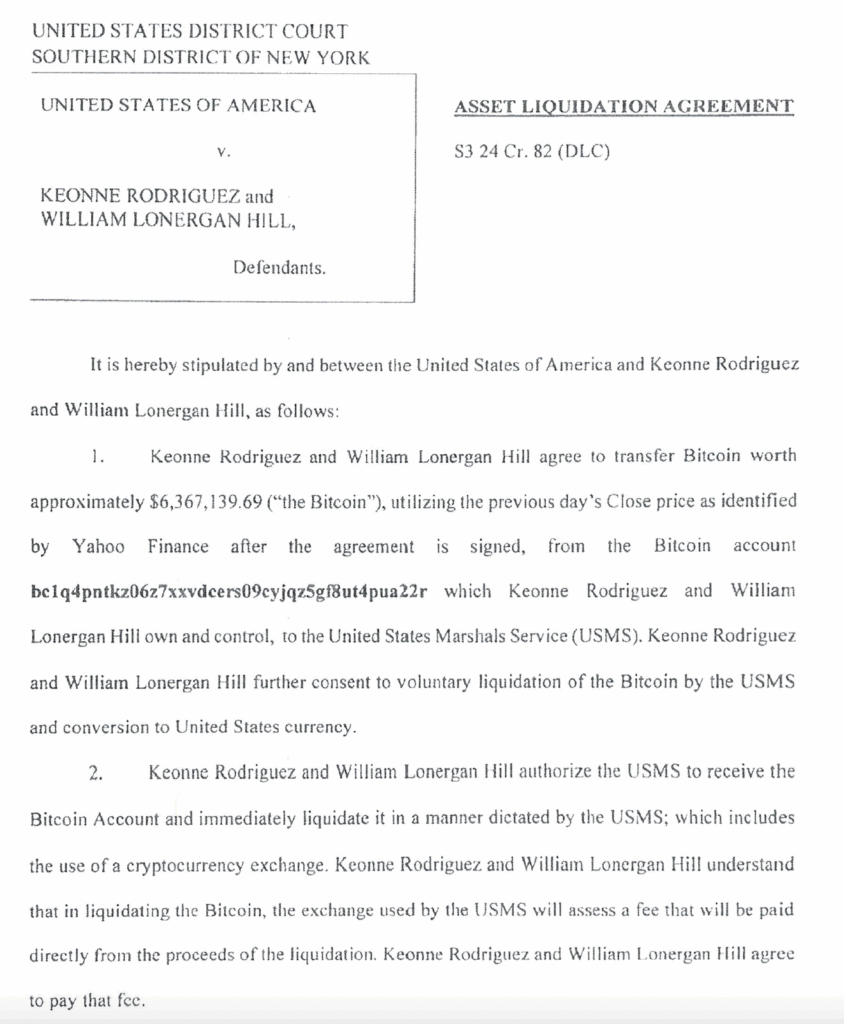
According to a document titled “Asset Liquidation Agreement”, which has been obtained exclusively by Bitcoin Magazine and has not until now been made public, the bitcoin that Rodriguez and Hill forfeited is to be sold — or already has been.
As per the document, the defendants agreed to transfer $6,367,139.69 worth of bitcoin — 57.55353033 bitcoin at the time the final party signed the agreement, which was Assistant United States Attorney Cecilia Vogelon November 3, 2025 — to the USMS.
The bitcoin, which was sent from address bc1q4pntkz06z7xxvdcers09cyjqz5gf8ut4pua22r on November 3, 2025, seems to have bypassed any direct custody by the USMS. Instead, it seems to have been sent directly to Coinbase Prime address 3Lz5ULL7nG7vv6nwc8kNnbjDmSnawKS3n8 (Arkham Intel attributes this address to the brokerage), presumably to be sold.
This Coinbase Prime address currently has a zero balance, indicating that the bitcoin may have already been sold.
Violating Executive Order 14233
If the USMS has sold the forfeited bitcoin, it likely contravened EO 14233, which orders that bitcoin acquired by the U.S. government via criminal forfeiture, termed “Government BTC” in the EO, “shall not be sold” and should be contributed into the U.S. SBR.
If the USMS sold the bitcoin, they did so at their own discretion and not as a legal mandate, which indicates that certain members of the DOJ may still view bitcoin as a taboo asset to be offloaded as opposed to a strategic asset that President Trump has directed government agencies to retain.
Given that the Samourai prosecution originated under the previous administration, which was notoriously hostile toward noncustodial crypto tools and their developers, the decision to ignore EO 14233 and sell the bitcoin despite a mandate from the executive branch fits a pattern of treating bitcoin as something that should be removed from government balance sheets as soon as possible.
Legal Details Regarding the Forfeiture and Liquidation
According to a legal source close to this matter, the Samourai developers’ forfeited their bitcoin under 18 U.S. Code § 982(a)(1), which stipulates that any offense that violates 18 U.S. Code § 1960, the statute that prohibits the operation of unlicensed money transmitting businesses, orders that person to forfeit to the United States any property involved in the offense.
Judging by § 982 and its incorporation of 21 U.S.C. § 853(c), a criminal forfeiture statute that stipulates that “property that is subsequently transferred to a person other than the defendant may be the subject of a special verdict of forfeiture and thereafter shall be ordered forfeited to the United States,” the bitcoin that Rodriguez and Hill forfeited fits the EO’s definition of “Government BTC”.
Neither § 982 nor the incorporated § 853 requires that property that is forfeited as part of a criminal offense be liquidated. Furthermore, the fund forfeiture statutes cited in section three of the EO — 31 U.S.C. § 9705 and 28 U.S.C. § 524(c) — regulate where forfeiture proceeds are deposited and how they may be used; they do not require that forfeited bitcoin be converted to cash rather than held in kind.
The EO also stipulates that “Government BTC” falls under the umbrella of “Government Digital Assets” and states that “the head of each agency shall not sell or otherwise dispose of any Government Digital Assets” except in certain scenarios, none of which apply in the Rodriguez or Hill cases and, in all of which, the U.S. attorney general would play a role in determining what should be done with the forfeited digital assets.
The Sovereign District of New York
When taking EO 14233 and the statutes cited in this article into account, the SDNY seems to have acted in a manner that defies the EO 14233’s mandate to transfer bitcoin obtained via criminal forfeiture to the U.S. SBR.
This would not mark the first time that the SDNY has acted in such a manner.
The judicial jurisdiction, sometimes colloquially referred to as “Sovereign District of New York,” has earned a reputation for operating independently and unilaterally, despite being part of a federal system.
On April 7, 2025, Deputy Attorney General Todd Blanche issued a memo entitled “Ending Regulation By Prosecution” in which he stated “the Department [of Justice] will no longer target virtual currency exchanges, mixing and tumbling services, and offline wallets for the acts of their end users…”
The SDNY seemed to disregard the language in this memo, though, as it proceeded with the Samourai Wallet or Tornado Cash cases.
And when the defense team for Hill and Rodrguez learned as per a Brady request that two high-ranking members of the U.S. Department of the Treasury’s Financial Crimes Enforcement Network (FinCEN) “strongly suggested” that Samourai Wallet wasn’t serving as a money transmitter due to the noncustodial nature of the service, the prosecution proceeded anyway.
Rodriguez was aware of these statistics, as well as the fact that Judge Denise Cote, the judge who presided over his and Hill’s cases, has a reputation for harsh sentencing.
He told me as much the morning before he pleaded guilty to the conspiracy to operate an unlicensed money transmitter business charge.
Is the War on Crypto Really Over?
Many Bitcoin and crypto proponents who voted for President Trump in 2024 as well as the crypto industry, which supported the president in his reelection, are now beginning to question whether or not President Trump really does want to see an end to the war on crypto.
For this to happen, the DOJ under President Trump must honor what is mandated in EO 14233 and follow Deputy Attorney General Blanche’s guidance to stop prosecuting developers of noncustodial crypto technology.
His pardoning Rodriguez as well having the DOJ look into why it sold the bitcoin that the Samourai developers forfeited would send a signal that the president is quite serious about his pro-Bitcoin and pro-crypto stance.
President Donald Trump said he’ll review the case of Keonne Rodriguez, co-founder of Samourai Wallet, as questions mount over the federal conviction of the Bitcoin privacy software developer.
When asked about Rodriguez’s upcoming prison sentence, Trump said, “I’ve heard about it. I’ll look at it.”
“I don’t know anything about it,” President Trump said. “But we’ll take a look.”
Rodriguez publicly acknowledged Trump’s sentiment, tweeting “Your continued noise is working. Thank you to everyone pushing @realDonaldTrump to pardon Bill and me. Let’s get this over the line. #pardonsamourai”
Rodriguez, along with co-founder William “Bill” Hill, was convicted of conspiracy to operate an unlicensed money transmitting business, a charge stemming from Samourai Wallet, a Bitcoin privacy tool that allowed users to mix coins and maintain financial anonymity without giving up custody of their funds.
JUST IN: President Trump says he will consider a pardon for the CEO of privacy-focused Bitcoin wallet Samourai.
The case, which began under the Biden administration and continued through the Trump Justice Department, culminated in Rodriguez receiving a five-year sentence and Hill four years, though Hill’s age and recent autism diagnosis led to a reduced sentence.
Critics of the prosecution argue the case represents a dangerous precedent for the cryptocurrency industry. The U.S. Department of Justice claimed that Samourai Wallet facilitated over $2 billion in unlawful transactions and laundered more than $100 million from criminal sources. However, only the “unlicensed money transmission” charge survived a high-profile trial, raising questions about the strength of the case.
Samourai Wallet’s mixing services, Whirlpool and Ricochet, were designed to obscure the origin of criminal proceeds from activities including drug trafficking, darknet marketplaces, fraud, cybercrime, and murder-for-hire operations.
Court documents reveal the developers actively encouraged criminal use, describing the service as “money laundering for bitcoin” and promoting its tools on darknet forums.
The Department of Justice framed the case as part of a broader crackdown on crypto mixing services. Rodriguez had requested a light sentence, but the court imposed the statutory five-year maximum.
Trump’s comments come amid his campaign promises to defend the right to self-custody and financial privacy. During the 2024 Bitcoin Conference in Nashville, he pledged to end what he described as the “anti-crypto crusade” of the prior administration.
With Rodriguez set to report to prison on December 18 and Hill already sentenced, the Trump administration faces a high-profile decision that could shape the future of financial privacy, software development, and cryptocurrency regulation in the United States.

 Login
Login

 President Trump Executive Director says the government has not sold any bitcoin forfeited by Samourai Wallet and the bitcoin will NOT be sold.