Rokid has launched its AI Glasses Style at $299, positioning them as a lighter, screenless, and more affordable alternative to Meta Ray-Ban glasses while focusing on voice-first AI features like translation and assistance.
Mentra Live is a Ray-Ban Meta alternative with a rare perk, an open-source OS and a MiniApp Store. It’s limited-run, app-driven camera glasses, but real-world polish and privacy details still need proof.
Samsung XR smart glasses may launch in two versions. A leak cites model numbers SM-O200P and SM-O200J, plus a 12MP autofocus camera, Wi-Fi and Bluetooth, and transition lenses on one variant.
In a recent article from IEEE Spectrum, [Alfred Poor] asks the question what do consumers really want in smart glasses? And are you finally ready to hang a computer screen on your face?
[Alfred] says that since Google Glass was introduced in 2012, smart glasses haven’t yet found their compelling use-case. Apparently it looks like while virtual reality (VR) might be out, augmented reality (AR) might be in. And of course now we have higher levels of “AI” in the mix, whatever that means.
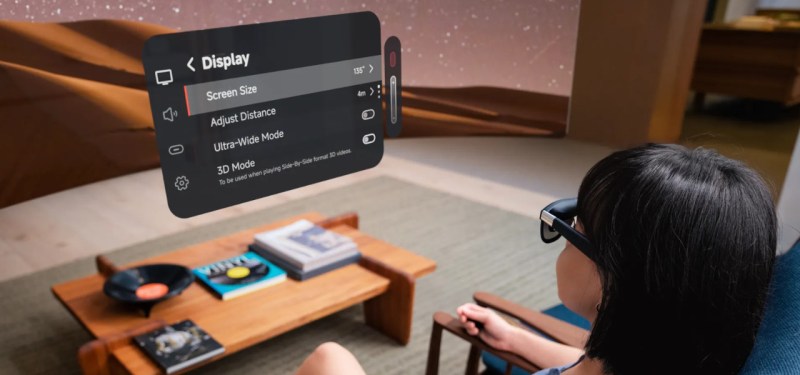
According to the article in the present day there are two competing visions of what smart glasses might be: we have One Pro from Xreal in Beijing, and AI Glasses from Halliday in Singapore, each representing different design concepts evolving in today’s market. The article goes into further detail. The video below the break is promotional material from Halliday showing people’s reactions to their AI Glasses product.
[Alfred] talks with Louis Rosenberg, CEO and chief scientist of Unanimous AI, who says he believes “that within five years, immersive AI-powered glasses will replace the smartphone as the primary mobile device in our digital lives.” Predicting the future is hard, but what do you think? Sound off in the comments!

 Login
Login