Reading view

There are new articles available, click to refresh the page.

New year, new opportunities? Here’s where contractors should focus in 2026

Interview transcript:

Terry Gerton Deltek has a new report out that’s looking ahead for federal contractor intelligence for 2026. But before we look forward, I want to look back a little bit. When you think of everything that happened in the contracting space in 2025, what stands out for you as the biggest trends?

Kevin Plexico Well, chaos reigns supreme this past year, for sure. And what I find just super interesting is that some companies happen to find themselves in really good places and align to the goals of the new administration and did really well. And others that happened to be in sort of the wrong place at the wrong time had profound impact. I think 2025 was a year where companies had to really take stock of the organizations that they’re selling to and their offerings to make sure they’re aligned to the goals of the administration and the mission that the government agencies have been asked to take on by that administration. That’s probably, to me, the biggest change. There’s been so much movement of money, in some cases money coming out of certain agencies. We’ve all heard about Agency for International Development and Department of State and Education. But then you look at organizations like the VA, DHS, and DoD that have continued to do really well. So, a lot of haves and have-nots this year, and I think for companies it’s just trying to figure out, based on this new administration, where should we really be aiming to be able to capitalize on it going forward?

Terry Gerton Every administration comes in with different priorities, but it seems like this one was able to make the pendulum swing really fast, and that may have caught companies off guard. What are some of the hard conversations that had to happen inside those boardrooms?

Kevin Plexico Well, early on, it was all about DOGE and the DOGE organization really putting some unprecedented pressure on some vendors. I mean, some of the letters I saw sent to professional services companies and some of demands that were made of value-added resellers were not anything I’ve seen a federal agency communicate to a vendor that was otherwise performing to the jobs that they were asked to do. And I think it’s, in some respects, a bit surreal that the administration was asking companies to identify wasteful spending. It’s just an awkward situation to be in if you have a customer, and the customer already hired you to do the work, and you’re now being asked to identify where there’s wasteful spending in that and sort of serve up cuts. So I think that was the early part of the year. We did see that start to sunset a bit and fade as we got into the summertime. But then all of a sudden, all eyes were turning to appropriations and funding for 2026. And we all know where that’s landed, which it hasn’t. We’re still waiting for full-year 2026, with just a couple agency exceptions. We bought some time ending the shutdown, which was, as you know, the longest on record. But there’s nothing to say that we might not have another shutdown here at the end of January. I still think where there’s that bit of uncertainty, the one silver lining this past year for the contracting community is the One Big Beautiful Bill, just because it had so much opportunity in it for contractors that really cut across the gamut of aerospace, defense, professional services, training, architecture, engineering, construction. There was literally something in there for everybody, but it does require really an honest assessment by a company to figure out, okay, how do we get after this? Because that might not be in the agencies that they’re used to doing business in.

Terry Gerton Right. And a lot of those funds haven’t been dispersed yet. So they’re still maybe in the RFP or RFQ stage. This unpredictability of funding flows is something you don’t normally see in government contracts. Everything from stop-work orders and termination notices earlier in the year to unpaid bills at the end of the fiscal year and the CR. Has that caused the GovCon community to sort of re-evaluate and re-adjust their planning for predictable cash flows?

Kevin Plexico I think this year, while it was a record-setting shutdown, is not an unusual year in that we don’t have a line of sight on what line appropriations are going to get done. I think industry has become used to that scenario. And while shutdowns are certainly not good for anyone, they’re usually relatively short-lived because of what happens. The pain gets so severe that finally Congress is like, we’re inflicting a lot of pain on rank-and-file Americans, we need to resolve this. I’m hoping that cooler heads will prevail the next time that this comes around. What I think is perhaps different this time versus what we’ve seen, say, the last decade or so is we’ve always had a bipartisan budget agreement or resolution that sort of set the top line that appropriators were negotiating towards. I think we’ve had that literally for about a decade, since back during the Budget Control Act, and we don’t have that for ’26. So there was no goalpost that Congress was working towards on a bipartisan basis that that they agreed on previously. And I think that’s the same for 2027. That’s what’s unique about this, is there’s nothing that says, here’s the goal that we’re working towards, and then how do we allocate it by the different appropriations bills that are negotiated?

Terry Gerton Kevin Plexico is senior vice president of information solutions at Deltek. Kevin, let’s turn our attention to the windshield and not the rear-view mirror now. With all of that disruption in 2025, what is at the top of Deltek’s intelligence report for 2026?

Kevin Plexico Well, I think 2026 is going to be a better year than 2025, thanks primarily to the One Big Beautiful Bill. As you pointed out, it’s not a single-year appropriation. The funding in that legislation lasts through, I think it has to be committed in contracts essentially by the end of 2029; then expenditures can take longer. So that gives us a bit of time and it certainly doesn’t mean that it has get rushed out the door like we’ve seen — some emergency supplemental appropriations have had that shape. And so that provides some longer-term opportunity and ability for companies to reposition, to get after some of that money. The biggest challenge on the base-level appropriations, we’ve got this ambitious goal of growing defense spending, paid for by significant cuts in civilian spending, and we saw that under the prior Trump administration. But they were never able to get appropriators to buy off on that. And I think that’s the dynamic that we have in the Senate, where it has to get 60 votes to get past the filibuster. It does really need a bipartisan-level agreement to get appropriations done. That’s particularly challenging in these contentious times, but I do think it helps prevent those draconian cuts that could be put in place for some civilian agencies that we’ve seen this and the prior Trump administration ask for that usually have not been enacted.

Terry Gerton One of the sectors that’s really struggled this past year is small businesses. What do you see in the future for them?

Kevin Plexico This is an interesting one, because on the one hand, the government has done a really good job of spending money with small business. But if you look at the level of participation in terms of prime contracts, it’s going down. The number of small businesses I think has declined by close to 30% over the last several years in terms of prime contracting. And I think that’s a problem that the administration really has to take a look at. Unfortunately, some of the things that we’re seeing them do around relying on best-in-class contracts, don’t create a new contract if there’s already an existing contract that you can place a task or delivery order under — those really favor the companies that already have those prime contracts. I think it makes it challenging for small businesses to enter the market. On the research and development side, we’re still waiting for Congress to extend the SBIR and STTR programs, which are Small Business Innovative Research-related work. So it’s a challenging market for all companies, but in particular for small businesses. They’re dependent on cash flow; shutdowns particularly impact small businesses. The rule changes that are being made in the FAR overhaul are pretty profound in terms of their impact on small business. I think it’s unpredictable to understand how much is it going to affect a service-disabled veteran-owned business versus an 8(a) company versus a women-owned business. It seems like they’re gravitating more towards a preference of just small business set-asides and trying to get away from sole-source awards. And that’s a big change for the small business community for sure. So I think getting smart about the new rules and how they’re going to be applied agency by agency is going to be super important for small businesses.

Terry Gerton Well, speaking about the FAR overhaul, let’s talk about GSA for a minute. They’ve really worked over this last year to centralize a lot of buying strategies, centralize lot of contracts. They’ve updated the OASIS contract. What are you seeing and what should contractors be expecting to hear from GSA?

Kevin Plexico Well, I think the thing that’s created a lot of confusion is the way they’re rolling it out. Usually when FAR changes are rolled out, they go through a rulemaking process, they issue drafts, take comments and then go to a final rule or interim rule. What they’ve done in this particular situation is instead of approaching it in that traditional way, they’ve rolled out the revised FAR and basically said that agencies can adopt it if they get a class deviation. So, you have to literally go to the FAR overhaul website and see which agencies have adopted these FAR clauses. And right now you basically have different agencies using different versions of the FAR. The DoD is still using the traditional FAR and DFAR. They don’t have any class deviations that I’m aware of, but many civilian agencies do. So it just puts a lot of onus on the contracting community to really be mindful of what regulations are being followed by the agency you’re selling to, because it’s not the same as everybody’s following the FAR anymore. Which version of the FAR? Is it this class deviation or is it the traditional FAR? And that’s just an example of the chaos that we talked about.

Terry Gerton If you could give contractors one piece of advice as they’re trying to put their 2026 business strategies together, what would it be?

Kevin Plexico I go to what we call the four Cs. Customers: Who are the right customers that you’re going to be focused on selling to? Contracts: What vehicles are they going to be using to get access to those providers? Compliance: What do you need to be able to comply with, and I know the CMMC is a big one, but even with all the FAR overhaul changes, I haven’t seen what I would call a deregulation of compliance requirements. There’s pressure on agencies to use more fixed-price; that would potentially take away some of the accounting requirements that come along with a cost-plus contract. I think I might have missed a C in that, but you get the gist of it, right? It’s really just being more strategic and being more thoughtful about how you’re going to go to market. You can’t just afford to live off the agencies you’ve been doing business with, because they might be starving for money going forward. So you really have to take an honest assessment of where you are today, where you want to play, and how are you going to position yourself to get there? Because it’s not a quick pivot by any stretch.

The post New year, new opportunities? Here’s where contractors should focus in 2026 first appeared on Federal News Network.

© Getty Images/iStockphoto/Urupong

Analyst working with business analytics and data management system on computer to make report with KPI and metrics connected to database.

Trove Shocks Investors: $9.4M ICO Funds Retained, Token Crashes 95% After Solana Pivot

Trove Markets has come under intense scrutiny after confirming it will retain roughly $9.4 million from a token sale that was originally marketed around a planned integration with Hyperliquid, despite pivoting its perps DEX to Solana just days before its token launch.

This led its newly launched TROVE token to collapse by more than 95% minutes after trading began.

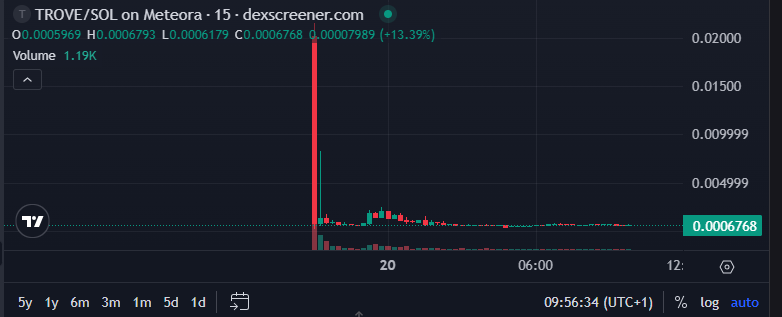
TROVE launched with an expected market capitalization of about $20 million, but within ten minutes of going live, the token plunged to around $0.0008, cutting its valuation to under $2 million, as shown by DEXScreener data.

Source: DEXScreener

At the time of writing, TROVE is trading near $0.000703, with a market cap of roughly $703,000.

The sudden drop followed growing frustration from contributors who said the project had changed direction too late in the fundraising process.

Liquidity Exit Triggers Trove’s Shift From Hyperliquid to Solana

Trove had raised more than $11.5 million through a public token sale tied to building a perpetual decentralized exchange using Hyperliquid’s infrastructure.

Just days before the token generation event, however, the team announced it would pivot to Solana instead.

That shift immediately raised questions about whether funds collected for the Hyperliquid build should be returned.

Instead, Trove said it would retain $9,397,403 to continue development on Solana, describing the move as the only viable way to keep the product alive.

One of Trove’s builders, known as Unwise, attributed the abrupt pivot to the withdrawal of a key liquidity partner, who had previously supported the Hyperliquid path with a position of roughly 500,000 HYPE tokens.

We’re pivoting Trove to Solana.

After recent sentiment around Trove, the liquidity partner that had been supporting our Hyperliquid path chose to unwind their 500k $HYPE position. That was their decision and we fully respect it.

This changes our constraints: we’re no longer…

— unwise (@unwisecap) January 18, 2026

With that support gone, the team said it no longer made sense to continue building on Hyperliquid rails and opted to rebuild the perps exchange on Solana from scratch.

Trove said the decision fundamentally changed its constraints and forced a reset rather than pushing forward with what it described as an uncertain setup.

Trove acknowledged on X that its handling of the ICO and subsequent decisions caused confusion, frustration, and a breakdown of trust.

https://t.co/sc8b59sjYE

— TROVE (@TroveMarkets) January 19, 2026

Trove said it had already refunded about $2.44 million as part of cleaning up participation and protecting distribution integrity, with an additional $100,000 slated to be refunded automatically to ICO participants.

The remaining funds, it said, have been spent or earmarked for developer salaries, frontend and backend infrastructure, a chief technology officer, advisory services, marketing, and operating costs.

Trove Under Pressure as Community Questions Fundraising Conduct

Despite those explanations, critics have continued to question the handling of the raise.

On X, some users accused the project of breaking fundraising expectations, arguing that money raised to build on Hyperliquid should not be repurposed after a last-minute pivot.

refund the people now!!!

you raised to money to build on hyperliquid!

Give back the money and raise on solana if you think that's what your community really wants

— HYPEconomist (@HYPEconomist) January 18, 2026

Others went further, calling for refunds, threatening legal action, or alleging the situation could result in lawsuits.

Additional on-chain analysis added to the controversy with data shared by Bubblemap showed that a single entity appeared to control about 12% of the TROVE supply, spread across dozens of fresh wallets funded through the same exchange and clustered in tight time windows.

2/ $TROVE launched earlier today and quickly dropped -90%

• The presale was at $20M FDV
• It now trades around $2M FDV https://t.co/HHABuaSnz7 pic.twitter.com/2FhDwew2IX

— Bubblemaps (@bubblemaps) January 19, 2026

Bubblemap said it had found no evidence directly linking those wallets to the Trove team but noted that the pattern raised open questions about presale behavior.

The turmoil follows an already chaotic ICO process earlier in January.

Trove initially announced the sale had crossed $11.5 million, far above its $2.5 million target, and promised pro-rata refunds. It then briefly announced a five-day extension, only to reverse that decision hours later, citing a mistake.

The post Trove Shocks Investors: $9.4M ICO Funds Retained, Token Crashes 95% After Solana Pivot appeared first on Cryptonews.

Making a mountain bike data acquisition system

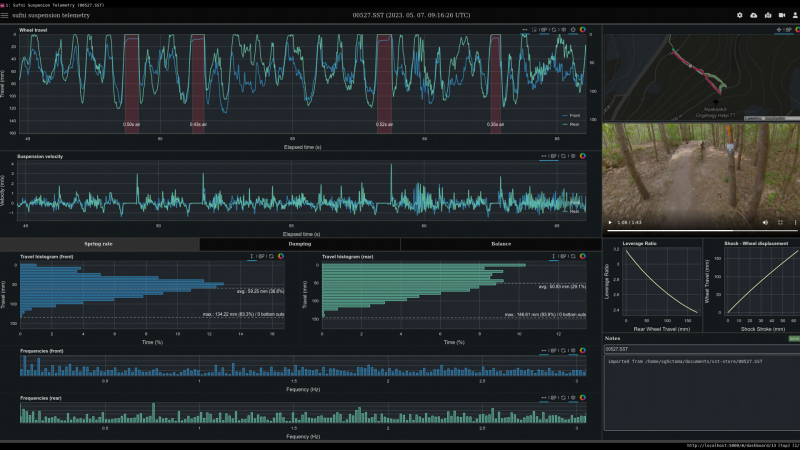
Professional mountain bike racing is a rather bizarre sport. At the highest level, times between podiums will be less than a second, and countless hours of training and engineering go into those fractions of seconds. An all too important tool for the world cup race team is data acquisition systems (DAQ). In the right hands, they can offer an unparalleled suspension tune for a world cup racer. Sadly DAQs can cost thousands of dollars, so [sghctoma] built one using little more then potentiometer and LEGO. 

The hardware is a fairly simple task to solve. A simple Raspberry Pi Pico setup is used to capture potentiometer data. By some simple LEGO linkage and mounts, this data is correlated to the bikes’ wheel travel. Finally, everything is logged onto an SD card in a CSV format. Some buttons and a small AMOLED provide a simple user interface wrapped in a 3D printed case.

Analyzing the data is a rather daunting task. The entire analysis framework is neatly wrapped into a web server. The DAQ can automatically sync with the web interface, and provide suspension metrics in conjunction with action camera footage and a GPS track for further analysis.

However, not all is as it seems when it comes to correlating the suspension data into such a nice UI. A key issue is that with four bar, or even six bar, mountain bike linkage designs, the leverage ratio applied to the shock changes through the wheels travel. That means, when measuring shock travel, it needs to be adjusted to find wheel travel according to manufacturer specifications.

You need to be a bit of a suspension wizard to make sense of the charts. Nevertheless, for the mountain biking hackers out there, everything is available on Github, so if you wish to analyze suspension performance, make sure to check it out!

This isn’t the first time we have seen mountain bike data loggers, make sure to check out this simple Arduino build next! 

Build Your Own Token Creator: Integrating @escapehub/token-creator SDK with React, Vue, and Svelte

By: EscapeHub

Creating ERC20 tokens has traditionally required deep Solidity knowledge and complex deployment scripts. The @escapehub/token-creator SDK changes that by providing a simple, framework-agnostic JavaScript library for deploying feature-rich tokens across 40+ EVM chains.

This guide shows you how to integrate the SDK into React, Vue, and Svelte applications — complete with wallet connections, vanity address mining, and multi-step token configuration wizards.

What is @escapehub/token-creator?

The @escapehub/token-creator SDK is a TypeScript library that handles:

  • Token deployment to 40+ EVM-compatible blockchains
  • Vanity address mining — generate custom token addresses (e.g., starting with 0xCAFE...)
  • Configurable token features — burns, fees, limits, security options
  • Chain configuration — built-in factory addresses, RPCs, and explorers for all supported networks

Supported Chains

The SDK supports major networks including:

  • Ethereum & Sepolia
  • Base & Base Sepolia
  • BNB Smart Chain & BSC Testnet
  • Polygon & Polygon Amoy
  • Arbitrum One & Arbitrum Sepolia
  • Avalanche, Fantom, Optimism, and 30+ more

Live Examples

Before diving into code, check out these production implementations:

Core SDK Usage

The SDK is framework-agnostic. Here’s the core pattern used across all frameworks:

Installation

npm install @escapehub/token-creator ethers

Token Deployment

import { deployToken, createDefaultConfig, getChainConfig } from '@escapehub/token-creator';
import { BrowserProvider } from 'ethers';
// Get ethers signer from your wallet provider
const provider = new BrowserProvider(walletClient, walletClient.chain.id);
const signer = await provider.getSigner();
// Build token configuration
const config = createDefaultConfig('My Token', 'MTK', '1000000', ownerAddress, {
burnEnabled: true,
feesEnabled: true,
buyFeeBps: 300, // 3% buy fee
sellFeeBps: 300, // 3% sell fee
// ... more options
});
// Get chain config (factory address, RPC, explorer, etc.)
const chainConfig = getChainConfig(chainId);
// Deploy the token
const result = await deployToken(signer, config, chainConfig, salt);
console.log('Token deployed:', result.tokenAddress);

Vanity Address Mining

Want your token address to start with 0xDEAD or 0xCAFE? The SDK includes async vanity mining:

import {
generateSaltAsync,
getImplementation,
getMinimalProxyInitCodeHash,
getChainConfig,
} from '@escapehub/token-creator';
const chainConfig = getChainConfig(chainId);
const implementation = await getImplementation(provider, chainConfig.factoryAddress);
const initCodeHash = getMinimalProxyInitCodeHash(implementation);
const result = await generateSaltAsync(chainConfig.factoryAddress, initCodeHash, {
pattern: 'CAFE',
mode: 'prefix', // or 'suffix', 'contains'
maxAttempts: 10_000_000,
onProgress: (attempts, hashRate) => {
console.log(`Mining: ${attempts} attempts at ${hashRate} H/s`);
},
});
if (result) {
console.log('Found address:', result.address);
console.log('Use this salt:', result.salt);
}

Framework Integrations

Now let’s see how to wrap the SDK for each framework. The core logic is identical — only the state management differs.

React Integration

Tech Stack: React 18, TypeScript, wagmi v2, Reown AppKit, Tailwind CSS

Create a custom hook for deployment:

// hooks/useTokenDeploy.ts
import { useState } from 'react';
import { deployToken, createDefaultConfig, getChainConfig } from '@escapehub/token-creator';
import { BrowserProvider } from 'ethers';
export function useTokenDeploy() {
const [status, setStatus] = useState<'idle' | 'confirming' | 'deploying' | 'success' | 'error'>('idle');
const [tokenAddress, setTokenAddress] = useState<string | null>(null);
const [error, setError] = useState<Error | null>(null);
  async function deploy(walletClient: any, formData: TokenFormData, salt?: string) {
setStatus('confirming');
try {
const provider = new BrowserProvider(walletClient, walletClient.chain.id);
const signer = await provider.getSigner();
      const config = createDefaultConfig(
formData.name,
formData.symbol,
formData.supply,
formData.owner,
formData.options
);
      const chainConfig = getChainConfig(walletClient.chain.id);
setStatus('deploying');
      const result = await deployToken(signer, config, chainConfig, salt);
setTokenAddress(result.tokenAddress);
setStatus('success');
return result;
} catch (e) {
setError(e as Error);
setStatus('error');
throw e;
}
}
  return { deploy, status, tokenAddress, error };
}

Usage in a component:

function TokenCreator() {
const { deploy, status, tokenAddress } = useTokenDeploy();
  return (
<div>
{status === 'confirming' && <p>Confirm in your wallet...</p>}
{status === 'deploying' && <p>Deploying token...</p>}
{status === 'success' && <p>Deployed at: {tokenAddress}</p>}
<button onClick={() => deploy(walletClient, formData)}>
Deploy Token
</button>
</div>
);
}

Full demo: github.com/escapehub-ai/token-creator-react

Vue Integration

Tech Stack: Vue 3.5 (Composition API), TypeScript, wagmi v2, Reown AppKit, Tailwind CSS

Create a composable for deployment:

// composables/useTokenDeploy.ts
import { ref } from 'vue';
import { deployToken, createDefaultConfig, getChainConfig } from '@escapehub/token-creator';
import { BrowserProvider } from 'ethers';
export function useTokenDeploy() {
const status = ref<'idle' | 'confirming' | 'deploying' | 'success' | 'error'>('idle');
const tokenAddress = ref<string | null>(null);
const error = ref<Error | null>(null);
  async function deploy(walletClient: any, formData: TokenFormData, salt?: string) {
status.value = 'confirming';
try {
const provider = new BrowserProvider(walletClient, walletClient.chain.id);
const signer = await provider.getSigner();
      const config = createDefaultConfig(
formData.name,
formData.symbol,
formData.supply,
formData.owner,
formData.options
);
      const chainConfig = getChainConfig(walletClient.chain.id);
status.value = 'deploying';
      const result = await deployToken(signer, config, chainConfig, salt);
tokenAddress.value = result.tokenAddress;
status.value = 'success';
return result;
} catch (e) {
error.value = e as Error;
status.value = 'error';
throw e;
}
}
  return { deploy, status, tokenAddress, error };
}

Usage in a component:

<script setup lang="ts">
import { useTokenDeploy } from '@/composables/useTokenDeploy';
import { useVanityMining } from '@/composables/useVanityMining';
const { deploy, status, tokenAddress } = useTokenDeploy();
const { mine, salt, mining, progress } = useVanityMining({
chainId: 11155111,
pattern: 'CAFE',
mode: 'prefix',
});
async function handleDeploy() {
await deploy(walletClient, formData, salt.value);
}
</script>
<template>
<div>
<p v-if="status === 'confirming'">Confirm in your wallet...</p>
<p v-else-if="status === 'success'">Deployed at: {{ tokenAddress }}</p>
<button @click="handleDeploy">Deploy Token</button>
</div>
</template>

Full demo: github.com/escapehub-ai/token-creator-vue

Svelte Integration

Tech Stack: SvelteKit 2, Svelte 5 (with runes), TypeScript, @wagmi/core v2, Reown AppKit, Tailwind CSS

Create a store for deployment:

// stores/deploy.ts
import { writable, derived } from 'svelte/store';
import { deployToken, createDefaultConfig, getChainConfig } from '@escapehub/token-creator';
import { BrowserProvider } from 'ethers';
function createDeployStore() {
const status = writable<'idle' | 'confirming' | 'deploying' | 'success' | 'error'>('idle');
const tokenAddress = writable<string | null>(null);
const error = writable<Error | null>(null);
  async function deploy(walletClient: any, formData: TokenFormData, salt?: string) {
status.set('confirming');
try {
const provider = new BrowserProvider(walletClient, walletClient.chain.id);
const signer = await provider.getSigner();
      const config = createDefaultConfig(
formData.name,
formData.symbol,
formData.supply,
formData.owner,
formData.options
);
      const chainConfig = getChainConfig(walletClient.chain.id);
status.set('deploying');
      const result = await deployToken(signer, config, chainConfig, salt);
tokenAddress.set(result.tokenAddress);
status.set('success');
return result;
} catch (e) {
error.set(e as Error);
status.set('error');
throw e;
}
}
  return { deploy, status, tokenAddress, error };
}
export const deployStore = createDeployStore();

Usage in a component:

<script lang="ts">
import { deployStore } from '$lib/stores/deploy';
import { vanityStore, vanitySalt } from '$lib/stores/vanity';
  const { status, tokenAddress } = deployStore;
  async function handleDeploy() {
await deployStore.deploy(walletClient, formData, $vanitySalt);
}
</script>
{#if $status === 'confirming'}
<p>Confirm in your wallet...</p>
{:else if $status === 'success'}
<p>Deployed at: {$tokenAddress}</p>
{/if}
<button on:click={handleDeploy}>Deploy Token</button>

Full demo: github.com/escapehub-ai/token-creator-svelte

Project Structure

All three demos follow a similar architecture:

src/
├── components/
│ ├── steps/ # Multi-step wizard
│ │ ├── BasicsStep # Name, symbol, supply
│ │ ├── FeaturesStep # Burns, fees, etc.
│ │ ├── FeesStep # Buy/sell fee configuration
│ │ ├── LimitsStep # Max wallet, max tx
│ │ ├── SecurityStep # Anti-bot, blacklist
│ │ ├── AdvancedStep # Custom options
│ │ ├── VanityStep # Vanity address mining
│ │ └── ReviewStep # Final review & deploy
│ └── ui/ # Reusable components
├── [hooks|composables|stores]/
│ ├── useTokenDeploy # Deployment logic
│ └── useVanityMining # Vanity mining logic
├── config/
│ └── web3.ts # Wallet configuration
└── types.ts # TypeScript definitions

Token Features

The SDK supports extensive token customization:

Burn: Allow token holders to burn their tokens

Fees: Configure buy/sell fees (in basis points)

Limits: Max wallet balance, max transaction size

Security: Anti-bot protection, blacklist functionality

Ownership: Renounce or transfer ownership

Prerequisites

To run any of the demos:

  1. Node.js 18+
  2. Reown Project ID — Get one free at cloud.reown.com
# Clone any demo
git clone https://github.com/escapehub-ai/token-creator-react
cd token-creator-react
# Install dependencies
npm install
# Configure environment
cp .env.example .env
# Add your VITE_REOWN_PROJECT_ID to .env
# Start dev server
npm run dev

Resources

Conclusion

The @escapehub/token-creator SDK abstracts away the complexity of ERC20 token deployment while giving you full control over token features. Whether you're building with React, Vue, or Svelte, the integration pattern is straightforward:

  1. Install the SDK
  2. Create a wrapper (hook/composable/store) for state management
  3. Use createDefaultConfig() to build your token config
  4. Call deployToken() with an ethers signer

The demos provide production-ready starting points with wallet connections, multi-step wizards, and vanity mining already implemented.

Happy building!

Tags: ethereum, erc20, token, web3, react, vue, svelte, blockchain, smart-contracts, typescript


Build Your Own Token Creator: Integrating @escapehub/token-creator SDK with React, Vue, and Svelte was originally published in Coinmonks on Medium, where people are continuing the conversation by highlighting and responding to this story.

Looking at a Real Fake Raspberry Pi RP2040 Board

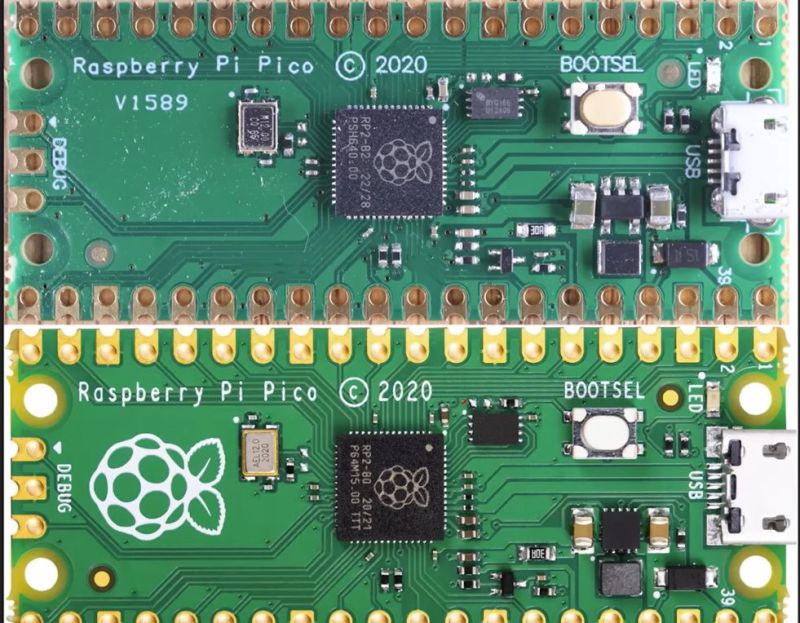
Since the RP2040 microcontroller is available as a stand-alone component, it’s easy enough for third parties to churn out their own variations — or outright clones of — the Raspberry Pi Pico. Thus we end up with for example AliExpress sellers offering their own versions that can be significantly cheaper than the genuine article. The ones that [electronupdate] obtained for a test and decapping session cost just $2.25 a pop.

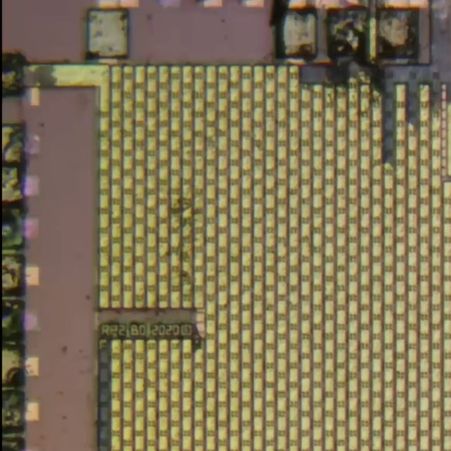
RP2 B0 stepping imprinted on the die shot.

As can be seen in the top image, the board from AliExpress misses the Raspberry Pi logo on the silkscreen for obvious reasons, but otherwise appears to feature an identical component layout. The QSPI Flash IC is marked on the die as BY250156FS, identifying it as a Boya part.

Niggles about flash ROM quality aside, what’s perhaps most interesting about this teardown is what eagle-eyed commentators spotted on the die shot of the RP2040. Although on the MCU the laser markings identify the RP2040 as a B2 stepping, the die clearly identifies it as an ‘RP2 B0’ part, meaning B0 stepping. This can be problematic when you try to use the USB functionality due to hardware USB bugs in the B0 and B1 steppings.

As they say, caveat emptor.

A New Life For An Old Amplifier

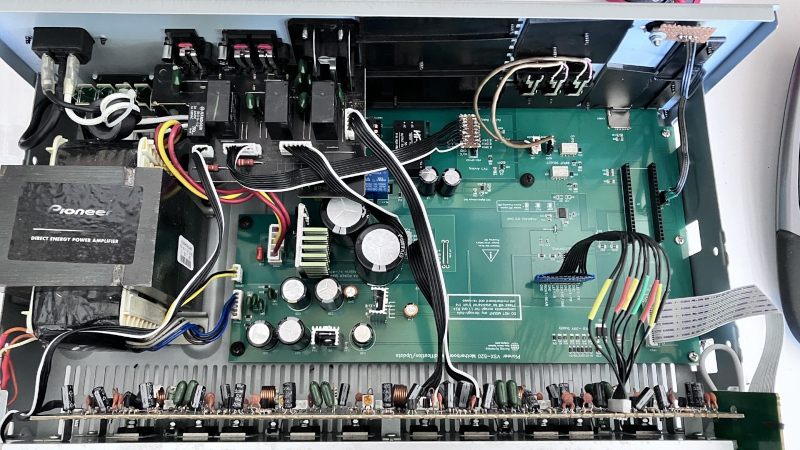
An audio amplifier was once a fairly simple analogue device, but in recent decades a typical home entertainment amplifier will have expanded to include many digital functions. When these break they are often proprietary and not easy to repair, as was the case with a broken Pioneer surround-sound device given to [Boz]. It sat on the shelf for a few years until he had the idea of a jukebox for his ripped CDs, and his returning it to life with a new main board is something to behold.

Internally it’s a surprisingly modular design, meaning that the front panel with its VFD display and driver were intact and working, as were the class AB amplifier and its power supply. He had the service manual so reverse engineering was straightforward, thus out came the main board in favor of a replacement. He took the original connectors and a few other components, then designed a PCB to take them and a Raspberry Pi Pico and DAC. With appropriate MMBASIC firmware it looks as though it was originally made this way, a sense heightened by a look at the motherboard inside (ignoring a couple of bodges).

We like seeing projects like this one which revive broken devices, and this one is particularly special quality wise. We’re more used to seeing it with gaming hardware though.

U.S. Forces maintain air and naval presence near Venezuela

The United States has continued elevated air and maritime military activity in the Caribbean region following Saturday’s U.S. operation in Venezuela, with fighter aircraft and naval assets operating near Venezuelan borders, according to local reports. Residents of Puerto Rico, where one of the United States’ operational military bases in the region is located, reported sustained […]

Rare RQ-170 stealth drone spotted supporting U.S. strikes on Venezuela

A rare U.S. Air Force RQ-170 “Sentinel” stealth surveillance drone was spotted returning on Saturday morning to Roosevelt Roads Naval Station in eastern Puerto Rico, following U.S. military strikes conducted overnight against targets in Venezuela. Video circulating on social media shows the flying-wing aircraft on approach and landing at the naval air station, now used […]

❌