For most of the week, the Ethereum price has remained in a range-bound spell, putting in no significant movement outside of the $3,000 and $2,880 price boundaries. Amid rising speculations, an on-chain analysis has recently been put out, which provides an answer to the question.
Open Interest Across Exchanges Falls To $17 Billion
In their latest QuickTake post on CryptoQuant, analytics platform Arab Chain reveals that there has been a fall in active Ethereum derivatives contracts across major exchanges, as indicated by data from the Ethereum: Open Interest-All Exchanges, All Symbol metric. Typically, rising Open Interest (OI) across exchanges indicates that more traders are entering leveraged positions. On the other hand, falling OI reflects more exits of leveraged positions, and by extension, reduced aversion to risk.
In the Quicktake post, Arab Chain highlights that open interest across exchanges has dipped to about $16.9 billion, marking the lowest level reached since mid-December last year. This, in turn, reflects an overall reduction in risk appetite across the Ethereum derivatives market. Because there is less speculative activity, there are also reduced risks of liquidations. Hence, the Ethereum price stands a higher chance of consolidating.
What’s Happening On Binance?
While exchanges in general are recording significant pull-outs from the derivatives market, Binance has shown an outlier performance. Arab Chain highlights that the world’s largest exchange by trading volume has instead recorded about $7.5 billion in Open Interest. Interestingly, this reading slightly exceeds the December average range of $6.8–$7.4 billion.
The divergence between the Open Interest values across all exchanges and that of Binance suggests that, while market participants are reducing their risk exposure, there is still liquidity in the derivatives market. Rather than a blatant exit, it has been repositioned toward the deeper and more liquid venue.
Arab Chain also explains that this behavior indicates a change in market operations from a higher-risk trading environment to one more price and risk efficient. In conclusion, the large traders are yet to make their exits but are merely reducing their exposure, while holding high-quality positions on Binance.
In addition, Ethereum’s proximity to the $3,000 price — especially as OI declines — shows that the market has been absorbing the deleveraging events while showing little selling pressure. Ultimately, Binance’s OI retaining levels above December’s support the idea that the market still has strong derivatives backing. Hence, the broader picture remains bullish. As of this writing, Ethereum trades at $2,958, reflecting a 0.33% growth since the past day, according to CoinMarketCap data.
Featured image from Pexels, chart from Tradingview.com
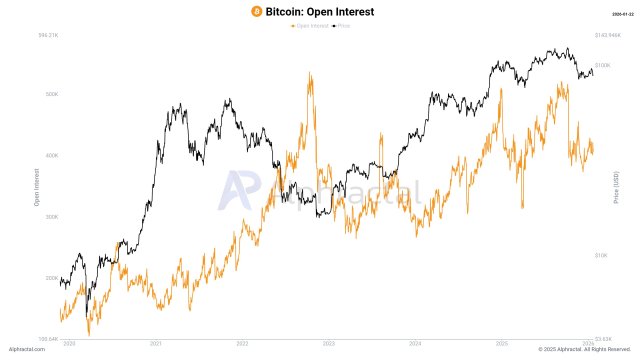
Bitcoin’s price is fluctuating below the $90,000 mark as volatility increases across the entire cryptocurrency market. During the bearish price action, attention is now being shifted to the cautious signal from the Bitcoin Open Interest in BTC terms, which has remained below past all-time high in years.
Open Interest Tells A Different Story When Measured In BTC
Amid the ongoing volatile action of the crypto market, the derivatives market for Bitcoin is providing a more subdued message. This message is unfolding on the Bitcoin Open Interest (OI) in BTC terms as outlined in a recent research by Joao Wedson, a market expert and founder of the Alphractal analytics platform.
In the report shared on the X platform, the market expert highlighted that the open interest measured in BTC terms has failed to reach new all-time highs since 2022. The BTC-based perspective shows a more restricted usage of leverage over cycles, whereas dollar-denominated measures frequently climb in tandem with price.
On Thursday, the metric experienced a bounce, but Wedson stated that the upward move was mainly in USD-dominated open interest. This pattern suggests that traders are becoming more cautious in the market by allocating capital more carefully as opposed to putting it all into risky positions.
According to the expert, the trend simply suggests that speculation is present in the market and it’s currently expanding. However, the chart shows that the broader market is still far from any form of extreme or irrational euphoria.
Not Enough Profit To Trigger A Bullish Recovery
BTC’s inability to produce another major rally is linked to the level of investors in profit. Darkfost stated that there are still not enough investors in profit to hope for a sustainable bullish recovery. Thus, it is crucial to understand that latent profits are not harmful to a market; it is quite the opposite.
When investors are most in profit, the situation is much more comfortable, which motivates them to hold. However, this only holds up to a certain point. Also, when the supply in profit surpasses 95% or even 100%, latest profits begin to impact the market and may trigger essential corrective phases.
The ongoing correction remained moderate with a drawdown to around 31%, but it was able to sharply reduce the percentage of supply in profit, suggesting very late entry by many investors. Currently, over 71% of BTC is in profit after dropping as low as 64%, a very concerning level that has typically been observed only when Bitcoin was entering a bear market.
However, in Darkfost’s view, the market must reclaim above 75% supply in profit to regain a more stable structure. As long as it stays above this level, the supply in profit has historically been associated with positive periods, as shown in the chart.
With the recent price rebound, the supply in profit saw a brief climb back to 75% before getting rejected. Meanwhile, many BTC investors possibly used this opportunity to exit at break-even or to cut their losses.
Ethereum is currently trading under pressure after failing to push above the $3,000 level again over the past 24 hours, a move that is reflecting trader sentiment across the derivatives markets. ETH is currently trading at $2,925, down 2.7% on the day, after moving within a 24-hour range capped at $3,012.99 and finding lows around $2,909.60, according to price data from CoinGecko.
As price action weakens, a notable change has been developing, with on-chain data showing funding rates drifting toward negative territory and derivative positioning beginning to tilt more defensively.
Funding Rates Slide As Shorts Gain Ground
Ethereum’s failure to hold above $3,000 is an important psychological break for traders, especially after several failed attempts to hold above that level in January. Price action over the past week shows sellers maintaining control after ETH rejected around $3,360 on January 18, followed by a steady push lower toward the high-$2,900s.
Although the pullback has so far been orderly above $2,900, this decline has come alongside fading momentum across the derivatives market.
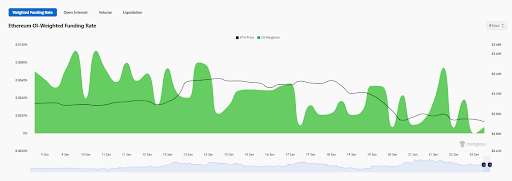
One of the clearest signals for this can be seen in Ethereum’s OI-weighted funding rate, which has been steadily compressing and is now edging toward negative levels. At the time of writing, Ethereum’s OI-weighted is at 0.0008%, close to breaking into negative territory and far below readings around 0.009%, which it registered earlier in the month.
Funding rates turning negative typically indicate that short positions are paying longs, meaning stronger demand for downside exposure. Funding spikes that previously accompanied the price rebound in early January have faded, and the overall trend suggests bearish positioning is slowly gaining the upper hand.
Open Interest, Liquidations, And What’s Next
Although Ethereum’s price action fell below $3,000, derivatives traders have stayed in the market, keeping total open interest at high levels. Data from CoinGlass shows aggregate Ethereum open interest increasing by 0.68% in the past 24 hours, which shows that many traders are not exiting Ethereum entirely. At the time of writing, the total open interest is sitting at about 13.36 million ETH, equivalent to roughly $39.19 billion.
Looking across major exchanges, Binance has the largest share of ETH open interest, accounting for about $8.95 billion, but it is down by 0.8% in the past 24 hours. CME follows with approximately $5.73 billion in open interest, up by 3.72% in the past 24 hours. Gate comes next at around $4.01 billion, while MEXC comes in close at $3.51 billion worth of ETH open interest.
Over the past 24 hours, Ethereum liquidations totaled $64.34 million, with long positions ($52.52 million) accounting for the majority of losses.
A hold above $2,900 could allow Ethereum’s funding rates to normalize and open the door for another rebound attempt to $3,000. However, a continued fall in funding rates into negative territory could see bearish control pushing Ethereum below $2,900.
In a sudden move, the cryptocurrency market flipped extremely bearish, causing major digital assets such as XRP to drop sharply. After days of trading above the $2 price mark, the altcoin has fallen below this level, bringing it to the key $1.80 support. While the leading altcoin continues to face heightened volatility, its derivatives market is telling a different story.
Traders Crowd Back Into The XRP Market
XRP’s price action and its derivatives market are moving in different directions as traders continue move back into the altcoin. On-chain data shows that derivatives activity is heating up, with Open Interest (OI) undergoing a sharp rise after weeks of downward performance or sluggish growth.
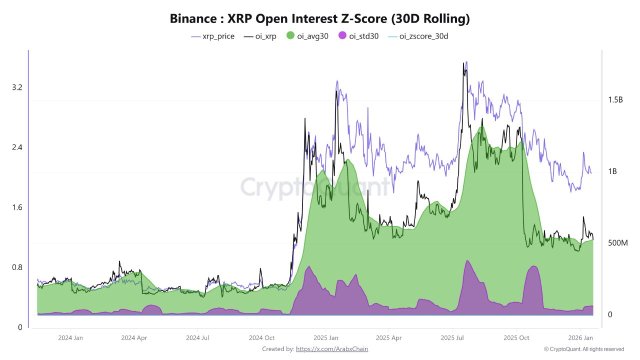
A crypto pundit and investor, Xaif Crypto, reported that XRP open interest has moved above its 30-day average as volatility reaches its highest level since November 2025. This rise in open interest is centered on Binance, the largest cryptocurrency exchange in the world.
As both speculative positioning and hedging activity pick up pace in reaction to broader price swings, the rise suggests a resurgence of trader activity. Furthermore, heightened volatility and rising open interest frequently indicate a turning point, when leverage is increasing, and the market is preparing for a big move.
The chart indicates that the total open interest is around $566 million against a 30-day average near $529 million. These figures suggest that new positions are steadily entering the market, not aggressively. However, this is not the major signal of the trend.
Currently, rising open interest volatility, with the standard deviation at its highest level in months, is the primary indicator. Meanwhile, the Z score is still moderate, sitting around the 0.57 level. Xaif Crypto stated that this development suggests cautious accumulation and growing risk without extreme leverage in the market.
It is worth noting that these conditions typically unfold prior to a strong directional move. With the current setup, XRP has entered a more dynamic and reactive trading environment than it has seen in months, regardless of whether this surge of activity resolves into continuation or reversal.
A Steady Wave Of Capital Inflows
A recent CoinShares report from Xaif Crypto shows that XRP is still attracting fresh capital at a significant rate. Despite a volatile market condition, weekly inflows have extended, pointing to a growing confidence among investors in the leading altcoin.
In the past week, the token pulled in over $69.5 million in inflows. This figure shows that demand is persistently building beneath the surface, indicating rising accumulation rather than speculative interest. While markets have shifted toward a volatile state, fresh capital is still being rotated into XRP.
The capacity of XRP to attract investment even in slower times is becoming a more significant indicator for its medium-term prospects. As both institutional and large-scale participants flock in, this raises the discussion that a bigger move might be imminent, and these investors are positioning themselves ahead of it.
XRP lost the $2 level after the broader crypto market suffered sharp declines on Monday, dragging price action back into a fragile zone. While the move rattled traders, Binance derivatives data suggests the sell-off has not triggered an extreme leverage unwind yet. Instead, the market appears to be entering a transitional phase where risk is rising, but speculative behavior remains relatively controlled.
Open interest metrics show a delicate balance between positioning and price weakness. Total XRP open interest on Binance climbed to roughly $566.48 million, pushing above the 30-day average near $528.84 million. This spread implies that fresh positions are still being added despite the downturn, but the pace looks measured rather than euphoric. In other words, traders are stepping in cautiously, not flooding the market with aggressive leverage.
The 30-day rolling Z-Score framework helps contextualize this shift. With open interest expanding while volatility stays contained, XRP may be building the conditions for a larger move ahead. For now, however, price remains vulnerable, and the next direction will likely depend on whether liquidity returns or fear deepens.
Open Interest Volatility Rises as XRP Builds Toward a Bigger Move
Arab Chain’s CryptoQuant read shows the most important shift isn’t the headline open interest figure, but the instability underneath it. The 30-day standard deviation of XRP open interest (oi_std30) has climbed to roughly $65.7 million, marking its highest level since November. That matters because it signals open interest is starting to swing more aggressively around its average, a pattern that often shows up before price leaves a tight range and enters expansion mode.
At the same time, the leverage signal still looks contained. The Z-Score holds near 0.57, signaling an elevated but not extreme level. In practical terms, positioning is growing, but it doesn’t look like the market is overheating or entering the kind of reckless leverage phase that typically leads to instant liquidation cascades. That combination—rising volatility in positioning while the Z-Score remains moderate—suggests momentum is building without a clear directional commitment yet.
This puts XRP in a “risk-on, but cautious” environment. Traders are adding exposure, volatility is creeping higher, and the setup is becoming more reactive. From here, oi_std30 becomes a key metric to track alongside price structure, because whichever way price breaks, the market is increasingly positioned for a larger move.
XRP Slides Back Toward $1.90 as Bears Keep Control
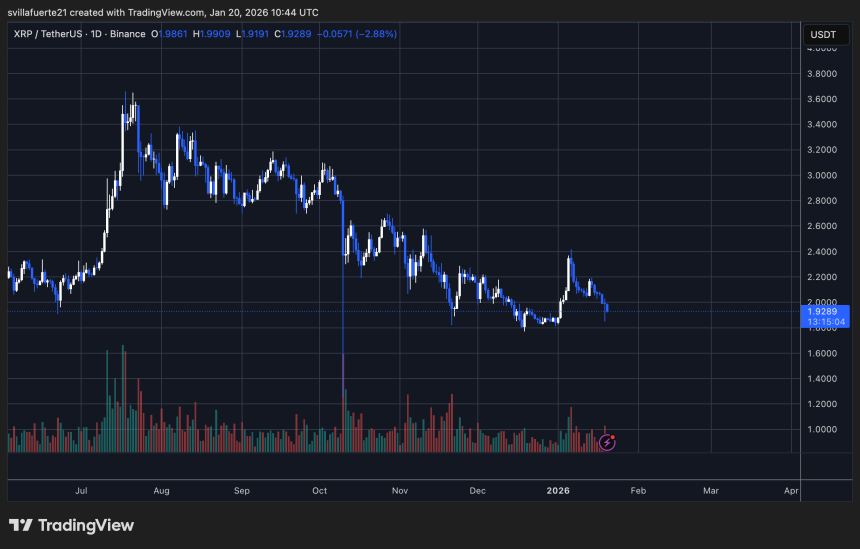
XRP remains under heavy pressure, with the chart showing price slipping back toward the $1.90 zone after failing to hold the $2 level. The market is printing a clear sequence of lower highs and lower lows, confirming that the broader trend is still bearish despite several short-lived rebounds over recent weeks. Each time XRP attempts to recover, sellers quickly step in and cap momentum before it can reclaim key resistance levels.
The latest move highlights this weakness. XRP briefly pushed higher in early January but immediately rolled over, showing that demand is still too soft to sustain a breakout. The $2.00 region has now flipped into overhead resistance, and price will likely need a strong bullish catalyst to break back above it with conviction.
From a structure perspective, the current support area sits around $1.85–$1.90, which has acted as a short-term floor during the recent consolidation. If this zone fails, XRP could quickly revisit lower liquidity pockets, extending the downtrend.
Volume also reflects uncertainty. Activity remains erratic despite occasional, isolated spikes. This suggests the market is still reacting to fear-driven flows rather than steady accumulation. Price stalls in a fragile consolidation phase. And bulls need to reclaim above $2 to shift the short-term narrative back in their favor.
Featured image from ChatGPT, chart from TradingView.com
You’ve likely at least heard of Marion Stokes, the woman who constantly recorded television for over 30 years. She comes up on reddit and other places every so often as a hero archivist who fought against disinformation and disappearing history. But who was Marion Stokes, and why did she undertake this project? And more importantly, what happened to all of those tapes? Let’s take a look.
Marion the Librarian
Marion was born November 25, 1929 in Germantown, Philadelphia, Pennsylvania. Noted for her left-wing beliefs as a young woman, she became quite politically active, and was even courted by the Communist Party USA to potentially become a leader. Marion was also involved in the civil rights movement.
Marion on her public-access program Input. Image via DC Video
For nearly 20 years, Marion worked as a librarian at the Free Library of Philadelphia until she was fired in the 1960s, which was likely a direct result of her political life. She married Melvin Metelits, a teacher and member of the Communist Party, and had a son named Michael with him.
Throughout this time, Marion was spied on by the FBI, to the point that she and her husband attempted to defect to Cuba. They were unsuccessful in securing Cuban visas, and separated in the mid-1960s when Michael was four.
Marion began co-producing a Sunday morning public-access talk show in Philadelphia called Input with her future husband John Stokes, Jr. The focus of the show was on social justice, and the point of the show was to get different types of people together to discuss things peaceably.
Outings Under Six Hours
Marion’s taping began in 1979 with the Iranian Hostage Crisis, which coincided with the dawn of the twenty-four-hour news cycle. Her final tape is from December 14, 2012 — she recorded coverage of the Sandy Hook massacre as she passed away.
In 35 years of taping, Marion amassed 70,000 VHS and Beta-max tapes. She mostly taped various news outlets, fearing that the information would disappear forever. Her time in the television industry taught her that networks typically considered preservation too expensive, and therefore often reused tapes.
But Marion didn’t just tape the news. She also taped various programs such as The Cosby Show, Divorce Court, Nightline, Star Trek, The Oprah Winfrey Show, and The Today Show. Some of her collection includes 24/7 coverage of news networks, all of which was recorded on up to eight VCRs: 3-5 were going all day every day, and up to 8 would be taping if something special was happening. All family outings were planned around the six-hour VHS tape, and Marion would sometimes cut dinner short to go home and change the tapes.
People can’t take knowledge from you. — Marion Stokes
You might be wondering where she kept all the tapes, or how she could afford to do this, both financially and time-wise. For one thing, her second husband John Stokes, Jr. was already well off. For another, she was an early investor in Apple stock, using capital from her in-laws. To say she bought a lot of Macs is an understatement. According to the excellent documentary Recorder, Marion own multiples of every Apple product ever produced. Marion was a huge fan of technology and viewed it as a way of unlocking people’s potential. By the end of her life, she had nine apartments filled with books, newspapers, furniture, and multiples of any item she ever became obsessed with.
In addition to the creating this vast video archive, Marion took half a dozen daily newspapers and over 100 monthly periodicals, which she collected for 50 years. This is not to mention the 40-50,000 books in her possession. In one interview, Marion’s first husband Melvin Metelits has said that in the mid-1970s, the family would go to a bookstore and drop $800 on new books. That’s nearly $5,000 in today’s money.
Why Tapes? Why Anything?
It’s easy to understand why she started with VHS tapes — it was the late 1970s, and they were still the best option. When TiVo came along, Marion was not impressed, preferring not to expose her recording habits to any possible governments. And she had every right to be afraid, with her past.
Those in power are able to write their own history. — Marion Stokes
As for the why, there were several reasons. It was a form of activism, which partially defined Marion’s life. The rest I would argue was defined by this archive she amassed.
Marion started taping when the Iranian Hostage Crisis began. Shortly thereafter, the 24/7 news cycle was born, and networks reached into small towns in order to fill space. And that’s what she was concerned with — the effect that filling space would have on the average viewer.
Marion was obsessed with the way that media reflects society back upon itself. With regard to the hostage crisis, her goal was trying to reveal a set of agendas on the part of governments. Her first husband Melvin Metelits said that Marion was extremely fearful that America would replicate Nazi Germany.
The show Nightline was born from nightly coverage of the crisis. It aired at 11:30PM, which meant it had to compete with the late-night talk show hosts. And it did just fine, rising on the wings of the evening soap opera it was creating.
To the Internet Archive
When Marion passed on December 14, 2012, news of the Sandy Hook massacre began to unfold. It was only after she took her last breath that her VCRs were switched off. Marion bequeathed the archive to her son Michael, who spent a year and half dealing with her things. He gave her books to a charity that teaches at-risk youth using secondhand materials, and he says he got rid of all the remaining Apples.
But no one would take the tapes. That is, until the Internet Archive heard about them. The tapes were hauled from Philadelphia to San Francisco, packed in banker’s boxes and stacked in four shipping containers.
So that’s 70,000 tapes at let’s assume six hours per tape, which totals 420,000 hours. No wonder the Internet Archive wasn’t finished digitizing the footage as of October 2025. That, and a lack of funding for the massive amount of manpower this must require.
If you want to see what they’ve uploaded so far, it’s definitely worth a look. And as long as you’re taking my advice, go watch the excellent documentary Recorder on YouTube. Check out the trailer embedded below.
Ethereum continues to show resilience, holding its ground above key support levels even as price faces firm resistance near the $3,400 zone. The ability to sustain strength after recent gains highlights improving market structure, suggesting that buyers remain in control. As long as ETH stays supported above its critical trend levels, the broader upside narrative remains intact despite near-term hesitation.
Daily Bull Market Support Band Holds As Key Reversal Zone
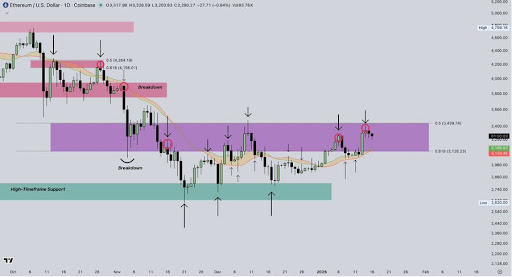
Luca, in a recent ETH update shared on X, pointed out that Ethereum’s market structure has strengthened considerably over the past several days. The price has been able to hold above the 1D Bull Market Support Band, a level that has acted as a reliable reversal zone multiple times over the last couple of months. This sustained hold suggests improving market confidence and a reduction in immediate downside risk.
Alongside this structural improvement, ETH successfully reclaimed the 0.618 Fibonacci point of interest around the $3,100 region. This level is often viewed as a critical threshold in corrective phases, and holding above it typically signals that buyers are gaining the upper hand.
Despite the positive developments, Ethereum has not moved higher without hesitation. ETH’s price recently faced rejection near the 0.5 Fibonacci level around $3,400, an outcome Luca noted was largely expected. Historically, this area has acted as a significant decision point, often attracting selling pressure and temporary pullbacks before the market decides on its next direction.
Looking forward, Luca believes the overall outlook remains constructive as long as ETH continues to trade above the 1D Bull Market Support Band and the 0.618 Fibonacci level. Maintaining these supports would keep the path open for renewed upside attempts, even if short-term consolidations occur, and the analyst’s positioning remains unchanged.
ETH Above Daily 200MA, Structure Remains Constructive
According to a recent post by Daan Crypto Trades, Ethereum is still advancing gradually while respecting the Daily 200-day moving average against Bitcoin. This type of slow, methodical grind often signals strength beneath the surface, suggesting that buyers remain in control even without aggressive momentum.
The analyst explained that prolonged consolidations and steady climbs like this typically resolve with an acceleration phase. Should ETH break out with stronger upside momentum, it could serve as a trigger for renewed interest across the altcoin market, helping lift sentiment and price action.
However, the structure remains conditional. Holding the Daily 200MA, highlighted in purple, is critical to maintaining this constructive setup. In parallel, Bitcoin must stay above the $94,000 level to maintain the broader low-timeframe bullish structure. As long as these conditions are met, the path of least resistance continues to favor further upside.
The crypto market was left in awe as the price of Bitcoin experienced a sudden surge, bringing the flagship asset dangerously close to the $100,000 mark. With the recent bounce, hopes for a retest of the current all-time high and beyond have reemerged. However, a crucial supply cluster continues to stand in the way.
A Fresh All-Time High Beckons For Bitcoin
Bitcoin’s price is gaining sharp upward traction as it retests the $98,000 price mark on Wednesday, a level last seen in November 2025. On-chain data shows that the crypto king is once again edging toward uncharted territory, with market structure pointing to a clear path toward a new all-time high.
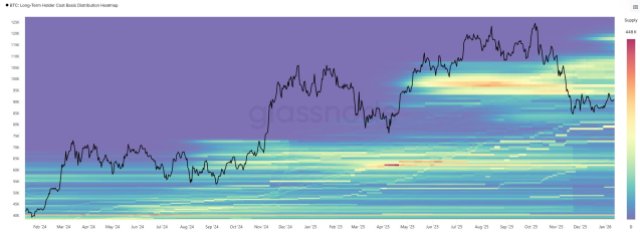
However, there is a significant barrier between present levels and price discovery: a dense supply cluster created by investors who have previously made purchases in the same range. This range was highlighted by Glassnode, a leading on-chain data platform, after examining the BTC Long-Term Holder Cost Basis Distribution Heatmap.
Data from the key metric shows a dense cost-basis cluster between the $93,000 and $109,000 price range, which is forming a substantial overhead supply zone. The supply zone serves as a technical and psychological barrier where a large number of holders may be waiting to take profits or quit at breakeven, resulting in concentrated resistance.
At this level, any sustained push higher must first absorb this supply, with a decisive breakout above the range. If Bitcoin is able to absorb this overhead supply and push through it decisively, momentum could pick up pace quickly. Glassnode noted that this crucial range is usually expected to reopen the path toward a new all-time high for Bitcoin over the longer term.
According to Glassnode in another post, BTC has ushered in the new year with constructive momentum, printing two higher highs and extending its value toward the $98,000 price level. However, the platform stated that the leg up currently runs directly into a historically supply zone.
BTC Market Is Displaying Deleveraging Signals
Looking at Bitcoin’s current action from an on-chain perspective, the flagship asset is starting to show signs of deleveraging. This deleveraging indicates that excess speculation is being removed from the market after a period of high leverage and aggressive positioning.
Coin Bureau’s report shared on X points to a sharp decline in BTC Open Interest (OI) from $15 billion in October to $10 billion today, as leveraged traders get flushed out. The drop represents an over 30% decrease within the period.
Interestingly, these deleveraging phases have often preceded major market bottoms, making this a critical moment for BTC. Nonetheless, should BTC continue to fall, more leverage is expected to still get wiped out.
At the time of writing, the Bitcoin price was trading at $96,247, demonstrating a 1.29% increase in the last 24 hours. Data from CoinMarketCap shows that trading volume is down despite the bullish price action, dropping by more than 3% in the past day.
Ethereum is showing tentative signs of relief after weeks of downside pressure, but the recovery remains fragile. The price is currently struggling to push decisively above the $3,400 level, a zone that has repeatedly acted as resistance during recent attempts to rebound. While short-term sentiment has improved alongside broader market stabilization, risks remain elevated. Several analysts warn that Ethereum could still face further declines in the coming weeks if momentum fades and macro or liquidity conditions deteriorate again.
Adding complexity to the picture, derivatives data suggest a renewed buildup of risk. A report from Arab Chain highlights that Ethereum’s open interest on Binance has climbed to approximately $8.6 billion, its highest level since October 9.
This marks a notable shift after a prolonged period of contraction following the sharp liquidation event in October, when open interest collapsed from above $10 billion to below $7 billion in a matter of days. That episode flushed excessive leverage from the market and forced traders into a defensive stance.
The current rise in open interest signals that traders are gradually returning and rebuilding positions at lower price levels. However, this also increases the price’s sensitivity to sudden moves.
Ethereum Derivatives Activity Rebuilds Confidence
Ethereum is currently testing a key structural resistance zone around $3,400, and the latest derivatives data adds important context to this price behavior. According to the CryptoQuant report by Arab Chain, the rise in open interest on Binance reflects renewed activity in the derivatives market and a clear return of traders’ appetite for leverage. This is a notable shift from the defensive posture seen after the October liquidation wave.
What stands out is that this increase in open interest is occurring while ETH trades near the $3,300–$3,400 area, well below its previous cycle highs. This suggests that traders are not chasing price at extremes, but instead building positions at relatively discounted levels. Historically, this type of positioning often reflects expectations of a medium-term upside move rather than short-term speculation.
At the same time, the fact that open interest has reached its highest level since October 9 without returning to prior overheated extremes points to a more balanced recovery. If this growth is driven by steady inflows rather than aggressive leverage, it supports the idea of a healthier market structure forming after the post-liquidation contraction phase.
However, risks remain asymmetric near resistance. A continued and rapid expansion in open interest while price stalls below $3,400 could increase vulnerability to sharp volatility. For Ethereum to sustain momentum, price and open interest must remain aligned, confirming that confidence is rebuilding rather than overstretching.
Price Faces Key Resistance Level
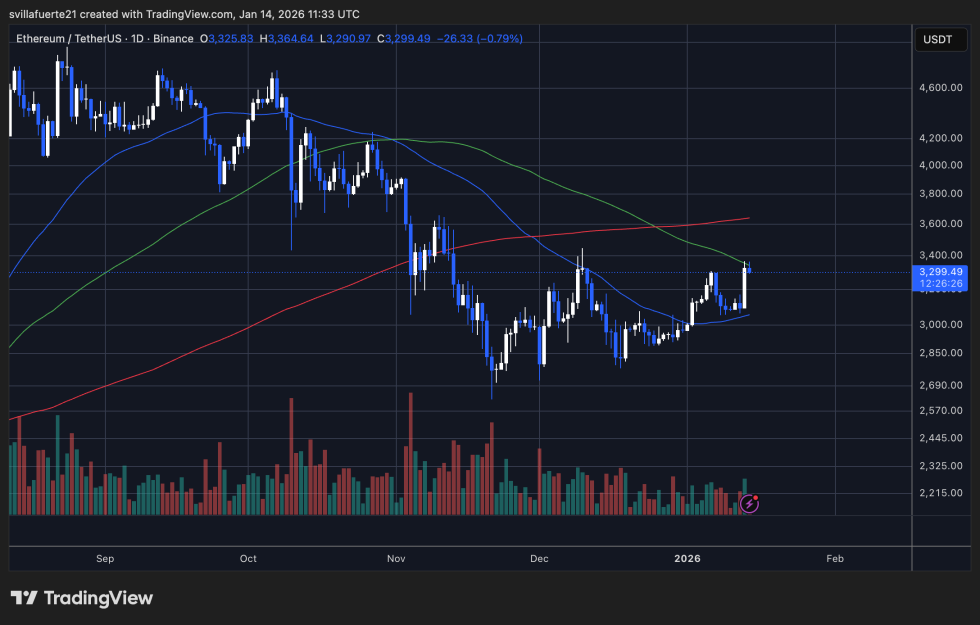
Ethereum price action on the daily chart shows a market attempting to recover, but still constrained by heavy structural resistance near the $3,400 region. After a sharp decline from the October highs, ETH established a local bottom below $2,900 and has since been forming higher lows, suggesting short-term stabilization rather than a confirmed trend reversal.
Price is currently trading near $3,300, where multiple technical factors converge. The descending 200-day moving average and prior horizontal support-turned-resistance are capping upside momentum. Each rally into this zone has met selling pressure, highlighting that this area remains a critical supply region. The inability to reclaim $3,400 decisively keeps the broader structure neutral-to-bearish.
On the downside, the rising short-term moving average and recent higher lows around $3,000–$3,050 provide initial support. As long as ETH holds above this range, the market maintains a constructive consolidation structure rather than resuming the prior impulsive downtrend. Volume has remained moderate during the recovery, indicating controlled participation rather than aggressive speculative buying.
ETH is compressing between rising short-term support and declining long-term resistance. This type of price behavior often precedes a directional move. A clean daily close above $3,400 would signal a shift in market control and open the door for a broader recovery.
Featured image from ChatGPT, chart from TradingView.com
The line between a Linux user and a Linux power user is a bit gray, and a bit wide. Most people who install Linux already have more computer literacy than average, and the platform has long encouraged experimentation and construction in a way macOS and Windows generally aren’t designed for. Traditional Linux distributions often ask more of their users as well, requiring at least a passing familiarity with the terminal and the operating system’s internals especially once something inevitably breaks.
In recent years, however, a different design philosophy has been gaining ground. Immutable Linux distributions like Fedora Silverblue, openSUSE MicroOS, and NixOS dramatically reduce the chances an installation behaves erratically by making direct changes to the underlying system either impossible or irrelevant.
SteamOS fits squarely into this category as well. While it’s best known for its console-like gaming mode it also includes a fully featured Linux desktop, which is a major part of its appeal and the reason I bought a Steam Deck in the first place. For someone coming from Windows or macOS, this desktop provides a familiar, fully functional environment: web browsing, media playback, and other basic tools all work out of the box.
As a Linux power user encountering an immutable desktop for the first time, though, that desktop mode wasn’t quite what I expected. It handles these everyday tasks exceptionally well, but performing the home sysadmin chores that are second nature to me on a Debian system takes a very different mindset and a bit of effort.
Deck Does What Others Don’t
I’ve owned my Deck for about a year now. Beyond gaming, the desktop mode has proven its value: it uses what essentially amounts to laptop hardware in a much smaller form factor, and is arguably more portable as a result. It easily plugs in to my existing workstation docks, so it’s easy to tote around, plug in, and start using. With a Bluetooth keyboard and mouse along with something to prop it up on, it makes an acceptable laptop substitute in certain situations as well. It’s also much more powerful than most of my other laptops with the possible exception of my M1 Macbook Air.
However, none of the reviews I watched or read circa 2023-2024 fully explained what an immutable OS was and how it’s different than something like Ubuntu or Fedora. Most of what I heard was that it runs “a modified version of Arch” with a “full Linux desktop” and little detail other than that, presumably to appeal to a wider audience that would be used to a fairly standard Windows PC otherwise. As a long-time Linux user the reviews I read led me to believe I’d probably just boot it up, open a terminal, and run pacman -S for all of the tools and software I’d normally install on any of my Debian machines.
Anyone familiar with immutable operating systems at this point will likely be laughing at my hubris and folly, although it’s not the first time I jumped into a project without a full understanding of what I would be doing. Again, having essentially no experience with immutable operating systems beyond having seen these words written together on a page, I was baffled at what was happening once I got my hands on my Deck and booted it into the desktop mode. I couldn’t install anything the way I was used to, and it took an embarrassing amount of time before I realized even basic things like Firefox and LibreOffice had to be installed with Flatpaks. These are self-contained Linux applications that bundle most of their own dependencies and run inside a sandbox, rather than relying on the host system’s libraries. In SteamOS they are installed in the home directory, which is important because any system updates from Valve will rewrite the entire installation except the home directory. They’re also installed from an app store of sorts, which also took some getting used to as I’ve been spoiled by about 20 years of apt having everything I could ever need.
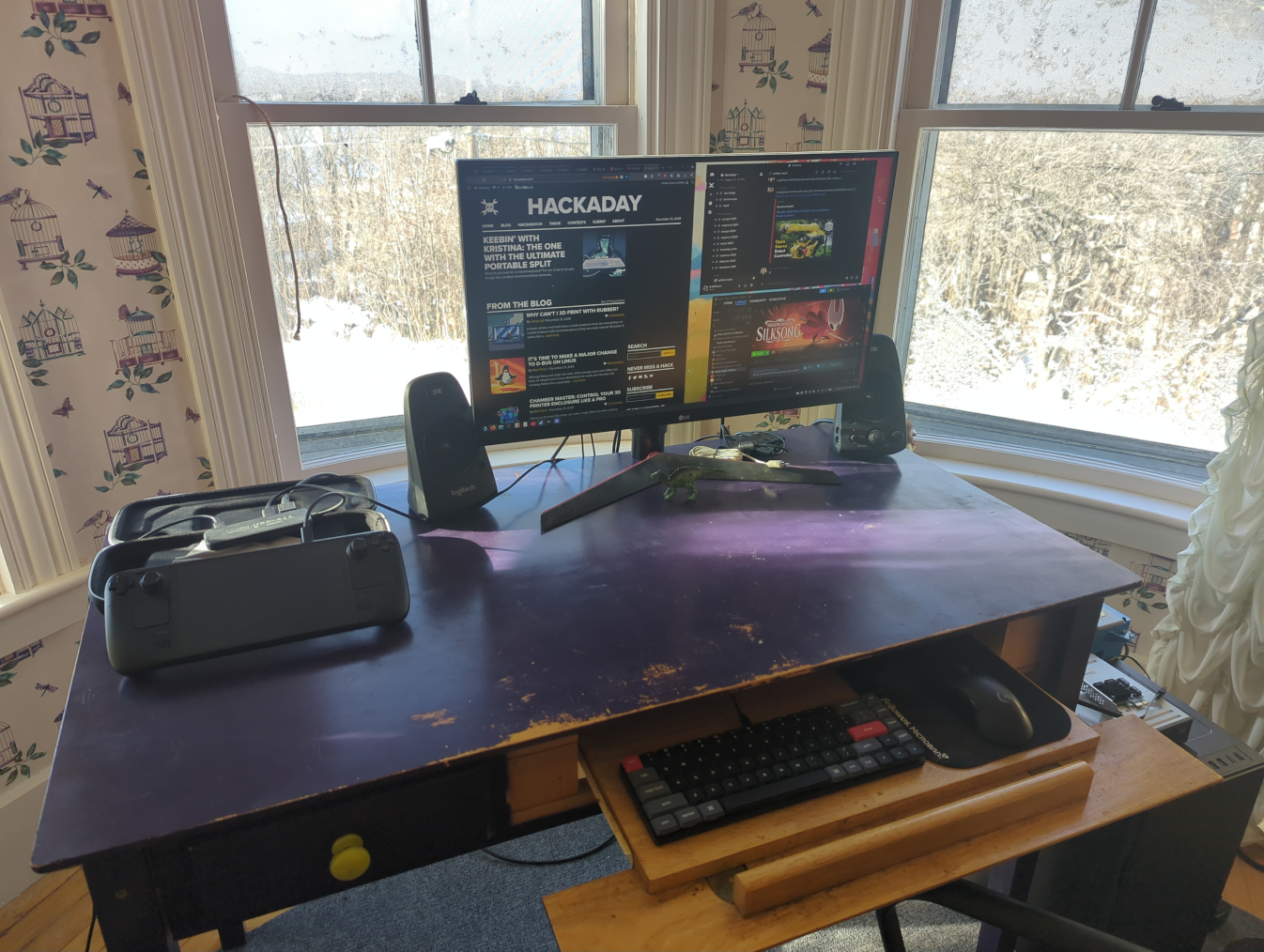
My main workstation. With a USB-C dock I can use any modern computer here, including the Steam Deck
But after that major hiccup of learning what my operating system was actually doing, it was fairly easy to get it working well enough to browse the internet, write Hackaday articles, and do anything else I could do with any other average laptop. This is the design intent of the Steam Deck, after all. It’s not meant for Linux power users, it’s meant as a computer where the operating system gets out of the way and lets its user play games or easily work in a recognizable desktop environment without needing extensive background Linux knowledge. That doesn’t mean that power users can’t get in and tinker, though; in fact tinkering is almost encouraged on this device. It just means that if they’re used to Debian, like I am, they have to learn a completely new way of working than they’re used to.
Going Beyond Intended Use
To start, I use a few tools on my home network that make it easier for me to move from computer to computer without interrupting any of my workflows. The first is Syncthing, which is essentially a self-hosted and decentralized Dropbox replacement that lets me sync files and folders automatically across various computers. Installing Syncthing is straightforward with a Flatpak but getting things to run at boot is not as easy. I did eventually get it working seamlessly by following this guide, though. This was my first learning experience on how to start system processes outside of a simple systemd command. Syncthing is a non-negotiable for me at this point as well and is essentially load-bearing in my workflow, and is actually the main reason I switched my Gentoo install from openRC to systemd since openRC couldn’t easily run a task at boot time as a non-root user.
I’m also a fan of NFS for network file sharing (as the name implies) and avoid Samba to stay away from any potential Windows baggage, although it’s generally a more supported file sharing protocol. Nonetheless, my media libraries all stream over my LAN using NFS, and my TrueNAS virtual machine on my Proxmox server also uses this protocol, so it was essential to get this working on my Deck as well.
Arguably Samba would be easier but we are nothing without our principles, however frivolous. On a Debian machine I would just edit /etc/fstab with the NFS share and mount points and be done, but consistently mounting my network shares at boot in SteamOS has been a bit elusive. Part of the problem is how SteamOS abstracts away root access in ways that are different from a traditional Linux installation, so things that need to be done at boot by root are not as easy to figure out. I have a workaround where I run a script to mount them quickly when I need them and it’s been working well enough that I haven’t figured out a true solution to this problem yet, but generally SteamOS doesn’t seem to be designed for persistent system-level configuration like this.
The only other major piece of infrastructure I run on all of my machines is Tailscale, which lets me easily configure a VPN for all of my devices so I can access them from anywhere with a network connection, not just when directly connected to my LAN. This was one of the easier things to figure out, as the Tailscale devs maintain an install script which automates the process and keeps the user from needing to do anything overly dramatic. This Reddit post goes into some Steam Deck-specific details that are helpful as well.
Ups and Downs
There were a few minor niggles for me even after sorting these major issues out. The Deck is actually quite capable of running virtual machines with its relatively powerful hardware, but the only virtualization software I’ve found as a Flatpak is Boxes, which is a bit limiting for those used to something like VMWare Workstation or KVM. Still, it works well enough that I’ve been able to experiment running other Linux operating systems easily on the Deck, and even tried out an old Windows XP image I have which I keep mostly so I can play my original copy of Starcraft without having to fuss with Wine.
Other than that, the default username “deck” trips me up in the terminal because I often forget it’s not the same username that I use for the the other machines on my network. The KDE Plasma desktop is also running X11 by default, and since I’ve converted all of my other machines to Wayland in an attempt to modernize, the Deck’s desktop feels a bit dated to me in that respect. My only other gripe is cosmetic in nature: I do prefer GNOME, and although SteamOS uses KDE as its default desktop environment I don’t care so deeply that I’ve tried to make any dramatic changes.
Provided there’s something to prop the Deck against, it can make a good laptop replacement using a Bluetooth mouse and keyboard in certain situations as well.
There have been a number of surprising side effects of running a system like this as well. Notably, the combination of Tailscale and Syncthing running at boot, even in gaming mode, lets me sync save states from non-Steam games, including emulators, so I can have a seamless experience moving from gaming on my Steam Deck to gaming on my desktop. (I’m still running this hardware for my desktop with the IME disabled.)
I’d actually go as far as recommend this software combination to anyone gaming across multiple machines based on how well it works. Beyond that major upside, I’ll also point out that running Filezilla as a Flatpak that gets automatically updated makes it much less annoying about reminding the user that there’s an update available, which has always been a little irksome to me otherwise.
The Steam Deck as a platform has also gotten a few of my old friends back into gaming after years of life getting in the way of building new desktop computers. It’s a painless way of getting a capable gaming rig, with the Steam Machine set to improve Valve’s offerings in this arena as well. So being able to reconnect with some of my older friends over a game of Split Fiction or Deep Rock Galactic has been a pleasant perk as well, although the Deck’s cultural cachet in this regard is a bit outside of our scope here.
I’ll also point out that this isn’t the only way of using the Deck as a generic Linux PC, either. I’ve mostly been trying to stick within the intended use of SteamOS as immutable Linux installation, but it’s possible to ignore this guiderail somewhat. The read-only filesystem that’s core to the OS’s immutability can be made writable with a simple command, and from there it behaves essentially like any other Arch installation.
Programs can be installed via pacman and, once everything is configured to one’s liking, the read-only state can be re-enabled. The only downside of this method is that a system update from Valve will wipe all of these changes. System updates don’t happen incredibly often, though, and keeping track of installed packages in a script that can be run after any updates will quickly get the system back to its pre-update condition. Going even farther than that, though, it’s also possible to install any operating system to a microSD card and use the Deck as you might any other laptop or PC, but for me this misses the point of learning a new tool and experiencing a different environment for its own sake, and also seems like a bit of overkill when there’s already a fully functional Linux install built into the machine.
An Excellent New Tool
Although my first experience with an immutable Linux distribution was a bit rough around the edges, it felt a lot like the first time I tried Linux back in 2005, right down to not entirely understanding how software was supposed to be installed at first. I was working with something new without fully grasping what I’d signed up for, and moments like using a software repository for the first time were genuinely eye-opening. Back then, not having to hunt down sketchy .exe files on the Internet just to get basic functionality on my computer felt revelatory; today, immutable distributions offer a similar shift, trading some initial confusion on my part for a system that’s more reliable and far harder to break. Even after years of using mainstream Linux distributions, there’s still plenty to learn, and that process of figuring things out remains part of the fun.
There’s never been a better time to get into Linux, either. Hardware prices keep climbing as a result of the AI bubble, all while Microsoft continues to treat perfectly functional PCs as e-waste and tightens the screws on their spyware-based ecosystem that users have vanishingly little control over. Against that backdrop, immutable Linux distributions like SteamOS, Bazzite, Fedora Silverblue, or even the old standbys like Mint, Debian, and Arch offer a way to keep using capable hardware without spending any money.
Even for longtime Debian system administrators and power users, immutable distributions are a new tool genuinely worth learning, with the caveat that there will likely be lots of issues like mine that crop up but which aren’t insurmountable. These tools represent a different way of thinking about what an operating system should be, though, and it’s exciting to see what that shift could mean for the future of PCs and gaming outside the increasingly hostile Microsoft–Apple duopoly.

 Login
Login