Hiring the right minds and skill sets in marketing in today’s age is vital to laying the right foundations for any company, let alone a crypto company.
India’s Financial Intelligence Unit (FIU‑IND) has launched a fresh anti‑money‑laundering crackdown aimed at privacy‑focused cryptocurrencies. The move targets Monero (XMR), Zcash (ZEC), and Dash (DASH), which together represent the largest and most widely used privacy coins globally.
India Tightens Crypto Oversight
Details of the action were shared on Friday by market analyst MartyParty on social media platform X (previously Twitter), who notes that FIU‑IND has issued a directive to crypto exchanges registered in India, instructing them to immediately suspend deposits, withdrawals, and trading activity for Monero, Zcash, and Dash.
At the heart of the regulator’s concerns is the technology underpinning these assets. Privacy coins rely on advanced cryptographic techniques designed to obscure transaction details, wallet balances, and user identities.
Monero uses ring signatures to hide the sender and receiver, Zcash allows shielded transactions that conceal transaction data, and Dash offers optional privacy features.
While these tools are valued by users seeking confidentiality, regulators argue they make it difficult for exchanges to meet know‑your‑customer (KYC) and transaction‑monitoring obligations. The regulator views these features as posing elevated risks related to money laundering, terrorist financing, and sanctions evasion.
The latest directive applies to all cryptocurrency exchanges registed in the country, which currently includes crypto platforms operating in compliance with Indian regulations. They have been instructed to stop supporting the assets, including delisting, blocking all deposits and withdrawals, and disabling any associated trading pairs.
Monero, Zcash, And Dash Show Mixed Market Reaction
The latest action builds on a broader regulatory push by Indian authorities. In October 2025, FIU‑IND ordered internet service providers to block access to 25 offshore crypto exchanges that failed to register.
By contrast, only a handful of exchanges currently remain fully registered and compliant in the country. Binance, Mudrex, Coinbase, CoinSwitch (CoinSwitch Kuber), and ZebPay continue to operate legally in India.
Despite the regulatory pressure, market prices for the targeted privacy coins showed short‑term resilience. Over the past 24 hours, all three assets posted gains after recovering from sharp losses earlier in the week.
Monero was trading at $524 at the time of writing, up 3.5% on the day. Zcash also rebounded modestly, rising 2.2% to trade at $372. Dash recorded the strongest daily performance, jumping 11.6% during the same period.
However, the broader trend remains negative. According to CoinGecko data, Monero, Zcash, and Dash are still down sharply on a weekly basis, with losses of approximately 21%, 8%, and 20% respectively over the past seven days.
Featured image from DALL-E, chart from TradingView.com
This week’s regulatory developments show a familiar reality in Washington: there is broad agreement that crypto needs rules, but little consensus on how those rules should be written or who should take the lead.
That tension was on full display as Senate Judiciary leaders Chuck Grassley and Dick Durbin raised concerns over a provision in Senate Banking Chair Tim Scott’s crypto market structure bill.
Senate Judiciary leaders oppose blockchain developer protections in crypto bill, warning exemptions modeled on Lummis-Wyden BRCA could block money laundering prosecutions.#Senate#CryptoBill#Developershttps://t.co/onqKSmbDQ2
The language would exempt certain blockchain software developers from financial licensing requirements, a move lawmakers warned could weaken law enforcement’s ability to pursue money laundering and other illicit financial activity.
In a private letter first reported by Politico, Grassley and Durbin argued that the provision falls squarely under the Judiciary Committee’s jurisdiction and noted that their panel was not consulted before the markup was scheduled and later postponed.
The section closely mirrors the Blockchain Regulatory Certainty Act, a bipartisan proposal led by Senators Cynthia Lummis and Ron Wyden, but its inclusion has now become another flashpoint in an already fragile legislative process.
Market Structure Bill Slips Further Down the Agenda
Momentum behind the broader market structure bill continues to slow. According to reports, the Senate Banking Committee has again delayed work on the legislation, pushing consideration to late February or March. Instead, lawmakers are shifting focus to housing legislation following President Donald Trump’s renewed push on affordability.
The delay reinforces a growing concern within the crypto industry: despite years of debate, market structure reform remains vulnerable to political reprioritization. What was once positioned as urgent now risks being sidelined by competing legislative priorities.
Partisan Cracks Begin to Show
While the Banking Committee hesitates, the Senate Agriculture Committee is moving ahead, even without Democratic support. Chair John Boozman has scheduled a markup for January 27, acknowledging that “differences remain on fundamental policy issues” but signaling a willingness to proceed regardless.
Senate Agriculture Committee advances crypto bill for January 27 markup without Democratic support as Banking delays CLARITY Act over stablecoin disputes.#ClarityAct#Stablecoinhttps://t.co/Wjz1vpYh5d
If passed, the move would mark a shift away from bipartisan consensus toward a more partisan approach, raising questions about the long-term durability of any resulting framework in a divided Congress.
Regulators Step In as Lawmakers Stall
As Congress struggles, regulators are increasingly filling the gap. Newly appointed CFTC Chair Michael Selig this week declared the start of a “golden age” for U.S. financial markets, launching a “Future-Proof” initiative intended to update decades-old rules to reflect crypto, blockchain, and artificial intelligence.
At the White House, Digital Asset Advisor Patrick Witt added pressure from another angle, urging swift passage of a market structure bill. Pushing back against claims that “no bill is better than a bad bill,” Witt warned that failure to act now could invite far more punitive legislation under a future Democratic Congress, particularly in the aftermath of a market crisis.
Enforcement Pulls Back—Coordination Moves Forward
Meanwhile, enforcement trends continue to shift. A Cornerstone Research report found that SEC crypto enforcement actions fell 60% in 2025 following Paul Atkins’ appointment as chair, indicating a move away from regulation by enforcement and toward a more targeted focus on fraud.
The SEC opened just 13 crypto enforcement cases in 2025, down 60% from 2024, with most new actions under Chair Paul Atkins focused on fraud.#SEC#CryptoEnforcementhttps://t.co/YI5S1uVisH
That recalibration was reinforced this week as Atkins and Selig announced a joint event aimed at regulatory harmonization between the SEC and CFTC, a symbolic but meaningful step toward reducing the jurisdictional confusion that has long plagued U.S. crypto markets.
The Bigger Picture
Taken together, this week’s developments point to a clear pattern: legislative paralysis is pushing more responsibility onto regulators. Whether that results in clarity or further fragmentation will depend on whether coordination can replace congressional gridlock—and whether lawmakers can still reclaim leadership before agencies set the rules by default.
Following the unsuccessful markup of the long-awaited crypto market Structure bill (CLARITY Act) by the Senate Banking Committee, the Senate Agriculture Committee unveiled a new draft of the bill, with a scheduled markup session for Tuesday, January 27.
Stablecoin Yield Regulations Excluded
The Agriculture Committee’s version of the bill primarily addresses regulations under the Commodity Futures Trading Commission (CFTC), which would gain expanded authority to regulate cryptocurrencies like Bitcoin (BTC) and Ethereum (ETH).
In contrast, the Senate Banking Committee’s section of the legislation focuses on the Securities and Exchange Commission (SEC) and its oversight. Notably, the Agriculture draft allocates $150 million to support the CFTC in the implementation of the proposed law.
Market expert James Murphy reviewed the key provisions of the new draft and expressed optimism about its implications. He highlighted that the bill creates a pathway for decentralized finance (DeFi) to avoid CFTC regulation, providing important protections for developers and specific service providers from liability.
The Senate Agriculture Committee’s draft also excludes any regulations concerning stablecoin yields. This decision is significant, particularly as it addresses a critical provision that resulted in Coinbase (COIN) withdrawing its support for the Banking Committee’s version of the bill last week.
The Banking Committee’s version of the CLARITY Act aims to limit the yield that stablecoin platforms can offer. While banks support this approach due to concerns about deposits potentially flowing out, crypto firms oppose it, arguing that such restrictions hinder competition.
In contrast, the Agriculture Committee bill seeks to exempt stablecoins from CFTC regulations and relies on existing frameworks like the already passed stablecoin bill, or GENIUS Act, which mandates that stablecoins be fully backed.
Senate Agriculture Chair John Boozman expressed appreciation for the collaborative efforts among lawmakers, particularly mentioning Senator Cory Booker and his staff for their contributions to consumer protections and CFTC authority.
Despite the remaining differences in fundamental policy issues with its Democratic counterpart, the Committee’s chair emphasized the importance of moving the bill forward:
While it’s unfortunate that we couldn’t reach an agreement, I am grateful for the collaboration that has made this legislation better. It’s time we move this bill, and I look forward to the markup next week.
But amid the broader cryptocurrency industry’s optimism surrounding the Agriculture Committee’s version of the market structure bill, the timeline for advancing the overall legislation remains uncertain.
Bloomberg reported that the Senate Banking Committee is expected to delay consideration of its own portion of the bill, which could push discussions into late February or even March.
Featured image from OpenArt, chart from TradingView.com
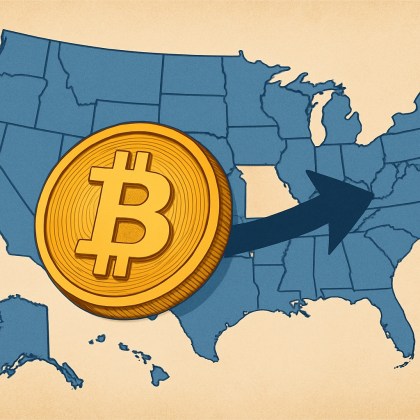
On Thursday, Senator Craig Bowser introduced a new piece of legislation aimed at creating a Strategic Bitcoin and cryptocurrency reserve for Kansas state.
The proposal, filed as Bill 352, would permit the Kansas Public Employees Retirement System (KPERS) to allocate up to 10% of its total funds into Bitcoin exchange-traded funds (ETFs).
Kansas Bitcoin Bill
Under the bill’s framework, KPERS would not be obligated to sell its Bitcoin ETF holdings if their value grows beyond the 10% allocation threshold, unless the board determines that doing so would better serve the interests of beneficiaries.
If enacted, the legislation would also require the KPERS board to conduct an annual review of the investment program, with the results formally submitted to the governor for oversight and evaluation.
Kansas’ move follows a growing trend among US states exploring BTC as a strategic asset as the regulatory environment surrounding crypto has significantly shifted under President Donald Trump’s administration.
US States Move Toward Crypto Reserves
Texas set an early benchmark last November when it became the first state to formally incorporate cryptocurrency into its treasury strategy by purchasing $10 million worth of Bitcoin.
In North Dakota, lawmakers are considering BTC investments as a potential hedge against inflation. Oklahoma has also entered the conversation, with Senator Dusty Deevers introducing the Bitcoin Freedom Act.
Meanwhile, Tennessee introduced a new bill last week—HB1695—designed to establish its own Strategic Bitcoin Reserve. West Virginia has put forward Senate Bill 143, which proposes allocating 10% of certain state funds toward a cryptocurrency reserve.
Missouri has made notable progress as well, advancing House Bill 2080 to create a Strategic Bitcoin Reserve Fund. That measure has already passed its second reading and is now moving forward for further consideration in the state House.
Featured image from DALL-E, chart from TradingView.com
Bitcoin (BTC) has recorded a dip below the $90,000 level. But how much of the drop was the result of various macroeconomic, geopolitical, and regulatory factors? Analysts have shared their valuable insights on the matter.
TLDR:
Euphoria over America’s commitment to crypto quickly faded;
Clarity Act is far more important to the future of digital assets than tariff news;
Clarity Act delay is likely just one in a series;
Bitcoin has remained “relatively resilient” over the past month;
Institutions are shifting from holding BTC to enabling it to function as productive capital;
Verbal intervention alone is unlikely to fully suppress volatility;
The sharp dislocation in sovereign bond markets once again highlights the fragility of traditional safe-haven assets.
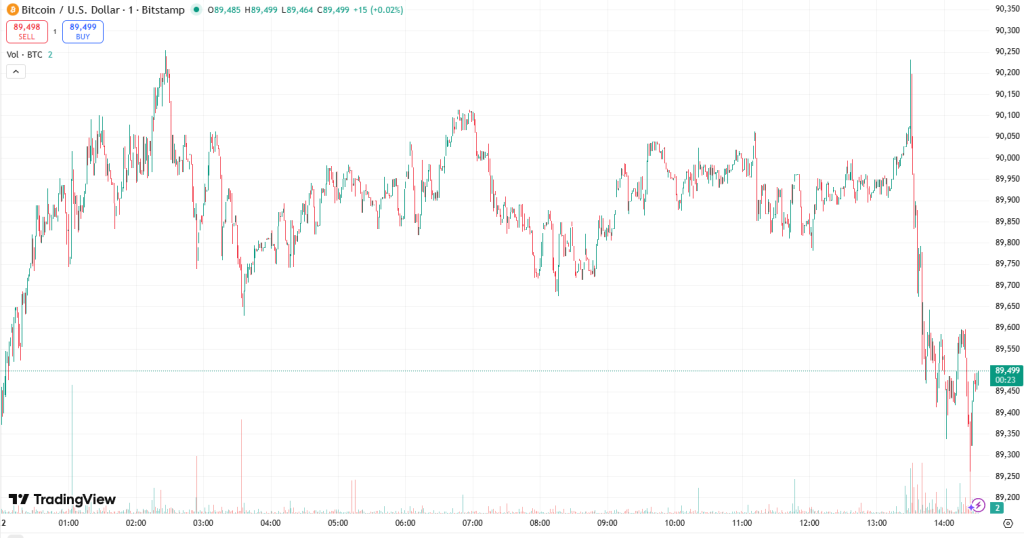
Over the past 24 hours, Bitcoin has remained mostly unchanged by the time of writing (Thursday afternoon, UTC). It has gone up by just 0.2%, currently trading at $89,582.
Earlier in the day, it saw a notable drop to the $87,300 level, before climbing to the briefly held $90,295.
Source: TradingView
Observing its performance over the past week, we see it’s now down nearly 8%, trading between $87,653 and $96,875.
Clarity Bill is Far More Important for Market Than Tariff Noise
Nic Puckrin, digital asset analyst and co-founder of Coin Bureau, commented on the CLARITY Act being postponed in the US. The bill was supposed to be passed last year but is still being delayed.
Puckrin says that, despite President Donald Trump’s statement that the bill would be signed “soon”, there’s a reason he didn’t mention it until the very end of his speech in Davos.
“While he may say crypto is a priority, […] it’s clearly not the first item on the agenda,” Puckrin writes.
Bitcoin grinding sideways while gold surges isn’t a sign of fading conviction.
It’s the shift from a high-beta venture asset to a crystallised institutional balance sheet play.
In macro stress, gold absorbs the immediate scale and urgency because it remains the world’s primary…
However, BTC fell below $90,000 yesterday. The most significant lesson learned from the market’s reaction is that “tariff noise” is not that relevant. Instead, the bill is “far more important to the future of digital assets.”
Puckrin writes:
“The momentary euphoria over America’s commitment to crypto quickly faded, and even the cancellation of tariffs on NATO countries couldn’t lift it higher.”
Taking a long time to agree on a perfect piece of legislation is not a good idea, he argues. Instead, passing the bill quickly would bring more benefits. However, this is likely just the first of many delays to “this potentially game-changing digital asset legislation.” And yet, “the longer CLARITY is delayed, the longer uncertainty prevails.”
“The big concern is that this could take years rather than months, leaving the crypto industry in the same limbo it has been fighting so hard to emerge from,” the analyst warns.
Dom Harz, Co-Founder of BOB, commented that many are keeping an eye on BTC’s day-to-day price movements. However, Bitcoin has remained “relatively resilient” nonetheless. It’s up 2% this month (at the writing time) despite broader market volatility.
As Davos is wrapping up, he says, “conversations among institutional leaders and investors highlight the growing emphasis on resilience, efficiency, and the search for credible and reliable stores of value.”
Notably, “institutions are shifting from simply holding BTC to searching for opportunities that enable it to function as productive capital, while remaining anchored to Bitcoin’s base layer security,” Harz says.
Therefore, he argues, the focus now needs to be on developing Bitcoin DeFi infrastructure to support secure participation and scale mainstream adoption.
Bitunix analysts noted a recent (what appears to be) bond market liquidity shock. It is a stress test of policy credibility within the global financial system, they write.
“In the short term, markets trade on sentiment; in the medium term, on the boundaries of central bank action; and in the long term, on whether institutional demand for non-sovereign assets is genuinely awakened,” the analysts explain.
So, what happened exactly?
On 21 January, Japan’s long-dated government bond market saw a sudden wave of selling. 30-year and 40-year as Japanese Government Bond (JGB) yields jumped more than 25 basis points in a single session, Bitunix writes.
“The magnitude of the move was described as a ‘six-standard-deviation’ event and quickly spilled over into U.S. Treasuries, pushing the U.S. 10-year yield to its highest level since last August,” they explained.
Bitunix Analyst $BTC is still moving in a range around $90K, with price reacting mainly to liquidity levels.@coinglass_com data shows a short-liquidation cluster near $91K, which could be swept if momentum builds. On the downside, $89K–$87K holds dense long-liquidation… pic.twitter.com/lefuwLuZMz
Japanese Finance Minister and the U.S. Treasury Secretary both called for market calm at Davos. The goal is “to contain the spread of a ‘weaponization of bond markets’ narrative.”
However, the analysts warn that “verbal intervention alone is unlikely to fully suppress volatility.” Structural pressures remain intact. These include Japan’s rapidly rising domestic rates, election-related uncertainty, and market expectations of unconventional Bank of Japan bond-buying measures weighing on sentiment.
Therefore, “for the crypto market, the sharp dislocation in sovereign bond markets once again highlights the fragility of traditional safe-haven assets.”
The analysts predict that:
In the short term, simultaneous pressure on bonds and risk assets may dampen risk appetite in crypto markets.
Over the medium term, if the politicisation of bond markets and monetary intervention become persistent features, this dynamic could reinforce the allocation case for BTC as a non-sovereign asset.
Over the longer term, sustained erosion in global interest rates and currency stability could result in a repricing of crypto assets’ strategic weight within portfolio allocation.
Wet werkelijk rendement Box 3 is set to begin on January 1, 2028, according to the Dutch parliament.
A 36% flat tax will apply to positive net returns above a €1,800 threshold per person.
Losses can be carried forward to offset future gains.
The Netherlands is preparing to change how it taxes investors, and the shift could have a direct impact on people holding Bitcoin and other crypto assets.
Starting in 2028, the country plans to tax unrealised gains, meaning investors could owe tax even if they have not sold their holdings.
According to a post shared by Crypto Rover, the Netherlands is moving towards taxing unrealised Bitcoin gains, bringing fresh attention to how governments may treat crypto under mainstream investment rules.
The policy is expected to cover a broad set of assets, including Bitcoin, other cryptocurrencies, stocks, bonds, and similar investments.
For many investors, the key issue is that tax would be triggered by changes in value over time, not by selling and locking in profits.
That makes the reform especially relevant for crypto holders, who often deal with sharp price swings and long holding periods.
Netherlands plans overhaul of Box 3 wealth tax
According to the Dutch parliament, the Netherlands will introduce a new tax system called Wet werkelijk rendement Box 3 starting January 1, 2028.
The idea is to tax investors based on the actual returns they make each year, rather than on estimated returns set by the government.
Under the planned approach, authorities would compare the value of a person’s assets at the start and end of the year. Any income earned during that period would also be included in the calculation.
This means investors could be taxed on both realised profits and unrealised gains that only exist on paper.
The tax will apply to Bitcoin, other cryptocurrencies, and traditional investment products.
The reform is designed to treat different asset classes equally and apply one consistent method across a modern portfolio.
Why the Netherlands is changing its tax model
The proposed change follows a court ruling that found the old Box 3 system unfair.
Under the previous framework, investors were taxed based on assumed returns, even if their holdings did not perform in line with those assumptions.
Lawmakers argue the new structure is more accurate because it is based on the real change in value of assets, rather than an estimate that may not reflect actual outcomes.
Supporters of the change believe it improves fairness, especially for investors whose returns have historically been overstated by the assumed-return method.
The planned system also reflects how investment behaviour has evolved over the years.
Many households now hold a mix of traditional assets and crypto, and the government appears to be moving towards rules that apply consistently across both categories.
How unrealised gains would be taxed each year?
Under the new rules, the government would calculate a person’s yearly investment result by comparing asset values at the beginning and end of the year, plus any income earned during that period.
A 36% flat tax would apply to positive net returns above a €1,800 annual threshold per person.
In simple terms, the tax would be linked to annual performance rather than transactions.
That means an investor could owe tax if their portfolio rises in value, even if they did not sell anything and did not receive cash from their holdings.
If an investor records a loss, that loss can be carried forward and used to offset future gains.
This gives investors some protection during negative years, although the timing mismatch between paper gains and cash flow remains a concern for some.
What the reform could mean for Bitcoin and crypto holders
For crypto investors, the biggest challenge is volatility. Bitcoin and other digital assets can rise sharply in a short time, and then fall just as quickly.
A year-end value increase could create a tax bill, even if the investor has not sold any crypto and has no cash available from those gains.
Critics warn this could create liquidity pressure, especially for long-term holders who do not want to sell their Bitcoin just to fund tax payments.
Some also fear it could push investors and crypto businesses to relocate if the system becomes too costly or difficult to manage.
With the Box 3 reform planned for 2028, the Netherlands is positioning itself for a major shift in investor taxation, and crypto holders may soon face annual tax calculations tied to market movements rather than selling decisions.
Bitcoin has lost roughly 25,000 millionaire addresses in the year since President Donald Trump returned to the White House, despite a sharp shift toward a more crypto-friendly regulatory environment in the United States.
Key Takeaways:
Bitcoin has lost about 25,000 millionaire addresses over the past year despite a more favorable US regulatory stance on crypto.
The largest Bitcoin holders saw smaller declines, indicating greater resilience to market volatility.
Much of the growth in millionaire addresses occurred before Trump took office.
Blockchain data analyzed by Finbold shows that the number of Bitcoin addresses holding at least $1 million fell from 157,563 at the time of Trump’s January 2025 inauguration to 132,383 by Jan. 20, 2026.
The decline of 25,180 addresses represents a drop of about 16% over the one-year period, raising questions about how policy optimism has translated into on-chain wealth.
Bitcoin’s Biggest Holders Prove More Resilient Amid Millionaire Decline
The pullback was more muted among the largest Bitcoin holders. Addresses holding more than $10 million worth of BTC declined from 18,801 to 16,453, a decrease of 12.5%.
The smaller contraction suggests that higher-tier holders were better positioned to absorb market volatility, while those closer to the millionaire threshold were more exposed to price swings.
Much of the surge in Bitcoin millionaire addresses occurred before Trump formally took office. Following his election victory in November 2024, Bitcoin traded near $69,000, with about 120,851 addresses holding at least $1 million.
As expectations grew around deregulation and stronger institutional support for crypto, prices climbed rapidly.
By January 2025, Bitcoin had rallied above $100,000, driving a sharp increase in high-value addresses as rising prices pushed more wallets over the millionaire mark.
The run-up reflected optimism around Trump’s pro-crypto messaging and the prospect of tighter integration between digital assets and traditional finance.
Once in office, Trump’s administration moved quickly to ease pressure on the crypto sector.
Pro-industry regulators were appointed, crypto-related legislation advanced in a Republican-controlled Congress, and long-standing barriers between banks and digital asset firms were reduced.
Trump and his family also launched several crypto ventures, including mining projects and branded tokens, drawing both attention and criticism.
Supporters argued the moves signaled long-term confidence in the sector, while critics raised ethical concerns over potential conflicts of interest, allegations the White House has consistently denied.
No shock here: 40% of Trump's wealth is in Bitcoin, and he's fueled by the crypto elite. Now he's pushing regulations that'll make him astronomically richer.
They're literally making a statue of him as a Bitcoin king!
The Trump administration advanced its pro-crypto agenda last week with a series of policy and regulatory moves.
President Trump signed an executive order urging regulators to remove barriers that prevent 401(k) plans from including alternative assets such as cryptocurrencies.
If implemented, the reforms could allow millions of Americans to allocate retirement funds to Bitcoin and other digital assets through regulated channels.
Trump also nominated economist Stephen Miran, a digital asset advocate, to the Federal Reserve Board of Governors, signaling continuity in his administration’s pro-crypto stance.
The Blockchain Association praised the measures as a “historic shift” that would expand consumer choice, empower wealth-building, and reduce operational barriers for blockchain businesses.
The SEC added to the positive momentum by clarifying that certain liquid staking models, such as those involving receipt tokens like stETH, are not securities.
The SSC launched the process after the Ministry of Finance issued Decision No. 96.
Banks and brokers, including SSI, VIX, and major lenders, are preparing to apply.
Rules include 10 trillion dong capital, 65% institutional ownership, and a 49% foreign cap.
Vietnam has formally moved closer to running a regulated crypto market after opening applications for licences to operate digital asset trading platforms.
The step brings the country’s long-planned pilot programme into action, setting the stage for approved exchanges to operate under direct regulatory oversight.
The State Securities Commission of Vietnam (SSC) said the licensing window opened on Tuesday, following the introduction of new administrative procedures under Decision No. 96 by the Ministry of Finance.
The decision implements a resolution on piloting a regulated crypto asset market, which Vietnam has been developing for years.
Even with the licensing process now live, the market is still in its early phase.
No platform has yet been licensed, and regulators have not announced approvals since the application window opened.
SSC opens licensing window under new procedures
The SSC confirmed that applications under the new administrative procedures will be accepted beginning January 20, 2026.
Vietnam’s Ministry of Finance issued Decision No. 96 as part of implementing the country’s resolution to pilot a regulated crypto asset market.
The SSC framed the move as a step towards bringing crypto under formal regulatory supervision.
The opening of the licensing window also follows a key legal shift. Vietnam’s Law on the Digital Technology Industry entered into force on Jan. 1, defining digital and crypto assets in statute for the first time.
Under the law, Vietnam recognises crypto assets as property. However, it explicitly excludes them from legal tender status.
The country also maintains restrictions on the use of crypto as a means of payment, keeping the pilot focused on regulated market activity rather than consumer transactions.
Domestic banks and securities firms prepare applications
While the licensing window marks progress, Vietnam’s regulated crypto market is still waiting for actual approvals.
That said, early interest from domestic financial firms appears to be emerging.
Vietnam News reported on Wednesday that around 10 securities companies and banks have publicly announced plans and their readiness to participate in the crypto asset market once licensed.
The report stressed that these institutions are preparing applications rather than already operating approved platforms.
Among the firms named was SSI Securities, which established SSI Digital in 2022.
Another is VIX Securities, which has invested in its VIXEX digital asset exchange unit.
Several major banks were also listed, including Military Bank, Techcombank, and VPBank.
The institutions indicated they plan to begin operations only after receiving regulatory approval.
No crypto exchange licensed as pilot enters operational phase
Even though Vietnam has opened the licensing window, the pilot framework remains at the starting line in practical terms.
Earlier hesitancy around the pilot has been linked to Vietnam’s high capital threshold and strict eligibility rules, which set a tough entry bar for potential operators.
That context matters because the latest application process does not automatically mean platforms will launch quickly.
Vietnamese regulators have not announced any receipt or approvals of applications since the licensing window opened, meaning the number of applicants and their progress remains unclear.
For investors and market participants, this suggests Vietnam is moving in a controlled and staged way, with formal procedures advancing before any exchange can legally operate under the pilot regime.
Vietnam’s crypto licensing framework is among the most restrictive in the region, reflecting the government’s cautious approach to market development.
Applicants must be Vietnamese entities with a minimum paid-in capital of 10 trillion dong, roughly $380 million.
At least 65% of the capital must be held by institutional shareholders, setting a high barrier that favours established domestic firms.
Foreign ownership is capped at 49%, restricting overseas participation and reinforcing Vietnamese control of licensed operators.
Taken together, these conditions show Vietnam is prioritising large-scale, institution-led platforms with strong capital bases.
The focus appears to be on controlling systemic risk and ensuring compliance standards from the start, rather than allowing fast, open-ended growth across the crypto sector.
SEC deputy secretary-general Jomkwan Kongsakul said crypto ETF rules could be issued early this year.
Thailand’s SEC will treat crypto as another asset class and allow up to 5% portfolio allocation to digital assets.
KuCoin Thailand is seeking to resolve an SEC suspension linked to capital requirements and a shareholder dispute.
Thailand’s Securities and Exchange Commission is preparing a new set of regulations designed to bring crypto investment products further into the country’s formal financial system.
The regulator is working on rules to support crypto exchange-traded funds (ETFs), crypto futures trading, and tokenised investment products, according to SEC deputy secretary-general Jomkwan Kongsakul.
The Bangkok Post reported on Thursday that the SEC aims to issue formal guidelines for crypto ETFs in Thailand “early this year.”
The move signals Thailand’s effort to position itself as a regional crypto hub for institutional investors, even as retail trading remains active despite a ban on crypto payments.
Crypto ETFs move closer to formal approval
Kongsakul said the SEC’s board has approved crypto ETFs in principle and the agency is now finalising investment and operational rules. He said the regulator sees crypto ETFs as a product that could reduce barriers for investors who may be hesitant about directly holding digital assets.
“A key advantage of crypto ETFs is ease of access; they eliminate concerns over hacking and wallet security, which has been a major barrier for many investors,” Kongsakul said.
Under the proposed framework, the SEC will treat crypto as “another asset class,” and investors will be able to allocate up to 5% of a diverse portfolio to digital assets.
Futures trading planned for TFEX
Alongside ETF guidelines, the SEC is also moving to regulate and enable crypto futures trading on the Thailand Futures Exchange (TFEX).
This would allow investors to gain exposure to crypto price movements through regulated derivatives markets.
Kongsakul said other initiatives under consideration include establishing market makers to support trading liquidity and recognising digital assets as an official asset class under the Derivatives Act.
Thailand has been working to attract more institutional interest in crypto markets, particularly through regulated products that sit within existing legal frameworks.
Tokenisation and sandbox collaboration with central bank
The SEC is also expanding its approach beyond ETFs and futures through tokenisation initiatives.
Kongsakul said the agency is working with the Bank of Thailand on a tokenisation sandbox, which could provide a controlled setting for testing tokenised instruments.
The SEC “will encourage issuers of bond tokens to enter the regulatory sandbox,” Kongsakul added.
By pushing tokenised bond products into a supervised environment, Thailand could develop regulated pathways for blockchain-based issuance without opening the door to unmonitored retail distribution.
Tighter oversight for financial influencers
While expanding products and market access, the SEC is also tightening standards around promotion and investment-related content online.
Kongsakul said the regulator is stepping up oversight of “financial influencers,” signalling that marketing and informal advice will face more restrictions.
He said, “Any recommendation related to securities or investment returns will require proper authorisation as either an investment advisor or introducing broker.”
The rules aim to curb unregulated investment promotion, particularly at a time when digital assets continue to be widely discussed across social media.
KuCoin Thailand works to resolve SEC suspension
The regulatory shift comes as the Thai SEC continues enforcement actions in the local exchange market.
Earlier in January, the SEC suspended KuCoin Thailand’s operations after the company’s capital fell below the minimum requirements for five consecutive days, according to local news outlet The Nation on Wednesday.
KuCoin Thailand said the breach was linked to a shareholder dispute between Singapore’s CI group and KuCoin Global, which prevented approval of a planned capital increase.
The company said the issue was not due to actual financial liquidity problems.
KuCoin entered the Thai market in June 2025 and is planning for its local entity to apply for a digital-asset broker license.
The company said this would allow it to offer a wider range of financial products.
Thailand’s crypto market remains active, with Bitkub, the country’s largest exchange, seeing daily trading volumes of around $60 million.
Even with crypto payments banned, regulators appear to be prioritising controlled investment access through structured products such as ETFs, futures, and tokenised instruments.
Residents of Thailand may soon have access to crypto exchange-traded funds as the Securities and Exchange Commission is working on formalizing regulations. Thai SEC deputy secretary-general, Jomkwan Kongsakul, has recently confirmed that the regulator plans on issuing formal guidelines that…

 Login
Login





 Senate Judiciary leaders oppose blockchain developer protections in crypto bill, warning exemptions modeled on Lummis-Wyden BRCA could block money laundering prosecutions.
 Crypto market structure bill – Clarity Act – has been further delayed by the US Senate Banking Committee until late February or March.
 Senate Agriculture Committee advances crypto bill for January 27 markup without Democratic support as Banking delays CLARITY Act over stablecoin disputes.
 The SEC opened just 13 crypto enforcement cases in 2025, down 60% from 2024, with most new actions under Chair Paul Atkins focused on fraud.











 (@angeloinchina)