Mixed bag this week in crypto markets: BTC edged down slightly overall (from ~$91k to ~$95.6k ), while altcoins like SUI (+20–31% ) and XRP surged. Your portfolio (BTC, ETH, SUI, AERO, XRP) stayed positive on average, buoyed by SUI/XRP strength amid BTC stability around 95–97k. 📈
📊 Weekly Coin Movements
Portfolio benefited from altcoin rotation away from BTC dominance.
CoinWeekly Change/VolatilityKey SwingsNoteBTC -0.58% to +5% 91k → 97k USD Stable, mild dip ETH -2% to +3% 3.200–3.500 USD Consolidation SUI +20–31% 1.5 → 1.8–2 USD Top winner 🚀 AERO Neutral No big moves Following alt trend XRP +21% → 2.1 USD BTC rotation play
🔍 BTC Technical Analysis (Weekly)
Moderate bullish momentum emerging.
RSI: 58 (neutral, not overbought).
MACD: Mild positive histogram (upside potential).
ADX: 28 (moderate trend strength).
Trend: Upward above 90k support, rising volatility via Bollinger Bands.
CategoryLast WeekNowChangeTotal Value ~$8,700 $8,927 +$227 (+2.6%) Est. Daily Yield ~$3.7–4.0 ~$3.8 Stable Accrued Yield (Lifetime) ~$1,691 $1,738 +$47 net
Notes: Growth from yields + mild BTC/ETH price lifts. Lower volatility, better range-resilience. Risk down, IL pressure eased. Subjective score: 8.2/10 (up from 7.5).
🧾 Quick Conclusion
Portfolio up ~2.6% in a week, holding steady daily cashflow (~$3.8). APY isn’t sky-high, but structure is mature, less volatile, and sustainable — less action, more results.
🧠 Final Take:
❌ No strategy issues.
❌ Beefy autocompound flawless.
✅ Time + volume will scale it.
👉 HODL portfolio: Real fees, controlled risk, gradual growth — no bridging frenzy.
Thoughts on SUI ETF buzz or XRP’s win? Comment below! 👇
⚠️ Disclaimer
🛑🛑🛑🛑🛑🛑🛑🛑🛑🛑🛑🛑🛑🛑🛑🛑🛑🛑🛑🛑🛑🛑🛑🛑
Disclaimer:
This post is just my personal opinion and ideas. I am not promoting or recommending any cryptocurrency or investment. Please do your own research and be careful when investing. Any decisions you make are at your own risk.
How to Use Crypto.com’s DeFi Wallet for Passive Income
What if your crypto could work for you — 24/7 — without relying on banks, brokers, or savings accounts that barely beat inflation?
In a world where traditional interest rates struggle to keep up with rising living costs, decentralized finance (DeFi) has emerged as a powerful alternative for investors seeking passive income, portfolio diversification, and long-term wealth building.
One of the most beginner-friendly yet powerful gateways into this ecosystem is Crypto.com’s DeFi Wallet.
Unlike centralized platforms that control your funds, Crypto.com DeFi Wallet gives you full ownership of your assets, while still offering access to staking, yield farming, liquidity pools, and on-chain rewards — all from a single mobile interface.
In this step-by-step guide, you’ll learn exactly how to use Crypto.com’s DeFi Wallet to generate passive income, even if you’re new to DeFi. We’ll cover setup, security, earning strategies, risk management, and how to maximize yields responsibly.
Whether your goal is earning yield on idle crypto, reducing reliance on traditional debt-based systems, or building decentralized income streams, this guide is designed to help you do it safely and strategically.
What Is Crypto.com’s DeFi Wallet?
Crypto.com’s DeFi Wallet is a non-custodial cryptocurrency wallet that allows users to earn passive income through staking, DeFi lending, liquidity pools, and yield protocols while maintaining full control of their private keys.
Key Features of Crypto.com’s DeFi Wallet
Self-custody (you own your keys, not Crypto.com)
Supports Ethereum, Cronos, Polygon, BNB Chain, Cosmos, and more
Access to staking, DeFi apps (dApps), and yield protocols
Seamless connection to the Crypto.com App
Built-in Web3 browser for DeFi access
Unlike centralized platforms, the wallet connects directly to decentralized finance applications (dApps), enabling on-chain rewards without intermediaries.
Building passive income with crypto is a skill — not a gamble.
Follow this publication to learn how professionals use DeFi, staking, and yield strategies to grow income, protect capital, and reduce reliance on traditional banks — without falling for hype or scams.
Can You Earn Passive Income With Crypto.com’s DeFi Wallet?
Yes, Crypto.com’s DeFi Wallet allows users to earn passive income by staking CRO, earning yield on stablecoins, providing liquidity to DeFi pools, and lending crypto assets through decentralized protocols — all while retaining self-custody.
Returns vary based on market conditions and protocol risk.
Why Use a DeFi Wallet for Passive Income?
Traditional savings accounts often offer negative real returns after inflation. DeFi flips this model by allowing users to earn yield directly from blockchain activity.
Benefits of DeFi Passive Income:
Higher yield potential than banks
No minimum balances
Permissionless access
Global, borderless income streams
Transparency via smart contracts
Crypto.com’s DeFi Wallet acts as a bridge between beginners and advanced DeFi strategies, making it ideal for investors who want passive income without unnecessary complexity.
Step 1: Download and Set Up Crypto.com’s DeFi Wallet
1. Download the Wallet
Available on iOS and Android
Search for “Crypto.com DeFi Wallet”
Ensure the developer is Crypto.com
2. Create a New Wallet
Select “Create New Wallet”
You’ll receive a 12-word recovery phrase
Write it down offline (never store digitally)
Important Security Note: Your recovery phrase is your money. Lose it, and your funds are gone forever.
3. Enable Security Settings
Set a strong passcode
Enable biometric authentication
Turn on transaction confirmations
Step 2: Fund Your DeFi Wallet
To earn passive income, you need assets inside your wallet.
Funding Options:
Transfer crypto from Crypto.com App
Send crypto from another wallet
Bridge assets from other chains
Popular assets for passive income:
CRO
ETH
USDC
ATOM
MATIC
Each asset offers different yield opportunities, risk levels, and lock-up terms.
Step 3: Understand the Passive Income Options Inside the DeFi Wallet
Crypto.com’s DeFi Wallet supports multiple income-generating strategies, each with different risk-reward profiles.
What Are the Best Passive Income Strategies in Crypto.com’s DeFi Wallet?
The most popular passive income methods include:
CRO staking
Stablecoin yield farming
Liquidity pool participation
DeFi lending protocols
Each strategy offers different risk levels, yield potential, and liquidity conditions.
Strategy 1: CRO Staking (Beginner-Friendly)
How CRO Staking Works
By staking CRO, you help secure the Cronos network and earn staking rewards in return.
Why CRO Staking Is Popular:
Predictable yields
No active management
On-chain transparency
Ideal for long-term holders
Step-by-Step CRO Staking:
Open DeFi Wallet
Select Earn
Choose CRO Staking
Select a validator
Stake your CRO
Typical APYs fluctuate based on network conditions, but CRO staking remains one of the most stable DeFi income options.
If you prefer income without price swings, stablecoins are your friend.
Common Stablecoin Options:
USDC
USDT
DAI
Where Stablecoin Yield Comes From:
Lending protocols
Liquidity pools
Automated market makers (AMMs)
Benefits:
Reduced volatility
Predictable yield
Ideal for capital preservation
This approach is especially attractive for investors focused on debt reduction, cash-flow stability, or income replacement strategies.
Is Stablecoin Yield Safer Than Crypto Staking?
Stablecoin yield strategies are generally less volatile than crypto staking because they are pegged to fiat currencies like the U.S. dollar. However, they still carry smart contract and protocol risk.
Stablecoins are often used for income stability and capital preservation.
Save this guide before you move on.
This step-by-step walkthrough is designed to be reused as you set up your DeFi wallet, choose staking options, and compare yield strategies. Saving now prevents costly mistakes later.
This strategy is best for experienced investors who understand DeFi mechanics and risk management.
What Is Impermanent Loss in DeFi?
Impermanent loss occurs when the price of tokens in a liquidity pool changes compared to holding them individually, potentially reducing overall returns despite earning trading fees.
It is a key risk factor when providing liquidity in DeFi protocols.
Strategy 4: DeFi Lending Protocols
Some DeFi platforms allow you to lend your crypto to borrowers and earn interest.
How Lending Generates Income:
Borrowers pay interest
Smart contracts automate repayments
Collateral protects lenders
Ideal Assets:
Stablecoins
Blue-chip cryptocurrencies
This method closely resembles traditional interest-based finance, but without banks acting as middlemen.
Step 4: Using the Built-In Web3 Browser
Crypto.com’s DeFi Wallet includes a Web3 browser, giving access to vetted DeFi protocols.
How to Use It:
Open DeFi Wallet
Tap Browser
Select a DeFi app
Connect your wallet
Review terms before depositing
Always:
Verify URLs
Avoid unknown dApps
Start with small amounts
Is Crypto.com’s DeFi Wallet Safe?
Crypto.com’s DeFi Wallet is considered secure because it is non-custodial, open-source, and requires users to manage their own private keys.
Security ultimately depends on user practices, such as protecting recovery phrases and avoiding unverified DeFi apps.
Step 5: Managing Risk Like a Professional
Passive income doesn’t mean risk-free income.
Smart Risk Management Tips:
Diversify across strategies
Avoid chasing unsustainable APYs
Use stablecoins for balance
Monitor protocol updates
Never invest money you can’t afford to lock up
Think of DeFi as a portfolio tool, not a lottery ticket.
Step 6: Tracking and Reinvesting Your Earnings
Best Practices:
Track yields monthly
Reinvest rewards strategically
Convert profits to stablecoins
Periodically rebalance
Compound interest remains one of the most powerful wealth-building forces — especially in DeFi.
Common Mistakes to Avoid
Ignoring smart contract risk
Falling for fake APY promises
Storing seed phrases digitally
Over-allocating to one protocol
Forgetting about gas fees
Avoiding these mistakes alone can dramatically improve long-term returns.
Are you servicing a high-interest debt or have low savings?
Private credit is becoming the new income solution. Get $300 on first deposit with Insidefinacent. See how it works.
Is Crypto.com DeFi Wallet Safe?
Security depends largely on user behavior.
Safety Strengths:
Non-custodial
Transparent smart contracts
Established ecosystem
Regular updates
Your biggest risk isn’t the wallet — it’s poor operational security.
Who Should Use Crypto.com’s DeFi Wallet?
This wallet is ideal for:
Passive income seekers
Crypto beginners entering DeFi
Long-term CRO holders
Investors diversifying away from banks
Individuals rebuilding finances or reducing debt through alternative income
Final Thoughts: Is Crypto.com DeFi Wallet Worth It for Passive Income?
If you’re serious about earning passive income with crypto, Crypto.com’s DeFi Wallet offers a balanced entry point into decentralized finance.
It combines:
Self-custody
Real yield opportunities
Beginner-friendly design
Access to advanced DeFi strategies
In a financial system increasingly defined by inflation, debt, and centralized control, learning how to generate decentralized income is no longer optional — it’s strategic.
5 On-Chain Metrics Every Trader Should Monitor on Uniswap
While most traders obsess over price charts and indicators, the smartest money is watching on-chain data unfold in real time.
Every swap, liquidity move, and whale transaction on Uniswap leaves a permanent footprint on the blockchain — and those footprints often reveal the next move before price reacts.
In decentralized finance (DeFi), information asymmetry is the edge. Traders who understand Uniswap’s on-chain metrics can identify accumulation, distribution, liquidity traps, and impending volatility long before it hits centralized exchanges.
This guide explains the five most important on-chain metrics every Uniswap trader should monitor, why they matter, and how to use them to make smarter trading and investment decisions — whether you’re day trading memecoins, managing a long-term DeFi portfolio, or protecting capital during volatile market cycles.
What Are On-Chain Metrics on Uniswap?
On-chain metrics on Uniswap are blockchain-based data points that track real-time trading activity, liquidity movements, wallet behavior, and price impact directly on decentralized exchange smart contracts.
Unlike technical indicators, on-chain metrics reflect actual capital flows, making them essential for DeFi traders seeking early signals, risk management insights, and smarter trade execution.
Why On-Chain Metrics Matter More Than Price on Uniswap
Uniswap is not a centralized exchange. There is:
No order book
No market makers
No hidden liquidity
No internal matching engine
Everything happens on-chain.
That means price is a result, not a signal.
On Uniswap, price changes only when:
Liquidity shifts
Capital flows in or out
Traders swap assets
Liquidity providers (LPs) add or remove funds
By monitoring on-chain metrics, traders gain insight into:
Smart money behavior
Whale accumulation and exits
Liquidity risks
Slippage exposure
Market sentiment in real time
This is why professional DeFi traders rely on on-chain analytics, not just technical indicators.
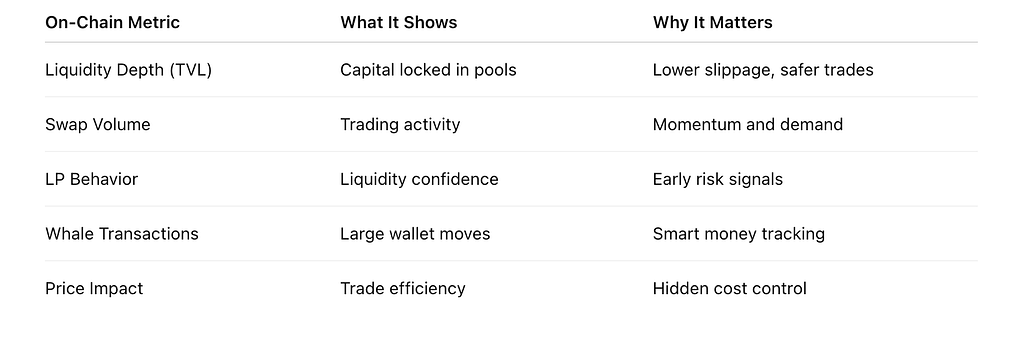
5 On-Chain Metrics Every Trader Should Monitor on Uniswap
The most important on-chain metrics for Uniswap traders:
Liquidity Depth (Total Value Locked — TVL)
Swap Volume and Trading Momentum
Liquidity Provider (LP) Behavior
Whale Transactions and Wallet Concentration
Price Impact and Slippage Trends
Together, these metrics reveal market strength, trader intent, and potential risk before price moves.
Are you servicing a high-interest debt or have low savings?
Private credit is becoming the new income solution. Get $300 on first deposit with Insidefinacent. See how it works.
Metric #1: Liquidity Depth (Total Value Locked — TVL)
What Is Liquidity Depth on Uniswap?
Liquidity depth refers to the amount of capital locked in a specific Uniswap pool, often measured as Total Value Locked (TVL).
TVL represents:
How much ETH, USDC, USDT, or other tokens are available for trading
How resilient a pool is to large trades
How much slippage traders will experience
Why Liquidity Depth Is Critical for Traders
Low liquidity = high slippage + price manipulation risk High liquidity = tighter spreads + healthier market conditions
For traders, liquidity depth directly impacts:
Entry and exit efficiency
Risk of price impact
Trade execution quality
A sudden drop in liquidity often signals:
Liquidity providers exiting
Loss of confidence in a token
Increased rug-pull risk (especially in low-cap tokens)
A rapid increase in liquidity can signal:
New capital inflows
Protocol partnerships
Smart money positioning ahead of news
How Traders Use This Metric
Smart traders monitor:
TVL changes over time
Liquidity concentration by price range (Uniswap v3)
LP behavior before major price moves
Pro Tip:
If price is rising but liquidity is falling, the move is fragile. If liquidity rises before price, accumulation may be underway.
Swap volume measures the total value of trades occurring in a Uniswap pool over a specific timeframe (hourly, daily, weekly).
Volume reflects:
Market interest
Capital rotation
Short-term momentum
Why Volume Is a Leading Indicator
On Uniswap, volume often spikes before price breaks out.
High swap volume combined with stable liquidity suggests:
Organic demand
Healthy price discovery
High volume with declining liquidity suggests:
Aggressive speculation
Potential exit liquidity setup
Low volume with stable liquidity suggests:
Consolidation
Accumulation or distribution phase
How Traders Use Swap Volume
Experienced traders compare:
Volume vs liquidity
Volume vs price trend
Volume across multiple pools (ETH vs stable pairs)
Example Insight:
If a token shows rising volume in its ETH pair but flat volume in stablecoin pairs, it often indicates speculative momentum rather than long-term capital deployment.
Metric #3: Liquidity Provider (LP) Behavior
Why LP Behavior Reveals Smart Money Moves
Liquidity providers are not passive participants — especially on Uniswap v3.
They actively manage positions, adjust ranges, and exit when risk increases.
Tracking LP behavior reveals:
Confidence in a token’s price stability
Anticipation of volatility
Exit signals before major drawdowns
Key LP Metrics to Monitor
Traders should watch:
Large LP deposits (capital entering)
Sudden LP withdrawals (capital fleeing)
Narrow vs wide liquidity ranges
Concentration around key price levels
Investor Insight:
When LPs withdraw liquidity before price dumps, it often signals informed risk management rather than panic selling.
Save this article — you’ll need it again.
These five Uniswap on-chain metrics don’t expire.
Markets change. Narratives rotate. But liquidity, volume, and wallet behavior always tell the truth.
Traders who revisit these signals consistently make better entries, safer exits, and fewer emotional mistakes.
Understanding Slippage, Price Impact & Gas Optimization on Uniswap
Every time you swap tokens on Uniswap, you’re either quietly compounding wealth — or unknowingly leaking money through slippage, price impact, and excessive gas fees.
Most DeFi users obsess over yield, APYs, and “the next token,” but overlook the invisible mechanics that quietly erode returns.
For high-net-worth investors, active traders, and long-term DeFi participants, these inefficiencies can add up to thousands or even millions lost over time.
This article breaks down slippage, price impact, and gas optimization on Uniswap in plain English — while also diving deep enough for serious investors who want capital efficiency, execution precision, and smarter on-chain strategies.
Whether you’re:
A DeFi beginner trying to avoid costly mistakes
An experienced crypto investor optimizing large trades
A yield farmer, DAO participant, or liquidity provider
Or someone using DeFi as part of a broader wealth diversification or debt relief strategy
…understanding these mechanics is non-negotiable.
What Is Slippage on Uniswap and Why Does It Matter?
Uniswap isn’t just a decentralized exchange — it’s core financial infrastructure for Web3.
As the largest decentralized exchange (DEX) by volume, Uniswap:
Processes billions in monthly trading volume
Serves as a pricing oracle for DeFi protocols
Enables permissionless token swaps without intermediaries
Replaces traditional market makers with automated liquidity pools
For investors focused on financial independence, alternative income streams, and decentralized wealth management, Uniswap is often the first and most frequent point of interaction with DeFi.
But unlike centralized exchanges, execution quality on Uniswap is your responsibility.
That’s where slippage, price impact, and gas optimization come in.
What Is Slippage on Uniswap?
Slippage on Uniswap is the difference between the expected price of a token swap and the actual price at which the transaction executes, caused by liquidity depth, trade size, market volatility, and automated market maker (AMM) mechanics.
In traditional finance, this happens during volatile market conditions. In DeFi, it’s structural.
Simple Slippage Example
You attempt to swap:
10 ETH → USDC
Expected price: $3,000 per ETH
Expected output: $30,000
But the transaction executes at:
$2,940 per ETH
Actual output: $29,400
That $600 difference? Slippage.
The wealthy are shifting into private credit for stable 10%+ income. See how it works.
Why Slippage Happens in DeFi
Slippage on Uniswap occurs due to liquidity mechanics, not market manipulation.
Key causes include:
1. Liquidity Pool Depth
Uniswap uses automated market maker (AMM) pools instead of order books.
If a pool is shallow:
Large trades move the price dramatically
Slippage increases exponentially
2. Trade Size Relative to Pool
Swapping $100 in a $50 million pool? Minimal slippage. Swapping $100,000 in a $500,000 pool? Significant slippage.
3. Market Volatility
Fast price movements between transaction submission and confirmation increase execution variance.
4. Front-Running & MEV
Bots monitor pending transactions and exploit large swaps by:
Buying ahead of you
Selling immediately after
This increases slippage and worsens execution.
Slippage Tolerance: The Hidden Risk Setting Most Users Ignore
When you set slippage tolerance on Uniswap, you’re defining how much value you’re willing to lose to complete a trade.
Common defaults:
0.5% for stable pairs
1% for liquid tokens
2–5% for volatile or low-liquidity tokens
Why High Slippage Tolerance Is Dangerous
High tolerance:
Signals MEV bots to attack your trade
Increases front-running risk
Allows extremely unfavorable execution
For large investors, slippage tolerance is a capital protection tool, not a convenience setting.
Slippage is one of those concepts that only becomes obvious after it costs real money.
Consider saving this article so you can revisit it before making large or time-sensitive swaps.
What Is Price Impact on Uniswap?
Price impact measures how much your trade moves the market price.
Unlike slippage (which includes external factors), price impact is deterministic — it’s built into Uniswap’s math.
The AMM Formula (Simplified)
Uniswap pools follow:
x × y = k
When you buy one asset:
Its supply decreases
The price automatically increases
Large trades distort the ratio
This is why:
Small trades barely move price
Large trades dramatically worsen execution
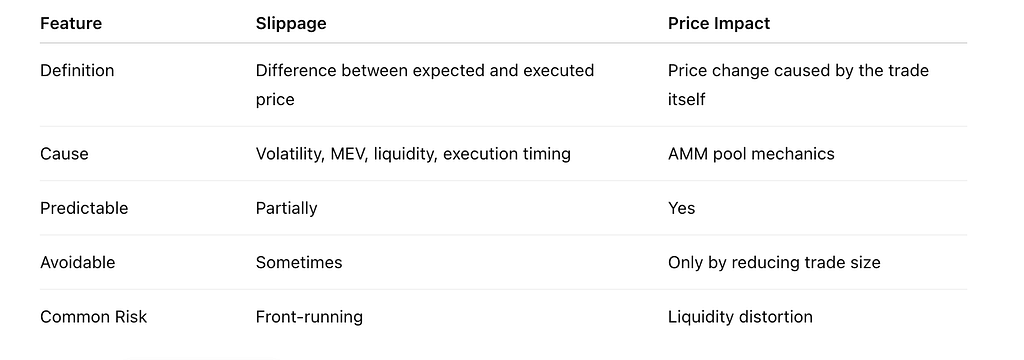
Slippage Vs Price Impact: Critical Difference
Slippage Vs Price Impact
For high-volume traders, price impact is often the bigger enemy.
How to Reduce Slippage on Uniswap
Trade tokens with deep liquidity pools
Split large trades into smaller transactions
Set conservative slippage tolerance
Avoid trading during high volatility
Use Layer 2 networks when possible
How Large Trades Destroy Returns Without You Noticing
Institutional traders split orders for a reason.
In DeFi:
A single large swap can move price 5–15%
Smaller sequential swaps often result in better average execution
For wealth-focused investors, trade structuring matters more than token selection.
Gas Fees: The Silent Profit Killer
Ethereum gas fees are the cost of executing transactions on-chain.
On Uniswap, gas fees vary based on:
Network congestion
Transaction complexity
Priority fee selection
Why Gas Optimization Is a Wealth Strategy
If you:
Make frequent swaps
Provide liquidity
Rebalance portfolios
Farm yield
…gas inefficiency can erase profits faster than poor market timing.
Understanding Gas Fees Components
Gas fees consist of:
Base fee (burned)
Priority fee (paid to validators)
During peak congestion:
Fees spike unpredictably
Poor timing costs real money
How Can You Reduce Gas Fees on Uniswap?
Trade during low network congestion periods
Avoid overpaying priority fees
Use Layer 2 networks like Arbitrum or Optimism
Batch transactions when possible
Monitor Ethereum gas trends before swapping
MEV, Front-Running & Sandwich Attacks Explained
Miner Extractable Value (MEV) is one of the most misunderstood risks in DeFi.
What Happens in a Sandwich Attack
Bot detects your large swap
Bot buys before you
Your trade executes at worse price
Bot sells immediately after
You get worse execution, pay full gas and bot extracts risk-free profit.
How to Protect Yourself from MEV
1. Reduce Slippage Tolerance
Lower tolerance = fewer attacks.
2. Break Large Trades into Smaller Ones
Reduces MEV profitability.
3. Use MEV-Protected RPCs
Some wallets route transactions privately.
4. Trade on Layer 2
Less MEV competition than Ethereum mainnet.
Many losses in decentralized trading come from structural mechanics rather than market direction.
You may want to save this article or share it with someone new to Uniswap who would benefit from understanding these risks early.
Why This Matters for Long-Term Wealth & Income
For investors focused on:
Passive income
DeFi yield strategies
Portfolio rebalancing
Capital preservation
Debt relief via alternative income
…execution efficiency compounds over time.
A 1–2% loss per trade doesn’t feel painful — until it happens hundreds of times.
Slippage & Gas in the Context of Debt Relief
Many users turn to crypto and DeFi:
After financial setbacks
To escape high-interest debt
To generate alternative income
Poor execution:
Undermines recovery efforts
Adds unnecessary friction
Turns opportunity into frustration
Understanding Uniswap mechanics is financial literacy for the decentralized age.
How to Launch a DeFi Project from Idea to Mainnet?
In the ever-evolving world of decentralized finance (DeFi), launching a project isn’t just about coding smart contracts or minting tokens — it’s a multifaceted journey that demands creativity, technical prowess, strategic planning, and community engagement. As we step into 2026, the DeFi landscape has matured significantly. Total value locked (TVL) in DeFi protocols has surged past $300 billion, driven by innovations in yield-bearing stablecoins, real-world asset (RWA) tokenization, and cross-chain interoperability. But with this growth comes heightened competition, regulatory scrutiny, and the need for genuine utility to stand out.
If you’re an aspiring founder, developer, or entrepreneur eyeing the DeFi space, this comprehensive guide will walk you through every step from conceptualizing your idea to deploying on mainnet. Drawing from successful launches like Uniswap’s V4 upgrades and Aave’s cross-chain expansions in 2025, we’ll cover best practices tailored to the 2026 meta, where sustainability, privacy, and AI integration are key narratives. Whether you’re building a lending platform, a DEX, or a novel yield optimizer, the principles here will help you navigate pitfalls and maximize your chances of success.
Why launch a DeFi project now? The market is ripe: Institutional adoption is accelerating, with banks like JPMorgan experimenting with tokenized deposits, and retail users are flocking to user-friendly apps. However, failures abound — over 60% of 2025 DeFi projects faded due to poor tokenomics or security breaches. Success hinges on execution: Projects like Curve Finance, which optimized stablecoin trading and hit $4.5 billion TVL by mid-2025, prove that focused utility wins. By following this roadmap, you’ll build a resilient project that not only launches but thrives in a post-hype era.
Phase 1: Ideation and Market Research
Every great DeFi project starts with a spark — an idea that solves a real problem in finance. In 2026, successful ideas revolve around underserved niches like DePIN (decentralized physical infrastructure networks), DefAI (decentralized AI), or sustainable yield strategies that go beyond hype farming. Begin by brainstorming: What pain point are you addressing? Is it high gas fees on Ethereum, lack of privacy in transactions, or inefficient RWA tokenization?
Conduct thorough market research to validate your concept. Analyze competitors using tools like DeFiLlama for TVL metrics and Dune Analytics for on-chain data. For instance, if you’re eyeing a lending protocol, study Aave’s $15 billion TVL and identify gaps, such as better support for emerging assets like tokenized real estate. Survey potential users via Discord polls or X (formerly Twitter) threads — ask about their frustrations with existing platforms.
Key steps:
Define your unique value proposition (UVP): Make it clear and concise. Example: “A privacy-focused DEX that enables anonymous trades without KYC, using zero-knowledge proofs.”
SWOT Analysis: Assess strengths (e.g., innovative tech), weaknesses (e.g., regulatory risks), opportunities (e.g., growing RWA market projected at $1.4 trillion by 2026), and threats (e.g., competition from established players like Uniswap).
Target Audience Profiling: Identify your users — retail degens, institutional investors, or developers? Tailor your project accordingly. For 2026, focus on cross-chain users who value interoperability.
Trend Alignment: Leverage 2026 narratives like prediction markets, robotics-integrated DeFi, or neo-banking. Posts on X highlight that projects aligning with these themes see 10x community growth.
Allocate 2–4 weeks here. Use free resources like CoinGecko’s research reports or Medium articles on DeFi trends. If your idea doesn’t pass validation — pivot early. Remember, 2025 saw many “yield farming” clones fail because they lacked innovation; aim for utility that encourages long-term holding.
By the end of this phase, you’ll have a validated whitepaper outline, setting a strong foundation.
Phase 2: Planning and Tokenomics Design
With your idea solidified, it’s time to blueprint your project. This phase involves creating a detailed roadmap, assembling a team, and designing tokenomics — the economic model that powers your protocol. Start with a whitepaper: Detail your project’s architecture, use cases, and governance. Tools like Notion or GitBook make this collaborative. Include timelines: Ideation to testnet (3–6 months), mainnet launch (another 3 months). Assemble a core team: You’ll need Solidity developers, marketers, and legal experts. In 2026, remote teams via platforms like Upwork or crypto-specific job boards (e.g., CryptoJobsList) are standard. Budget wisely — development costs can range from $50,000-$500,000 depending on complexity.
Tokenomics is crucial: Design a token that incentivizes participation without inflation pitfalls. Key elements:
Supply and Distribution: Fixed or inflationary? Allocate 20–30% for liquidity, 10–20% for team (vested over 2–4 years), and 40–50% for community rewards. Example: Governance tokens like UNI reward voters.
Utility Mechanisms: Integrate staking for yields (4–12% APY in 2026 norms), burning for deflation, or revenue shares from protocol fees. Launch Strategy: Choose between fair launch (e.g., via Pump.fun for memes) or IDO/IEO on platforms like DAO Maker. For DeFi, liquidity bootstrapping pools (LBPs) on Balancer ensure fair pricing.
Incorporate compliance: With the U.S. GENIUS Act in effect since 2025, ensure your token isn’t a security. Consult lawyers for KYC/AML if needed, especially for RWA projects.
Roadmap milestones: MVP development, audits, community beta. Organize and track project progress through tools like Trello or Asana. This phase ensures your project is economically sound and legally robust, preventing post-launch dumps.
Phase 3: Choosing the Blockchain and Tech Stack
The blockchain you build on defines your project’s scalability, costs, and user base. In 2026, Ethereum remains king with 60% DeFi TVL, but Layer-2s like Optimism and Arbitrum offer cheaper transactions. Alternatives like Solana for speed or Binance Smart Chain for low fees are viable. Factors to consider:
Factors to consider:
Scalability and Fees: If your project involves high-frequency trades (e.g., DEX), opt for Solana (up to 65,000 TPS) over Ethereum’s base layer.
Ecosystem Fit: Ethereum has mature tools like Hardhat for development; newer chains like Sei Network excel in DeFi-specific features like parallel execution.
Interoperability: Use bridges like Wormhole for cross-chain assets, aligning with 2026’s multi-chain trend.
Tech stack recommendations:
Smart Contracts: Solidity for Ethereum-compatible chains; Rust for Solana. Frontend: React.js with Web3.js or ethers.js for wallet integration. Backend: Node.js for off-chain logic; IPFS for decentralized storage. Tools: Foundry for testing, Chainlink for oracles (price feeds), and The Graph for indexing.
Budget for gas optimizations — 2025 exploits like the July hack on a major protocol cost millions. Test on multiple chains if planning cross-chain launches. This phase locks in your technical foundation, ensuring efficiency from day one.
Phase 4: Smart Contract Development
Now, the hands-on building begins. Smart contracts are the heart of your DeFi project — code that automates trustless interactions.
Follow agile development: Break into sprints (2–4 weeks) for features like liquidity pools or borrowing mechanics. Best practices:
Modular Design: Use OpenZeppelin libraries for ERC-20/721 standards to avoid reinventing the wheel.
Security First: Implement reentrancy guards and access controls from the start. Study past audits of protocols like Compound.
Integration: Connect to external services — e.g., Chainlink VRF for randomness in yield lotteries.
Hire experienced devs or outsource to firms like 4IRE Labs, known for secure DeFi builds. Use version control with GitHub and collaborate via Discord.
For a lending platform example: Code contracts for collateral deposits, interest calculations, and liquidations. Test locally with Ganache or Hardhat.
This phase takes 2–4 months; iterate based on internal reviews. By completion, you’ll have a functional MVP ready for scrutiny.
Phase 5: Security Audits and Testing
DeFi’s Achilles heel is security 2025 saw $1 billion in exploits. Don’t skimp here.
Conduct internal tests: Unit tests with Mocha/Chai, integration tests simulating user flows. Then, external audits: Firms like PeckShield or Certik charge $10,000-$100,000 but are essential. They check for vulnerabilities like flash loan attacks.
Additional steps: Bug Bounties: Launch on Immunefi with rewards up to $1 million for critical finds. Testnet Deployment: Roll out on networks like Sepolia (Ethereum) to gather user feedback. Stress Testing: Simulate high loads with tools like Locust.
Address all findings before proceeding. Compliance checks for regulations like MiCA in the EU are also key. This phase builds trust — audited projects attract 5x more liquidity.
Phase 6: Building Community and Marketing
A DeFi project without a community is doomed. In 2026, organic growth trumps paid shills. Strategies:
Social Presence: Build on X, Discord, and Telegram. Share educational content — e.g., threads on tokenomics.
Airdrops and Incentives: Reward early users with tokens for testing or referrals.
Partnerships: Collaborate with KOLs or other protocols for co-marketing. Content Marketing: Write blogs, host AMAs, and use spaces for hype. Aim for 10x community growth pre-launch.
Secure listings on DEXs like Uniswap post-launch. Budget 20% of funds for marketing. Consistent engagement turns users into advocates.
Phase 7: Testnet Deployment and Iteration
Deploy to testnet: Use tools like Remix or Truffle. Monitor with Etherscan. Gather feedback: Run beta programs, fix bugs. Iterate on UI/UX — tools like Figma help. This 1–2 month phase refines your product, ensuring mainnet readiness.
Phase 8: Mainnet Launch and Post-Launch Strategies
The big day: Announce via all channels, provide liquidity (at least 20% of supply). Use Streamflow for vesting.
Post-launch:
Monitoring: Track metrics with Dune; respond to issues swiftly. Upgrades: Plan for governance votes on improvements. Scaling: Expand to more chains; sustain yields without dilution. Risk Management: Implement delta-neutral strategies for users.
Celebrate milestones, but stay vigilant — success is ongoing.
Conclusion
Launching a DeFi project in 2026 is challenging yet rewarding. From ideation to mainnet, focus on utility, security, and community. With regulatory tailwinds and maturing tech, now’s the time to build. Start small, iterate relentlessly, and you could join the ranks of DeFi giants. Remember: In crypto, you’re the startup — go create value.

 Login
Login