❌

Reading view

There are new articles available, click to refresh the page.

Fire at Rad Power Bikes retail facility in California is latest trouble for Seattle startup

The Rad Power Bikes retail shop in Huntington Beach, Calif. (Rad Power Bikes Photo)

A fire broke out at a Rad Power Bikes retail location in Huntington Beach, Calif., on Sunday, drawing more attention to the Seattle-based e-bike company’s recent setbacks.

The Huntington Beach Fire Department responded to a two-alarm structure fire at a plaza housing the store on Pacific Coast Highway. Video streamed on YouTube shows firefighters dealing with the incident, and at least two e-bikes can be seen lying on the ground outside the facility. A photo on Facebook showed smoke rising from the building, which also contains an Equinox gym.

β€œWe’re working with local authorities to review a thermal incident that occurred at our Huntington Beach store Sunday evening,” a Rad spokesperson told GeekWire. β€œThe incident was contained and happened while the store was closed. The cause of the fire has not been confirmed.”

Elektrek reported the news early Tuesday.

The fire comes in the midst of a rough period for the once high-flying Rad Power Bikes. The startup filed for Chapter 11 bankruptcy protectionΒ in December followingΒ surprising news in NovemberΒ that the company wasΒ fighting for survivalΒ as it faced β€œsignificant financial challenges.”

The U.S. Consumer Product Safety Commission (CPSC)Β issued a warning to consumersΒ less than two months ago to stop using some of the company’s bikes because of danger posed by their lithium-ion batteries. The CPSC warning mentioned 31 reports of fire, with 12 involving property damage.

β€œSome of these incidents occurred when the battery was not charging, the product was not in use, and the product was in storage,” the report stated.

In a statement at the time, Rad said it β€œfirmly stands behind our batteries and our reputation as leaders in the e-bike industry, and strongly disagrees with the CPSC’s characterization of certain Rad batteries as defective or unsafe.”

Related:

Making a mountain bike data acquisition system

Professional mountain bike racing is a rather bizarre sport. At the highest level, times between podiums will be less than a second, and countless hours of training and engineering go into those fractions of seconds. An all too important tool for the world cup race team is data acquisition systems (DAQ). In the right hands, they can offer an unparalleled suspension tune for a world cup racer. Sadly DAQs can cost thousands of dollars, so [sghctoma] built one using little more then potentiometer and LEGO.Β 

The hardware is a fairly simple task to solve. A simple Raspberry Pi Pico setup is used to capture potentiometer data. By some simple LEGO linkage and mounts, this data is correlated to the bikes’ wheel travel. Finally, everything is logged onto an SD card in a CSV format. Some buttons and a small AMOLED provide a simple user interface wrapped in a 3D printed case.

Analyzing the data is a rather daunting task. The entire analysis framework is neatly wrapped into a web server. The DAQ can automatically sync with the web interface, and provide suspension metrics in conjunction with action camera footage and a GPS track for further analysis.

However, not all is as it seems when it comes to correlating the suspension data into such a nice UI. A key issue is that with four bar, or even six bar, mountain bike linkage designs, the leverage ratio applied to the shock changes through the wheels travel. That means, when measuring shock travel, it needs to be adjusted to find wheel travel according to manufacturer specifications.

You need to be a bit of a suspension wizard to make sense of the charts. Nevertheless, for the mountain biking hackers out there, everything is available on Github, so if you wish to analyze suspension performance, make sure to check it out!

This isn’t the first time we have seen mountain bike data loggers, make sure to check out this simple Arduino build next!Β 

AC Motor Converted into DC eBike Powerplant

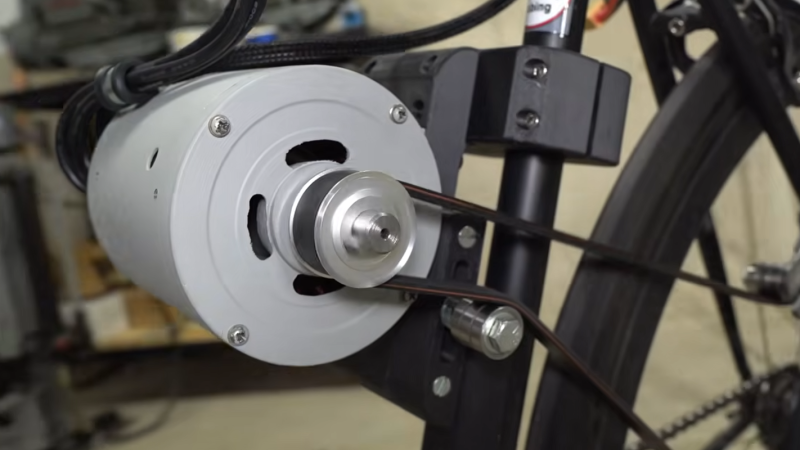
AC induction motors are everywhere, from ceiling fans to vehicles. They’re reliable, simple, and rugged β€” but there are some disadvantages. It’s difficult to control the speed without complex electronics, and precisely placing the shaft at a given angle is next to impossible. But the core of these common induction machines can be modified and rewired into brushless DC (BLDC) motors, provided you have a few tools on hand as [Austin] demonstrates.

To convert an AC induction motor to a brushless DC electric motor (BLDC), the stator needs to be completely rewired. It also needs a number of poles proportional to the number of phases of the BLDC controller, and in this case the 24-pole motor could accommodate the three phases. [Austin] removed the original stator windings and hand-wound his own in a 16-pole configuration. The rotor needs modification as well, so he turned the rotor on a lathe and then added a set of permanent magnets secured to the rotor with JB Weld. From there it just needs some hall effect sensors, a motor controller and power to get spinning.

At this point the motor could be used for anything a BLDC motor would be used. For this project, [Austin] is putting it on a bicycle. A 3D printed pulley mounts to the fixed gear on the rear wheel, and a motor controller, battery, and some tensioners are all that is left to get this bike under power. His tests show it comfortably drawing around 1.3 kW so you may want to limit this if you’re in Europe but other than that it works extremely well and reminds us of one of our favorite ebike conversions based on a washing machine motor instead of a drill press.

Dad Makes Kid’s Balance Bike Into Electric Snow Trike Like a Boss

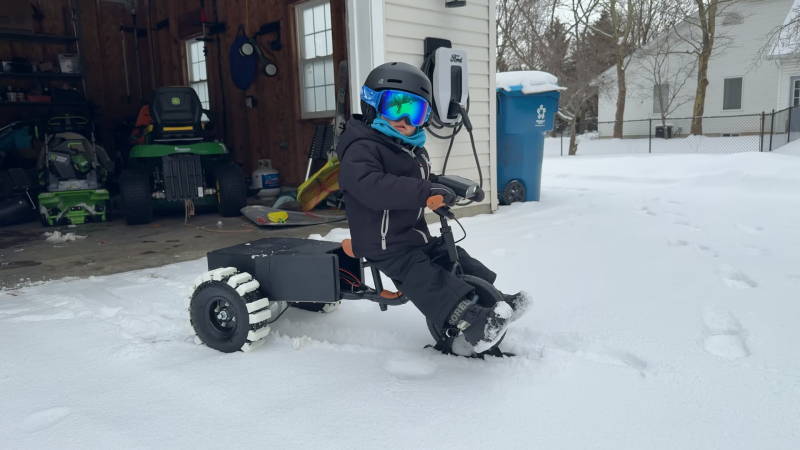
The balance bikes toddlers are rocking these days look like great fun, but not so great in the snow. Rather than see his kid’s favourite toy relegated to shed until spring, [John Boss] added electric power, and an extra wheel to make one fun-looking snow trike. Like a boss, you might say.

Physically, the trike is a delta configuration: two rear wheels and one front, though as you can see the front wheel has been turned into a ski. That’s not the most stable configuration, but by shifting the foot pegs to the front wheel and keeping the electronics down low, [John] is able to maintain a safe center of gravity. He’s also limiting the throttle so kiddo can’t go dangerously fast– indeed, the throttle control is in the rear electronics component. The kid just has a big green β€œgo” button.

Bit-banging the throttle, combined with the weight of the kiddo up front, creates a strong tendency towards wheel-spin, but [John] fixes that with a some cleverly printed TPU paddles zip-tied to the harbor-freight wheels and tires he’s hacked into use. Those wheels are fixed to a solid axle that’s mounted to flat plate [John] had made up to attach to the bike frame. It’s all surprisingly solid, given that [John] is able to demonstrate the safety factor by going for a spin of his own. We would have done the same.

We particularly like the use of a tool battery for hot-swappable power. This isn’t the first time we’ve seen a kid’s toy get the tool battery treatment, but you aren’t limited to mobile uses. We’ve seen the ubiquitous 18V power packs in everything from fume extractors to a portable powerpack that can even charge a Tesla.

Bicycle Tows 15,000 Pounds

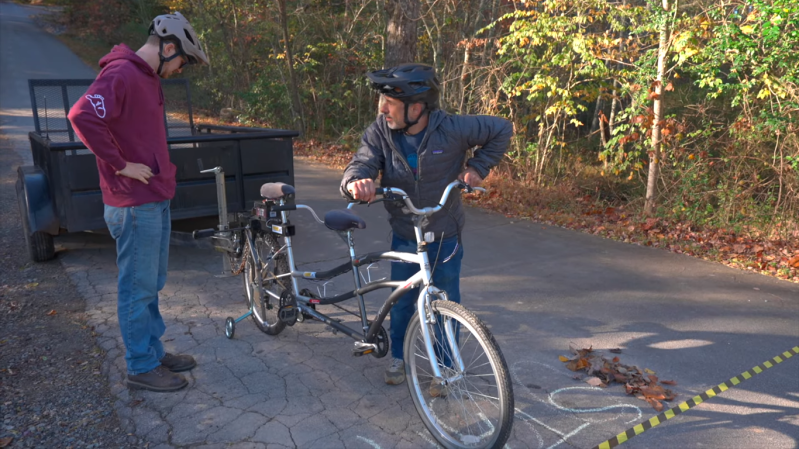
An old joke in physics is that of the β€œspherical cow”, poking fun at some of the assumptions physicists make when tackling a new problem. Making the problem simple like this can help make its fundamentals easier to understand, but when applying these assumptions to real-world problems these assumptions are quickly challenged. Which is what happened when [Seth] from Berm Peak attempted to tow a huge trailer with a bicycle β€” while in theory the bike just needs a big enough gear ratio he quickly found other problems with this setup that had to be solved.

[Seth] decided on a tandem bike for this build. Not only does the second rider add power, but the longer wheelbase makes it less likely that the tongue weight of the trailer will lift the front wheel off the ground. It was modified with a Class 3 trailer hitch, as well as a battery to activate the electric trailer brakes in case of an emergency. But after hooking the trailer up the first time the problems started cropping up. At such a high gear ratio the bike is very slow and hard to keep on a straight line. Some large, custom training wheels were added between the riders to keep it stable, but even then the huge weight still caused problems with the chain and even damaged the bike’s freehub at one point.

Eventually, though, [Berm Peak] was able to flat tow a Ford F-150 Lightning pulling a trailer a few yards up a hill, at least demonstrating this proof of concept. It might be the absolute most a bicycle can tow without help from an electric motor, although real-world applications for something like this are likely a bit limited. He’s been doing some other bicycle-based projects with more utility lately, including a few where he brings abandoned rental e-bikes back to life by removing proprietary components.

Sleeping Rough in Alaska with a USPS Cargo Bike

Out of all 49 beautiful US states (plus New Jersey), the one you’d probably least want to camp outside in during the winter is arguably Alaska. If you were to spend a night camping out in the Alaskan winter, your first choice of shelter almost certainly wouldn’t be a USPS electric cargo trike, but over on YouTube [Matt Spears] shows that it’s not that hard to make a lovely little camper out of the mail bike.Β 

We’re not sure how much use these sorts of cargo trikes get in Alaska, but [Matt] seems to have acquired this one surplus after an entirely-predictable crash took one of the mirrors off. A delta configuration trike β€” single wheel in front β€” is tippy at the best of times, but the high center of gravity you’d get from a loading the rear with mail just makes it worse. That evidently did not deter the United States Postal Service, and it didn’t deter [Matt] either.

His conversion is rather minimal: to turn the cargo compartment into a camper, he only adds a few lights, a latch on the inside of the rear door, and a wood-burning stove for heat. Rather than have heavy insulation shrink the already-small cargo compartment, [Matt] opts to insulate himself with a pile of warm sleeping bags. Some zip-tie tire chains even let him get the bike moving (slowly) in a winter storm that he claims got his truck stuck.

While it might not be a practical winter vehicle, at least on un-plowed mountain roads, starting with an electric-assist cargo trike Uncle Sam already paid for represented a huge cost and time savings vs starting from scratch like this teardrop bike camper we featured a while back. While not as luxurious, it seems more practical for off-roading than another electric RV we’ve seen.

❌