A robot camera phone is set for a March 1 reveal at MWC Barcelona 2026. Honor has confirmed the date and a pop-up AI camera assistant, but specs, pricing, and availability are still unknown.
Most people don’t upgrade home security because they love shopping for cameras. They do it because they want fewer blind spots, clearer footage, and a setup that doesn’t become a weekly chore. This Arlo Ultra Outdoor Security Camera bundle gives you three wireless 4K HDR cameras plus a charging station, and it’s priced at $399.99, […]
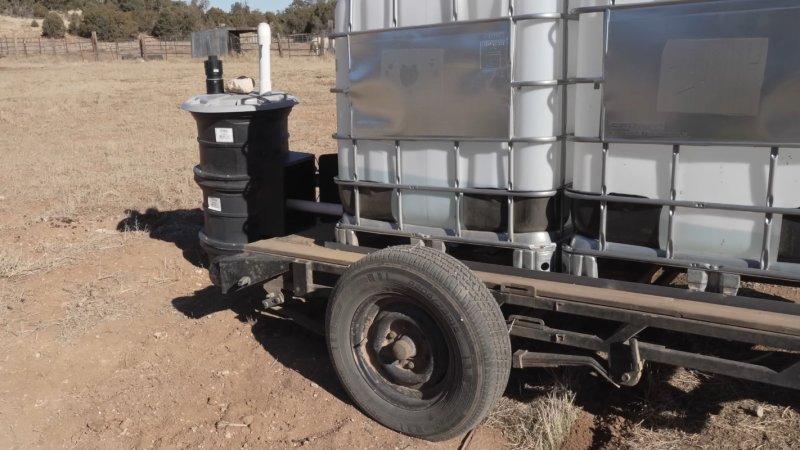
Living without standard utility hookups like electricity, Internet, water, and sewer comes with a whole host of challenges, all of which are most commonly solved by spending lots of money. For electricity, a solar array or a generator is fairly common. The Internet can similarly be accessed via a satellite link if wires aren’t available. For water, most people will drill a well, but that gets similarly expensive. [Cranktown City] recently bought an off-grid home and needed a way to get water to it on a budget, so he built this water trailer instead.
The trailer started off as a standard single-axle utility trailer. The weight rating was probably around 3,500 pounds or 1588 kg. A few support structures were welded in. The supports serve double duty as a frame for two IBC totes, which can hold about 550 gallons or 2082 liters of water. The trailer also got upgraded wiring, including some extra wires to support a backup camera. The two totes were then plumbed together with a ball valve for an outlet. That valve was mated to a motor that can be remotely activated from within a truck to dump the water out into a cistern.
On the cistern side, [Cranktown City] welded up a door with a linear actuator and a remote control. When he’s ready to dump the water into the cistern, he can easily back up the trailer using the backup camera, open the door to the cistern remotely, and then activate the ball valve on the trailer to start filling the reservoir. It’s a clever solution to bringing water to his off-grid property at a fraction of the cost of a drilled well. We’ve seen some other unique ways to live off-grid as well, like this hydroelectric generator, which might offset the cost of an expensive solar array.
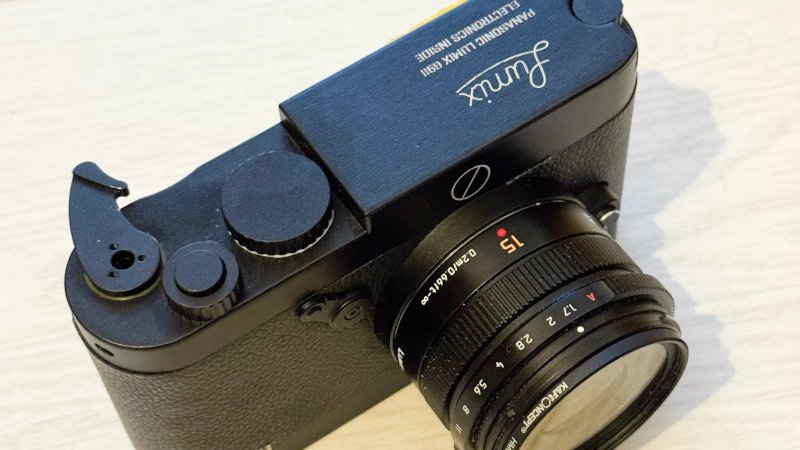
There’s an old adage in photography that the best camera in the world is the one in your hand when the shot presents itself, but there’s no doubt that a better camera makes a difference to the quality of the final image. Among decent quality cameras the Leica rangefinder models have near cult-like status, but the problem is for would-be Leica owners that they carry eye-watering prices. [Cristian Băluță] approached this problem in s special way, by crafting a Leica-style body for a Panasonic Lumix camera. Given the technology relationship between the Japanese and German companies, we can see the appeal.
While the aesthetics of a Leica are an important consideration, the ergonomics such as the position of the lens on the body dictated the design choices. He was fortunate that the internal design of the Lumix gave plenty of scope for re-arrangement of parts, given that cameras are often extremely packed internally. Some rather bold surgery to the Lumix mainboard and a set of redesigned flex PCBs result in all the parts fitting in the CNC machined case, and the resulting camera certainly looks the part.
The write-up is in part a journey through discovering the process of getting parts manufactured, but it contains a lot of impressive work. Does the performance of the final result match up to its looks? We’ll leave you to be the judge of that. Meanwhile, take a look at another Leica clone.
Clockwise from top left: Amera CEO Deep Kapur; Clara CEO Melinda Yormick; Oikyo CEO Saptak Sen; and Specbook AI CEO Gordon Hempton.
Founders in the Seattle area are busy building software for health insurance, AI model tuning, construction processes, and hospital operations.
Our latest Startup Radar spotlights four early stage tech startups in the region: Amera, Clara, Oiyko, and Specbook AI.
Read on for brief descriptions of each company — along with pitch assessments from “Mean VC,” a GPT-powered critic offering a mix of encouragement and constructive criticism.
Check out past Startup Radar posts here, and email me at taylor@geekwire.com to flag other companies and startup news.
The business: Targeting health insurance payers with software that automates the claims processing workflow. Its product converts medical claim documents into structured data, replacing manual entry and supporting newer payment models. Amera is generating revenue, working with multiple plan administrators, and participating in the Fall 2025 cohort at Y Combinator.
Leadership: CEO Deep Kapur previously worked at Microsoft, Protocol Labs, and most recently Rupa Health. Co-founder Louise Tanski was also at Rupa Health and co-founded QueryStax (acquired by Moonshot Brands).
Mean VC: “You’re solving a real pain point in healthcare admin, and early revenue plus YC traction suggest you’re on the right track. The key will be proving your structured data actually drives measurable cost or accuracy improvements — not just faster paperwork.”
The business: A self-described “AI-powered operating room orchestration” platform for hospitals. Clara aims to be like Apple’s “Find My” app, but for patient care, helping hospital staff quickly locate equipment and people. The company has raised around $375,000 and is working with a lab at the University of Washington on a non-clinical pilot.
Leadership: CEO Melinda Yormick has more than a decade of operating room experience as a registered nurse and nurse manager. She was named a 2025 “Up and Comer” at the PSBJ Healthcare Leadership Awards. Co-founder Aaron Cooke was previously a senior software engineer at Viome and Julep.
Mean VC: “The problem is clear to anyone who’s worked in a hospital, and your background gives you credibility where it counts. But unless you can tie this to patient outcomes or hard ROI, hospital budgets may treat it as a luxury.”
The business: Helps companies fine-tune AI models using their own data, enabling employees to add business-specific context. The company is participating in WTIA’s startup accelerator.
Leadership: Co-founders Saptak Sen and Suchi Mohan first met at Microsoft in India in 2001. Sen, the CEO at Oiyko, was most recently a vice president at Tetrate and head of container integrations at AWS. Mohan was a senior technical program manager at Microsoft for more than four years.
Mean VC: “Fine-tuning with business context is a sharp idea, especially as enterprises grow wary of generic AI outputs. Still, you’ll need to show how you differ from the wave of enterprise LLM tooling coming from giants and better-funded peers.”
The business: Builds AI agents for industrial and civic projects that can quickly analyze data and perform tasks such as design reviews and reviewing construction submittals. Specbook AI is working with large construction companies and municipalities. Contracted revenue is in the six figures.
Leadership: Co-founders Gordon Hempton and Wes Hather co-founded Outreach, the Seattle-based sales software company. More recently they launched two startups: B2B sales software company FullContext and virtual work platform Spot.
Mean VC: “Digitizing construction reviews and civic workflows is overdue, and six-figure contracts suggest you’re solving a real pain. To scale, you’ll need to prove your product can handle diverse requirements without slipping into custom consulting.”
Security researcher Jon “Gainsec” Gaines and YouTuber Benn Jordan discuss their examination of Flock Safety’s AI-powered license plate readers and how cost-driven design choices, outdated software, and weak security controls expose them to abuse.
Zimperium zLabs reveals DroidLock, a new Android malware acting like ransomware that can hijack Android devices, steal credentials via phishing, and stream your screen via VNC.

 Login
Login