Fast-food chain Steak ‘n Shake is rolling out a bitcoin bonus program for hourly workers, deepening its embrace of bitcoin just days after disclosing a $10 million bitcoin purchase for its corporate treasury.
Starting March 1, hourly employees at company-operated Steak ’n Shake locations will earn a bitcoin bonus worth $0.21 for every hour worked. The rewards will vest after two years, meaning workers must remain employed for that period before they can access the accumulated bitcoin.
The bonus is roughly equivalent to about 1% of the U.S. federal minimum wage and will be administered in partnership with Fold, a bitcoin rewards application.
Employees will continue to receive their regular wages in dollars, with the bitcoin component treated as an additional incentive rather than a replacement for cash pay.
The move builds on Steak ‘n Shake’s broader crypto strategy, which began in 2025 when the burger chain started accepting bitcoin payments via the Lightning Network at all U.S. locations.
At the time, company executives said the integration reduced card processing fees by roughly half and helped attract younger customers. Same-store sales rose more than 10% in the second quarter of 2025, according to company comments.
Steak ‘n Shake loves bitcoin
Last week, Steak ‘n Shake disclosed that it had added $10 million worth of bitcoin to its balance sheet, marking one of the more significant treasury allocations to the asset by a consumer-facing restaurant brand.
The company has also leaned into bitcoin-themed marketing, including the launch of a limited-time “Bitcoin Meal” in October that includes a small donation to open-source bitcoin development.
The hourly bonus rate references bitcoin’s fixed supply cap of 21 million coins, a symbolic nod frequently used in crypto culture.
At current prices, a worker putting in 30 hours a week would earn roughly $327 worth of bitcoin per year under the program, assuming a stable bitcoin price.
Last year, a company executive said that Bitcoin transactions were already outperforming expectations.
“The day we launched Bitcoin, 1 out of every 500 bitcoin transactions in the world happened at Steak ‘n Shake,” Executive Dan Edwards said at the Bitcoin Conference.
“Bitcoin is faster than credit cards, and when customers choose to pay in Bitcoin, we’re saving 50% in processing fees,” said Edwards. “That makes Bitcoin a win for the customer, a win for us, and a win for the Bitcoin community.”
Strategy chairman Michael Saylor pushed back on critics who say companies that hold Bitcoin are reckless. He told a podcast that buying Bitcoin should be seen as a choice about where to put cash, not as a moral failing.
He said firms face few good options for idle money, and that Bitcoin is one of those options for companies that can stand big price swings.
Corporate Bitcoin Treasury Choice
Based on reports tracking public disclosures, publicly listed firms hold about 1.1 million BTC in total. That amount equals roughly 5.5% of the 19.97 million coins now in circulation.
Strategy is the biggest public holder, with 687,410 BTC, according to BitcoinTreasuries data. Those numbers help explain why markets and regulators pay attention when companies buy large amounts.
Saylor framed the issue as a simple accounting decision. He compared holding Bitcoin to other moves a firm might make with extra cash.
Treasuries pay very little. Stock buybacks can fail if a company is losing money. He used a clear example: a company losing $10 million per year could still come out ahead if its Bitcoin position gained $30 million over the same time. That point is meant to show why some executives see Bitcoin as a way to improve net results.
Risk Vs. Reward On Balance Sheets
The argument has limits. Bitcoin can drop fast. A firm with heavy debt or thin margins may be forced to sell at the worst time. Not every company has the same ability to wait for a recovery.
Strategy’s big size and long view make it hard to compare with smaller firms that don’t have the same runway or the same investor base.
Investors and analysts see two sides. Some view large Bitcoin bets as proof of conviction. Others see concentration risk that adds volatility to corporate returns.
That scrutiny grows as more firms add coins to their books. When holdings reach the hundreds of thousands, it is no longer a niche choice; it becomes part of how markets judge a firm’s financial picture.
Price Context Matters
Bitcoin was trading around $95,250 at the time of writing, with an intraday range from about $94,320 to $95,660 on major exchanges.
That level shapes how recent buyers are viewed. Gains make the strategy look smart. Losses make it look unattractive. Timing and cash needs often decide the outcome.
Featured image from Unsplash, chart from TradingView
A major rule change is being considered by MSCI, one of the most influential index providers in global markets. If adopted, it would materially alter how public companies that hold digital assets—particularly Bitcoin—are classified and included in major equity indexes.
For companies, investors, asset managers, and anyone who depends on index-based benchmarks, this proposal raises fundamental questions about how markets define operating businesses and what role balance sheets should play in index eligibility.
Join the call for MSCI to withdraw its digital asset exclusion rule.
Here’s what’s at stake—and why it matters.
1. MSCI Is Proposing a New 50% Balance-Sheet Threshold
At the center of the proposal is a simple rule:
If digital assets make up 50% or more of a company’s total assets, that company would be excluded from MSCI’s Global Investable Market Indexes.
MSCI’s rationale is that crossing this threshold allegedly changes the company’s “primary business,” making it more fund-like rather than operational.
This single ratio would override all other indicators of what the company actually does.
2. The Proposal Misclassifies Operating Companies as Investment Funds
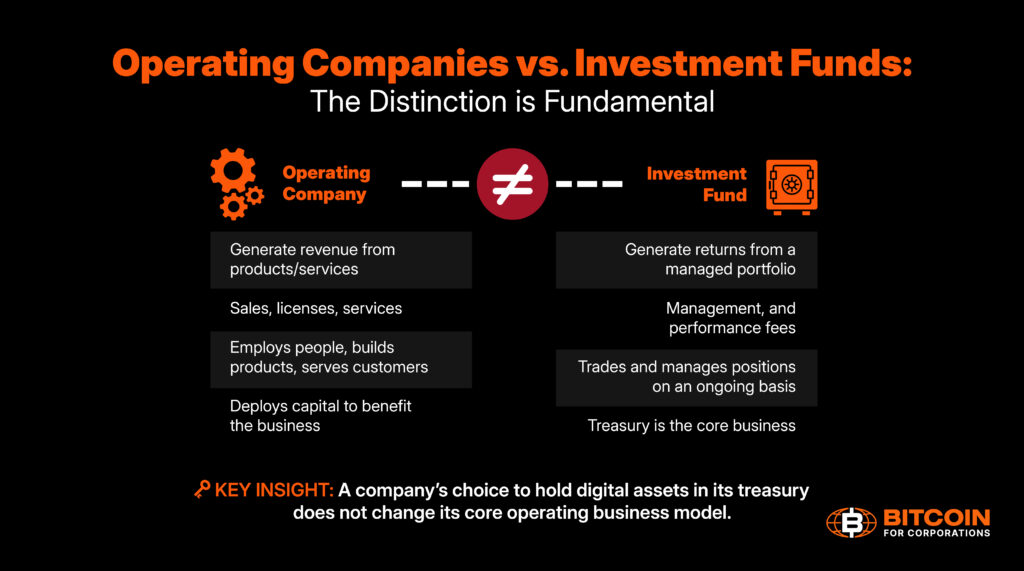
The core objection is straightforward: holding Bitcoin on a balance sheet does not transform an operating company into an investment fund.
Operating companies generate revenue from products and services
They employ people, invest in R&D, and serve customers
Treasury assets exist to support long-term capital strategy
By contrast, investment funds exist solely to manage portfolios for return.
Treating these two structures as equivalent—based on a balance-sheet ratio alone—collapses a distinction that has long been foundational to corporate and securities law.
If your organization relies on clear, fundamentals-based definitions of operating companies, this misclassification matters. Bitcoin For Corporations is asking MSCI to withdraw the proposal and engage on a more principled framework. You can add your name to the open letter here.
3. Treasury Strategy Does Not Redefine Core Business Activity
A company can change how it stores excess capital without changing what it does.
A manufacturer that holds cash remains a manufacturer
A software firm holding foreign currency remains a software firm
A company holding Bitcoin as treasury reserve remains an operating company
Treasury allocation is a capital management decision, not a change in business model.
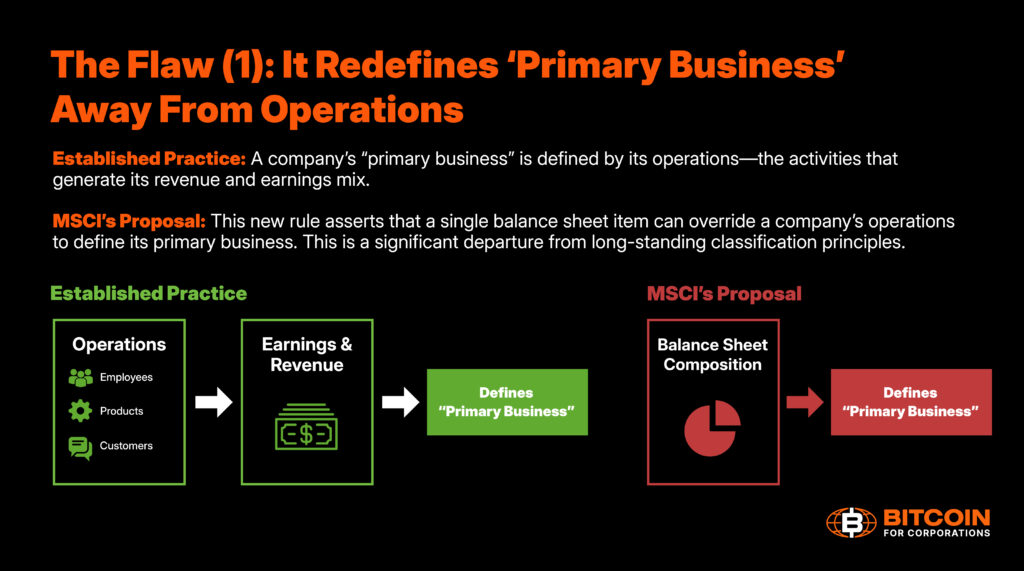
4. This Would Be a Radical Departure From Decades of Index Practice
Historically, index classification has been driven by operational reality, not asset composition alone.
Primary business determination has relied on:
Revenue sources
Earnings contribution
Ongoing commercial activity
This proposal replaces that holistic approach with a single market-price-driven metric on the asset side of the balance sheet—something never applied consistently across asset classes before.
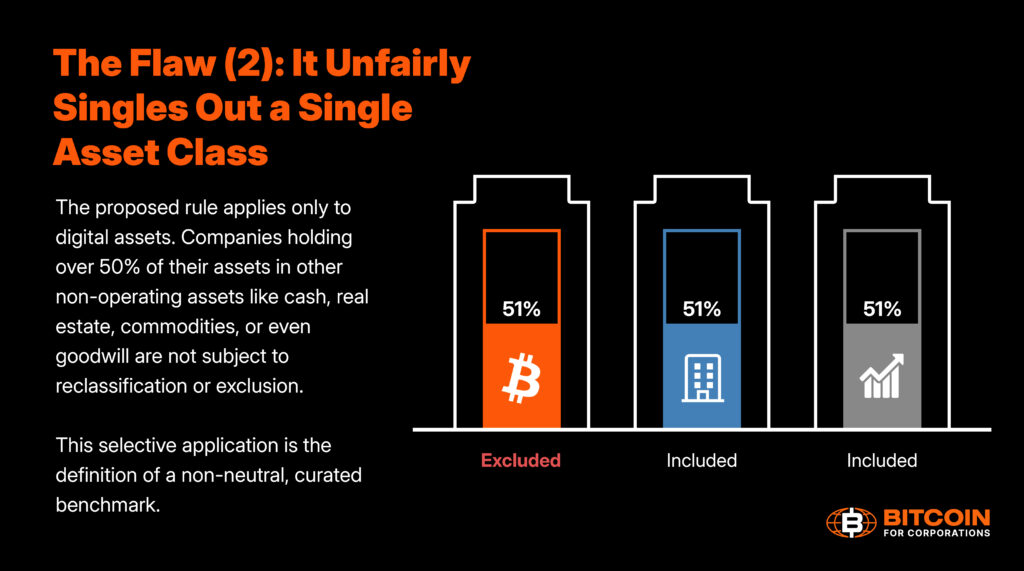
5. Digital Assets Are Being Singled Out—Uniquely
Under the proposal:
A company with 51% of assets in Bitcoin → excluded
A company with 51% in real estate → included
A company with 51% in equities or commodities → included
No equivalent rule exists for other treasury assets.
This lack of neutrality directly conflicts with the principles that global indexes are supposed to uphold.
6. The Proposal Conflicts With Core Index Principles
MSCI’s benchmarks are built on three foundational ideas:
Neutrality – no asset-class favoritism
Representativeness – reflecting real economic activity
Stability – avoiding unnecessary churn
A rule that reclassifies companies based on volatile market prices undermines all three.
7. The Rule Would Introduce Structural Instability Into Indexes
Consider a company with:
45% of assets in digital form → eligible
No operational change
Normal market appreciation pushes it to 51%
Under the proposal, that company would suddenly be excluded—despite:
No change in revenue
No change in operations
No change in business strategy
This creates a scenario where companies could flip in and out of indexes purely due to price movement, forcing unnecessary rebalancing, costs, and tracking error for index-linked funds.
This kind of mechanical instability would impose real costs on index-tracking funds, issuers, and long-term investors—without improving market clarity. That’s why companies and market participants are urging MSCI to withdraw the proposal and revisit it with industry input. Join the call for MSCI to withdraw this rule proposal, and add your signature to the open letter here.
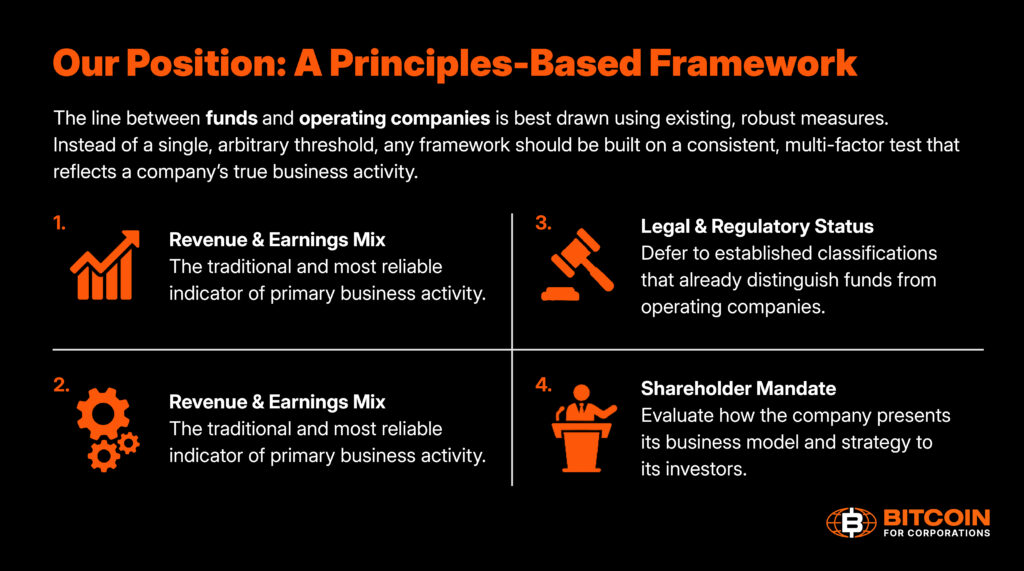
8. A More Robust Alternative Already Exists
The issue is not classification—it’s how classification is done.
A principles-based, multi-factor framework would evaluate:
Revenue and earnings mix
Legal and regulatory status
Core corporate activities (employees, R&D, capex)
Public disclosures and stated strategy
This approach reflects the entire business, not a single fluctuating ratio.
9. The Coalition’s Ask Is Clear and Constructive
Market participants are calling for a two-step solution:
Withdraw the current proposal due to its structural flaws
Engage with the market to develop a neutral, principles-based framework that preserves index integrity
The goal is not special treatment—but consistent treatment aligned with long-standing market norms.
Why This Matters
Indexes are not academic exercises. They:
Guide trillions of dollars in capital allocation
Shape passive investment flows
Influence cost of capital for public companies
If index rules become arbitrary, unstable, or asset-specific, they stop reflecting the real economy—and start distorting it.
Final Thought
If your organization depends on fundamentals-based equity benchmarks, this proposal affects you—whether or not you hold digital assets today.
Indexes only work when they remain neutral, stable, and grounded in operating reality. Market participants are asking MSCI to withdraw the proposed digital asset rule and work toward a principles-based alternative.If you or your organization depend on fair and consistent equity benchmarks, adding your signature to the open letter helps ensure those standards are preserved.
Index integrity relies on clear principles, not price-driven thresholds.
Engagement now helps ensure global benchmarks remain neutral, stable, and representative for everyone who relies on them.
Disclaimer: This content was prepared on behalf of Bitcoin For Corporations for informational purposes only. It reflects the author’s own analysis and opinion and should not be relied upon as investment advice. Nothing in this article constitutes an offer, invitation, or solicitation to purchase, sell, or subscribe for any security or financial product.
Satsuma Technology (LSE: SATS) sold nearly half its bitcoin treasury and announced major board changes as it prepares for a planned uplisting to the London Stock Exchange’s main market.
The U.K.-based company sold 579 BTC out of its 1,199 BTC holdings, raising about £40 million ($53 million) in net proceeds, according to a Thursday announcement. The move leaves Satsuma with 620 BTC and roughly £90 million in cash.
The sale is designed to ensure the company has enough liquidity to repay £78 million in convertible loan notes due on Dec. 31, 2025.
Some noteholders have not yet committed to converting their debt into equity once Satsuma publishes its prospectus for the uplisting. The company said it wants to hold sufficient cash in case those conversions do not occur.
Alongside the treasury move, Satsuma proposed appointing Ranald McGregor-Smith as Chair and Clive Carver as Senior Independent Director. Both would join upon completion of the uplisting.
McGregor-Smith spent his career advising FTSE100 and FTSE250 firms and co-founded corporate broker Whitman Howard. He also sits on the board of Sabien Technology Group. Carver, a chartered accountant, has chaired and served as a non-executive director at several listed companies over the past decade and will also chair Satsuma’s Audit Committee.
Current Chair Matt Lodge will step down after the uplisting but remain on the board. Non-executive director Darcy Taylor resigned immediately as part of the restructuring.
CEO Henry K. Elder said the board changes bring stronger PLC governance at a key transition point. He also said the bitcoin sale positions the company for “stability and growth” as it advances its broader strategy.
Satsuma shares edged up to 1.05 pence following the announcement. The stock remains down nearly 30% over the past month.After the sale, Satsuma ranks as the 61st largest publicly traded bitcoin holder.
The report, covering 100+ companies, shows large treasuries like Strategy and Strive dominated net purchases, while early signs of selling emerged, led by Sequans.
Quarterly accumulation slowed but remains steady, with Q4 2025 on track for ~40,000 BTC added. Mining companies now hold 12% of corporate BTC.
Public and private treasuries bought over 12,644 BTC in November, bringing total holdings past 4 million BTC. Global diversification and disciplined buying continue despite volatility.
Corporate Bitcoin treasuries faced mark-to-market losses in November, according to an exclusive Corporate Adoption Report from Bitcoin Treasuries.
The report, covering more than 100 companies, offers a systematic look at how last month’s price drop affected public company holdings.
Bitcoin briefly fell below $90,000 in late November. The decline pushed many 2025 buyers into the red. Of the 100 companies for which cost basis is measurable, about two-thirds now sit on unrealized losses at current prices, per the report.
Despite the volatility, large balance sheets continued to dominate net Bitcoin buying. Strategy, Strive, and a small cohort of high-conviction buyers accounted for most net additions.
Public Bitcoin treasury equities remain weak versus BTC and broad indices. Still, a minority of companies delivered at least 10% gains over the past 6–12 months.
Early signs of corporate Bitcoin selling also emerged. At least five companies reduced BTC exposure in November. Sequans led the group, selling roughly one-third of its holdings. While small in aggregate, these moves suggest some management teams are willing to crystallize losses or de-risk when volatility spikes.
Quarterly Bitcoin accumulation is slowing, but not collapsing. Q4 2025 is on track for roughly 40,000 BTC in net additions to public company balance sheets. This is below the last four quarters but broadly in line with Q3 2024, as companies normalize to a slower, more selective accumulation pace.
In November, public and private treasuries purchased, added, or disclosed over 12,644 BTC in November and the total BTC held across all tracked entities surpassed 4 million by month’s end.
Bitcoin purchases
Big treasuries know for their bitcoin buying continue to dominate purchases. Strategy added 9,062 BTC across three transactions in November, per the report.
Its largest buy, 8,178 BTC, came on Nov. 17. Strategy ended the month with 649,870 BTC, worth about $59 billion. Currently, the company has 660,624 after some December purchases.
Strive added 1,567 BTC at an average price of $103,315 per BTC in November. The purchase brought its month-end holdings to 7,525 BTC, or $684 million. The company funds its Bitcoin strategy primarily through perpetual preferred equity.
Mining companies remain significant players. Cango and Riot added 508 BTC and 37 BTC, respectively, from mining operations. American Bitcoin added 139 BTC through combined purchase and mining strategies.
Per the report, mining companies now account for 12% of public company BTC holdings.
Bitcoin selling and rebalancing
Sales were limited but notable. As mentioned earlier, Sequans sold nearly one-third of its holdings, to reduce convertible debt. Hut 8 reduced holdings by 389 BTC. KindlyMD and Genius Group also trimmed exposure.
Some companies added small amounts even amid the downturn. DDC Enterprise Limited picked up 100 BTC during the pullback.
Metaplanet continued “additional purchase” filings on the Tokyo exchange. ETF flows returned to net inflows after a month of redemptions.
The data suggests a barbell pattern: small distressed sellers versus programmatic buyers and disciplined treasuries. Investors see BTC increasingly used as collateral or for cash flow, rather than just as a speculative asset.
Global trends and future outlook
Corporate Bitcoin holdings are increasingly global. U.S. companies dominate the top 20, but Japan, China, Europe, and other regions are growing.
Non-U.S. public company holdings rose 3,180 BTC from two months prior, now representing about 9% of all public company BTC. Analysts say this geographic diversification reduces regulatory risk.
Despite November’s volatility, corporate adoption of Bitcoin continues. Large treasuries are still buying aggressively. The quarterly pace of accumulation is slower than earlier in 2025, the report noted, but steady growth persists.
Those interested in reading the full report can do so below:

 Login
Login