Reading view

There are new articles available, click to refresh the page.

The Supreme Court’s dangerous double standard on independent agencies

The Supreme Court appears poised to deliver a contradictory message to the American people: Some independent agencies deserve protection from presidential whim, while others do not. The logic is troubling, the implications profound and the damage to our civil service system could be irreparable.

In December, during oral arguments in Trump v. Slaughter, the court’s conservative majority signaled it would likely overturn or severely weaken Humphrey’s Executor v. United States, the 90-year-old precedent protecting independent agencies like the Federal Trade Commission from at-will presidential removal. Chief Justice John Roberts dismissed Humphrey’s Executor as “just a dried husk,” suggesting the FTC’s powers justify unlimited presidential control. Yet just weeks later, during arguments in Trump v. Cook, those same justices expressed grave concerns about protecting the “independence” of the Federal Reserve, calling it “a uniquely structured, quasi-private entity” deserving special constitutional consideration.

The message is clear: Wall Street’s interests warrant protection, but the rights of federal workers do not.

The MSPB: Guardian of civil service protections

This double standard becomes even more glaring when we consider Harris v. Bessent, where the D.C. Circuit Court of Appeals ruled in December 2025 that President Donald Trump could lawfully remove Merit Systems Protection Board Chairwoman Cathy Harris without cause. The MSPB is not some obscure bureaucratic backwater — it is the cornerstone of our merit-based civil service system, the institution that stands between federal workers and a return to the spoils system that once plagued American government with cronyism, inefficiency and partisan pay-to-play services.

The MSPB hears appeals from federal employees facing adverse actions including terminations, demotions and suspensions. It adjudicates claims of whistleblower retaliation, prohibited personnel practices and discrimination. In my and Harris’ tenure alone, the MSPB resolved thousands of cases protecting federal workers from arbitrary and unlawful treatment. In fact, we eliminated the nearly 4,000 backlogged appeals from the prior Trump administration due to a five-year lack of quorum. These are not abstract policy debates — these are cases about whether career professionals can be fired for refusing to break the law, for reporting waste and fraud or simply for holding the “wrong” political views.

The MSPB’s quasi-judicial function is precisely what Humphrey’s Executor was designed to protect. This is what Congress intended to follow in 1978 when it created the MSPB in order to strengthen the civil service workforce from the government weaponization under the Nixon administration. The 1935 Supreme Court recognized that certain agencies must be insulated from political pressure to function properly — agencies that adjudicate disputes, that apply law to fact, that require expertise and impartiality rather than ideological alignment with whoever currently occupies the White House. Why would today’s Supreme Court throw out that noble and constitutionally oriented mandate?

A specious distinction

The Supreme Court’s apparent willingness to treat the Federal Reserve as “special” while abandoning agencies like the MSPB rests on a distinction without a meaningful constitutional difference. Yes, the Federal Reserve sets monetary policy with profound economic consequences. But the MSPB’s work is no less vital to the functioning of our democracy.

Consider what happens when the MSPB loses its independence. Federal employees adjudicating veterans’ benefits claims, processing Social Security applications, inspecting food safety or enforcing environmental protections suddenly serve at the pleasure of the president. Career experts can be replaced by political loyalists. Decisions that should be based on law and evidence become subject to political calculation. The entire civil service — the apparatus that delivers services to millions of Americans — becomes a partisan weapon to be wielded by whichever party controls the White House.

This is not hypothetical. We have seen this movie before. The spoils system of the 19th century produced rampant corruption, incompetence and the wholesale replacement of experienced government workers after each election. The Pendleton Act of 1883 and subsequent civil service reforms were not partisan projects — they were recognition that effective governance requires a professional, merit-based workforce insulated from political pressure.

The real stakes

The Supreme Court’s willingness to carve out special protection for the Federal Reserve while abandoning the MSPB reveals a troubling hierarchy of values. Financial markets deserve stability and independence, but should the American public tolerate receiving partisan-based government services and protections?

Protecting the civil service is not some narrow special interest. It affects every American who depends on government services. It determines whether the Occupational Safety and Health Administration (OSHA) inspectors can enforce workplace safety rules without fear of being fired for citing politically connected companies. Whether Environmental Protection Agency scientists can publish findings inconvenient to the administration. Whether veterans’ benefits claims are decided on merit rather than political favor. Whether independent and oversight federal organizations can investigate law enforcement shootings in Minnesota without political interference.

Justice Brett Kavanaugh, during the Cook arguments, warned that allowing presidents to easily fire Federal Reserve governors based on “trivial or inconsequential or old allegations difficult to disprove” would “weaken if not shatter” the Fed’s independence. He’s right. But that logic applies with equal force to the MSPB. If presidents can fire MSPB members at will, they can install loyalists who will rubber-stamp politically motivated personnel actions, creating a chilling effect throughout the civil service.

What’s next

The Supreme Court has an opportunity to apply its principles consistently. If the Federal Reserve deserves independence to insulate monetary policy from short-term political pressure, then the MSPB deserves independence to insulate personnel decisions from political retaliation. If “for cause” removal protections serve an important constitutional function for financial regulators, they serve an equally important function for the guardians of civil service protections.

The court should reject the false distinction between agencies that protect Wall Street and agencies that protect workers. Both serve vital public functions. Both require independence to function properly. Both should be subject to the same constitutional analysis.

More fundamentally, the court must recognize that its removal cases are not merely abstract exercises in constitutional theory. They determine whether we will have a professional civil service or return to a patronage system. Whether government will be staffed by experts or political operatives. Whether the rule of law or the whim of the president will govern federal employment decisions.

A strong civil service is just as important to American democracy as an independent Federal Reserve. Both protect against the concentration of power. Both ensure that critical governmental functions are performed with expertise and integrity rather than political calculation. The Supreme Court’s jurisprudence should reflect that basic truth, not create an arbitrary hierarchy that privileges financial interests over the rights of workers and the integrity of government.

The court will issue its decisions over the next several months and when it does, it should remember that protecting democratic institutions is not a selective enterprise. The rule of law requires principles, not preferences. Because in the end, a government run on political loyalty instead of merit is far more dangerous than a fluctuating interest rate.

Raymond Limon retired after more than 30 years of federal service in 2025. He served in leadership roles at the Office of Personnel Management and the State Department and was the vice chairman of the Merit Systems Protections Board. He is now founder of Merit Services Advocates.

The post The Supreme Court’s dangerous double standard on independent agencies first appeared on Federal News Network.

© AP Photo/Julia Demaree Nikhinson
The Supreme Court is seen during oral arguments over state laws barring transgender girls and women from playing on school athletic teams, Tuesday, Jan. 13, 2026, in Washington. (AP Photo/Julia Demaree Nikhinson)

Why The Dogecoin Price Could Outperform Bitcoin Again

The cryptocurrency market has shown choppy and uneven momentum in the past week. Bitcoin’s price recently climbed to an eight-week high above $97,000, but it has since retraced to trade around the low $90,000s.

Dogecoin’s movement has mirrored this mixed mood. A brief rally lifted it close to resistance around $0.15 last week, but the meme coin has since slid back below $0.13, weighed down by profit-taking among investors.

Against this backdrop of consolidation and short-term corrections, technical analysis shared recently by a crypto analyst on X highlighted a setup in the BTC/DOGE cross-pair chart that shows Dogecoin is going to outperform Bitcoin if current technical patterns play out as expected.

BTC vs DOGE: What the Technicals Suggest

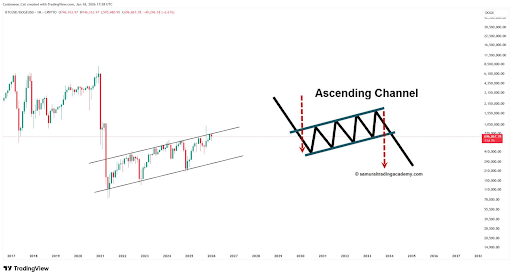
Technical analysis of the BTCUSDT/DOGEUSDT chart shows the two crypto heavyweights trading in an ascending channel that has repeatedly tested its upper boundary without a convincing breakout, a sign that the uptrend may be weakening. In technical trading frameworks, failure to sustain momentum at resistance often precedes a reversal. 

In this case, the declining slope of recent attempts to push higher in the BTC/DOGE ratio indicates that Bitcoin may be losing relative strength to Dogecoin in the short term. As it stands, the BTC/DOGE pair looks like it is now rejecting at the upper boundary of this ascending channel, and the next move is a push downwards.

Dogecoin

This interpretation of the ratio doesn’t comment on the absolute price of both cryptocurrencies but only the performance comparison of the two assets. If the ratio breaks down below the channel’s lower trendline, then it could be interpreted as a signal that Dogecoin is gaining relative performance against Bitcoin, and this could cause crypto traders to reallocate capital into the relatively stronger asset.

What Dogecoin Outperforming Bitcoin Might Look Like

Bitcoin’s price action over the past several days has been defined by volatility around the mid-$90,000 level. Easing inflation fears and the United States Supreme Court declining to rule on international trade tariffs helped lift BTC close to $97,000 last week. However, the leading cryptocurrency is now back to trading around $93,030 at the time of writing.

Meanwhile, Dogecoin’s trajectory has matched Bitcoin’s price action and the wider crypto market trend. DOGE faced rejection following spikes to resistance around $0.15, which prompted a slide back to $0.127, just below the $0.13 price level that has acted as a support in recent months.

If the technical prediction on the BTC/DOGE ratio unfolds as anticipated, the outperformance by Dogecoin against Bitcoin could play out in many ways. The outperformance could appear not necessarily as DOGE exploding upward in isolation, but also as DOGE holding stronger or falling less than Bitcoin during corrections.

Dogecoin

Hacker Pleads Guilty to Access Supreme Court, AmeriCorps, VA Systems

FTC, privacy, AI privacy lawsuits court

Nicholas Moore, a 24-year-old Tennessee man, pleaded guilty to using stolen credentials of authorized users to hack into computer systems of the Supreme Court, VA, and AmeriCorps, obtaining sensitive information and then posting it online to his Instagram account.

The post Hacker Pleads Guilty to Access Supreme Court, AmeriCorps, VA Systems appeared first on Security Boulevard.

Will a Supreme Court Ruling Against Trump Cause a Bitcoin Crash?

Bitcoin Magazine

Will a Supreme Court Ruling Against Trump Cause a Bitcoin Crash?

Bitcoin is trading near $90,000, extending a fall-off after spending several days above $92,000. The crypto now faces a fresh macro test as markets brace for a U.S. Supreme Court decision that could land Friday on the legality of President Donald Trump’s global tariffs.

The case centers on tariffs imposed in early 2025 under the International Emergency Economic Powers Act, a 1977 statute typically used for sanctions during national emergencies. 

Trump used the law to justify “Liberation Day” tariffs ranging from 10% to 50% on global imports, alongside targeted duties on China, Canada, and Mexico tied to fentanyl trafficking concerns. 

His administration argued that persistent trade deficits and national security risks met the threshold for an emergency.

Lower courts disagreed. Both the U.S. Court of International Trade and a federal appeals court ruled that Trump exceeded his authority, emphasizing that Congress holds primary power over tariffs. 

The Supreme Court heard arguments in November, with skepticism voiced across ideological lines. While the court does not preannounce decisions, it has signaled rulings could be released on Jan. 9.

If the tariffs are struck down, the financial implications could be large. Reuters reported that more than $133.5 billion in duties could be subject to refunds, raising questions about timing, fiscal impact, and replacement policies. 

Trump has claimed the tariffs generated roughly $600 billion in revenue, a figure that has shaped market anxiety around refunds and Treasury financing.

The ruling’s impact on Bitcoin

All traders are watching this situation closely, not because tariffs directly affect Bitcoin’s network, but because macro shocks in all markets often ripple through risk assets. During prior trade escalations, Bitcoin tended to sell off alongside equities as liquidity tightened and risk appetite faded.

Warnings have grown louder on social media. Semi-popular trader Wimar.X called Friday “the worst day of 2026,” arguing that a negative ruling could force markets to price refund obligations, emergency policy responses, and retaliation risks at the same time. “That’s not clarity. That’s chaos,” he wrote.

Prediction markets reflect those concerns. 

On Polymarket, odds imply a strong chance (76%) the court invalidates the tariffs, suggesting traders see downside risk as under-appreciated. Still, not all expect a lasting selloff. 

For Bitcoin, the near-term risk appears tied to volatility rather than direction. The asset remains sensitive to shifts in yields, equities, and dollar liquidity. A sharp risk-off move could push prices lower, especially with Bitcoin still below key resistance near $94,000 to $95,000. A ruling that reduces uncertainty could also produce a brief relief rally.

The larger question is not whether Bitcoin crashes on a headline, but whether a court decision reshapes the macro backdrop for BTC. 

This post Will a Supreme Court Ruling Against Trump Cause a Bitcoin Crash? first appeared on Bitcoin Magazine and is written by Micah Zimmerman.

Florida adult-use marijuana legalization stinks, state attorney general tells Supreme Court

A ban on public cannabis use in a proposed adult-use legalization measure in Florida is misleading because citizens might still smell it, the state attorney general recently claimed.

Florida adult-use marijuana legalization stinks, state attorney general tells Supreme Court is a post from: MJBizDaily: Financial, Legal & Cannabusiness news for cannabis entrepreneurs

Bitcoin Price Teeters Near $90,000 as Early-2026 Rally Falters

Bitcoin Magazine

Bitcoin Price Teeters Near $90,000 as Early-2026 Rally Falters

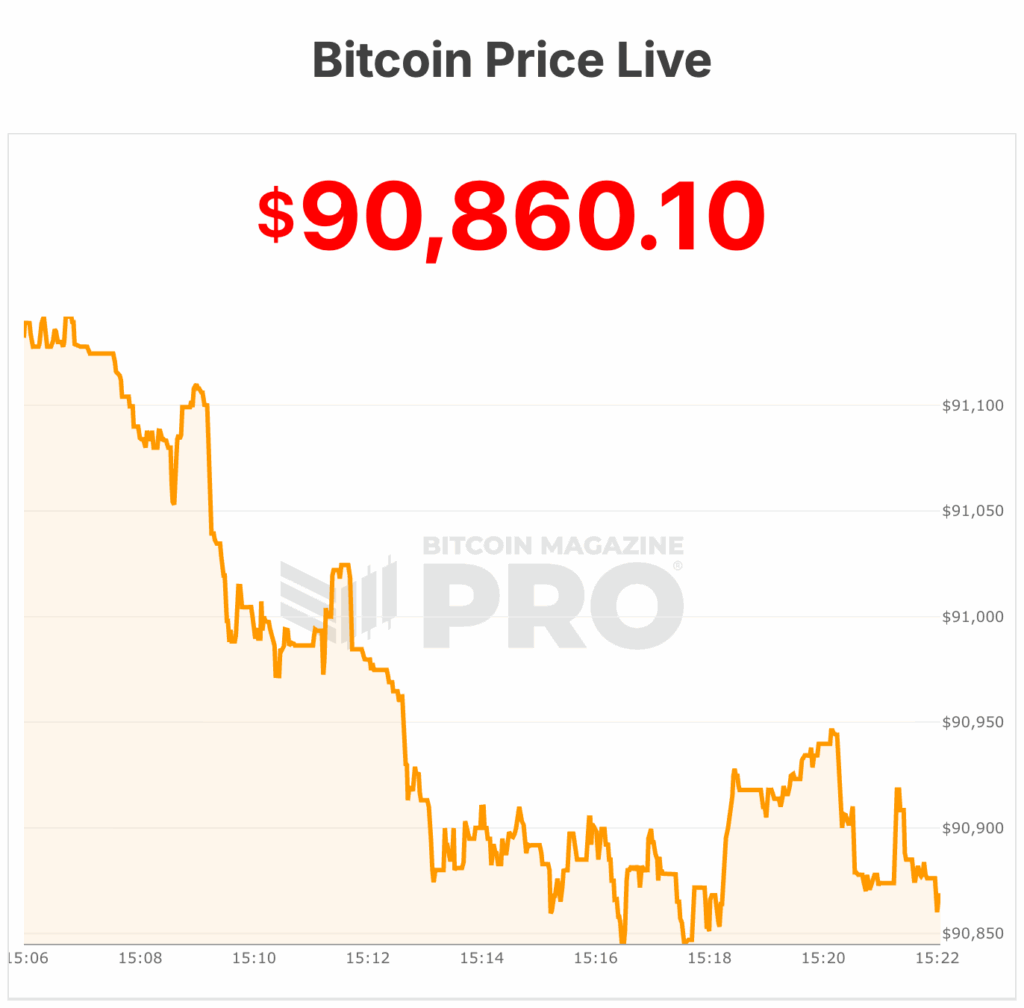
Bitcoin hovered just below the $91,000 level today, paring recent gains after an explosive start to the new year that briefly pushed prices toward fresh seven-day highs.

The bitcoin price was trading around $90,815, down roughly 1% over the past 24 hours, according to market data. Daily trading volume stood near $52 billion, while bitcoin’s total market capitalization slipped to about $1.82 trillion, also down around 1% on the day.

The pullback leaves the bitcoin price roughly 3% below its recent seven-day high near $94,700, after prices surged more than 8% in the first days of 2026. That rally carried the bitcoin price above $94,000 earlier this week, fueled by renewed ETF inflows, bullish options positioning and a resurgence of the geopolitical hedge narrative.

Bitcoin’s circulating supply now stands at 19.97 million BTC, inching closer to its fixed cap of 21 million coins.

The latest move marks a pause after bitcoin broke out of a multi-week consolidation range that capped prices through much of December. The $91,000 level, which previously acted as resistance, has now become a key short-term support zone as traders reassess momentum.

Market participants say the retreat reflects profit-taking rather than a decisive shift in trend, particularly after last week’s rapid upside move.

From a technical perspective, a sustained break below $91,000 could expose deeper support near $87,000, while a move back above $94,000 would reopen the path toward resistance in the $98,000–$100,000 range.

Bitcoin price volatility looms ahead of January 9

Beyond near-term technicals, traders are increasingly focused on macro catalysts — particularly a U.S. Supreme Court ruling scheduled for January 9 on the legality of President Donald Trump’s global tariffs.

Prediction markets suggest a high probability the court will strike down the tariffs, a decision that could force the U.S. Treasury to refund as much as $133–$140 billion to importers. Such an outcome could inject volatility across equities, bonds and crypto markets simultaneously.

Bitcoin, which has shown heightened sensitivity to macro and policy shocks, could see sharp price swings depending on how markets reprice fiscal risk and liquidity conditions.

Despite near-term uncertainty, broader bullish signals remain in place. Bitcoin ETFs recently recorded their strongest daily inflows since October, while options markets continue to show heavy positioning for higher prices later in the year.

At the time of writing, the bitcoin price is at $90,860.10.

bitcoin price

This post Bitcoin Price Teeters Near $90,000 as Early-2026 Rally Falters first appeared on Bitcoin Magazine and is written by Micah Zimmerman.

Veterans Affairs will no longer perform some emergency services

  • Veterans Affairs will no longer perform abortions in emergency cases, in light of a new legal opinion from the Justice Department. The VA started providing abortions to veterans in certain life-threatening circumstances in fall 2022. This comes after the Supreme Court ruling on the Dobbs v. Jackson case. The department began the process of rolling back the policy this summer. That process is still making its way through the official rule-making process.
  • Another agency CIO is heading out the door. Jeff Seaton, the NASA chief information officer, is retiring after 32 years of federal service. Seaton is taking advantage of the ability to delay his retirement under the deferred resignation program. His last day is Dec. 27. Seaton has been NASA CIO for almost five years and previously worked in senior technology roles at headquarters and at NASA Langley Research Center. The space agency is hiring a replacement for Seaton. Its job announcement said the new CIO will be a career senior executive service member. Applications for the position are due by Jan. 9.
  • One nonprofit is continuing to press for investigations into potential Hatch Act violations during the government shutdown. In a new letter to the Office of Special Counsel, the legal organization Democracy Forward called on OSC to open Hatch Act investigations, pointing to multiple incidents of partisan messaging during October and November. The group specifically highlights how agencies posted messages to their websites that blamed the shutdown on Democrats. And in a separate letter to the Government Accountability Office, Democracy Forward also raised potential violations of the Antideficiency Act during the 43-day shutdown.
    (Hatch Act letters - Democracy Forward)
  • The Missile Defense Agency has tapped more companies to support the Golden Dome initiative. The agency has made over a thousand awards under its Scalable Homeland Innovative Enterprise Layered Defense, or SHIELD, contract worth up to $151 billion. The new awards expand a pool of pre-approved vendors eligible to compete for future task orders, bringing the total number of qualifying offerors to more than 2,000 companies. The agency said it has now transitioned to the ordering phase and drafting solicitations.
  • Defense Secretary Pete Hegseth has directed all department heads to recognize "outstanding” Defense Department civilian employees with cash bonuses. A new memo authorizes Pentagon leaders to award the top 15% of civilian employees bonuses worth 15% to 25% of their basic pay, capped at $25,000. Hegseth directed department heads to issue the bonuses by Jan. 30. The memo to recognize top talent comes amid Hegseth’s broader push to shrink and reshape the Pentagon’s civilian workforce.
  • A top official at the Centers for Disease Control and Prevention is no longer reviewing requests for telework as a reasonable accommodation for employees with disabilities. Supervisors have instructed staff to email their medical documentation directly to Lynda Chapman, the agency’s chief operating officer, to “bypass” the traditional reasonable accommodation system, and receive up to 30 days of telework as an interim accommodation. But CDC employees tell Federal News Network that Chapman no longer has access to their reasonable accommodation requests. Former CDC officials say many of the human resources staff trained to handle reasonable accommodation requests were targeted by layoffs earlier this year.
  • House Democrats are pressing the Office of Personnel Management for answers on how the agency is addressing abnormally high volumes of federal retirement applications. In a letter sent this week, the lawmakers raised concerns about the delays retiring federal employees are currently experiencing. That’s after the Trump administration’s deferred resignation program spurred a major influx of retirement applications. The lawmakers are giving OPM Director Scott Kupor until the end of January to respond with more details on OPM’s plans.
  • House Democrats are urging the Transportation Security Administration to preserve union rights for TSA airport screeners. Homeland Security Committee Ranking Member Bennie Thompson (D-Miss.) and 11 of his colleagues say TSA’s push to end union rights will not improve efficiency or security at airport screening lines. In a new letter, lawmakers urge Homeland Security Secretary Kristi Noem to keep TSA’s 2024 collective bargaining agreement in place. TSA plans to void the collective bargaining agreement effective Jan. 11. The American Federation of Government Employees is urging a federal judge to take action, pointing to a preliminary injunction that blocked TSA’s previous attempt to eliminate the union agreement.
  • The owner of a federal contractor is facing up to 90 years in prison after being indicted by a Baltimore grand jury in a scheme to defraud the government that included rigging bids for IT contracts and receiving kickbacks in exchange for influence over IT procurements. Victor Marquez is facing wire fraud charges. The Justice Department said Marquez and his co-conspirators used his access to sensitive procurement information to rig bids for procurements for large government IT contracts. Marquez allegedly received more than $3.8 million in compensation in the form of kickbacks for steering procurements to his co-conspirators, who referred to the payments to Marquez as the “Vic tax.”

The post Veterans Affairs will no longer perform some emergency services first appeared on Federal News Network.

© The Associated Press

FILE - This Dec. 9, 2020, file photo provided by the California Office of Emergency Services (OES) shows hospital beds set up in the practice facility at Sleep Train Arena in Sacramento, Calif., that is ready to receive patients as needed. Medical staffing is stretched increasingly thin as California hospitals scramble to find beds for patients amid an explosion of coronavirus cases that threatens to overwhelm the state's emergency care system. (California OES via AP, File)
❌