
Reading view

There are new articles available, click to refresh the page.

What U.S. – China Cooperation Means for the World

OPINION -- China was very critical of the capture of Venezuelan President Nicolas Maduro last week. The spokesperson for the Ministry of Foreign Affairs said the U.S. action was “blatant interference” in Venezuela and a violation of international law.

Mr. Maduro was accused of working with Columbian guerrilla groups to traffic cocaine into the U.S. as part of a “narco-terrorism” conspiracy. Of all countries, China should appreciate the need to stop Mr. Maduro from smuggling these illicit drugs into the U.S., killing tens of thousands of Americans. China experienced this in the Opium War of 1839-1842, when Great Britain forced opium on China, despite government protestations, resulting in the humiliating Treaty of Nanjing, ceding Hong Kong to Great Britain. Mr. Maduro was violating U.S. laws, in a conspiracy to aid enemies and kill innocent Americans. Fortunately, the U.S. had the political will, and military might, to quickly and effectively put an end to this assault. China should understand this and withhold criticism, despite their close relationship with Mr. Maduro and Venezuela.

The scheduled April meeting of presidents Donald Trump and Xi Jinping will hopefully ease tension related to the South China Sea and Taiwan. The meeting will also offer an opportunity of the two presidents to elaborate on those transnational issues that the U.S. and China can work together on, for the common good.

The National Security Strategy of 2025 states that deterring a conflict over Taiwan is a priority and does not support any unilateral change to the status quo in the Taiwan Strait. It also states that one-third of global shipping passes annually through the South China Sea and its implications for the U.S. economy are obvious.

The Cipher Brief brings expert-level context to national and global security stories. It’s never been more important to understand what’s happening in the world. Upgrade your access to exclusive content by becoming a subscriber.

The April meeting will permit Messrs. Trump and Xi to candidly discuss the South China Sea and Taiwan and ensure that there are guardrails to prevent conflict. Quiet and effective diplomacy is needed to address these issues, and the Trump – Xi meeting could establish the working groups and processes necessary to ensure the U.S. and China do not stumble into conflict.

Also important are the transnational issues that require the attention of the U.S. and China. This shouldn’t be too difficult, given the history of cooperation between the U.S. and China, primarily in the 1980s and 1990s.

Indeed, it was China’s Chairman Deng Xiaoping who approved cooperation with the U.S. on the collection and sharing of intelligence on the Soviet Union.

China opposed the December 1979 Soviet Union invasion of Afghanistan and worked with the U.S. to provide weapons and supplies to the resistance forces in Afghanistan – who eventually prevailed, with the Soviet Union admitting defeat and pulling out of Afghanistan in 1989. The war in Afghanistan cost the Soviet Union immense resources, lives and prestige, weakening the Soviet Union and contributing to its later dissolution.

After the 1979 normalization of relations, the U.S. and China cooperated on a few transnational issues: nuclear nonproliferation; counternarcotics, focusing on Southeast Asia’s Golden Triangle and the heroin from Burma going into China and the U.S.; counterterrorism and the sharing of intelligence on extremist networks.

In 2002, Secretary of State Colin Powell asked China to assist with the denuclearization of North Korea. The following year, China hosted the Six-Party Talks on North Korea’s nuclear program and actively assisted convincing North Korea, in the Joint Statement of September 19, 2005, to commit to complete and verifiable dismantlement of all nuclear weapons and nuclear weapons programs.

China also cooperated with the U.S. on public health issues, like SARS and the avian flu.

Cooperation on these transnational issues was issue-specific, pragmatic, and often insulated from political tensions. Indeed, even during periods of rivalry, functional cooperation persisted when interests overlapped.

Opportunities to Further Enhance Bilateral Cooperation for the Common Good

Although U.S. – China cooperation on counternarcotics is ongoing, specifically regarding the fentanyl crisis, trafficking in cocaine, heroin and methamphetamines also requires close attention. More can be done to enhance bilateral efforts on nuclear nonproliferation, starting with China agreeing to have a dialogue with the U.S. on China’s ambitious nuclear program. Extremist militant groups like ISIS continue to be active, thus requiring better cooperation on counterterrorism. Covid-19 was a wakeup call: there needs to be meaningful cooperation on pandemics. And ensuring that the space domain is used only for peaceful purposes must be a priority, while also ensuring that there are acceptable guidelines for the lawful and moral use of Artificial Intelligence.

U.S. – China cooperation today is more about preventing a catastrophe. The Belgrade Embassy bombing in 1999, when the U.S. accidentally bombed China’s embassy in Belgrade, killing three Chinese officials and the EP-3 incident of 2001, when a Chinese jet crashed into a U.S. reconnaissance plane, killing the Chinese pilot, and China detaining the U.S. crew in Hainan Island are two examples of incidents that could have spiraled out of control. Chinas initially refused to take the telephone calls from Presidents Bill Clinton and George W. Bush, both hoping to deescalate these tense developments.

Need a daily dose of reality on national and global security issues? Subscriber to The Cipher Brief’s Nightcap newsletter, delivering expert insights on today’s events – right to your inbox. Sign up for free today.

Thus, crisis management and military de-confliction should be high on the list of subjects to be discussed, with a robust discussion of nuclear risk reduction. Stability in Northeast Asia and a nuclear North Korea, aligned with Russia and viewing the U.S. and South Korea as the enemies, should also be discussed, as well as nuclear nonproliferation.

The April summit between Messrs. Trump and Xi will be an opportunity to candidly discuss Taiwan and the South China Sea, to ensure we do not stumble into conflict.

The summit is also an opportunity to message to the world that the U.S. and China are working on a myriad of transnational issues for the common good of all countries.

The author is the former associate director of national intelligence. All statements of fact, opinion or analysis expressed are those of the author and do not reflect the official positions or views of the U.S. government. Nothing in the contents should be construed as asserting or implying U.S. government authentication or information or endorsement of the author’s views.

The Cipher Brief is committed to publishing a range of perspectives on national security issues submitted by deeply experienced national security professionals. Opinions expressed are those of the author and do not represent the views or opinions of The Cipher Brief.

Have a perspective to share based on your experience in the national security field? Send it to Editor@thecipherbrief.com for publication consideration.

Read more expert-driven national security insights, perspective and analysis in The Cipher Brief, because national security is everyone’s business.
What China’s ‘World-Class Navy’ Means for the U.S. and Asia


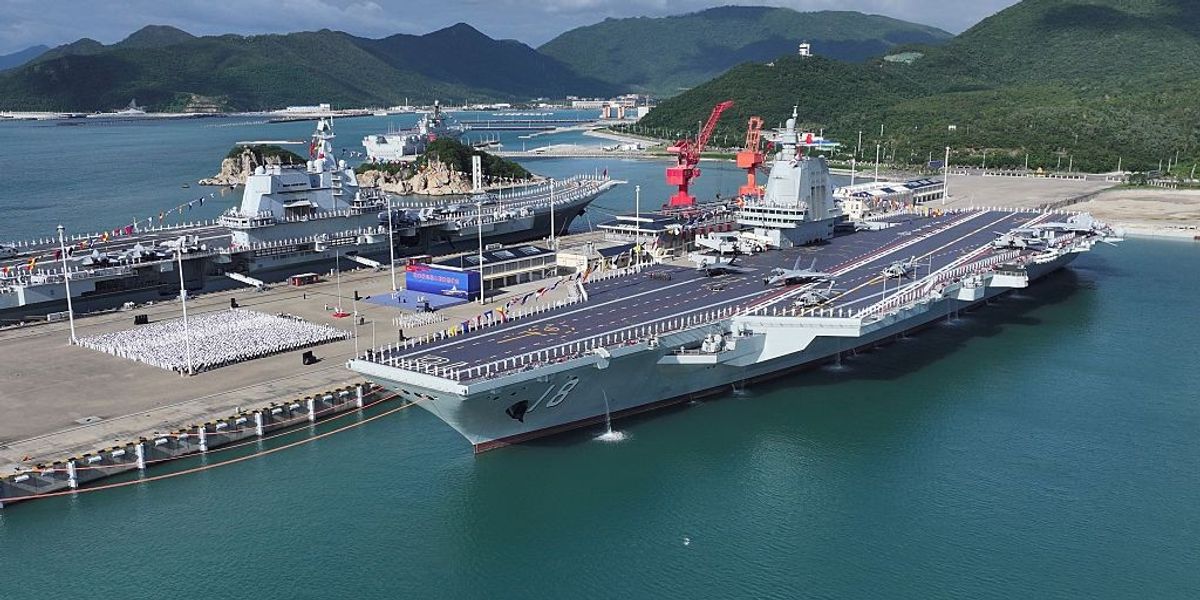
DEEP DIVE — On a Wednesday in November, with Chinese President Xi Jinping looking on, the People’s Liberation Army Navy (PLAN) commissioned the 80,000-ton Fujian, the country’s third aircraft carrier and largest to date, in a ceremony that also featured its latest Navy stealth fighters, helicopters and command aircraft. A week later, China’s Ministry of Defense announced that the Sichuan, one of the world’s largest amphibious assault ships, had completed initial sea trials and would be ready for deployment next year. And last week, Shanghai is hosted “Marintec China,” the largest maritime conference in the world.

These are all signs of China’s continued rise as a maritime power and challenger to U.S. supremacy on the seas. And they have happened at a lightning-fast pace.

China now has “a world-class Navy,” retired Rear Admiral Mike Studeman, a former Commander of the Office of Naval Intelligence, told The Cipher Brief. “It's not, ‘Hey, we're going to achieve this in 2049.’ And it's just not in the numbers, it's in the quality. These ships are modern by any standard.”

The recently commissioned Fujian is the first Chinese carrier (and only the second in the world, after the U.S. Gerald R. Ford) to be equipped with electromagnetic catapults for launching aircraft. As for the new amphibious vessel, the Sichuan, experts have been impressed both by its sophistication and the fact that it was built in just over two years.

Top U.S. Navy officials are taking note. On an Asia-Pacific tour last month, Admiral Daryl Caudle, the U.S. Chief of Naval Operations, acknowledged the new carrier and assault ship and the overall “impressive” growth of China’s Navy.

“How they utilize those aircraft carriers globally is, of course, a concern of mine,” Adm. Caudle said in Japan. As for the Sichuan assault vessel, Adm. Caudle said, “We’ll watch that very closely and see what they’re going to do there. That’s a large ship, very capable.”

Experts say the recent milestones are the latest evidence of gains that have seen China’s Navy surpass the U.S. fleet in overall numbers while boosting the quality of its vessels as well.

“It's impressive,” former Rear Admiral, Mark Montgomery, told The Cipher Brief. “They're building a hundred merchant ships for every one we build, and two warships for every one we build. And they have quantitatively exceeded the size of our U.S. naval ship numbers.”

Montgomery was quick to add that China’s advances “don’t mean they have a more capable Navy” than the U.S. In terms of the quality of submarines and destroyers and carriers – “your choice, ship class after ship class,” as he put it – the U.S. remains without peer. But Montgomery and others say that China has rapidly narrowed the quality gap, and already changed the strategic equation for any potential conflict over the South China Sea or Taiwan.

China is “building a lot of ships, but the technological sophistication of those vessels has also significantly increased,” said Matthew Funaiole, Senior Fellow at the China Power Project at the Center for Strategic and International Studies (CSIS). “They're really trying to compete with other countries – and they obviously have their sights set on the U.S. in terms of maritime dominance in the region.”

The Trump Administration issued an executive order in April to jumpstart the U.S. shipbuilding industry and restore “American maritime dominance,” but experts say the U.S. has work to do to match the urgency of the Chinese buildup.

“The shipbuilding capacity in China now dwarfs that of the United States,” Emmanouil Karatarakis wrote in a recent analysis for The Cipher Brief. Citing estimates that China's overall shipbuilding capability (armed and unarmed) is now hundreds of times larger than the U.S.'s, he added, “This imbalance has far-reaching implications for long-term strategy and wartime readiness.”

Subscriber+Members are invited to join in an exclusive virtual conversation on Monday, December 8 at 2:30p ET on Russia’s Gray Zone Operations in Europe with former leaders from the Department of Defense, CIA, NATO and the British Foreign Office. Members receive links to register via email.

Not a Subscriber+Member? Let’s fix that.

China’s maritime rise

As with many elements of China’s rise as a global power, this one began in the early 1990s. At the time, China’s Navy was deployed primarily to guard its coastline – and while precise figures are hard to come by, estimates of its 1990 force range from 350-400 vessels, most of which were small patrol craft. Back then, the PLAN had no modern destroyers or submarines, and when China first put a carrier to water – in 2012 – it was a retrofitted Soviet vessel (the ship had actually been built in the 1980s, in the then-Soviet republic of Ukraine).

Today, China’s Navy boasts more than 1,000 vessels, including roughly 370 warships and submarines in what the Pentagon calls China’s “battle force” capability. The bulk of this rags-to-riches rise in maritime assets has come during the tenure of Xi Jinping.

“Xi Jinping has always been clear-eyed about the fact that a great power is a maritime power,” RADM Studeman said. “He personally understands that China, in order to be the leading power in the world, needs to have a maritime capability bar none. And that's the course they're on.”

Beijing has taken advantage of a booming commercial shipbuilding industry and the fact that – unlike in the U.S. – the civilian and military sectors in China are intertwined. Shipbuilding was included in the 10 core technologies in Beijing’s “Made in China 2025” industrial strategy, a blueprint for competing with global leaders in key industrial sectors.

A CSIS report offered staggering evidence of China’s maritime rise: the country’s share of global shipbuilding has jumped from 5% in 1999 to roughly 50%, while the U.S. now builds fewer than 1% of commercial ships globally. China’s largest state-owned shipbuilder built more commercial vessels by tonnage in 2024 than the entire U.S. shipbuilding industry had built since the end of World War II.

As for warships, China is now on track to have a 425-ship fleet by 2030, while the U.S. Navy currently has fewer than 300 deployable battle-force vessels – a total which experts worry may drop as aging ships are retired faster than new ones are put to water. “The growing size and sophistication of China’s Navy, combined with Beijing’s increasing assertiveness,” the CSIS report said, “poses major challenges to U.S. and allied military readiness and deterrence in the Indo-Pacific.”

Strategic implications

Experts say there are two basic strategic aims behind China’s maritime growth: preparing for potential conflict in the region, and adding a critical element for the country’s projection of global power and influence.

For the latter goal, the Fujian adds a major “chess piece,” as RADM Studeman put it, helping the PLAN expand its growing “blue-water” capabilities and extend its reach well beyond China’s Southeast Asian neighbors.

“They have been going up into the Bering Sea and parts of the Arctic and Antarctic,” Studeman said. “And they've been able to expand their footprint and develop their capabilities in an evolutionary way, which has been remarkable to see.”

The new carrier group might also be used in a maritime blockade of Taiwan, global humanitarian missions, and show-of-force deployments far from China’s shores.

“China wants to have the ability to operate globally,” Funaiole told The Cipher Brief. “I don’t think they want to do the same things the U.S. does, which is to have forward-positioned fleets all over the world. But they do want the ability to operate in different regions that are further and further away from the Chinese mainland, and you need to have a blue-water Navy in order to do that. It's the key to power projection.”

As far as a potential Taiwan conflict is concerned, the Sichuan – the newly-minted amphibious vessel, would be the more important “chess piece.” It’s an assault ship built to provide launch platforms for large combat drones, helicopters, and amphibious equipment, according to China’s Ministry of Defense.

“The carriers are less important for a Taiwan contingency than a lot of the other assets,” Funaiole said. “The amphibious ships are critical for that being successful.”

RADM Montgomery echoed the point, calling the new carrier group “a muscle flex and power projection,” while noting that the Sichuan and other assets would bring more concrete benefits in a regional conflict.

“The rest of their Navy [beyond the carrier group] isn't a muscle flex,” he said. “This is actually building a capability and capacity to push the United States farther and farther away from the area of crisis and contingency, whether in the East China Sea around the Senkaku [Islands] with Japan, in Taiwan, or in the South China Sea. The idea is to keep our Navy as far away as possible with a mix of missiles, aircraft, submarines, surface ships, all of that.” Those elements have been developed “at close to breakneck speed,” Montgomery said. “They've done a fantastic job of identifying, developing, resourcing and fielding a Navy air and missile force that places the US Navy and US Air Force at risk.”

U.S. Navy commanders have also warned that in the event of a Pacific war, China would be better equipped to replace lost ships – by virtue of geography and its more efficient shipbuilding. Taiwan war scenarios have shown that China would be able to absorb far heavier warship losses than the U.S.

Save your virtual seat now atThe Cyber Initiatives Group Winter Summit on December 10 from 1p – 4p ET for expert-led conversations on cyber, AI and the future of national security.

Can the U.S. turn the tide?

The White House’s April order, issued under the heading “Restoring America’s Maritime Dominance,” marked a recognition of China’s rise and a high-profile effort to reverse the erosion of U.S. shipbuilding. As The Cipher Brief has reported, the order mandates a whole-of-government push to jump-start the domestic shipbuilding industry.

The order called for the creation of an “Office of Shipbuilding” within the National Security Council, and said that within 210 days, the Assistant to the President for National Security Affairs “shall submit a Maritime Action Plan (MAP) to the President…to achieve the policy set forth in this order.”

That 210-day deadline has passed (November 5 was the 210th day), and there has been no public announcement of such a plan. The White House did not respond to requests for comment.

RADM Studeman acknowledged that even in the best-case scenario, these goals would take years to achieve, but added that he was disappointed by a slow pace of progress since the order was signed.

I expected to see more frankly,” he said. “I think that they're incredibly good ideas that were in that directive, and unless it's going on very quietly, I haven't seen enough progress in each of the areas.”

RADM Montgomery agreed.

“I know it's expectation management, but I'm disappointed,” he said, adding that he worries that future U.S. budgets may not provide the funds he believes are needed to kickstart the warship-building industry.

“China has modernized shipyards, as have Japan and Korea, who equally outpace us,” Montgomery said. “We do not have modernized shipyards for a number of reasons. We have not properly invested in that. Our labor costs are significantly higher, and that's particularly true in shipbuilding and defense manufacturing.”

He and others hold out hope that investments and expertise from Korea and Japan will help boost the U.S. output. The authors of the CSIS report urged a blend of punitive measures against China and long-term investments in U.S. and allied shipbuilding capacity. “U.S. Navy leaders have begun intensive outreach to allies like Japan and South Korea to support U.S. shipbuilding efforts,” the report stated, “an effort that President Trump has indicated he supports. However, much work remains to be done.”

“You need basically startup VC capital to get things going on it,” Funaiole said. “And it's not just the technical part or the physical infrastructure. We also have a lack of expertise and shipbuilding in this country. And so there also needs to be personnel training investments and exchange programs with other countries as well and specialization into new areas.”

Experts agree on this much: failure to address these issues risk damage to U.S. national security.

“As tensions rise,” the CSIS report said, “leaders in Beijing may calculate that China’s superior shipbuilding capacity would be a material benefit to outlasting adversaries in a protracted military conflict.”

Read more expert-driven national security insights, perspective and analysis in The Cipher Brief because National Security is Everyone’s Business.


Trump’s Trip Was a True “Pivot” to East Asia

OPINION — President Trump’s meetings in East Asia last week did more to enhance our relationship with a few allies and partners in the region than the past fifteen years of talking about a “pivot to Asia”.

Yes, showing the flag and having the President interact with counterparts is an important part of diplomacy, at the highest level. It has impact because it shows that the U.S. cares about allies and partners, that the U.S. values this relationship and will be there for allies and partners, regardless of the cost.

So, Mr. Trump’s visit to the region was more than tariffs and trade. It was about relationships that principally deal with national security,

Mr. Trump’s meetings with Japan’s new Prime Minister, Sanae Takaichi, and South Korea’s President Lee Jae Myung were particularly noteworthy. The U.S. and Japan signed security and economic measures – and a Memorandum of Cooperation – to expand cooperation on shipbuilding and critical-minerals supply chains, an apparent initiative to reduce reliance on China for rare earth and other critical minerals. More importantly, it established a relationship with Japan’s new prime minister that will ensure we remain close allies.

With South Korea, U.S. approval to develop nuclear-powered submarines using U.S. technology and facilities was a major U.S. decision, with South Korea joining a select few states that operate nuclear-propulsion submarines. There are a few particulars related to the fuel and safeguard agreements that will have to be addressed, but the bottom line is that South Korea, within a few years, will have nuclear-powered submarines (with conventional weapons), a major enhancement of their deterrent capabilities. South Korea also committed to purchasing large quantities of U.S. energy – oil and gas – and a $350 billion trade and investment agreement.

The Cipher Brief brings expert-level context to national and global security stories. It’s never been more important to understand what’s happening in the world. Upgrade your access to exclusive content by becoming a subscriber.

The highly touted meeting of Mr. Trump with Chinese President Xi Jinping was important because it happened, while underwhelming for the substantive progress. Yes, China did agree to resume purchasing U.S. soybeans and agreed to suspend planned export restrictions on rare earth minerals for one year, while also committing to greater cooperation on the trafficking of fentanyl precursor chemicals into the U.S. In return, the U.S. reduced tariffs on Chinese products from 57% to 47%.

The U.S. also said it discussed the possible sale of U.S. computer chips to China, although not the newest AI chips. For many, Mr. Trump’s announcement that he will visit China in April 2026, with a subsequent trip to the U.S. by Mr. Xi was welcomed by many, hoping that a more robust dialogue with China would be in our respective countries’ interest.

Interestingly, there was no mention of Taiwan or potential conflict in the South China Sea. Apparently, the Trump-Xi meeting dealt exclusively with trade and fentanyl-related issues. Or, if these issues were discussed, both agreed that there would be no public statement documenting these discussions.

Mr. Trump’s visit to Malaysia, Japan and South Korea was an important visit of a U.S. president who prides himself on being a peacemaker. In Malaysia Mr. Trump witnessed the signing of a peace accord between Cambodia and Thailand that he personally brokered. Indeed, that’s how Mr. Trump started his five-day trip to East Asia. He ended it with a request that the U.S. and China help end the war in Ukraine. This has been a heavy lift for the U.S. and Mr. Trump personally, who tried to end this war. It’s also a challenge for China, given that China continues to buy Russian oil, and reportedly provides machine tools, semiconductors and other dual-use items that help Russia rebuild its defense industry.

Mr. Trump’s trip to East Asia was a success, especially for what he accomplished in South Korea and Japan.

This column by Cipher Brief Expert Ambassador Joseph DeTrani was first published in The Washington Times

Read more expert-driven national security insights, perspective and analysis in The Cipher Brief because National Security is Everyone’s Business.

Inside Xi Jinping’s Military Purge: Loyalty, Power, and Taiwan

OPINION — Last week’s Fourth Plenum of the Chinese Communist Party witnessed a purge of China’s senior military leaders, culminating in over two years of the removal of senior military officials once loyal to President Xi Jinping.

The last two defense ministers – Wei Feng he and Li Shangfu – were removed in October 2023 and June 2024. And now, He Wei Dong, Vice Chairman of the Central Military Commission (CMC) was expelled from the Party and Military for “serious violations of Party discipline.” Admiral Miao Hua, Director of the CMC’s Political Work Department (responsible for the political/ideological work in the military) was removed from the CMC in June 2025 and later officially expelled.

The list goes on and on: Lin Xiangyang, Former Commander of the Eastern Theatre Command; Wang Houbin, Former Commander of the PLA Rocket Force; Wang Chunning, Former Commander of the People’s Armed Police. These are just three of eight or nine senior military officers purged in October 2025.

Purges of senior officials are not new to China. On July 1, 1989, Zhao Ziyang was removed as the Party’s General Secretary -- and Vice Chairman of the CMC -- for supporting the students during the June 1989 Tiananmen Square demonstrations, and on July 1, 1987, Hu Yaobang was removed as the Party’s General Secretary for supporting the students who were demanding more democracy. Deng Xiaoping accused Mr. Hu, a former protégé of his, of “bourgeoise liberalization.”

And in 1971, Lin Biao, Vice Chairman of the Chinese Communist Party and his wife, Ye Qun, planned the assassination of Chairman Mao Zedong, to replace Mao as the supreme leader. The plot was discovered and Lin Biao died in an airplane crash as he was fleeing for his life.

Many of the recently purged generals, including He Weidong and Admiral Miao Hua, worked in the 31st Group Army stationed in Fujian Province during the 1970s and 80s. This region is the front line for any potential military operation against Taiwan. In fact, He Weidong later served as commander of the Eastern Theatre Command from 2019 to 2022, the unit responsible for operations concerning Taiwan.

General He was a member of the Communist Party’s Politburo and Vice Chairman of the CMC, the third highest-ranking military official in China. His professional prominence was also due to his association with Xi Jinping, but in October 2025, General He and eight others senior military officers were expelled from the Communist Party and the military. They in fact were referred for criminal prosecution on charges of corruption and “serious violations of discipline and law.”

General He and the other purged generals all had connections to Fujian and the former Eastern Theatre Command commander Lin Xiangyang and Navy Admiral Miao Hua. It would be fair to assume that these senior military officers disagreed with some of Mr. Xi’s policies toward Taiwan.

The Cipher Brief brings expert-level context to national and global security stories. It’s never been more important to understand what’s happening in the world. Upgrade your access to exclusive content by becoming a subscriber.

Given the importance of Taiwan for Mr. Xi and the Communist Party, a disagreement with seniors in the military over Taiwan could develop into an issue that affects the inner workings of the Party. Mr. Xi has consistently refused to renounce the use of force to bring Taiwan under its control and continues to conduct military exercises near Taiwan. Mr. Xi maintains, however, that “peaceful reunification” is preferable but reserves the option of using force, particularly in response to “external forces” or “separatist activities” in Taiwan.

Hopefully, Mr. Xi will pursue a policy of peaceful reunification with Taiwan and immediately halt military exercises and related activities to intimidate Taiwan.

This column by Cipher Brief Expert Ambassador Joseph DeTrani was first published in The Washington Times

Read more expert-driven national security insights, perspective and analysis in The Cipher Brief because National Security is Everyone’s Business.

❌