Reading view

There are new articles available, click to refresh the page.

Strategy Is Becoming Bitcoin’s Central Bank Proxy, Says Michael Saylor

Michael Saylor says Strategy’s evolving capital-markets machine is starting to resemble a “central bank of Bitcoin,” positioning the company as a conduit between traditional money markets and the Bitcoin network. In an interview with Gatecast, the Strategy executive chairman argued the firm’s shift toward perpetual preferred equity and “digital credit” instruments is designed to fund continuous bitcoin accumulation while stripping out refinancing risk.

Saylor traced the company’s pivot to the COVID-era shock of 2020, when “the physical economy of the world came to a grinding halt and the financial system was turned upside down.” Facing what he framed as an existential decision, he said Strategy discovered Bitcoin during “the war on COVID and the war on currency,” and used it to “escape a pretty miserable existence and turned into something digital and modern and much better.”

Strategy Is Building A ‘Central Bank of Bitcoin’

That transformation now sits on a scale Saylor claims is often misunderstood. Addressing criticism that Strategy is simply levering up to buy more Bitcoin, he said the firm has raised roughly $44 billion over the past year and a half and characterized “most of that” as equity rather than debt. “There isn’t really leverage,” Saylor said. “Equity is capital that you have forever. We’re funneling that capital into the crypto economy. We’re buying Bitcoin.” He added that Strategy has acquired “about $48 billion worth of Bitcoin” across “like 88 different transactions,” purchasing “as soon as we raise the capital.”

When asked whether Strategy is still just a buyer or something closer to a “shadow central bank of Bitcoin” given its holdings, Saylor leaned into the analogy. “Bitcoin is digital capital. It is the world reserve capital network. It’s replaced gold as the global non-sovereign store of value for the human race,” he said. Then came the framing: “Banks normally buy credit. We actually sell credit. So what we’re doing is the reverse of commercial banking, retail banking. It is sort of like central banking. We are sort of like the central bank of Bitcoin.”

Saylor’s “central bank” claim hinges on a product stack meant to translate Bitcoin’s balance-sheet asset into yield-bearing instruments for investors who won’t hold BTC directly. He described STRC as “a currency that’s pegged to the dollar” and “backed […] with Bitcoin,” with proceeds recycled into BTC purchases. In his telling, that mechanism links “the Bitcoin economy” to “the traditional finance economy and to the money markets of the world.”

Michael Saylor: “We are sort of like the central bank of Bitcoin.” pic.twitter.com/IyZ9EHLAQn

— TFTC (@TFTC21) January 22, 2026

The more material shift, he argued, is Strategy’s progression away from maturity-driven debt toward perpetual structures. Saylor laid out a four-stage evolution: initial use of credit and leverage, a senior note secured by BTC collateral that the company later refinanced and vowed not to repeat, then non-recourse convertible bonds, an approach he said became constrained by market size and retail inaccessibility and finally “digital credit,” which he described as “an equity […]a perpetual preferred equity.”

In one of his clearest statements of intent, Saylor said Strategy’s priority is to prevent principal from ever coming due. “We don’t want to have leverage. We want to have amplification via equity. We never want the principal to come due. We’d rather pay a higher dividend forever,” he said. “I’d rather pay 10% forever than pay 5% for 5 years.” Strategy, he added, has “announced a $1.44 billion cash reserve for the dividends,” giving it “the option to not raise any capital in the capital markets for up to two years,” and in his view “effectively stripped the credit risk off of the business.”

Saylor also pitched liquidity as a differentiator. He said Strategy has raised $7 billion over the last nine months via these instruments and described an emerging market of about $8 billion outstanding. Where preferred stocks typically trade thinly, he argued Strategy’s “digital credit instruments were trading 30 million a day,” with “Stretch […] more than a hundred million a day,” which he framed as a step-change in market access.

The firm’s investor pitch, as Saylor described it, splits the world into capital and credit buyers. “Bitcoin is digital capital. The world will be built on digital capital. But the world will run on digital credit,” he said, arguing that products like Stretch can offer a money-market-like alternative “powered by digital capital” while sidestepping Bitcoin’s volatility.

At press time, BTC traded at $89,250.
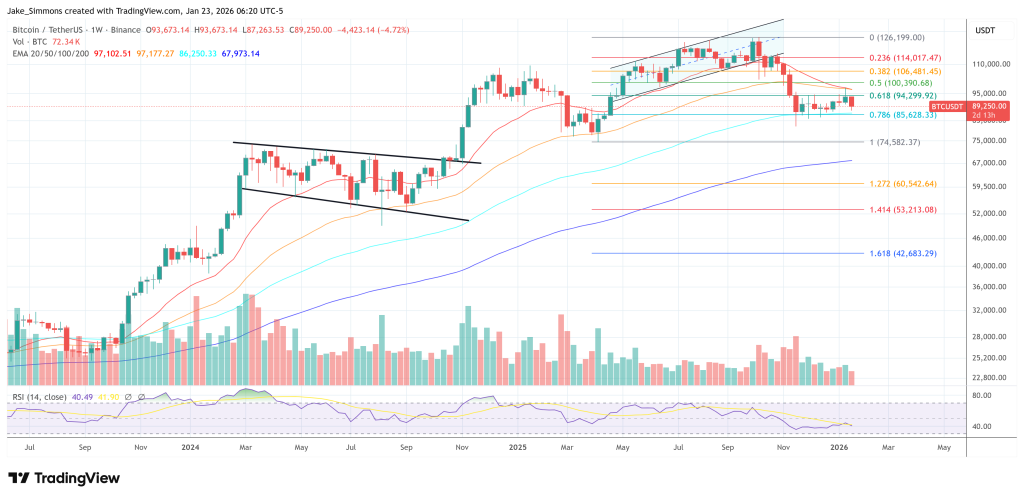
Bitcoin price chart

Bitcoin Is At Risk From Saylor: Pundit Shares Why Strategy’s BTC Holdings Is A Net Negative

Crypto pundit Crypto Chase has explained how Strategy’s Bitcoin holdings is a net negative for BTC’s adoption, especially among large investors. The pundit also ruled out the possibility of capitulation on Michael Saylor’s part, even if the flagship crypto drops below their entry point. 

Why Saylor’s Strategy Bitcoin Holdings Puts BTC At Risk

In an X post, Crypto Chase opined that Strategy’s BTC holdings do more to deter institutions and high-net-worth individuals than to attract them. The pundit added that there really isn’t any full-scale capitulation below Saylor’s average entry price of $76,000, as he believes that Saylor and Strategy will hold until zero, except if the board forces them to do otherwise.  

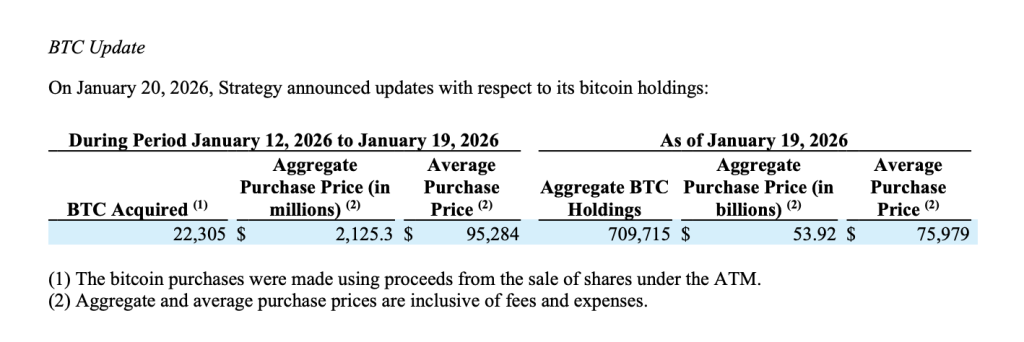
This statement followed Strategy’s latest $2.13 billion Bitcoin purchase, which saw the company’s holdings cross the 700,000 BTC milestone. The company now holds 709,715 BTC, which it acquired for $53.92 billion at an average price of $75,979. Meanwhile, Crypto Chase also stated that if the company were to offload these coins, the Bitcoin price would go back to $3,000 or lower. 

The pundit warned that there are not even close to enough bids to handle such selling pressure. As such, he believes that Strategy’s Bitcoin holdings would have to be sold over the counter to the U.S. government or Trump to avoid a total collapse of the flagship crypto. However, Saylor has so far asserted that they have no intention of ever selling their BTC holdings. 

Crypto Chase also mentioned that fear among uneducated market participants could provide a good entry if the narrative is that Saylor and Strategy would be liquidated if BTC drops below their average entry price. The pundit reiterated that it is game over if that ever happened, though. He is also not confident Bitcoin will rise to new highs anytime soon, noting there is significant overhead and Total Cost of Ownership, with entry points above $100,000. 

From Another Crypto Pundit’s Point Of View

It is worth noting that Crypto Chase’s statement about Saylor’s Strategy and Bitcoin’s holdings was in response to crypto pundit Ansem’s point of view. In an X post, Ansem said he believes Bitcoin will find its place alongside gold and silver in portfolios and benefit from large, high-net-worth individuals and institutions adding small positions. He remarked that BTC, as a digital analog, is easier to transport across global borders and easier to transact with. 

Ansem also noted that Saylor and Strategy’s cost average is currently around $75,000 and that he believes that a drop below that level would be a full-scale capitulation into a generational buying opportunity. From a technical standpoint, the pundit does not think Bitcoin will trade below last cycle’s price peak of $69,000 in 2021.

Bitcoin

Billionaire Michael Saylor Hints at More Bitcoin Buying in Mid-Week Post

“Thinking about buying more bitcoin,” posted Michael Saylor on Thursday morning, reflecting Strategy’s reputation as one of the most aggressive corporate accumulators of BTC.

Thinking about buying more bitcoin.

— Michael Saylor (@saylor) January 22, 2026

The X post follows the company’s latest disclosure that it added 22,305 Bitcoin to its balance sheet, spending approximately $2.13 billion as part of its ongoing accumulation strategy. The purchase was completed at an average price of $95,284 per BTC, inclusive of fees and expenses.

Latest Purchase Expands Strategy’s Bitcoin War Chest

The acquisition disclosed on January 20 was funded through proceeds from Strategy’s at-the-market equity and preferred stock sales conducted between January 12 and January 19.

The approach mirrors the company’s prior capital-raising playbook, which has repeatedly converted equity issuance into Bitcoin exposure during periods of market consolidation.

As of January 19, Strategy holds 709,715 Bitcoin acquired for approximately $53.92 billion at an average price of $75,979 per BTC.

Bitcoin Price Action Shows Consolidation

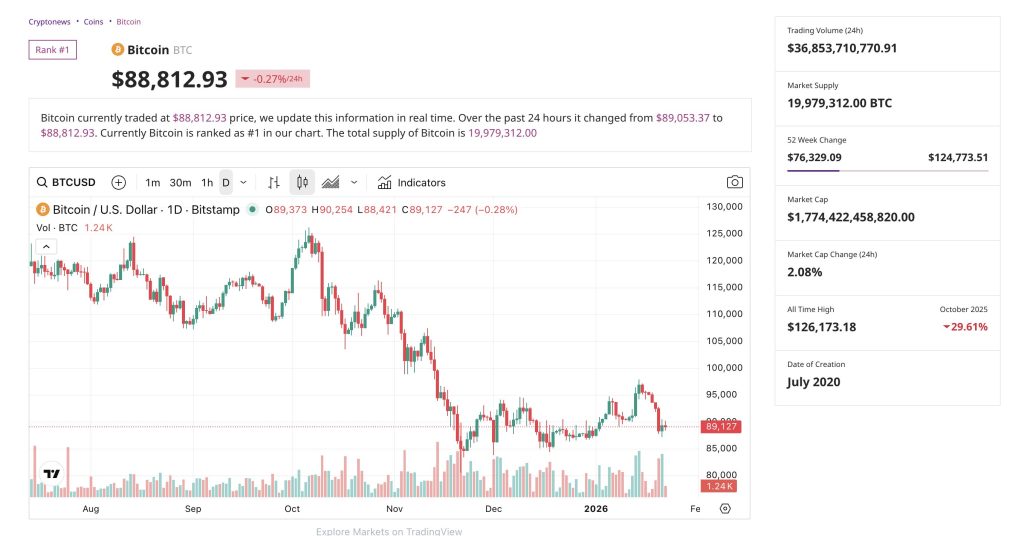
Bitcoin is trading around $88,800 on Thursday, down roughly 0.3% over the past 24 hours, according to CryptoNews data. The asset has retreated from recent highs above $95,000 and remains well below its October 2025 all-time high near $126,000.

Recent price action shows Bitcoin moving within a broad consolidation range, with buyers stepping in near the $85,000–$90,000 zone while upside momentum has stalled below $100,000.

Trading volumes have moderated, suggesting market participants are waiting for fresh catalysts amid tightening financial conditions and shifting macro expectations.

Despite the pullback, Bitcoin remains up on a year-over-year basis, with its market capitalisation hovering near $1.77 trillion, emphasizing its position as the largest digital asset by a wide margin.

Markets convulsed after President Donald Trump threatened steep tariffs on eight European nations unless Denmark cedes Greenland, with rhetoric including hints the U.S. might seize the territory by force, triggering a global risk-off move on January 20.

Gold surged to record highs while Bitcoin plunged into the low-$90K range, with some intraday trades dipping as low as $87K.

Strategy’s Long-Term Conviction Remains Intact

Saylor has framed bitcoin as a long-duration treasury reserve asset rather than a short-term trade. Strategy’s accumulation pace has shown little sensitivity to near-term volatility, with purchases continuing across both rising and falling markets.

The latest X post and buy earlier this week shows the company’s view that periods of consolidation represent accumulation opportunities rather than signs of weakness.

While the strategy has drawn both praise and criticism from market observers, Saylor has repeatedly argued that Bitcoin’s long-term scarcity and monetary properties outweigh interim drawdowns.

The post Billionaire Michael Saylor Hints at More Bitcoin Buying in Mid-Week Post appeared first on Cryptonews.

Dominating Bitcoin: Strategy Has Crossed 700,000 BTC, What % Of Supply Do They Control?

Strategy continues to dominate as the largest Bitcoin treasury company. This time, the company has expanded its holdings, crossing 700,0000 BTC in the process, and currently holds over 3% of the total Bitcoin supply. 

Strategy Now Holds 3.4% Of Bitcoin Supply As Holdings Top 700,000 BTC

Michael Saylor’s Strategy now holds approximately 3.4% of the total Bitcoin supply as the company increased its holdings to over 700,000. In a press release, the company revealed that it acquired 22,305 BTC for $2.13 billion at an average price of $95,284 per Bitcoin last week. It now holds 709,715 BTC, which it acquired for $53.92 billion at an average price of $75,979. 

This purchase was Strategy’s largest weekly announcement since November 2024 and its fifth-largest announcement ever. It also came just a week after the company announced it had acquired 13,627 BTC for $1.25 billion. Meanwhile, this latest purchase has come amid a decline in BTC’s price.  

Bitcoin dropped below $90,000 yesterday for the first time since the start of the year, dragging the Strategy stock with it. MSTR dropped as much as 8% yesterday, falling to around $160. The stock is still up over 3% year-to-date (YTD). However, it is worth noting that Saylor and his company continue to dilute MSTR shares to buy more Bitcoin. The company sold 10.4 million MSTR shares last week to fund most of this latest purchase. 

Reactions To The Latest BTC Purchase

Market analyst Rob noted that Strategy no longer highlights BTC yield as a flagship metric. He further stated that even after buying over 35,000 BTC in the first few weeks of this year, the BTC yield achieved is 0.4%, which amounts to an annualized rate of about 6% to 10%. The analyst also remarked that the law of diminishing Bitcoin yield means the ability to deliver a yield decreases as the BTC stack grows. 

With Strategy now holding over 700,000 BTC, Rob explained that it is harder to generate a return. According to him, this means that going forward, the play is more about squeezing the Bitcoin price itself higher rather than increasing the BTC per share. He added that this also explains why MSTR’s mNAV has collapsed to just over 1x. 

Crypto commentator Ran Neuner warned that a company like Strategy buying and holding such a large concentration of a reserve asset is not healthy. He added that right now, Saylor and his company are the only ones really buying Bitcoin. Meanwhile, market expert Bit Paine said it is a market failure that Saylor is allowed to buy this much BTC at prices below $100,000

At the time of writing, the BTC price is trading at around $90,000, down in the last 24 hours, according to data from CoinMarketCap.

Bitcoin

Strategy Stock ($MSTR) Slides 7% as Aggressive Bitcoin Buying Continues 

Bitcoin Magazine

Strategy Stock ($MSTR) Slides 7% as Aggressive Bitcoin Buying Continues 

Strategy (MSTR) made headlines this morning for its continued ambitious Bitcoin accumulation strategy, even as its stock struggles under mounting investor pressure. 

On Tuesday, shares of the Bitcoin-focused company fell over 7% in early trading at times, despite the firm officially surpassing the 700,000-BTC milestone.

The latest acquisition, disclosed January 20, adds 22,305 Bitcoin to Strategy’s treasury at an average cost of $95,284 per coin, bringing total holdings to roughly 709,715 BTC. The purchases were funded through the company’s at-the-market (ATM) equity and preferred stock programs, which raised about $2.125 billion in net proceeds between January 12 and 19. 

Sales included 2.95 million STRC variable-rate preferred shares and 10.4 million MSTR Class A common shares, with smaller amounts raised via STRK preferred stock.

While the milestone cements Strategy’s position as the world’s largest corporate holder of Bitcoin, representing over 3% of the cryptocurrency’s total circulating supply, the stock decline shows how closely Strategy still follows the price of Bitcoin.

Bitcoin plunged over 5% in just 36 hours, dipping below $90,000 as macro uncertainty and scrutiny of corporate bitcoin treasuries spooked the market. A sharp $4,000 drop Sunday night was fueled by over $500 million in liquidations in crypto derivatives.

Analysts say MSTR’s recent price weakness stems from issuing millions of new shares to buy Bitcoin, with TD Cowen recently cutting its price target to $440 due to a “weaker outlook for Bitcoin yield.”

Institutional interest in Strategy ($MSTR)

Despite the sell-off, institutional interest in Strategy remains notable. Last week, Vanguard Group disclosed a $505 million investment in MSTR, marking its first entry into the company’s stock. 

Technical analysts point to an inverted head-and-shoulders pattern forming on the daily chart, suggesting a potential bullish reversal if shares can sustain a breakout above $175. Failure to hold above $168 could, however, trigger a drop below $160.

The latest tranche of Bitcoin was acquired at an aggregate cost above Strategy’s historical average of $75,979 per BTC, illustrating the firm’s willingness to continue scaling its holdings despite elevated prices. 

Saylor has repeatedly emphasized the company’s long-standing “capital markets-to-Bitcoin” approach, using equity issuance to fund crypto accumulation.

Speaking at the Bitcoin MENA conference last year, Saylor framed Bitcoin as the foundation of a new era in digital capital and credit, not just an investable asset. 

Saylor said that major U.S. banks have moved from cautious observers to offering Bitcoin custody and credit solutions.

He argued that, like gold historically, Bitcoin could underpin a global digital credit system, aligning long-term growth with investor returns.

This post Strategy Stock ($MSTR) Slides 7% as Aggressive Bitcoin Buying Continues  first appeared on Bitcoin Magazine and is written by Micah Zimmerman.

Michael Saylor’s Strategy ($MSTR) Spends $2.13 Billion to Buy 22,305 Bitcoin

Bitcoin Magazine

Michael Saylor’s Strategy ($MSTR) Spends $2.13 Billion to Buy 22,305 Bitcoin

Strategy (MSTR), the world’s largest publicly traded corporate holder of bitcoin, has added another major tranche of BTC to its balance sheet, purchasing 22,305 bitcoin for approximately $2.13 billion over the past week.

The acquisition, disclosed today, was made at an average price of roughly $95,284 per bitcoin, roughly 4% more than current prices. As of Jan. 19, 2026, Strategy now holds a total of 709,715 BTC, acquired for approximately $53.92 billion at an average price of $75,979 per coin.

The latest purchase marks Strategy’s largest weekly bitcoin acquisition since November 2024 and its fifth-largest bitcoin purchase announcement to date.

Led by executive chairman Michael Saylor, the company has continued its aggressive, near-weekly accumulation strategy, using capital markets activity to convert traditional financial assets into bitcoin exposure. 

The latest purchase was funded through a combination of common stock issuance and sales of the company’s perpetual preferred equity, Stretch (STRC).

Strategy’s aggressive bitcoin purchasing strategy

According to regulatory filings, the company raised about $2.125 billion in net proceeds between Jan. 12 and Jan. 19 through its at-the-market (ATM) programs. The bulk of the funds came from the sale of 10.4 million shares of MSTR Class A common stock, generating approximately $1.83 billion. 

An additional $294.3 million was raised through the issuance of roughly 2.95 million STRC preferred shares. Smaller amounts were generated via STRK preferred stock, while no shares were issued under the STRF or STRD programs during the period.

Despite the continued accumulation, Strategy shares were under pressure in early trading, falling about 5% as bitcoin prices slid below $91,000. The pullback follows a broader crypto market sell-off after BTC traded above $94,000 late last week.

With more than 709,000 bitcoin now held, Strategy controls over 3% of bitcoin’s total circulating supply. 

Several weeks ago, the company also announced they are increasing their U.S. dollar reserve to $2.25 billion, up from $1.44 billion in December, intended to support dividend payments on preferred shares and interest obligations on outstanding debt.

BREAKING: 🇺🇸 STRATEGY BUYS ANOTHER 22,305 #BITCOIN FOR $2.1B pic.twitter.com/Rt9XSMP7QK

— Bitcoin Magazine (@BitcoinMagazine) January 20, 2026

Strategy and MSCI

Earlier this month, the company was relieved of some selling pressure when MSCI concluded its review of digital asset treasury companies and decided not to exclude them from its major global equity indexes.

The index provider said bitcoin-heavy firms will remain eligible under existing rules while it conducts further research on how to distinguish operating companies from investment-like entities.

The decision eased months of market anxiety after MSCI had proposed reclassifying companies with more than 50% of assets in digital assets as fund-like and therefore ineligible for inclusion.

Companies like Strategy, along with industry groups, pushed back strongly, warning that exclusions could trigger billions of dollars in forced passive selling.

strategy

This post Michael Saylor’s Strategy ($MSTR) Spends $2.13 Billion to Buy 22,305 Bitcoin first appeared on Bitcoin Magazine and is written by Micah Zimmerman.

Billionaire Michael Saylor’s Strategy Buys 22,305 Bitcoin for $2 Billion – Is Something Big Coming?

Billionaire Michael Saylor’s Strategy has added another 22,305 bitcoin to its balance sheet spending approximately $2.13 billion as the company continues its aggressive accumulation strategy.

Strategy has acquired 22,305 BTC for ~$2.13 billion at ~$95,284 per bitcoin. As of 1/19/2026, we hodl 709,715 $BTC acquired for ~$53.92 billion at ~$75,979 per bitcoin. $MSTR $STRC $STRK $STRF $STRD $STRE https://t.co/6hpAeOxp2I

— Strategy (@Strategy) January 20, 2026

The purchase disclosed on January 20, follows sales conducted under Strategy’s at-the-market (ATM) equity and preferred stock programs between January 12 and January 19, 2026. The bitcoin was acquired at an average price of approximately $95,284 per BTC, inclusive of fees and expenses.

As of January 19, Strategy now holds a total of 709,715 bitcoin acquired for roughly $53.92 billion at an average price of $75,979 per BTC.

ATM Program Funds Latest Bitcoin Acquisition

According to the filing, Strategy raised approximately $2.125 billion in net proceeds during the period through a combination of equity and preferred stock issuance. The majority of capital was generated through sales of STRC variable-rate preferred shares and MSTR Class A common stock.

Notably, Strategy sold 2.95 million STRC shares for $294.3 million in net proceeds and issued 10.4 million MSTR shares, generating $1.83 billion. Smaller amounts were raised through STRK preferred stock sales, while no issuance occurred under STRF or STRD during the period.

The company confirmed that proceeds from the ATM program were used directly to fund bitcoin purchases, reinforcing its long-standing capital markets-to-bitcoin conversion strategy.

Bitcoin Holdings Continue to Scale

With the latest acquisition, Strategy’s bitcoin holdings have grown by more than 22,000 BTC in a single week, cementing its position as the largest corporate holder of bitcoin globally.

At current levels, the company’s aggregate holdings represent over 3% of bitcoin’s total circulating supply. While the average purchase price of recent acquisitions sits above Strategy’s historical cost basis, management has repeatedly emphasized long-term accumulation over short-term price sensitivity.

The disclosure shows that while the latest tranche was acquired near recent market highs, Strategy’s blended acquisition price remains materially lower due to earlier purchases made at discounted levels.

Capital Markets Strategy Remains Intact

Strategy’s continued use of preferred stock issuance and equity sales reflects a deliberate effort to diversify funding sources while minimizing operational cash flow dependence.

The firm still has more than $8.4 billion of MSTR stock and billions in preferred securities available for future issuance under its ATM programs.

Despite heightened volatility in crypto markets and ongoing regulatory uncertainty, Strategy has maintained its bitcoin-centric capital allocation framework, positioning BTC as its primary treasury reserve asset.

Long-Term Conviction Unchanged

The latest purchase shows Strategy’s unwavering conviction in bitcoin as a long-duration store of value and monetary asset. By systematically converting capital raised in traditional markets into bitcoin exposure, the company continues to operate as a leveraged proxy for institutional bitcoin adoption.

As of January 19, Strategy’s balance sheet reflects not just scale but persistence — a defining feature of its approach as bitcoin enters a more institutionally driven phase of market maturity.

The post Billionaire Michael Saylor’s Strategy Buys 22,305 Bitcoin for $2 Billion – Is Something Big Coming? appeared first on Cryptonews.

Bitcoin Bulls Fired Up As Saylor Teases ‘Bigger Orange’ After Huge Buy

Michael Saylor’s hint about a “Bigger Orange” has sent fresh energy through parts of the Bitcoin market. It came after Strategy executed a very large buy, and traders took the message as a sign there may be more accumulation ahead. Short bursts of buying have a way of changing tone on trading floors.

Saylor Signals New Buying Spree

According to reports, Strategy purchased more than $1.25 billion in Bitcoin in its latest move, adding thousands of coins to its holdings. That stack has pushed the company closer to a massive total that some sources put near 700,000 BTC.

Markets reacted quickly. Prices nudged higher in the hours after the news, and shares of Strategy were treated by some investors as a way to get extra Bitcoin exposure.

Traders Pounced And Charts Reacted

Momentum traders were the first to lean in. They saw the buy as proof that a major corporate buyer still sees value in stacking coins during dips.

Options desks showed increased call buying, and volume spiked on spot desks in New York and Asia. Sentiment grew more positive, but caution remained. Big buys can lift short-term prices, yet they don’t always start long, steady rallies.

₿igger Orange. pic.twitter.com/HI47hMCnui

— Michael Saylor (@saylor) January 18, 2026

Market Reaction And Investor Moves

Retail and institutional players both turned their attention to liquidity. Reports note that when one large buyer moves, other firms often reassess their risk and allocation plans.

Hedge funds checked their models. Family offices ran fresh numbers. For some investors, the appeal is simple: owning a scarce asset that an influential buyer keeps adding to can feel reassuring.

Corporate Treasuries And Public Perception

Corporate cash strategies have been in the spotlight since Strategy first started buying coins. CEOs and boards watch those moves closely, and investors watch boards.

For a public company to keep buying, confidence has to be high enough to risk press questions and regulatory attention. That choice is being watched by analysts who say such buys shape public debate about Bitcoin’s role as part of a company’s balance sheet.

What Analysts Are Watching

Analysts are tracking three things: how many coins are being taken off exchanges, whether accumulation is steady or one-off, and how the market digests more large purchases.

On-chain trackers showed notable withdrawals after the reported purchase, which can tighten available supply. Some onlookers cautioned that short-term price jumps can be reversed if selling follows or if macro news turns sour.

A Cautious Ending Note

Based on market chatter, the “Bigger Orange” tease is more than a bit of bravado — it is treated as a strategic signal by many market players.

Still, outcomes are far from certain. Buying by a major corporate holder can shift sentiment and squeeze short positions, but markets are shaped by many forces at once.

For now, traders, investors, and watchers will keep an eye on any follow-up moves and how price and liquidity respond in the next sessions.

Featured image from Unsplash, chart from TradingView

Saylor Defends Bitcoin Treasury Firms Amid Rising Criticism

Strategy chairman Michael Saylor pushed back on critics who say companies that hold Bitcoin are reckless. He told a podcast that buying Bitcoin should be seen as a choice about where to put cash, not as a moral failing.

He said firms face few good options for idle money, and that Bitcoin is one of those options for companies that can stand big price swings.

Corporate Bitcoin Treasury Choice

Based on reports tracking public disclosures, publicly listed firms hold about 1.1 million BTC in total. That amount equals roughly 5.5% of the 19.97 million coins now in circulation.

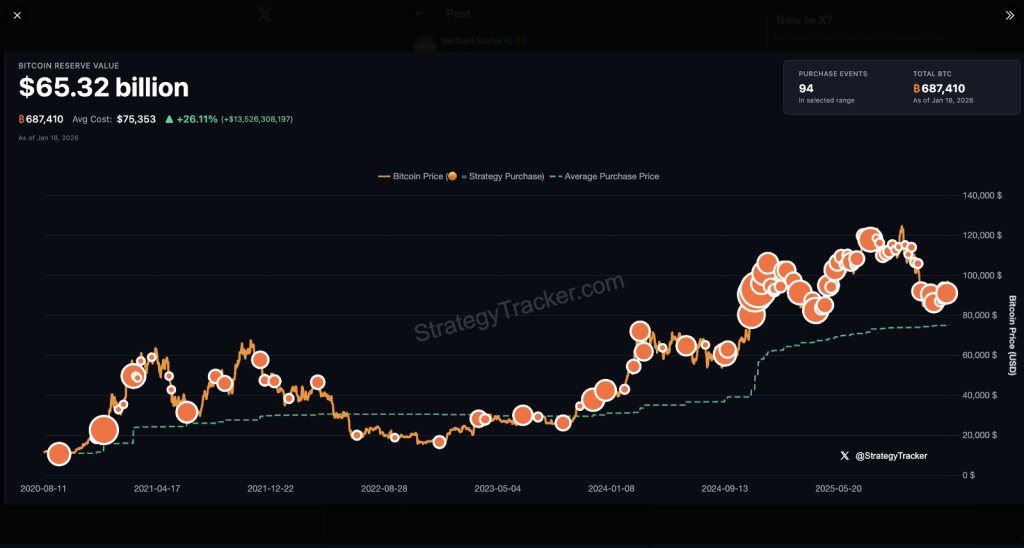
Strategy is the biggest public holder, with 687,410 BTC, according to BitcoinTreasuries data. Those numbers help explain why markets and regulators pay attention when companies buy large amounts.

Saylor framed the issue as a simple accounting decision. He compared holding Bitcoin to other moves a firm might make with extra cash.

Treasuries pay very little. Stock buybacks can fail if a company is losing money. He used a clear example: a company losing $10 million per year could still come out ahead if its Bitcoin position gained $30 million over the same time. That point is meant to show why some executives see Bitcoin as a way to improve net results.

Risk Vs. Reward On Balance Sheets

The argument has limits. Bitcoin can drop fast. A firm with heavy debt or thin margins may be forced to sell at the worst time. Not every company has the same ability to wait for a recovery.

Strategy’s big size and long view make it hard to compare with smaller firms that don’t have the same runway or the same investor base.

Investors and analysts see two sides. Some view large Bitcoin bets as proof of conviction. Others see concentration risk that adds volatility to corporate returns.

That scrutiny grows as more firms add coins to their books. When holdings reach the hundreds of thousands, it is no longer a niche choice; it becomes part of how markets judge a firm’s financial picture.

Price Context Matters

Bitcoin was trading around $95,250 at the time of writing, with an intraday range from about $94,320 to $95,660 on major exchanges.

That level shapes how recent buyers are viewed. Gains make the strategy look smart. Losses make it look unattractive. Timing and cash needs often decide the outcome.

Featured image from Unsplash, chart from TradingView

Popular Attorney Reveals Why Ripple Was Unable To Push XRP All These Years

Famous legal expert Bill Morgan has highlighted how Ripple was unable to promote XRP over the past few years due to its former legal battle against the U.S. Securities and Exchange Commission (SEC). 

Why Ripple Was Unable To Promote XRP In The Past

In an X post, Bill Morgan stated that Ripple could not promote XRP or the XRP Ledger in the past for fear of being sued by the SEC for promoting and offering an unregistered security. He noted that despite that, the company was still sued by the regulator. The lawyer’s response followed XRPL stakeholder Wietse’s comments about how the XRPL has a track record of regularly being too early and also being too late. 

Wietse made this comment after XRP community member Crypto Eri pointed out that the XRP Ledger has supported tokenized gold since, though it hasn’t received enough publicity. Wietse added that the network is too early for people to notice and realize how great certain things are, and too late for others, causing too little, too late catch-up. 

However, Bill Morgan believes that XRP and XRP Ledger would have gotten more publicity if Ripple had been able to actively promote the altcoin in the past. He noted that during the SEC lawsuit, the crypto firm barely mentioned XRP. Meanwhile, the lawyer noted that Bitcoin, Ethereum, and other cryptos were promoted with impunity and that former SEC official Bill Hinman effectively promoted ETH while in office.  

The lawyer added that, to this day, Ripple’s promotion of XRP and the XRP Ledger remains muted. He stated that the company does it by stealth under the cover of acquisitions and RLUSD. Morgan believes that this is nothing compared to how Michael Saylor actively talks about and promotes Bitcoin. 

XRP Is Still At The Centre Of Ripple’s Vision

Ripple has, in recent times, reiterated that XRP is at the centre of its vision. In his New Year’s message, the firm’s CEO, Brad Garlinghouse, stated that the altcoin has been and will continue to be the heartbeat of that vision. This came as he noted that their two major acquisitions last year, Ripple Prime and GTreasury, will greatly accelerate and expand their ability to deliver on their vision, which is to enable the Internet of Value. 

He added that building and using crypto infrastructure, updating their global financial plumbing, and rethinking legacy systems don’t happen overnight. As such, they will continue to take the long view of what crypto-based assets such as XRP and RLUSD can do rather than chasing cycles and hype. 

At the time of writing, the XRP price is trading at around $2.16, up over 5% in the last 24 hours, according to data from CoinMarketCap.

Ripple

Strategy ($MSTR) Stock Soars 10% Above $189 as Bitcoin Nears $100,000

Bitcoin Magazine

Strategy ($MSTR) Stock Soars 10% Above $189 as Bitcoin Nears $100,000

Shares of Strategy ($MSTR) surged more than 10% Wednesday morning, briefly climbing above $189 per share, as investors piled back into the bitcoin treasury trade.

The move caps a volatile stretch for the stock following sharp drawdowns earlier this month.

Strategy, which holds the largest bitcoin position of any public company, has seen its equity trade as a high-beta proxy for bitcoin, with gains and losses often magnified relative to spot price movements. 

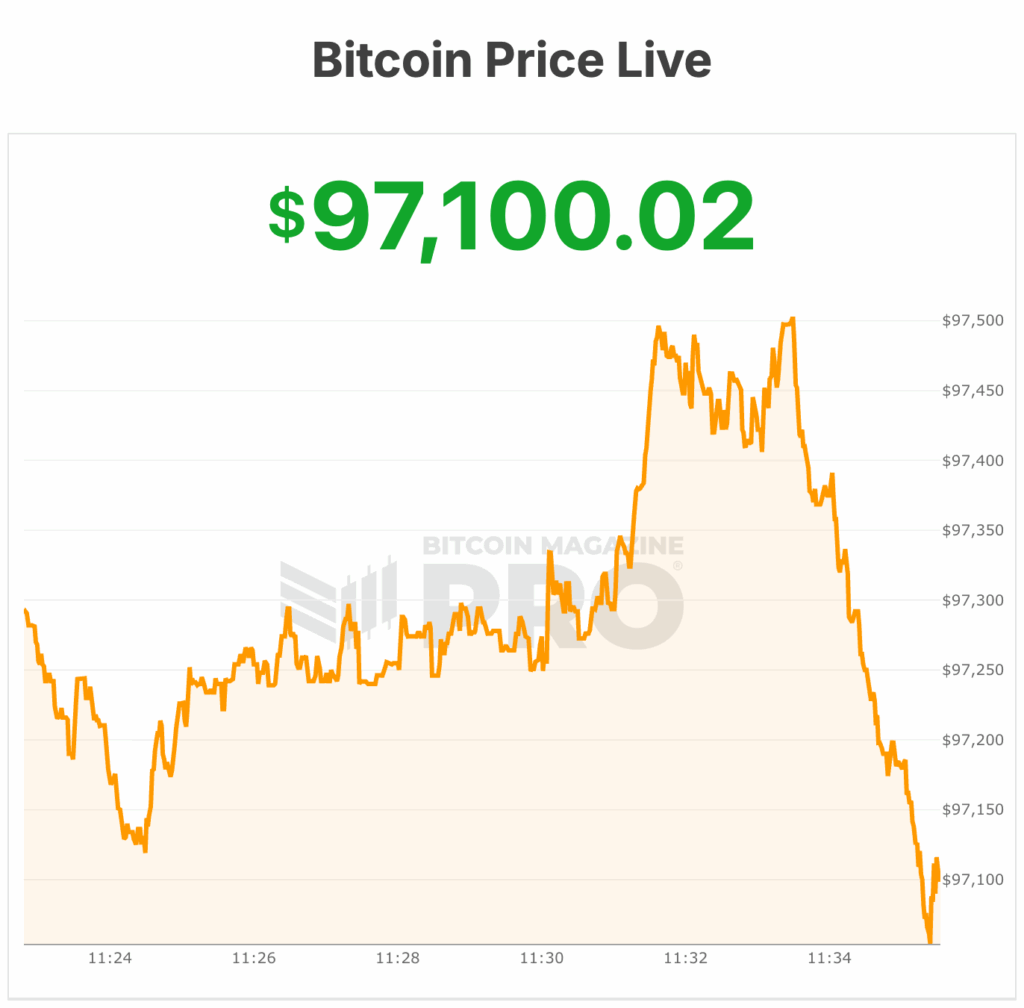
As bitcoin pushed toward the upper end of its recent range near $97,000, MSTR followed with a rapid upside move that outpaced the broader equity market.

The rally builds on momentum that began late last week after Strategy disclosed another large bitcoin purchase, adding more than 13,000 BTC to its balance sheet.

The acquisition lifted the company’s total holdings to roughly 687,000 bitcoin, reinforcing its long-stated approach of accumulating BTC through a mix of operating cash flow, equity issuance, and capital markets activity. 

Executive Chairman Michael Saylor has framed the strategy as a long-term bet on bitcoin as a superior store of value and a treasury reserve asset.

Market participants say the size and consistency of Strategy’s purchases have helped re-anchor the bull case for the stock after weeks of pressure tied to bitcoin’s pullback and concerns around dilution. 

While critics continue to point to leverage risk and accounting volatility, supporters argue that Strategy’s balance sheet has become one of the most direct institutional on-ramps to bitcoin exposure in public markets.

Sentiment also improved following signs of insider confidence. A recent open-market purchase by a company director marked the first such buy in several years, standing out in a period when insider activity had largely consisted of scheduled sales. 

Strategy’s recent MSCI drama

Structural factors added to the rebound. Earlier this month, index provider MSCI opted not to remove bitcoin-focused treasury companies from certain benchmarks, easing fears of forced selling by passive funds. 

That decision reduced near-term downside risk for Strategy, which has grown increasingly sensitive to index flows as its market capitalization expanded during bitcoin’s 2024 and 2025 rallies.

Still, Strategy’s model remains closely tied to bitcoin volatility. The company reported large unrealized losses in prior quarters as accounting rules required it to mark down bitcoin holdings during price declines. 

Those losses reversed only when prices recovered, creating earnings swings that traditional equity investors often struggle to price.

Wednesday’s jump above $189 highlights the reflexive nature of the trade. As bitcoin strengthens, Strategy’s equity also strengthens and attracts momentum-driven capital seeking leveraged exposure.

strategy

This post Strategy ($MSTR) Stock Soars 10% Above $189 as Bitcoin Nears $100,000 first appeared on Bitcoin Magazine and is written by Micah Zimmerman.

Here’s Why Bitcoin Is Increasingly Framed As A Modern Savings Tool

In an era marked by rising inflation, Bitcoin was framed as a radical experiment in digital cash. However, as the global economic landscape has shifted, the narrative around BTC has changed. It is now being discussed as a modern savings tool designed for a world where traditional savings are steadily losing their purchasing power.

Normalisation Of Bitcoin As A Savings Asset

A common framing of Bitcoin today is that it is a savings technology, digital gold, and something to hold, rather than use. According to Ben SAN’s post on X, that framing has become incomplete and ultimately wrong. This is because BTC is not meant to sit alongside fiat as another savings vehicle, but to replace fiat as a monetary base and a financial base that cannot be used or function as money.

However, for BTC to operate as a form of finance, it has to be usable at scale. That usability at scale implies execution, settlement abstraction, fast interactions, and cost-efficient transactions. BTC layer 1 is designed for finality and neutrality, not to satisfy these requirements, and it shouldn’t be.

This is why BTC needs layer 2s to operate as money. “Once you accept that Bitcoin needs L2s to be usable as money, you stop asking whether alts are competing with Bitcoin and start asking whether they are serving Bitcoin,” the expert stated. If acceptance of altcoins is ever possible in the BTC-first community, it won’t come from alternative monetary assets. Instead, the acceptance of the altcoins will only come from systems that keep BTC as the unit of account and native asset, while extending its usability crucially without weakening its guarantees. 

In these cases, auxiliary tokens may be introduced, but only where BTC is structurally incapable of performing the required coordination or incentive functions around expressiveness and yield. Furthermore, any non-BTC asset that has a legitimate chance of being accepted within the community will earn that legitimacy by filling those gaps in a way BTC itself cannot fulfill.

History Shows What Happens After These Bitcoin Buys

Crypto analyst Mattertrades highlighted that Bitcoin is trading above the weekly resistance, and the path is slow and clear. This setup is a result of Michael Saylor stepping in this week with his largest purchase since July, acquiring $1.5 billion worth of BTC. The last time he did this, BTC surged to $126,000.

At the same time, the Morgan Stanley Capital International (MSCI)-related news for Strategy was very bullish, and it actually attracted more buyers. Mattertrades concluded that this is how a bullish case quietly forms. If Saylor’s purchases bring in more buyers, reflexivity will begin because when he starts accumulating such large amounts again, other players will follow suit.

Bitcoin

Strategy ($MSTR) Just Spent $1.25 Billion on 13,627 Bitcoin, Pushing BTC Holdings to 687,410

Bitcoin Magazine

Strategy ($MSTR) Just Spent $1.25 Billion on 13,627 Bitcoin, Pushing BTC Holdings to 687,410

Strategy added to its bitcoin treasury for a third straight week, acquiring 13,627 BTC for roughly $1.25 billion at an average price of $91,519 per coin, according to an SEC filing dated January 12.

The purchases were made between January 5 and January 11 and funded through the company’s at-the-market offering program, which included sales of Class A common stock (MSTR) and its 10.00% Series A perpetual preferred stock, Stretch (STRC). 

The sales generated about $1.2 billion in net proceeds, with $1.1 billion coming from common stock and $119 million from preferred equity.

The latest buy brings Strategy’s total bitcoin holdings to 687,410 BTC, acquired for an aggregate cost of $51.8 billion at an average purchase price of $75,353 per bitcoin. 

At current prices, the stash is worth roughly $62 billion.

Last week, Strategy disclosed another sizable bitcoin purchase, acquiring 1,286 BTC for about $116 million in a filing with the U.S. Securities and Exchange Commission.

The buys, made between late December and early January, lifted the company’s total holdings to 673,783 BTC at the time, funded through Class A share sales under its at-the-market program.

Strategy also increased its U.S. dollar reserves last week to $2.25 billion to support preferred dividends and debt obligations, while reporting an average bitcoin cost basis of roughly $75,000 per coin.

BREAKING: 🇺🇸 STRATEGY BUYS ANOTHER 13,627 #BITCOIN pic.twitter.com/Pu9lvU1ovt

— Bitcoin Magazine (@BitcoinMagazine) January 12, 2026

Despite bitcoin rebounding above $90,000 to start 2026, the firm recorded a $17.44 billion unrealized loss in the fourth quarter of 2025 after prices fell sharply from October highs.

Strategy’s recent MSCI drama 

Over the past several months, Strategy has been at the center of attention tied to its inclusion in MSCI’s global equity indexes due to its massive Bitcoin treasury strategy. 

MSCI — one of the world’s most influential index providers — launched a review in late 2025 to consider whether companies with more than ~50 % of assets in digital assets (so-called Digital Asset Treasury Companies, or DATCOs) should remain in major benchmarks like the MSCI World and MSCI USA indexes.

If excluded, passive funds tracking these indexes could be forced to sell billions of dollars of MSTR shares, with estimates suggesting up to ~$2.8 billion in outflows from MSCI-linked funds alone and even more if other providers followed suit. Analysts from JPMorgan and TD Cowen estimated that exclusion from these indices could threaten billions in additional market value on top of that.

Strategy’s stock endured some declines and heightened risk-off sentiment as markets priced in the threat of index exclusion, with its share price dropping sharply in late 2025 amid these concerns. 

Company leadership, including Michael Saylor, publicly defended its positioning as a legitimate operating company rather than a passive fund, engaging with MSCI during the consultation and stressing its enterprise operations alongside Bitcoin holdings.

In a statement on X, Saylor said that the company is “not a fund, not a trust, and not a holding company.” He described the firm as a publicly traded operating company with a $500 million software business and a unique treasury strategy that uses Bitcoin as productive capital.

In early January 2026, MSCI announced it would not implement proposed exclusions of DATCOs from its indexes at this time, effectively postponing any removal for the upcoming February 2026 review. This decision was widely interpreted as short-term relief for Strategy — lifting some selling pressure and leading to a 4 %–6 % rise in MSTR stock as investors welcomed the reprieve.

However, MSCI also signaled a broader consultation on how to classify non-operating companies, indicating that similar debates could resurface later in 2026. 

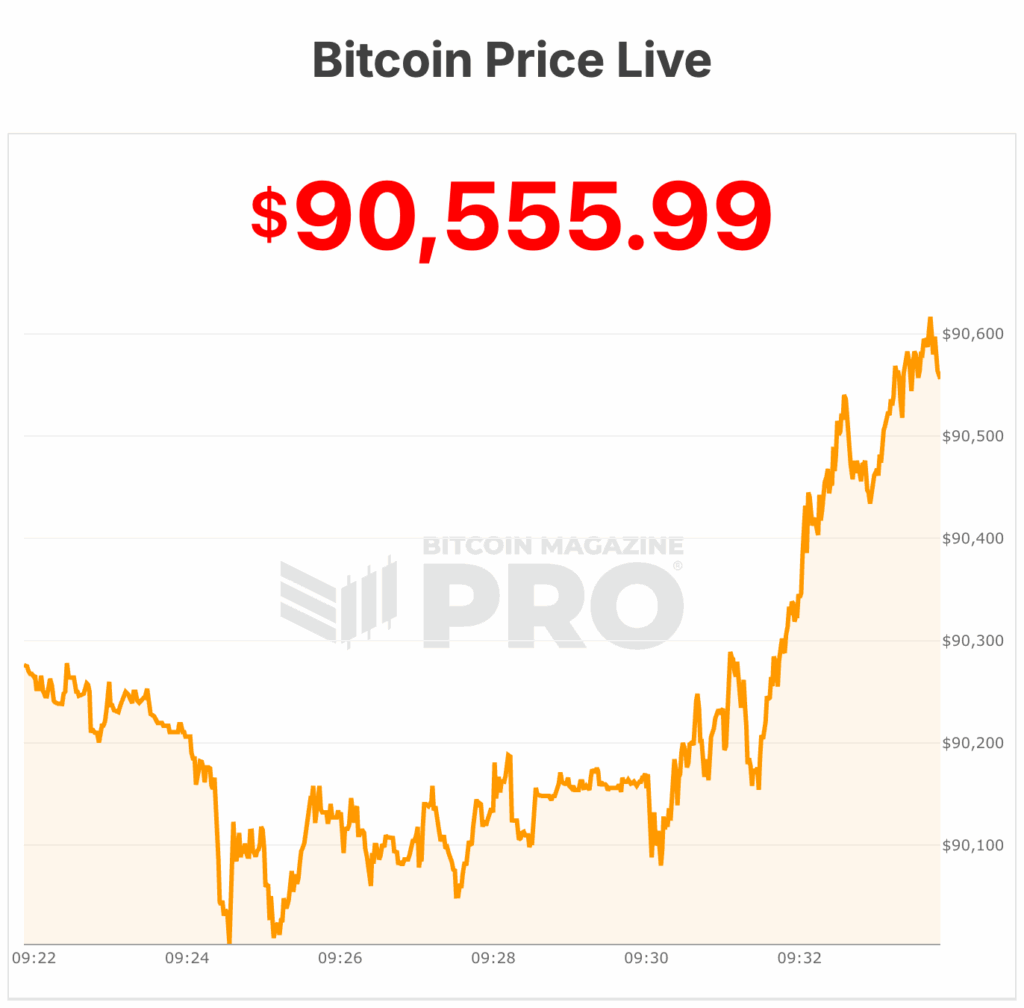
Despite all this buying, the price of bitcoin has been little-changed over the last couple of months. Bitcoin has bounced around the $90,000 range and is currently trading at $90,555.  

Strategy

This post Strategy ($MSTR) Just Spent $1.25 Billion on 13,627 Bitcoin, Pushing BTC Holdings to 687,410 first appeared on Bitcoin Magazine and is written by Micah Zimmerman.

MSCI Will Not Exclude Bitcoin Treasury Companies Like Michael Saylor’s Strategy From Global Indexes

Bitcoin Magazine

MSCI Will Not Exclude Bitcoin Treasury Companies Like Michael Saylor’s Strategy From Global Indexes

In a major development for Bitcoin-focused corporations and the broader digital asset ecosystem, global index provider MSCI has concluded its review of digital asset treasury companies (DATCOs) and decided against excluding them from its flagship indexes.

MSCI said the current treatment of affected companies will remain unchanged for now, meaning DATCOs already included in MSCI indexes will stay included as long as they continue to meet existing eligibility requirements. 

The index provider acknowledged feedback from institutional investors expressing concern that some digital asset treasury companies resemble investment funds, which are typically excluded from its indexes. 

At the same time, MSCI said distinguishing between investment-oriented entities and operating companies that hold digital assets as part of their core business requires further research and market input. 

As a result, MSCI said it plans to launch a broader consultation on the treatment of non-operating companies, while deferring any exclusions, additions, or size-related changes for DATCOs in the interim, according to the company announcement. 

JUST IN: MSCI decides to NOT exclude Michael Saylor's Strategy and other Bitcoin treasury companies from its indexes. pic.twitter.com/OTnQgG2jca

— Bitcoin Magazine (@BitcoinMagazine) January 6, 2026

The move reverses fears that have swirled in financial and crypto markets for months that firms — like Strategy — holding a majority of their assets in Bitcoin and other digital assets could be stripped from widely tracked global equity benchmarks like the MSCI All Country World and Emerging Markets indexes.

The proposal, first announced by MSCI late last year, would have effectively classified DATCOs — public companies with greater than 50 % of assets in digital assets — as fund-like entities rather than operating companies, and thus ineligible for inclusion in its core indices. 

That framework had ignited fierce criticism from industry players and advocates.

Strategy and bitcoin industry pushback against MSCI

Strategy — the largest publicly traded Bitcoin treasury company — and other DATCOs had been at the center of the debate. 

Strategy formally urged MSCI to scrap the proposal, arguing that excluding firms based on asset composition alone would be “misguided,” “arbitrary,” and could destabilize index neutrality. 

In an open letter to the MSCI Equity Index Committee, Strategy stressed that DATCOs are operating companies, not passive funds, and should not be judged solely on balance sheet Bitcoin holdings.

Industry coalitions such as Bitcoin For Corporations also mobilized support, framing the move as discriminatory and warning that exclusion could trigger billions in passive outflows and broader market dislocations.

Analysts had projected potential capital flight of up to $2.8 billion from Strategy alone if MSCI followed through with exclusion, with broader estimates of forced selloffs across crypto treasuries ranging much higher. 

The decision ends that uncertainty. It preserves the status of DATCOs within MSCI’s suite of indexes and avoids triggering index-linked passive selling that had loomed as a structural market risk.

Market reaction was swift: shares of digital asset heavyweights including Strategy saw immediate relief buying.

Shares of MSTR jumped over 7% after the news broke in after hours trading. 

This post MSCI Will Not Exclude Bitcoin Treasury Companies Like Michael Saylor’s Strategy From Global Indexes first appeared on Bitcoin Magazine and is written by Micah Zimmerman.

Michael Saylor’s Strategy Bought 1,286 BTC Last Week, Increases USD Reserve to $2.25B

Bitcoin Magazine

Michael Saylor’s Strategy Bought 1,286 BTC Last Week, Increases USD Reserve to $2.25B

Michael Saylor’s Strategy, the Tysons Corner, Virginia-based firm formerly known as MicroStrategy, kicked off the new year with another large Bitcoin acquisition, buying 1,286 BTC for approximately $116 million, according to a Monday filing with the U.S. Securities and Exchange Commission (SEC). 

The purchase, made between December 29, 2025, and January 4, 2026, boosts the company’s Bitcoin holdings to 673,783 BTC, valued at around $62.7 billion at current prices.

The latest buy was funded entirely through the proceeds of MSTR Class A stock sales under the company’s at-the-market (ATM) program. The company sold nearly 2 million shares, generating $312.2 million in net proceeds. 

The acquisition also coincides with the firm increasing its U.S. dollar reserve to $2.25 billion, up from $1.44 billion in December, intended to support dividend payments on preferred shares and interest obligations on outstanding debt.

The average price for the recent purchase was $90,391 per Bitcoin, with a small portion — 3 BTC — acquired in the final days of 2025 at $88,210 each. 

Overall, Strategy’s Bitcoin portfolio was accumulated at an average cost basis of $75,026 per coin, reflecting total expenditures of $50.55 billion. 

Despite the gains in 2026, the company reported a $17.44 billion unrealized loss on its digital assets in the fourth quarter of 2025, largely due to Bitcoin sliding from its October high of $126,000.

Bitcoin’s price surpassed $90,000 at the start of the year, partly buoyed by geopolitical tensions in the U.S.-Venezuela corridor and ongoing market optimism. As of Monday, BTC traded near $93,000, representing a roughly 6% gain year-to-date.

The move underscores the company’s continued commitment to its Bitcoin-first treasury model. Michael Saylor, co-founder and executive chairman, signaled the purchase on Sunday via X posting the firm’s Bitcoin portfolio with the caption, “Orange or Green?” 

This weekly acquisition pattern has become a hallmark of Strategy’s approach to building its bitcoin holdings over time.

Strategy’s MSCI delisting possibility 

However, the firm faces ongoing challenges beyond market volatility. Strategy could soon be removed from the Morgan Stanley Capital International (MSCI) global indices, which proposed last October that companies with 50% or more of assets in digital currencies resemble investment funds and may be excluded. 

A potential MSCI delisting could trigger $2.8 billion in stock outflows, according to executives, with further impacts possible across other indexes, including the Nasdaq 100 and Russell benchmarks. Analysts from JPMorgan and TD Cowen estimate that exclusion from these indices could threaten billions in additional market value.

In December, Strategy submitted a formal response to MSCI’s consultation. The company called the threshold “misguided” and warned it could have “profoundly harmful consequences” for investors and the broader digital asset industry. 

Earlier in November, Saylor pushed back on media reports warning that Strategy could face billions in passive outflows if MSCI did follow through with its decision.

In a statement on X, Saylor said that the company is “not a fund, not a trust, and not a holding company.” He described the firm as a publicly traded operating company with a $500 million software business and a unique treasury strategy that uses Bitcoin as productive capital.

Despite these pressures, Strategy’s aggressive accumulation of Bitcoin has influenced other publicly traded firms. 

Tokyo-listed Metaplanet, for instance, has now become the fourth-largest corporate holder of Bitcoin, with 35,102 coins valued at roughly $3.27 billion.

Strategy’s USD reserve and stock sale-driven purchases illustrate a carefully managed, albeit high-risk, strategy of maintaining liquidity while expanding its digital asset holdings. The company has used the reserve to bolster its financial footing amid market swings, aiming to ensure operational continuity and investor confidence.

At the time of writing, bitcoin is dropping to below $92,000.

strategy

This post Michael Saylor’s Strategy Bought 1,286 BTC Last Week, Increases USD Reserve to $2.25B first appeared on Bitcoin Magazine and is written by Micah Zimmerman.

Strategy Reloads on Bitcoin, Buys 1,229 BTC for $109 Million

Bitcoin Magazine

Strategy Reloads on Bitcoin, Buys 1,229 BTC for $109 Million

Strategy, the largest publicly traded holder of bitcoin, has resumed accumulating bitcoin, purchasing 1,229 coins for approximately $108.8 million during the week ended December 28.

The acquisition was made at an average price of $88,568 per bitcoin and lifts the company’s total holdings to 672,497 BTC, according to a regulatory filing released today. Strategy has now spent roughly $50.44 billion acquiring bitcoin at an average cost basis of $74,997 per coin.

The latest purchase was funded through the sale of 663,450 shares of Class A common stock under the company’s at-the-market (ATM) equity program, generating $108.8 million in net proceeds.

Strategy said it did not sell any preferred securities during the period and retains substantial capacity for future issuances.

Strategy had paused bitcoin purchases the prior week after bolstering its U.S. dollar reserves to roughly $2.2 billion, signaling continued flexibility in timing its market entries.

At press time, bitcoin was trading near $87,200, slightly below Strategy’s most recent purchase price, following a volatile session that saw BTC briefly push above $90,000 before reversing lower. Despite the pullback, Strategy’s bitcoin holdings are valued at nearly $59 billion, leaving the firm with more than $8 billion in unrealized gains.

Shares of Strategy (MSTR) slipped about 1% in premarket trading to around $156.51, mirroring bitcoin’s drop. The stock is now down roughly 45% year-to-date, reflecting both bitcoin’s volatility and investor sensitivity to Strategy’s leveraged exposure to BTC.

According to disclosed data, Strategy recorded a year-to-date bitcoin yield of 23.2% in 2025, reinforcing its long-term accumulation strategy. The company has not reported any bitcoin sales since adopting BTC as its primary treasury reserve asset.

BREAKING: 🇺🇸 STRATEGY BUYS ANOTHER 1,229 #BITCOIN FOR $108.8 MILLION pic.twitter.com/DoF1a0tZK9

— Bitcoin Magazine (@BitcoinMagazine) December 29, 2025

Strategy’s near $2 billion in bitcoin buys

In the first two weeks of December, Strategy sharply ramped up its bitcoin accumulation, executing back-to-back purchases totaling nearly $2 billion as BTC prices pulled back toward the $90,000 level, at the time. 

Between Dec. 1 and Dec. 14, the company acquired 21,269 bitcoin across two consecutive weeks, first buying 10,624 BTC for about $963 million at an average price of $90,615, followed by 10,645 BTC for roughly $980 million at an average price of $92,098. 

These marked Strategy’s largest weekly purchases since mid-2025. 

At the time of writing, the bitcoin price is trading at $87,300 after being up over $90,000 in the last 24 hours.

This post Strategy Reloads on Bitcoin, Buys 1,229 BTC for $109 Million first appeared on Bitcoin Magazine and is written by Micah Zimmerman.

Bitcoin-treasury Strategy Boosts Cash Reserve to $2.19 Billion, Pauses BTC Buying

Bitcoin Magazine

Bitcoin-treasury Strategy Boosts Cash Reserve to $2.19 Billion, Pauses BTC Buying

Billionaire Bitcoin advocate Michael Saylor’s company, Strategy Inc., increased its U.S. dollar reserves by $748 million last week, lifting total cash liquidity to $2.19 billion, according to a regulatory filing released today.

The update confirms that the company continues to hold 671,268 bitcoin, leaving its total BTC position unchanged during the reporting period from Dec. 15 to Dec. 21. 

Strategy remains the largest corporate holder of bitcoin, with an aggregate purchase price of roughly $50.33 billion.The increase in cash stems from sales conducted under the company’s at-the-market equity offering program. 

During the week, the company sold roughly 4.54 million shares of its Class A common stock, generating $747.8 million in net proceeds after commissions. No preferred stock was issued, despite multiple preferred share classes remaining available for sale.

As of Dec. 21, Strategy reported more than $41 billion in remaining capacity across its common and preferred stock ATM programs. 

The filing shows that the company did not purchase any bitcoin during the period. Its holdings remained steady at 671,268 BTC, acquired at an average price of $74,972 per coin, inclusive of fees and expenses. The lack of accumulation marks a pause following a large bitcoin purchase earlier in December.

JUST IN: Michael Saylor posts the Saylor Bitcoin tracker, hinting at buying more BTC 🚀 pic.twitter.com/ZUe7WzXMU6

— Bitcoin Magazine (@BitcoinMagazine) December 21, 2025

Strategy has historically relied on equity and debt issuance to fund bitcoin acquisitions. The absence of new purchases suggests a tactical pause, rather than a change in long-term strategy.

Strategy’s dollar reserves

The company first disclosed the establishment of a dedicated U.S. dollar reserve on Dec. 1, when the balance stood at $1.44 billion. The reserve is intended to support preferred dividend payments, service debt obligations, and manage short-term volatility. 

The increase to $2.19 billion strengthens Strategy’s near-term financial flexibility.

Management did not specify how or when the cash will be deployed. In prior filings, Strategy has said capital raises are designed to support long-term bitcoin accumulation while maintaining sufficient liquidity to operate through market cycles.

The continued use of at-the-market offerings underscores Strategy’s active engagement with capital markets. 

While bitcoin holdings were unchanged during the week, the company reiterated its commitment to transparency by publishing regular updates through its investor dashboard and SEC filings.

MSCI and Strategy 

All this is happening while MSCI considers a rule change that could reshape how crypto-heavy companies are treated in global equity markets. MSCI is weighing whether to remove firms like Strategy from its major indexes if more than 50% of their assets are held in digital assets, arguing that these companies resemble investment funds rather than operating businesses. 

Under the proposal, firms classified as “Digital Asset Treasury” companies would be excluded to preserve benchmark integrity and limit volatility. Strategy, the largest corporate holder of bitcoin, sits at the center of the debate, but several other companies with similar balance-sheet strategies could also be affected. 

Strategy has formally pushed back, calling the 50% threshold arbitrary, discriminatory, and unworkable. The company argues it is an operating technology business building digital credit and financial infrastructure, not a passive crypto vehicle. 

Analysts and industry participants have also criticized the proposal, warning that exclusion could force index funds to sell billions of dollars’ worth of shares. 

Estimates suggest potential outflows of $2.8 billion to $9 billion for Strategy alone, and $10 billion to $15 billion across the sector. MSCI is expected to decide by January 15, 2026, ahead of a potential February index implementation.

The outcome of this decision could send shockwaves through the market and potentially impact Bitcoin price performance over the coming months.

Earlier today, ​​Citigroup cut its price target on MicroStrategy to $325 per share from $485. The bank maintained its buy rating on the stock. At the time of writing, Bitcoin is trading near $90,000.

Strategy
Michael Saylor at BTC Inc’s Bitcoin Amsterdam Conference

This post Bitcoin-treasury Strategy Boosts Cash Reserve to $2.19 Billion, Pauses BTC Buying first appeared on Bitcoin Magazine and is written by Micah Zimmerman.

Michael Saylor’s Bitcoin Treasury Strategy Now Accounts for 3.2% of BTC Supply

Bitcoin Magazine

Michael Saylor’s Bitcoin Treasury Strategy Now Accounts for 3.2% of BTC Supply

Over the last two months, the broader bitcoin market has bled to semi-surprising lows and it seems like fear has crept into the forefront of market sentiment. But Strategy’s Michael Saylor, in true Saylor fashion, just put his head down and bought more bitcoin. 

Over the past two weeks, Strategy has spent nearly $2 billion just on Bitcoin.

Strategy has steadily expanded their Bitcoin treasury over the years, now holding 671,268 BTC — equivalent to 3.2% of all Bitcoin ever expected to exist, the company says.

The firm’s average purchase price for its holdings sits at roughly $75,000 per BTC, with a total acquisition cost of $50 billion and a current Bitcoin net asset value of $60 billion. 

Strategy has added Bitcoin in every quarter since Q3 2020, totaling 90 separate acquisitions.

Per Bitcointreasuries.net, Strategy’s Bitcoin holdings tower over every other publicly traded treasury, owning 12 times the next largest holder, MARA Holdings. 

While most companies in the top 10 hold between 13,000 and 53,000 BTC, Strategy’s accumulation dwarfs them, underscoring its unprecedented scale of BTC holdings. 

Earlier this month, Strategy created a $1.44 billion cash reserve to safeguard future dividends and interest payments, in an effort to reassure investors it would not need to sell any of its roughly $56 billion in Bitcoin amid broader Bitcoin market weakness.

Funded by recent Class A stock sales, the reserve initially covered 21 months of obligations, with plans to extend to 24 months. CEO Phong Le said the move sharply reduced the likelihood of BTC liquidation, addressing fears from prior comments. 

JUST IN: Michael Saylor's Strategy now owns 3.2% of all Bitcoin ever to be in existence 🤯 pic.twitter.com/R907KnHsee

— Bitcoin Magazine (@BitcoinMagazine) December 16, 2025

Strategy wants more bitcoin: ‘We are going to buy all of it’

At the Bitcoin MENA conference, Saylor discussed his bitcoin beliefs more, saying that Bitcoin was the foundation of a new digital capital and credit era. Addressing sovereign wealth funds, banks, and investors, Saylor framed Bitcoin as “digital capital,” contrasting it with traditional assets like gold, real estate, and equities, and emphasizing its potential as a core store of value in the digital economy. 

Saylor emphasized the growing institutional adoption of Bitcoin, with major U.S. banks—including Bank of America, Wells Fargo, JP Morgan, and Citi—now offering custody solutions and credit against Bitcoin. 

He also cited bipartisan government support from agencies like the Treasury, SEC, and CFTC.

Central to Strategy’s vision is converting volatile Bitcoin into predictable, yield-generating credit. Through over-collateralized instruments like STRK (8% dividend) and STRF (10% perpetual bond), Strategy delivers steady cash flows while enhancing long-term Bitcoin exposure.

Saylor claimed these mechanisms allow the company to double Bitcoin per share every seven years, creating liquidity and aligning corporate growth with investor returns. He likened Bitcoin-backed credit to gold-backed financial systems, envisioning a global shift toward digital gold-supported credit integrated into traditional banking.

Earlier this week, news came out that Strategy will retain its spot in the Nasdaq 100 index despite an annual reshuffle that removed six companies and added three.

Strategy
Strategy’s Michael Saylor speaking at Bitcoin Amsterdam

This post Michael Saylor’s Bitcoin Treasury Strategy Now Accounts for 3.2% of BTC Supply first appeared on Bitcoin Magazine and is written by Micah Zimmerman.

Michael Saylor’s Strategy ($MSTR) Makes Second Straight $1 Billion Bitcoin Buy

Bitcoin Magazine

Michael Saylor’s Strategy ($MSTR) Makes Second Straight $1 Billion Bitcoin Buy

Strategy, the world’s largest publicly traded bitcoin holder, added nearly another $1 billion worth of BTC last week, marking its second consecutive mega-purchase as bitcoin prices pulled back toward the $90,000 level.

The company acquired 10,645 bitcoin for approximately $980.3 million, paying an average price of $92,098 per BTC, according to a filing released Monday. 

Strategy now holds 671,268 bitcoin, purchased for a total of $50.33 billion, giving it an average acquisition cost of $74,972 per coin.

As with recent purchases, the acquisition was funded primarily through equity issuance. The company raised $888.2 million through sales of common stock, with the remainder coming from sales of its STRD preferred shares.

Despite ongoing concerns around shareholder dilution, the company has aggressively leaned on equity markets to increase its bitcoin exposure.

The latest buy comes amid a broader pullback in bitcoin, which dipped below $90,000 over the weekend before stabilizing near $89,600. MSTR shares were flat in premarket trading Monday.

BREAKING: 🇺🇸 STRATEGY BUYS ANOTHER 10,645 #BITCOIN FOR $980.3 MILLION pic.twitter.com/lbsLi7n6te

— Bitcoin Magazine (@BitcoinMagazine) December 15, 2025

The purchase stands out not only for its size, but for its timing. While Strategy has been a steady buyer throughout 2025, most of its weekly acquisitions in recent months were relatively modest due to fundraising constraints. 

Over the past two weeks, however, Executive Chairman Michael Saylor has ramped up purchases, signaling renewed conviction despite volatility in both bitcoin and Strategy’s stock.

Strategy ($MSTR) stays on the Nasdaq 100

Separately, MSTR confirmed it will remain a constituent of the Nasdaq 100, maintaining its position in the index under the technology category. 

The company has also pushed back against proposals from index provider MSCI, which is reviewing whether to exclude bitcoin treasury companies from its benchmarks.

In the letter, Strategy argued that their proposed digital asset threshold is “misguided” and would have “profoundly harmful consequences.”

MSCI is expected to make a final decision in January.

The company, formerly known as MicroStrategy, pivoted from enterprise software to a bitcoin-focused treasury strategy in 2020. The model has since been replicated by dozens of firms, though critics argue these companies increasingly resemble bitcoin investment vehicles rather than operating businesses.

Still, Saylor has remains unapologetic and bold in his purchasing decisions. As of December 14, 2025, Strategy reports a year-to-date BTC yield of 24.9%, showing its commitment to accumulating bitcoin regardless of short-term market or equity price pressures.

At the time of writing, bitcoin is trading near $89,650. 

Strategy

This post Michael Saylor’s Strategy ($MSTR) Makes Second Straight $1 Billion Bitcoin Buy first appeared on Bitcoin Magazine and is written by Micah Zimmerman.

Strategy Formally Urges MSCI to Keep Digital Asset Treasury Companies on Global Indexes

Bitcoin Magazine

Strategy Formally Urges MSCI to Keep Digital Asset Treasury Companies on Global Indexes

Strategy, the world’s largest Bitcoin treasury company, has submitted a formal response to MSCI’s consultation on digital asset treasury companies (DATs), urging the index provider not to exclude companies whose digital asset holdings exceed 50% of total assets.

In its detailed letter to the MSCI Equity Index Committee, Strategy argued that the proposed threshold is “misguided” and would have “profoundly harmful consequences” for both investors and the broader digital asset industry.

Founded in 1989, the company operates as a corporate treasury and capital markets business with significant Bitcoin holdings, offering investors a range of equity and fixed-income securities backed by its digital assets. 

According to the company, its model is fundamentally different from a passive investment fund. Strategy actively uses its Bitcoin reserves to generate returns for shareholders, providing novel financial instruments akin to traditional bank and insurance products. 

The company emphasized that “DATs are operating companies, not investment funds,” noting that its operational flexibility allows it to adapt its business model as the technology evolves.

Strategy calls MSCI’s logic “arbitrary, and unworkable.”

Strategy criticized MSCI’s proposal for introducing a digital-asset-specific 50% threshold, calling it “discriminatory, arbitrary, and unworkable.” 

The company highlighted that many traditional businesses — including oil companies, timber operators, REITs, and media firms — also maintain concentrated holdings in single asset types but are not treated as investment funds. 

The company warned that price volatility, differing accounting standards, and asset valuation changes would create index instability, causing DATs to whipsaw in and out of MSCI’s indices.

The letter further argued that the proposal would inappropriately inject policy considerations into index construction.

“MSCI has consistently held itself out as providing indices that accurately and objectively measure market performance,” Strategy wrote.

JUST IN: Strategy officially asks MSCI to revoke its proposal to exclude #Bitcoin treasury companies like $MSTR from its indexes. pic.twitter.com/3k1RlJDZjX

— Bitcoin Magazine (@BitcoinMagazine) December 10, 2025

Excluding DATs based on the type of assets they hold, rather than the underlying business model, could compromise MSCI’s neutrality and mislead investors about how these companies operate. 

Strategy noted that its investors buy exposure to the company’s management and innovation capabilities, not merely to Bitcoin itself, citing historical trading patterns in which the company’s stock often outperformed the underlying value of its digital holdings.

Strategy: Digital assets are popular in government policy

The company also framed the debate in the context of U.S. economic policy. Strategy noted that the federal government, under President Trump, has made digital assets central to national economic endeavors, including the establishment of a Strategic Bitcoin Reserve and promoting access to digital assets in retirement accounts. 

Excluding DATs from MSCI indices would, the letter argued, conflict with these policies and chill innovation in a nascent sector. 

Analysts cited in the letter estimate that Strategy alone could face up to $2.8 billion in stock outflows if MSCI implements the exclusion, with broader implications for the emerging digital asset economy.

Strategy positioned itself within a historical context, comparing the rise of digital asset treasuries to earlier industrial leaders. 

The letter highlighted examples like Standard Oil, AT&T, Intel, and NVIDIA, noting that these companies made concentrated investments in emerging technologies that were initially viewed as risky but ultimately became foundational to economic growth. 

Similarly, the letter argued, digital asset treasuries are building critical infrastructure for a new financial system.

Don’t succumb to ‘short-sightedness’

The letter concluded by urging MSCI to reject the 50% threshold, citing the risk of stifling innovation, damaging index integrity, and undermining federal strategy. Strategy recommended that MSCI allow the market to continue evolving and conduct more thorough consultation before considering any policy that would differentiate DATs from other operating companies. 

The company invoked MSCI’s precedent in reorganizing the Communication Services sector after nearly two decades of industry evolution, suggesting a measured, deliberative approach.

“History shows that when foundational technologies have emerged, institutions that prospered allowed markets to test them rather than throttling them in advance,” Strategy wrote. “MSCI can either succumb to short-sightedness or allow its indices to reflect, neutrally and faithfully, the next era of financial technology.”

Elsewhere, companies like Strive and Bitcoin For Corporations also challenged MSCI’s decision.

Strategy
Michael Saylor, Strategy Chairman

This post Strategy Formally Urges MSCI to Keep Digital Asset Treasury Companies on Global Indexes first appeared on Bitcoin Magazine and is written by Micah Zimmerman.

❌